Nuthatches are small, agile songbirds known for their ability to climb both up and down tree trunks with ease. Found across North America, Europe, Asia, and parts of Africa, these birds display unique adaptations, striking plumage, and varied calls. From the widespread Eurasian Nuthatch to the rare Algerian and Yunnan species, each has its own charm. In this guide, we’ll explore 11 fascinating types of nuthatches worldwide.
1. White-breasted Nuthatch

The White-breasted Nuthatch (Sitta carolinensis) is the largest nuthatch species in North America and is well known for its habit of climbing down tree trunks headfirst. It is a common sight in deciduous forests, parks, and backyards where it frequently visits bird feeders. Its loud, nasal calls and acrobatic movements make it easy to spot.
Identification
- Size: About 5–6 inches long
- Color: White face and underparts with a blue-gray back
- Cap: Black crown on males, grayish on females
- Bill: Long, slightly upturned and pointed
- Tail: Short with black edging
Habitat
This species prefers mature deciduous and mixed forests, particularly areas with oak, hickory, and maple. It is also commonly found in suburban woodlots and backyard feeders.
Diet
The White-breasted Nuthatch feeds mainly on insects and spiders during warmer months. In winter, it relies heavily on seeds and nuts, often wedging them into bark crevices and hammering them open.
Behavior
These birds are agile climbers and unique in moving headfirst down trees in search of food. They are territorial year-round and often store food for later use. Their calls are sharp and repetitive, serving as both communication and warning signals.
2. Red-breasted Nuthatch

The Red-breasted Nuthatch (Sitta canadensis) is a small, energetic bird found across North America, especially in coniferous forests. Known for its sharp, nasal “yank-yank” call, it is a frequent visitor to feeders and is easily recognized by its colorful plumage and active climbing behavior.
Identification
- Size: About 4.5 inches long
- Color: Blue-gray upperparts with a rusty-red breast and belly
- Face: White face with a bold black eye stripe
- Cap: Black crown on males, bluish-gray on females
- Bill: Short, thin, and pointed
Habitat
This species favors coniferous and mixed woodlands, particularly spruce, pine, and fir forests. In winter, it may wander southward into deciduous woodlands and suburban areas.
Diet
The Red-breasted Nuthatch feeds on insects, spiders, and seeds from conifers. In colder months, it often takes sunflower seeds and suet from feeders. It also stores food by wedging seeds into bark for later consumption.
Behavior
Active and curious, this bird climbs up, down, and sideways on tree trunks while searching for food. It is territorial and often aggressive toward larger birds at feeders. Unlike many songbirds, it sometimes lines its nest cavity entrance with resin, possibly to deter predators.
3. Pygmy Nuthatch

The Pygmy Nuthatch (Sitta pygmaea) is one of the smallest nuthatches, found mainly in the western United States. These tiny, social birds are often seen in noisy flocks, chattering while moving through pine forests. Their cooperative breeding and group living behavior make them especially unique among nuthatches.
Identification
- Size: About 4 inches long
- Color: Blue-gray back with pale underparts
- Cap: Brownish-gray crown
- Bill: Short, thin, and pointed
- Tail: Short with white corners visible in flight
Habitat
This species is closely associated with ponderosa pine and other montane conifer forests. It prefers open woodlands and often stays high in the canopy, though it will also visit feeders in nearby towns.
Diet
Pygmy Nuthatches primarily eat insects and spiders, especially during the breeding season. They also consume pine seeds and will store food in bark crevices to use later, particularly in winter.
Behavior
These birds are highly social and often roost communally in tree cavities during cold nights, with groups of 10 or more huddled together to conserve heat. They forage acrobatically, often hanging upside down on pine cones while extracting seeds. Their constant chattering makes them easy to detect.
4. Brown-headed Nuthatch

The Brown-headed Nuthatch (Sitta pusilla) is a small, vocal bird found in the southeastern United States. It is best known for its high-pitched squeaky calls, which resemble a rubber duck’s sound. Closely tied to pine forests, this nuthatch is considered a specialist species and is often observed foraging in small family groups.
Identification
- Size: About 4 inches long
- Color: Blue-gray back with whitish underparts
- Head: Distinct pale brown cap
- Bill: Short, thin, and sharp
- Tail: Short with white edges visible in flight
Habitat
This species is strongly associated with pine forests, especially longleaf pine, loblolly pine, and slash pine ecosystems. It is rarely found outside these habitats, making it sensitive to habitat loss.
Diet
Brown-headed Nuthatches feed mainly on insects, spiders, and pine seeds. They are known to use bark crevices to hide food for later use, especially during the colder months when insects are scarce.
Behavior
These birds are agile foragers, often moving headfirst down pine trunks while searching for prey. They are also one of the few bird species known to use tools, such as small flakes of bark, to pry insects out of crevices. Highly social, they often forage and nest cooperatively.
5. Corsican Nuthatch

The Corsican Nuthatch (Sitta whiteheadi) is a rare and localized species found only on the island of Corsica in the Mediterranean. It is closely tied to mature Corsican pine forests, making it one of the most habitat-specific nuthatches. Because of its limited range, it is considered vulnerable and is a conservation priority.
Identification
- Size: About 4.5–5 inches long
- Color: Blue-gray back with whitish underparts
- Cap: Black crown in males, grayish in females
- Bill: Long, straight, and sharp
- Tail: Short, typical of nuthatches
Habitat
This species lives almost exclusively in old-growth Corsican pine forests at higher elevations. Its survival is closely linked to the health and conservation of these pine ecosystems.
Diet
Corsican Nuthatches feed on pine seeds, insects, and spiders. During winter, seeds become their main food source, while in spring and summer, they rely more on insects to feed their young.
Behavior
They are active foragers, climbing tree trunks and branches in search of food. Unlike some other nuthatches, Corsican nuthatches are less bold around humans and tend to stay deeper within forested areas. Their songs are softer and less nasal than many of their relatives.
6. Algerian Nuthatch

The Algerian Nuthatch (Sitta ledanti) is one of the rarest and most endangered nuthatches in the world. Endemic to northern Algeria, it was first discovered in 1975 and is now known from only a few mountain forests. Its restricted range and declining habitat make it a highly vulnerable species.
Identification
- Size: About 4.5 inches long
- Color: Blue-gray back with pale underparts
- Cap: Black crown with a contrasting white throat
- Bill: Slim, pointed, and slightly upturned
- Tail: Short with dark edging
Habitat
This species inhabits montane coniferous and mixed forests in northern Algeria, particularly areas dominated by Algerian fir, cedar, and pine. It prefers mature, dense woodlands at higher elevations.
Diet
The Algerian Nuthatch feeds on insects, spiders, and a variety of seeds. Like other nuthatches, it caches food in bark crevices for later use, especially in colder months.
Behavior
It forages actively by climbing tree trunks and branches, often hanging upside down while searching for prey. The Algerian Nuthatch is elusive and shy, making it harder to observe compared to its more widespread relatives. Its call is soft but distinctive, aiding in identification within dense forests.
7. Eurasian Nuthatch

The Eurasian Nuthatch (Sitta europaea) is the most widespread nuthatch species, found across Europe and Asia. Known for its bold personality and ability to climb both up and down tree trunks, it is a frequent visitor to gardens and bird feeders. Its loud, whistling calls and striking plumage make it one of the most easily recognized nuthatches.
Identification
- Size: About 5.5 inches long
- Color: Blue-gray back with buff to orange underparts
- Face: White face with a strong black eye stripe
- Bill: Long, straight, and pointed
- Tail: Short with dark edging
Habitat
This species inhabits deciduous and mixed forests, preferring areas with mature oaks, beeches, and maples. It also adapts well to suburban parks and gardens where trees are plentiful.
Diet
The Eurasian Nuthatch eats a mix of insects, spiders, seeds, and nuts. It is well known for wedging nuts and acorns into bark crevices and hammering them open with its strong bill.
Behavior
Highly agile, this bird can move both upward and headfirst downward along tree trunks. It is territorial year-round and often aggressive toward other birds at feeders. In winter, it stores seeds and nuts, retrieving them later when food is scarce.
8. Krüper’s Nuthatch
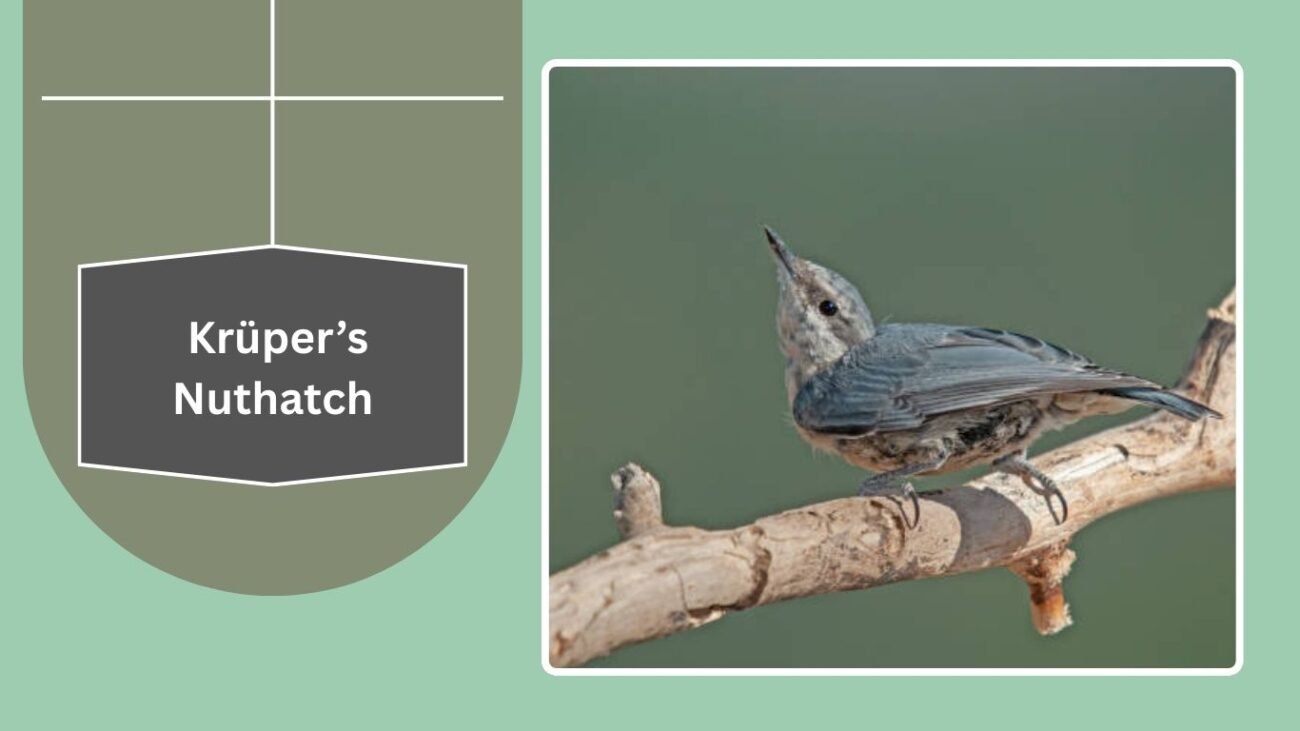
The Krüper’s Nuthatch (Sitta krueperi) is a small nuthatch native to parts of southeastern Europe, the Middle East, and western Asia. It is best recognized by the reddish patch on its breast and its preference for pine forests. Although its range is limited compared to the Eurasian Nuthatch, it remains a well-established species in suitable habitats.
Identification
- Size: About 4.5 inches long
- Color: Blue-gray upperparts with pale underparts
- Markings: Distinctive reddish patch on the upper breast
- Face: White throat with a black eye stripe
- Bill: Short, straight, and pointed
Habitat
This species lives in pine and mixed coniferous forests, particularly Black Pine, Turkish Pine, and other Mediterranean pines. It favors mountainous regions but can also be found in lower-elevation forests with sufficient conifer cover.
Diet
Krüper’s Nuthatches feed mainly on insects and spiders during the breeding season, switching to seeds and nuts in the winter months. They are adept at extracting seeds from pine cones.
Behavior
Active and acrobatic, these birds forage by creeping along trunks and branches. Like other nuthatches, they can move headfirst down trees. They are territorial and often use tree cavities for nesting, typically in old woodpecker holes.
9. Chestnut-bellied Nuthatch

The Chestnut-bellied Nuthatch (Sitta cinnamoventris) is a striking nuthatch species found across the Indian subcontinent and parts of Southeast Asia. It is known for its rich chestnut-colored underparts and loud, sharp calls. This species is often seen in pairs or small groups, energetically climbing tree trunks in search of food.
Identification
- Size: About 5 inches long
- Color: Blue-gray back with deep chestnut underparts
- Face: White throat with a narrow black eye stripe
- Bill: Strong, straight, and pointed
- Tail: Short with black markings
Habitat
The Chestnut-bellied Nuthatch inhabits broadleaf and mixed forests, often in hilly and montane regions. It adapts well to wooded gardens, plantations, and secondary forests, as long as large trees are available.
Diet
This species primarily eats insects and spiders but also consumes seeds and nuts during colder months. It often stores food in bark crevices for later use.
Behavior
Agile and acrobatic, the Chestnut-bellied Nuthatch forages along tree trunks and branches, frequently moving headfirst downward. It is a noisy bird, with constant chattering calls, and is territorial during the breeding season. It nests in cavities, often reusing old woodpecker holes.
10. Velvet-fronted Nuthatch

The Velvet-fronted Nuthatch (Sitta frontalis) is a colorful and distinctive nuthatch found across South and Southeast Asia. Unlike most nuthatches, it has bright plumage with vivid contrasts, making it easy to identify. It is highly active and often forages in mixed-species flocks within forest canopies.
Identification
- Size: About 4.5 inches long
- Color: Blue upperparts with purple tones and pale underparts
- Face: Bright yellow eyes and black eye stripe
- Forehead: Distinct velvet-black patch above the bill
- Bill: Reddish and slightly curved
Habitat
This species inhabits a wide range of forests, from lowland evergreen woods to montane forests. It is often found in well-wooded parks, plantations, and secondary growth forests throughout its Asian range.
Diet
Velvet-fronted Nuthatches primarily feed on insects, especially beetles, ants, and caterpillars. They also eat small seeds and will sometimes probe bark crevices for hidden food.
Behavior
Highly social, this species often moves in small groups and joins mixed flocks with other insect-eating birds. It forages actively along trunks and branches, frequently hanging upside down to reach prey. Its calls are sharp and metallic, helping it stay in contact with flock members.
11. Yunnan Nuthatch

The Yunnan Nuthatch (Sitta yunnanensis) is a rare and localized species found only in the montane pine forests of Yunnan province, China. Because of its very limited range and declining habitat, it is considered vulnerable and is a focus of conservation efforts.
Identification
- Size: About 4.5 inches long
- Color: Pale blue-gray upperparts with whitish underparts
- Markings: Narrow black eye stripe with a faint buff wash on the flanks
- Bill: Slim, pointed, and slightly upturned
- Tail: Short with dark edges
Habitat
This species is restricted to high-altitude Yunnan pine forests, generally above 2,000 meters. It prefers open coniferous woodlands and is rarely seen outside its limited distribution.
Diet
The Yunnan Nuthatch feeds mainly on insects and spiders, but will also take pine seeds and other small plant materials, particularly during winter.
Behavior
It forages actively by creeping along pine branches and trunks, often hanging upside down like other nuthatches. The Yunnan Nuthatch is less social than some of its relatives, usually seen in pairs or small family groups rather than large flocks. Its call is high-pitched and sharp, useful for detecting it in the dense mountain forests.