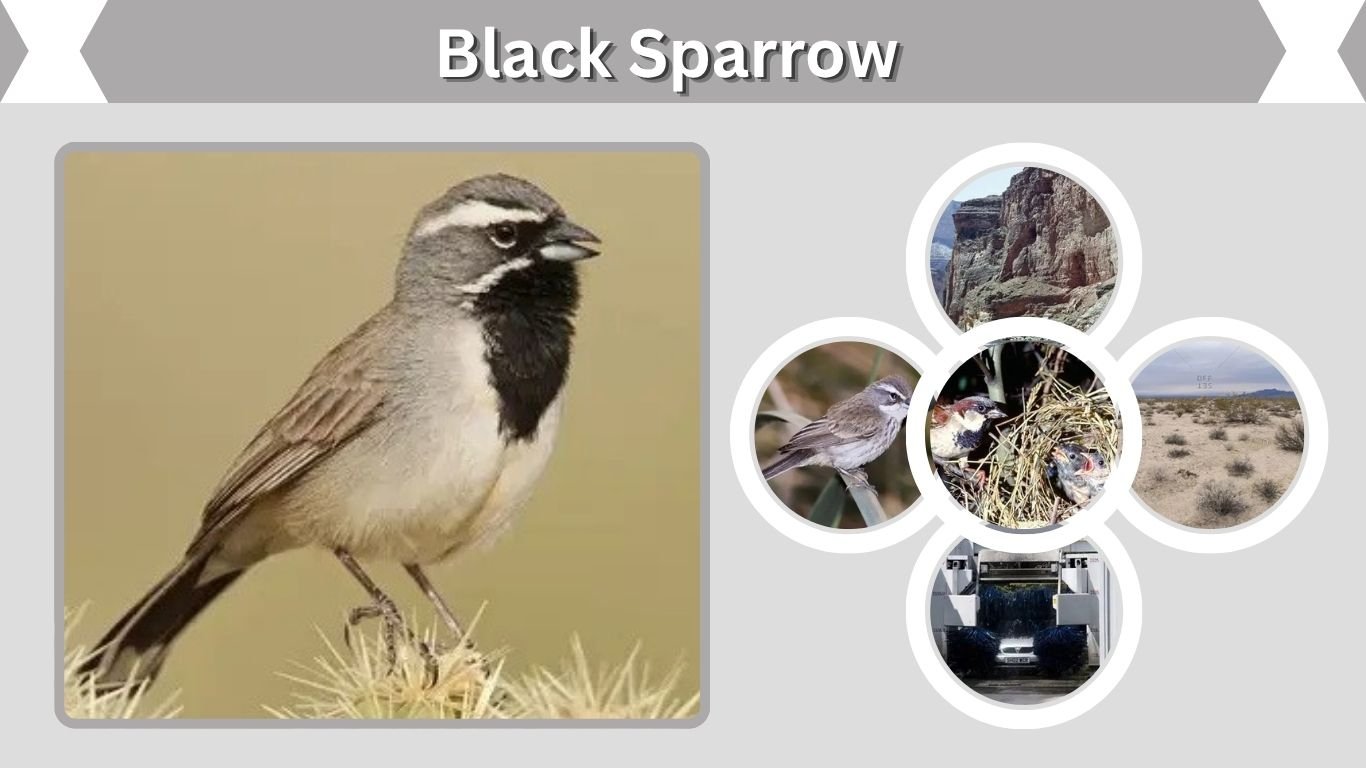
The term “black sparrow” can be confusing because it may refer to different small dark birds. In many bird identification searches, people use “black sparrow” to describe a sparrow with a black throat, black face, black bib, or unusually dark feathers. The best-known match is the Black-throated Sparrow, a small desert bird with a bold black throat and white facial stripes. This guide explains what a black sparrow may be and how to identify it.
What Is a Black Sparrow?
“Black sparrow” is usually a descriptive name, not always one exact species. Some people use it for a Black-throated Sparrow, while others may mean a male house sparrow, a dark-eyed junco, or a melanistic house sparrow.
Common Meanings of Black Sparrow
A black sparrow may refer to:
- Black-throated Sparrow
- Male house sparrow with a black bib
- Dark-eyed junco
- Black-chinned sparrow
- Melanistic or unusually dark house sparrow
- Small blackish bird mistaken for a sparrow
The key is to look at where the black color appears. A true Black-throated Sparrow has a black throat patch with bright white face stripes. Cornell describes it as a medium-sized sparrow with a white stripe above and below the eye and a black throat.
Black Sparrow Identification
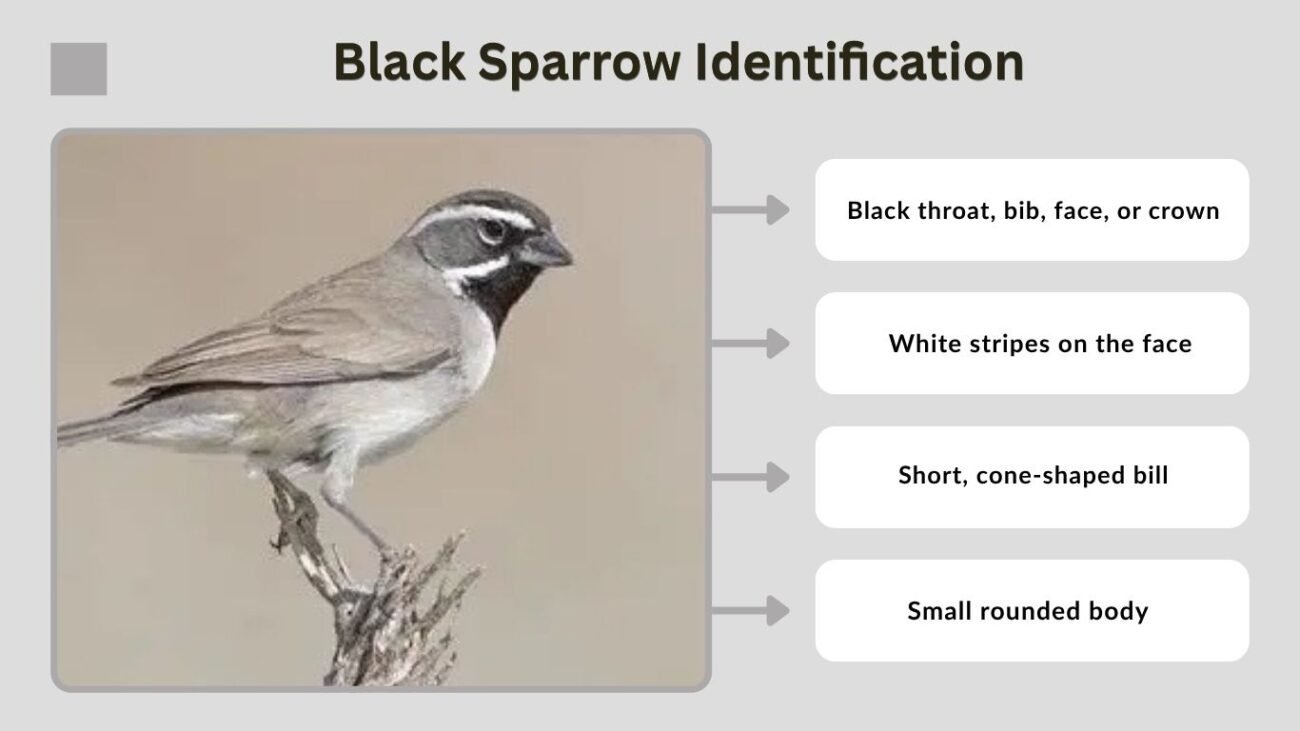
A black sparrow-like bird should be identified by markings, body shape, habitat, and behavior. Color alone can be misleading because shadows, wet feathers, poor lighting, or molting can make a brown bird look darker.
Key Features to Check
Look for these details:
- Black throat, bib, face, or crown
- White stripes on the face
- Brown or gray-brown back
- Short, cone-shaped bill
- Small rounded body
- Tail length and shape
- Habitat: desert, yard, forest edge, feeder, or city area
- Call or song pattern
If the bird has a neat black throat and two white facial stripes, it may be a Black-throated Sparrow. Adults of this species have a gray face, strong white stripes, and a black triangular throat patch.
Black-Throated Sparrow
The Black-throated Sparrow is one of the clearest examples of a “black sparrow.” It is not fully black, but its throat and upper breast are strongly black, creating a bold contrast with the white face lines and pale underparts.
Appearance
A Black-throated Sparrow has:
- Black throat patch
- White stripe above the eye
- White stripe below the eye
- Gray face
- Grayish-brown upperparts
- Pale cream or whitish underparts
- Dark tail with white outer tail markings
- Thick seed-eating bill
Male and female Black-throated Sparrows look alike, which makes them easier to identify than many other sparrows. Juveniles look duller and usually lack the adult’s strong black throat.
Black Sparrow vs House Sparrow
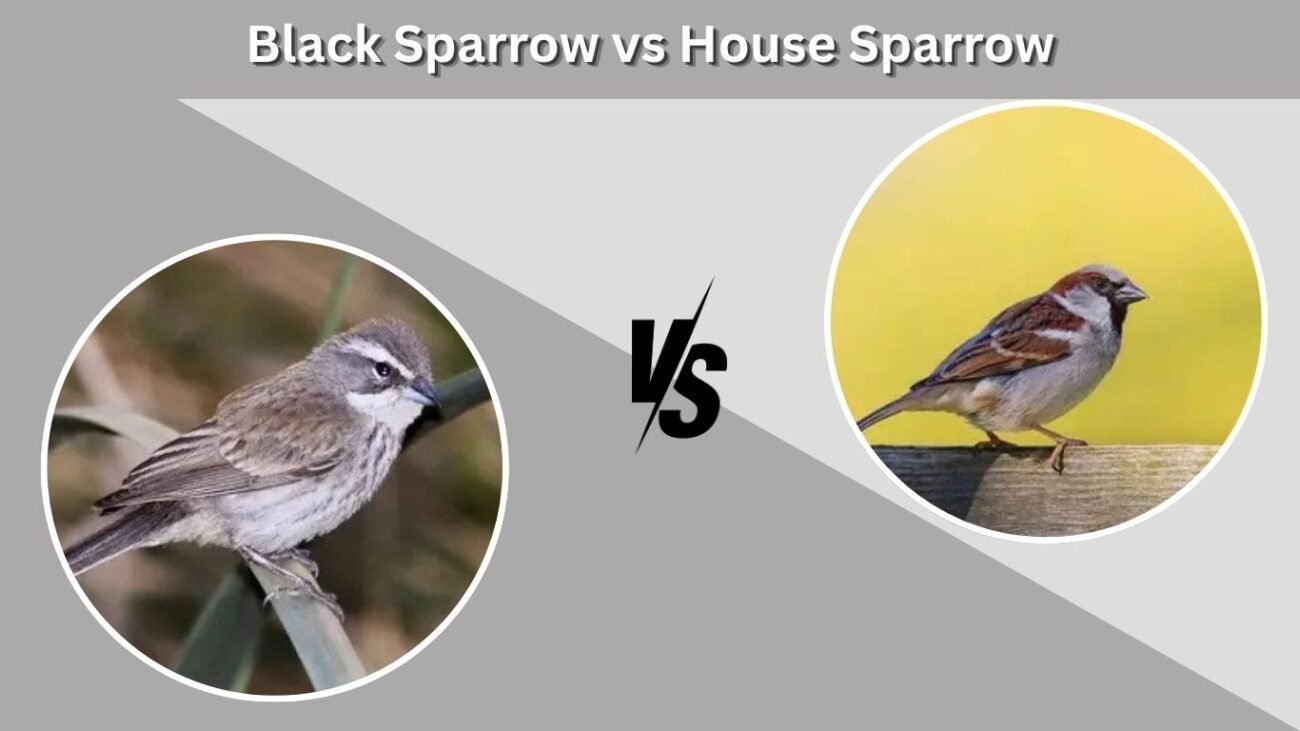
A male house sparrow can also look like a “black sparrow” because it has a black bib on the throat and chest. However, a house sparrow is chunkier and usually lives much closer to people.
| Feature | Black-Throated Sparrow | Male House Sparrow |
| Black marking | Black throat patch | Black bib on throat/chest |
| Face | White stripes and gray mask | Gray crown, white cheek, dark face marks |
| Body shape | Slimmer, medium-sized sparrow | Chunkier and fuller-chested |
| Habitat | Desert scrub, washes, dry areas | Cities, farms, parks, buildings |
| Tail | Medium tail with white outer markings | Shorter tail |
| Female look | Similar to male | Plain brown, no black bib |
House Sparrows are stockier than many American sparrows, with a larger rounded head, shorter tail, and stouter bill. They are also closely associated with human development, including cities, parks, farms, and buildings.
Black Sparrow Habitat
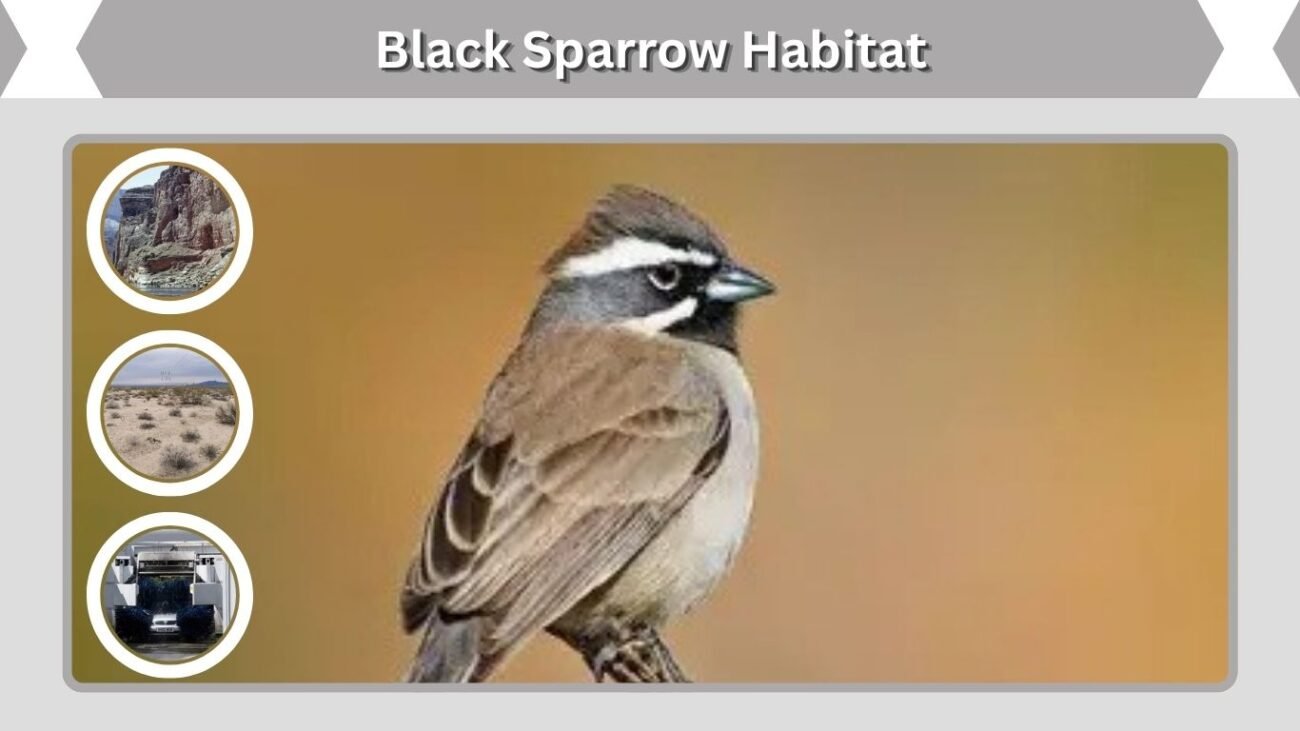
Habitat is one of the best clues. A Black-throated Sparrow is linked to dry, open landscapes, while a house sparrow is usually found around people.
Black-throated Sparrows live in dry scrubby areas, desert scrub, canyons, and washes. They often move low across open desert habitat with scattered shrubs. House Sparrows, on the other hand, are common around city streets, yards, parks, zoos, and farm buildings.
Black Sparrow Diet and Behavior
A black sparrow-like bird usually feeds on seeds, grains, or insects, depending on the species and season. The Black-throated Sparrow often forages on the ground near shrubs and cacti.
| Topic | Black-Throated Sparrow |
| Main food | Seeds and insects |
| Feeding style | Ground foraging near shrubs |
| Breeding food | More insects |
| Nonbreeding food | More seeds |
| Nest site | Low shrubs, often near desert plants |
Black-throated Sparrows mainly eat insects during the breeding season and seeds during the nonbreeding season. They hop along the ground while searching for food and also glean from shrubs.
Black Sparrow Sound
Sound can help when the bird is hidden. A Black-throated Sparrow may give a thin chip call. Its song is usually simple, clear, and musical, often heard in open desert areas.
A house sparrow sounds different. It usually makes repeated cheeps, chirps, and noisy flock calls around buildings, roofs, signs, and feeders. If the bird is calling from a desert shrub, think of Black-throated Sparrow. If it is chirping around a roof or parking lot, it may be a house sparrow.
Why Some Sparrows Look Almost Black
Sometimes a sparrow may look black even if it is not a naturally black species. This can happen because of lighting, wet feathers, dirt, molt, or melanism. Melanism is a condition where a bird has unusually dark feathers due to extra dark pigment.
Possible Reasons
A sparrow may look black because:
- It is standing in shadow
- Its feathers are wet
- It has dirty or oily plumage
- It is molting
- It is a dark juvenile
- It has melanistic coloring
- It is not actually a sparrow
For accurate identification, compare the bird’s bill, tail, body shape, behavior, and location instead of relying only on color.
Black Sparrow Nesting
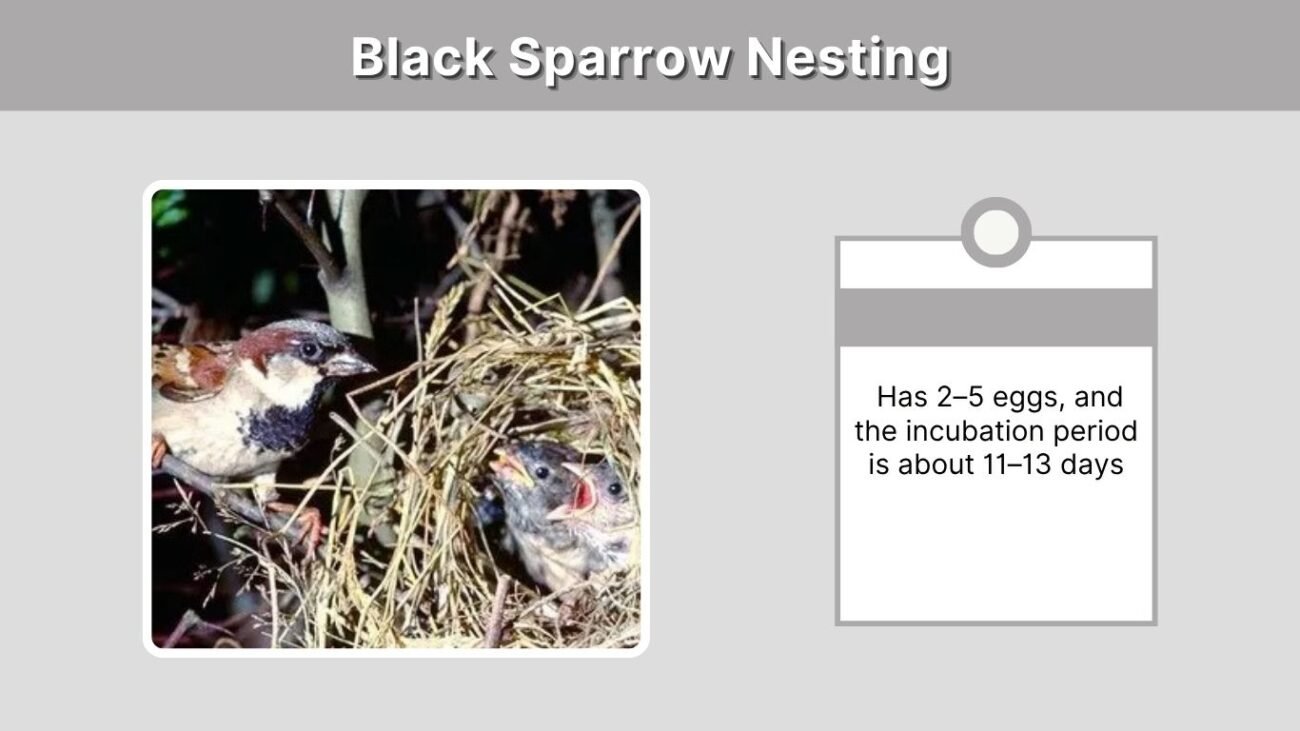
Black-throated Sparrows nest low in shrubs. The female builds a cup-shaped nest using grasses, plant stems, rootlets, and finer lining materials. Nest plants may include desert shrubs and cacti such as cholla, creosote, mesquite, and acacia.
The clutch usually has 2–5 eggs, and the incubation period is about 11–13 days. Young birds remain in the nest for about 9–10 days before fledging.
FAQs
Is a black sparrow a real bird?
“Black sparrow” is usually a descriptive phrase rather than one exact bird name. Many people use it for the Black-throated Sparrow, male house sparrow, dark-eyed junco, or another small dark bird that looks like a sparrow.
What does a Black-throated Sparrow look like?
A Black-throated Sparrow has a black throat patch, gray face, two white facial stripes, grayish-brown upperparts, and pale underparts. Adults look bold and clean, while juveniles are duller and may not show the strong black throat.
Is a black sparrow the same as a house sparrow?
No, not always. A male house sparrow has a black bib and may be called a black sparrow by mistake. However, the Black-throated Sparrow is a different bird with white face stripes, a black throat, and a desert habitat.
Where do black sparrows live?
If you mean the Black-throated Sparrow, it lives mainly in dry scrub, desert scrub, canyons, and washes. If you mean a dark house sparrow, it is more likely to be found around homes, farms, parks, and city buildings.
Why is the sparrow in my yard black?
A yard sparrow may look black because it is a male house sparrow with a dark bib, a wet or dirty bird, or a rare melanistic individual. Check its markings, bill, size, behavior, and whether it stays near buildings or feeders.