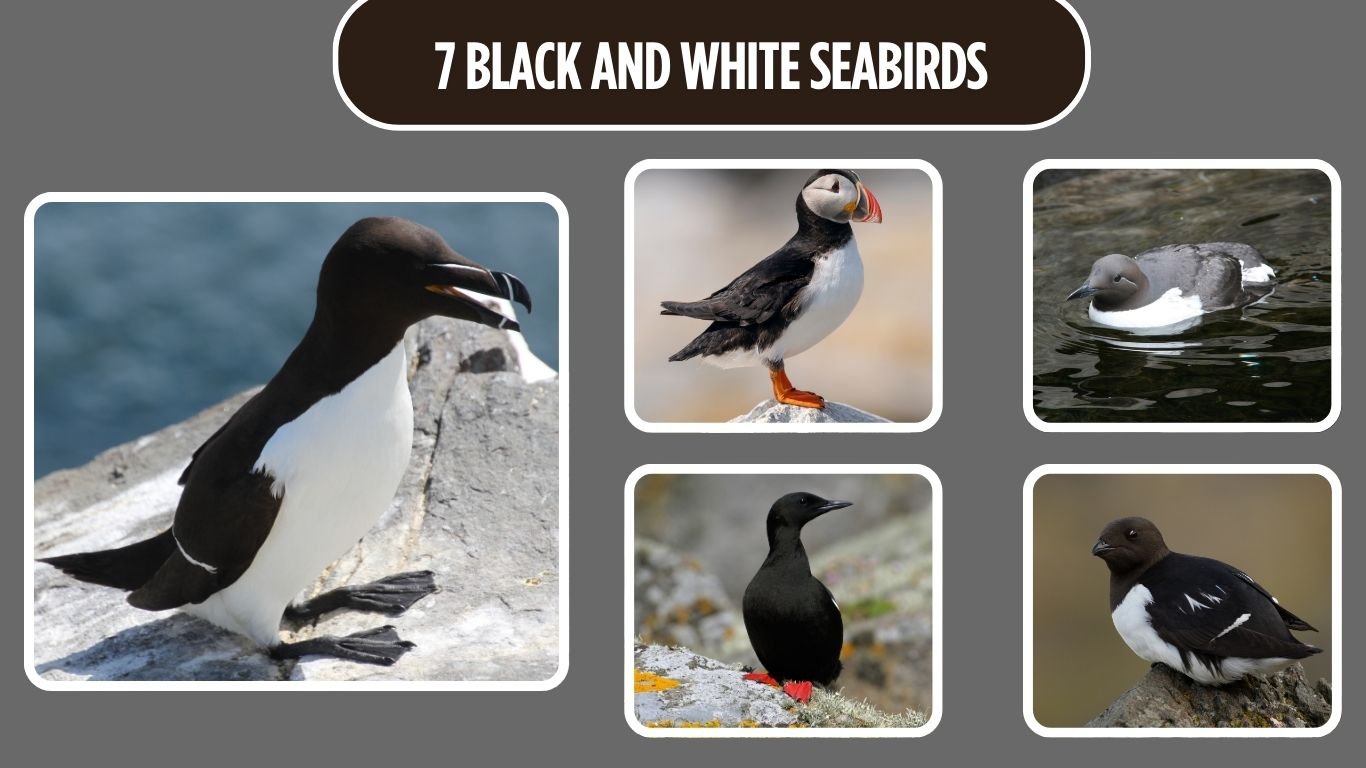
Black and white seabirds are among the most visually striking birds along ocean coasts and open waters. From the bold patterns of the Razorbill to the sharp contrasts of Sabine’s Gull, these seabirds combine elegance with powerful survival skills like deep diving, long-distance flying, and food stealing. In this guide, we’ll explore seven remarkable black and white seabirds, highlighting their identification features, coloration, feeding habits, and nesting behavior—perfect for birdwatchers and ocean lovers alike.
1. Razorbill
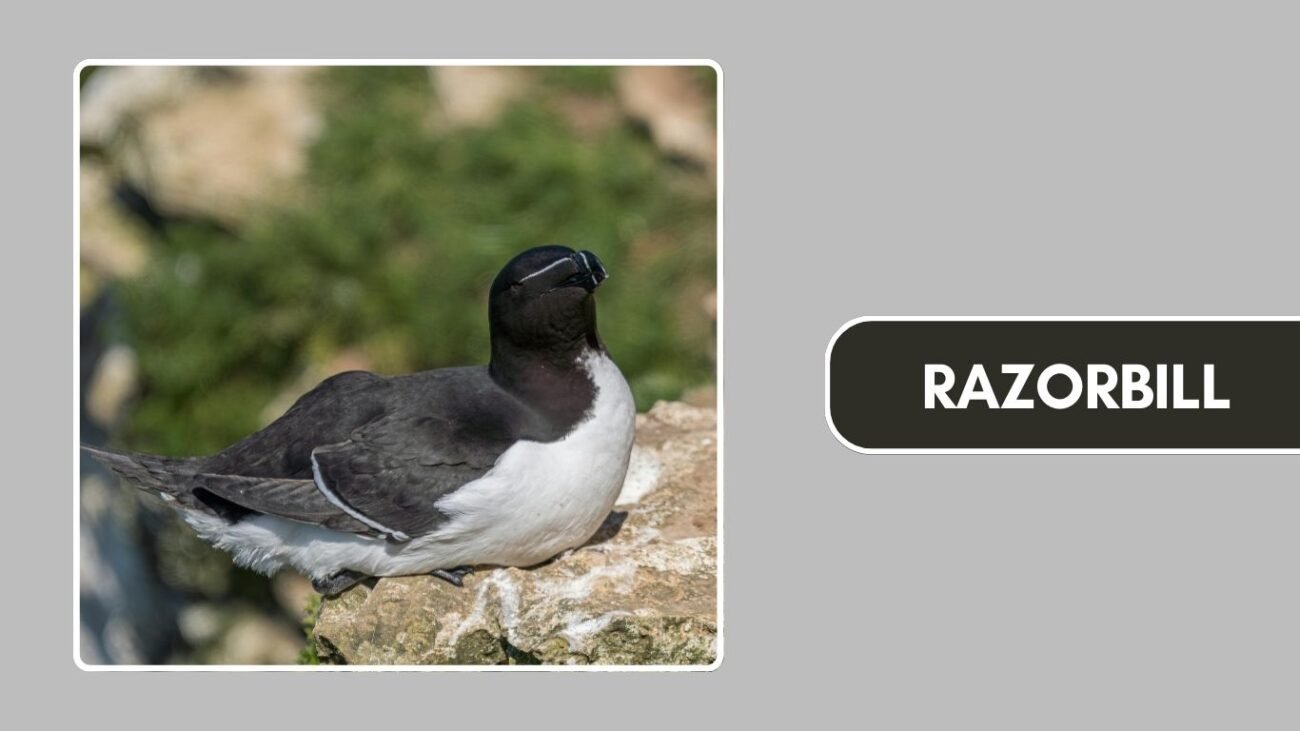
Razorbills are sleek, deep-diving seabirds found in the North Atlantic. They are members of the auk family and are often seen perched on rocky cliffs or darting underwater in search of fish.
Identification
- Size: 15–17 inches (38–43 cm)
- Build: Stout body with short tail and strong wings
- Beak: Thick, compressed, with white line marking
- Habitat: Coastal cliffs, rocky islands, and open ocean
Color Pattern
- Head & Upperparts: Solid black, including the back, wings, and head
- Underparts: Clean, bright white from the throat down to the belly
- Beak: Black with a distinctive vertical white line
- Eyes: Dark, set against the black face, giving a sharp contrast
Feeding Behavior
Razorbills dive deep underwater, using their wings to swim after small schooling fish such as sand eels and herring.
Nesting Habits
They breed in tight colonies on coastal cliffs, laying one egg in a rock crevice. Both parents share nesting and feeding duties.
At Sea
Outside the breeding season, razorbills spend months entirely at sea, enduring rough oceanic conditions with ease.
2. Puffin
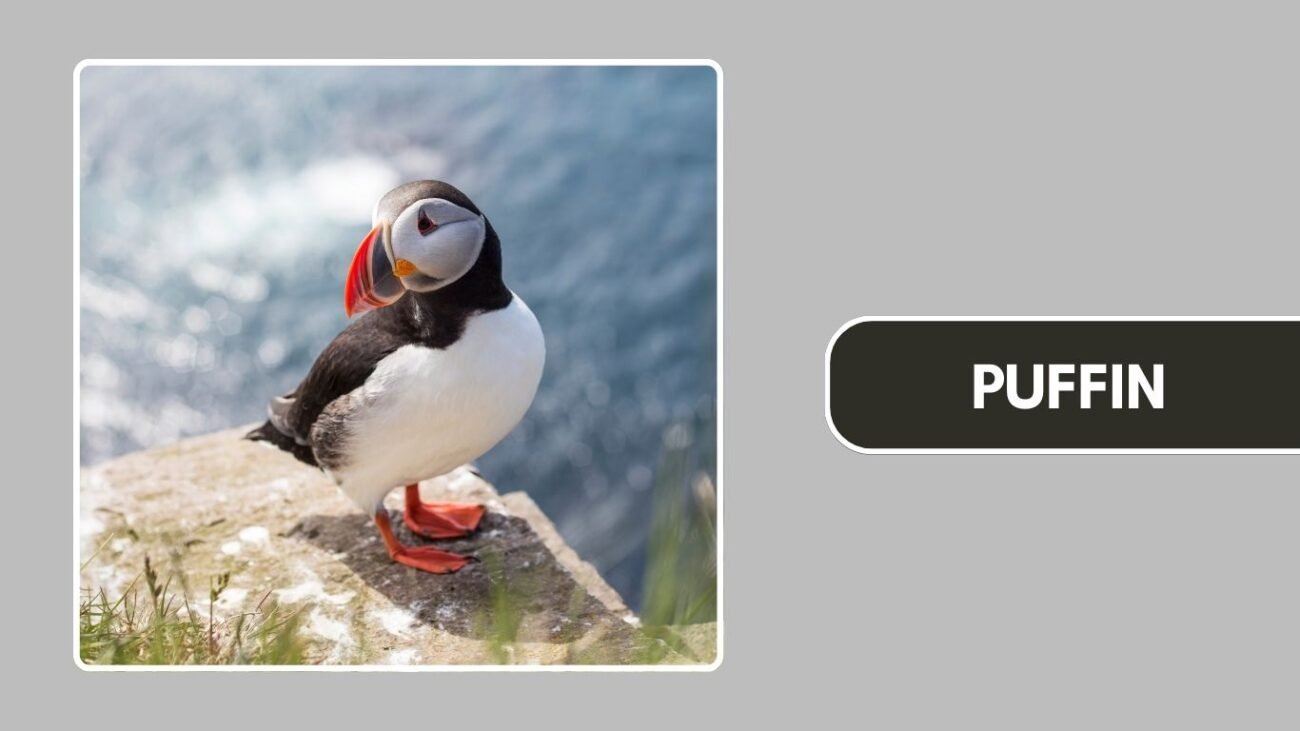
Puffins are beloved seabirds known for their colorful beaks and comical appearance. Despite their clown-like looks on land, they are agile and powerful swimmers below the waves. Most commonly found in the North Atlantic, they nest in coastal cliffs and offshore islands.
Identification
- Size: 10–12 inches (25–30 cm)
- Build: Stocky with short wings and legs
- Beak: Large, triangular, and vividly colored in the breeding season
- Habitat: Rocky cliffs, grassy slopes, and offshore islands in cold northern waters
Color Pattern
- Head: Black crown and nape with white cheeks
- Back and Wings: Solid black
- Underparts: White chest and belly
- Beak: Bright orange, yellow, and blue in breeding season; duller in winter
- Feet: Bright orange
- Eyes: Triangular dark markings around the eyes give them a wide-eyed expression
Feeding Behavior
Puffins feed almost entirely on small fish such as sand eels, capelin, and herring. They are excellent divers and use their wings to “fly” underwater. A puffin can carry multiple fish in its beak at once, thanks to backward-facing spines on the roof of its mouth and tongue.
Nesting and Reproduction
During the breeding season, puffins return to the same nesting colonies, often digging burrows into grassy cliffsides. They lay a single egg per year, and both parents take turns incubating it and feeding the chick once it hatches.
Seasonal Life
Puffins are only visible to humans during the breeding season. For the rest of the year, they live far out at sea, surviving the harsh conditions of the open ocean. Their colorful beaks fade after the breeding season, a sign of the shift back to solitary, pelagic life.
3. Common Murre
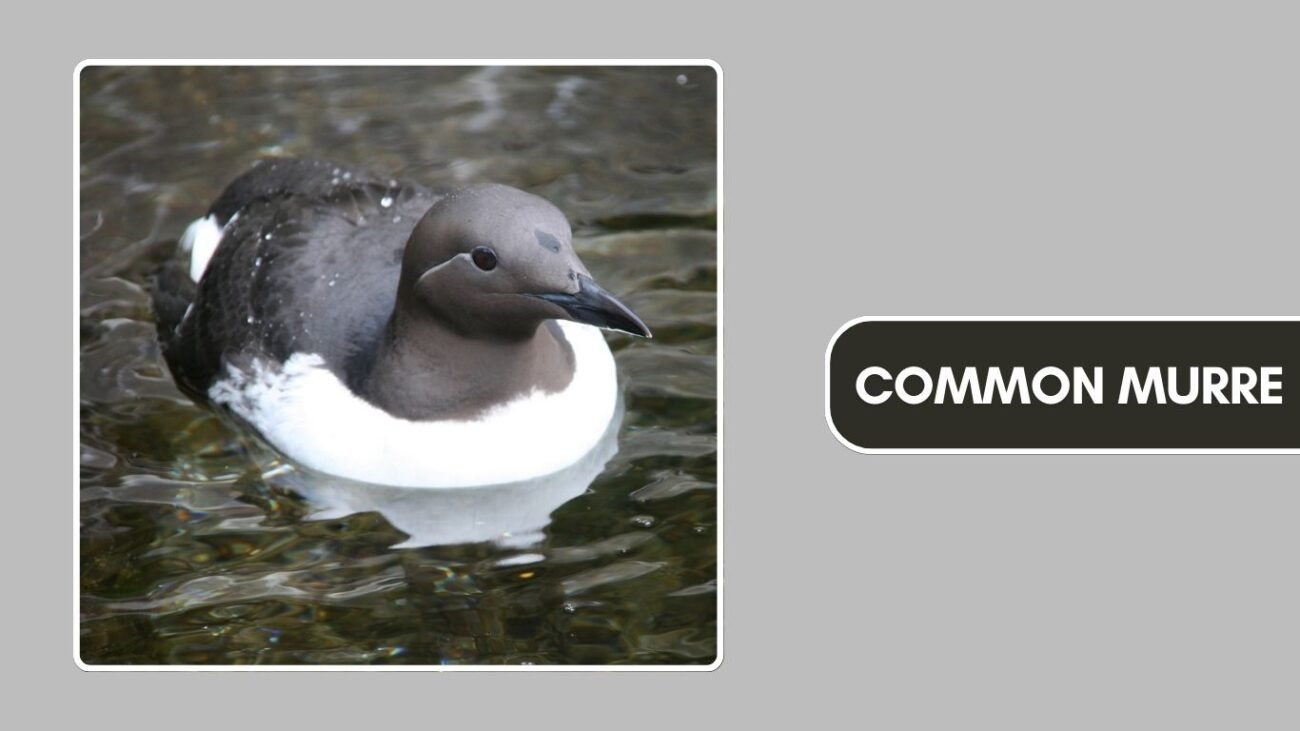
The Common Murre is a black and white seabird that resembles a penguin in posture but is fully capable of flight. It’s a deep diver and one of the most abundant seabirds found along cold-water coasts in the Northern Hemisphere.
Identification
- Size: 15–18 inches (38–46 cm)
- Build: Sleek, upright body with a narrow head
- Bill: Thin and pointed
- Habitat: Steep sea cliffs, rocky coastlines, and offshore waters
Color Pattern
- Head, Neck, and Back: Blackish-brown (appears black at a distance)
- Underparts: Clean white from throat to belly
- Bill: Black and needle-like
- Wings: Black on top, with white underwing
- Eyes: Dark, blending into the black head
Feeding Behavior
Common Murres are incredible divers, capable of plunging more than 600 feet (180 meters) underwater. They use their wings to swim and hunt small fish, squid, and crustaceans. Their dives are quick and precise, often performed in flocks near feeding grounds.
Nesting Colonies
They nest in massive, densely packed colonies on high, narrow cliff ledges. Unlike many seabirds, murres do not build a traditional nest. Instead, they lay a single, pear-shaped egg directly on bare rock. The egg’s shape prevents it from rolling off the cliff ledge.
Adaptations and Behavior
Chicks leave the ledge at just a few weeks old, leaping into the ocean below before they can even fly—guided by calls from their parents. Once at sea, the father continues to care for and feed the chick until it can fend for itself.
4. Black Guillemot
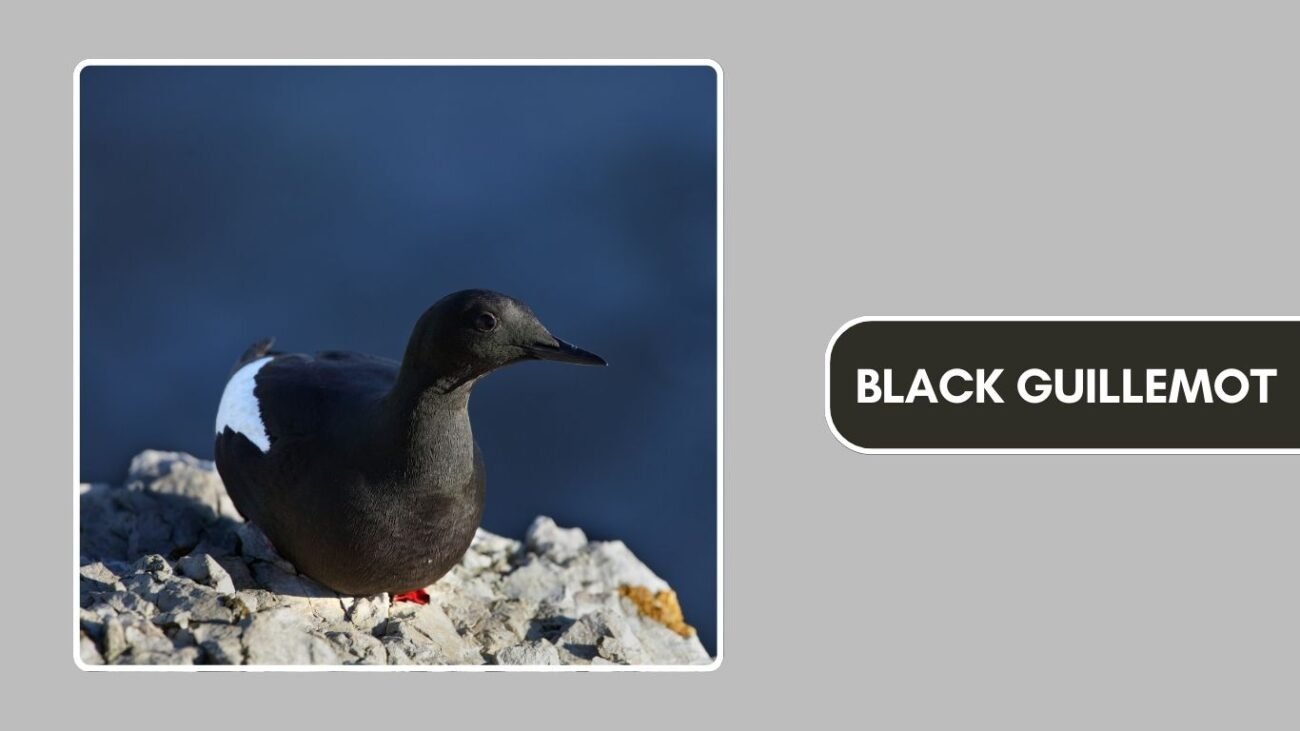
The Black Guillemot is a striking black-and-white seabird commonly found along rocky northern coastlines. Unlike other auks that form massive colonies, Black Guillemots are more solitary nesters and are often seen alone or in pairs.
Identification
- Size: 12–15 inches (30–38 cm)
- Build: Compact with rounded body and short tail
- Bill: Thin, straight, and black
- Habitat: Cold coastal waters, rocky shorelines, and cliffs
Color Pattern
- Breeding Plumage:
- Body: Entirely black
- Wings: Bold white wing patches
- Feet: Bright red
- Bill: Black with a red interior
- Body: Entirely black
- Non-Breeding Plumage:
- Mottled white and gray body with black markings
- White face and underparts
- Mottled white and gray body with black markings
Feeding and Diving
Black Guillemots are expert divers that use their wings to propel through the water. They feed on small fish, crustaceans, and marine invertebrates—often diving near rocky sea floors or kelp beds. Their foraging technique involves agile underwater swimming and quick surface re-emergence.
Nesting Behavior
They nest in rock crevices, under boulders, or in man-made structures. Nest sites are usually close to the waterline. Both parents incubate the 1–2 eggs and take turns feeding the chicks until fledging.
Year-Round Residents
Unlike many seabirds, Black Guillemots often remain in their breeding region year-round. In winter, they switch to their lighter non-breeding plumage and move to offshore waters but don’t usually migrate far south.
5. Little Auk
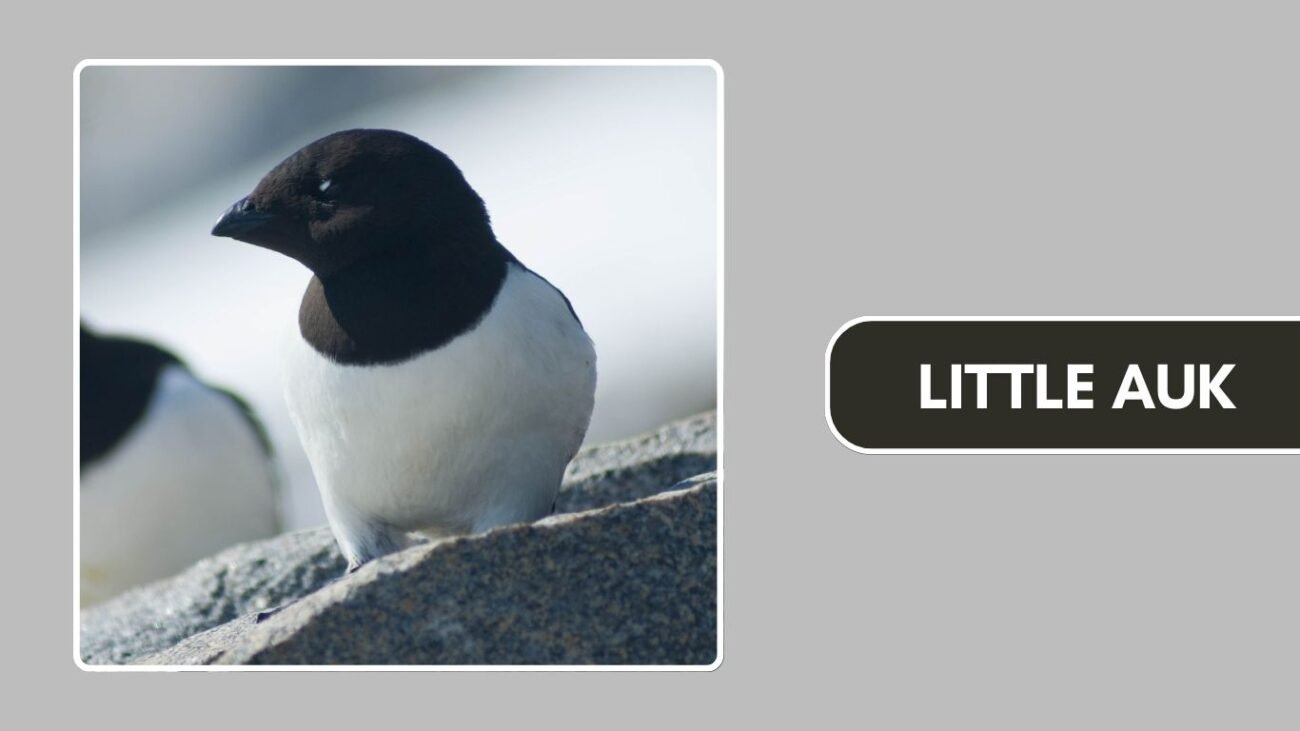
The Little Auk, also known as the Dovekie, is a small black-and-white seabird that thrives in the Arctic. Despite its tiny size, it’s one of the most numerous seabirds in the North Atlantic, often spotted in huge flocks near cold coastal waters.
Identification
- Size: 7–9 inches (18–23 cm)
- Build: Small and round-bodied
- Bill: Short and stubby
- Habitat: Arctic coasts, icy waters, and steep cliffs
Color Pattern
- Head and Back: Black in breeding season
- Underparts: Bright white belly and chest
- Wings: Black above, white below
- Non-Breeding Plumage: Paler face and throat
- Feet: Dark and webbed
Feeding Behavior
Little Auks feed on zooplankton, tiny crustaceans, and small fish. They forage in groups, diving and swimming together beneath the surface. Their small wings beat rapidly underwater, allowing them to maneuver with precision in pursuit of prey.
Nesting and Colonies
They breed in vast colonies on steep Arctic cliffs or rocky slopes. Nests are tucked into natural crevices, protected from predators and harsh winds. Each pair typically lays one egg per season, and both parents care for the chick.
Arctic Specialists
Little Auks are built for cold. Their dense plumage and compact size help them retain heat. Outside of breeding, they roam icy seas in massive flocks that can number in the millions.
Their high-pitched calls and synchronized diving make them a fascinating sight in Arctic regions. Despite their abundance, they are vulnerable to climate change and shifting oceanic currents.
6. Sabine’s Gull
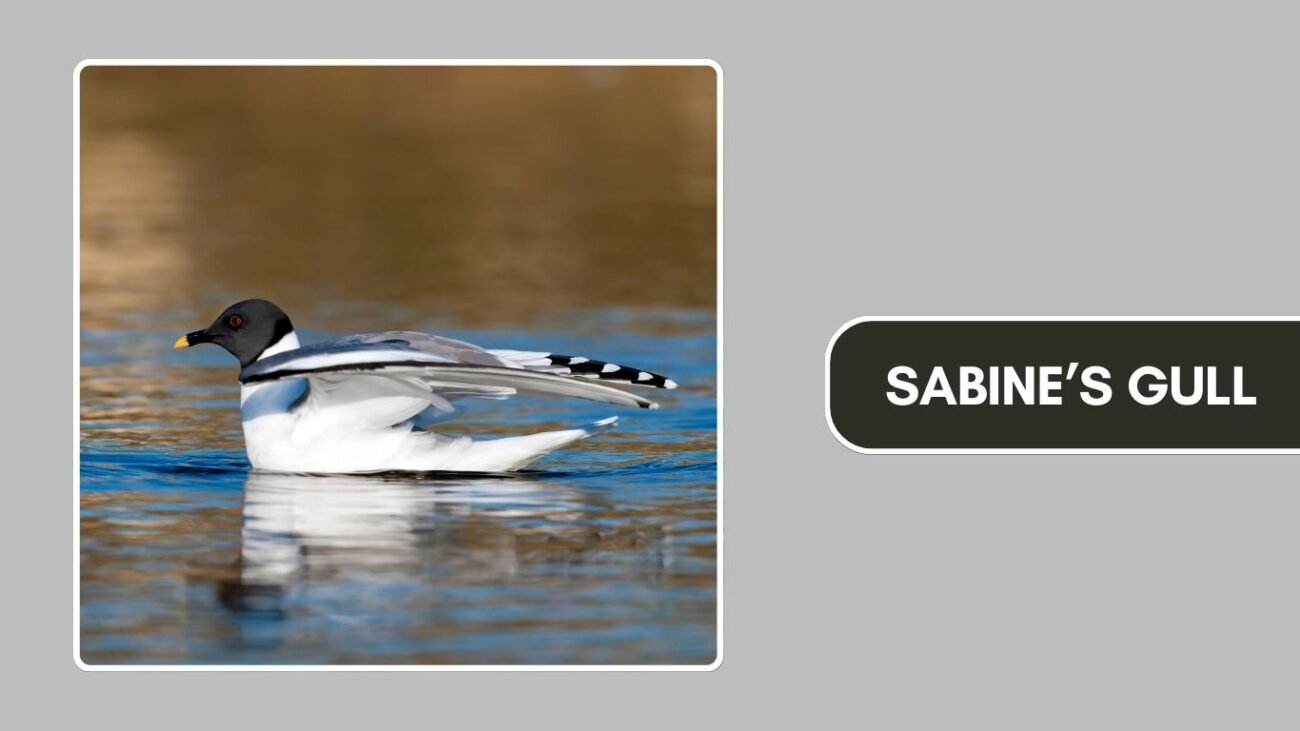
Sabine’s Gull is a graceful and uniquely patterned black-and-white seabird, known for its striking wing markings and long-distance migration. Unlike typical gulls, Sabine’s Gull spends much of its life far out at sea and only comes ashore to breed in the high Arctic.
Identification
- Size: 11–13 inches (28–33 cm)
- Build: Slim body with narrow wings and long tail
- Bill: Short, slender, black with a yellow tip
- Habitat: Breeds in Arctic tundra; winters at sea off tropical coasts
Color Pattern
- Head: Black or dark gray hood during breeding season (white in winter)
- Back and Wings: Pale gray back with distinctive black, white, and gray triangle pattern on the wings
- Underparts: White
- Tail: White with a shallow fork
- Legs: Black
Feeding and Foraging
Sabine’s Gull feeds on aquatic insects, crustaceans, and small fish. While at sea, it forages along the ocean surface, picking food in flight or dipping its feet to snatch prey just below the surface.
Breeding and Nesting
They nest in isolated colonies on tundra wetlands near Arctic coastlines. The nest is a shallow scrape lined with grass and moss, and they usually lay 1–3 eggs. Both parents take part in incubation and chick care.
Migration and Behavior
Sabine’s Gull undertakes one of the longest migrations of any gull species—traveling from the Arctic all the way to the South Atlantic off the coasts of West Africa and South America.
Their sharply contrasting wing pattern makes them easy to identify in flight, and their elegant gliding and dipping movements are distinct from the more aggressive style of common gulls.
7. Antarctic Skua
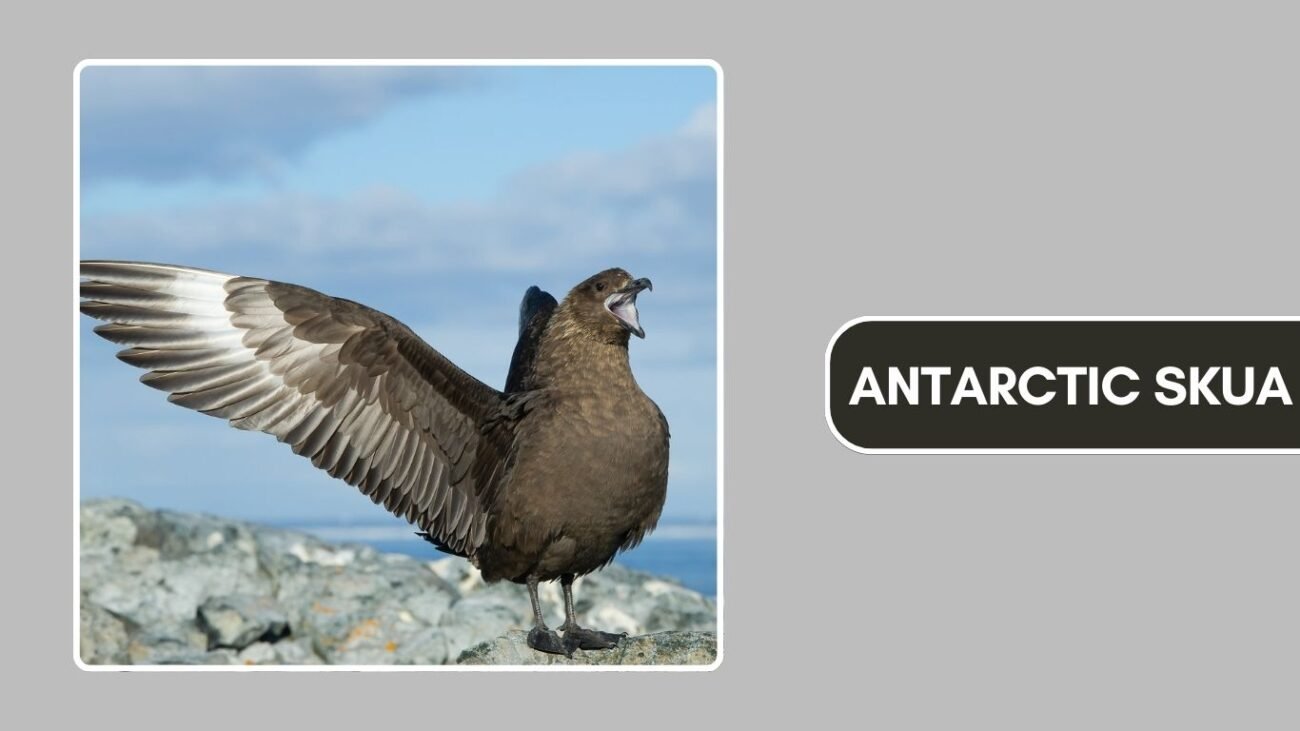
The Antarctic Skua is a powerful black-and-white seabird found around Antarctica and nearby sub-Antarctic islands. Known for their bold, sometimes aggressive behavior, skuas often steal food from other birds and even prey on penguin chicks.
Identification
- Size: 20–23 inches (52–58 cm)
- Build: Stocky and broad-winged
- Bill: Strong, hooked, and dark
- Habitat: Coastal Antarctica, islands, and surrounding southern oceans
Color Pattern
- Head and Body: Dark brown or blackish with mottled white patches (plumage varies widely)
- Underparts: Pale white or heavily streaked depending on individual
- Wings: Black with white wing flashes clearly visible in flight
- Tail: Rounded
- Eyes and Legs: Dark brown and gray-black
Feeding Strategy
Antarctic Skuas are opportunistic feeders. They scavenge dead animals, steal fish from gulls and petrels, and even raid penguin colonies for eggs and chicks. They’re strong fliers and can pursue prey mid-air or attack on the ground.
Nesting and Territory
Skuas breed on ice-free coastal land, laying two eggs in a shallow ground scrape. Both parents are extremely territorial during the breeding season, attacking intruders with swift, low-flying dives.
Survival in Harsh Conditions
Adapted to extreme cold and isolation, Antarctic Skuas are nomadic outside the breeding season, following ships or ice edges in search of food. Their endurance, boldness, and adaptability make them one of the most dominant seabirds in the southern polar region.