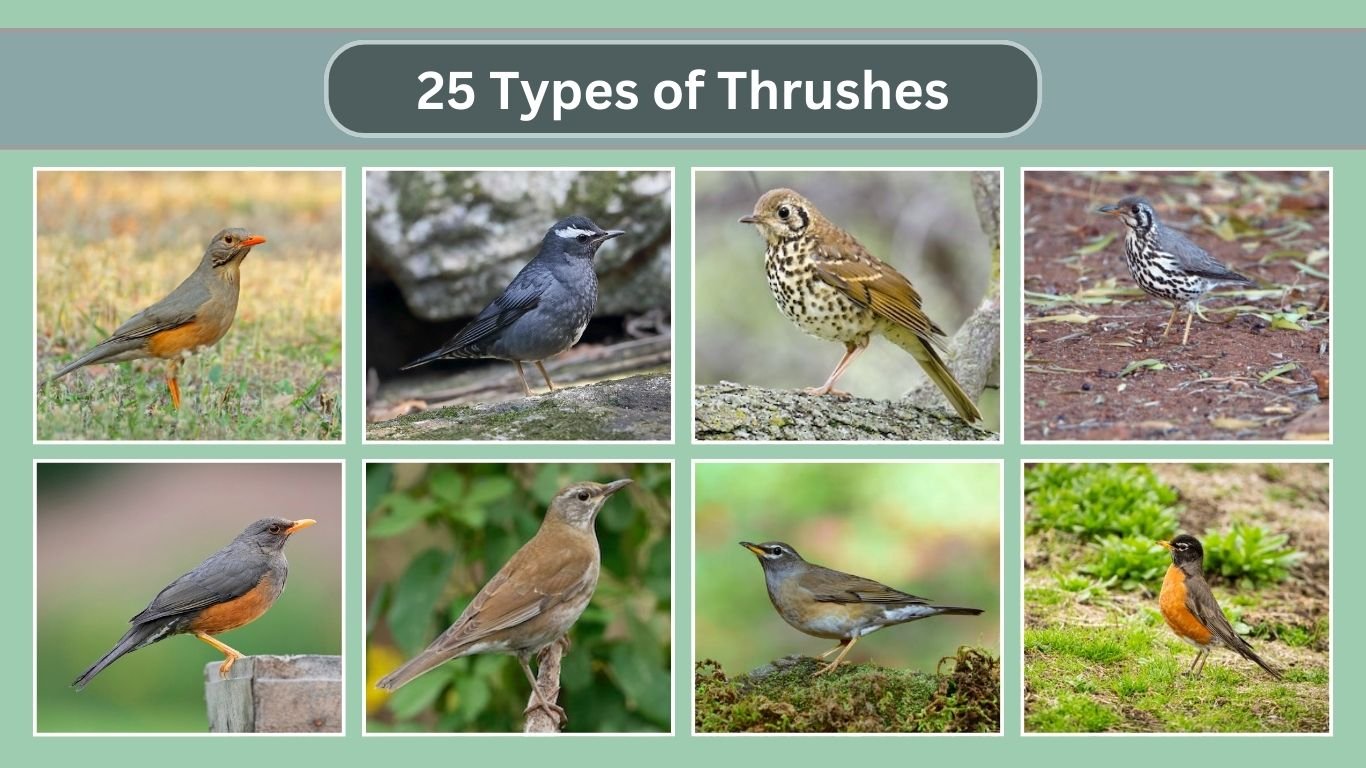
Thrushes are a diverse group of songbirds found across the world, admired for their melodious voices, varied plumage, and ecological importance. From the well-known American Robin to the elusive Siberian Thrush, these birds thrive in forests, gardens, mountains, and open landscapes. Each species contributes to nature by dispersing seeds, controlling insects, and inspiring cultures with their songs. Here are 25 fascinating thrush species you should know.
1. American Robin
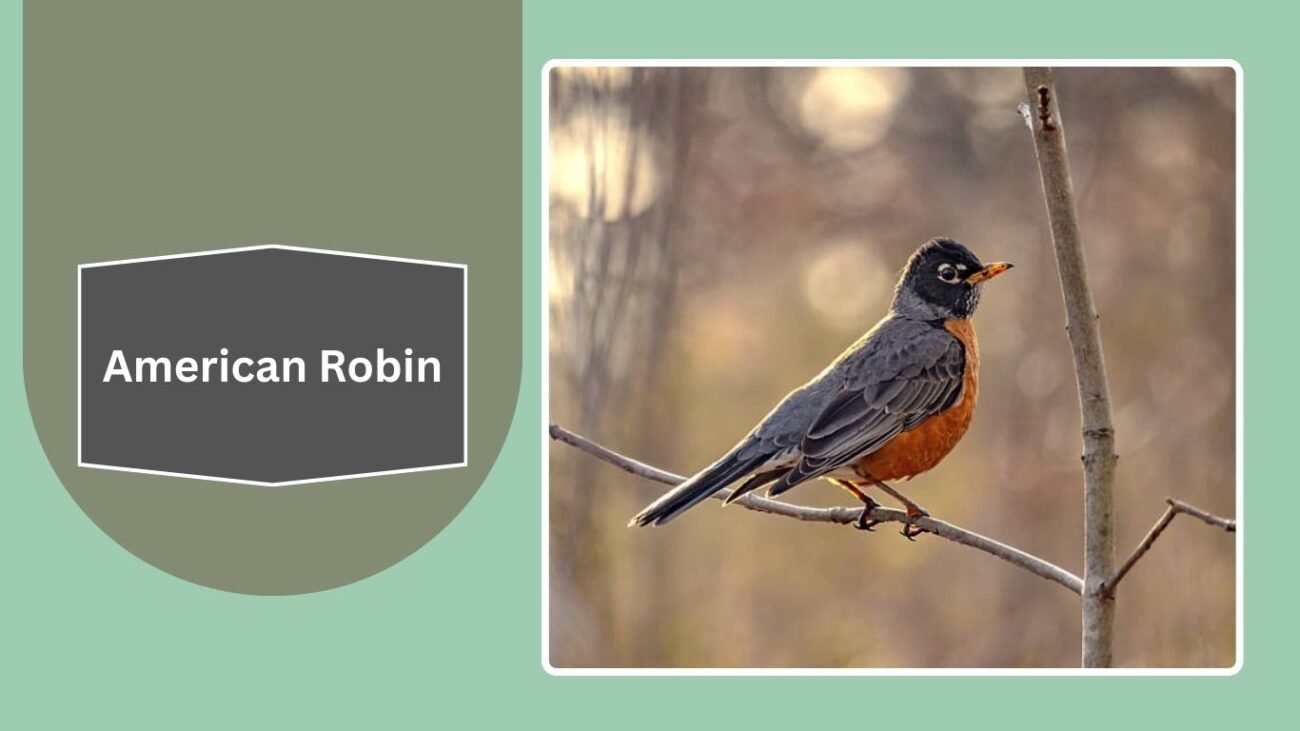
The American Robin (Turdus migratorius) is one of the most familiar thrushes in North America. Known for its cheerful song and bright red-orange breast, it is often considered a harbinger of spring. This bird is highly adaptable and thrives in gardens, parks, woodlands, and suburban areas.
Identification
- Medium-sized bird, about 23–28 cm (9–11 in) long
- Distinct red-orange breast and underparts
- Gray-brown back and wings
- White throat with dark streaks
- Yellow bill and white eye ring
Behavior
American Robins are early risers, often seen foraging on lawns for earthworms at dawn. They are territorial during the breeding season but gather in large flocks during migration and winter. Their melodious song is one of the most recognizable bird calls in North America.
Habitat
They inhabit a wide range of environments including forests, farmlands, towns, and cities across the United States and Canada. In winter, many migrate south to Central America and the Caribbean.
Importance
The American Robin plays a vital role in insect control and seed dispersal. Its cultural significance is also strong, being featured in folklore, music, and literature as a symbol of renewal and springtime.
2. Wood Thrush
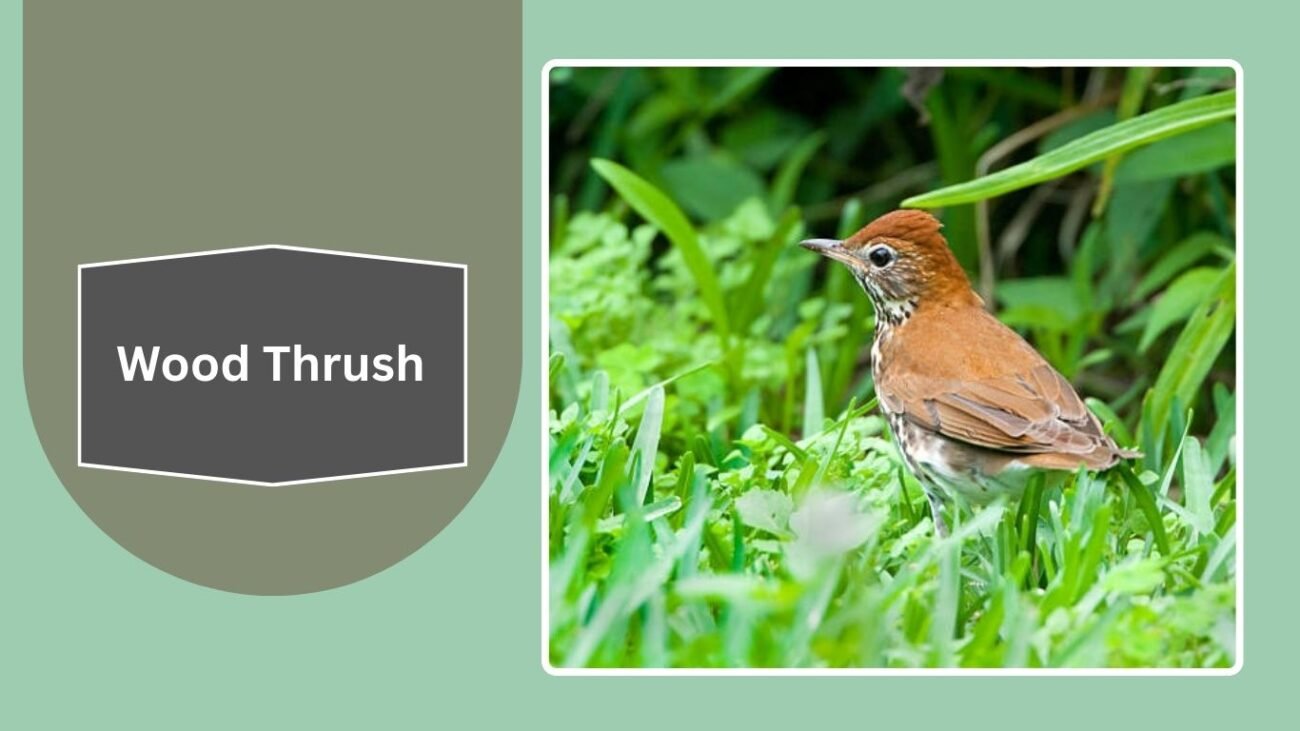
The Wood Thrush (Hylocichla mustelina) is celebrated for its hauntingly beautiful flute-like song. Found in the deciduous forests of eastern North America, this thrush is a symbol of deep woodlands and is often heard before it is seen.
Identification
- Medium-sized thrush, about 20 cm (8 in) long
- Rich reddish-brown back and wings
- White underparts with bold black spots
- Large dark eyes and straight bill
- Slightly plump body with upright stance
Behavior
Wood Thrushes are solitary and secretive, spending much of their time foraging on the forest floor for insects, snails, and fruit. Their song, consisting of clear, flute-like notes, is considered one of the most beautiful in North America.
Habitat
They prefer mature deciduous and mixed forests with dense understory vegetation. During migration, they travel to Central America, where they spend the winter in tropical forests.
Importance
Wood Thrushes help maintain forest health by dispersing seeds and controlling insect populations. Unfortunately, their numbers are declining due to habitat loss and fragmentation.
3. Hermit Thrush
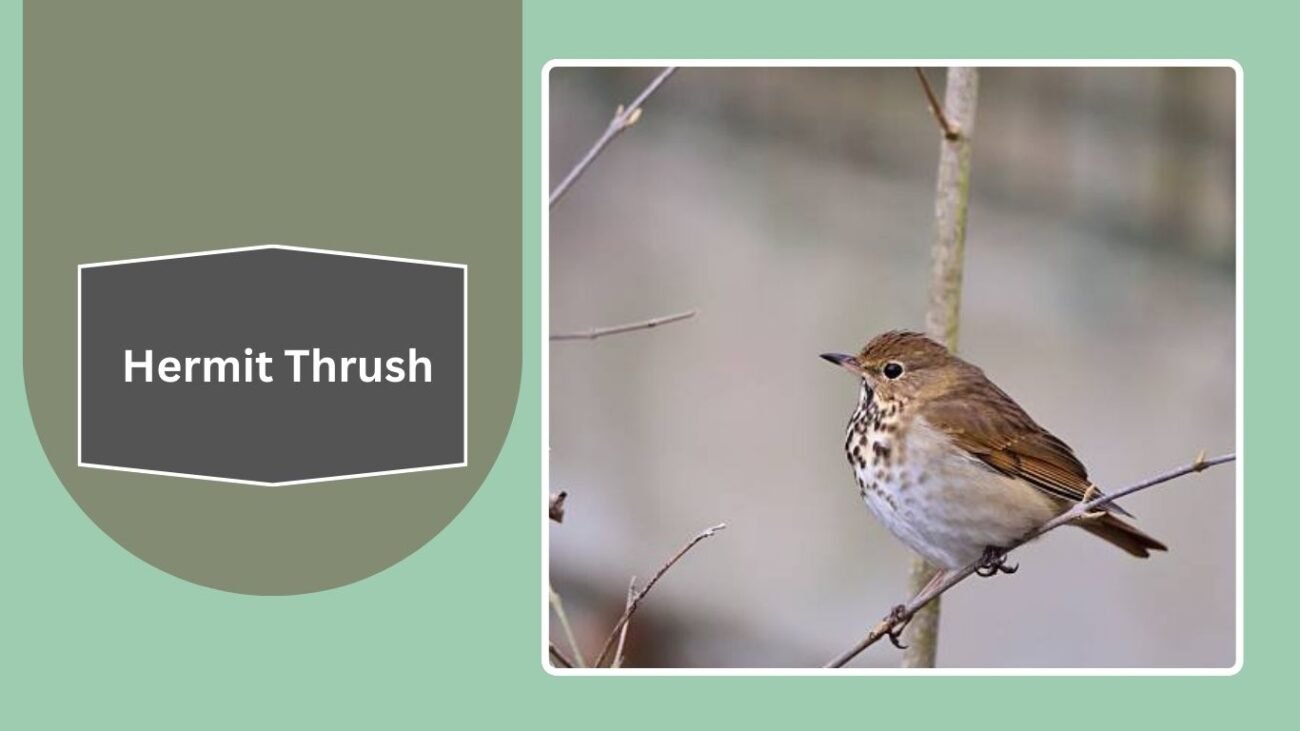
The Hermit Thrush (Catharus guttatus) is a small but distinguished thrush, famous for its ethereal, flute-like song that resonates in quiet woodlands. Unlike other thrushes, it is one of the last to migrate, often lingering into late fall.
Identification
- Small thrush, about 15–18 cm (6–7 in) long
- Brownish upperparts with a reddish tail
- Pale underparts with fine dark spots on the breast
- Thin eye ring
- Slender bill and delicate build
Behavior
Hermit Thrushes forage mostly on the ground, flipping leaves to uncover insects and small invertebrates. In fall and winter, they feed heavily on berries. Their song, a series of clear, musical phrases, is often described as spiritual or haunting.
Habitat
They breed in coniferous and mixed forests across Canada and the northern United States. In winter, they migrate to the southern U.S. and Central America, favoring woodlands and shrubby areas.
Importance
These thrushes are valuable seed dispersers, particularly for berry-producing plants. Their song has also inspired poets and naturalists, including Walt Whitman, who wrote about it as a voice of nature.
4. Veery
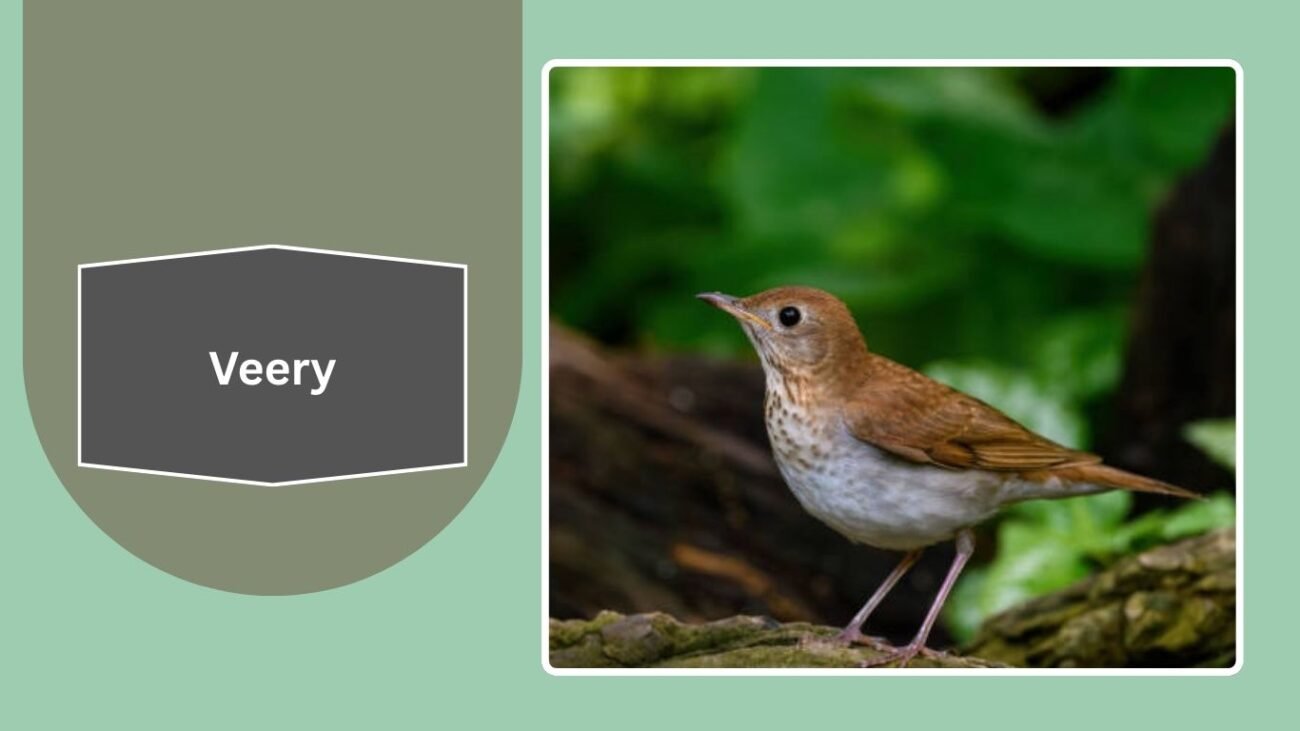
The Veery (Catharus fuscescens) is a shy and secretive thrush, best known for its soft, downward-spiraling song that fills the summer evenings of North American forests. Its gentle presence and subtle beauty make it a favorite among bird enthusiasts who are lucky enough to encounter it.
Identification
- Medium-sized thrush, about 16–19 cm (6–7.5 in) long
- Warm cinnamon-brown back and wings
- Pale underparts with faint, blurred spotting on the chest
- Slightly buff-colored face and throat
- Thin eye ring and slender bill
Behavior
Veeries are ground foragers, feeding mainly on insects, spiders, and earthworms. They are also fond of berries during the late summer and fall. Their flute-like song, often described as a spiraling echo, is one of the most enchanting sounds in the forest.
Habitat
They inhabit moist deciduous forests, especially near streams and wetlands, across southern Canada and the northern United States. During migration, they travel to South America, wintering in the Amazon Basin.
Importance
Veeries play an important ecological role by dispersing seeds and controlling insect populations. Their sensitivity to habitat changes also makes them an indicator species for forest health.
5. Swainson’s Thrush
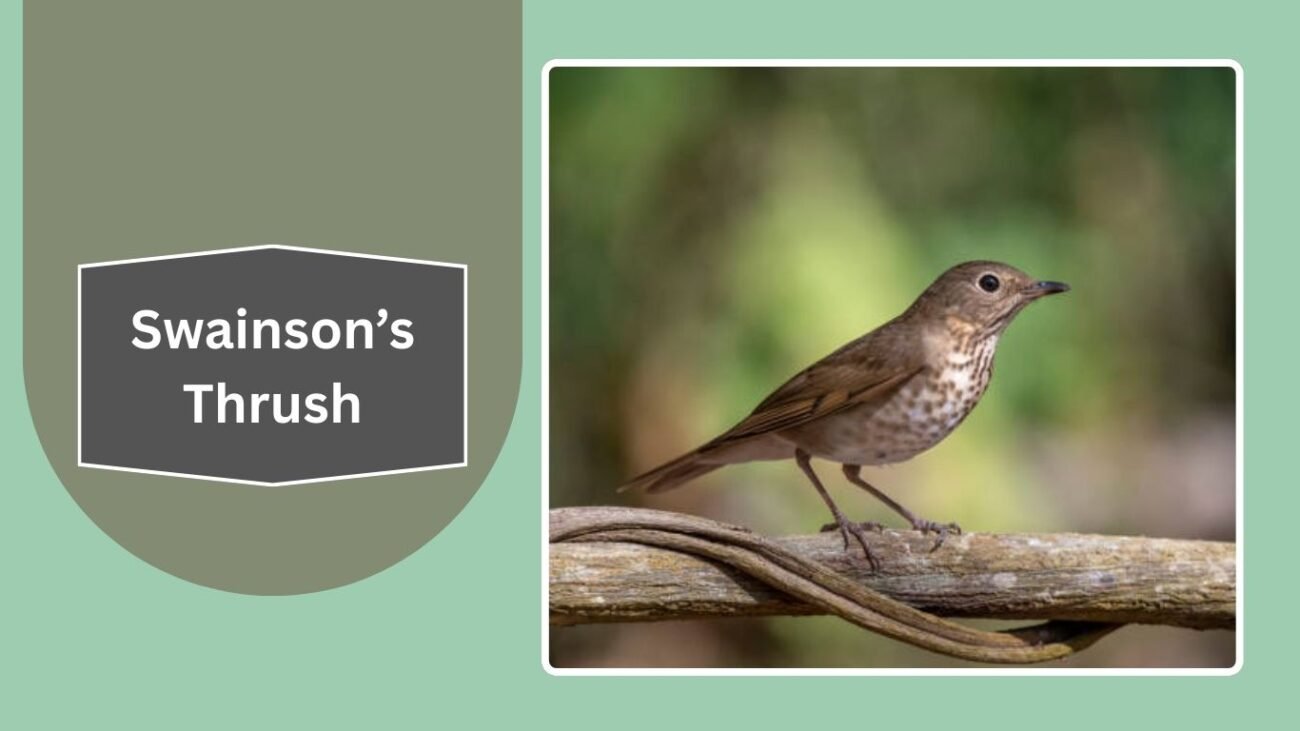
Swainson’s Thrush (Catharus ustulatus) is another forest-dwelling thrush, instantly recognizable by its upward-spiraling, flute-like song. Known as a long-distance migrant, this bird travels thousands of miles between North and South America.
Identification
- Small thrush, about 16–18 cm (6.3–7 in) long
- Olive-brown back and wings with slightly paler underparts
- Buffy eye ring, giving a “spectacled” look
- Spotted breast with soft, dusky markings
- Slender legs and thin bill
Behavior
Swainson’s Thrushes feed mostly on insects and spiders during the breeding season but switch to fruits and berries in the fall. They are elusive, often staying in dense foliage, but their unique, ascending song reveals their presence.
Habitat
They breed in coniferous and mixed forests across Canada, Alaska, and the northern United States. During migration, they travel along both the Pacific and Atlantic flyways to winter in South America.
Importance
As one of the most significant seed dispersers in neotropical forests, Swainson’s Thrushes are vital for regenerating plant communities. Their long migration also makes them key species for studying bird navigation and climate change impacts.
6. Gray-cheeked Thrush
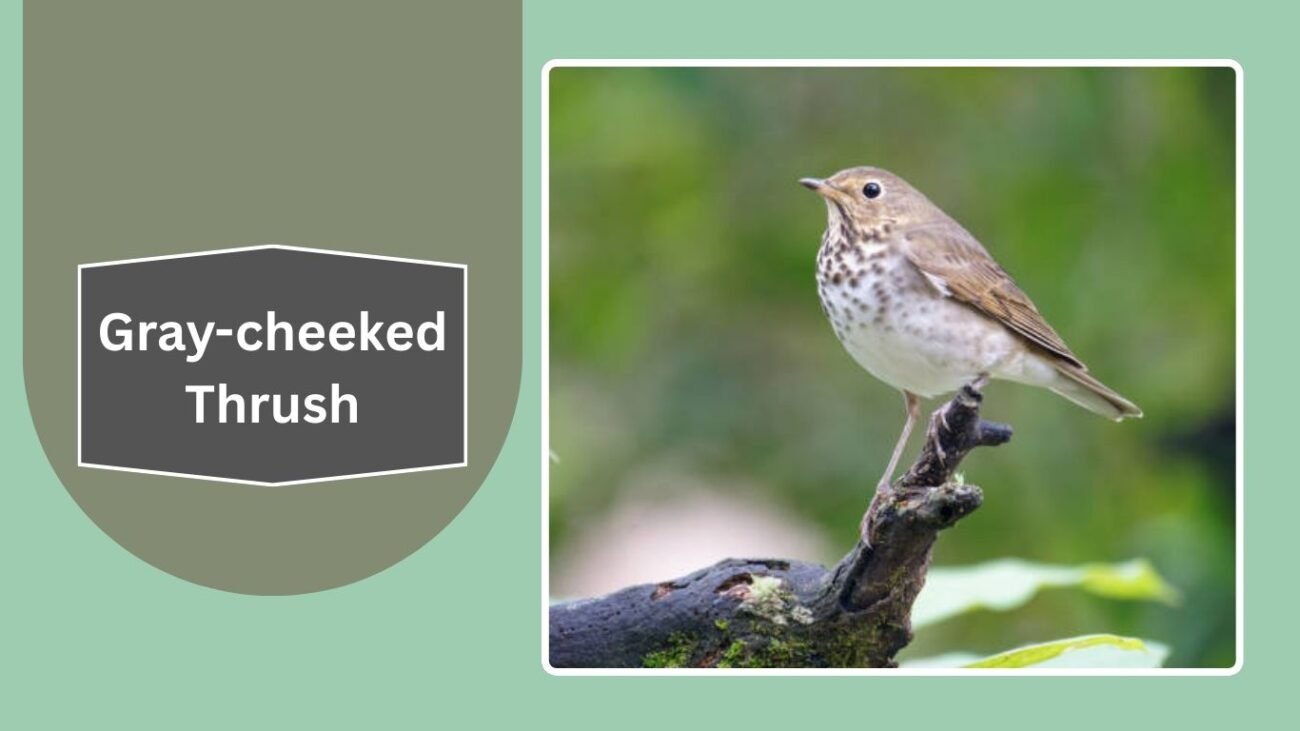
The Gray-cheeked Thrush (Catharus minimus) is a secretive and elusive thrush, often hidden deep within thickets and dense undergrowth. It is one of the longest-distance migratory songbirds, breeding in the far northern forests of North America and wintering in South America.
Identification
- Medium-sized thrush, about 16–18 cm (6.3–7 in) long
- Brownish-olive upperparts with grayish wash on the face
- Lacks a strong eye ring, giving it a plainer look compared to other thrushes
- Pale underparts with dusky spotting concentrated on the breast
- Slender body and straight bill
Behavior
Gray-cheeked Thrushes are shy and difficult to spot, often foraging on the ground under dense cover. They eat insects, beetles, caterpillars, and berries. During migration, they are often detected more by their call notes than by sight, as they tend to stay hidden in vegetation.
Habitat
They breed in the boreal forests of Alaska, Canada, and northeastern Siberia. During migration, they travel through North America and winter in northern South America, including Colombia and Venezuela.
Importance
This thrush plays a role in forest ecology by dispersing seeds of fruiting plants. Its long migratory journey makes it a valuable species for research on bird navigation, endurance, and the effects of climate change on migratory patterns.
7. Bicknell’s Thrush
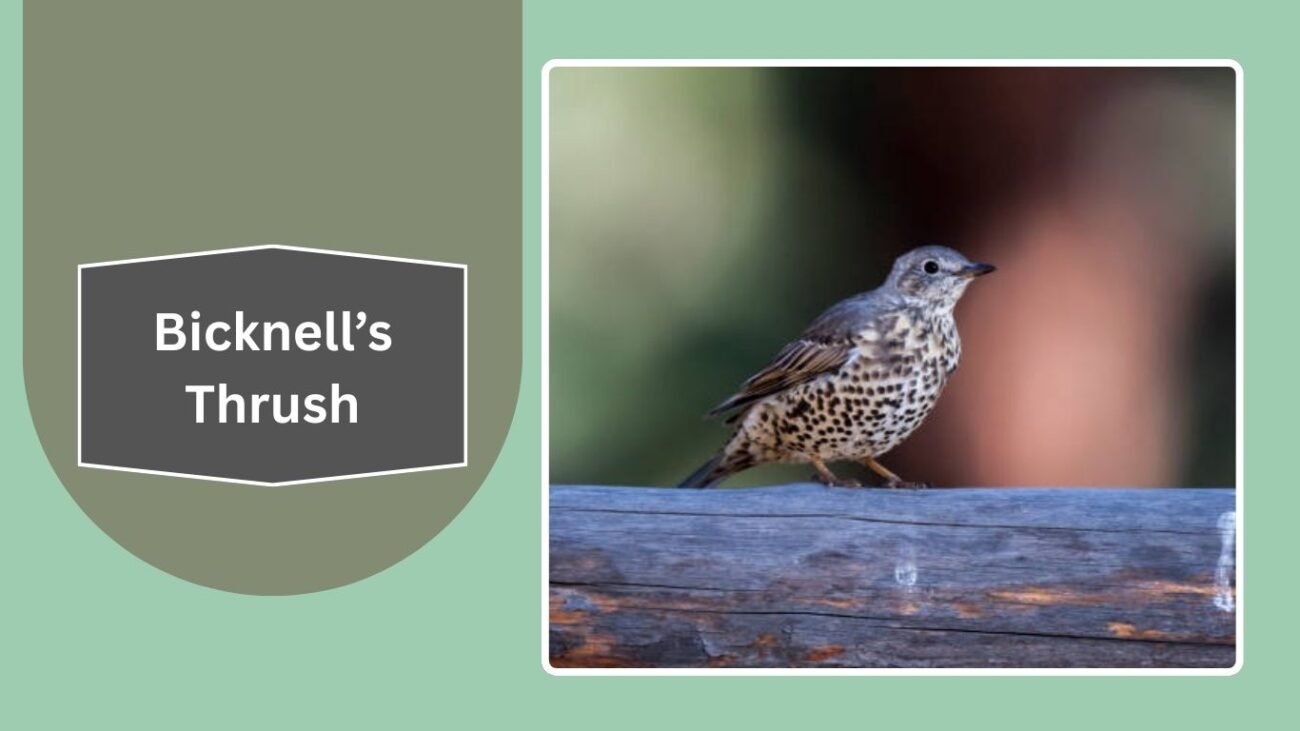
Bicknell’s Thrush (Catharus bicknelli) is one of the rarest and most threatened thrush species in North America. Closely resembling the Gray-cheeked Thrush, it is distinguished by subtle physical traits and a restricted breeding range. It is considered a species of conservation concern due to habitat loss and climate change.
Identification
- Small thrush, about 16–17 cm (6.3–6.7 in) long
- Brownish-olive upperparts and grayish face with faint eye ring
- Slightly smaller and warmer-toned than the Gray-cheeked Thrush
- Spotted breast with pale underparts
- Short tail and slender build
Behavior
Bicknell’s Thrushes are elusive and often stay in thick, high-altitude forests. They feed mainly on insects, spiders, and fruit, foraging both on the ground and in low vegetation. Their song is a jumble of clear, high-pitched notes that can be difficult to distinguish from other Catharus thrushes.
Habitat
This thrush breeds only in high-elevation spruce-fir forests of the northeastern United States (New York, Vermont, New Hampshire, and Maine) and southeastern Canada. In winter, it migrates to the Caribbean, particularly Hispaniola.
Importance
As one of the rarest North American songbirds, Bicknell’s Thrush is a flagship species for conservation. Protecting its habitat helps preserve entire high-altitude ecosystems. Its restricted range and vulnerability to climate shifts highlight the urgency of conservation efforts.
8. Varied Thrush
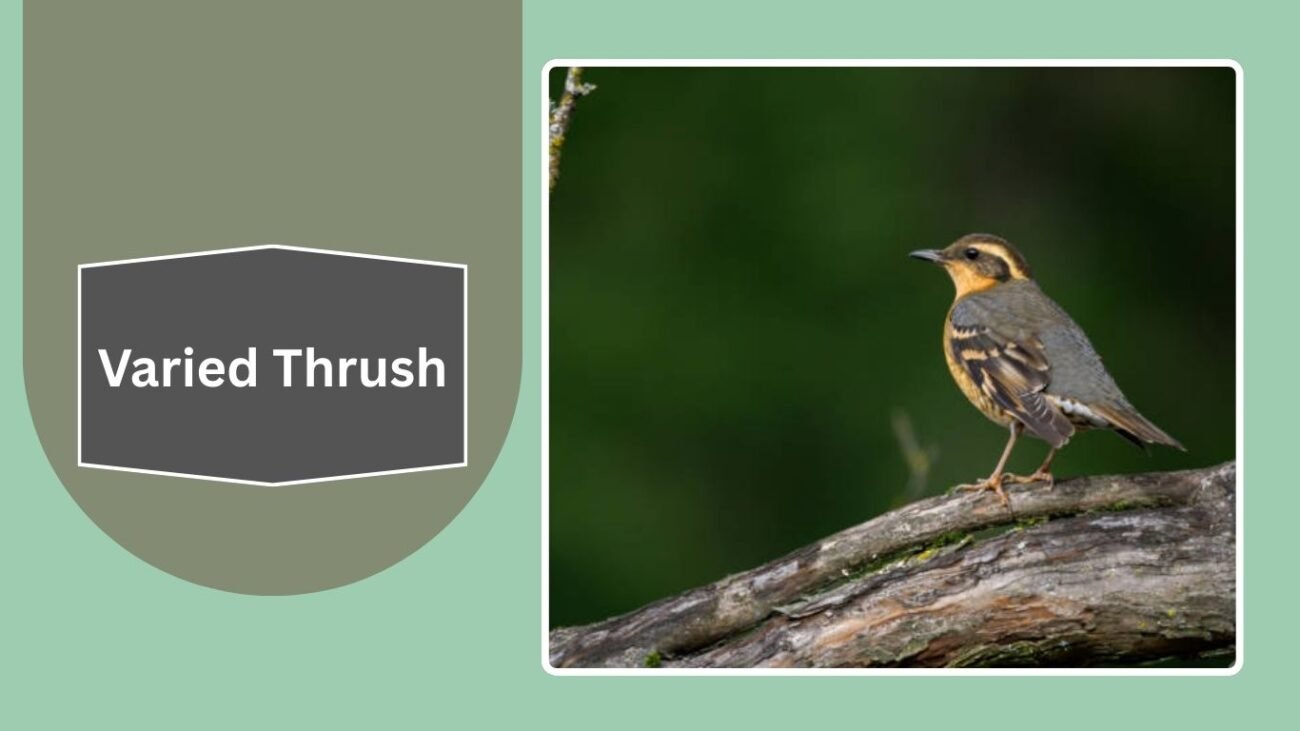
The Varied Thrush (Ixoreus naevius) is a striking forest bird of western North America, often compared to a “robin in exotic dress.” With its bold orange and black plumage, it brings a splash of color to the dark evergreen forests it inhabits. Its haunting, single-note whistle carries through misty woodlands, creating an unforgettable atmosphere.
Identification
- Medium-sized thrush, about 20–26 cm (8–10 in) long
- Bright orange breast, throat, and eyebrow stripe
- Black band across the chest, giving a bold contrast
- Slate-blue back and wings with orange wing bars
- Females have duller, brownish tones compared to males
Behavior
Varied Thrushes are shy and prefer staying close to dense forest cover. They forage on the ground, flicking aside leaf litter in search of insects, beetles, and grubs. In fall and winter, they switch to berries and seeds. Their eerie, drawn-out whistle, repeated at intervals, is a signature sound of the Pacific Northwest forests.
Habitat
They breed in the coniferous forests of Alaska, British Columbia, and the Pacific Northwest, often at higher elevations. During winter, they descend into lowlands and can be seen in gardens, parks, and orchards, sometimes appearing at backyard feeders.
Importance
Varied Thrushes are important seed dispersers and insect controllers in forest ecosystems. Their sensitivity to habitat changes makes them an indicator species for the health of Pacific Northwest old-growth forests.
9. Eurasian Blackbird (Common Blackbird)
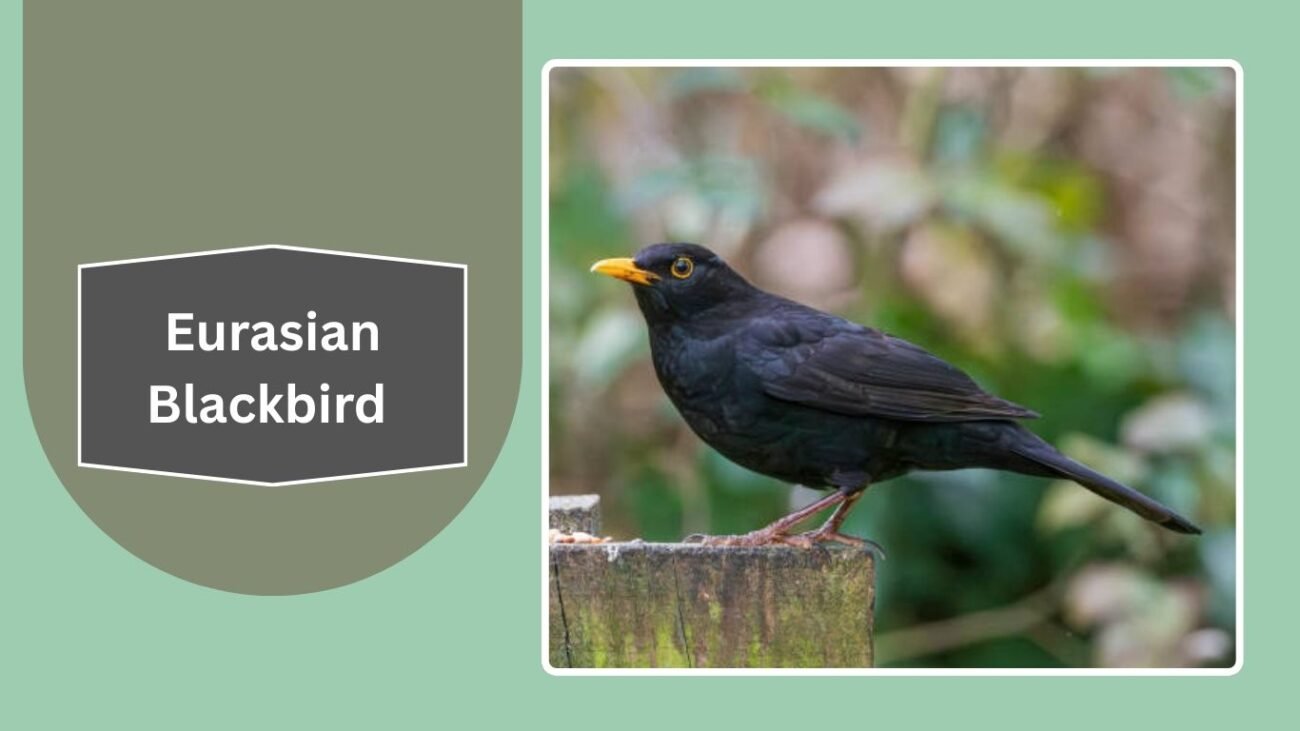
The Eurasian Blackbird (Turdus merula) is one of the most familiar and beloved thrushes in Europe, Asia, and parts of North Africa. Known for its melodious song, it has long been a subject of poetry, folklore, and music. Despite its name, only males are black—females and juveniles are brown.
Identification
- Medium-sized thrush, about 23–29 cm (9–11 in) long
- Males: glossy black plumage with bright yellow bill and eye ring
- Females: brown plumage with streaked breast and duller bill
- Juveniles resemble females but are more mottled
- Upright stance with long tail
Behavior
Blackbirds are territorial, especially males, which sing loudly from perches to defend their area. They feed on worms, insects, and fruit, often seen hopping across lawns in search of prey. Their song is flute-like, rich, and highly varied, often delivered at dawn and dusk.
Habitat
They inhabit woodlands, gardens, farmlands, and urban parks across Europe, Asia, and North Africa. They have also been introduced to Australia and New Zealand, where they thrive in suburban and rural areas.
Importance
The Eurasian Blackbird is a cultural icon, featured in nursery rhymes like “Sing a Song of Sixpence” and immortalized in music such as The Beatles’ song Blackbird. Ecologically, they are crucial seed dispersers and play a role in controlling insect populations.
10. Song Thrush
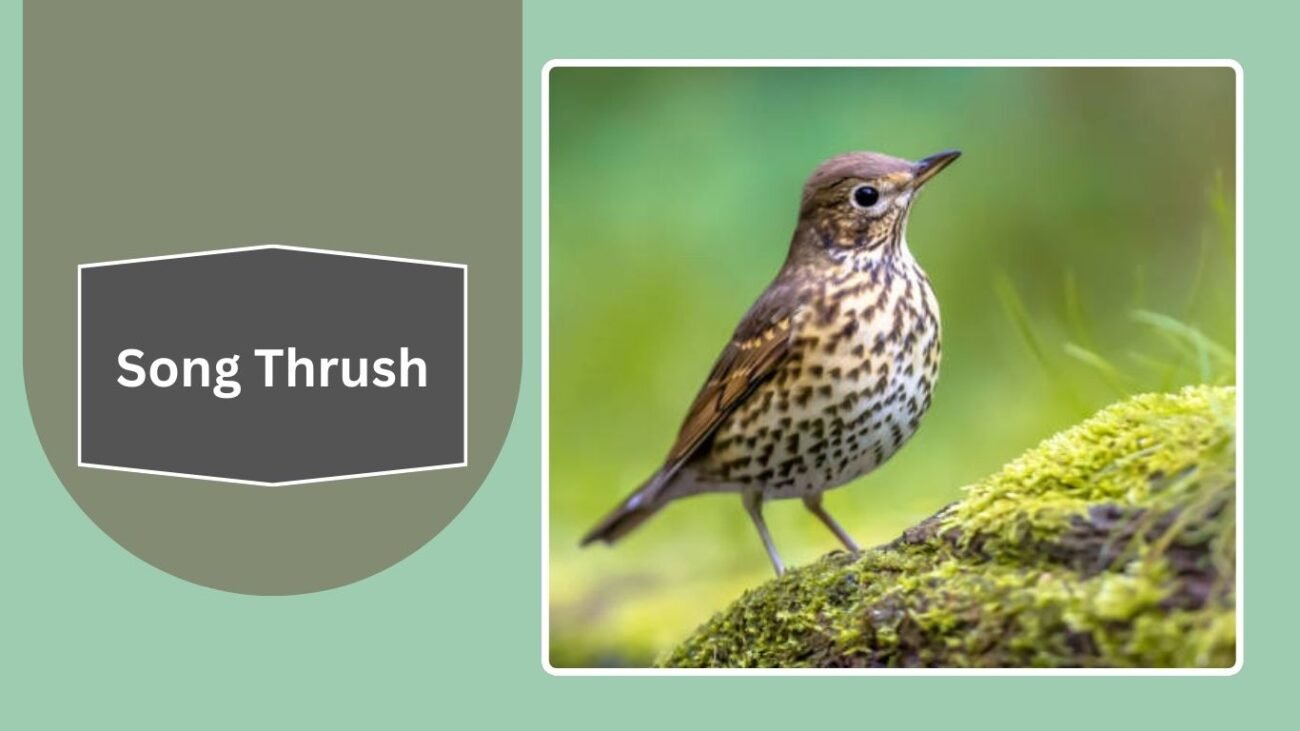
The Song Thrush (Turdus philomelos) is renowned for its clear, melodic song, where phrases are repeated two or three times in succession. Widely distributed across Europe and parts of Asia, it is a familiar bird in gardens, woodlands, and parks, often recognized before it is seen.
Identification
- Medium-sized thrush, about 20–23 cm (8–9 in) long
- Warm brown upperparts with creamy underparts
- Bold dark spots shaped like arrowheads on the chest and belly
- Pale eye ring and pinkish legs
- Short tail compared to other thrushes
Behavior
Song Thrushes feed mainly on earthworms, snails, and insects, using stones to crack snail shells—a unique behavior among thrushes. They are solitary and territorial during the breeding season but may form loose flocks in winter. Their song, rich and repetitive, makes them one of Europe’s best-known songbirds.
Habitat
They are found in woodlands, gardens, hedgerows, and parks across Europe, extending into parts of Asia. Many populations migrate south to the Mediterranean and North Africa for winter, while others remain year-round in milder regions.
Importance
Song Thrushes help control snail and insect populations and are important for seed dispersal. Their cultural presence is strong in European poetry and literature, symbolizing spring and renewal.
11. Mistle Thrush
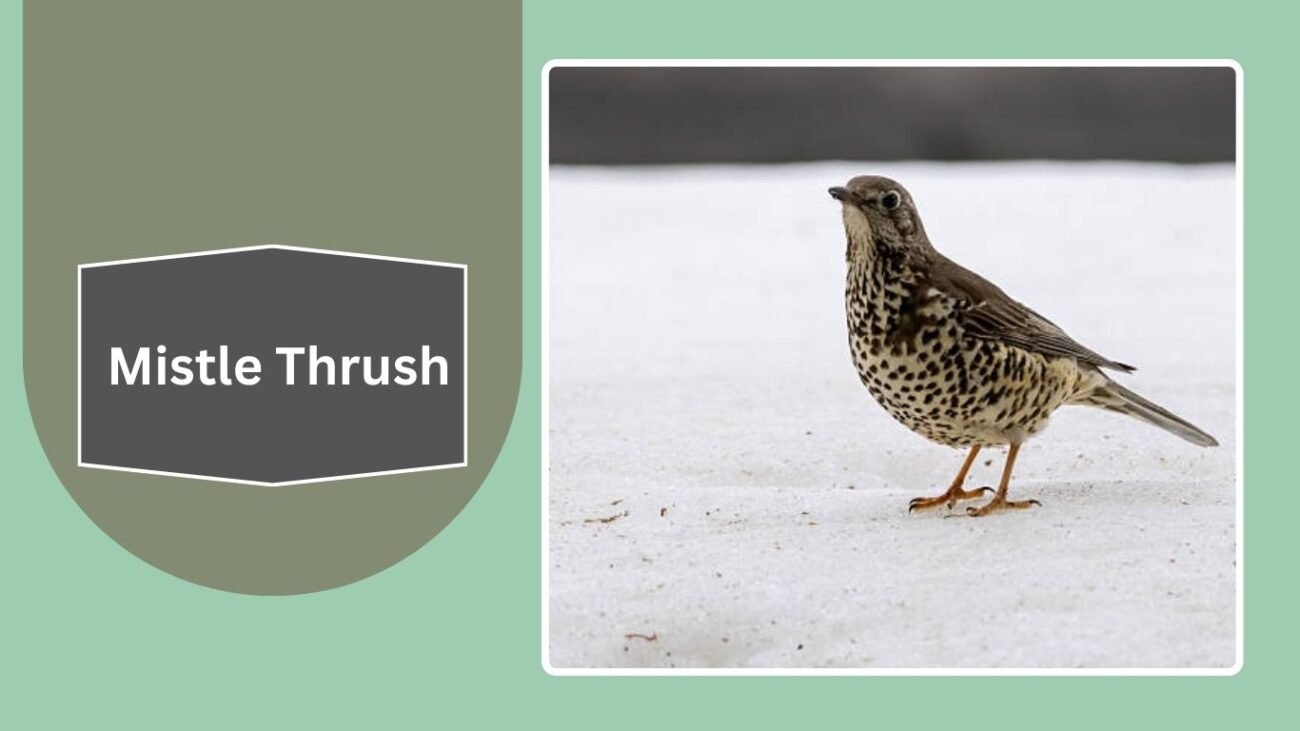
The Mistle Thrush (Turdus viscivorus) is the largest thrush species in Europe. It is a bold and upright bird, often singing its loud, fluting song even during stormy weather, earning it the nickname “Stormcock.”
Identification
- Large thrush, about 26–29 cm (10–11 in) long
- Gray-brown upperparts with paler underparts
- Large, round dark spots covering the breast and belly
- Long tail and upright stance, giving a proud appearance
- Pale edges on wings visible in flight
Behavior
Mistle Thrushes are aggressive defenders of their food sources, particularly mistletoe berries, which they guard fiercely in winter. They forage mainly on the ground, eating insects, worms, and berries. Their loud, far-carrying song is often delivered from tall treetops.
Habitat
They inhabit open woodlands, parks, orchards, and hedgerows across Europe and parts of Asia. Many populations are resident, while northern birds migrate southward in winter.
Importance
As their name suggests, they play a vital role in spreading mistletoe seeds, helping the plant thrive in new areas. They are also symbolic in folklore, often associated with resilience due to their habit of singing in harsh weather.
12. Redwing
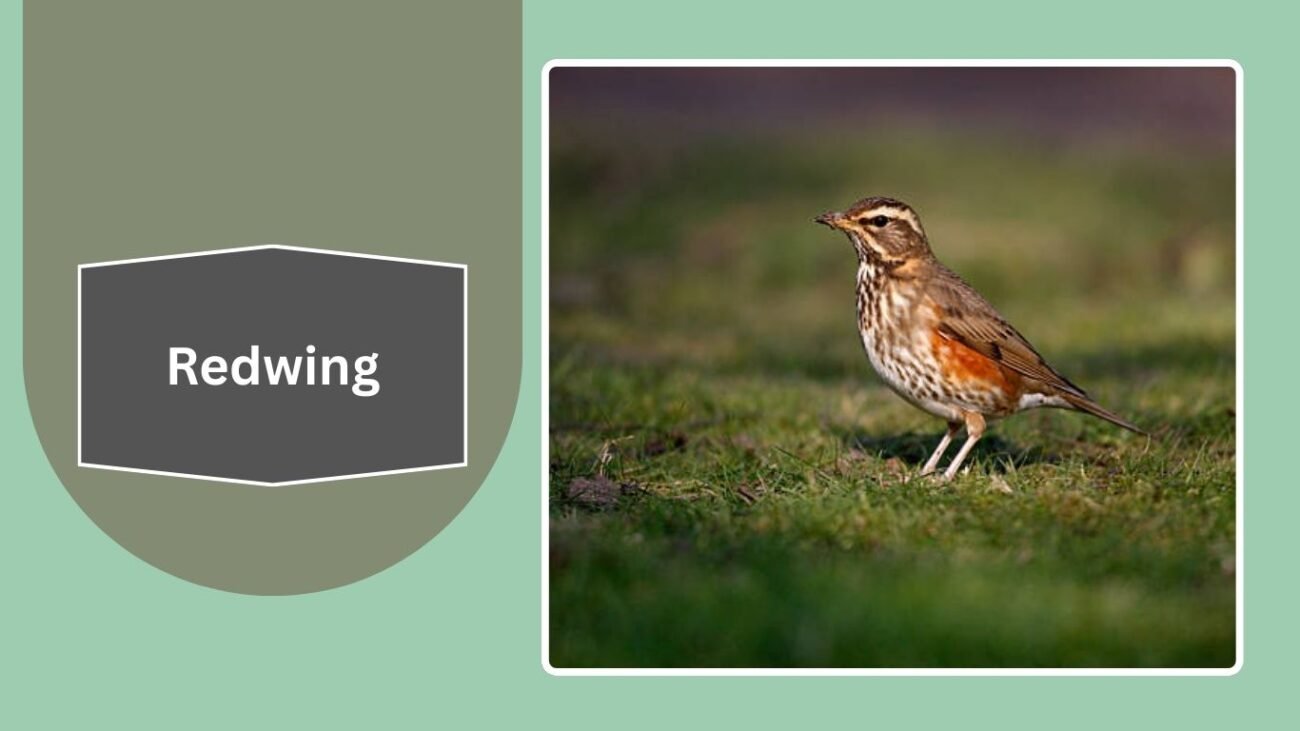
The Redwing (Turdus iliacus) is a small migratory thrush that breeds in the northern forests of Europe and Asia and winters further south. It is best identified by its striking red flanks and underwing, which are often revealed in flight. Though somewhat shy, it often joins flocks of Fieldfares and other thrushes in winter, feeding on berries and fallen fruit.
Identification
- Small thrush, about 19–24 cm (7.5–9.5 in) long
- Brown upperparts and cream underparts with dark streaks
- Distinct red flanks and underwing coverts
- Pale eyebrow (supercilium) above the eye
- Slender body and medium-length tail
Behavior
Redwings forage mostly on the ground, feeding on worms, insects, and berries. In winter, they often move in nomadic flocks, roaming fields, hedgerows, and orchards in search of food. Their thin, high-pitched “tseep” call is commonly heard at night during migration.
Habitat
They breed in birch and coniferous forests across Scandinavia, Iceland, and Russia. In winter, they migrate to Western and Southern Europe, North Africa, and parts of the Middle East, favoring open countryside with berry-bearing shrubs.
Importance
Redwings are important seed dispersers for berry-producing plants such as hawthorn and rowan. Their arrival in winter is a seasonal marker in many European landscapes.
13. Fieldfare
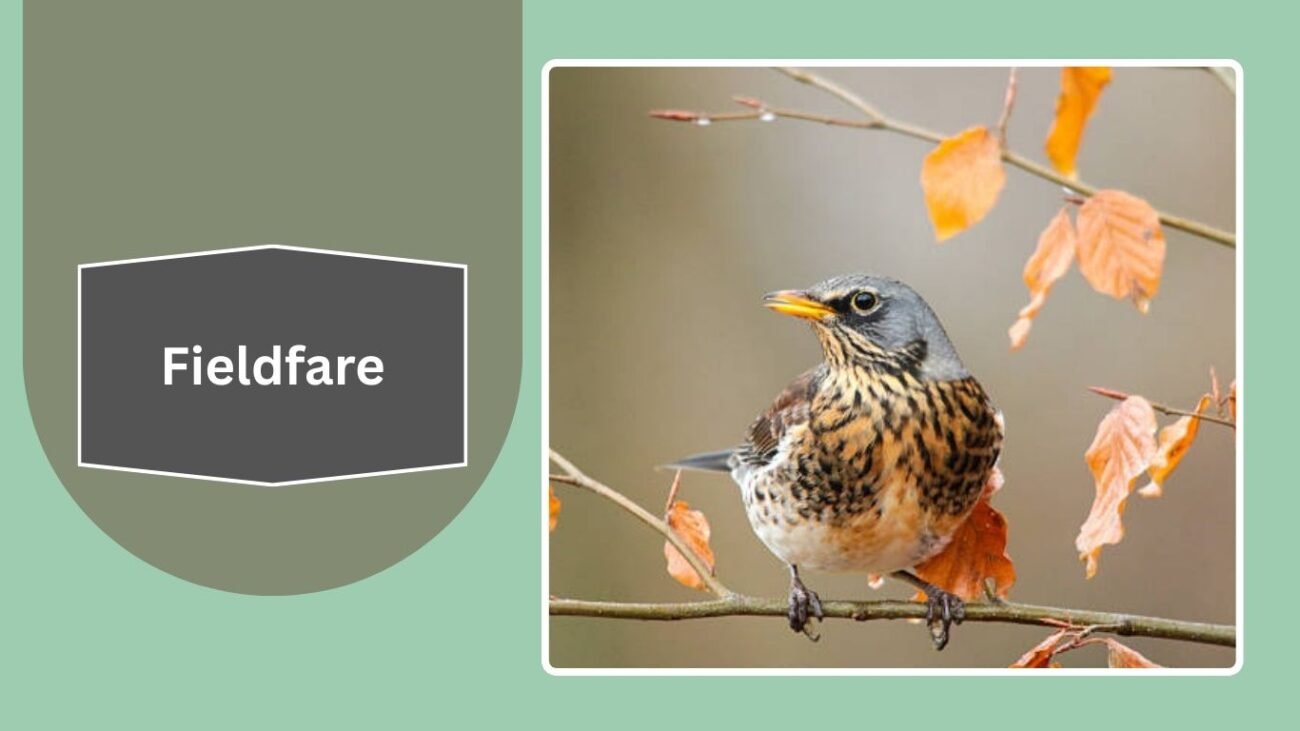
The Fieldfare (Turdus pilaris) is a colorful and sociable thrush that breeds across northern Europe and Asia. Known for forming large, noisy winter flocks, it is often seen feeding in open fields, orchards, and hedgerows. Its harsh “chack-chack” call is distinctive when flying overhead.
Identification
- Medium-sized thrush, about 25–27 cm (10–11 in) long
- Ash-gray head and rump with chestnut-brown back
- White underparts with dark streaks and spotted chest
- Long tail with dark underside
- Strong flight with flickering wingbeats
Behavior
Fieldfares are highly gregarious, especially in winter, when they gather in large flocks to feed on berries and fallen fruit. During breeding, however, they nest in colonies for protection, aggressively mobbing predators. They feed on insects, worms, and fruit, depending on the season.
Habitat
They breed in woodlands, farmlands, and tundra edges across Scandinavia, Eastern Europe, and Russia. In winter, they migrate south to Western Europe, the Mediterranean, and North Africa, where they are common in open countryside.
Importance
Fieldfares are valuable seed dispersers and help control insect populations. Their presence in large flocks during winter makes them an iconic seasonal bird in European landscapes.
14. Ring Ouzel
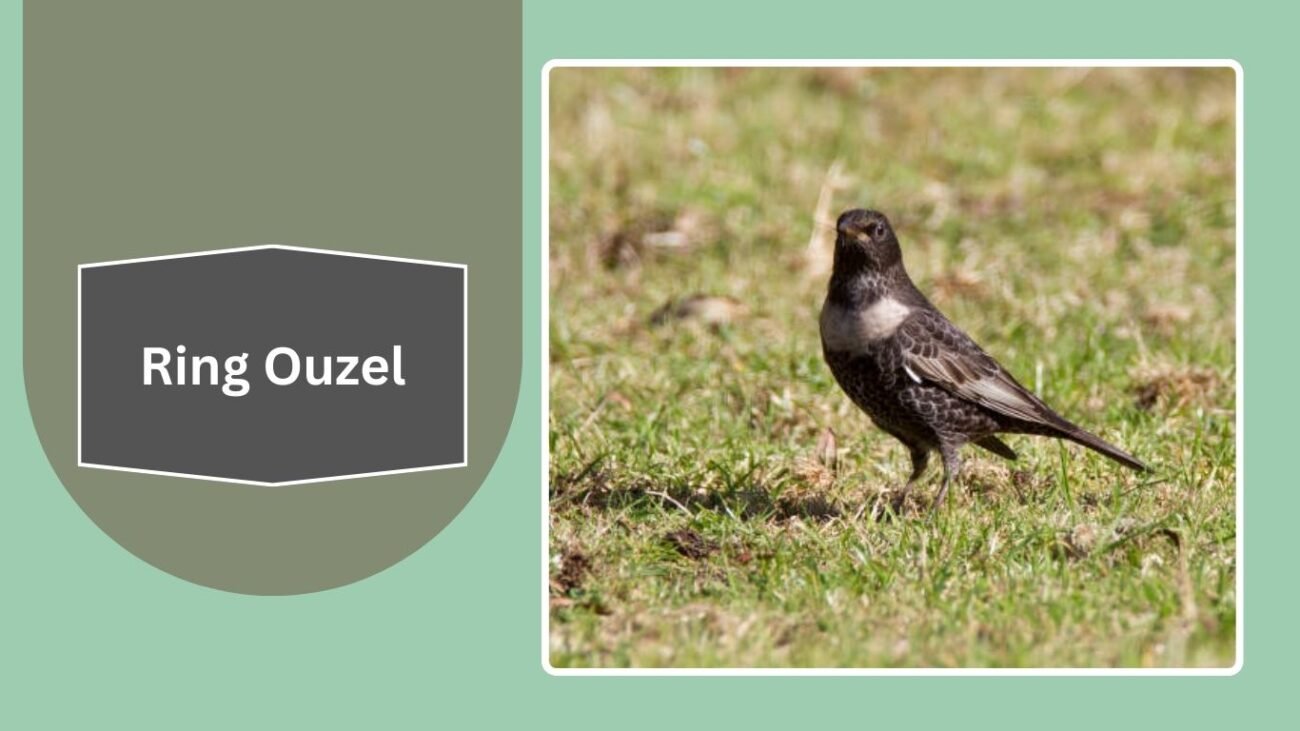
The Ring Ouzel (Turdus torquatus) is often called the “mountain blackbird” because of its resemblance to the Eurasian Blackbird but with a bold white crescent across its chest. It is a shy, migratory thrush that prefers upland and mountainous habitats across Europe and western Asia.
Identification
- Medium-sized thrush, about 23–24 cm (9–9.5 in) long
- Males: black plumage with a distinct white crescent on the breast
- Females: slightly browner with a duller crescent
- Pale edges on feathers giving a scaly look in worn plumage
- Long tail and upright stance
Behavior
Ring Ouzels feed on insects, earthworms, and berries, especially rowan and juniper. They are wary birds, often flying off quickly with a loud, sharp call. During autumn, they migrate in flocks, stopping at berry-rich sites to refuel. Their song is similar to the blackbird’s but shorter and more melancholic.
Habitat
They breed in upland moorlands, rocky slopes, and alpine pastures across northern and central Europe, extending east into western Asia. In winter, they migrate south to the Mediterranean, North Africa, and the Middle East.
Importance
Ring Ouzels play a role in dispersing mountain berries and are also a cultural symbol of wilderness in highland regions such as Scotland. Sadly, their populations are in decline due to habitat changes and climate shifts.
15. White’s Thrush
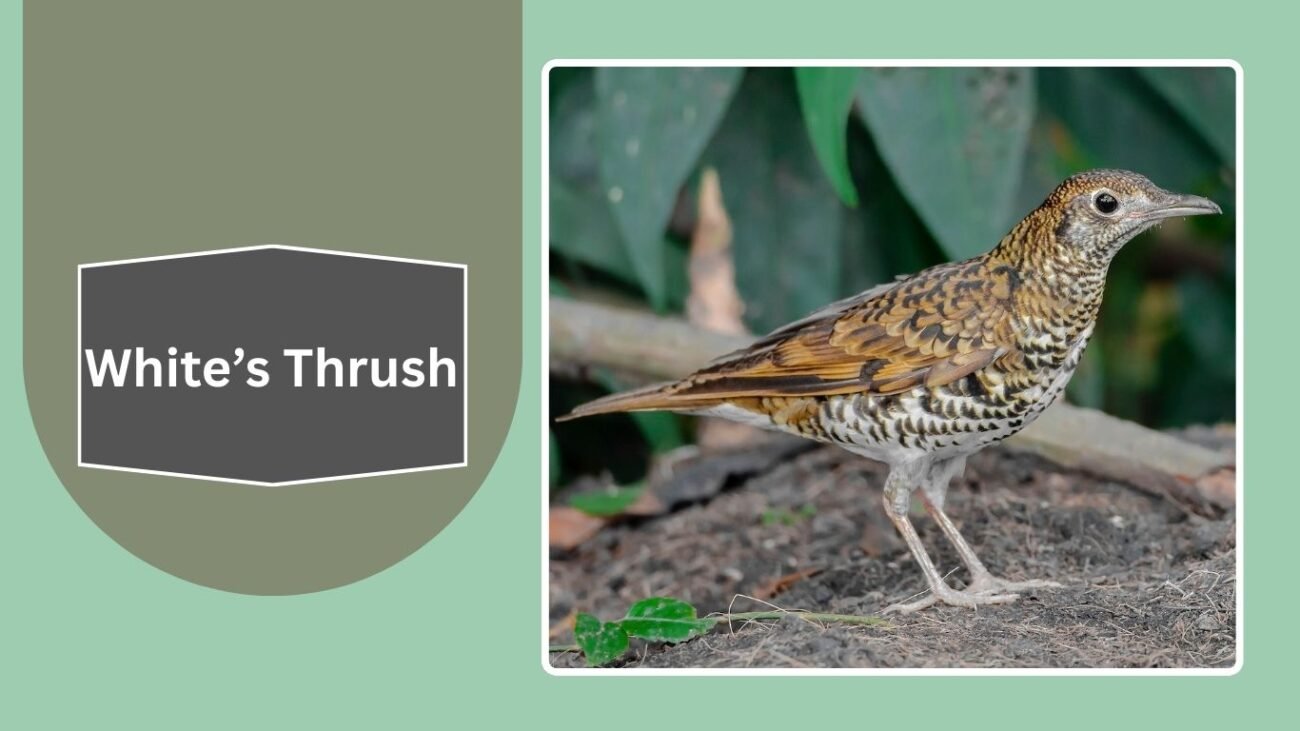
White’s Thrush (Zoothera aurea), sometimes known as the scaly thrush, is a striking species with bold golden-brown plumage covered in intricate black scalloping. Secretive and elusive, it is more often heard than seen in its dense woodland habitats.
Identification
- Large thrush, about 27–31 cm (10.5–12 in) long
- Golden-brown plumage with heavy black crescent-shaped markings
- Pale underparts with similar bold scaling
- Strong legs and a slightly curved bill
- In flight, shows broad wings with pale underwing coverts
Behavior
White’s Thrushes are solitary and shy, usually foraging quietly on the forest floor for insects, snails, and earthworms. Their cryptic plumage provides excellent camouflage among leaf litter. They also eat berries and fruits during autumn and winter. Their call is a sharp “tseep,” and their song is a series of melancholy whistles.
Habitat
They breed in mixed and coniferous forests across Siberia, northeast China, and Japan. In winter, they migrate south to Southeast Asia, including India, Thailand, and the Philippines. Occasionally, they appear as rare vagrants in Europe.
Importance
This thrush is an important forest species for insect control and seed dispersal. Its rarity in parts of its range makes it a prized sighting for birdwatchers, contributing to eco-tourism in Asia.
16. Eyebrowed Thrush
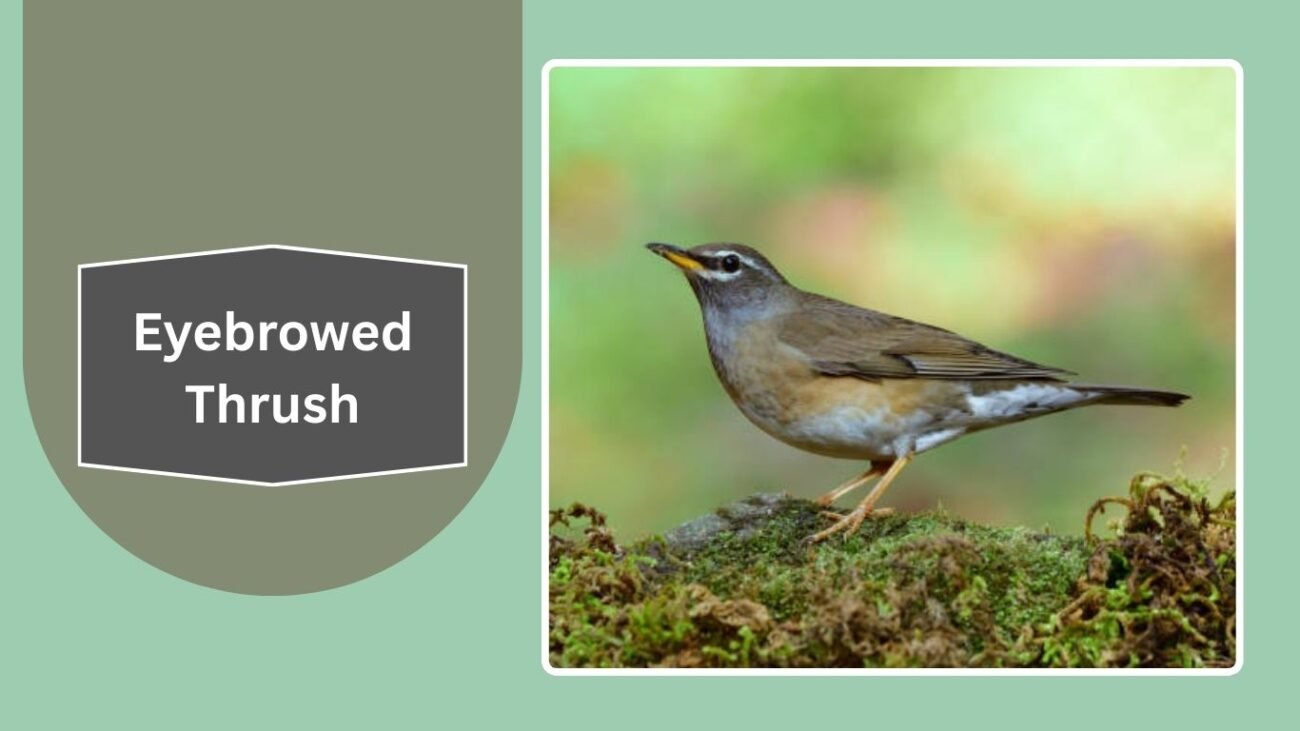
The Eyebrowed Thrush (Turdus obscurus) is a migratory thrush of Asia, instantly recognizable by the bold pale stripe above its eye. It is a regular winter visitor to parts of South and Southeast Asia and is sometimes seen in large flocks, especially in areas rich in fruiting trees.
Identification
- Medium-sized thrush, about 20–24 cm (8–9.5 in) long
- Gray-brown upperparts with a rufous wash on the flanks and breast
- Distinct pale eyebrow (supercilium)
- White underparts with light streaking on the sides
- Slim bill and longish tail
Behavior
Eyebrowed Thrushes forage actively in trees and on the ground, feeding mainly on insects, berries, and seeds. They are often gregarious in winter, forming mixed flocks with other thrushes and starlings. Their song is a series of short, clear whistles, but during migration, they more often give sharp call notes.
Habitat
They breed in Siberian forests and northeastern Asia, preferring mixed and coniferous woodlands. In winter, they migrate south to India, China, Japan, and Southeast Asia, where they frequent orchards, parks, and forest edges.
Importance
As a migratory species, they contribute to seed dispersal across vast regions. Their seasonal movements make them an important ecological link between northern breeding grounds and southern wintering habitats.
17. Dusky Thrush
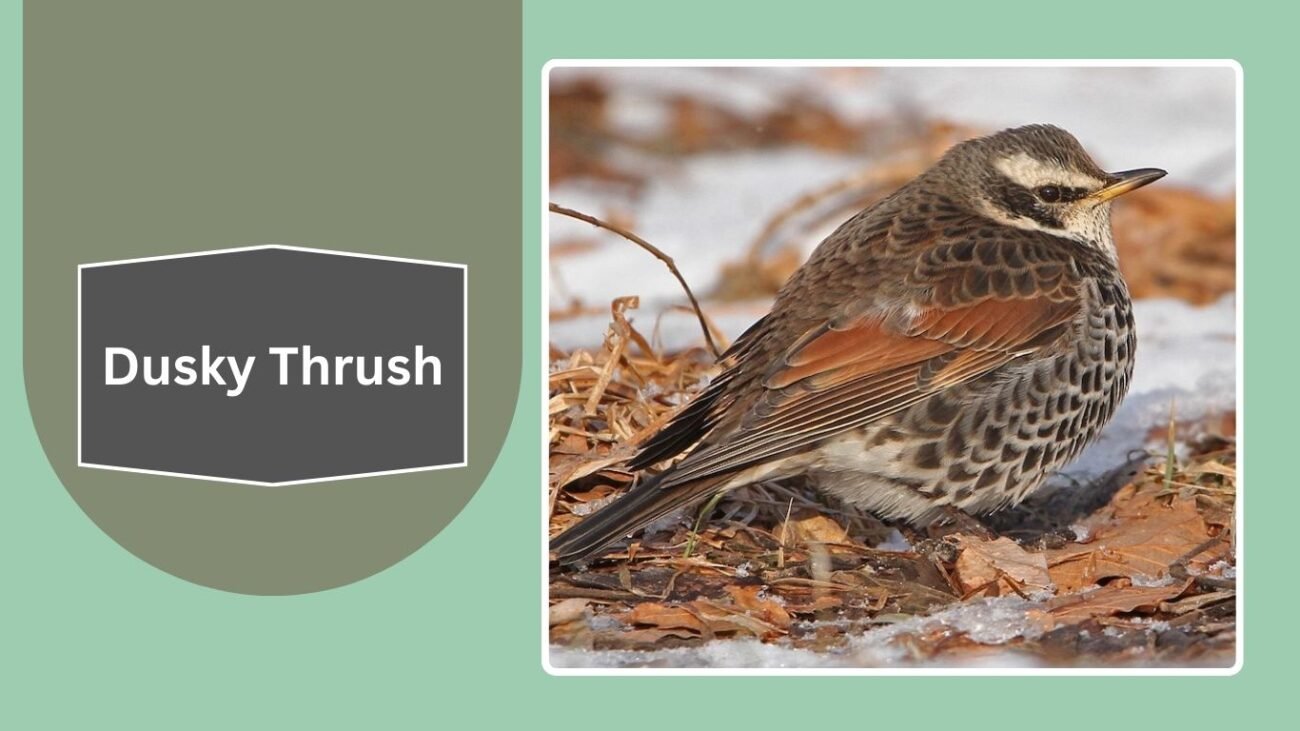
The Dusky Thrush (Turdus eunomus) is a striking thrush that breeds in Siberia and winters across East Asia. It is easily distinguished by its bold plumage pattern, making it a favorite among birdwatchers when it occasionally strays into Europe as a rare vagrant.
Identification
- Medium-sized thrush, about 23–25 cm (9–10 in) long
- Dark brown back and wings
- Boldly streaked underparts with black spotting
- White eyebrow stripe and pale throat with dark streaking
- Reddish-brown flanks and underwing coverts
Behavior
Dusky Thrushes are adaptable feeders, taking insects, worms, and snails in summer, then switching to berries and fruits in winter. They often forage on the ground in open habitats but will perch in fruiting trees during colder months. Their call is a harsh “tchack,” similar to that of a Fieldfare.
Habitat
They breed in open forests, scrublands, and river valleys across Siberia. In winter, they migrate to China, Korea, and Japan, where they are common in farmland, parks, and wooded areas. Rarely, individuals reach Western Europe.
Importance
Dusky Thrushes are important dispersers of wild fruit and play a role in pest control through insect feeding. Their status as a rare visitor to Europe makes them a highly sought-after bird for twitchers and birdwatching tourism.
18. Naumann’s Thrush
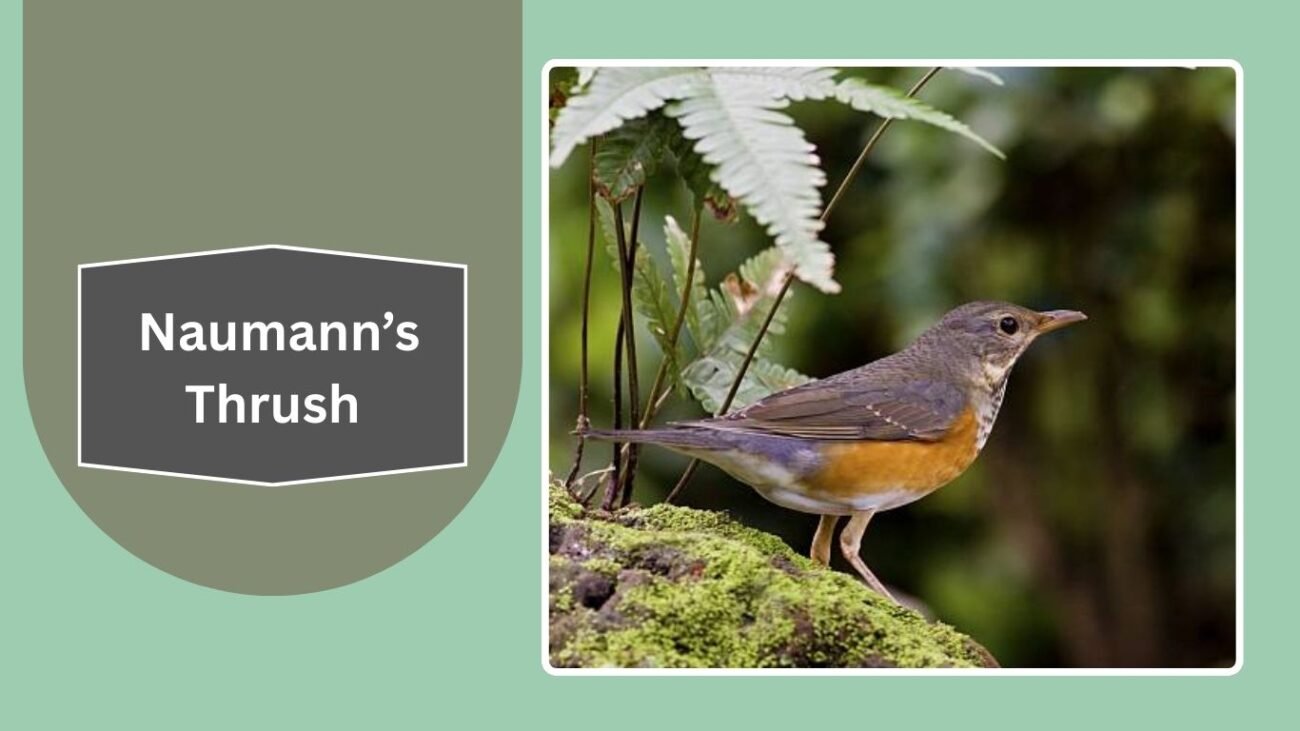
Naumann’s Thrush (Turdus naumanni) is a migratory thrush from East Asia, closely related to the Dusky Thrush, and the two are sometimes considered subspecies. It is named after the German naturalist Johann Andreas Naumann and is admired for its rufous tones, which set it apart from its darker relatives.
Identification
- Medium-sized thrush, about 23–25 cm (9–10 in) long
- Brownish-gray upperparts
- Rufous-red flanks, rump, and underwing coverts
- White throat and underparts with dark spotting on the breast
- Prominent pale eyebrow stripe
Behavior
Naumann’s Thrush is an active forager, feeding on the ground in open areas. It eats insects, snails, and earthworms during the breeding season and relies heavily on berries and fruits in winter. Its call is a harsh “chack,” similar to the Fieldfare and Dusky Thrush.
Habitat
They breed in open forests and riverine woodlands across Siberia and Mongolia. In winter, they migrate to East Asia, particularly China, Korea, and Japan, where they are common in parks, farmlands, and gardens.
Importance
This thrush contributes to seed dispersal and insect control across its range. Its close relationship with the Dusky Thrush makes it of interest to ornithologists studying species variation and hybridization.
19. Pale Thrush
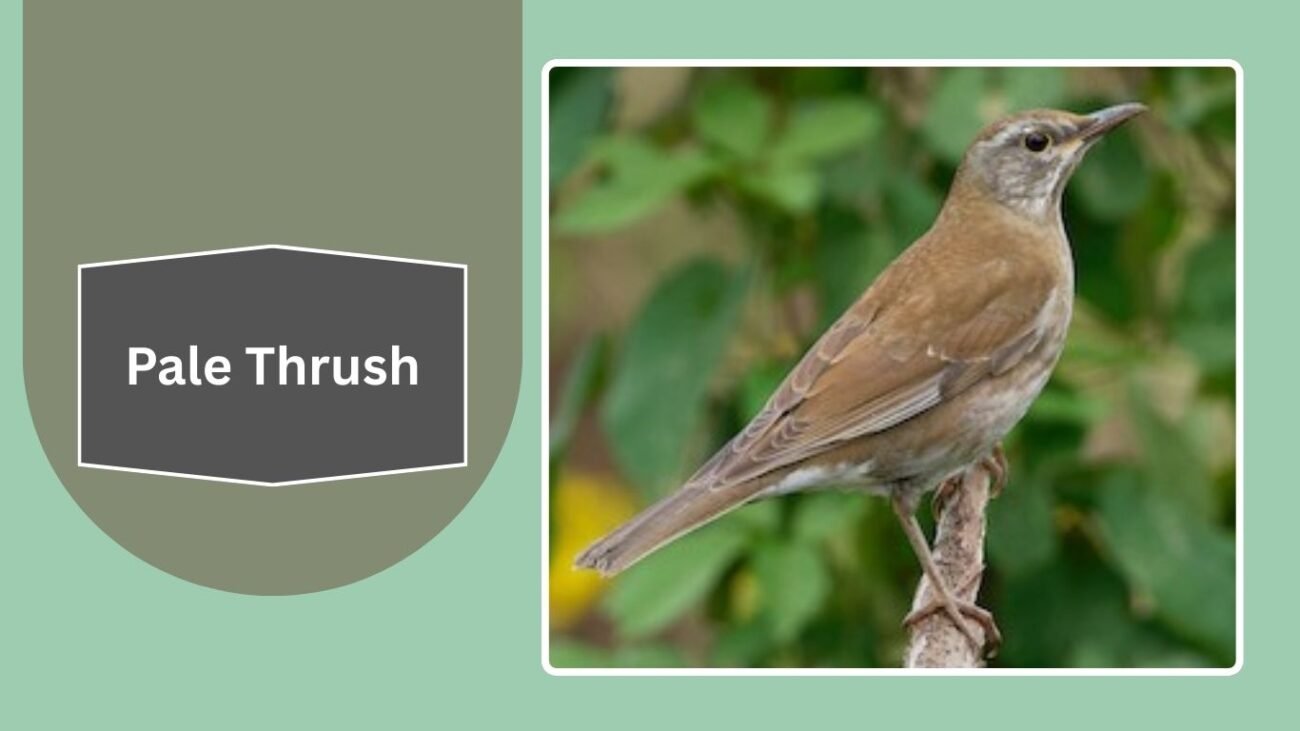
The Pale Thrush (Turdus pallidus) is a winter visitor to East Asia, known for its soft brown tones and understated beauty. Though not as boldly patterned as some thrushes, its simplicity makes it distinctive. It is frequently seen in parks and gardens during migration and winter months.
Identification
- Medium-sized thrush, about 23 cm (9 in) long
- Gray-brown back and wings
- Paler underparts with faint streaking on the breast
- White throat with fine dark lines
- Bill is dark with a yellow base
Behavior
Pale Thrushes feed mainly on insects, earthworms, and berries, foraging on the ground and in low shrubs. They are usually shy and prefer to stay near cover, flying off quickly when disturbed. Their song is a series of clear whistles, but they are more often heard giving sharp call notes.
Habitat
They breed in Korea, northeast China, and Japan, favoring forests and wooded hillsides. In winter, they migrate south to warmer regions of East Asia, including southern Japan, Taiwan, and southern China.
Importance
By feeding on insects and dispersing fruit seeds, Pale Thrushes play a valuable role in both pest control and plant regeneration. Their seasonal presence in parks and gardens also connects human settlements to migratory bird patterns.
20. Chinese Thrush
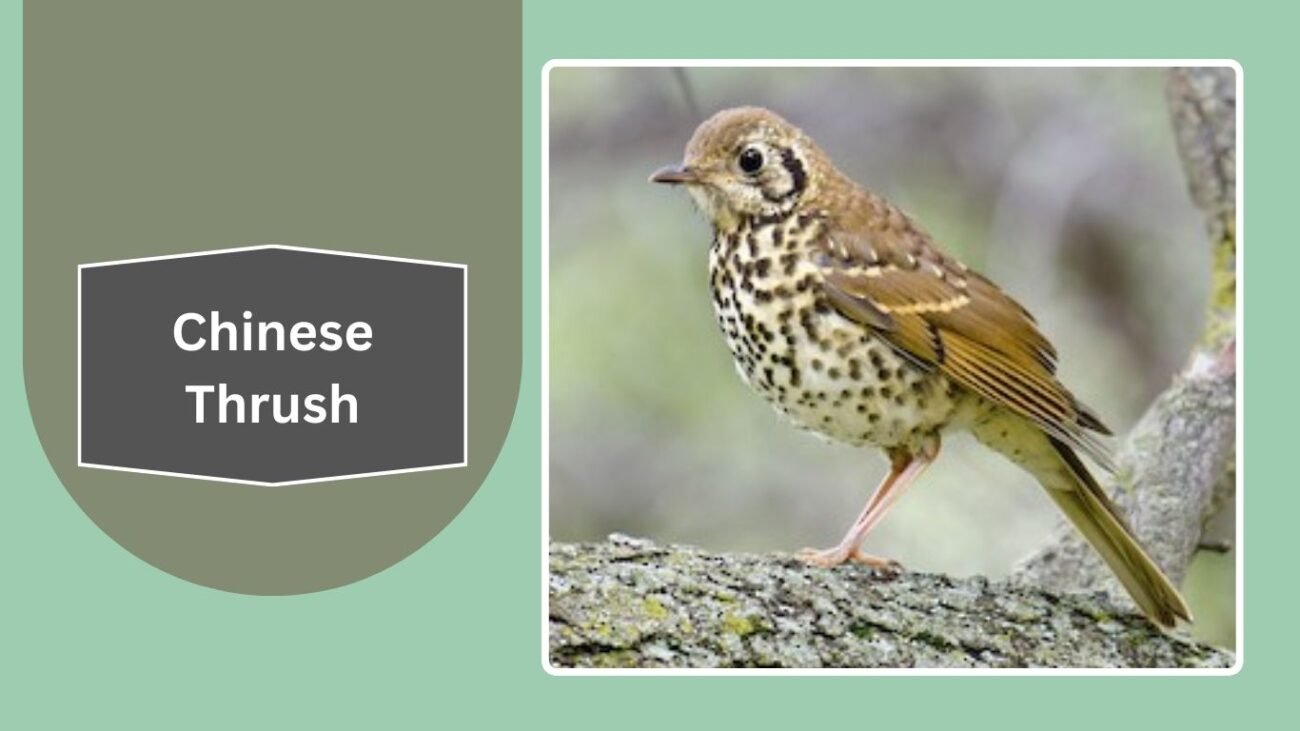
The Chinese Thrush (Turdus mupinensis) is a lesser-known but beautiful thrush native to central China. With its finely scaled plumage and preference for forested habitats, it resembles the White’s Thrush but is smaller and more localized in distribution.
Identification
- Medium-sized thrush, about 22–24 cm (8.5–9.5 in) long
- Brownish upperparts with intricate black scalloping
- Pale underparts with dark crescent-shaped markings
- Slim bill and relatively short tail
- Both sexes look similar in plumage
Behavior
Chinese Thrushes are shy and elusive, foraging quietly on the ground for insects, worms, and snails. In autumn and winter, they also consume berries and fruits. Their song is melodious but less powerful than that of other Turdus thrushes, often given from within dense cover.
Habitat
They inhabit montane forests and wooded valleys in central and southwestern China, particularly Sichuan. They are mostly resident, though some individuals may move to lower elevations during winter.
Importance
Chinese Thrushes contribute to insect control and seed dispersal within their limited range. Their restricted distribution makes them of interest to ornithologists and birdwatchers, adding value to China’s avian biodiversity.
21. Siberian Thrush
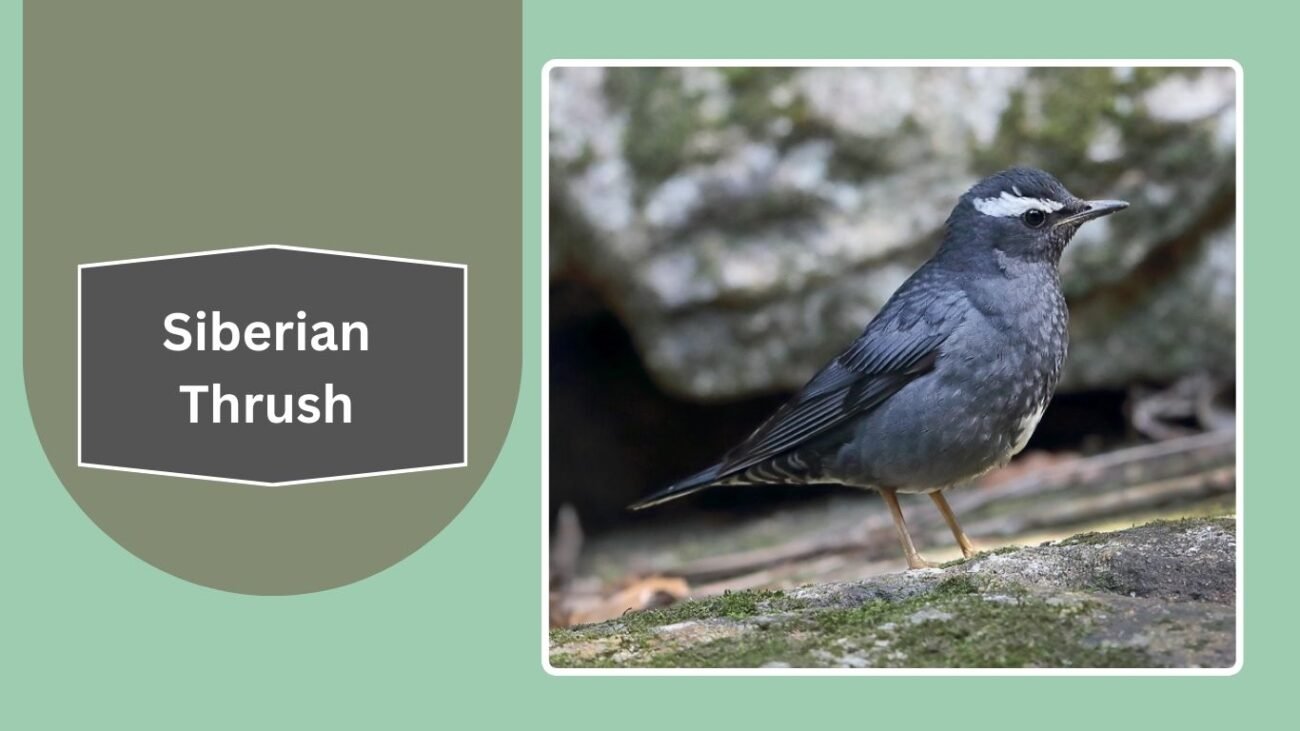
The Siberian Thrush (Geokichla sibirica) is a secretive and striking species, considered one of the most elusive thrushes in Asia. Males are dark and glossy with a distinctive white stripe above the eye, while females are cryptically patterned for camouflage. It is a long-distance migrant, traveling thousands of kilometers between breeding and wintering grounds.
Identification
- Medium-sized thrush, about 20–23 cm (8–9 in) long
- Males: dark bluish-black plumage with bold white eyebrow and underwing
- Females: brown plumage with buff and dark streaking
- Short tail and slim build
- Strong sexual dimorphism in plumage
Behavior
Siberian Thrushes are shy, keeping close to dense vegetation. They forage mainly on the forest floor, eating insects, worms, and berries. During migration, they often remain hidden in undergrowth, making them difficult to spot. Their song is a series of clear, flute-like notes.
Habitat
They breed in dense, damp forests of Siberia and the Russian Far East. In winter, they migrate to South and Southeast Asia, including India, Bangladesh, Thailand, and Malaysia.
Importance
As a long-distance migrant, the Siberian Thrush plays a key role in seed dispersal across continents. Its rarity outside of migration hotspots makes it a prized sighting for birdwatchers, contributing to eco-tourism in Asia.
22. African Thrush
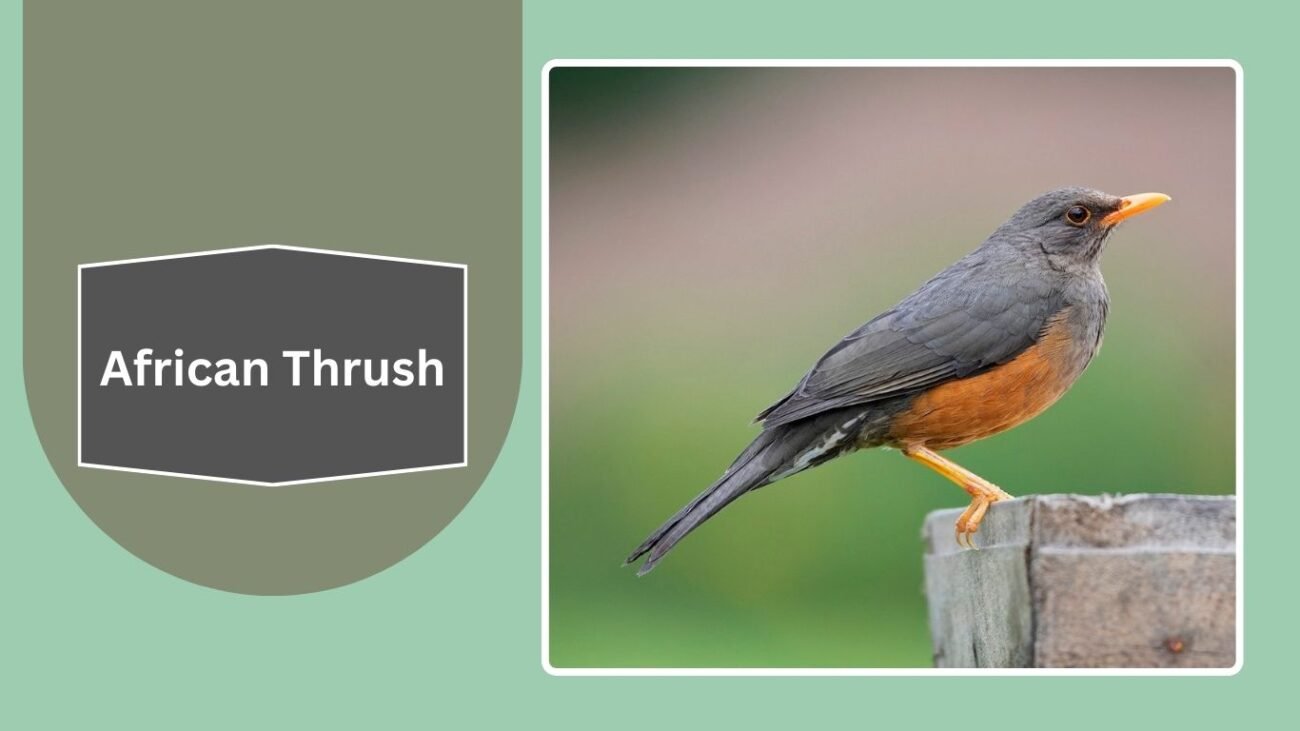
The African Thrush (Turdus pelios) is a widespread species found across much of sub-Saharan Africa. Adaptable and often seen in both rural and urban environments, it is recognized for its melodious song and resemblance to the Eurasian Blackbird.
Identification
- Medium-sized thrush, about 22–24 cm (8.5–9.5 in) long
- Olive-brown upperparts and wings
- Paler underparts with streaks on the throat and breast
- Yellowish bill and legs
- Both sexes appear similar, though juveniles may show mottling
Behavior
African Thrushes are active foragers, searching for insects, snails, and worms on the ground, while also eating berries and fruit. Their song is rich, flute-like, and often delivered from treetops, especially in the early morning and evening. They are territorial during breeding but can be seen in loose groups outside the season.
Habitat
They occupy woodlands, gardens, savannas, and cultivated areas across much of Africa south of the Sahara. Their adaptability allows them to thrive even in urban parks and settlements.
Importance
African Thrushes help regulate insect populations and disperse seeds of fruiting plants, contributing to ecological balance in both wild and human-altered landscapes.
23. Kurrichane Thrush
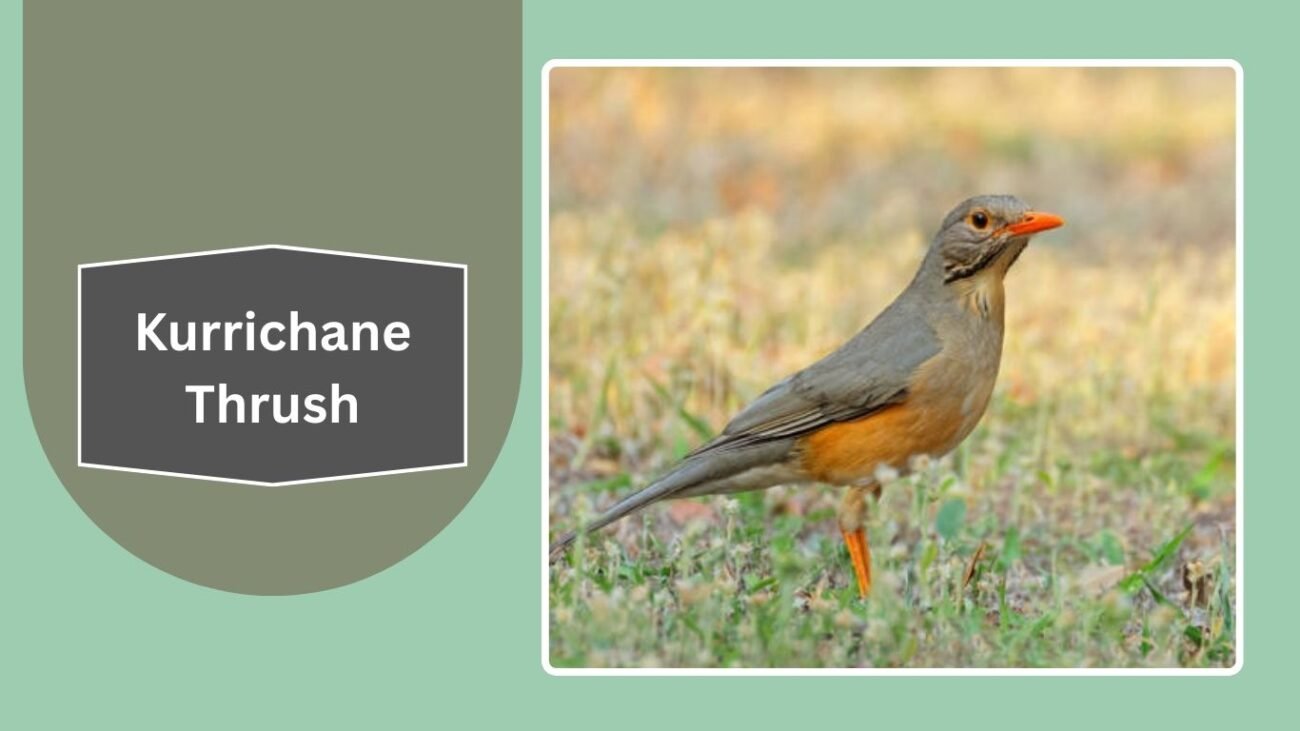
The Kurrichane Thrush (Turdus libonyana) is a smaller African thrush with bright features that make it stand out. Native to southern Africa, it is named after Kurrichane (now Kurichane), a region in South Africa where it was first described.
Identification
- Medium-sized thrush, about 21–23 cm (8–9 in) long
- Gray-brown upperparts with paler underparts
- Bright orange bill, eye ring, and legs
- Subtle spotting on the breast in juveniles, adults usually plain
- Upright stance and slender build
Behavior
Kurrichane Thrushes are often bold and approachable, foraging in gardens, parks, and forest edges. They feed on insects, earthworms, and fruit, hopping actively on the ground in search of food. Their song is clear, melodious, and similar to that of the African Thrush but more varied.
Habitat
They are widespread in southern Africa, including South Africa, Botswana, Zimbabwe, and Mozambique. They prefer woodlands, riverine forests, and suburban areas with tree cover.
Importance
This thrush is valuable in maintaining ecological balance by dispersing fruit seeds and controlling insect numbers. Its presence in gardens and towns also connects people to native African birdlife, making it a culturally familiar species.
24. Olive Thrush
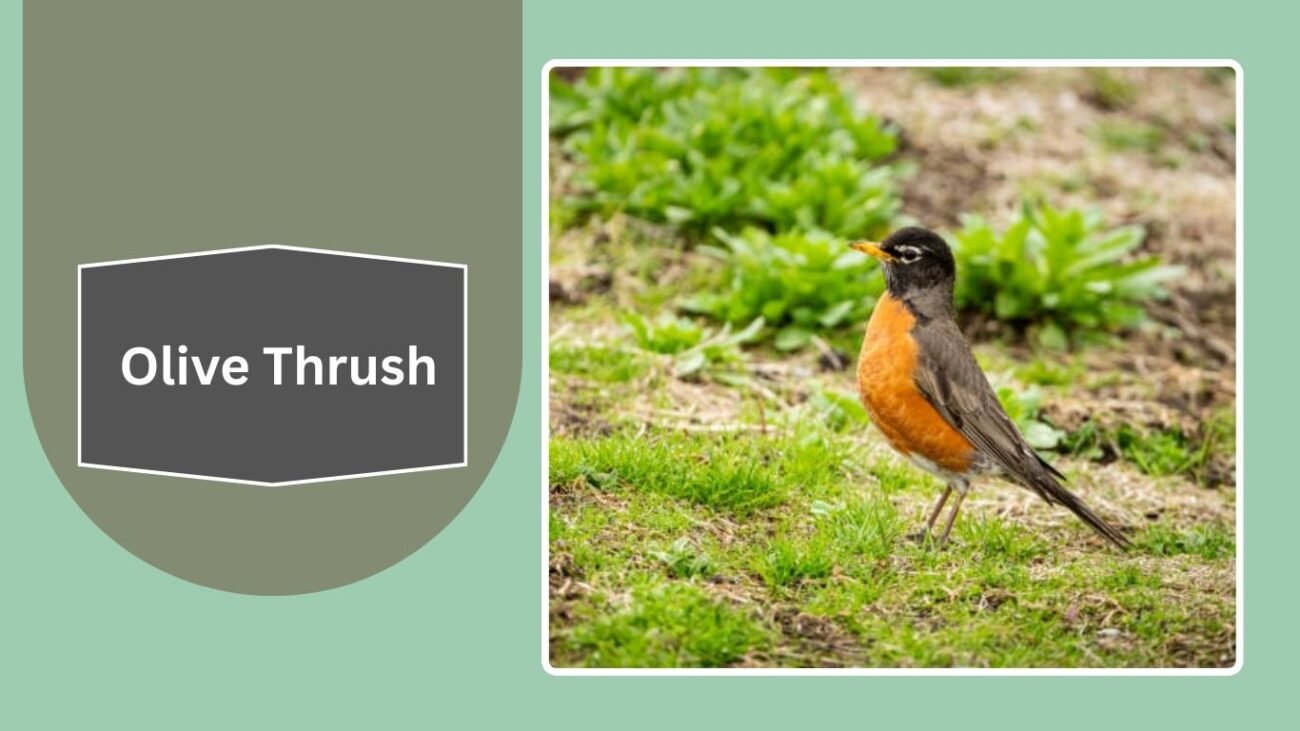
The Olive Thrush (Turdus olivaceus) is one of the most common and widespread thrushes in southern Africa. Its adaptability to both wild and urban environments makes it a familiar garden bird, often seen hopping on lawns or singing from rooftops.
Identification
- Medium-sized thrush, about 24–25 cm (9.5–10 in) long
- Dark olive-brown upperparts and head
- Orange bill and eye ring (brighter in adults)
- Grayish to brownish underparts, with some subspecies showing orange flanks
- Juveniles are mottled and duller in color
Behavior
Olive Thrushes are bold foragers, feeding on insects, snails, earthworms, and fruit. They are often seen in gardens and forest edges, turning over leaf litter in search of prey. Their song is rich and varied, delivered loudly from treetops or rooftops, particularly in the early morning.
Habitat
They inhabit a wide range of environments, including forests, woodlands, gardens, and towns across South Africa, Lesotho, Swaziland, and into East Africa. They are year-round residents rather than long-distance migrants.
Importance
The Olive Thrush is a significant seed disperser, helping maintain the health of native fruiting plants. Its presence in urban areas provides an important link between people and local biodiversity.
25. Groundscraper Thrush
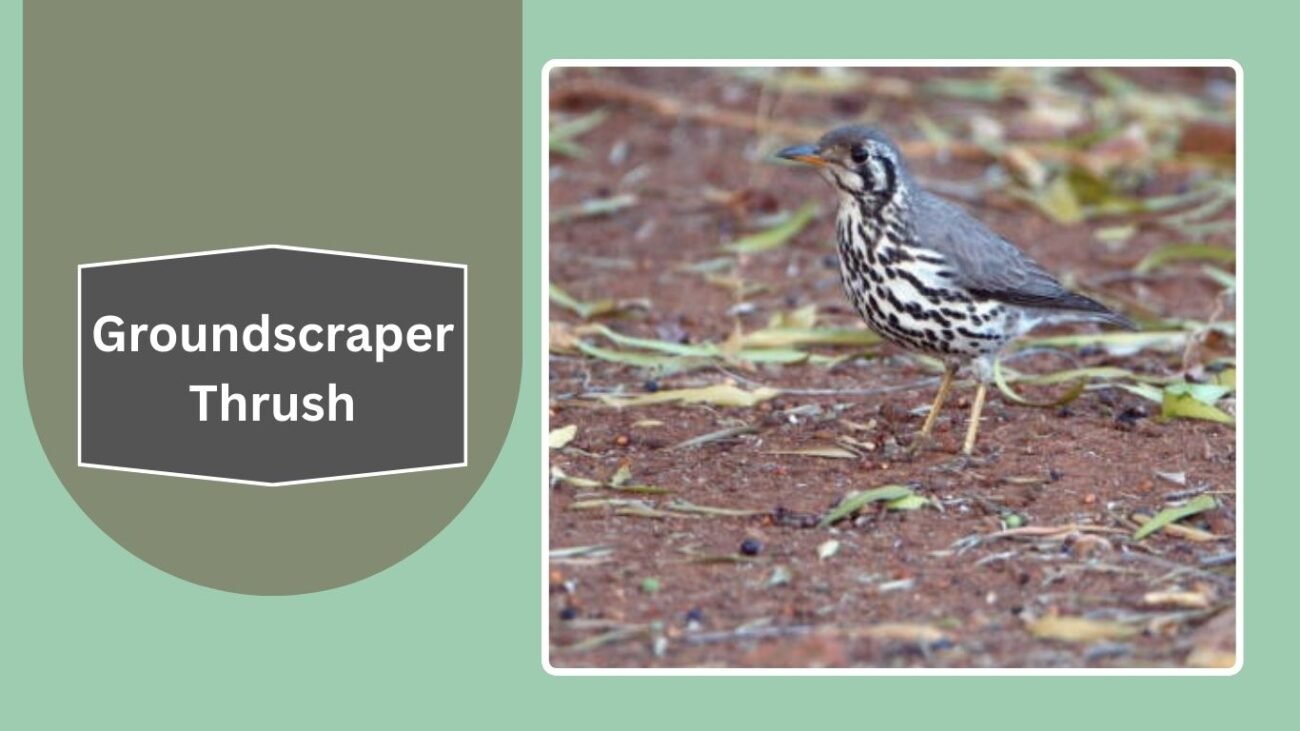
The Groundscraper Thrush (Turdus litsitsirupa) is a unique African thrush, known for its preference for open country and its distinctive ground-based behavior. Unlike many thrushes that seek cover, this species boldly struts across lawns and grasslands in search of food.
Identification
- Medium-sized thrush, about 22–24 cm (8.5–9.5 in) long
- Brownish-gray upperparts with pale underparts
- Bold dark spots scattered across the breast and belly
- White eye ring and yellowish bill
- Strong legs adapted for walking and running
Behavior
Groundscraper Thrushes spend much of their time on the ground, walking briskly while hunting for insects, worms, and small invertebrates. They also eat fruit and seeds. Their song is melodious but not as rich as other thrushes, often delivered from exposed perches.
Habitat
They inhabit open savannas, grasslands, gardens, and farmlands across southern and eastern Africa. Unlike forest-dwelling thrushes, they are well adapted to drier and more open habitats.
Importance
This thrush contributes to natural pest control by feeding on ground-dwelling insects. Its adaptation to open landscapes also makes it a distinctive member of the thrush family in Africa, showcasing the diversity of the group.