










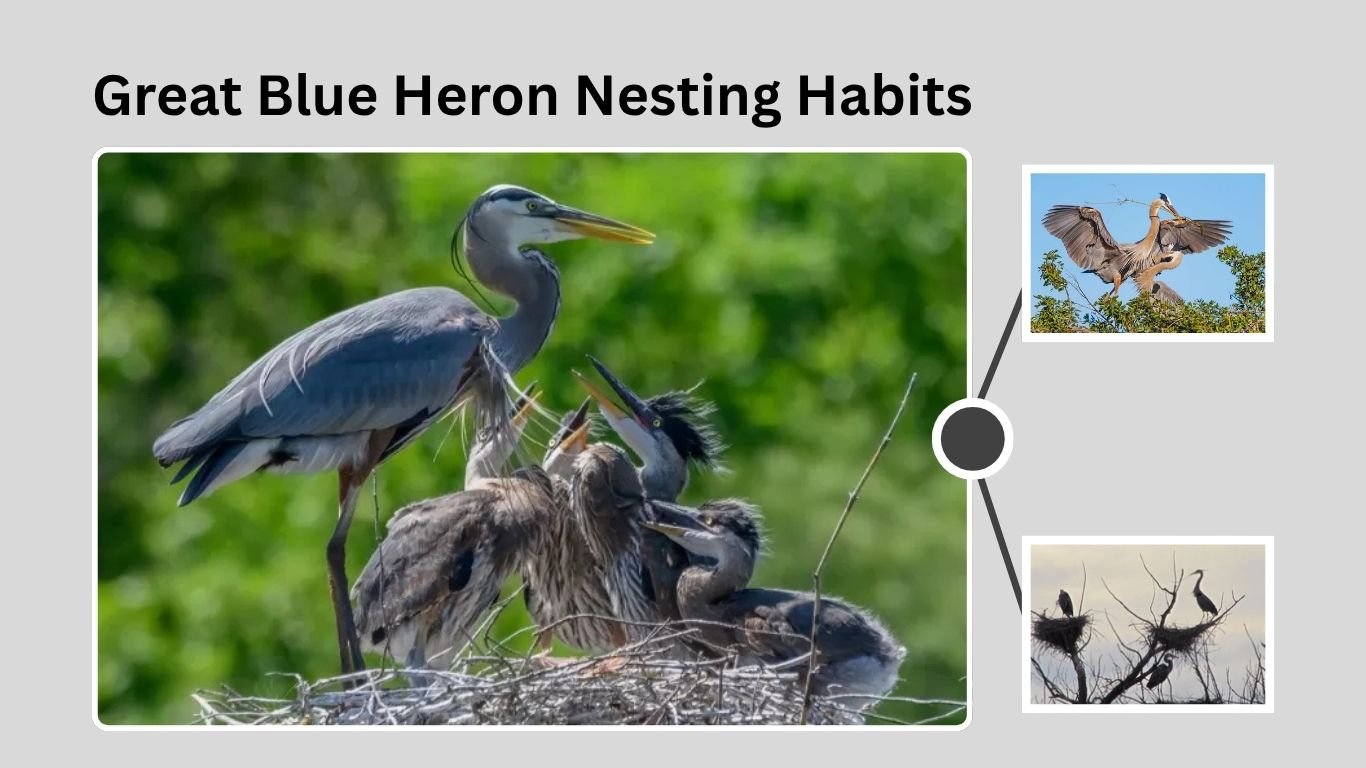
The great blue heron is one of the most striking birds in North America, known not only for its size and grace but also for its fascinating nesting habits. These elegant waders build massive nests high in trees near water, forming colonies called rookeries. Their nesting season reveals remarkable cooperation, precise timing, and a strong instinct to protect their young — traits that make them among the most successful herons in the world.
Identification
Species Overview
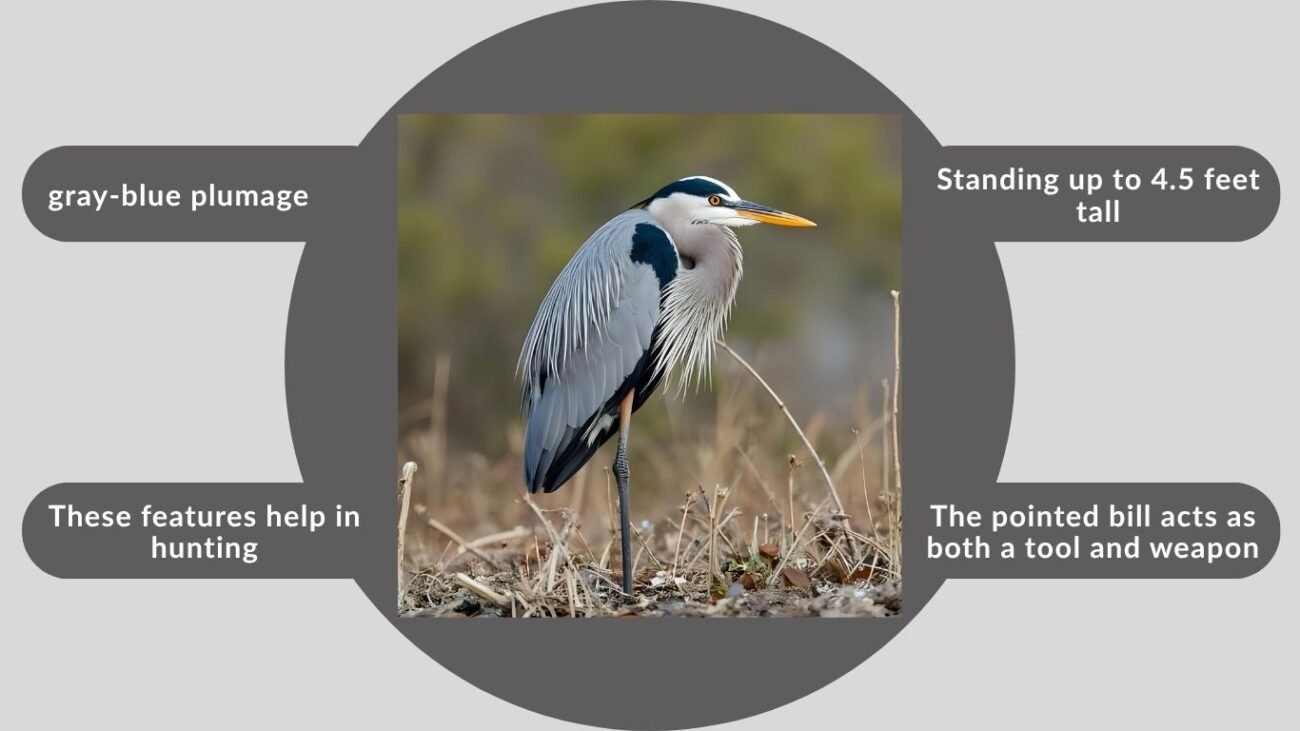
The great blue heron (Ardea herodias) inhabits lakes, rivers, marshes, and coastal regions across North America. Standing up to 4.5 feet tall, it has a long neck, sharp bill, and gray-blue plumage that blends perfectly with reeds and water reflections. These features not only help in hunting but also in nesting, allowing the bird to remain hidden from predators while tending to its eggs and chicks.
Physical Adaptations for Nesting
The heron’s body is built for balance and precision — key traits during nest construction and maintenance. Its long wings carry large twigs and branches to great heights, while strong legs provide stability on swaying tree limbs. The pointed bill acts as both a tool and weapon, used for arranging sticks and defending the nest from intruders.
Nesting Overview

Nesting Definition and Behavior
Great blue herons are colonial nesters, meaning they prefer to breed in groups known as heronries or rookeries. These colonies may consist of just a few pairs or several hundred nests. Each pair constructs its own nest, but the proximity provides safety in numbers. The nests are built primarily of sticks, often 20 to 100 feet above the ground in tall trees close to feeding areas.
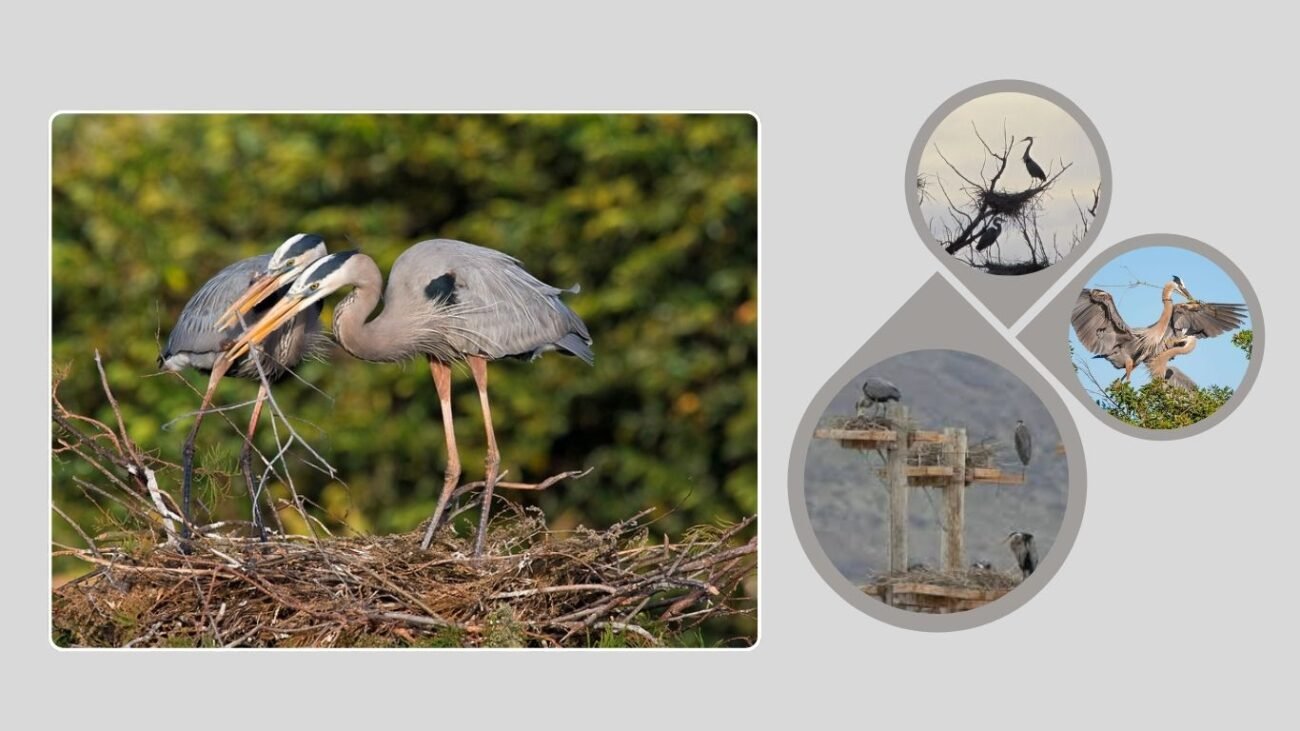
While most herons nest in trees, some colonies use ground sites or artificial platforms, especially where tall trees are scarce. The height offers protection from ground predators such as raccoons and snakes, while the nearby water ensures a constant supply of food for both adults and chicks.
Nesting Materials
Both male and female herons contribute to building. The male gathers sticks, twigs, and reeds, often flying long distances to find suitable materials. The female arranges them carefully, weaving a sturdy platform with a shallow center. The interior is lined with softer materials like leaves, moss, or grasses. In southern regions, Spanish moss is a favorite lining material, creating a cushioned surface for the eggs.
Nesting Season and Timing
General Nesting Season
The nesting season for great blue herons typically begins in late winter or early spring, depending on the region. Males arrive first at traditional nesting sites to claim their spot, often reusing the same nests from previous years. When females arrive, pairs form quickly and begin building or repairing their nests.
Courtship rituals mark the beginning of the nesting season. Males perform elaborate displays, including stretching their necks, snapping their bills, and presenting twigs to females as part of pair bonding. Once bonded, the couple works together to complete the nest within a few days.
Regional Nesting Differences
Because of their wide distribution, great blue herons’ nesting times vary with climate:
| Region | Nesting Start | Notes |
| Florida & Gulf States | January–February | Early start due to warm winters |
| California | February–April | Coastal colonies remain active year-round |
| Midwest (Ohio, Kentucky) | March–May | Nesting begins after ice melt |
| Pacific Northwest (Oregon, Washington) | April–June | Cooler regions have delayed breeding |
| Canada & Northern States | May–July | Shorter nesting window due to late thaw |
This variation ensures that chicks hatch during periods of abundant food supply, giving them the best chance for survival.
Nesting Duration
Once eggs are laid, both parents share incubation duties for about 25 to 30 days. After hatching, chicks remain in the nest for approximately 7 to 8 weeks, cared for and fed by both parents. In regions with mild climates, some herons may raise two broods per year, though one is most common.
Nesting Habitat
Preferred Nesting Sites
Great blue herons choose nesting locations based on three key factors: height, proximity to water, and predator safety. Tall trees along rivers or lakes are ideal because they provide clear visibility and quick access to feeding grounds. Common tree species used for nesting include cypress, cottonwood, pine, and willow.
Herons also exhibit a strong tendency to return to the same nesting colonies year after year. These long-established sites often become multigenerational rookeries, where dozens of pairs build close together, filling the treetops with a symphony of croaks and wingbeats during the nesting season.
Human-Built Nesting Platforms
In areas where natural nesting trees have been lost to logging or development, conservation groups have installed artificial nesting platforms. These elevated structures replicate natural tree height and spacing, helping maintain stable breeding populations. Platforms have been especially successful in Florida, Ontario, and the Pacific Northwest, where human encroachment once threatened traditional nesting sites.
Nest Structure and Size
Nest Construction Process
Nest building begins soon after pair formation. Males deliver sticks to the female, who arranges them into a broad circular platform. Over several days, the structure becomes sturdy enough to hold the adult birds and their clutch of eggs. The nest continues to evolve as the season progresses — parents add sticks and materials to strengthen the base after storms or high winds.
Nest Size and Appearance
A typical great blue heron nest is an impressive structure, measuring 3 to 4 feet across and up to 2 feet deep. Older nests, especially those reused over many years, can become massive, weighing as much as 100 pounds. The outer layers are composed of thick sticks, while the inner lining is soft and insulating.
| Attribute | Measurement | Notes |
| Width | 3–4 feet | Expands with reuse |
| Depth | 1–2 feet | Provides stability for eggs |
| Height (in trees) | 20–100 feet | Offers protection and view |
| Weight | Up to 100 pounds | In multi-year nests |
Ground and Alternative Nests
Although uncommon, great blue herons sometimes build ground nests — particularly on predator-free islands or marsh platforms. These nests tend to be smaller and more vulnerable to environmental hazards like flooding. In such cases, isolation rather than height becomes the primary defense against danger.
Courtship and Mating Behavior
Courtship Rituals
Courtship marks the start of nest building. Males select and defend potential nesting sites, performing visual displays to attract females. These displays include wing spreading, neck stretching, and twig presentation — a behavior that doubles as both attraction and partnership initiation. When a female accepts a twig, it signals the formation of a breeding pair.
Pair Bonding and Cooperation
After pairing, cooperation becomes essential. The male focuses on gathering materials, while the female constructs and shapes the nest. Though great blue herons are monogamous for a single breeding season, they may choose different partners the following year. During incubation, both parents share responsibility for keeping the eggs warm and protected from predators.
Egg Laying and Incubation
Egg Characteristics
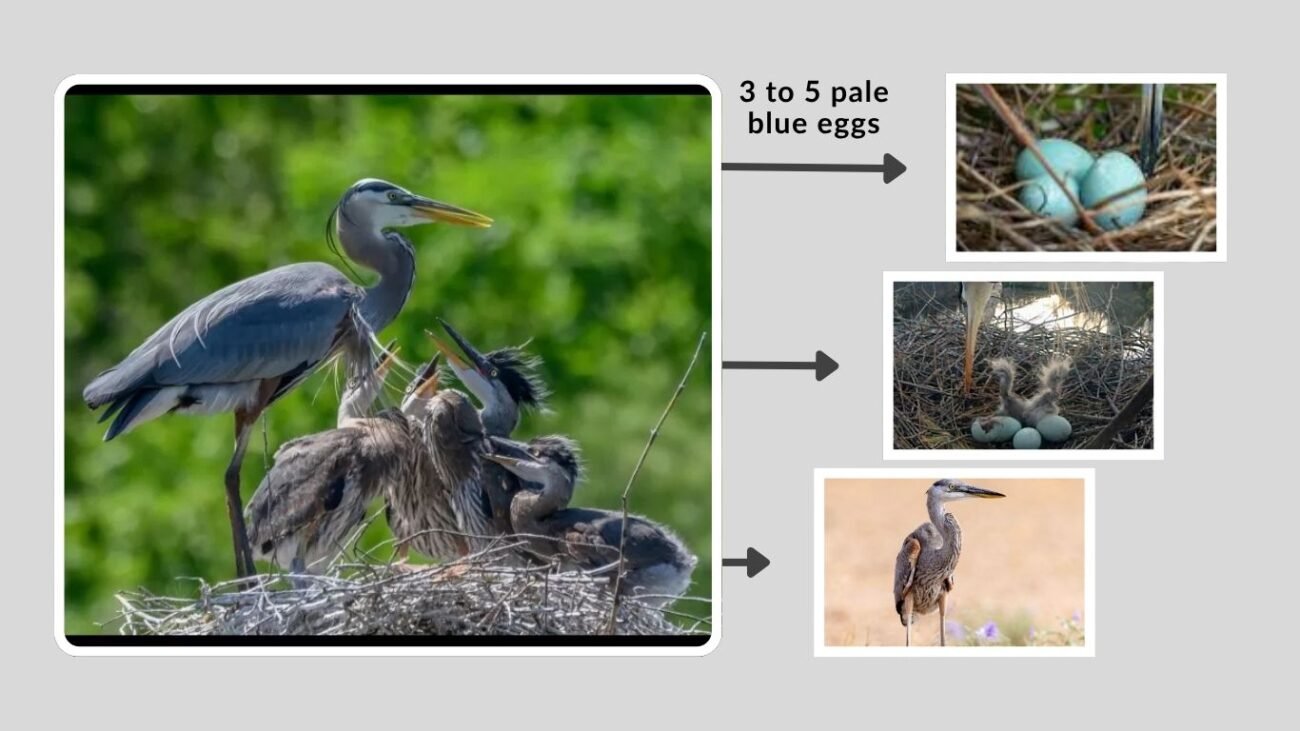
Once the nest is completed, the female begins to lay eggs—typically 3 to 5 pale blue eggs per clutch. Each egg is laid about one to two days apart, ensuring staggered hatching. This spacing gives the older chicks a slight advantage in size and strength, increasing their survival rate during food shortages. The eggs are oval-shaped, smooth, and about two inches long.
Incubation Behavior
Both the male and female share incubation duties equally, alternating throughout the day and night. The incubation period lasts about 25 to 30 days. During this time, one parent remains vigilant at the nest while the other hunts for food. The adults frequently turn the eggs using their bills to ensure even warmth and proper development.
In hot weather, the herons may shade the eggs with their wings, while in cooler climates they use body heat to maintain a stable temperature. Their dedication during this stage is crucial — even brief exposure to harsh elements can be fatal to developing embryos.
Chick Development and Nest Life
Feeding the Chicks
When the chicks hatch, they are covered with soft gray down and have large, dark eyes. Both parents participate in feeding, regurgitating partially digested food directly into the chicks’ throats. During the first few weeks, this feeding occurs several times per day. The diet mainly consists of small fish, tadpoles, and amphibians that are easy for the chicks to swallow.
As the young herons grow stronger, the parents bring larger prey, including small snakes or rodents. Feeding can become competitive, as older chicks often outcompete younger siblings. This natural hierarchy ensures that at least some of the brood survives even if food becomes scarce.
Growth and Fledging
Chicks grow rapidly and begin stretching their wings by the fourth week. By six to seven weeks, their flight feathers have developed, and they start hopping and flapping on the edge of the nest. Around eight weeks, they take their first flight, though they often remain close to the nesting colony for several more weeks while learning to hunt.
Even after fledging, young herons may still depend on their parents for food for a short period. Eventually, they disperse to find feeding territories of their own, marking the start of their independent lives.
Nest Reuse and Maintenance
Many great blue herons return to the same nesting site year after year. Reused nests are often repaired and expanded, becoming enormous over time. Some rookeries have been active for decades, with layers of sticks marking each generation of herons. This long-term reuse also strengthens colony bonds, as birds return to familiar neighbors and safe habitats.
Nesting Colonies (Rookeries)
Colony Characteristics
Nesting colonies, or rookeries, are one of the most remarkable aspects of great blue heron behavior. These colonies can contain dozens to hundreds of nests, often clustered in tall trees above shallow wetlands. Nesting together provides protection — predators are less likely to attack when many vigilant adults are present.
Heron colonies are noisy and active during breeding season. The air is filled with the sounds of croaks, wing flaps, and the constant movement of adults bringing sticks or food. Despite the apparent chaos, each pair maintains a small territory around its nest, defending it aggressively against intruders.
Communication and Defense
Great blue herons rely on body language and vocalizations to communicate. A raised crest, stretched neck, or loud squawk can signal alarm or aggression. Males are particularly protective during the early nesting period, defending both the nest and their mate.
Common predators include eagles, owls, raccoons, and crows, which target eggs and young chicks. Adult herons rely on their sharp bills and group defense behaviors to deter these threats.
Nesting Challenges and Conservation
Threats to Nesting Success
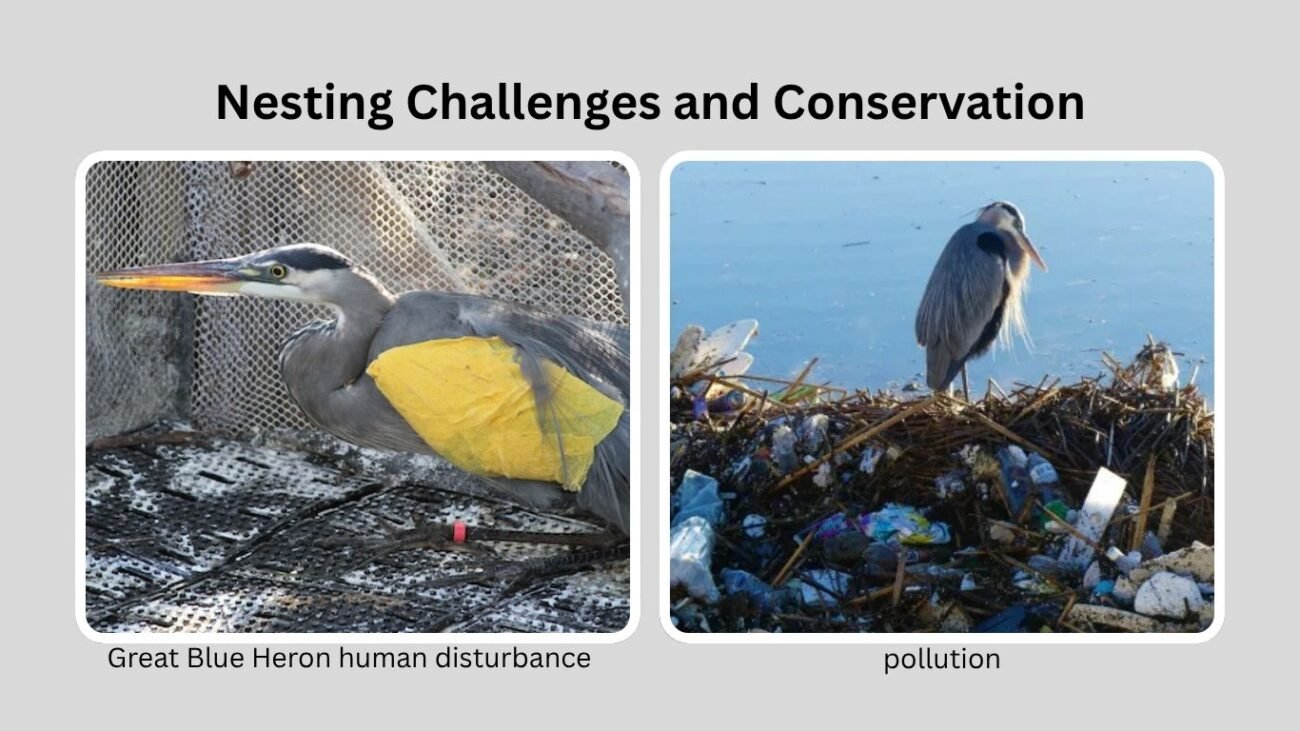
Heron nesting success depends heavily on environmental stability. Habitat loss, pollution, and human disturbance pose major challenges. As wetlands are drained or developed, suitable nesting trees become scarce. Boating and recreational activities near rookeries can also cause stress, leading to nest abandonment.
Severe weather events, such as storms or flooding, often destroy nests or displace entire colonies. In urban areas, herons sometimes attempt to nest on rooftops or utility poles — sites that offer height but not safety.
Conservation Efforts
Conservation groups and wildlife organizations have developed strategies to protect heron nesting sites. The creation of artificial nesting platforms has been especially successful, providing safe elevated areas that mimic natural trees. Protected zones around rookeries, including buffer areas restricting human access, help minimize disturbance.
Live-streamed nest cameras — such as the Cornell Lab of Ornithology’s Sapsucker Woods Heron Cam — have increased public awareness and appreciation for these birds. These cameras allow researchers to study nesting behavior in real time, providing valuable insights for ongoing conservation efforts.
Ecological Importance of Nesting Behavior
The great blue heron’s nesting habits play a vital role in maintaining healthy ecosystems. By nesting near water, herons help control fish, amphibian, and insect populations, keeping ecological balance in check. Their choice of nest locations also indicates the overall health of wetland environments — herons rarely nest where pollution or habitat degradation is high.
As top wetland predators, herons contribute to biodiversity by supporting a complex food web. Protecting their nesting areas ensures the survival of countless other species that share these fragile habitats.
FAQs
Where do great blue herons build their nests?
They typically nest in tall trees near lakes, rivers, or marshes, forming colonies called rookeries. When trees are unavailable, they use cliffs, ground islands, or man-made platforms close to water sources.
When is the great blue heron nesting season?
The nesting season starts in early spring, varying by region. Southern populations, such as those in Florida, may begin as early as January, while northern birds start in April or May as temperatures rise.
Do great blue herons reuse their nests each year?
Yes. Great blue herons often reuse the same nests, reinforcing and expanding them annually. Over time, reused nests can grow several feet wide and weigh more than 100 pounds.
How long do baby herons stay in the nest?
Chicks typically remain in the nest for seven to eight weeks before fledging. During this time, both parents feed and protect them, ensuring they develop strong flight feathers and hunting skills.
Do great blue herons ever nest on the ground?
Rarely. Ground nesting occurs mostly on isolated islands or marshes where predators are few. Elevated tree nests remain the preferred choice for safety and visibility.


