Brown recluse and wolf spiders are often confused because both can be brown, fast-moving, and found around homes. However, they are very different in size, body shape, markings, behavior, danger level, and habitat. A brown recluse is usually smoother, smaller, and more medically concerning, while a wolf spider is usually larger, hairier, and more beneficial as a ground-hunting predator.
Brown Recluse vs Wolf Spider: Quick Comparison
Brown recluse spiders and wolf spiders may look similar at first glance, especially when seen quickly indoors. The easiest way to separate them is to compare body texture, markings, eye pattern, size, and behavior. A wolf spider usually looks stronger and hairier, while a brown recluse looks smoother and more delicate.
| Feature | Brown Recluse | Wolf Spider |
| Body texture | Smooth, little visible hair | Hairy and robust |
| Common size | Smaller, slimmer body | Often larger and bulkier |
| Markings | Violin-shaped mark on front body | Stripes or mottled patterns |
| Eyes | 6 eyes in 3 pairs | 8 eyes in a distinct pattern |
| Web use | Hides in irregular retreats | Hunts without prey-catching webs |
| Bite concern | Can be medically serious | Usually mild unless allergic |
| Behavior | Reclusive, hides in dark places | Active ground hunter |
Main Difference
The main difference is appearance and risk. A brown recluse has a plain brown body, thin legs, and a violin-shaped mark on the cephalothorax. It is also one of the few spiders in North America that can cause medically important bites. A wolf spider is usually larger, hairier, and patterned. It can bite if handled, but it is not considered as dangerous as a brown recluse.
Why They Are Confused
Both spiders can be brown and may enter homes, basements, garages, sheds, and storage areas. People often notice a spider running across the floor and assume it is a brown recluse. In reality, many large brown spiders seen indoors are wolf spiders. The confusion becomes worse because both may avoid people and hide in quiet places.
Identification: How to Tell Them Apart
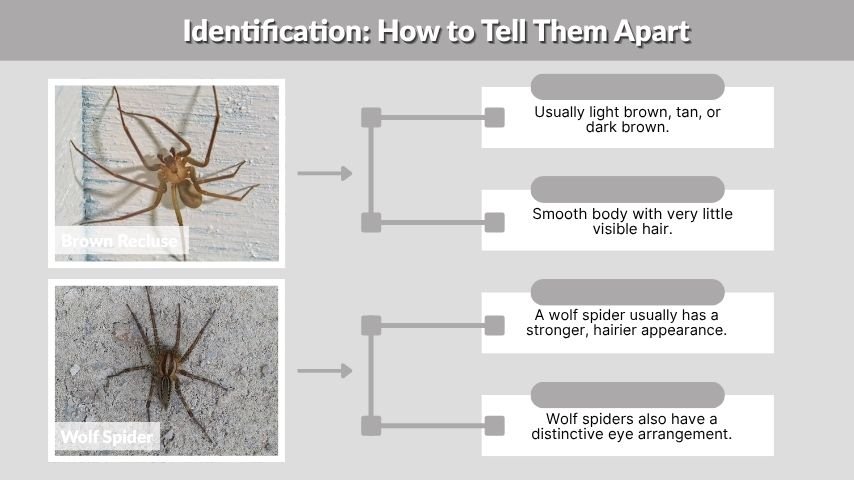
Correct identification matters because a brown recluse bite can require more caution than a wolf spider bite. Size and color are helpful, but they are not enough. The best identification uses several features together, including eyes, markings, body hair, leg shape, and habitat.
Brown Recluse Identification
- Usually light brown, tan, or dark brown.
- Smooth body with very little visible hair.
- Dark violin-shaped marking on the front body section.
- Plain abdomen without bold stripes, spots, or bands.
- Long, thin legs that are usually one solid color.
- Six eyes arranged in three pairs.
- Often found hiding in boxes, shoes, closets, attics, basements, and storage areas.
A brown recluse does not look thick or fuzzy. Its body is more delicate than a wolf spider’s body. The violin mark can help, but it should not be the only feature used because some harmless spiders have dark marks that look similar.
Wolf Spider Identification
A wolf spider usually has a stronger, hairier appearance. Its body may show stripes, mottled brown markings, gray patches, or darker patterns. Many wolf spiders have a bold, earthy camouflage look that helps them blend into soil, leaves, grass, bark, and mulch.
Wolf spiders also have a distinctive eye arrangement. Their eyes are larger and more noticeable than those of many spiders. They are active hunters and do not depend on sticky prey-catching webs. Females may carry an egg sac attached to the spinnerets and later carry spiderlings on their back, which is a strong clue that the spider is a wolf spider.
Size Comparison
Size is one of the most useful clues, but it can also be misleading. A spider’s leg position, movement, and lighting can make it appear larger than it really is. Brown recluse spiders are often smaller than expected, while wolf spiders often appear large and intimidating.
Brown Recluse Size
An adult brown recluse usually has a body length of about ¼ to ½ inch. When the legs are included, it may appear around ¾ inch to 1 inch across. Males can look leggier because their legs appear long compared with the body. Females are often slightly heavier-bodied.
Young brown recluse spiders are much smaller and may be difficult to identify without close inspection. Their markings can be faint, and their color may be lighter than adults. Because of this, small brown spiders should not automatically be identified as brown recluses.
Wolf Spider Size
Wolf spiders range from small to large depending on the species. Many are larger than brown recluse spiders and have thicker bodies. Their hairy legs and robust shape make them look even bigger. Some wolf spiders are small enough to overlap with brown recluse size, but their body texture and markings are usually different.
A wolf spider often looks more muscular, patterned, and ground-dwelling. If the spider is large, fuzzy, striped, and fast, it is more likely to be a wolf spider than a brown recluse.
Body Shape and Markings
Body shape is one of the easiest visual clues when comparing these two spiders. A brown recluse looks smooth and plain, while a wolf spider usually looks textured and patterned. Even if both are brown, the details are very different.
Brown Recluse Markings
The brown recluse is famous for the violin-shaped mark on the cephalothorax. This mark points backward toward the abdomen. However, the mark can be faint on some individuals, and lighting can make it hard to see.
The abdomen is usually plain and oval. It should not have bold stripes, bands, spots, or strong patterns. The legs are also usually plain, without obvious banding. If a spider has heavily striped legs or a patterned abdomen, it is probably not a brown recluse.
Wolf Spider Patterns
Wolf spiders usually have more visible patterns. Their bodies may show dark stripes, pale lines, mottled patches, or camouflage markings. Their legs are often hairy and may appear banded or textured.
They do not have the clean violin mark of a brown recluse. Some may have dark central markings, but the overall body is usually more rugged and patterned. Their hairy body is one of the strongest differences from the smooth-looking brown recluse.
Eye Pattern Differences
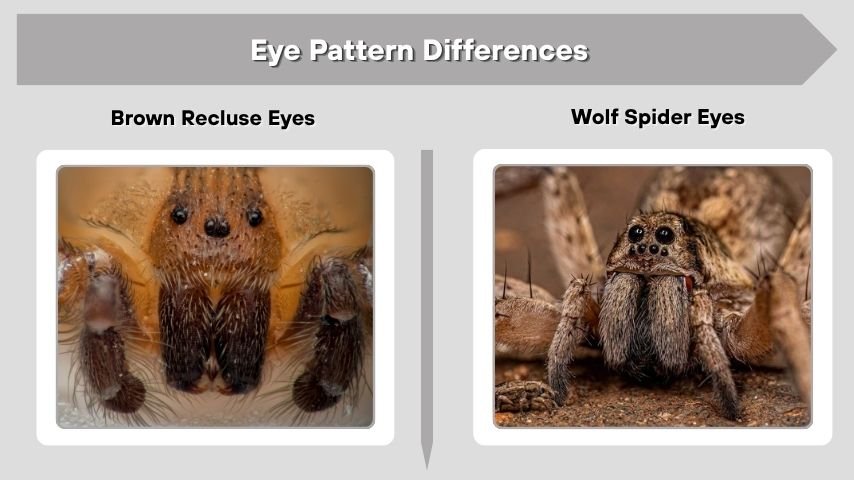
Eye pattern is one of the most reliable ways to separate a brown recluse from a wolf spider. However, it is not always easy to see with the naked eye. A magnifying glass, close-up photo, or expert inspection may be needed.
Brown Recluse Eyes
A brown recluse has six eyes arranged in three pairs. This is unusual because many common spiders have eight eyes. The three pairs are arranged with one pair in front and one pair on each side. This feature is very helpful for confirmation.
Still, most people should not handle a spider just to check its eyes. If identification is important, capture it safely in a container or take a clear close-up photo from a safe distance.
Wolf Spider Eyes
Wolf spiders have eight eyes in a distinctive arrangement. They usually have a lower row of small eyes, two large forward-facing eyes, and another pair above. Their eyes often reflect light at night, which is one reason they are easy to notice with a flashlight.
This eye pattern fits their hunting lifestyle. Wolf spiders rely heavily on vision while moving across the ground in search of prey.
Habitat and Indoor Behavior
Where the spider is found can give useful clues. Brown recluse spiders prefer hidden, undisturbed places. Wolf spiders are wandering hunters and are often seen moving across floors, patios, lawns, mulch, or ground-level areas.
Brown Recluse Habitat
Brown recluse spiders prefer dry, dark, quiet spaces. Indoors, they may hide in cardboard boxes, stored clothes, shoes, bedding, closets, attics, basements, garages, and behind furniture. They are called “recluse” for a reason: they avoid open activity and usually stay hidden during the day.
They may build irregular silk retreats, but they do not make large orb webs or neat web traps. They come out mostly at night to hunt.
Wolf Spider Habitat
Wolf spiders are active ground hunters. Outdoors, they live in grass, leaf litter, mulch, gardens, fields, woodpiles, and under objects. Indoors, they may enter accidentally, especially when weather changes or when they chase prey.
They do not build prey-catching webs. Instead, they run after insects and other small arthropods. Seeing a large brown spider running across a floor often points more toward a wolf spider than a brown recluse.
Bite Comparison
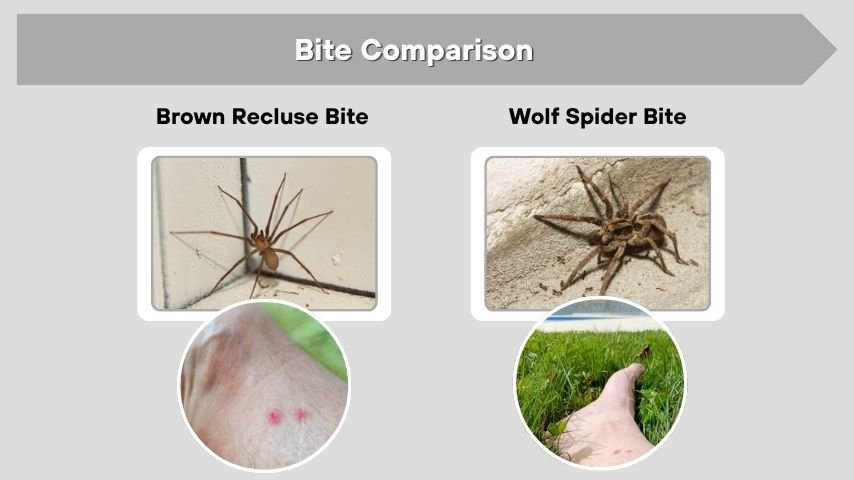
Both spiders can bite, but they do not have the same medical importance. A brown recluse bite can sometimes cause more serious local skin damage. A wolf spider bite is usually less concerning and often causes only temporary pain, redness, or swelling.
Brown Recluse Bite
A brown recluse bite may begin with mild pain, redness, or irritation. In some cases, symptoms can worsen over several hours. A blister, darkened area, or slow-healing sore may develop. Severe reactions are not the most common outcome, but they can happen.
Medical attention is important if the bite area becomes worse, pain increases, skin changes color, a sore expands, or symptoms such as fever, chills, nausea, or weakness appear. Many skin problems are wrongly blamed on brown recluse bites, so proper medical evaluation is better than guessing.
Wolf Spider Bite
A wolf spider bite is usually less serious. It may cause pain, redness, swelling, itching, or mild irritation. Most cases improve with basic care, such as cleaning the area and using a cold compress. However, allergic reactions are possible with any bite or sting.
If swelling spreads, breathing becomes difficult, dizziness occurs, or the bite becomes infected, medical care is needed. A wolf spider bite should not be ignored if symptoms are unusual or worsening.
Brown Recluse vs Wolf Spider in Different States
Location can help with identification because brown recluse spiders are not equally common everywhere. Wolf spiders are widespread and found in many regions, while brown recluse populations are more limited.
Florida, Texas, Missouri, and Michigan
In Missouri and nearby central states, brown recluse spiders are more commonly established. In Texas, some recluse species occur, and wolf spiders are also common. In Florida, many brown spiders are mistaken for brown recluses, but wolf spiders and other look-alikes are often more likely. In Michigan, true brown recluse records are less common, so similar-looking spiders may be misidentified.
A local extension office or pest professional can help confirm a spider if location makes identification uncertain.
Why Range Matters
If a spider is found outside the known brown recluse range, it should not automatically be called a brown recluse. Many harmless spiders can be brown, similar in size, or have dark body markings. Range does not identify a spider by itself, but it helps reduce false alarms.
Wolf spiders are much more widespread, so they are often the more likely explanation for a large, hairy, brown spider found indoors or outdoors.
Which Spider Is More Dangerous?

The brown recluse is more medically important than the wolf spider. Its venom can sometimes cause tissue damage and slow-healing wounds. However, it is not aggressive and usually bites only when trapped against skin.
Risk Level
- Brown recluse bites can sometimes become serious.
- Wolf spider bites are usually mild and temporary.
- Neither spider wants to attack humans.
- Bites often happen when spiders are pressed, trapped, or handled.
- Most brown spiders found indoors are not brown recluses.
- Proper identification is better than panic.
- Medical care is needed for worsening wounds or systemic symptoms.
Which One Should You Worry About?
A confirmed brown recluse deserves more caution, especially in homes where they are established. Stored clothing, bedding, shoes, and boxes should be handled carefully in infested areas. Wolf spiders may look scarier, but they are usually beneficial predators and are not considered highly dangerous.
The safest approach is to avoid handling either spider directly.
How to Safely Deal With Either Spider
You do not need to crush every spider you see. Many spiders help control insects. However, if a spider is in a bedroom, closet, or high-contact area, safe removal is reasonable.
Safe Removal Tips
Use a clear cup or jar to cover the spider, then slide stiff paper underneath and move it outside. Wear gloves when cleaning clutter, moving boxes, or picking up stored clothing. Shake out shoes, towels, and clothes in areas where brown recluses may live.
Seal gaps around doors, windows, baseboards, and utility openings. Reduce clutter in basements, attics, closets, and garages. Sticky traps can help monitor indoor spider activity, especially in storage areas.
When to Call a Professional
Call a pest control professional if you repeatedly find suspected brown recluse spiders indoors, especially in bedrooms or storage spaces. One spider does not always mean an infestation, but repeated sightings may require inspection.
For wolf spiders, prevention usually means reducing outdoor hiding places near the home, sealing entry points, and managing insects that attract them.
FAQs
Is a brown recluse more dangerous than a wolf spider?
Yes, a brown recluse is usually more medically concerning than a wolf spider. Its bite can sometimes cause skin damage, slow healing, or worsening symptoms. Wolf spider bites are usually milder, causing pain, redness, or swelling. However, any bite that worsens or shows infection should be checked by a medical professional.
How can I tell a wolf spider from a brown recluse?
A wolf spider is usually larger, hairier, and more patterned than a brown recluse. Brown recluses are smoother, plainer, and often have a violin-shaped mark on the front body section. Eye pattern is also different: brown recluses have six eyes, while wolf spiders have eight eyes.
Which is bigger, a brown recluse or a wolf spider?
A wolf spider is usually bigger than a brown recluse. Brown recluses often have a body length of about ¼ to ½ inch, while many wolf spiders are bulkier and may grow larger depending on the species. Wolf spiders also look bigger because of their hairy body and thicker legs.
Do wolf spiders and brown recluses live in the same places?
They can both be found around homes, but they prefer different hiding places. Brown recluses like dry, dark, undisturbed indoor areas such as closets, boxes, attics, and basements. Wolf spiders are active hunters often found on the ground, in grass, mulch, leaf litter, garages, and sometimes indoors.
Can a wolf spider bite look like a brown recluse bite?
Sometimes the early symptoms may look similar, such as redness, swelling, or pain. However, bite appearance alone cannot confirm the spider species. Many skin problems are mistaken for spider bites. If the bite area worsens, becomes dark, forms a sore, or causes fever or weakness, seek medical advice.