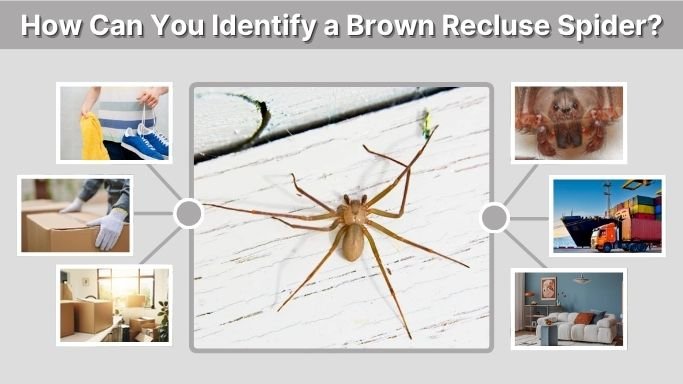
A brown recluse spider can be difficult to identify because many harmless brown spiders look similar. The safest way to recognize one is to check several features together, not just one mark. A true brown recluse usually has a violin-shaped marking on its back, six eyes arranged in three pairs, a plain brown body, smooth-looking legs, and a shy habit of hiding in dark, quiet places. This guide explains the key signs, common mistakes, habitat clues, and safety steps so you can identify a brown recluse spider more confidently.
What Does a Brown Recluse Spider Look Like?
A brown recluse is a small, plain-looking spider with a light brown to dark brown body. It does not look hairy, shiny, or heavily patterned like many other spiders. Its body is usually simple in color, and its legs are long, thin, and evenly colored. The most famous feature is the violin-shaped mark near the front of the body.
Basic Appearance
The brown recluse has two main body parts: the cephalothorax and the abdomen. The cephalothorax is the front section where the legs and eyes are attached. This is also where the dark violin-shaped marking appears. The abdomen is the back section and is usually plain, soft-looking, and oval.
Brown recluses are usually not large spiders. Many adults are around the size of a U.S. quarter when the legs are spread, though size can vary. Because they are small and plain, people often overlook them until they appear in closets, boxes, basements, garages, or storage areas.
Identification
- Body color is usually tan, light brown, or medium brown.
- The body looks plain, not striped or spotted.
- A dark violin-shaped mark appears on the cephalothorax.
- The “neck” of the violin points toward the abdomen.
- It has six eyes, arranged in three pairs.
- Legs are long, thin, and evenly colored.
- Legs do not have strong bands, stripes, or thick spines.
- Abdomen is usually plain and oval-shaped.
- Body has fine hair but does not look fuzzy.
- It often hides instead of staying in open areas.
The Violin Mark on a Brown Recluse
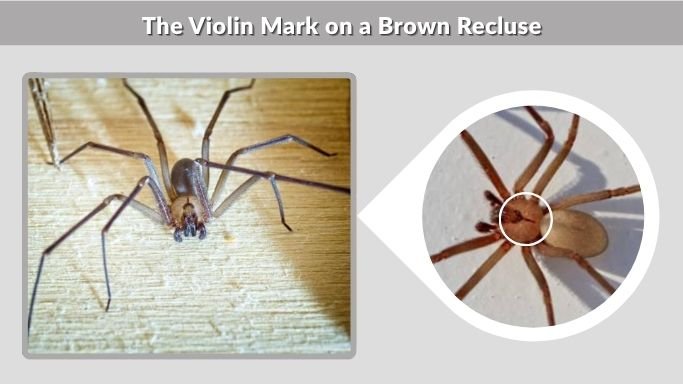
The violin mark is the most talked-about feature of a brown recluse. It is found on the top of the cephalothorax, not on the abdomen. This marking may look like a dark violin, fiddle, or narrow bottle shape. However, this mark alone is not enough for identification because some other spiders also have dark marks on their bodies.
How to Check the Violin Shape
The violin shape is usually darker than the rest of the spider. The wide part of the violin sits near the eyes, while the narrow “neck” points backward toward the abdomen. In a clear view, this feature can help separate a brown recluse from many common house spiders.
However, young brown recluses may have a lighter or less obvious violin mark. Some adults may also have unclear markings depending on lighting, age, or color variation. That is why you should not identify the spider by the violin mark alone.
Why the Violin Mark Can Be Misleading
Many people see any brown spider with a dark mark and assume it is a brown recluse. This is a common mistake. Cellar spiders, wolf spiders, grass spiders, and other house spiders can have markings that look similar from a distance.
A true brown recluse should match several signs together: violin mark, six eyes, plain legs, plain abdomen, correct body shape, and possible location in its known range. If only one feature matches, the spider may not be a brown recluse.
Brown Recluse Eye Pattern
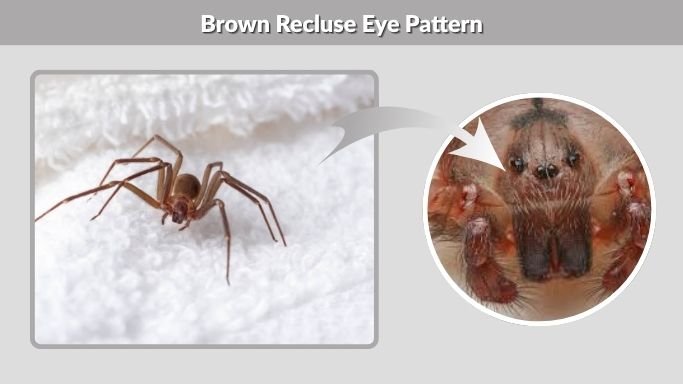
The eye pattern is one of the strongest identification clues. Most spiders have eight eyes, but a brown recluse has six eyes. These six eyes are arranged in three pairs. One pair is in the front, and the other two pairs sit on the sides.
Six Eyes in Three Pairs
The six-eye pattern is very important because it separates brown recluses from many common spiders. If the spider clearly has eight eyes, it is not a brown recluse. The three-pair pattern is often described as a curved arrangement of eye pairs.
The problem is that the eyes are very small. You usually cannot confirm them with the naked eye. A magnifying glass, close-up photo, or microscope may be needed. For most homeowners, it is safer to take a clear photo or capture the spider in a container and ask a local extension office or pest expert for help.
Eye Pattern vs Body Markings
The violin marking is easier to see, but the eye pattern is more reliable. A spider may have a violin-like mark and still not be a brown recluse. But if it has six eyes in the correct three-pair arrangement, the identification becomes much stronger.
Still, you should never handle a suspected brown recluse with bare hands just to check its eyes. Use safe methods, such as a jar and stiff paper, or avoid contact completely.
Brown Recluse Size, Legs, and Body Shape
A brown recluse has a simple body shape. It is not thick and hairy like many wolf spiders. It is not extremely long-legged like a cellar spider. It is not round-bodied like some cobweb spiders. Its overall appearance is flat, plain, and slender.
Body Size
Adult brown recluses are usually small to medium-sized spiders. The body alone is often about 6–12 mm long, while the leg span makes the spider look larger. They are not giant spiders, so a very large brown spider may be something else.
Young brown recluses look smaller and may be harder to identify. Their violin marking may be faint, and their body color may be lighter. This makes eye pattern and habitat clues even more important.
Leg Features
The legs of a brown recluse are usually plain and evenly colored. They do not have strong bands, dark rings, or heavy spines. This is a helpful clue because many brown spider look-alikes have banded legs.
Brown recluse legs are also fairly thin and smooth-looking. They are not extremely hairy. If the spider has thick, spiny, heavily patterned legs, it is probably not a brown recluse.
Quick Brown Recluse Identification Table
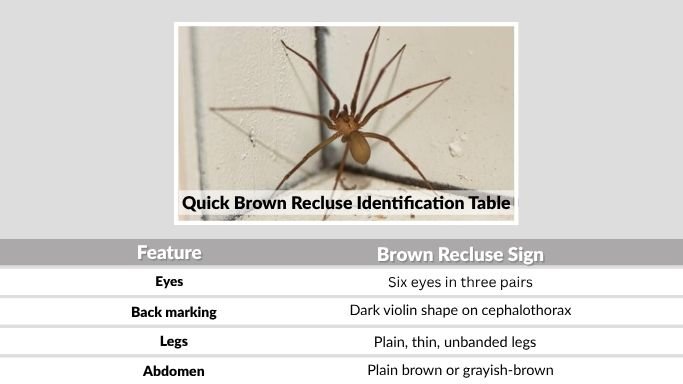
A single feature is not enough to confirm a brown recluse. Use this table to compare the main signs before making a decision.
| Feature | Brown Recluse Sign | What May Mean It Is Not a Brown Recluse |
| Eyes | Six eyes in three pairs | Eight eyes or unclear eye pattern |
| Back marking | Dark violin shape on cephalothorax | Mark on abdomen or random body pattern |
| Legs | Plain, thin, unbanded legs | Striped, ringed, or spiny legs |
| Abdomen | Plain brown or grayish-brown | Spots, stripes, or strong patterns |
| Body texture | Smooth-looking with fine hair | Very fuzzy, shiny, or bulky |
| Behavior | Hides in dark, quiet areas | Stays openly in webs or runs in grass |
| Range | Found in known recluse regions | Found far outside normal range |
Where Brown Recluse Spiders Hide
Brown recluse spiders are named “recluse” because they prefer hidden, quiet places. They are not usually found sitting in the open during the day. They often hide in clutter, boxes, clothing, shoes, furniture, storage rooms, and dark corners.
Indoor Hiding Places
Inside homes, brown recluses prefer dry and undisturbed areas. They may hide in basements, closets, attics, garages, crawl spaces, and storage boxes. They can also hide behind baseboards, under furniture, inside shoes, or between folded clothes.
People are sometimes bitten when they accidentally press the spider against the skin. This can happen when putting on clothing, moving boxes, reaching into storage, or sleeping in an area where spiders are active.
Outdoor Hiding Places
Outside, brown recluses may hide under rocks, logs, bark, boards, and debris. They like protected areas where they can avoid light and disturbance. Around homes, they may live in sheds, woodpiles, stacked materials, and outdoor storage spaces.
Because they are nocturnal hunters, they may move around at night looking for prey. During the day, they usually stay hidden.
Brown Recluse Range and Location
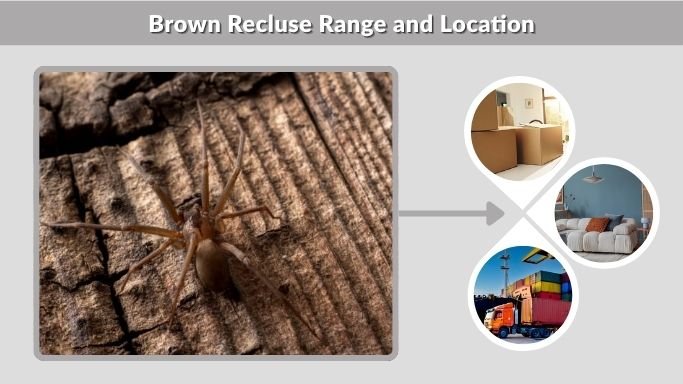
Location is one of the most important clues. Brown recluses are not found everywhere. They are mainly established in the south-central and Midwestern United States. Reports from far outside their usual range are often misidentifications or isolated transported spiders.
Why Range Matters
If you live in an area where brown recluses are common, identification is more realistic. If you live far outside their established range, a random brown spider is more likely to be another species.
This does not mean a brown recluse can never appear outside its range. Spiders can travel in boxes, furniture, or shipments. But long-term established populations are much more limited. Always combine range with physical features before identifying the spider.
Common Range Clues
Brown recluses are often associated with states in the central, south-central, and parts of the Midwest U.S. They are more likely in places such as Missouri, Arkansas, Kansas, Oklahoma, Texas, Tennessee, Kentucky, and nearby areas.
In many northern, coastal, or far western regions, most “brown recluse” sightings turn out to be other brown spiders.
Common Spiders Mistaken for Brown Recluse
Many harmless spiders are mistaken for brown recluses. This happens because people focus only on the brown color or a dark body marking. Careful comparison can prevent unnecessary fear and wrong treatment.
Wolf Spiders
Wolf spiders are often brown and fast-moving. They may be larger than brown recluses and usually have more noticeable body patterns. Their legs are often hairy or banded. They also have eight eyes, not six. Wolf spiders commonly run on floors, lawns, and outdoor surfaces.
Cellar Spiders
Cellar spiders have very long, thin legs and small bodies. They are often found in corners, basements, and garages. Their body shape is very different from a brown recluse. They usually hang in loose webs and do not have the same violin-shaped body pattern.
Grass Spiders
Grass spiders are brown and may enter homes. They often have long spinnerets at the back of the abdomen and visible stripes or patterns. They make funnel-like webs in grass, shrubs, or corners. Their striped body pattern is not like the plain abdomen of a brown recluse.
House Spiders
Common house spiders can be brown, tan, or gray. Many have patterns on the abdomen and live in webs. A brown recluse does not build a neat web for catching flying insects in the same way. It is more of a wandering hunter that uses hidden retreats.
Brown Recluse Web and Behavior
Brown recluses do make silk, but they do not create beautiful round webs like orb-weaver spiders. Their webs are usually irregular, messy, and hidden. You may find them in dark corners, boxes, cracks, or storage areas.
Hunting Behavior
Brown recluses are hunting spiders. They leave their hiding places at night and search for small insects and other prey. During the day, they stay hidden in retreats.
They are not aggressive spiders. They usually avoid people and bite only when trapped or pressed against the skin. This is why bites often happen when a person puts on clothing, handles stored items, or rolls onto a spider in bed.
Signs of Indoor Activity
Possible signs include seeing small plain brown spiders in quiet areas, finding irregular silk retreats in storage spaces, or catching similar spiders on sticky traps. However, sticky traps alone do not confirm a brown recluse unless the spider is properly identified.
If you repeatedly find suspected brown recluses indoors, you may need professional inspection.
How to Safely Check a Suspected Brown Recluse
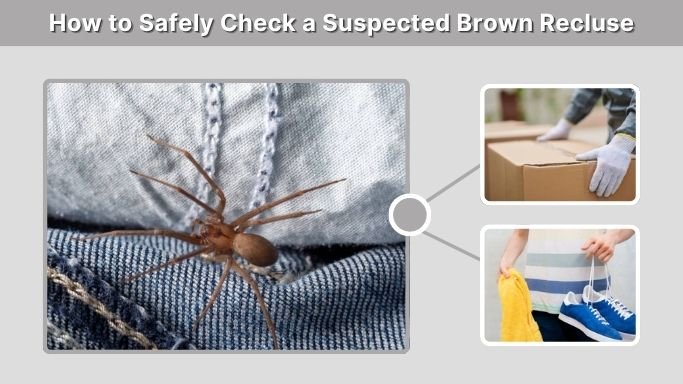
You should never pick up a suspected brown recluse with your hands. Even though they are shy, they can bite if trapped. Use safe methods if you need to inspect or remove one.
Safe Checking Steps
- Do not touch the spider directly.
- Use a clear jar or container to trap it.
- Slide stiff paper or cardboard under the container.
- Take a clear photo from above if possible.
- Avoid crushing the spider if identification is needed.
- Wear gloves when moving boxes, clothing, or stored items.
- Shake out shoes, towels, and clothing in suspected areas.
- Contact a local extension office or pest expert for confirmation.
When to Call a Professional
Call a professional if you see many suspected brown recluses, find them in bedrooms, or notice them in clothing and storage areas. Large indoor populations can be difficult to manage without proper inspection and control.
A professional can identify the spider, locate hiding areas, reduce clutter-related harborage, and suggest safe control methods.
What If You Think You Found a Brown Recluse?
If you think you found a brown recluse, stay calm and avoid direct contact. Most brown spiders are not brown recluses. Focus on careful identification before making a decision.
What to Do First
Capture the spider safely if possible. Place it in a sealed container or take clear photos. Try to photograph the top of the body, the legs, and the eye area if the camera can focus closely.
Do not rely only on color. A spider being brown does not mean it is a brown recluse. Check the violin mark, eye pattern, plain legs, body shape, behavior, and location.
If Someone May Have Been Bitten
If a bite is suspected, wash the area with soap and water, apply a cool compress, and monitor symptoms. Seek medical advice if pain increases, a blister or open sore develops, the wound spreads, or symptoms such as fever, nausea, chills, or weakness appear.
Do not try to cut the wound, use harsh chemicals, or apply unproven home treatments. A healthcare professional can evaluate the bite and rule out infections or other skin problems.
FAQs
How can you identify a brown recluse spider?
You can identify a brown recluse by checking several features together. It usually has a violin-shaped mark on the cephalothorax, six eyes arranged in three pairs, plain brown legs, and a smooth-looking body. It also tends to hide in dark, quiet, undisturbed places.
Is the violin mark enough to identify a brown recluse?
No, the violin mark alone is not enough. Some other spiders have dark markings that can look similar. A better identification uses the violin mark, six-eye pattern, plain unbanded legs, body shape, behavior, and geographic range together.
What color is a brown recluse spider?
A brown recluse is usually tan, light brown, or medium brown. Its body is mostly plain, without bold stripes or spots. The violin-shaped mark is usually darker than the rest of the body and appears on the front body section.
Do brown recluse spiders have eight eyes?
No, brown recluses have six eyes, arranged in three pairs. This is one of their most useful identification features. Most common spiders have eight eyes, so seeing eight eyes means the spider is not a brown recluse.
Where are brown recluse spiders usually found?
Brown recluse spiders are usually found in dark, dry, quiet places. Indoors, they may hide in closets, basements, attics, garages, boxes, shoes, and folded clothes. Outdoors, they may hide under logs, rocks, boards, bark, or debris.