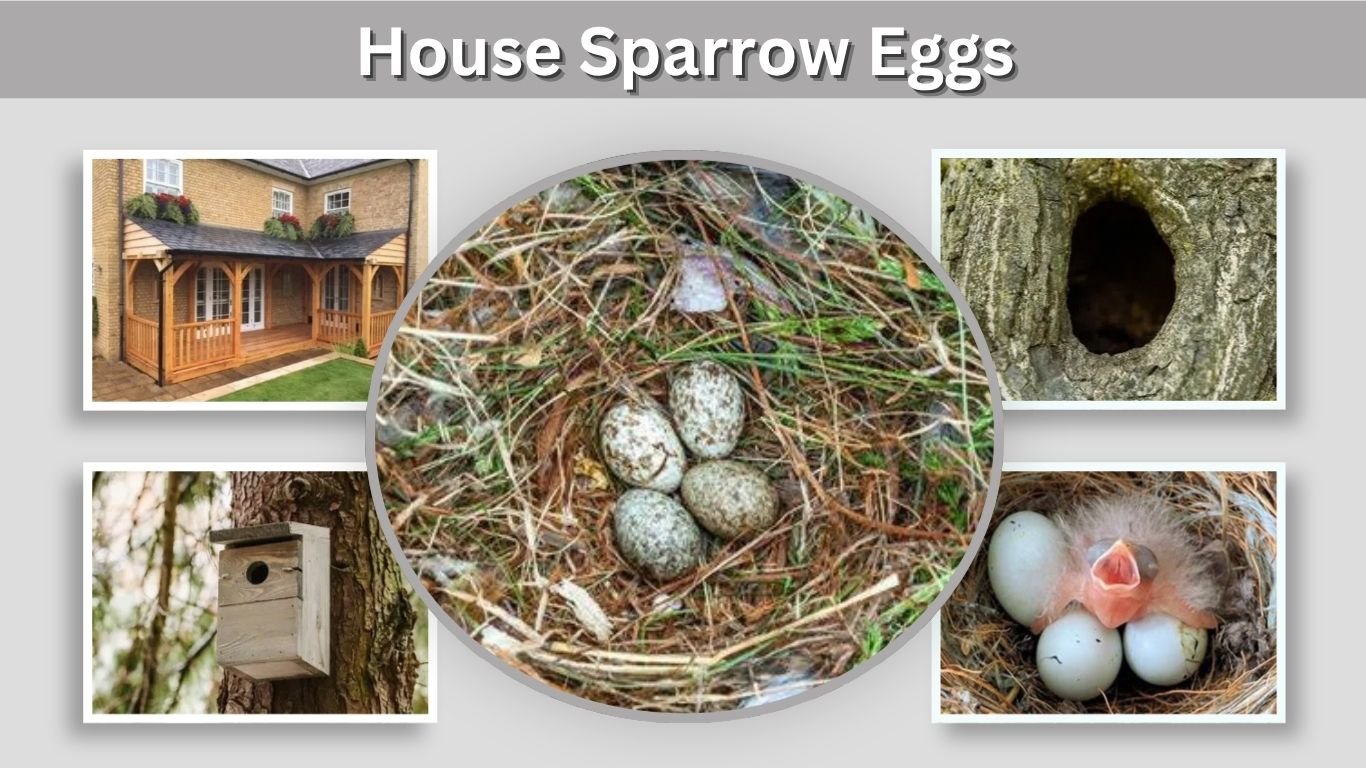
House sparrow eggs are small, pale, and usually marked with gray or brown spots. They are often found in messy nests built inside roof gaps, vents, wall holes, sheds, signs, and nest boxes. If you find eggs in a bulky nest near your home, they may belong to house sparrows. Learning the color, size, hatch time, and identification clues can help you tell house sparrow eggs apart from eggs of bluebirds, wrens, finches, and other small birds.
What Do House Sparrow Eggs Look Like?
House sparrow eggs are usually light-colored with darker speckling. The base color may be whitish, greenish white, bluish white, or pale grayish. The spots are usually gray, brown, or dark brown and may appear heavier toward the larger end of the egg.
Cornell Lab describes house sparrow eggs as light white to greenish white or bluish white, usually spotted with gray or brown. It also lists the egg length as about 0.8–0.9 inch and width as about 0.6 inch.
House Sparrow Egg Identification
Use these clues for house sparrow egg identification:
- Small oval eggs
- Pale white, greenish white, bluish white, or grayish base color
- Brown or gray speckles
- Spots may be heavier near the larger end
- Usually laid in a messy, bulky nest
- Nest often contains grass, straw, feathers, paper, and string
- Often found in roof gaps, eaves, vents, wall cavities, signs, sheds, or nest boxes
- Usually several eggs in one clutch, not just one egg
House sparrow eggs can vary in appearance. Some eggs look heavily speckled, while others may have lighter markings. This variation is normal, so the nest location and nest style are also important for identification.
House Sparrow Egg Color
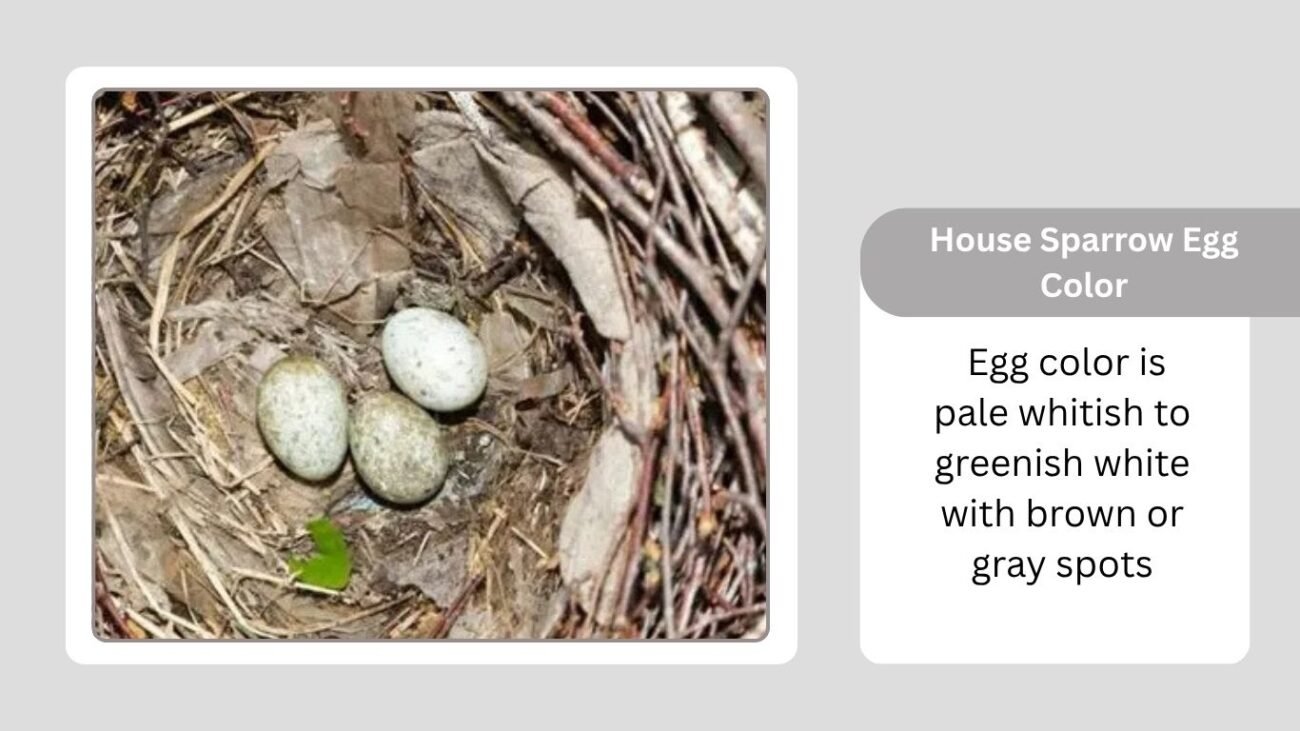
The most common house sparrow egg color is pale whitish to greenish white with brown or gray spots. Some eggs may look bluish white or slightly cream-colored. The spots can be scattered across the shell or concentrated near one end.
Audubon describes house sparrow eggs as whitish to greenish white with brown and gray dots, often concentrated toward the larger end. It also notes that both parents incubate the eggs for 10–14 days.
Why Do House Sparrow Eggs Have Spots?
Spots and speckles help camouflage the eggs inside the nest. House sparrows often nest in cavities, but the markings may still help break up the outline of the eggs. Speckling can also vary between individual females, so not every clutch looks exactly the same.
Egg spots do not always tell you the species by themselves. Many small birds lay spotted eggs. For accurate identification, compare egg color with nest material, nest location, clutch size, and parent birds.
House Sparrow Egg Size
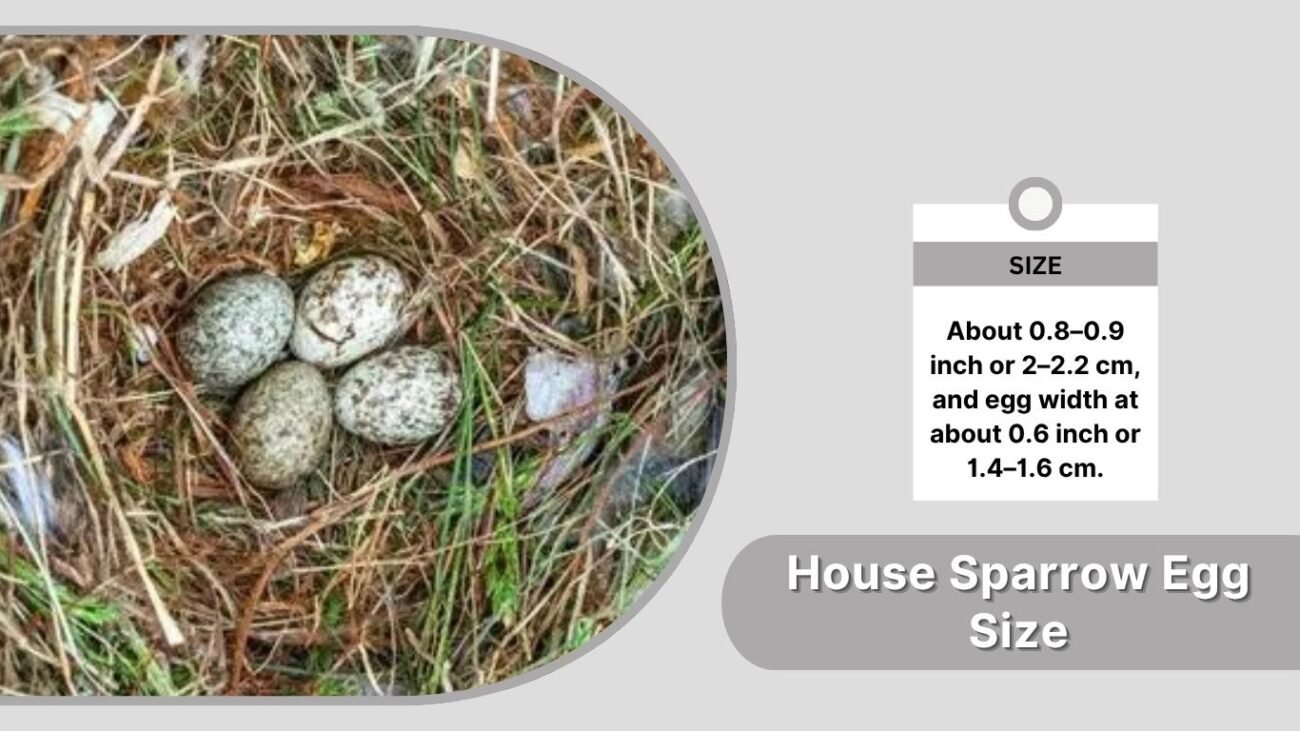
House sparrow eggs are small because house sparrows are small birds. Cornell lists house sparrow egg length at about 0.8–0.9 inch or 2–2.2 cm, and egg width at about 0.6 inch or 1.4–1.6 cm.
| Feature | House Sparrow Egg |
|---|---|
| Length | About 0.8–0.9 inch |
| Width | About 0.6 inch |
| Shape | Small oval |
| Base color | Whitish, greenish white, or bluish white |
| Markings | Brown or gray spots |
| Incubation | Usually 10–14 days |
Are House Sparrow Eggs Bigger Than Finch Eggs?
House sparrow eggs are similar in size to many small songbird eggs, but they are often a little larger than some finch eggs. However, size alone is not the safest way to identify them. A house finch nest, for example, is usually a neater cup, while a house sparrow nest is often messier and stuffed into a cavity.
How Many Eggs Do House Sparrows Lay?
House sparrows usually lay several eggs per clutch. Cornell lists the clutch size as 1–8 eggs, while Audubon says house sparrows usually lay 3–6 eggs, sometimes 2–7 and rarely 1–8.
In many backyard nests, a typical clutch may contain 3–5 eggs. NestWatch lists house sparrows with a common clutch size of 3–5 eggs and an incubation period around 13 days in its common species nesting chart.
Do House Sparrows Lay More Than One Brood?
Yes, house sparrows can raise multiple broods in one breeding season. Cornell lists 1–4 broods per year. This means the same pair may nest, lay eggs, raise chicks, and then use the same nest or site again later in the season.
Because they can produce several broods, house sparrows may be very persistent around buildings, vents, roof gaps, and nest boxes.
House Sparrow Eggs Hatch Time
House sparrow eggs usually hatch after about 10–14 days of incubation. In many cases, the average hatch time is close to 13 days. Both parents may help with incubation, although the female often does more of the sitting.
The hatch time begins after incubation becomes regular. Some birds do not sit tightly on the first egg immediately, so eggs in the same nest may hatch close together rather than on separate days.
How Long Do House Sparrow Eggs Take to Hatch?
House sparrow eggs take about 10–14 days to hatch. If eggs have been in a nest for longer than two weeks without hatching, they may be infertile, abandoned, chilled, or delayed because incubation started later than expected.
Avoid touching or moving eggs just to check them. Disturbing a nest can stress the birds and may cause abandonment, especially if the nest is already in a risky location.
What Happens After House Sparrow Eggs Hatch?
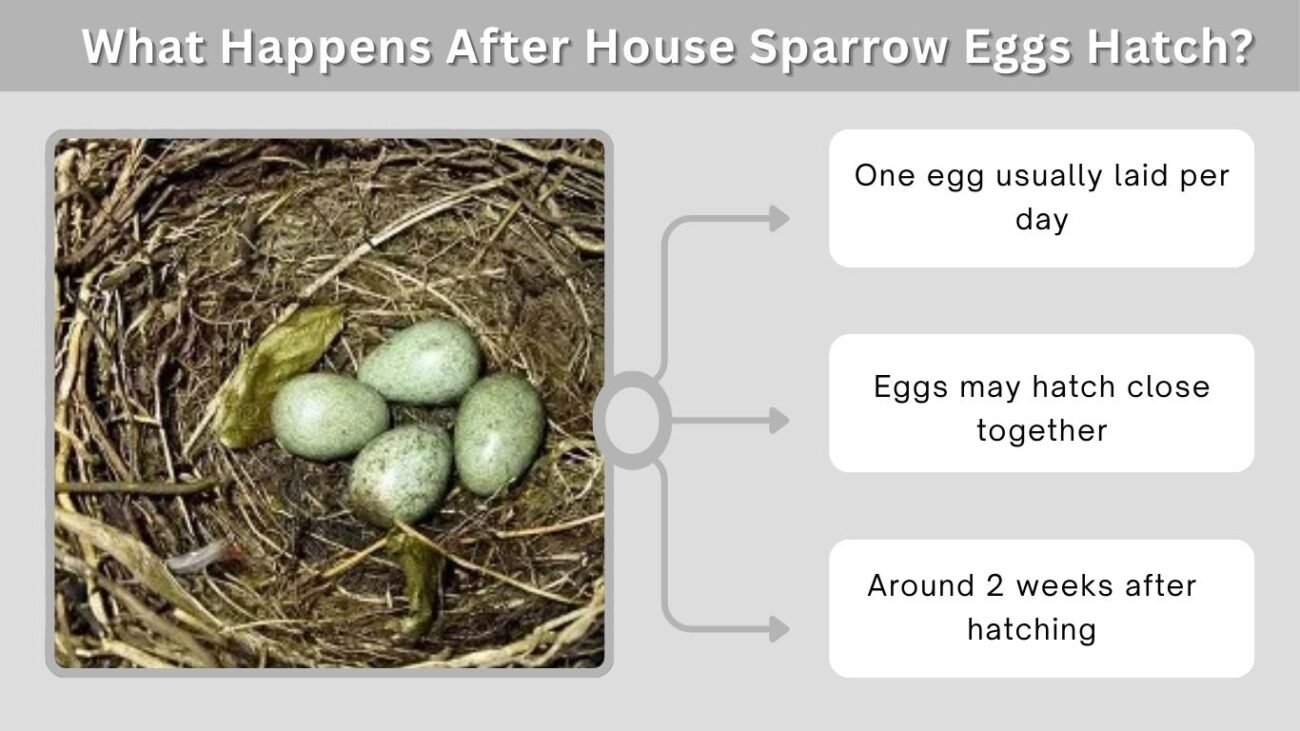
When house sparrow eggs hatch, the chicks are helpless. They are born naked, pink-skinned, with closed eyes. Cornell describes newly hatched house sparrows as entirely naked with bright pink skin, closed eyes, and clumsy condition.
Both parents feed the nestlings. The young remain in the nest for about 10–14 days, according to Cornell, while Audubon says young leave the nest about two weeks after hatching.
House Sparrow Nestling Timeline
| Stage | Approximate Time |
|---|---|
| Egg laying | One egg usually laid per day |
| Incubation | About 10–14 days |
| Hatching | Eggs may hatch close together |
| Nestling period | About 10–14 days |
| Fledging | Around 2 weeks after hatching |
After fledging, young sparrows may still be fed by their parents for a short time while they learn to fly well and find food.
House Sparrow Eggs and Nest
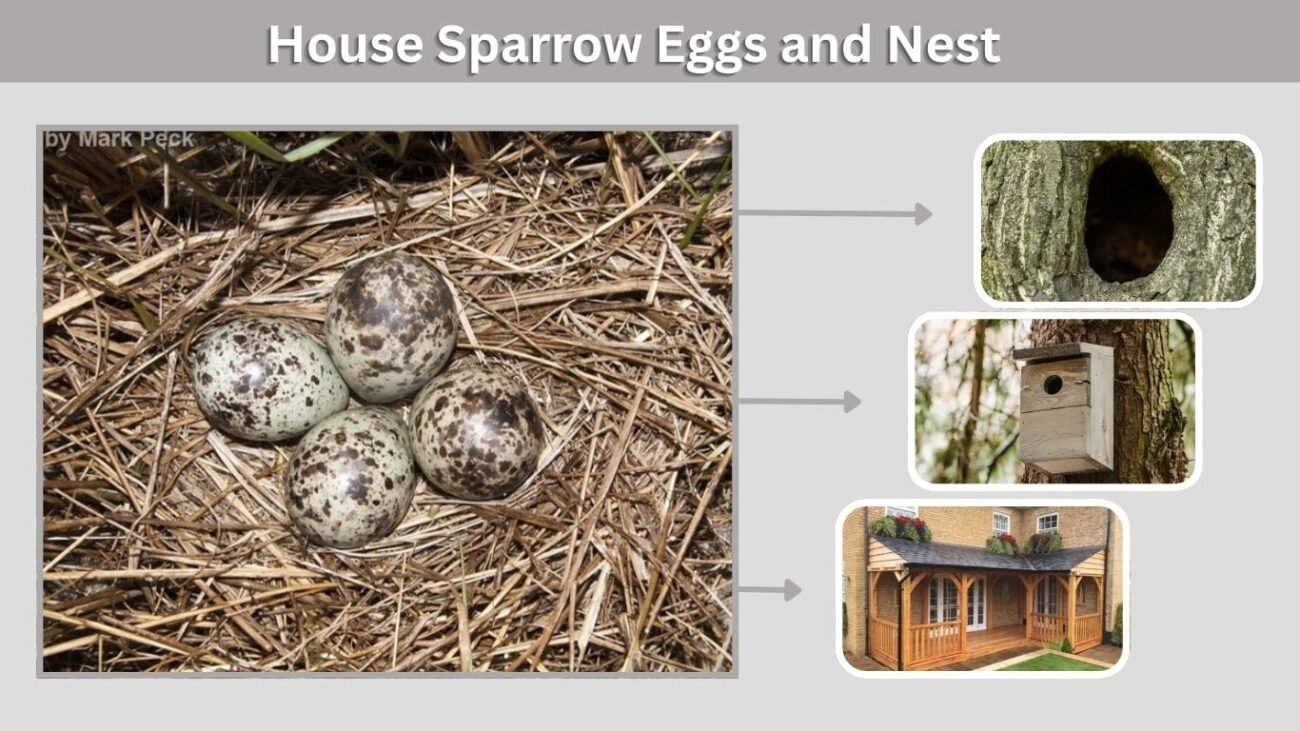
House sparrow eggs are usually found in a messy, bulky nest. The nest is often made from coarse dry vegetation, grass, straw, feathers, paper, string, cloth fibers, and other debris. House sparrows often stuff these materials into cavities, filling much of the space.
Common places to find house sparrow eggs include:
- Roof gaps
- Eaves
- Wall cavities
- Attic openings
- Dryer vents
- Store signs
- Sheds and barns
- Porch corners
- Tree holes
- Nest boxes
House sparrows are strongly connected with human buildings and often nest close to people. If you find spotted eggs in a messy nest inside a building gap or birdhouse, house sparrows are one possible identification.
House Sparrow Eggs vs Bluebird Eggs
House sparrow eggs and bluebird eggs can appear in nest boxes, but they usually look different. Bluebird eggs are often pale blue and usually unspotted, though some may be white. House sparrow eggs are typically whitish, greenish white, or bluish white with brown or gray spots.
| Feature | House Sparrow Eggs | Bluebird Eggs |
|---|---|---|
| Color | Whitish, greenish white, bluish white | |
| Markings | Brown or gray spots | |
| Nest style | Messy, bulky, often stuffed | |
| Bluebird egg color | Usually pale blue | |
| Bluebird nest style | Neater grass or pine needle cup |
House sparrows may take over bluebird boxes. If you manage birdhouses for native birds, learning the difference between house sparrow eggs and bluebird eggs is important.
House Sparrow Eggs vs House Finch Eggs
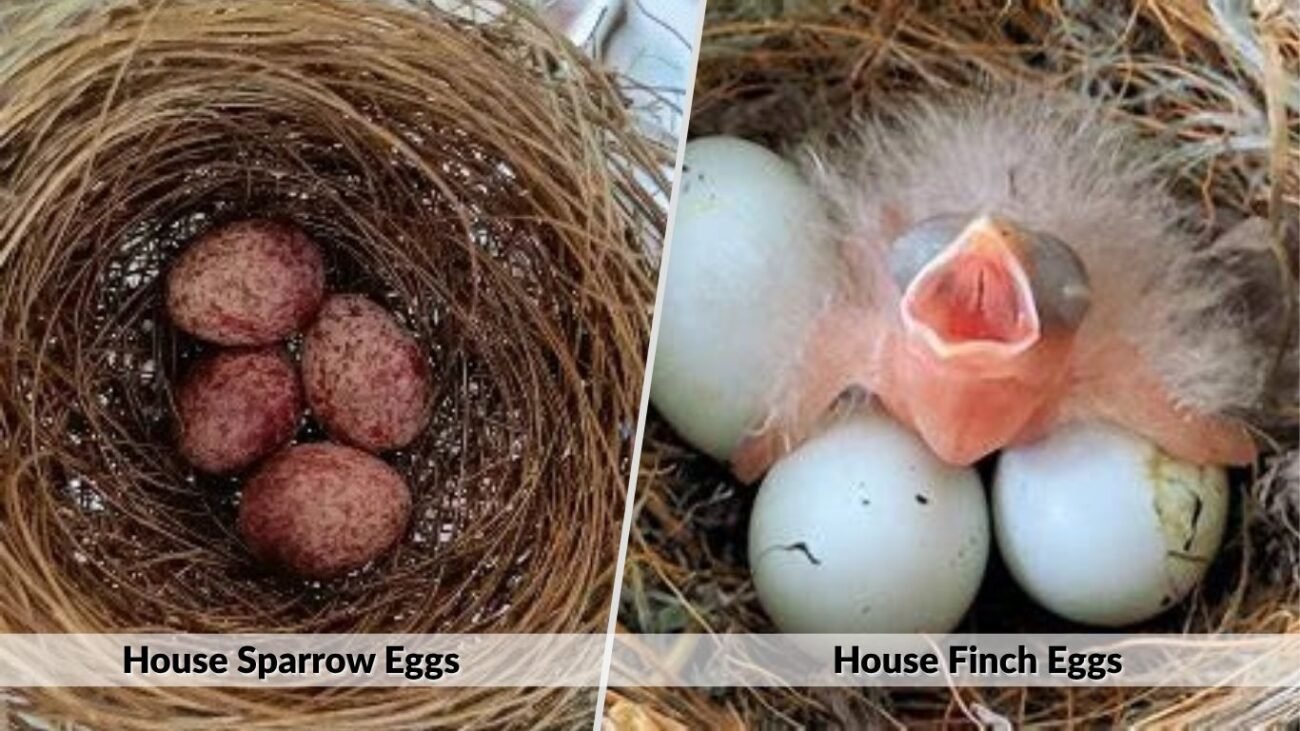
House finch eggs are often pale blue or bluish white with fine dark speckles, mostly near the larger end. House sparrow eggs may look more grayish, greenish, or whitish and are often more heavily spotted. However, egg appearance can overlap.
The nest is often the better clue. House finches usually build a neat cup-shaped nest in ledges, hanging plants, wreaths, or sheltered places. House sparrows usually build a messier, bulkier nest in cavities, holes, and nest boxes.
Can You Move House Sparrow Eggs?
Moving house sparrow eggs is usually not recommended. Eggs are fragile, and parent birds may not accept a moved nest. In many places, bird nests and eggs are protected by law, though legal status can vary by species and country.
In the United States, House Sparrows are non-native and are not protected under the federal Migratory Bird Treaty Act, according to NestWatch. However, many native bird nests are protected, so you should be certain of the species before taking action.
If eggs are inside a dangerous place, such as a vent or machinery area, contact a local wildlife rehabilitator, extension service, or pest/wildlife professional for guidance.
Should You Remove House Sparrow Eggs?
Whether you should remove house sparrow eggs depends on your location, local rules, and the situation. In nest boxes managed for native birds, some bird monitors remove or manage house sparrow nests because house sparrows can compete aggressively with native cavity-nesting birds.
However, if you are not sure the eggs belong to house sparrows, do not remove them. Many native birds lay small spotted eggs, and mistakes can harm protected species.
When Removal May Be Considered
Removal may be considered when:
- The nest is confirmed as house sparrow
- Local laws allow removal
- The nest is in a dangerous vent or building space
- The nest is threatening native birds in a managed box
- The nest is inactive and causing blockage or damage
Never seal a hole or vent while birds, eggs, or chicks may be inside. Wait until the site is inactive or get professional help.
FAQs
What color are house sparrow eggs?
House sparrow eggs are usually whitish, greenish white, bluish white, or pale grayish. They commonly have brown or gray spots, and the markings may be heavier near the larger end of the egg.
How big are house sparrow eggs?
House sparrow eggs are about 0.8–0.9 inch long and around 0.6 inch wide. In metric measurements, they are roughly 2–2.2 cm long and 1.4–1.6 cm wide.
How long do house sparrow eggs take to hatch?
House sparrow eggs usually hatch after about 10–14 days of incubation. The average is often close to 13 days, but timing can vary depending on temperature, incubation behavior, and whether the eggs are fertile.
How many eggs do house sparrows lay?
House sparrows usually lay 3–6 eggs, though clutch size can range from 1–8 eggs. They may raise multiple broods in one season, especially in areas with good food and safe nesting places.
What do baby house sparrows look like when they hatch?
Newly hatched house sparrows are naked, pink-skinned, helpless, and have closed eyes. They depend completely on their parents for warmth and food until they grow feathers and leave the nest about two weeks later.