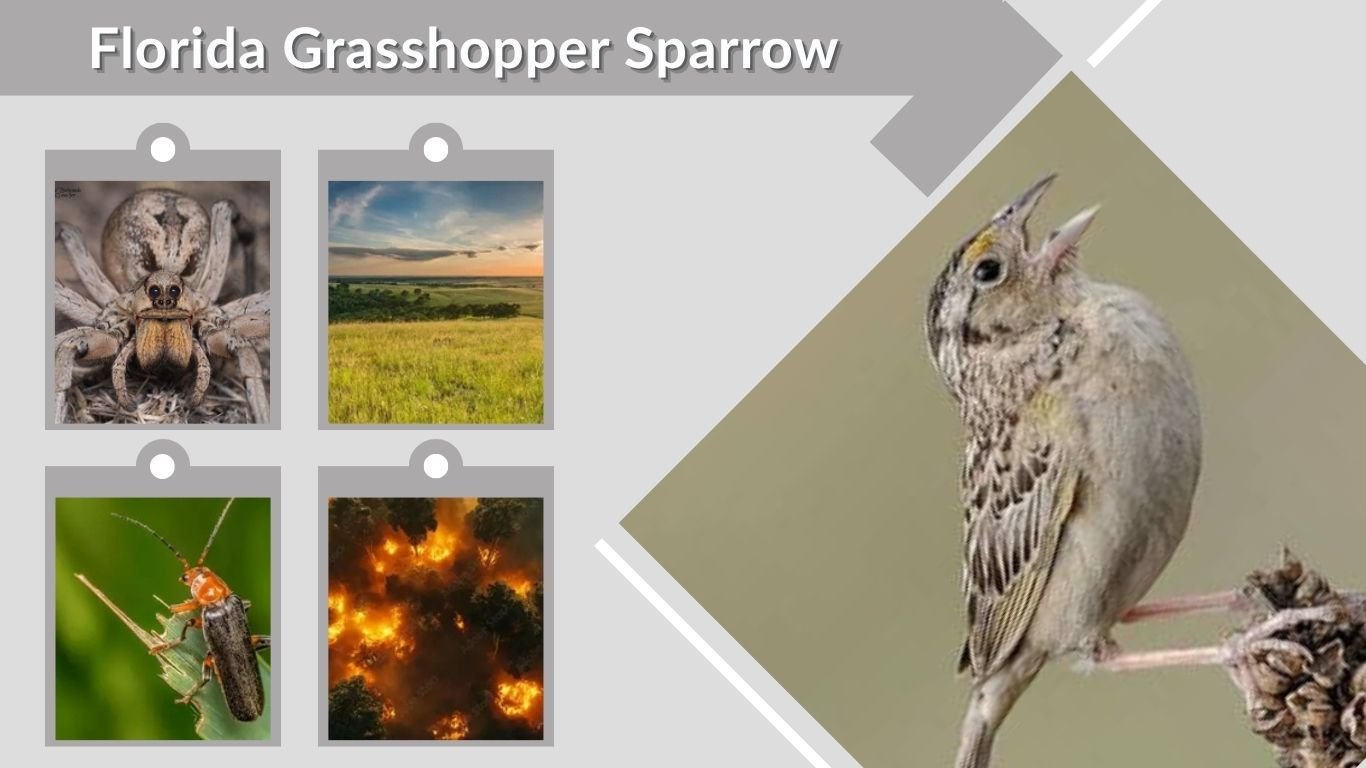
The Florida grasshopper sparrow is a tiny, secretive songbird found nowhere outside Florida’s dry prairies. Known for its insect-like song and ground-dwelling habits, this rare bird has become a major focus of conservation work. Habitat loss, flooding, nest predators, and its restricted range brought the subspecies dangerously close to extinction. Captive breeding and release programs have since provided new hope, although the Florida grasshopper sparrow remains federally endangered and requires intensive protection to survive.
Florida Grasshopper Sparrow Facts
The Florida grasshopper sparrow is one of several geographic forms of the grasshopper sparrow. It is a permanent Florida resident rather than a seasonal visitor.
| Feature | Information |
| Common name | Florida grasshopper sparrow |
| Scientific name | Ammodramus savannarum floridanus |
| Federal status | Endangered |
| Length | About 5 inches |
| Wingspan | About 8 inches |
| Primary habitat | Treeless dry prairie |
| Diet | Insects and seeds |
| Nest location | On the ground |
| Typical clutch | 3–5 eggs |
| Migration | Non-migratory |
The Florida Fish and Wildlife Conservation Commission classifies it as a native, imperiled subspecies. It received Florida endangered status in 1977 and federal protection under the Endangered Species Act in 1986.
Florida Grasshopper Sparrow Identification
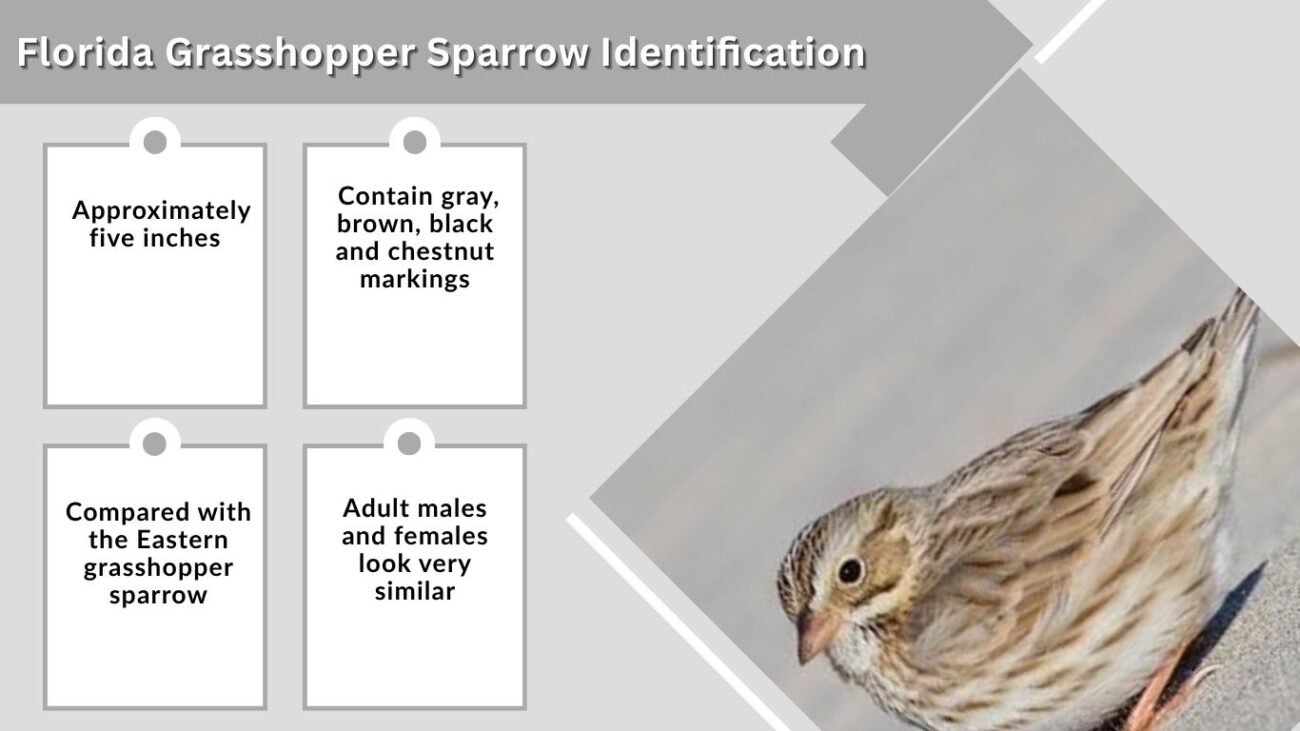
Florida grasshopper sparrows are small, short-tailed birds whose patterned feathers blend almost perfectly with prairie grasses. Because they spend much of their time near the ground, they are usually heard before they are seen.
Size and body shape
An adult reaches approximately five inches in length and has a wingspan of about eight inches. It has a relatively large head, short tail, thick bill and compact body. The crown appears flattened and displays a narrow pale stripe through its center.
Colors and markings
The upperparts contain gray, brown, black and chestnut markings, while the breast is light brown or buff and mostly unstreaked. Yellow-orange coloring may appear between the eye and bill and near the bend of the wing.
Compared with the Eastern grasshopper sparrow, the Florida subspecies generally has darker, grayer plumage. However, FWC notes that reliably distinguishing the two forms can be difficult, even when birds are examined closely during periods of seasonal range overlap.
Male, female and juvenile appearance
Adult males and females look very similar, so plumage alone is usually insufficient for determining sex. Males are more noticeable during the breeding season because they sing from exposed grasses and low shrubs.
Juveniles generally show more streaking than adults. A baby Florida grasshopper sparrow develops quickly and leaves its ground nest when only about eight days old, although its parents continue feeding it afterward.
Florida Grasshopper Sparrow Habitat and Range
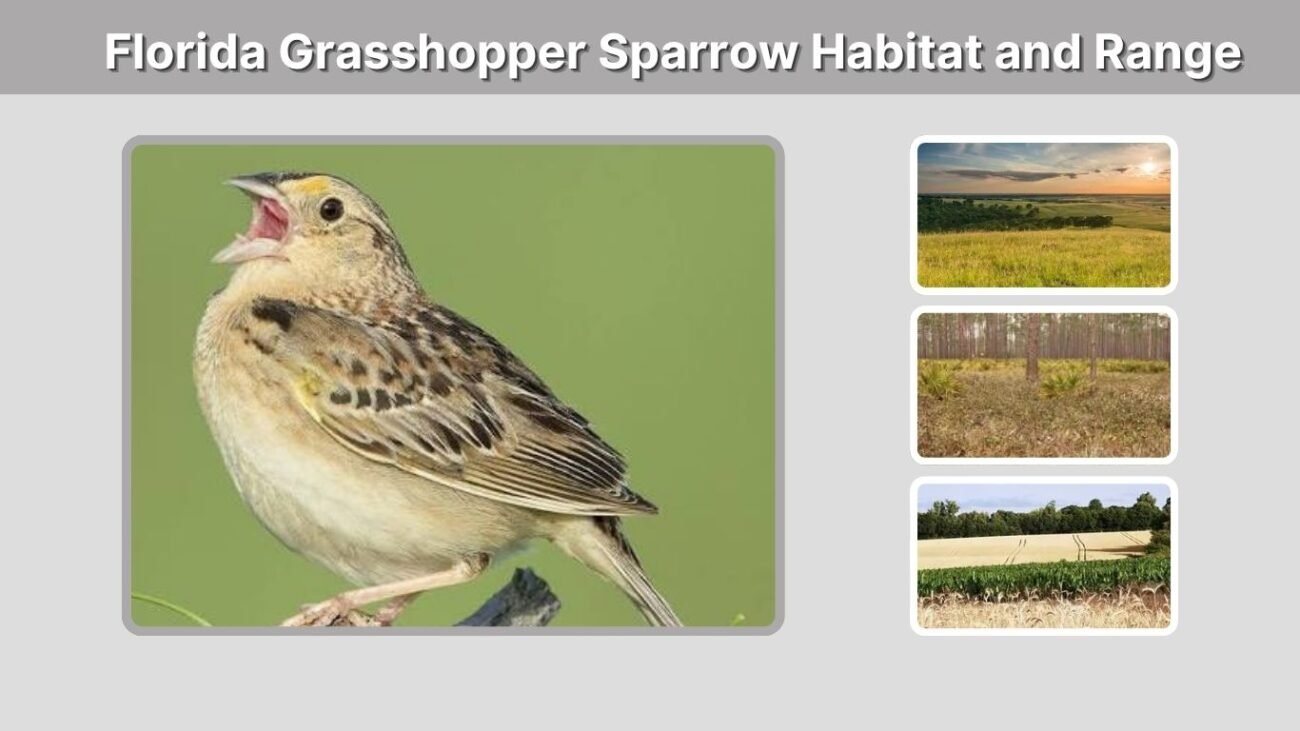
This sparrow occupies a very specialized ecosystem. It needs a broad, open prairie with sufficient grass for shelter but enough bare soil for walking and feeding.
Dry prairie habitat
Suitable habitat contains bunchgrasses, wiregrass, sedges, dwarf live oak, low shrubs and scattered saw palmetto. Tall trees and dense woody vegetation are generally absent. The spaces between plants are important because the bird searches for insects and seeds on or near the ground.
Florida’s dry prairie is maintained by recurring fire. Grasshopper sparrows often favor prairie burns within the previous two years because fire reduces trees and thick shrubs while encouraging appropriate ground vegetation. Only about 19 percent of Florida’s original dry prairie remains, according to FWC.
Where does it live?
The Florida grasshopper sparrow occurs only in south-central Florida. Its recognized range includes parts of Osceola, Okeechobee, Highlands and Polk counties.
Important protected landscapes include Three Lakes Wildlife Management Area, Kissimmee Prairie Preserve State Park and Avon Park Air Force Range. The bird does not migrate and may reuse the same territory in successive years.
Florida Grasshopper Sparrow Call and Song
The bird is named for its voice, which resembles the buzzing of a grasshopper. Listening for singing males is one of the most effective ways for researchers and birders to detect it.
Primary song
The primary Florida grasshopper sparrow song begins with two or three faint introductory notes followed by a thin, insect-like buzz. Males typically sing from the top of a grass stem, shrub or other low perch between late March and July.
Because the introductory notes are quiet and the buzz resembles an insect, the song can easily be overlooked in a windy prairie.
Secondary song and calls
A paired male may also produce a longer, rambling warble, especially later in the breeding season. Short contact and alarm calls are used around mates, young birds and potential threats.
Researchers conduct point-count surveys partly by listening for territorial males. However, counts of singing males do not necessarily reveal every female, juvenile or silent bird occupying the habitat.
What Does the Florida Grasshopper Sparrow Eat?
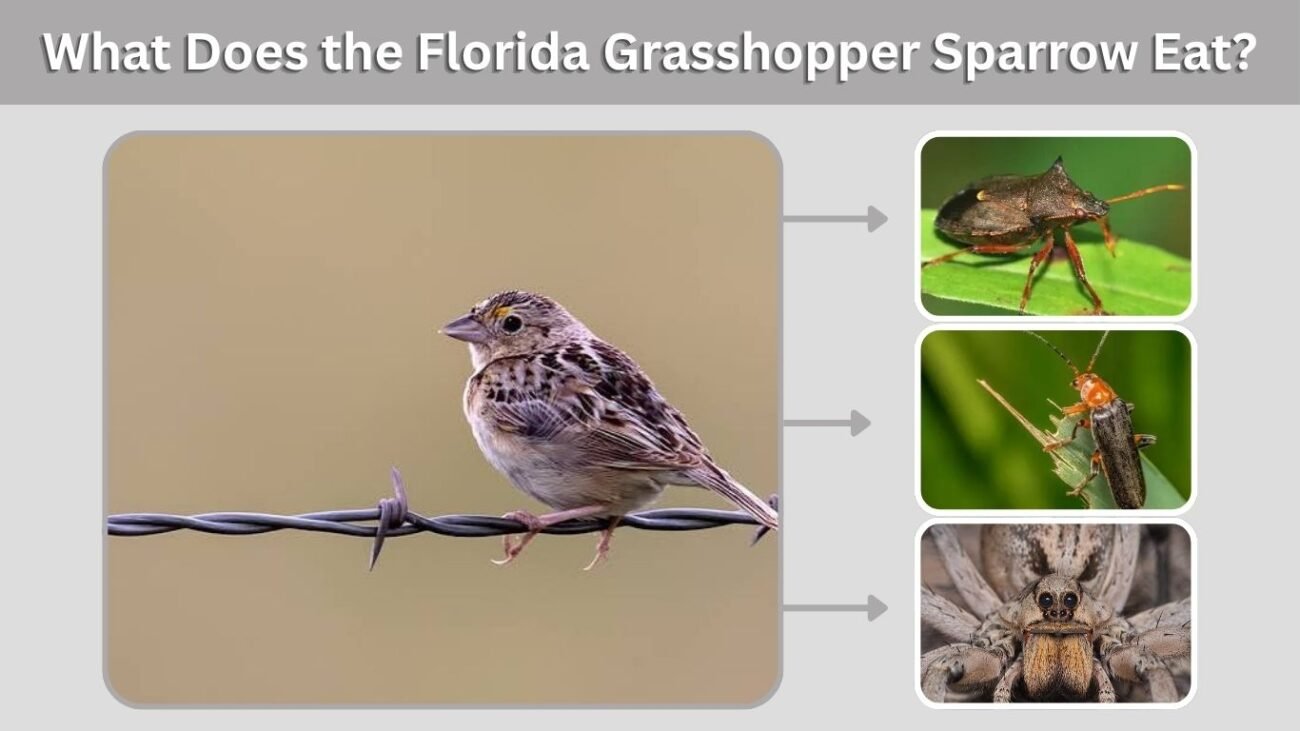
The Florida grasshopper sparrow feeds mainly on insects and seeds. Grasshoppers are an important food source, but the bird also consumes beetles, caterpillars, spiders and other small invertebrates when they are available.
Seeds become particularly important when insect activity declines. Adults search for food by walking through bare openings beneath prairie vegetation. Insects supply protein for growing nestlings, while seeds provide a dependable source of energy throughout the year.
Within the prairie food chain, the sparrow acts as both predator and prey. It controls small insect populations while providing food for snakes, birds of prey and several terrestrial predators.
Nest, Eggs and Baby Development
Florida grasshopper sparrows nest directly on the ground, making their reproductive cycle closely connected to vegetation structure, rainfall and predator activity.
Nest construction
The female builds a cup-shaped nest in a shallow depression. Grass is woven over the top to form a partial dome, while clumps of wiregrass, dwarf live oak or saw palmetto conceal the entrance.
The nest requires dense cover for protection but must remain close to open patches where adults can forage and perform distraction displays.
Eggs and incubation
A female generally lays three to five creamy-white eggs marked with reddish-brown flecks, especially near the larger end. Incubation lasts approximately 11–12 days.
The young remain in the nest for about eight days after hatching. Once they leave, they stay within their parents’ territory for several weeks and continue receiving food. A pair may make multiple nesting attempts during one season, particularly after an earlier nest fails.
Are Florida Grasshopper Sparrows Solitary?
Adults are often encountered alone while feeding, but they are not entirely solitary. During the breeding season, males establish territories and form pairs with females. Parents cooperate in feeding and protecting their young.
The birds do not normally form large, conspicuous flocks. Their ground-oriented behavior, muted coloring and widely spaced territories make them appear more solitary than many familiar backyard sparrows.
Why Is the Florida Grasshopper Sparrow Endangered?
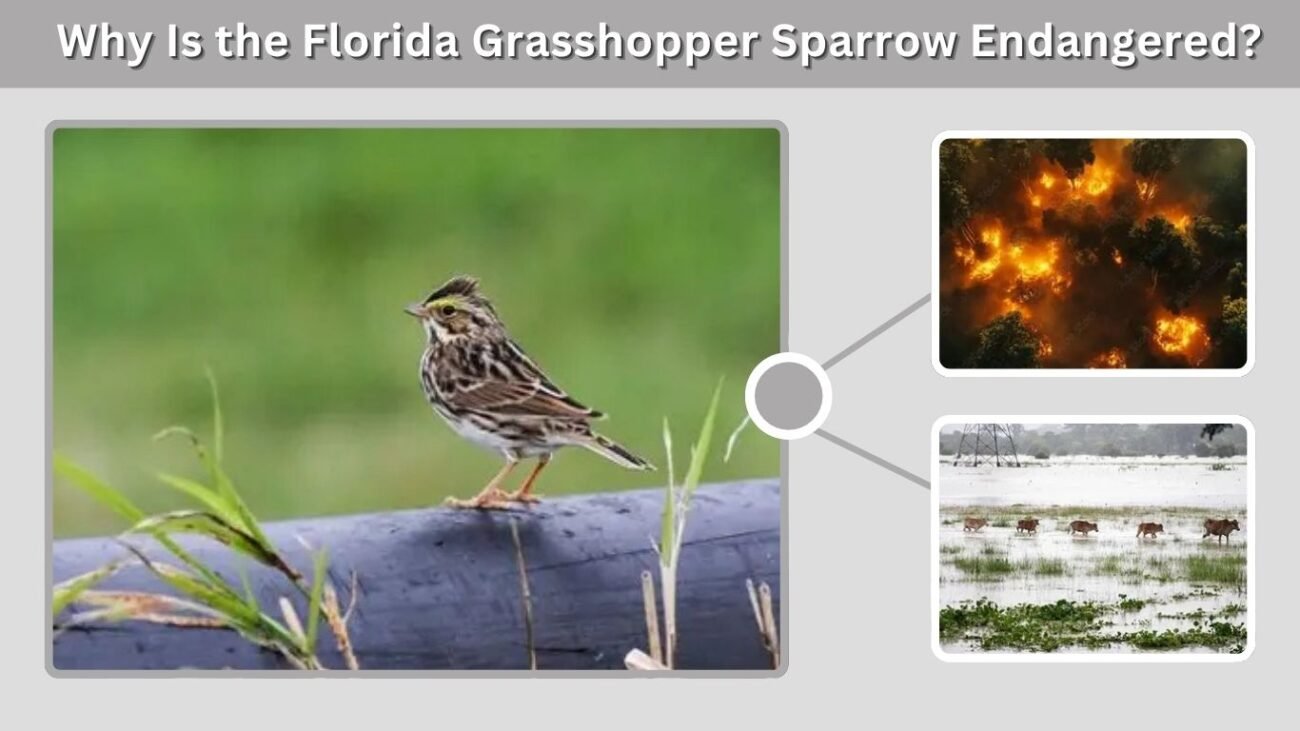
The subspecies is endangered because it has an extremely limited range and depends on a habitat that has been heavily reduced and altered.
Major threats include:
- Conversion of prairie into agricultural land or development
- Fragmentation and isolation of remaining populations
- Fire suppression and woody plant encroachment
- Flooding during the nesting season
- Predation of nests, eggs and chicks
- Small population size and limited distribution
Potential nest predators include snakes, raccoons, skunks, rodents, crows, birds of prey, armadillos, opossums, coyotes, fire ants and even box turtles. Because nests are built on the ground, one season of poor reproductive success can substantially affect a small population.
Florida Grasshopper Sparrow Population
A precise current population figure is difficult to provide. Surveys frequently count singing males rather than every individual, and estimates may treat wild-born, captive-reared, recently released and surviving birds differently.
FWC recorded only 75 singing males on three public properties in 2012, while another assessment reported fewer than 48 singing males across monitored sites in 2018. Audubon stated in 2024 that the wild population had fallen from more than 1,000 birds to fewer than 100 over the preceding two decades.
These figures should not be confused with the number released through conservation programs. The release total is cumulative and does not indicate how many released birds remain alive at one time.
Captive Breeding and Recovery Efforts
Conservation breeding was introduced when the remaining wild population approached extinction. Breeding centers raise young birds, while partner facilities prepare fledglings for release into protected prairie habitat.
The first captive-reared sparrows were released in 2019. Released birds have subsequently paired with wild birds, produced offspring and contributed young that later became breeders.
In July 2024, conservation partners released the 1,000th captive-bred Florida grasshopper sparrow at Avon Park Air Force Range. This was a cumulative milestone rather than a current population count, but it demonstrated the scale of the recovery effort.
Other recovery measures include:
- Prescribed burning and prairie restoration
- Removal of encroaching trees and shrubs
- Protection and monitoring of nests
- Banding and tracking released birds
- Research into disease and nest failure
- Surveys of public and private prairie
- Establishment of additional populations
The program has reduced the immediate danger of extinction, but long-term recovery depends on creating several self-sustaining populations across protected dry prairies.
FAQs
Is the Florida grasshopper sparrow extinct?
No. The Florida grasshopper sparrow remains alive in the wild and in managed breeding populations. However, it is federally endangered and still faces a serious extinction risk. Captive breeding, habitat management and repeated releases have prevented its disappearance and strengthened several monitored populations.
How much does a Florida grasshopper sparrow weigh?
The bird is extremely lightweight, generally weighing roughly 17–20 grams, although body mass varies with age, sex, season and physical condition. Its compact, approximately five-inch body allows it to move efficiently through dense grasses and remain concealed from predators.
Does the Florida grasshopper sparrow migrate?
No. Unlike northern grasshopper sparrow populations, the Florida subspecies is non-migratory. Adults remain within south-central Florida throughout the year and may return to the same breeding territories in successive seasons. This limited movement increases its dependence on protecting suitable prairie within its restricted range.
What is the Florida grasshopper sparrow’s biggest threat?
The greatest long-term threat is the loss, degradation and fragmentation of dry prairie habitat. Fire suppression allows trees and woody shrubs to overtake open prairie, while agriculture and development remove habitat completely. Flooding and nest predation create additional risks during the breeding season.
How can the Florida grasshopper sparrow be saved?
Recovery requires protecting remaining dry prairie, restoring degraded land, conducting prescribed burns and establishing additional breeding populations. Captive breeding and carefully planned releases can support declining groups, but released birds ultimately need extensive, well-managed habitat where they can reproduce successfully without continuous intervention.