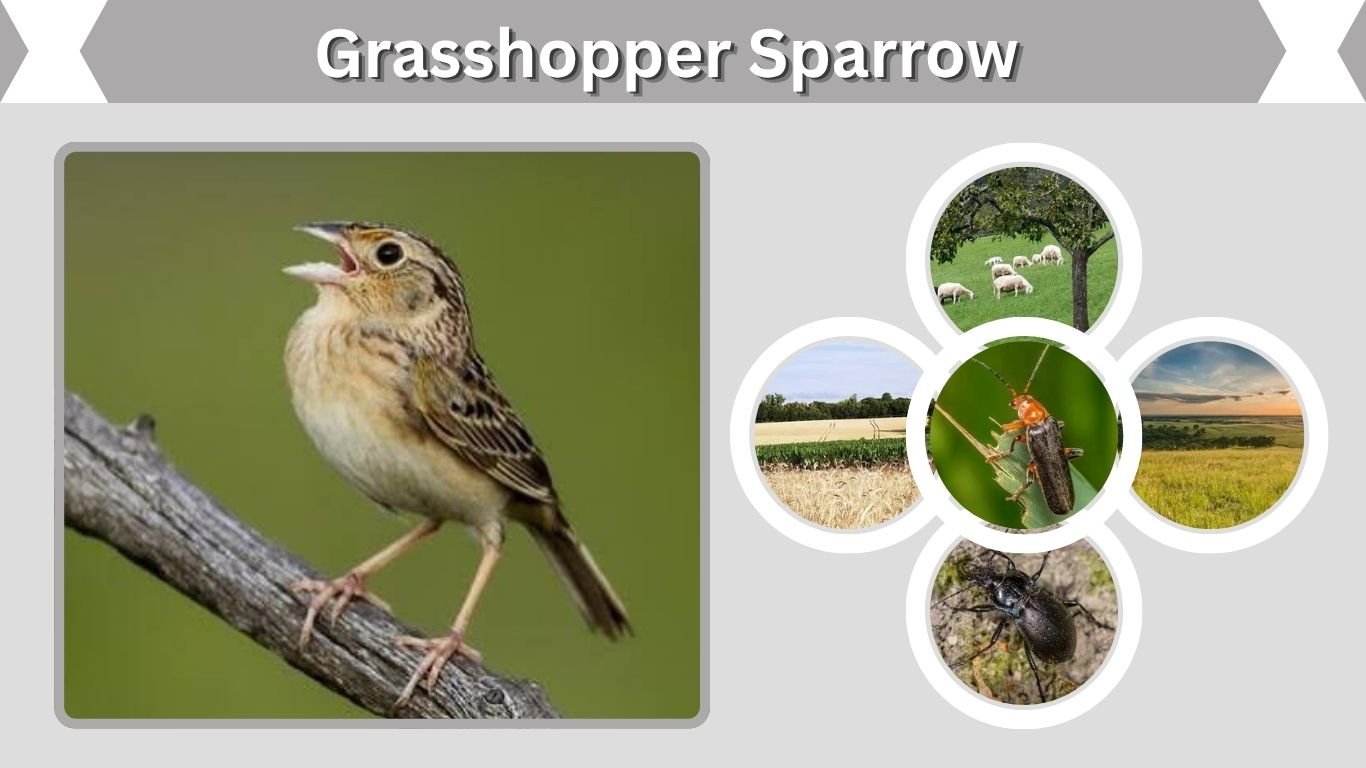
The grasshopper sparrow is a secretive grassland songbird known for its flat head, short tail, insect-like song, and habit of disappearing into dense vegetation. Although it is distributed across a large part of the Americas, habitat loss has caused significant declines in many regions. One subspecies, the Florida grasshopper sparrow, is federally endangered and restricted to a small area of south-central Florida. Understanding its appearance, habitat, diet, nesting habits, and sounds makes this unusual sparrow easier to identify and appreciate.
Grasshopper Sparrow Quick Facts
Grasshopper sparrows belong to the New World sparrow family. Their scientific name is Ammodramus savannarum, while the Florida subspecies is classified as Ammodramus savannarum floridanus. They are small, ground-oriented birds that depend heavily on open grasslands.
| Feature | Description |
| Common name | Grasshopper sparrow |
| Scientific name | Ammodramus savannarum |
| Bird family | Passerellidae |
| Main habitat | Prairies, pastures and open grasslands |
| Primary summer food | Grasshoppers and other insects |
| Winter food | Grass and weed seeds |
| Nest location | On the ground |
| Clutch size | Usually 3–7 eggs |
| Migration | Resident or short- to long-distance migrant |
| Florida subspecies | Federally endangered |
Grasshopper Sparrow Identification
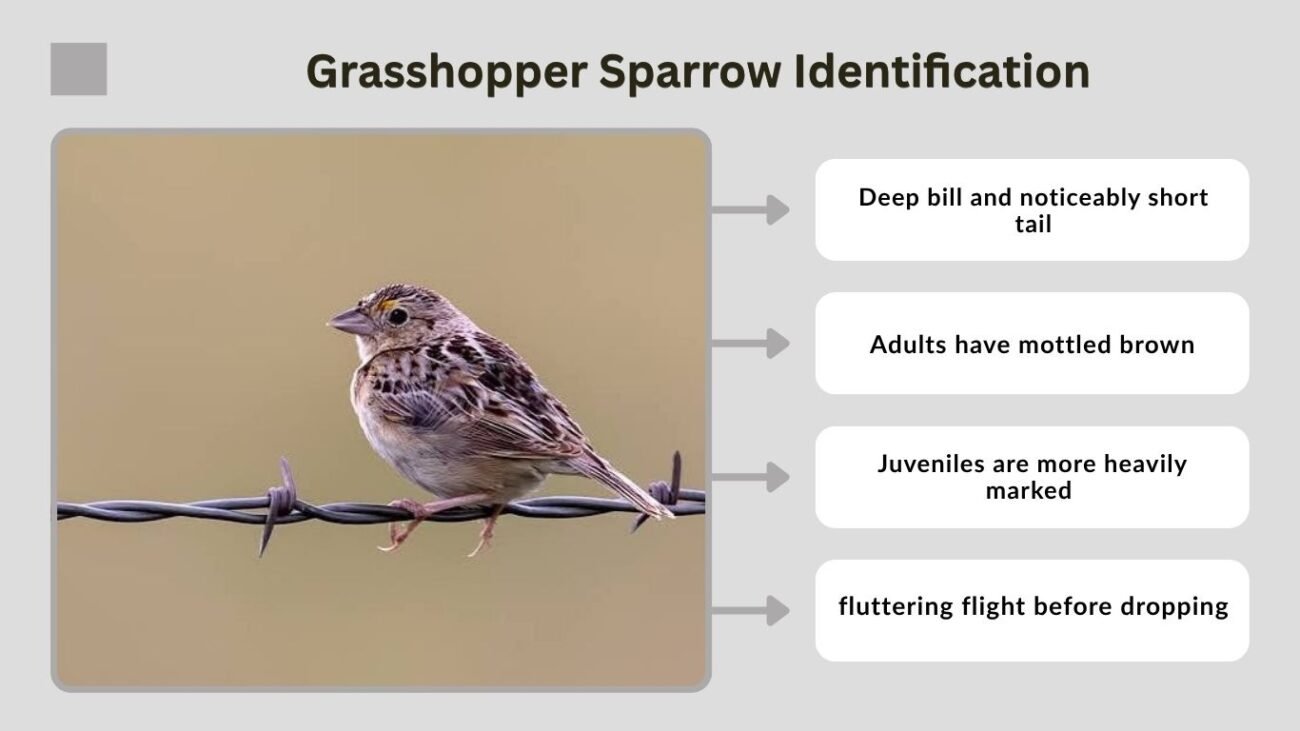
This bird’s muted coloring allows it to blend into dry grass exceptionally well. It is often detected by sound before it is seen.
Size and body shape
A grasshopper sparrow has a relatively large head, thick neck, deep bill and noticeably short tail. Its flat-headed appearance helps distinguish it from many slender, longer-tailed sparrows. When disturbed, it generally makes a short, fluttering flight before dropping back into the vegetation.
Color and markings
Adults have mottled brown, tan, black and chestnut upperparts. The breast and belly are mostly pale, buff-colored and unstreaked. Look for a thin white eye ring and a small yellow or orange-yellow patch between the eye and bill. Yellow may also be visible at the bend of the wing.
Juvenile grasshopper sparrow
Juveniles are more heavily marked than adults. A young grasshopper sparrow typically has brown and buff streaking across its breast and back, although it may already display the yellow-orange mark in front of the eye.
Grasshopper Sparrow Habitat and Range
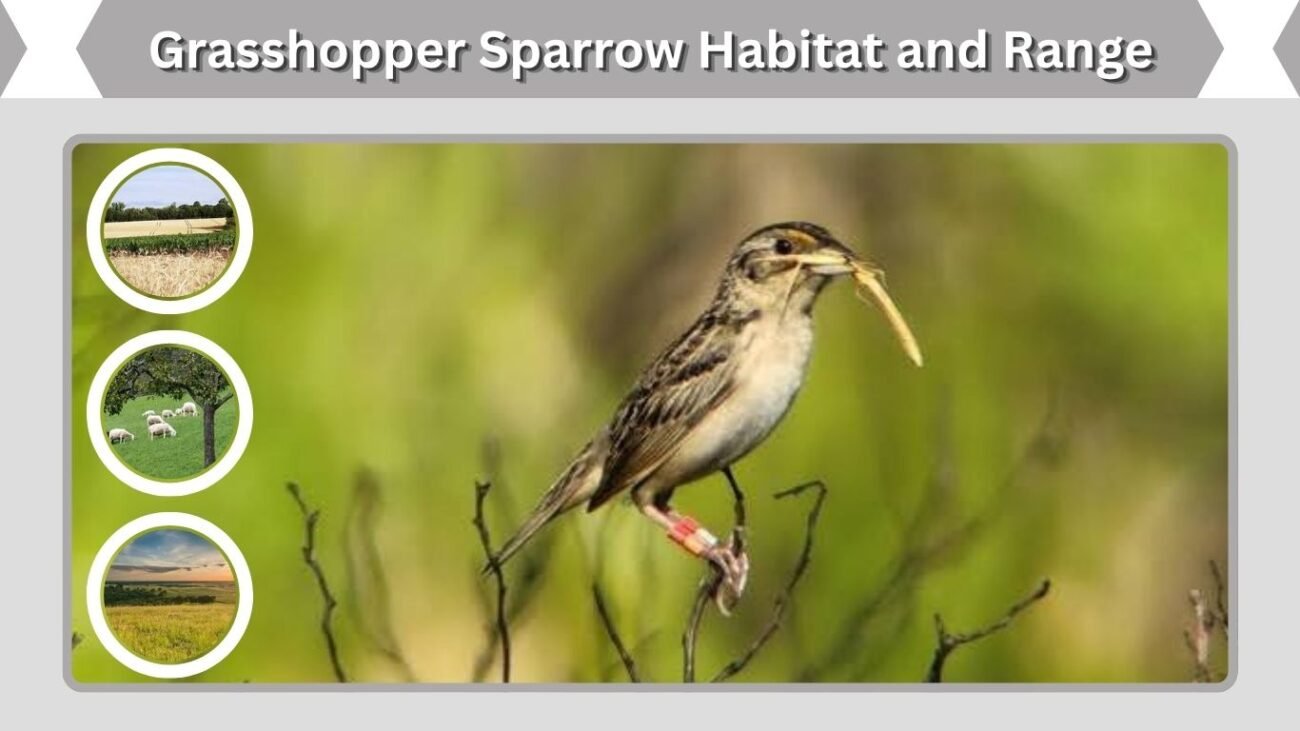
Grasshopper sparrows require open landscapes rather than forests, wetlands or heavily wooded environments. Vegetation structure is often more important to them than the exact plant species present.
They breed in native prairies, hayfields, pastures and other grasslands containing tall grass, scattered bare soil and relatively little shrub cover. Bare patches allow the birds to walk and search for food, while taller grass provides nesting cover. They usually avoid areas that have become densely overgrown with shrubs.
Their range extends across much of North America and into parts of Central America, the Caribbean and South America. Northern populations commonly migrate south after breeding. Birds living farther south may travel only short distances or remain in the same general region year-round.
Grasshopper Sparrow Call and Song
The grasshopper sparrow was named for its distinctive vocalization rather than its appearance or diet.
What does its song sound like?
The main grasshopper sparrow song usually begins with one or two short introductory notes followed by a thin, high-pitched buzz or trill. The final portion can sound remarkably similar to a grasshopper or other singing insect. Males usually deliver this song from a grass stem, fence post or another low perch.
Grasshopper sparrow calls
In addition to its territorial song, the species produces short contact and alarm calls. One commonly described call is a very high, thin “seep.” These quiet sounds can be difficult to hear in windy grasslands.
Listening is often the best way to locate the bird. After hearing a song, scan the tops of grass stalks, low shrubs and fences rather than searching only on the ground.
What Do Grasshopper Sparrows Eat?
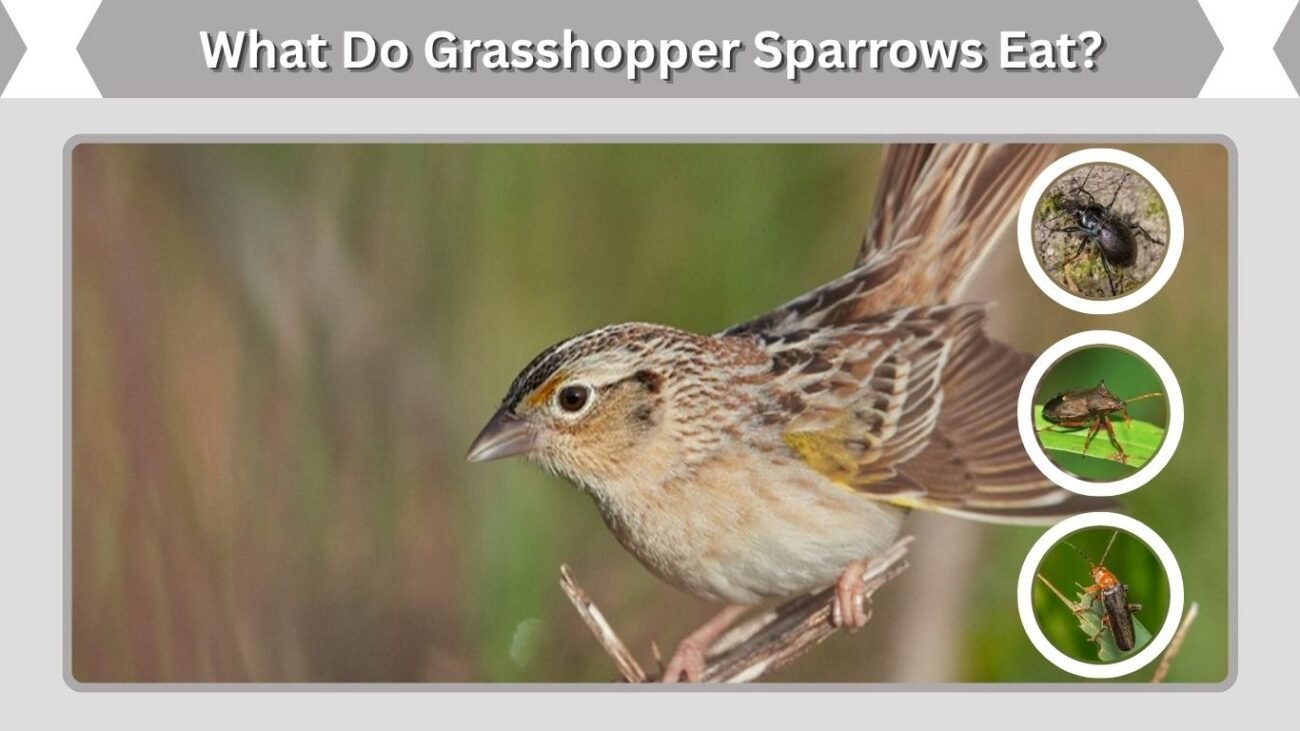
Despite the name, these sparrows do not survive entirely on grasshoppers. Their diet changes according to season and food availability.
During spring and summer, grasshopper sparrows consume:
- Grasshoppers
- Beetles and true bugs
- Caterpillars
- Spiders
- Other small invertebrates
In winter, insects become less available, so the birds eat primarily small seeds from grasses and herbaceous plants. They normally collect food while walking or running across exposed soil beneath grass cover.
Eating insects provides adults and growing chicks with valuable protein. By consuming grasshoppers, beetles and caterpillars, these birds also contribute to the ecological balance of grassland habitats.
Grasshopper Sparrow Nest and Eggs
Grasshopper sparrows construct carefully concealed nests directly on the ground. The nest is normally placed beside or beneath a dense clump of grass or sedges.
Nest structure
The female creates a cup-shaped nest lined with fine grasses and sometimes animal hair. Overhanging vegetation is often woven into a partial dome, leaving a small entrance on one side. This tunnel-like construction hides the nest from above but does not eliminate the risk from ground predators.
Eggs and chicks
A typical clutch contains three to seven white eggs marked with light reddish-brown speckles. Incubation lasts approximately 11–13 days. Chicks remain in the nest for only about six to nine days before leaving, although the parents continue caring for them afterward. Some pairs can raise several broods during one breeding season.
Ground nests are vulnerable to snakes, mammals, flooding, mowing and trampling. For the endangered Florida subspecies, predation of eggs and nestlings is considered a major cause of nest failure.
Grasshopper Sparrow Adaptations
Several physical and behavioral adaptations help this small bird survive in open country.
- Camouflaged feathers: Brown and tan plumage matches dead grass and soil.
- Ground movement: The bird often runs through vegetation instead of flying above it.
- Domed nest: Overhanging grass helps conceal eggs and chicks.
- Insect-like song: The thin buzz carries through open grassland while remaining difficult to locate.
- Seasonal diet: Switching from insects to seeds allows the bird to survive periods when insect prey is scarce.
Grasshopper sparrows are weak, reluctant fliers compared with many other songbirds. When approached, they frequently escape by running through grass or flying only a short distance before hiding again.
Florida Grasshopper Sparrow
The Florida grasshopper sparrow is a darker, non-migratory subspecies found only in the dry prairies of south-central Florida. Adults are approximately five inches long and show blackish-gray upperparts, a pale unstreaked underside, a buff throat and yellow markings near the eye and wing. Males and females do not have obvious plumage differences.
Habitat and behavior
Florida grasshopper sparrows depend on treeless dry prairie containing grasses, sedges, scattered low shrubs and areas of bare ground. Their habitat requires periodic fire to prevent trees and dense shrubs from taking over. Males are most frequently heard singing between late March and July.
Is the Florida grasshopper sparrow endangered?
Yes. It is protected as endangered under both federal and Florida regulations. Habitat conversion, fragmentation, unsuitable fire management, flooding, nest predation and its extremely restricted distribution have contributed to its decline.
A June 2025 report estimated that fewer than 200 known Florida grasshopper sparrows remained. However, captive breeding and release programs have improved the bird’s prospects. Conservation partners celebrated the release of the 1,000th captive-bred individual in 2024, and released birds have successfully bred in the wild.
Grasshopper Sparrow vs. Savannah Sparrow
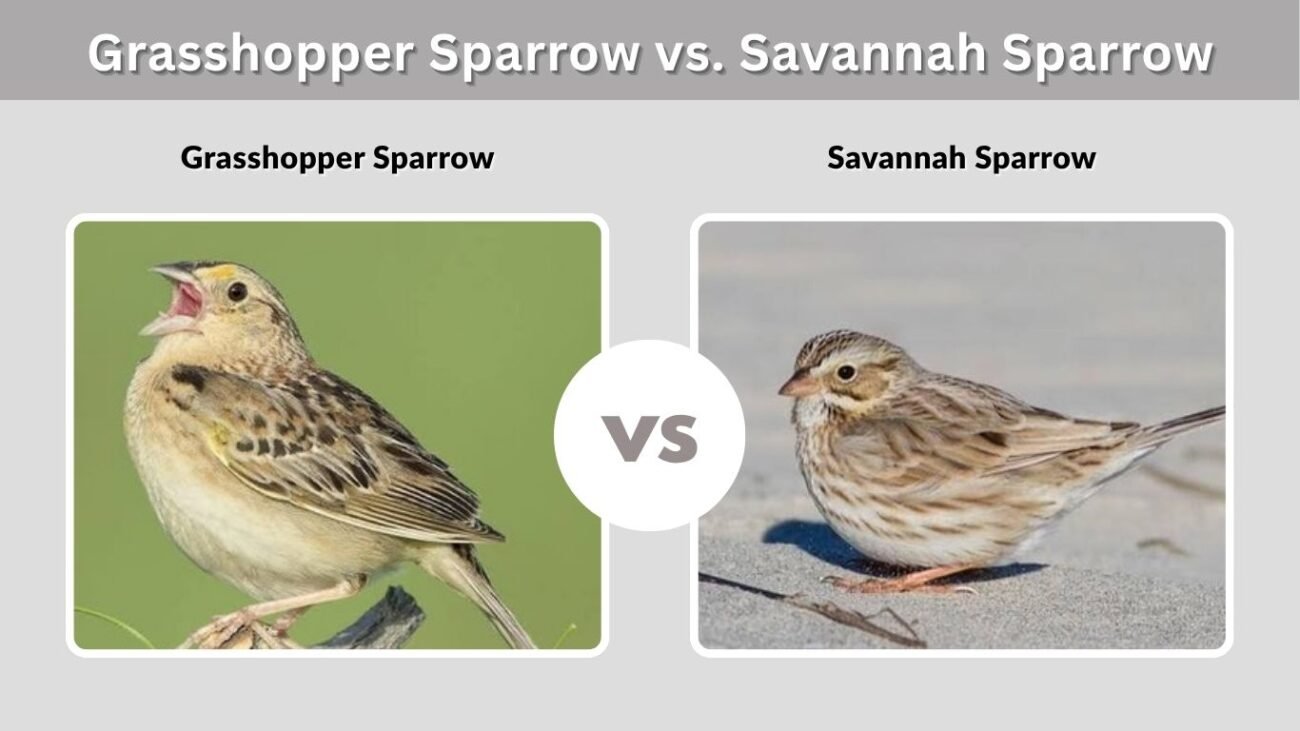
These two grassland birds may both display yellow near the eye, but their breast patterns are noticeably different.
| Characteristic | Grasshopper Sparrow | Savannah Sparrow |
| Breast | Mostly buff and unstreaked | White or pale with crisp brown streaks |
| Bill | Relatively large and deep | Smaller and more slender |
| Head shape | Flat-headed with thick neck | More rounded and conventionally shaped |
| Facial pattern | Plain face and white eye ring | Stronger eyebrow and facial pattern |
| Typical behavior | Runs and hides in dense grass | More likely to perch after being flushed |
The Savannah sparrow’s heavily streaked breast is usually the simplest field mark. An adult grasshopper sparrow has a much cleaner underside, along with a bulkier head and bill.
FAQs
Do sparrows eat grasshoppers?
Many sparrow species eat grasshoppers, especially while raising chicks. Grasshopper sparrows consume them regularly during summer, along with beetles, caterpillars, spiders and other invertebrates. In winter, their diet shifts mainly toward grass and weed seeds.
Are grasshopper sparrows rare?
The species can still be found across a broad geographic range, but its populations have declined considerably because of grassland loss and degradation. It may be locally uncommon or absent where prairies have been converted to cropland, development or dense shrubland.
Do grasshopper sparrows migrate?
Migration varies by region. Birds breeding in northern areas generally migrate to the southern United States, Mexico, Central America or the Caribbean. Southern populations may make only local movements, while the endangered Florida grasshopper sparrow remains in Florida throughout the year.
Are grasshopper sparrows diurnal?
Yes, grasshopper sparrows are primarily active during daylight. They forage on the ground, defend territories, feed their chicks and sing during the day. Male songs are particularly noticeable during the morning, although birds may continue singing later under suitable weather conditions.
Why is the grasshopper sparrow declining?
The greatest problem is the disappearance or degradation of open grasslands. Development, intensive agriculture, early hay mowing, fire suppression, excessive shrub growth and habitat fragmentation can remove feeding and nesting areas. Ground nests also expose eggs and chicks to predators, machinery and severe weather.