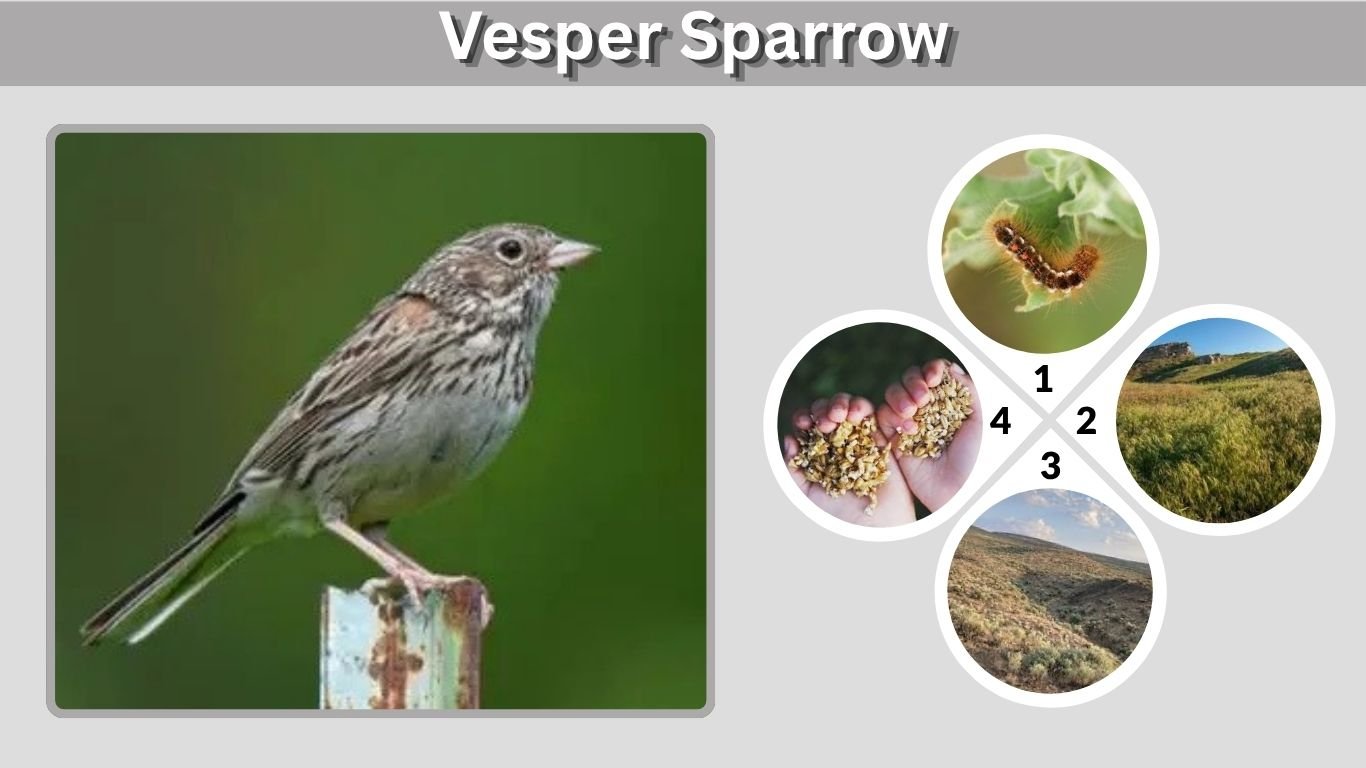
The vesper sparrow is a streaked grassland bird recognized by its white eye ring, chestnut shoulder patch, and white outer tail feathers. Although its muted coloring makes it easy to overlook, its rich musical song often reveals its presence on farms, prairies, and open fields. Vesper sparrows spend much of their time feeding on the ground but frequently sing from fence posts and shrubs. Learning their field marks, habitat preferences, nesting habits, and calls makes identification considerably easier.
Vesper Sparrow Quick Facts
The vesper sparrow belongs to the New World sparrow family. Its common name refers to “vespers,” or evening, because males are known to continue singing around twilight. Its scientific name is Pooecetes gramineus.
| Feature | Description |
| Common name | Vesper sparrow |
| Scientific name | Pooecetes gramineus |
| Main habitat | Grasslands, farms and open fields |
| Diet | Seeds, grain and invertebrates |
| Nest location | On the ground |
| Typical clutch | 3–4 eggs |
| Migration | Partial migrant |
| Best field mark | White outer tail feathers |
| Distinctive sound | Musical whistles followed by trills |
How to Identify a Vesper Sparrow
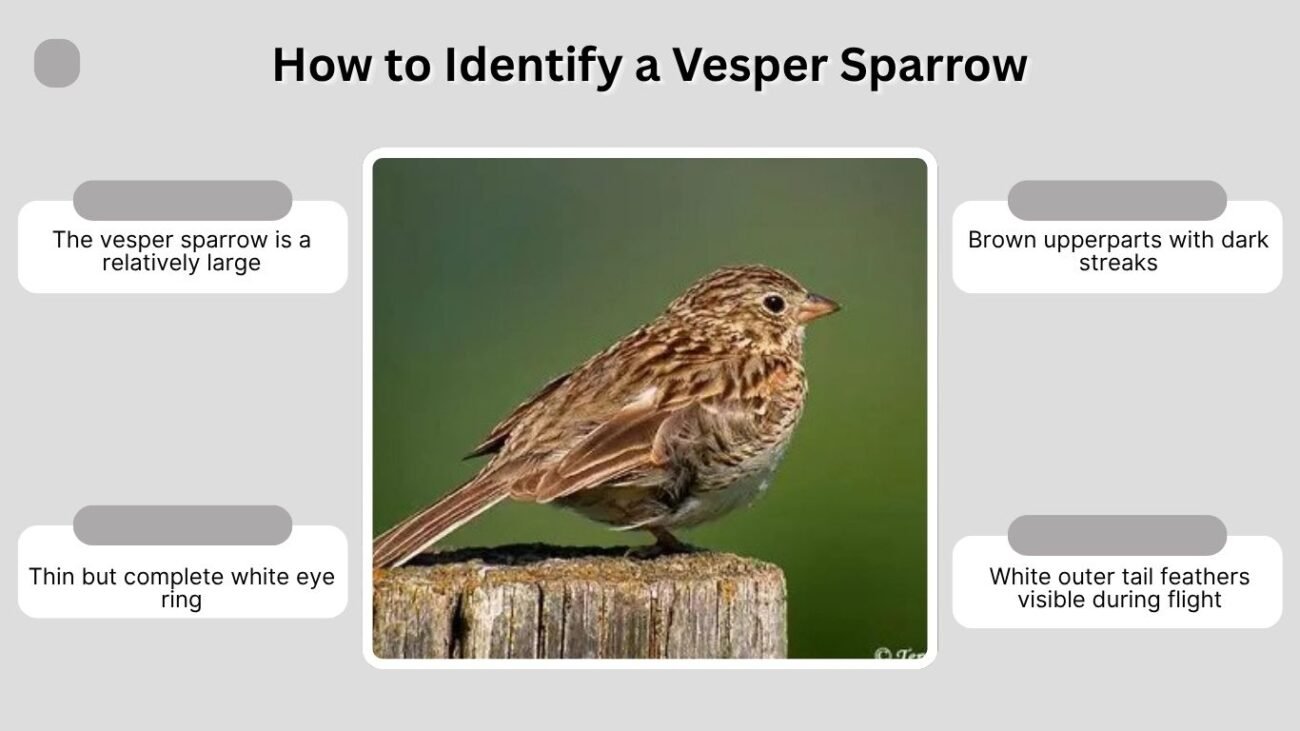
Vesper sparrows have the streaked brown appearance shared by several grassland birds. However, a combination of facial, shoulder, and tail markings separates them from similar species.
Size and body shape
The vesper sparrow is a relatively large, sturdy sparrow with a rounded head, conical bill, long wings, and moderately long, notched tail. It frequently walks or hops across bare soil while searching for food.
When disturbed, it often flies to a fence, shrub, or low tree before returning to the ground.
Colors and markings
Look for the following identification features:
- Brown upperparts with dark streaks
- Pale breast covered with fine brown streaking
- Thin but complete white eye ring
- Small chestnut patch at the bend of the wing
- White outer tail feathers visible during flight
- Pale lower belly and whitish outer tail corners
The chestnut shoulder patch is sometimes hidden by folded wing feathers. The white tail edges are therefore one of the most dependable field marks, particularly when the bird flies away.
Male, female and juvenile
Adult males and females look very similar. During the breeding season, males are easier to notice because they sing repeatedly from elevated perches.
A juvenile vesper sparrow generally has softer, buffier plumage and heavier streaking than an adult. Its eye ring and white outer tail feathers become useful identification marks as its plumage develops.
Vesper Sparrow Habitat and Range
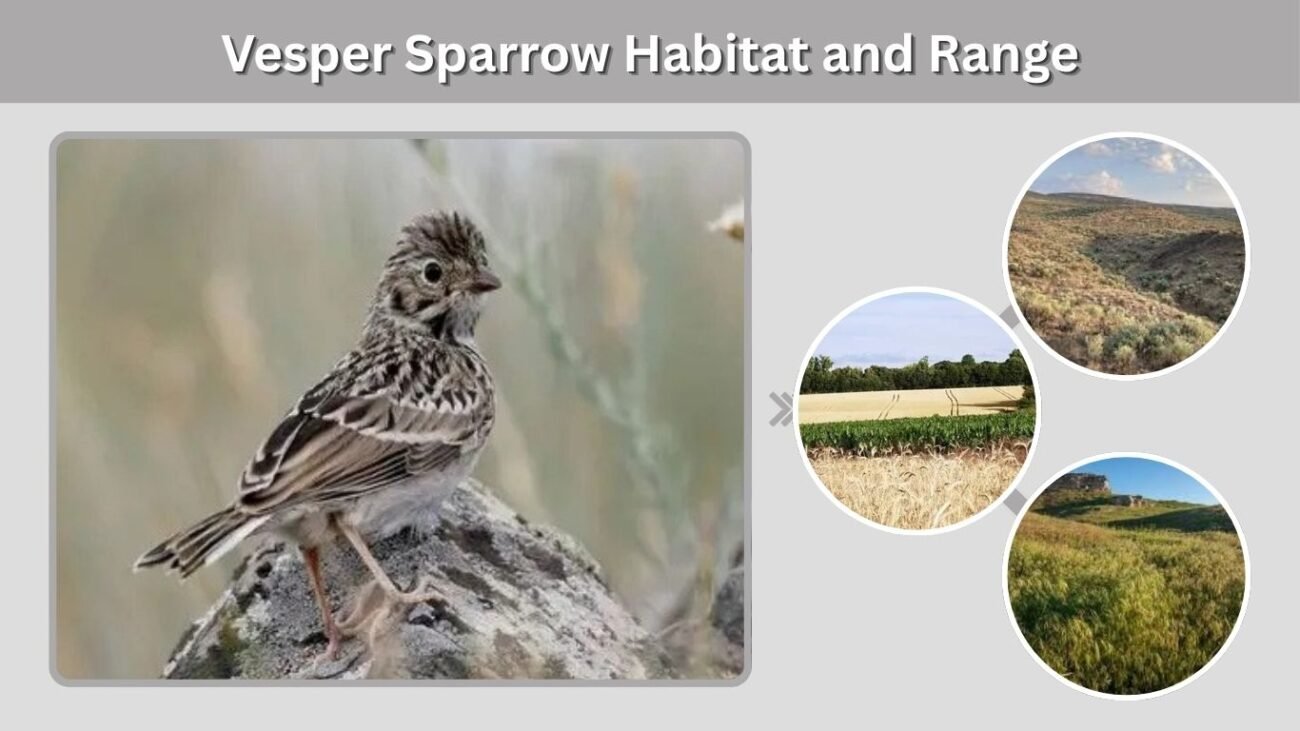
Vesper sparrows are associated with open landscapes containing short vegetation, bare ground, and scattered elevated song perches. They are often described as grassland birds, although they also occupy agricultural and disturbed environments.
Preferred habitat
Common habitats include:
- Native prairie
- Dry grassland
- Pasture and hayfields
- Crop fields and field edges
- Sagebrush country
- Recently disturbed land
- Open areas with scattered shrubs
They generally avoid dense woodland, heavily developed places, and grassland that has become completely covered by tall, thick vegetation. Fence posts, shrubs, rocks, and small trees give males suitable places from which to sing.
Range and migration
Vesper sparrows breed across much of southern Canada and the northern and western United States. Their winter range includes the southern United States, Mexico, and parts of Central America.
The species is a partial migrant. Northern breeding populations migrate south, often traveling at night in small groups. Some birds in warmer regions move shorter distances or remain near their breeding range throughout the year.
Vesper Sparrow Song and Call
The vesper sparrow’s song is one of its most appealing features. A singing male may perform during the morning, throughout the day, and around sunset.
What does the song sound like?
The song usually begins with several clear, repeated whistles. These introductory notes are followed by accelerating musical trills and descending phrases.
Its song may resemble that of a song sparrow, but the vesper sparrow usually starts with more evenly spaced whistles. Males sing from fence posts, wires, shrubs, rocks, and other conspicuous perches.
Calls
The common vesper sparrow call is a short, sharp note used during flight, alarm, or contact with other birds. Its call is far less elaborate than its territorial song.
Because the bird’s plumage blends with dry grass and soil, recognizing the song may be the easiest way to find it. After hearing the song, scan nearby fences and exposed branches.
What Do Vesper Sparrows Eat?
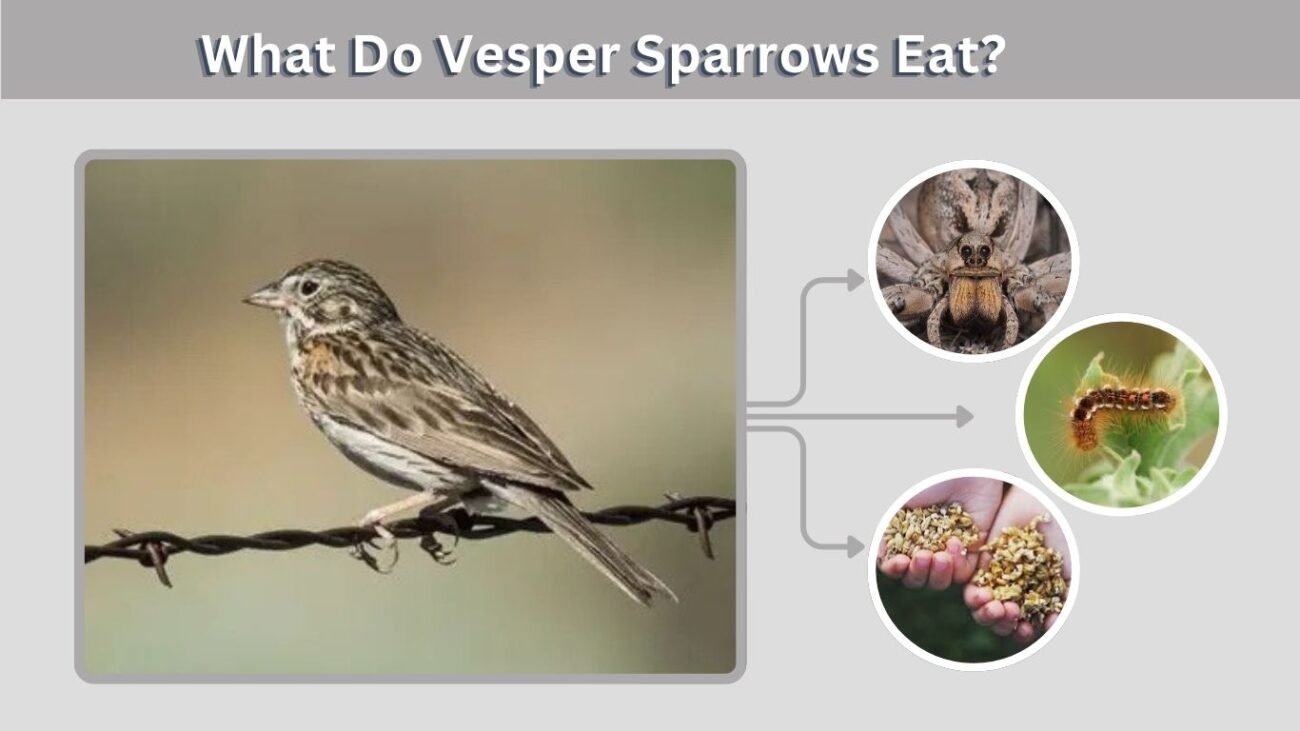
Vesper sparrows are omnivorous rather than decomposers. They obtain most of their food directly from the ground.
Their diet includes grass and weed seeds, waste grain, beetles, grasshoppers, caterpillars, spiders, and other small invertebrates. Seeds form a large portion of the diet outside the breeding season, while insects become especially important during spring and summer.
Both parents feed insects to their nestlings because animal prey supplies the protein needed for rapid growth. Outside the breeding season, vesper sparrows may forage together in small, loosely organized groups.
Vesper Sparrow Nest and Eggs
Vesper sparrows nest on the ground, usually beneath or beside vegetation. Their concealed nests can be difficult to detect even at close range.
Nest construction
The female selects a shallow depression near a clump of grass, crop plant, shrub, or other protective cover. She constructs an open cup from grasses, roots, and plant fibers, then lines it with finer material.
Some nests are built in existing depressions, including animal hoofprints. This gives the nest a lower profile and helps hide it from overhead predators.
Eggs and young
A typical clutch contains three or four eggs, although clutches may range from two to six. The eggs are whitish or pale greenish-white with brown and gray markings. The female performs most incubation, which lasts approximately 11–13 days.
Both parents feed the chicks. Young vesper sparrows usually leave the nest after approximately 9–10 days, before they can fly strongly. They remain close to protective vegetation while their parents continue feeding them. A pair may raise more than one brood in a successful season.
Vesper Sparrow Behavior and Flight
Vesper sparrows spend much of the day walking through low vegetation and open soil. When threatened, they often crouch or run before taking flight.
Their flight is strong and slightly undulating. As a bird turns or lands, the white outer tail feathers create conspicuous flashes. This tail pattern is particularly helpful when identifying a vesper sparrow in flight.
Males defend breeding territories through singing and display. Outside the breeding season, individuals become more social and may join small flocks with other sparrows.
Vesper Sparrow vs. Similar Sparrows
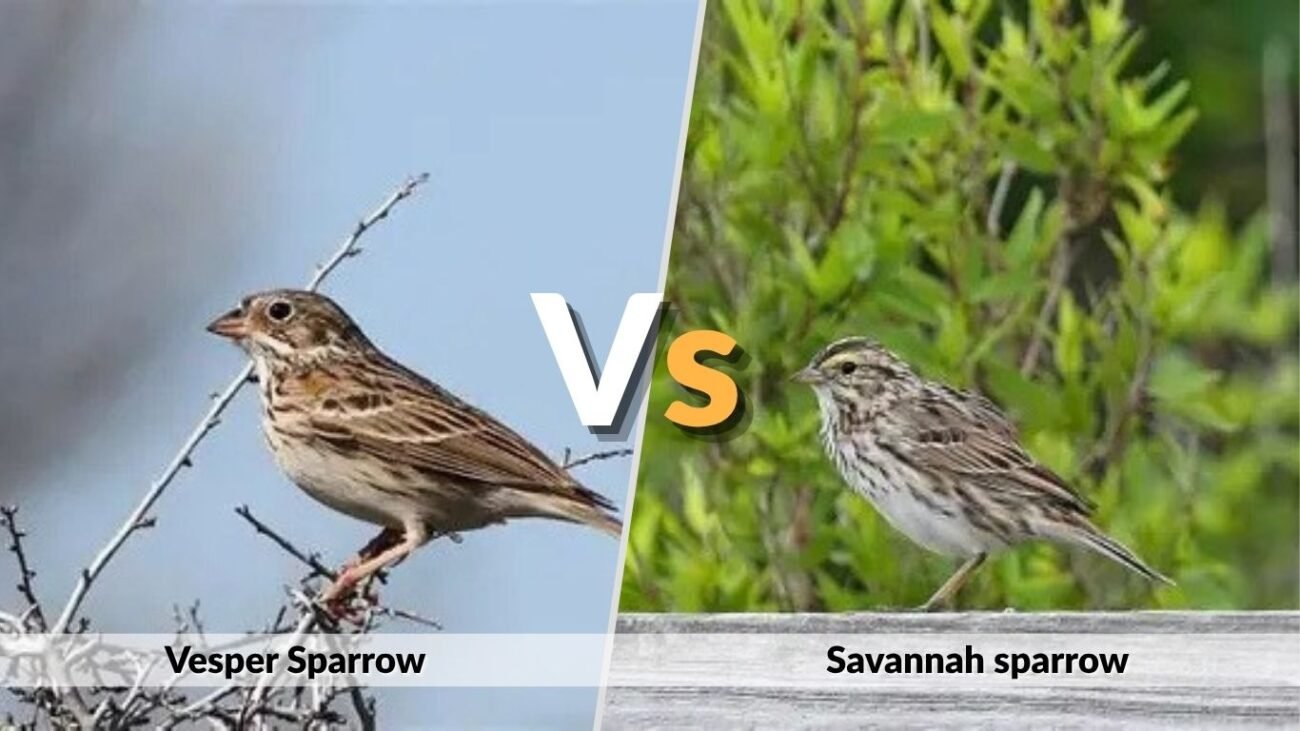
Several streaked sparrows occupy open fields, but differences in the face, breast, tail, and preferred habitat help separate them.
| Species | Key identification features |
| Vesper sparrow | White eye ring, chestnut shoulder and white outer tail feathers |
| Savannah sparrow | Yellow eyebrow area, short tail and heavily streaked breast |
| Song sparrow | Bold breast streaks, central breast spot and rounded tail |
| Field sparrow | Pink bill, plain breast and reddish cap |
| Brewer’s sparrow | Smaller body, pale eye ring and finely streaked crown |
The white outer tail feathers offer the quickest distinction between a vesper sparrow and a Savannah sparrow. A Savannah sparrow usually looks shorter-tailed and has yellow coloration near the eyebrow.
A song sparrow normally has bolder breast markings that gather into a dark central spot. Its facial pattern is also stronger, whereas the vesper sparrow has a cleaner face dominated by a white eye ring.
Oregon Vesper Sparrow
The Oregon vesper sparrow, Pooecetes gramineus affinis, is the rarest of the four generally recognized vesper sparrow subspecies. It breeds in a restricted region extending through southwestern British Columbia, western Washington, western Oregon, and northwestern California. It migrates to central and southern California and northwestern Baja California for winter.
The subspecies depends on open prairie, pasture, savanna, and lightly cultivated land with patches of bare ground and scattered shrubs. Habitat conversion, development, intensive agriculture, poorly timed mowing, invasive vegetation, and disturbance around ground nests have contributed to its decline.
The Oregon vesper sparrow is listed as endangered by Washington State. As of July 2026, the U.S. Fish and Wildlife Service was still reviewing whether it should receive federal Endangered Species Act protection, with a decision anticipated around September 2026.
FAQs
Is the vesper sparrow endangered?
The vesper sparrow as a whole is not federally listed as endangered in the United States. However, populations have declined in many areas as open land disappears or changes. The Oregon vesper sparrow is endangered in Washington and is undergoing a federal status review.
Why is it called a vesper sparrow?
“Vesper” refers to evening or evening prayers. The bird received this name because males are known for delivering their musical songs around dusk, although they also sing during other parts of the day.
How big is a vesper sparrow?
A vesper sparrow is a medium-to-large sparrow with a sturdy body and moderately long tail. It is generally larger and more robust than a chipping sparrow or Brewer’s sparrow but much smaller than a robin.
Where do vesper sparrows build their nests?
Vesper sparrows place their nests directly on the ground. The nest is usually concealed beside grass, crops, weeds, or low shrubs. Females sometimes use natural hollows or hoofprints as the foundation for their cup-shaped nests.
What is the best way to identify a vesper sparrow?
Look for a complete white eye ring, streaked breast, and chestnut shoulder patch. When the bird flies, check for bright white outer tail feathers. Its clear opening whistles and musical trills provide additional evidence when visual identification is difficult.