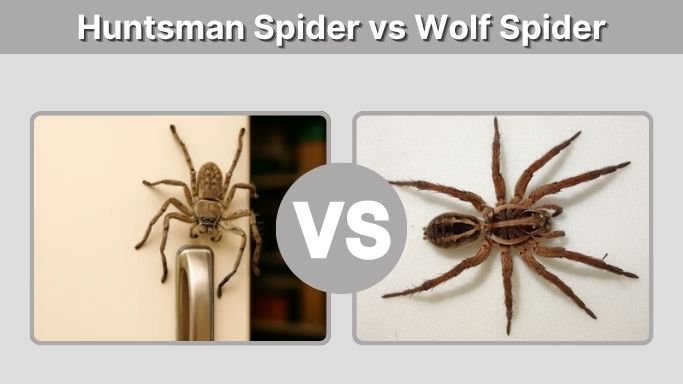
Huntsman spiders and wolf spiders are often confused because both are fast, hairy-looking hunters that do not rely on sticky webs to catch prey. However, they belong to different spider families and have different body shapes, leg positions, eye patterns, hunting styles, and habitats. Huntsman spiders are flatter with sideways legs, while wolf spiders are stockier, ground-running spiders with strong eyesight and a more compact body.
Huntsman Spider vs Wolf Spider: Main Differences
Huntsman spiders and wolf spiders may look similar at first, especially when they are large and brown. Both can appear in homes, gardens, sheds, forests, and outdoor spaces. Still, the easiest way to separate them is by looking at body shape, leg position, and eye arrangement.
| Feature | Huntsman Spider | Wolf Spider |
| Family | Sparassidae | Lycosidae |
| Body shape | Flat and wide | Stocky and compact |
| Leg position | Legs spread sideways like a crab | Legs point more forward and backward |
| Hunting style | Ambushes and chases prey | Runs on the ground and actively hunts |
| Web use | Does not use webs to catch prey | Does not use webs to catch prey |
| Common habitat | Tree bark, walls, ceilings, houses, forests | Ground, grass, leaf litter, burrows, gardens |
| Eye pattern | Less obvious to casual viewers | Large front eyes are easier to notice |
| Egg care | Female guards egg sac | Female carries egg sac attached to spinnerets |
1. Appearance and Body Shape
Huntsman spiders have a flat, wide body that helps them squeeze under bark, behind walls, inside cracks, and into narrow spaces. Their legs extend sideways, giving them a crab-like appearance. This is why some huntsman spiders are also called giant crab spiders.
Wolf spiders look more compact and muscular. Their bodies are usually thicker, and their legs do not spread as sideways as huntsman spiders. They often look like strong ground runners rather than flat wall-climbing spiders.
If the spider looks wide, flattened, and crab-like, it may be a huntsman. If it looks stocky, hairy, and built for running across the ground, it may be a wolf spider.
2. Size Comparison
Both huntsman spiders and wolf spiders can vary greatly in size. Some species are small, while others are large enough to frighten homeowners. Huntsman spiders are often famous for their long leg span, which can make them look much bigger than their body size.
Wolf spiders are usually judged more by body size because their legs are not as extremely spread out. Some large wolf spiders can look bulky and intimidating, but many huntsman spiders appear larger because of their long, sideways legs.
In simple terms, huntsman spiders often win in leg span, while wolf spiders may look thicker and more compact in body form.
3. Leg Position
The leg position is one of the best ways to tell them apart. Huntsman spiders have laterigrade legs, meaning the legs are rotated outward and extend to the sides. This makes them look like they are standing wide and flat.
Wolf spiders have legs arranged more like typical running spiders. Their legs are strong and suited for moving quickly over soil, grass, leaves, and rocks. They do not have the same crab-like sideways posture as huntsman spiders.
This difference is helpful because color can vary, but leg posture is easier to notice once you know what to look for.
Habitat and Where You Find Them
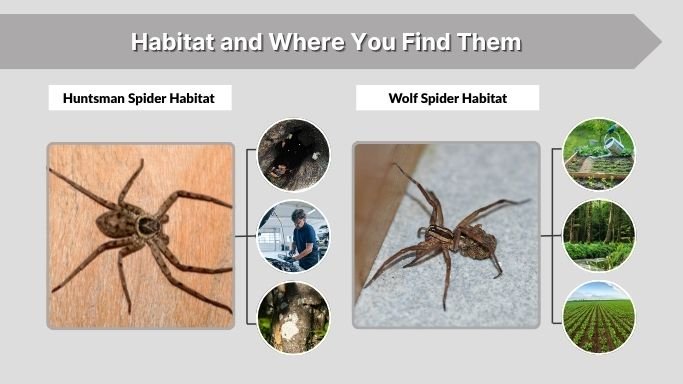
Huntsman spiders and wolf spiders live in different microhabitats, even if they sometimes appear in the same general area. Huntsman spiders are more likely to be seen on vertical surfaces, while wolf spiders are usually found on the ground.
Huntsman Spider Habitat
Huntsman spiders commonly live under loose bark, inside tree crevices, behind rocks, in sheds, garages, and sometimes inside homes. In warm regions, they may appear on walls, ceilings, doors, and behind curtains.
They like narrow hiding places because their flat bodies help them fit into tight spaces. Outdoors, they often rest under bark during the day and hunt at night. Indoors, they may hide behind picture frames, furniture, cabinets, or window areas where insects are common.
Huntsman spiders are especially well known in Australia, but different huntsman species also occur in Asia, Africa, the Americas, and other warm regions.
Wolf Spider Habitat
Wolf spiders are mainly ground-dwelling spiders. They live in grass, gardens, fields, forests, leaf litter, sandy areas, and sometimes burrows. Many species stay close to the ground and run after prey instead of climbing walls.
Wolf spiders may enter homes by accident, especially during seasonal changes or when looking for shelter. Indoors, they are often found on floors, basements, garages, and dark corners rather than high walls or ceilings.
Some wolf spiders make burrows, while others simply hide under leaves, stones, logs, or debris.
Hunting Style and Diet
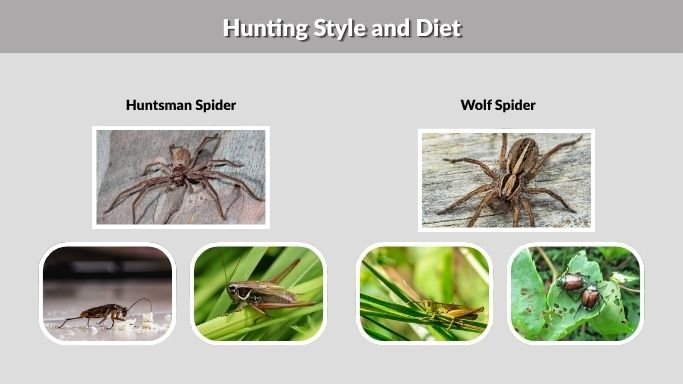
Both huntsman spiders and wolf spiders are active hunters. They do not use sticky orb webs to trap prey. Instead, they rely on speed, strength, and quick attacks.
1. Huntsman Spider Hunting Style
Huntsman spiders are ambush hunters and fast chasers. They often wait on walls, tree trunks, bark, or hidden surfaces until prey comes close. Then they rush forward and grab it.
Common huntsman spider prey includes:
- Cockroaches
- Moths
- Crickets
- Beetles
- Flies
- Grasshoppers
- Other spiders
- Small lizards in rare cases
Huntsman spiders are especially famous for eating cockroaches. This makes them useful in homes and gardens, even though many people are scared of their size and speed.
2. Wolf Spider Hunting Style
Wolf spiders are powerful ground hunters. They rely on strong eyesight and fast movement to chase prey across soil, grass, leaves, and rocks. Some species wait near burrows and attack passing insects.
Common wolf spider prey includes:
- Crickets
- Grasshoppers
- Beetles
- Flies
- Ants
- Small moths
- Other spiders
- Soft-bodied insects
Wolf spiders are excellent predators in gardens and fields. They help control insect populations naturally and are important in the food chain.
3. Which One Is Faster?
Both spiders are fast, but they move differently. Huntsman spiders can move quickly across walls, ceilings, and flat surfaces. Their sideways legs help them dart suddenly and change direction.
Wolf spiders are fast runners on the ground. They chase prey across soil, grass, and leaf litter. In a home, a wolf spider may sprint across the floor, while a huntsman may race across the wall.
So, huntsman spiders are excellent flat-surface sprinters, while wolf spiders are strong ground runners.
Eye Pattern and Identification
Eye arrangement is one of the most reliable ways to identify spiders, but it can be hard to see without a close look. Still, wolf spiders are famous for their noticeable large eyes.
Wolf Spider Eyes
Wolf spiders usually have large, forward-facing eyes. Their eye pattern is one of their most recognizable traits. Two large eyes often shine when light hits them at night. This is why people sometimes spot wolf spiders with a flashlight in grass or gardens.
Their strong vision helps them hunt on the ground. They do not wait for prey to get stuck in webs, so good eyesight is important.
Huntsman Spider Eyes
Huntsman spiders also have multiple eyes, but their eye pattern is not usually as obvious to casual observers. They rely on speed, touch, and movement detection when hunting.
If you can clearly see large, reflective front eyes, it may be a wolf spider. If the spider is flat, wide, and crab-like on a wall or tree trunk, it may be a huntsman spider.
Egg Sac and Baby Spider Behavior
One of the most interesting differences between huntsman spiders and wolf spiders is how females care for their eggs and young.
Huntsman Spider Egg Care
Female huntsman spiders usually create a flattened egg sac and guard it. They may hide with the egg sac under bark, behind objects, or in a sheltered place. During this time, the female can become more defensive.
She may stay close to the eggs and avoid hunting as actively. Once the spiderlings hatch, they eventually disperse and begin feeding on tiny insects.
Wolf Spider Egg Care
Wolf spiders are famous for carrying their egg sacs attached to their spinnerets. This means the egg sac stays behind the female as she moves. After the babies hatch, they often climb onto the mother’s back and ride there for a short period.
This behavior is one of the easiest ways to identify a female wolf spider. If you see a spider carrying a round egg sac behind her, or many tiny spiderlings on her back, it is very likely a wolf spider.
Huntsman Spider vs Wolf Spider Bite
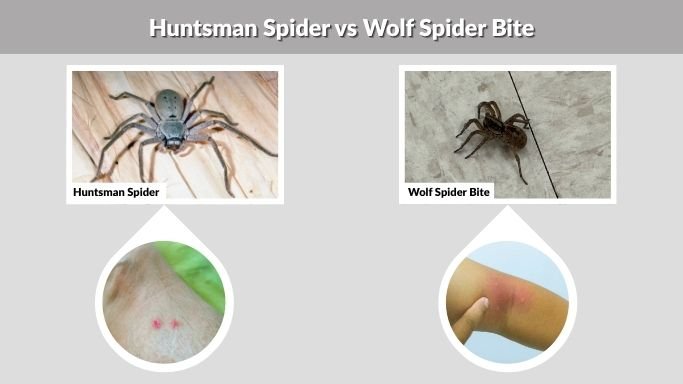
Both spiders can bite if handled, trapped, or pressed against the skin. However, neither huntsman spiders nor wolf spiders are usually considered dangerously venomous to healthy adults.
| Bite Factor | Huntsman Spider | Wolf Spider |
| Bite reason | Usually defensive | Usually defensive |
| Pain level | Mild to moderate | Mild to moderate |
| Common symptoms | Local pain, swelling, redness | Local pain, swelling, redness |
| Medical concern | Usually low | Usually low |
| Best response | Clean bite, use cold pack, monitor | Clean bite, use cold pack, monitor |
Are Huntsman Spiders Dangerous?
Huntsman spiders are not usually dangerous to humans. They may bite if frightened or handled, but serious reactions are uncommon. A bite may cause pain, redness, or swelling.
Their size and speed make them look more threatening than they really are. They are more interested in escaping than attacking people.
Are Wolf Spiders Dangerous?
Wolf spiders are also not usually dangerous to humans. They can bite if grabbed or trapped, but they are not aggressive toward people. A bite may feel similar to a bee sting or mild spider bite reaction.
People sometimes confuse wolf spiders with more concerning spiders because of their brown color and hairy body. Correct identification is important before assuming danger.
When to Seek Medical Help
Most bites from these spiders can be managed with basic care, but medical help may be needed if symptoms become serious.
Seek help if you notice:
- Severe pain
- Spreading swelling
- Trouble breathing
- Dizziness
- Fever
- Skin infection
- Allergic reaction
- Worsening symptoms after 24–48 hours
Children, elderly people, and people with allergies should be monitored more carefully after any spider bite.
Huntsman Spider vs Brown Recluse vs Wolf Spider
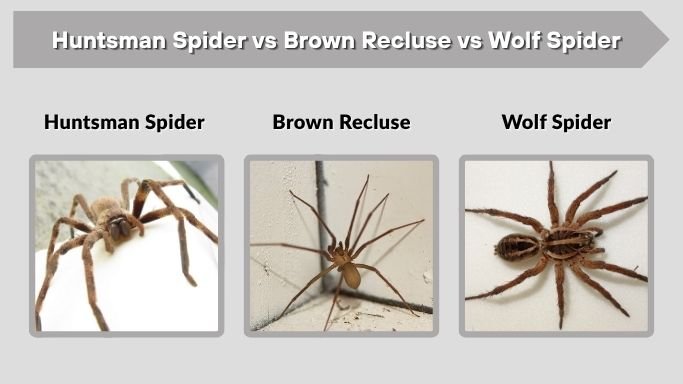
Many people compare huntsman spiders with brown recluse spiders because all can be brown. However, they are very different. Brown recluse spiders are smaller, more delicate, and known for the violin-shaped marking on the back.
Quick Comparison
Huntsman spiders are large, flat, and crab-like. Wolf spiders are stocky ground hunters with large eyes. Brown recluse spiders are smaller, smoother-looking, and have long thin legs compared with wolf spiders.
Brown recluse spiders are more medically important than huntsman or wolf spiders. If you live in an area where brown recluse spiders occur, learn the correct identification features rather than judging only by color.
Huntsman Spider vs Tarantula
Huntsman spiders are often compared with tarantulas because both can be large and hairy-looking. However, tarantulas are usually heavier-bodied spiders, while huntsman spiders are flatter and faster.
Tarantulas often move more slowly and have thicker bodies and legs. Huntsman spiders are built for speed and squeezing into narrow spaces. Tarantulas are usually burrowers or ground-dwelling spiders, depending on the species, while huntsman spiders often climb walls, trees, and bark surfaces.
A giant huntsman may have a wider leg span, but a large tarantula such as the Goliath birdeater is much heavier in body mass.
Florida Huntsman Spider vs Wolf Spider
In Florida and other warm regions, people may confuse huntsman-like spiders with wolf spiders. Florida has large wandering spiders, including wolf spiders and huntsman-type spiders such as the pantropical huntsman.
How to Tell Them Apart in Florida
Look at where the spider is found. A large spider on a wall, ceiling, or behind bark with sideways legs may be a huntsman. A stocky spider running on the ground, in grass, or across the floor may be a wolf spider.
Also look at body shape. Huntsman spiders are flatter and wider. Wolf spiders are more compact and often have stronger-looking bodies.
Which Spider Would Win?
Searches like “huntsman spider vs wolf spider who would win” are common, but the answer depends on size, species, environment, and chance. In nature, spiders do not fight for entertainment. They usually avoid risky conflict unless food, territory, or survival is involved.
A larger huntsman spider might overpower a smaller wolf spider. A large wolf spider could also attack a smaller huntsman. In many cases, both would rather escape than fight.
It is better to compare their biology than imagine a fight. Both are skilled predators adapted to different hunting styles.
Identification Checklist
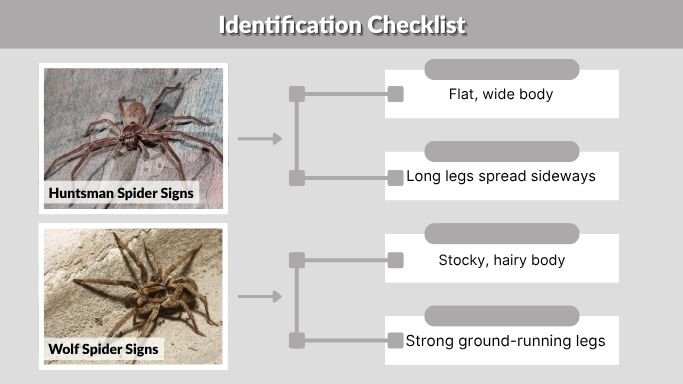
Use this simple checklist to identify whether you are seeing a huntsman spider or a wolf spider.
Huntsman Spider Signs
- Flat, wide body
- Long legs spread sideways
- Crab-like posture
- Often seen on walls or ceilings
- Hides under bark or in cracks
- Very fast on flat surfaces
- Commonly eats cockroaches
- Female guards egg sac
Wolf Spider Signs
- Stocky, hairy body
- Strong ground-running legs
- Often seen on floors, grass, or soil
- Large noticeable eyes
- May carry egg sac behind body
- Babies may ride on mother’s back
- Hunts on the ground
- Often found in gardens and leaf litter
FAQs
Is a huntsman spider bigger than a wolf spider?
A huntsman spider often looks bigger because of its long sideways leg span. However, wolf spiders can have a thicker and more compact body. Size depends on the species, age, and sex of the spider. In many cases, huntsman spiders appear wider, while wolf spiders look stockier.
How can I tell a huntsman spider from a wolf spider?
Look at body shape, leg position, and location. Huntsman spiders are flatter with legs spread sideways like a crab and are often seen on walls or tree bark. Wolf spiders are stockier ground hunters with noticeable eyes and are usually found on floors, soil, grass, or leaf litter.
Are huntsman spiders more dangerous than wolf spiders?
No, huntsman spiders are not usually more dangerous than wolf spiders. Both can bite defensively, but serious effects are uncommon. A bite from either spider may cause local pain, redness, or swelling. Medical attention is needed if symptoms become severe or an allergic reaction occurs.
Do huntsman spiders and wolf spiders make webs?
Neither huntsman spiders nor wolf spiders use sticky webs to catch prey. They are active hunters that chase or ambush insects. Some wolf spiders may use silk for burrows or egg sacs, while huntsman spiders use silk for shelter and egg protection rather than prey-catching webs.
Which spider is better for pest control?
Both spiders help control pests. Huntsman spiders are especially useful against cockroaches, moths, and indoor insects. Wolf spiders help reduce insects in gardens, lawns, fields, and leaf litter. Even though they may look scary, both spiders play a helpful role in controlling pest populations.