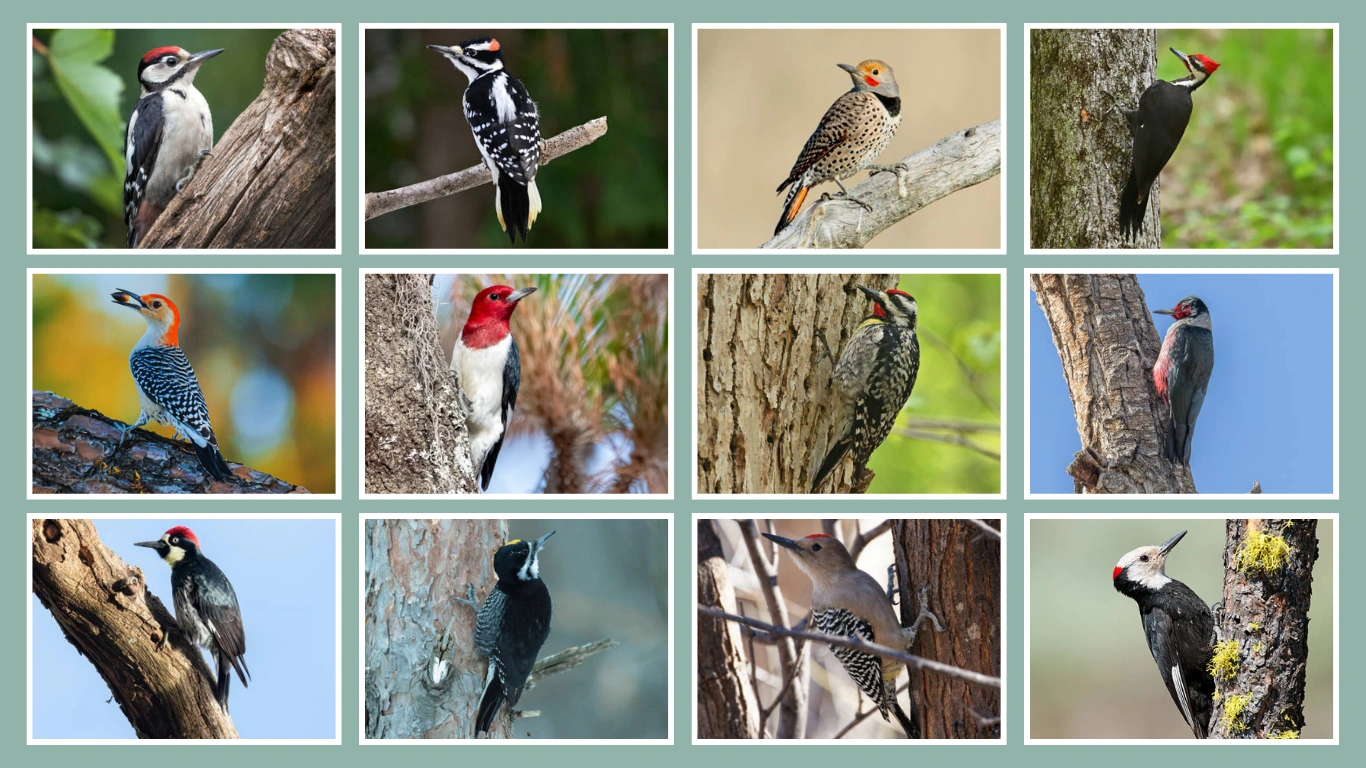
North America is home to a wide variety of woodpecker species, each with its own unique markings, behaviors, and preferred habitats. From the tiny Downy Woodpecker to the legendary Ivory-billed, these birds play a vital role in forest ecosystems. This guide covers 20 common woodpeckers found across the continent, detailing how to identify them, where they live, and how long they typically survive in the wild
1. Downy Woodpecker
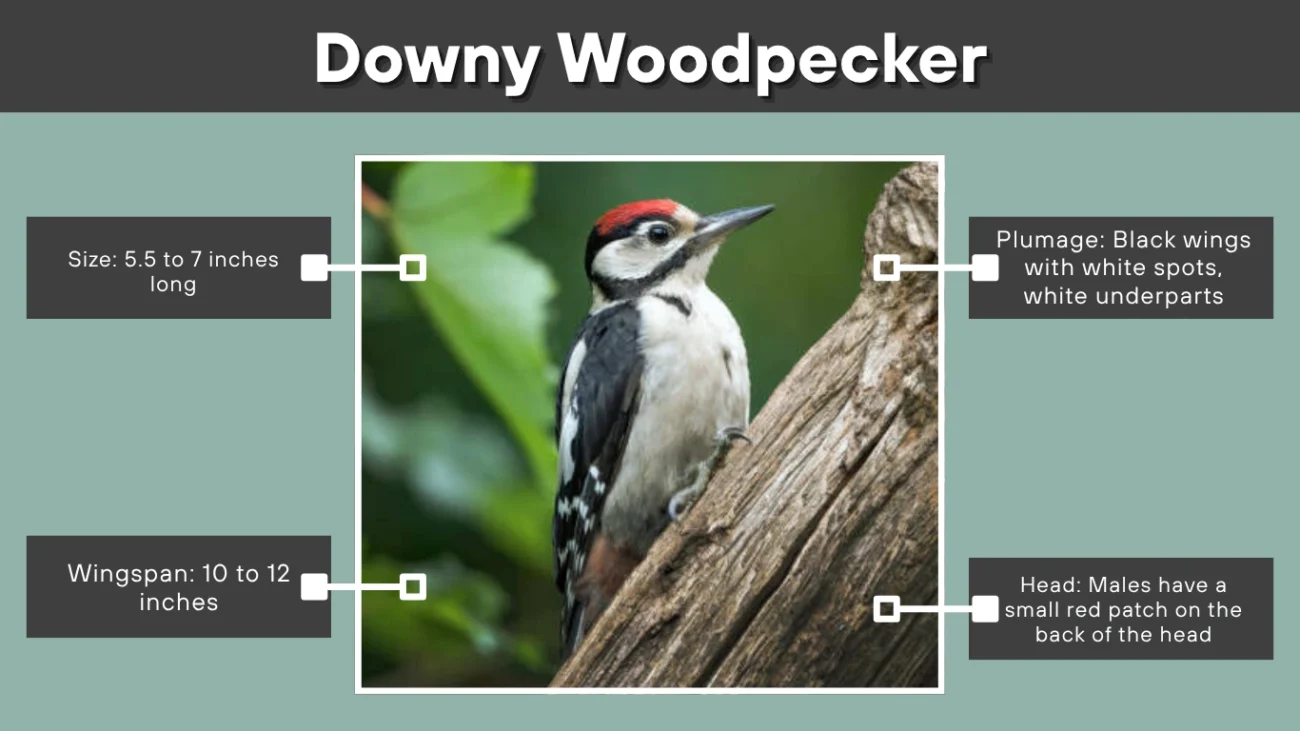
The Downy Woodpecker (Dryobates pubescens) is the smallest and one of the most widespread woodpeckers in North America. Its black-and-white plumage and acrobatic movements make it a familiar sight in both wild forests and urban areas.
Identification
- Size: 5.5 to 7 inches long
- Wingspan: 10 to 12 inches
- Plumage: Black wings with white spots, white underparts
- Head: Males have a small red patch on the back of the head
- Bill: Short and chisel-like
- Behavior: Frequently clings to tree trunks and branches, drumming on wood
Where Found in North America
This species is found year-round across most of the United States and southern Canada. It is especially common in the eastern and central U.S., parts of the Pacific Northwest, and southern Canadian provinces.
Habitat
The Downy Woodpecker thrives in a variety of environments, including deciduous forests, woodland edges, suburban parks, orchards, and gardens. It easily adapts to both rural and urban settings.
Lifespan
In the wild, Downy Woodpeckers generally live 4 to 6 years, although some individuals have been known to reach 11 years of age.
2. Hairy Woodpecker
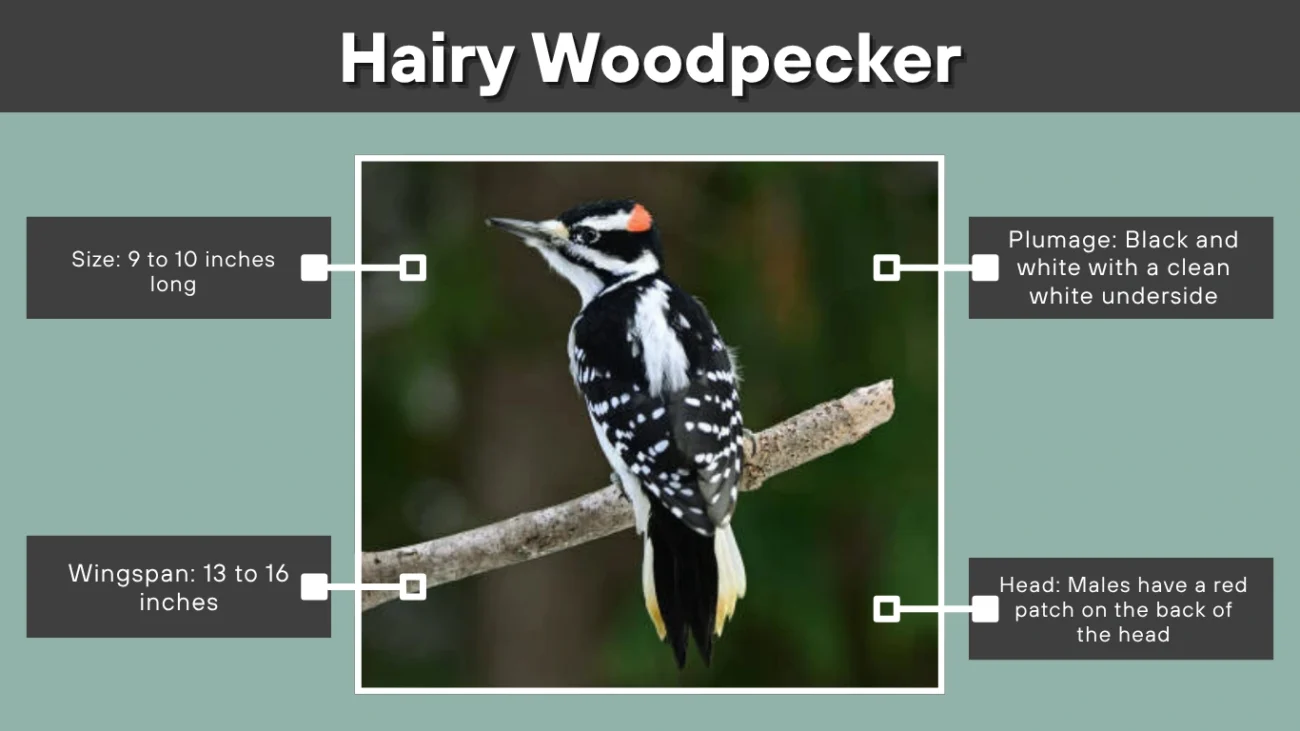
The Hairy Woodpecker (Dryobates villosus) looks very similar to the Downy Woodpecker but is noticeably larger with a longer bill. It is a strong flier and a powerful driller, often found in mature forests and woodland areas.
Identification
- Size: 9 to 10 inches long
- Wingspan: 13 to 16 inches
- Plumage: Black and white with a clean white underside
- Head: Males have a red patch on the back of the head
- Bill: Long and straight, almost the same length as the head
- Behavior: Often seen on tree trunks, making loud, slow drumming sounds
Where Found in North America
Hairy Woodpeckers are found throughout most of North America, from Alaska and Canada to parts of Mexico. They are more often seen in mature forests than in suburban areas.
Habitat
They prefer mature deciduous or mixed woodlands but can also be found in mountain forests, swamps, and sometimes suburban areas with old trees.
Lifespan
Typically lives between 5 to 15 years in the wild, depending on environmental conditions and predation.
3. Northern Flicker

The Northern Flicker (Colaptes auratus) is a large, brownish woodpecker known for its unique behavior of foraging on the ground for ants. It has distinctive markings and is one of the few woodpecker species commonly seen feeding on lawns.
Identification
- Size: 11 to 12 inches long
- Wingspan: 16 to 20 inches
- Plumage: Brown with black bars, large black crescent on the chest
- Head: Males have a red or black mustache mark, depending on the region
- Tail: White rump, visible in flight
- Behavior: Frequently forages on the ground, especially for ants and beetles
Where Found in North America
Widespread across North America. Two main forms exist: the “yellow-shafted” in the eastern and northern regions, and the “red-shafted” in the west.
Habitat
Often found in open woodlands, forest edges, fields with scattered trees, and even city parks. Prefers areas where it can feed on insects from the ground.
Lifespan
Average lifespan in the wild is around 6 to 9 years. Some may live over a decade under favorable conditions.
4. Pileated Woodpecker
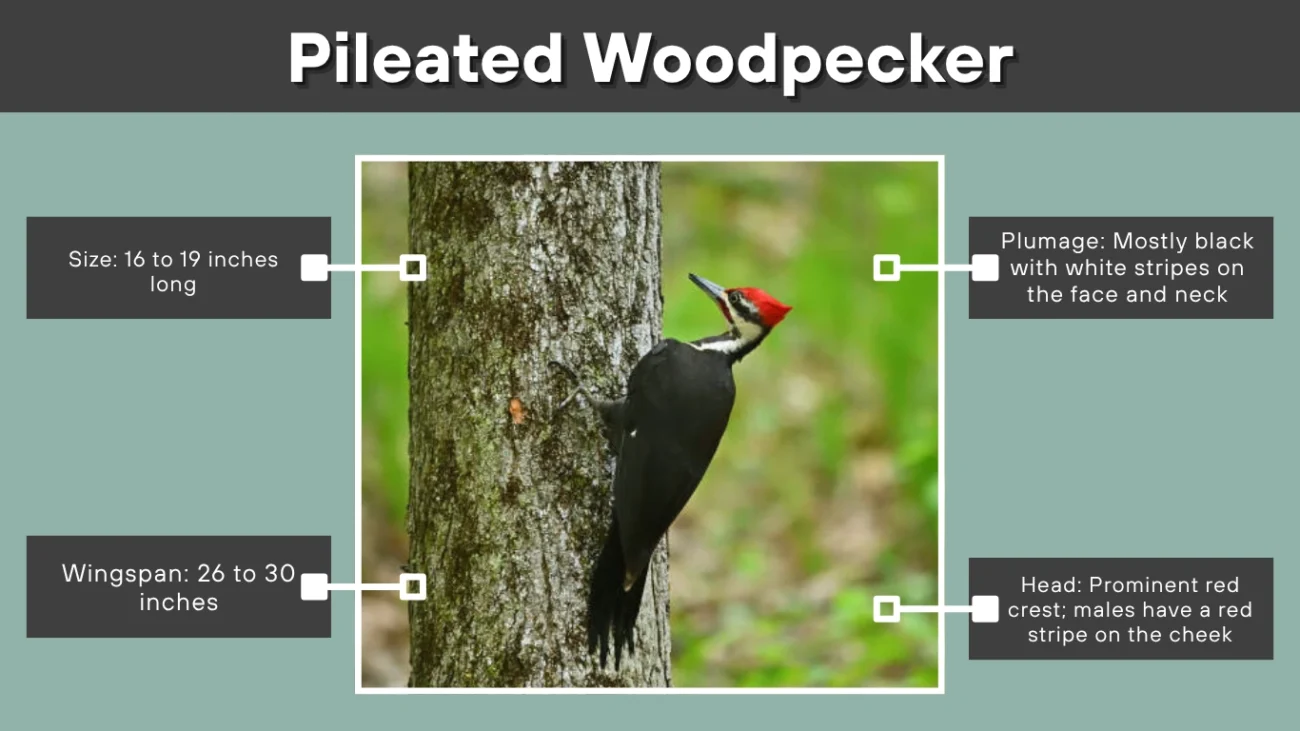
The Pileated Woodpecker (Dryocopus pileatus) is the largest woodpecker species in North America. Its striking red crest and loud, echoing calls make it a memorable sight in mature forests.
Identification
- Size: 16 to 19 inches long
- Wingspan: 26 to 30 inches
- Plumage: Mostly black with white stripes on the face and neck
- Head: Prominent red crest; males have a red stripe on the cheek
- Bill: Long and chisel-like, used for powerful drilling
- Behavior: Leaves large rectangular holes in trees while foraging for carpenter ants
Where Found in North America
Commonly found in the eastern United States, parts of Canada, and along the Pacific Coast. Especially abundant in heavily wooded areas.
Habitat
Prefers mature deciduous or mixed forests with large standing dead trees. Often found in forested wetlands, old-growth woods, and sometimes near rural developments with dense tree cover.
Lifespan
Typically lives 9 to 13 years in the wild, though some may survive longer in stable, undisturbed environments.
5. Red-bellied Woodpecker

Despite its name, the Red-bellied Woodpecker (Melanerpes carolinus) has only a faint reddish tint on its belly. It is known for its vivid red cap and loud, rolling call, commonly heard in eastern woodlands and suburbs.
Identification
- Size: 9 to 10.5 inches long
- Wingspan: 15 to 18 inches
- Plumage: Light gray body with black-and-white barred back
- Head: Bright red crown and nape (more prominent in males)
- Bill: Medium-length, straight
- Behavior: Agile climber, often seen scaling tree trunks and branches
Where Found in North America
Widespread across the eastern and southeastern United States. Not typically found in the far north or west.
Habitat
Common in open woodlands, hardwood forests, river bottoms, parks, and suburban areas with large trees.
Lifespan
Generally lives 6 to 12 years in the wild, with some individuals reaching up to 15 years.
6. Red-headed Woodpecker

The Red-headed Woodpecker (Melanerpes erythrocephalus) is unmistakable with its bold red head and contrasting black-and-white body. Unlike most woodpeckers, it frequently catches insects in flight and stores food for later.
Identification
- Size: 7.5 to 9 inches long
- Wingspan: 16 to 17 inches
- Plumage: Bright red head, white underparts, black back with large white wing patches
- Bill: Strong and straight
- Behavior: Known for catching flying insects and storing food in tree crevices
Where Found in North America
Primarily found in the central and eastern United States. More common in the Midwest, Great Plains, and Southeast regions.
Habitat
Favors open woodlands, groves, orchards, forest edges, and dead tree stands. Often seen in areas with scattered trees and minimal underbrush.
Lifespan
Typically lives around 9 to 12 years in the wild.
7. Yellow-bellied Sapsucker

The Yellow-bellied Sapsucker (Sphyrapicus varius) is a migratory woodpecker known for drilling neat rows of holes in trees to feed on sap. Its yellowish belly and red cap help distinguish it from other species.
Identification
- Size: 7 to 8.5 inches long
- Wingspan: 13 to 16 inches
- Plumage: Black-and-white patterned body with a pale yellow belly
- Head: Red forehead and (in males) red throat
- Bill: Medium length, slightly curved
- Behavior: Drills horizontal rows of sap wells in tree bark
Where Found in North America
Breeds in Canada and the northeastern U.S.; winters in the southeastern U.S., Mexico, and Central America.
Habitat
Prefers deciduous forests and mixed woodlands. Also found in orchards, parks, and areas with birch, maple, or aspen trees.
Lifespan
Lives around 5 to 7 years in the wild.
8. Lewis’s Woodpecker
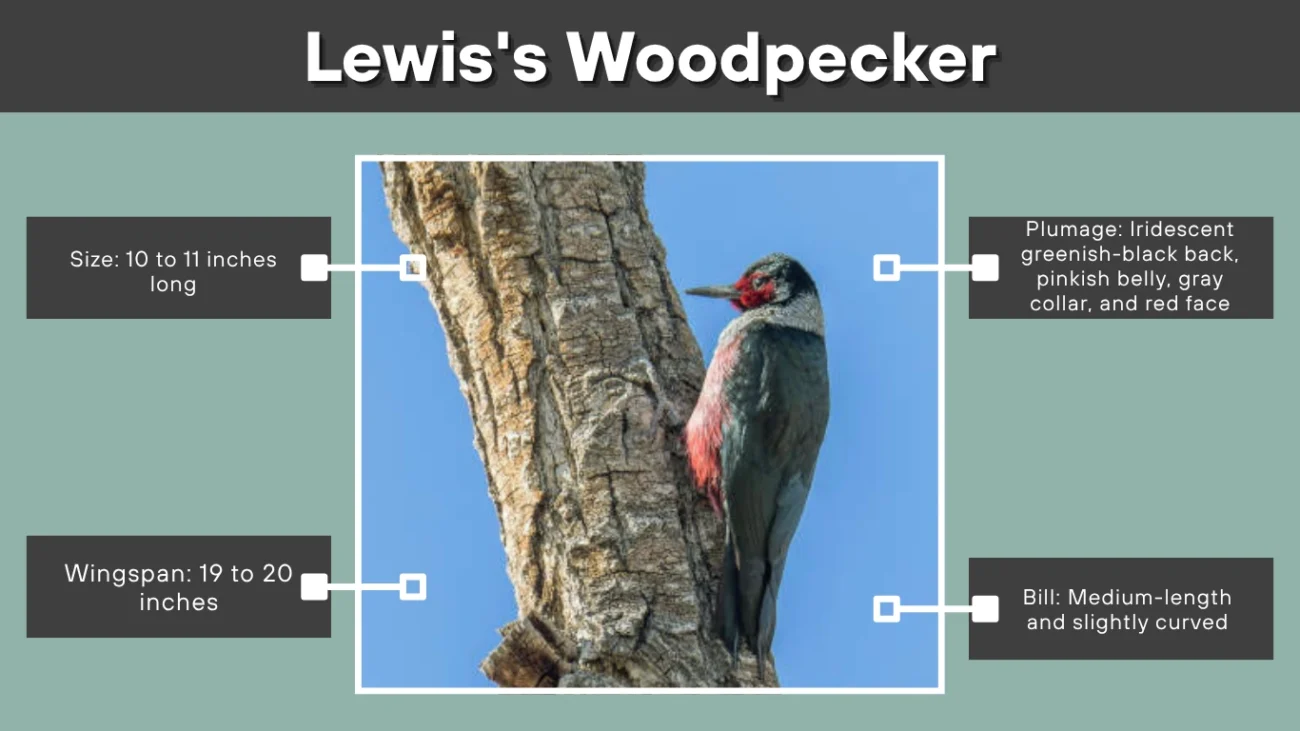
Lewis’s Woodpecker (Melanerpes lewis) stands out from other woodpeckers due to its dark, glossy feathers and slow, crow-like flight. It behaves more like a flycatcher than a typical woodpecker, often catching insects in the air.
Identification
- Size: 10 to 11 inches long
- Wingspan: 19 to 20 inches
- Plumage: Iridescent greenish-black back, pinkish belly, gray collar, and red face
- Bill: Medium-length and slightly curved
- Behavior: Often perches quietly on exposed branches and catches flying insects mid-air
Where Found in North America
Primarily found in the western United States and parts of southwestern Canada. Common in the Rocky Mountain region, Great Basin, and scattered parts of California and Oregon. It is typically a short-distance migrant, moving southward in winter.
Habitat
Prefers open pine woodlands, burned forests, oak savannas, and areas with standing dead trees. It often nests in cavities left in fire-scarred pines or cottonwoods and uses the same nesting site for many years. Unlike many woodpeckers, it avoids dense forests and favors sunny, open landscapes.
Lifespan
In the wild, Lewis’s Woodpeckers can live 4 to 10 years, with threats such as habitat loss and competition for nesting sites affecting longevity. Banding records show some individuals surviving beyond a decade.
9. Acorn Woodpecker
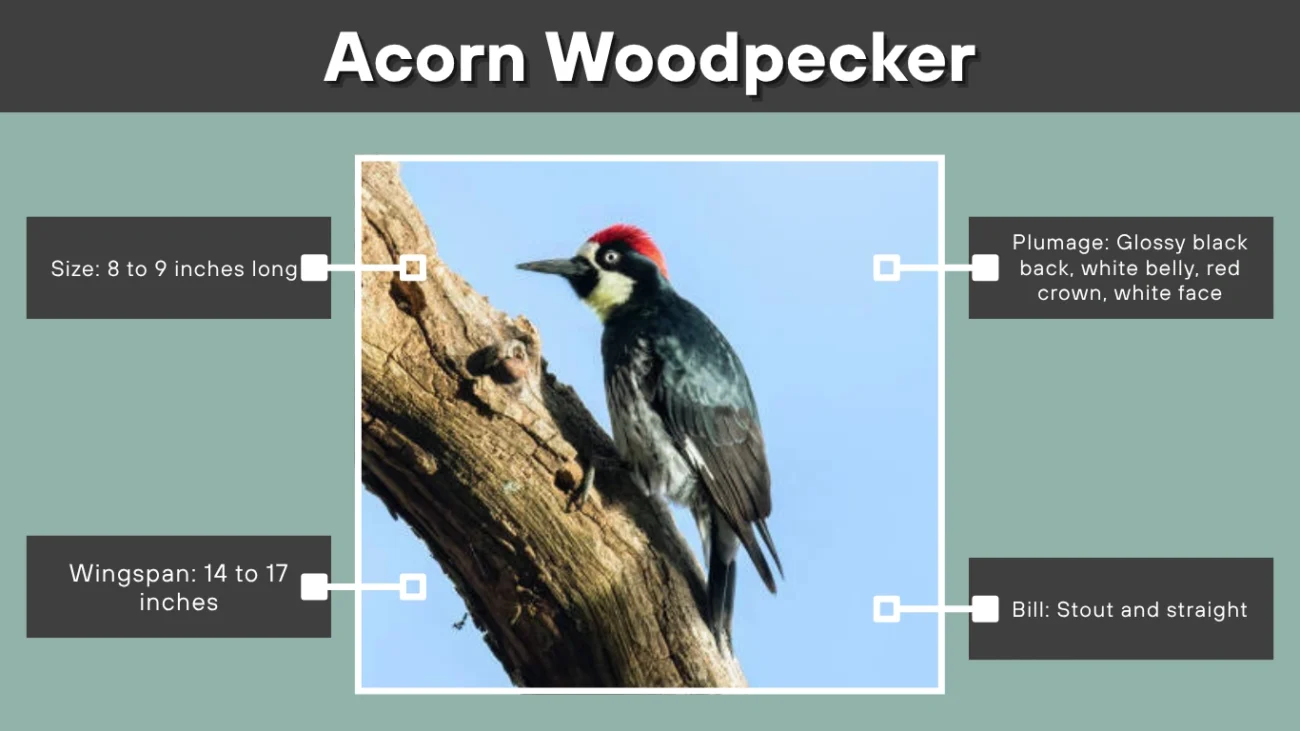
The Acorn Woodpecker (Melanerpes formicivorus) is known for its communal lifestyle and its habit of storing thousands of acorns in tree trunks, utility poles, and wooden structures. Its clown-like face makes it easily recognizable.
Identification
- Size: 8 to 9 inches long
- Wingspan: 14 to 17 inches
- Plumage: Glossy black back, white belly, red crown, white face with black around the eyes
- Bill: Stout and straight
- Behavior: Lives in family groups, stores acorns in granary trees
Where Found in North America
Native to the western United States, especially in California, Arizona, New Mexico, and extending into parts of Oregon and Texas. Also found throughout Mexico and Central America. Year-round resident in its range.
Habitat
Typically inhabits oak and mixed oak-pine woodlands, especially areas with plenty of mature oak trees for storing acorns. It also adapts well to parks, golf courses, and ranchlands. The species builds communal granaries in dead trees or wooden structures, which serve as food storage and social hubs.
Lifespan
Acorn Woodpeckers commonly live 8 to 12 years in the wild. Their cooperative breeding system and group defense of food stores contribute to higher survival rates within their communities.
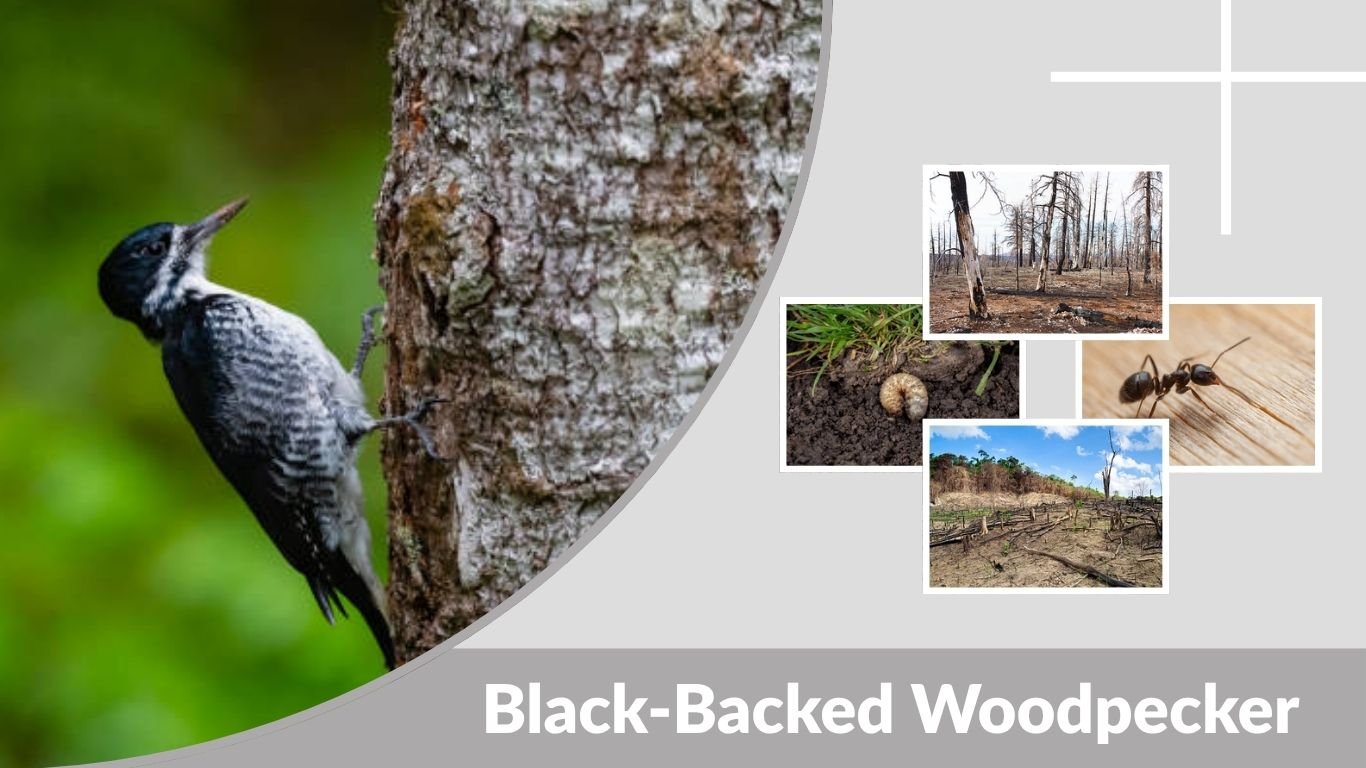
10. Black-backed Woodpecker
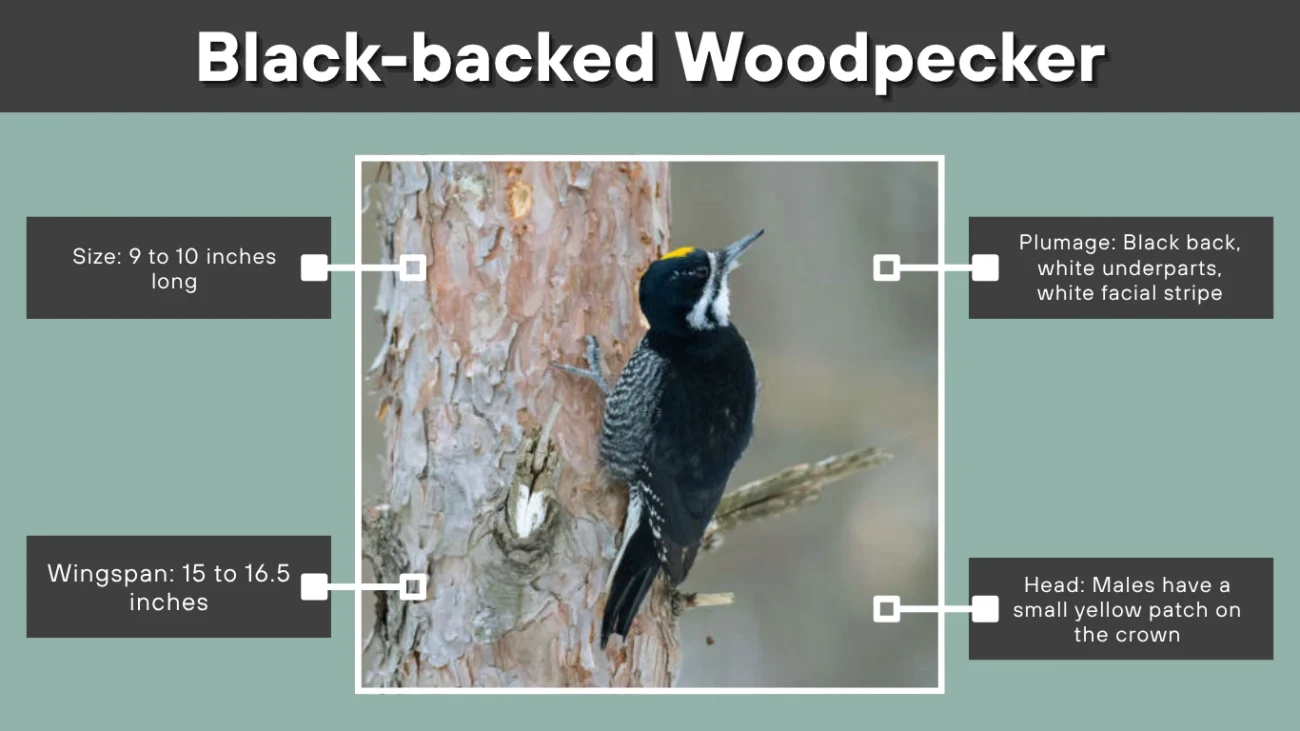
The Black-backed Woodpecker (Picoides arcticus) is a specialized bird adapted to recently burned forests, where it feeds on wood-boring beetle larvae. Its dark plumage helps it blend into charred tree trunks.
Identification
- Size: 9 to 10 inches long
- Wingspan: 15 to 16.5 inches
- Plumage: Black back, white underparts, white facial stripe
- Head: Males have a small yellow patch on the crown
- Bill: Strong and straight
- Behavior: Often silent and still; chips away at bark to find insect larvae
Where Found in North America
Primarily found in boreal forests of Canada and the northern U.S., including the Rockies, northern Great Lakes, and parts of New England. Most often observed in areas recently affected by wildfire, as it thrives in post-burn habitats.
Habitat
Prefers burned coniferous forests with standing dead trees. The bird is strongly tied to these environments due to its dependence on beetle larvae found in fire-damaged wood. It avoids urban or heavily managed forests and is rarely seen outside fire-affected zones.
Lifespan
Generally lives 6 to 8 years in the wild. Its dependence on ephemeral burned habitats means its population density can fluctuate with wildfire frequency.
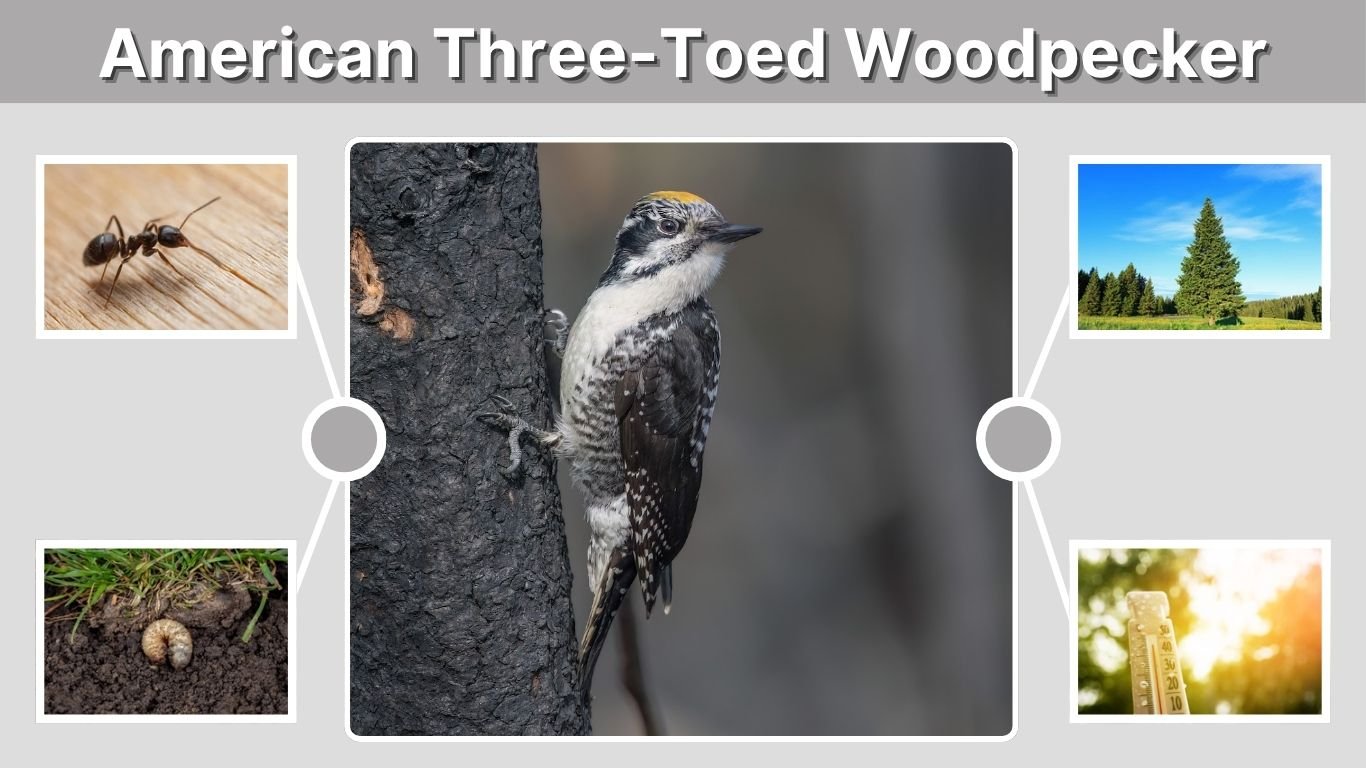
11. American Three-toed Woodpecker

The American Three-toed Woodpecker (Picoides dorsalis) is a quiet and elusive bird of the northern forests. Its three-toed feet help it grip tree trunks firmly, a feature it shares with only a few other woodpecker species.
Identification
- Size: 8.5 to 9.5 inches long
- Wingspan: 14.5 to 15.5 inches
- Plumage: Black-and-white barred back, pale underparts
- Head: Males have a yellow crown; females do not
- Bill: Short and chisel-shaped
- Behavior: Peels bark to access insect larvae; known for quiet tapping rather than loud drumming
Where Found in North America
Ranges across Alaska, much of Canada, and down into the northern Rocky Mountains, northern Great Lakes, and parts of the Northeast U.S. It tends to stay year-round in coniferous forests of these regions.
Habitat
Favors mature and old-growth boreal or subalpine forests, particularly in areas affected by beetle infestations or fire. It often inhabits spruce, fir, or pine forests and is most active where insect outbreaks create an abundance of food.
Lifespan
Lives around 5 to 7 years in the wild. Its reclusive nature and preference for remote habitats help reduce predation, contributing to longer survival in some individuals.
12. Gila Woodpecker
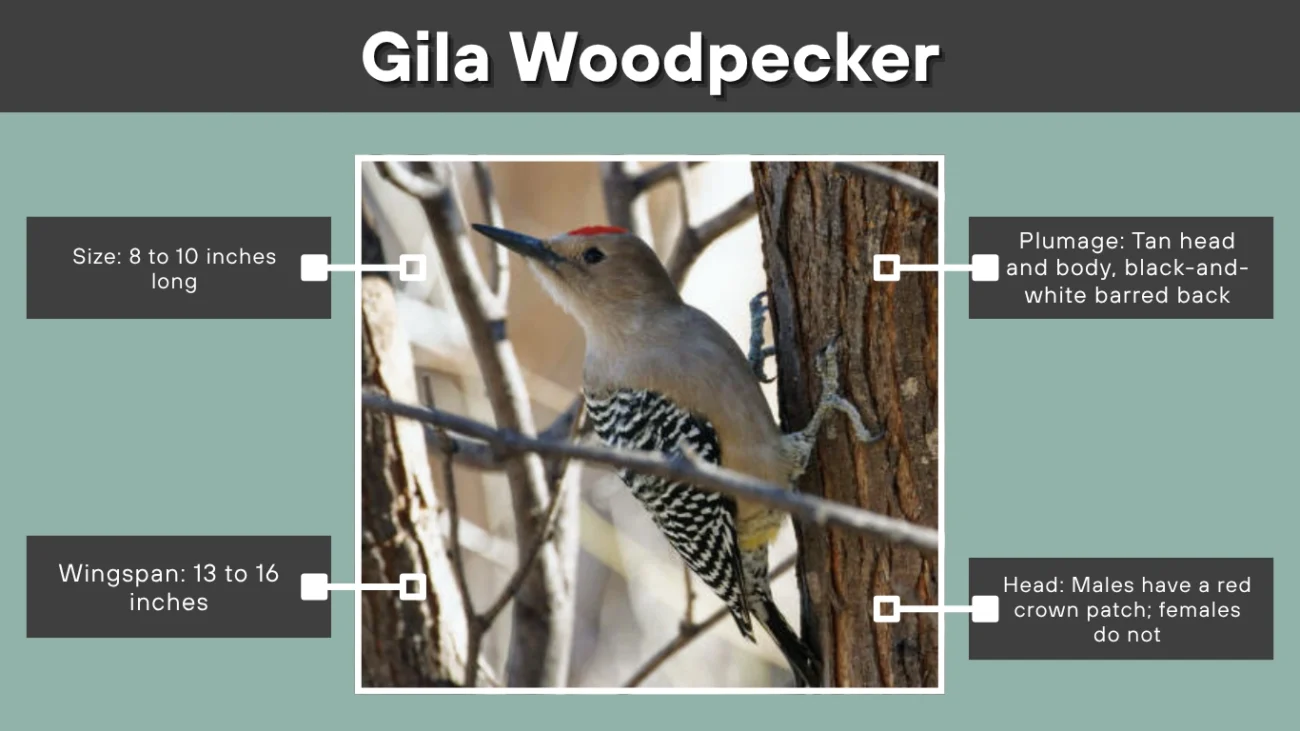
The Gila Woodpecker (Melanerpes uropygialis) is a desert-adapted species, well known for its presence in saguaro cacti and urban areas of the southwestern United States. It’s vocal, active, and often seen flitting between cactus arms or suburban palm trees.
Identification
- Size: 8 to 10 inches long
- Wingspan: 13 to 16 inches
- Plumage: Tan head and body, black-and-white barred back
- Head: Males have a red crown patch; females do not
- Bill: Straight and sturdy
- Behavior: Often uses saguaro cacti for nesting and drumming
Where Found in North America
Found in the southwestern United States, especially southern Arizona, southeastern California, southern Nevada, and parts of New Mexico. It also extends into western Mexico. It is a year-round resident in desert environments.
Habitat
Prefers desert scrub, arid woodlands, and suburban areas with large cacti or tall trees. The Gila Woodpecker is strongly associated with the Sonoran Desert, where it excavates nesting holes in saguaro cacti. It also adapts well to golf courses, parks, and urban gardens where palm trees or telephone poles offer nest sites.
Lifespan
Typically lives 6 to 10 years in the wild. The availability of nesting sites and food sources (insects, cactus fruit, seeds) influences longevity and population health.
13. Ladder-backed Woodpecker
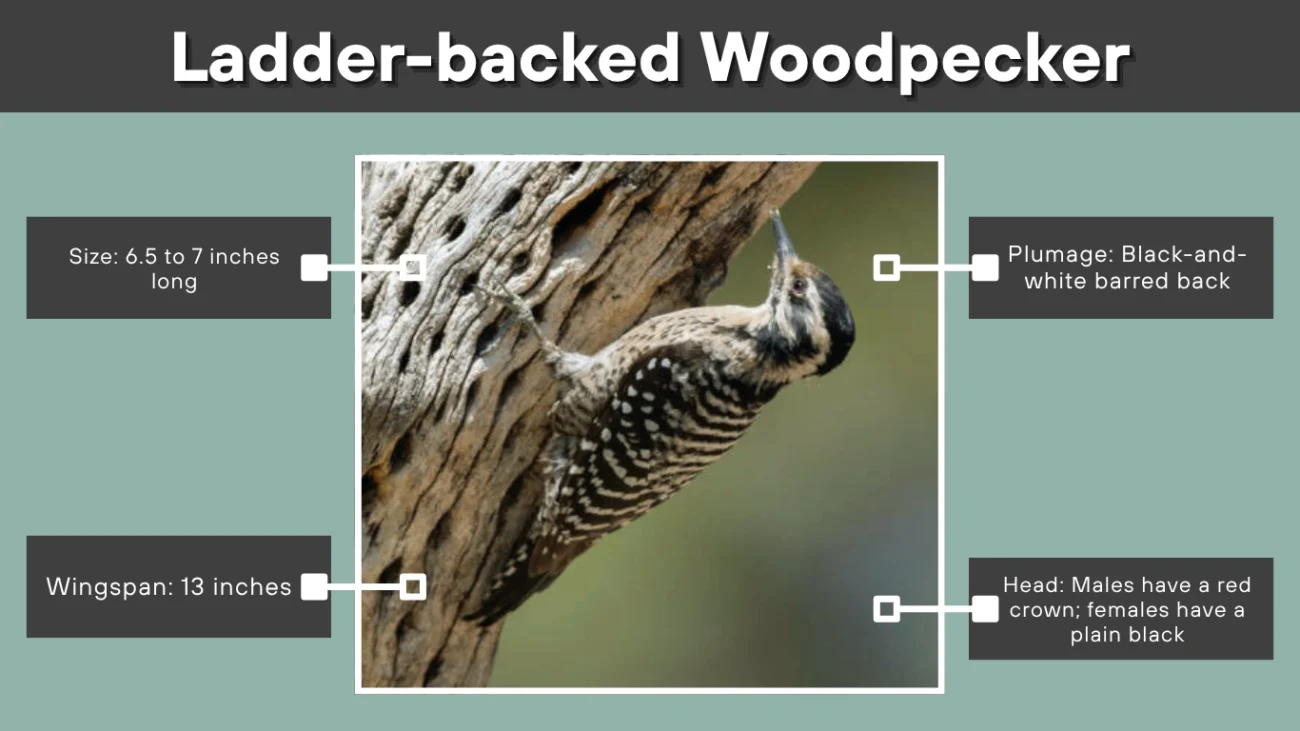
The Ladder-backed Woodpecker (Dryobates scalaris) is a small, dryland woodpecker named for the ladder-like black-and-white pattern on its back. It is commonly found in desert and scrubby regions of the southwestern U.S. and Mexico.
Identification
- Size: 6.5 to 7 inches long
- Wingspan: 13 inches
- Plumage: Black-and-white barred back, pale buff underparts with spots
- Head: Males have a red crown; females have a plain black-and-white head
- Bill: Short and straight
- Behavior: Forages on small branches and twigs, often seen in pairs
Where Found in North America
Widespread in the arid and semi-arid regions of the southwestern U.S., including Texas, Arizona, New Mexico, and southern California. Its range continues south through Mexico.
Habitat
Favors desert scrub, mesquite groves, dry woodlands, and brushy canyons. It avoids dense forests but is well adapted to thorny thickets and cactus-dominated landscapes. It sometimes appears in agricultural zones and suburban areas near desert habitats.
Lifespan
Generally lives 5 to 8 years in the wild. Population stability depends on the availability of dead wood for nesting and minimal disturbance to dryland habitats.
14. Red-naped Sapsucker
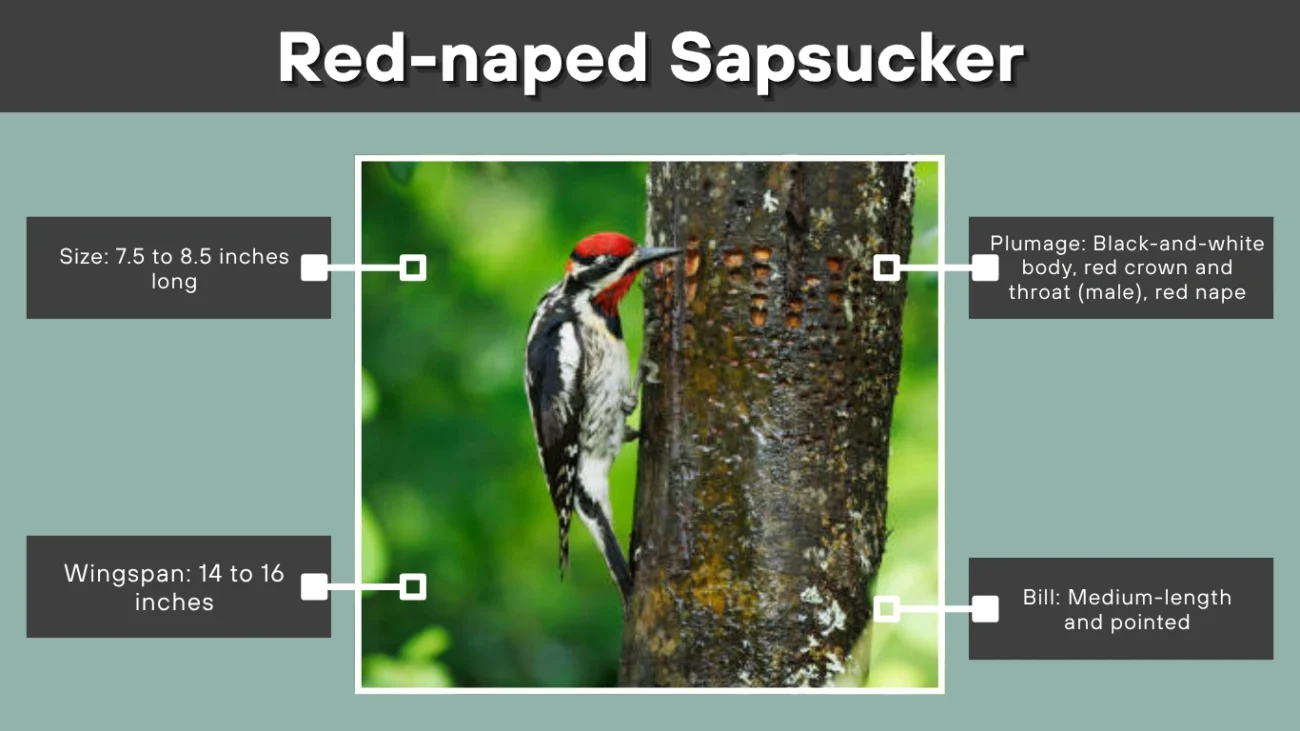
The Red-naped Sapsucker (Sphyrapicus nuchalis) is a medium-sized woodpecker recognized by the red patch on the nape of its neck. It drills neat horizontal rows of holes in trees to feed on sap, similar to its close relative, the Yellow-bellied Sapsucker.
Identification
- Size: 7.5 to 8.5 inches long
- Wingspan: 14 to 16 inches
- Plumage: Black-and-white body, red crown and throat (male), red nape
- Bill: Medium-length and pointed
- Behavior: Feeds on tree sap, insects, and fruit; often returns to same trees repeatedly
Where Found in North America
Common in the western United States and parts of southwestern Canada, especially during the breeding season. Found from the Rocky Mountains to the Great Basin and as far south as New Mexico and Arizona. Winters in the southwestern U.S. and Mexico.
Habitat
Breeds in mixed aspen, pine, and conifer forests at mid-elevations, often near streams. During migration and winter, it can be found in woodlands, orchards, and even desert oases. Prefers trees with thin bark for easier sap extraction, such as aspens, birches, and willows.
Lifespan
Typically lives 5 to 7 years. It may live longer in stable habitats with an abundance of sap-producing trees.
15. Williamson’s Sapsucker
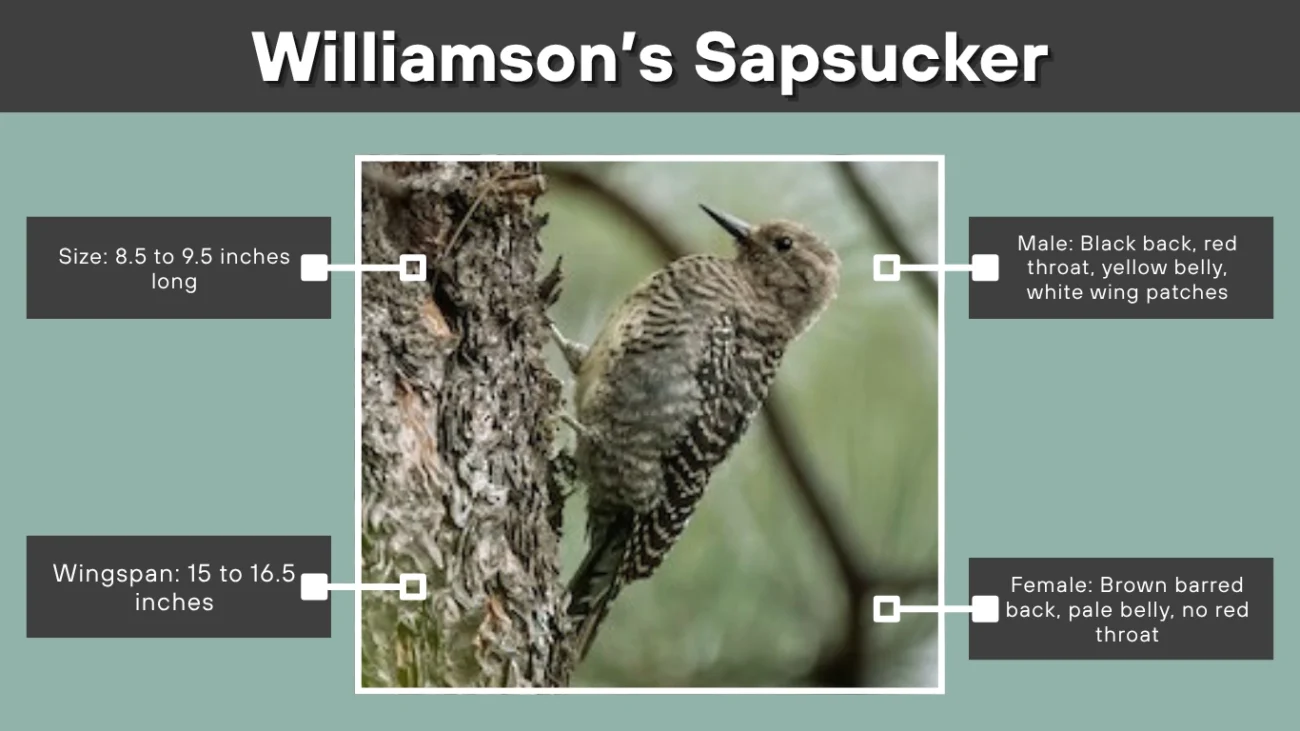
Williamson’s Sapsucker (Sphyrapicus thyroideus) is a strikingly marked woodpecker, with males and females showing very different plumage. It’s known for drilling sap wells and feeding on ants and beetles found beneath tree bark.
Identification
- Size: 8.5 to 9.5 inches long
- Wingspan: 15 to 16.5 inches
- Male: Black back, red throat, yellow belly, white wing patches
- Female: Brown barred back, pale belly, no red throat
- Bill: Sturdy and straight
- Behavior: Drills sap wells in conifers and feeds on both sap and insects
Where Found in North America
Breeds in the western mountainous regions of North America—from British Columbia and the Rockies down to Arizona and New Mexico. Winters in the southwestern U.S. and northern Mexico.
Habitat
Primarily inhabits high-elevation conifer forests, especially those with large ponderosa pines, Douglas-firs, and larches. During migration, may move to lower elevations or mixed forests. Nesting often occurs in dead conifers or snags in mature forests.
Lifespan
Lives approximately 6 to 9 years in the wild. Habitat quality and tree availability for sap feeding and nesting strongly influence survival and reproduction.
16. White-headed Woodpecker
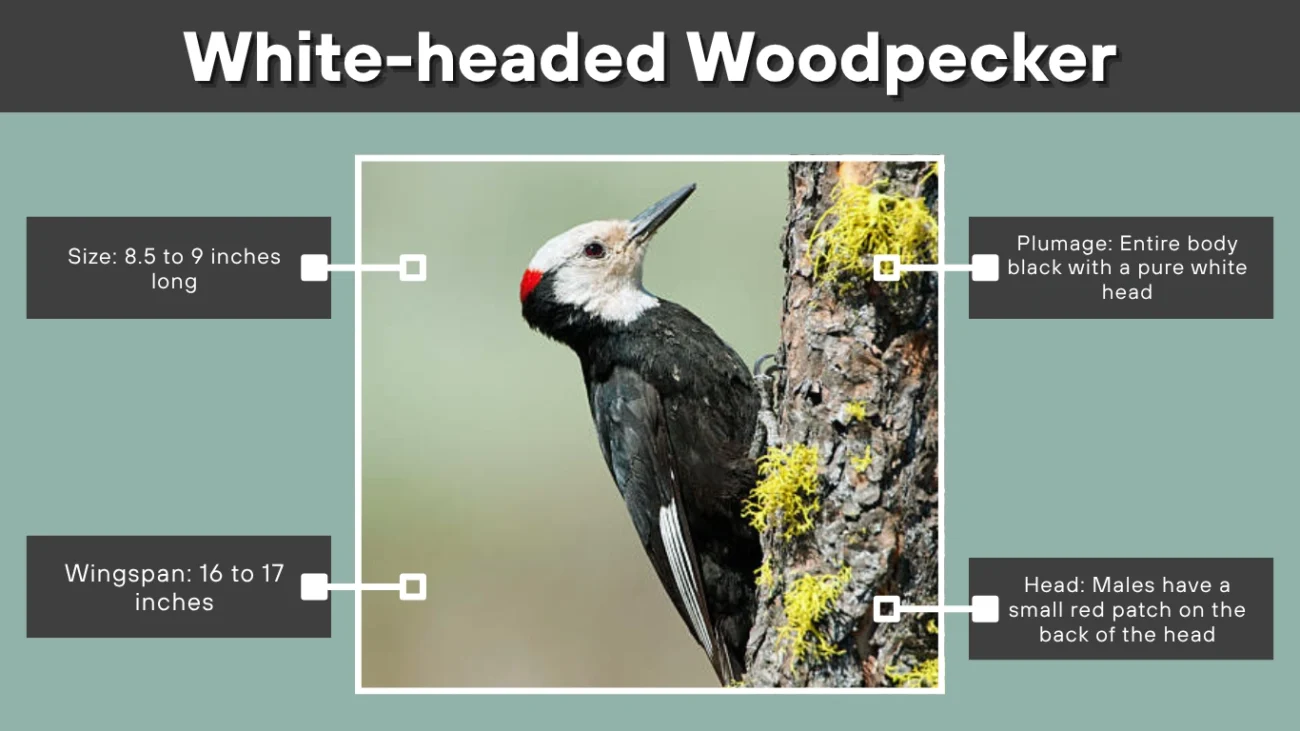
The White-headed Woodpecker (Dryobates albolarvatus) is a striking bird with a jet-black body and a bright white head. It is rarely seen far from pine forests and is highly dependent on conifer seeds for food.
Identification
- Size: 8.5 to 9 inches long
- Wingspan: 16 to 17 inches
- Plumage: Entire body black with a pure white head
- Head: Males have a small red patch on the back of the head
- Bill: Long and slightly curved
- Behavior: Often found foraging on pine trunks and cones, moving slowly and deliberately
Where Found in North America
Restricted to mountainous regions of the western United States, especially in California, Oregon, Washington, and parts of Idaho and Nevada. Found year-round in its range, typically at mid to high elevations.
Habitat
Prefers mature coniferous forests, especially those dominated by ponderosa pine, Jeffrey pine, and sugar pine. It nests in dead trees or snags and depends on large, old-growth pines for food and cavity nesting. Avoids dense lowland forests and urban environments.
Lifespan
Typically lives 5 to 8 years. Because of its reliance on specific forest types and old trees, habitat loss is a major threat to its population stability.
17. Golden-fronted Woodpecker
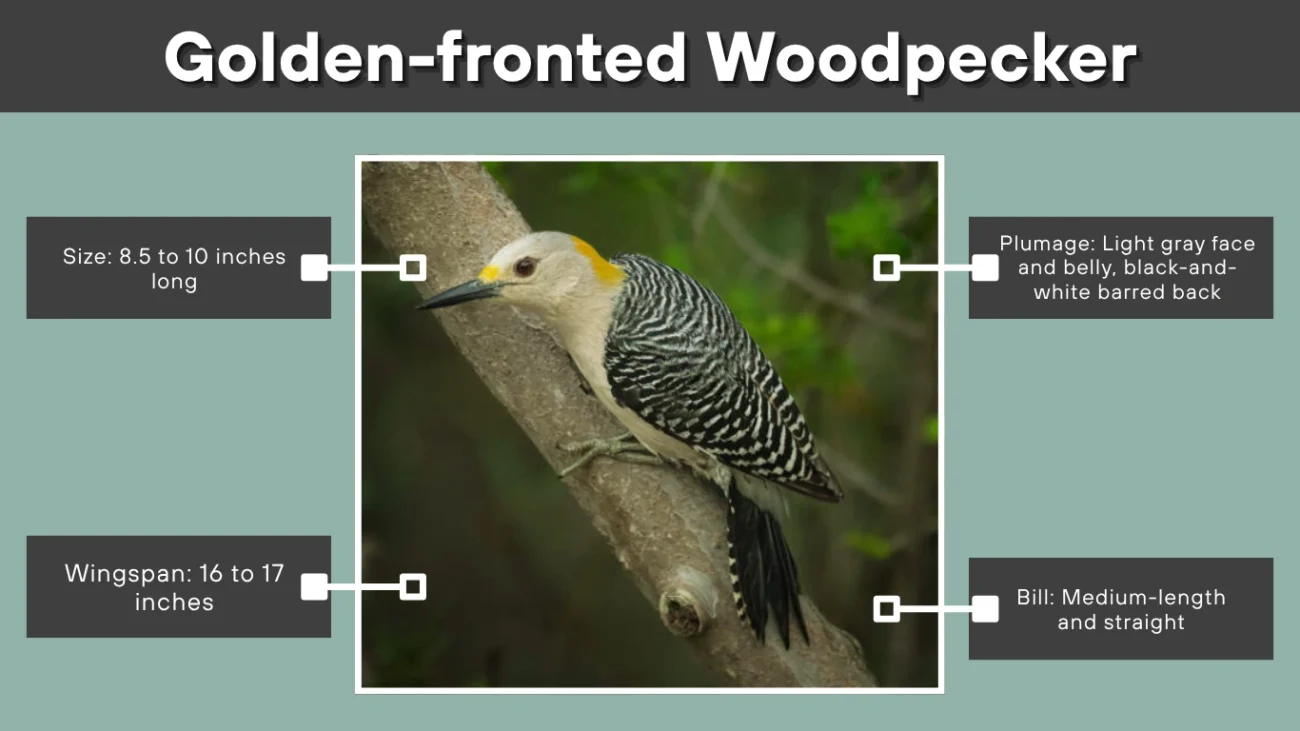
The Golden-fronted Woodpecker (Melanerpes aurifrons) is a bold and noisy bird found in southern parts of the U.S. Its golden nape and bright markings make it stand out in dry, open habitats.
Identification
- Size: 8.5 to 10 inches long
- Wingspan: 16 to 17 inches
- Plumage: Light gray face and belly, black-and-white barred back
- Head: Males have a golden nape, red crown, and yellow patch above the bill
- Bill: Medium-length and straight
- Behavior: Forages on trunks and branches, often vocal and conspicuous
Where Found in North America
Primarily found in Texas, Oklahoma, and southwestern parts of the U.S., extending into Mexico and Central America. It is a year-round resident in its range.
Habitat
Inhabits dry woodlands, mesquite brush, riparian forests, and open country with scattered trees. Also frequently found in ranch lands, farmland edges, and suburban yards with mature trees. Nests in cavities excavated in dead trees or utility poles.
Lifespan
Generally lives 6 to 10 years. Adapts well to modified landscapes, but still requires standing dead trees or structures for nesting.
18. Ivory-billed Woodpecker
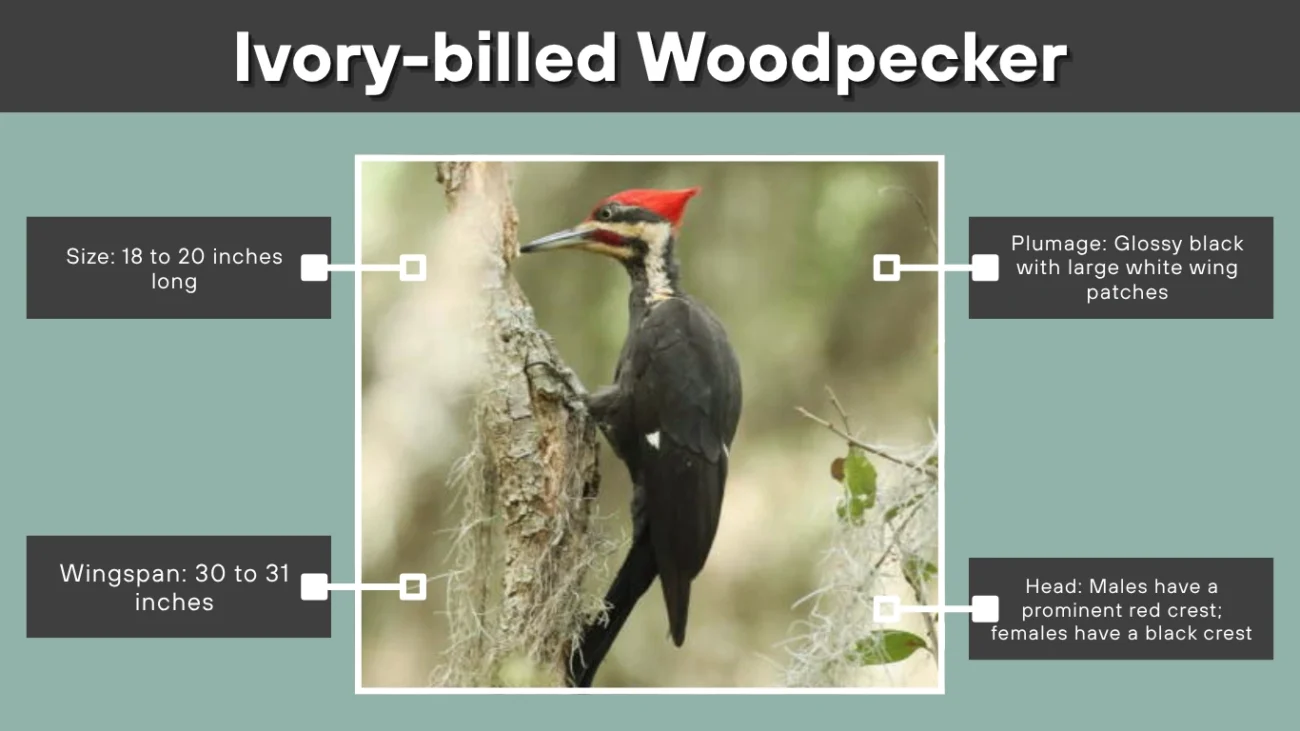
The Ivory-billed Woodpecker (Campephilus principalis) is one of the most iconic and controversial birds in North America, long believed to be extinct or extremely rare. It is the second-largest woodpecker in the world and is notable for its striking appearance and elusive nature.
Identification
- Size: 18 to 20 inches long
- Wingspan: 30 to 31 inches
- Plumage: Glossy black with large white wing patches and white stripes on the neck
- Head: Males have a prominent red crest; females have a black crest
- Bill: Long, ivory-colored, and slightly curved
- Behavior: Powerful drumming, capable of stripping bark to reach beetle larvae
Where Found in North America
Historically found in the southeastern United States, especially in swampy bottomland forests of Louisiana, Mississippi, Arkansas, and Florida. Reports in recent decades are unconfirmed or debated, and the species is likely extinct or extremely rare.
Habitat
Preferred large, undisturbed bottomland hardwood forests, swamps, and old-growth forests with abundant dead and dying trees. It depended heavily on areas with frequent flooding and rich in decaying wood for food.
Lifespan
Unknown due to lack of confirmed modern studies, but estimated at 10 to 15 years in the wild. If still extant, the population would be critically small and vulnerable to habitat loss.
19. Arizona Woodpecker
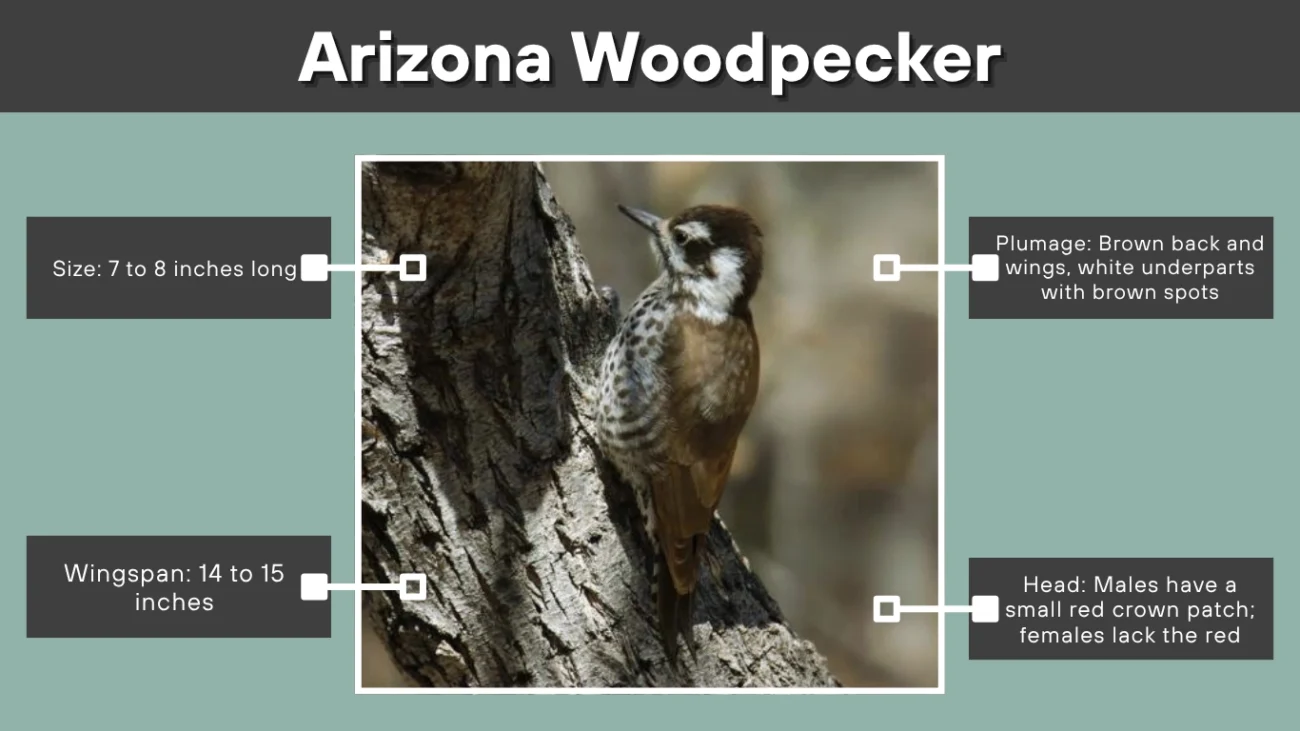
The Arizona Woodpecker (Dryobates arizonae) is a small, brown woodpecker found in highland forests of the southwestern U.S. It is one of the few North American woodpeckers with mostly brown plumage.
Identification
- Size: 7 to 8 inches long
- Wingspan: 14 to 15 inches
- Plumage: Brown back and wings, white underparts with brown spots
- Head: Males have a small red crown patch; females lack the red
- Bill: Short and straight
- Behavior: Often seen in pairs or family groups, foraging quietly on tree trunks
Where Found in North America
Found in southeastern Arizona and southwestern New Mexico, extending into the highlands of Mexico. It is a non-migratory, year-round resident in its limited U.S. range.
Habitat
Inhabits montane pine-oak forests, particularly those with mature trees and some degree of dryness. Prefers elevations between 4,500 and 8,000 feet. It nests in dead trees and forages for insects by flaking bark.
Lifespan
Estimated lifespan is 5 to 7 years in the wild. Survival depends heavily on the availability of suitable nesting sites and the preservation of pine-oak ecosystems.
20. Nuttall’s Woodpecker
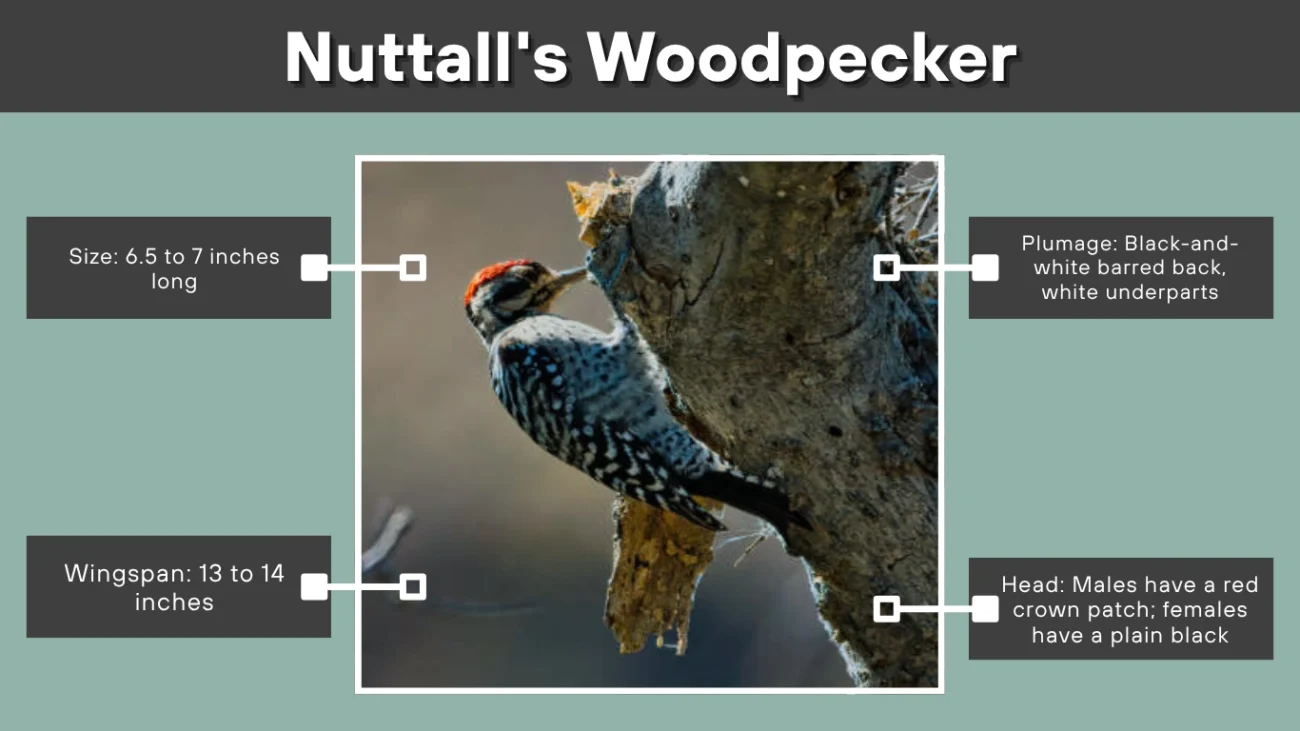
Nuttall’s Woodpecker (Dryobates nuttallii) is a small, agile woodpecker found almost exclusively in California. It is closely related to the Ladder-backed Woodpecker and is best known for its rapid drumming and preference for oak woodlands.
Identification
- Size: 6.5 to 7 inches long
- Wingspan: 13 to 14 inches
- Plumage: Black-and-white barred back, white underparts with light spotting
- Head: Males have a red crown patch; females have a plain black-and-white head
- Bill: Short and straight
- Behavior: Often forages along small branches and twigs, moving quickly and quietly
Where Found in North America
Endemic to California, primarily in the coastal ranges, Central Valley, and the Sierra Nevada foothills. Also occurs in extreme northern Baja California. It is a year-round resident throughout its limited range.
Habitat
Prefers oak woodlands, riparian forests, and chaparral with scattered trees. Rarely found in dense coniferous forests. It nests in tree cavities, often choosing oaks or sycamores. Adapts well to rural and semi-urban landscapes that maintain mature trees.
Lifespan
Typically lives 4 to 7 years in the wild. Its small range makes it vulnerable to habitat fragmentation, but it remains relatively stable where oak habitats are preserved.
FAQs
What is the most common woodpecker in North America?
The Downy Woodpecker is the most widespread and commonly seen woodpecker across North America. It frequents backyards, forests, and parks and adapts well to both urban and rural environments.
How do woodpeckers avoid brain injury while pecking?
Woodpeckers have specialized adaptations such as a reinforced skull, shock-absorbing tissue, and a tightly packed brain that help prevent injury during rapid pecking.
Do all woodpeckers drum on trees?
Yes, most woodpeckers drum on trees, but not always to find food. Drumming is also a way to communicate territory boundaries and attract mates.
Are woodpeckers harmful to trees or homes?
While they can damage wooden structures or trees with repeated drilling, most woodpeckers only target dead or infested wood. They can become a concern when nesting in homes or pecking on siding.
What do woodpeckers eat?
Woodpeckers primarily eat insects such as ants, beetle larvae, and termites. Many also consume sap, nuts, berries, and fruit depending on the species and season.