Kingfishers are some of the most dazzling birds on the planet, with their shimmering blues, fiery oranges, and lightning-fast dives. But did you know there are over 32 unique types of “common” kingfishers found across forests, rivers, and islands worldwide? From the glowing Blue-eared Kingfisher of Asia to the rare Sangihe Dwarf Kingfisher, explore all 32 types—each more vibrant and fascinating than the last.
1. Common Kingfisher (Alcedo atthis)

The Common Kingfisher is a dazzling bird known for its bright colors and swift diving skills. It’s commonly found near clear, slow-moving waters across Europe, Asia, and parts of North Africa, where it hunts small fish and nests in riverbanks.
Identification
- Length: 16–17 cm
- Wingspan: 24–26 cm
- Weight: 34–46 grams
- Bill: Long and pointed; black in males, orange base in females
- Legs: Short and reddish-orange
- Eyes: Dark and alert
- Tail: Short, stubby, and square
Color Pattern and Growth
Juvenile kingfishers have duller plumage with greenish-blue upperparts and pale underparts. As they grow, their feathers develop into vivid electric blue and deep orange. Males and females look similar, though females have a distinct orange base on the lower mandible. Adult coloration becomes more vibrant with age and a healthy diet.
Habitat
This bird thrives in freshwater environments such as rivers, streams, ponds, and lakes. It prefers clean water with plenty of small fish and natural riverbanks or quiet bankside vegetation for nesting and perching.
Hunting and Diet
Common Kingfishers rely on a perch-to-dive hunting style, targeting small fish and aquatic insects. With sharp vision adapted for underwater sight, they dive with precision and return to their perch to swallow prey headfirst.
Nesting
They dig burrows into sandy or earthy riverbanks to lay eggs. Each burrow ends in a nesting chamber. Both male and female share incubation duties and care for the chicks. They may raise two or three broods in a season.
2. Blue-eared Kingfisher (Alcedo meninting)
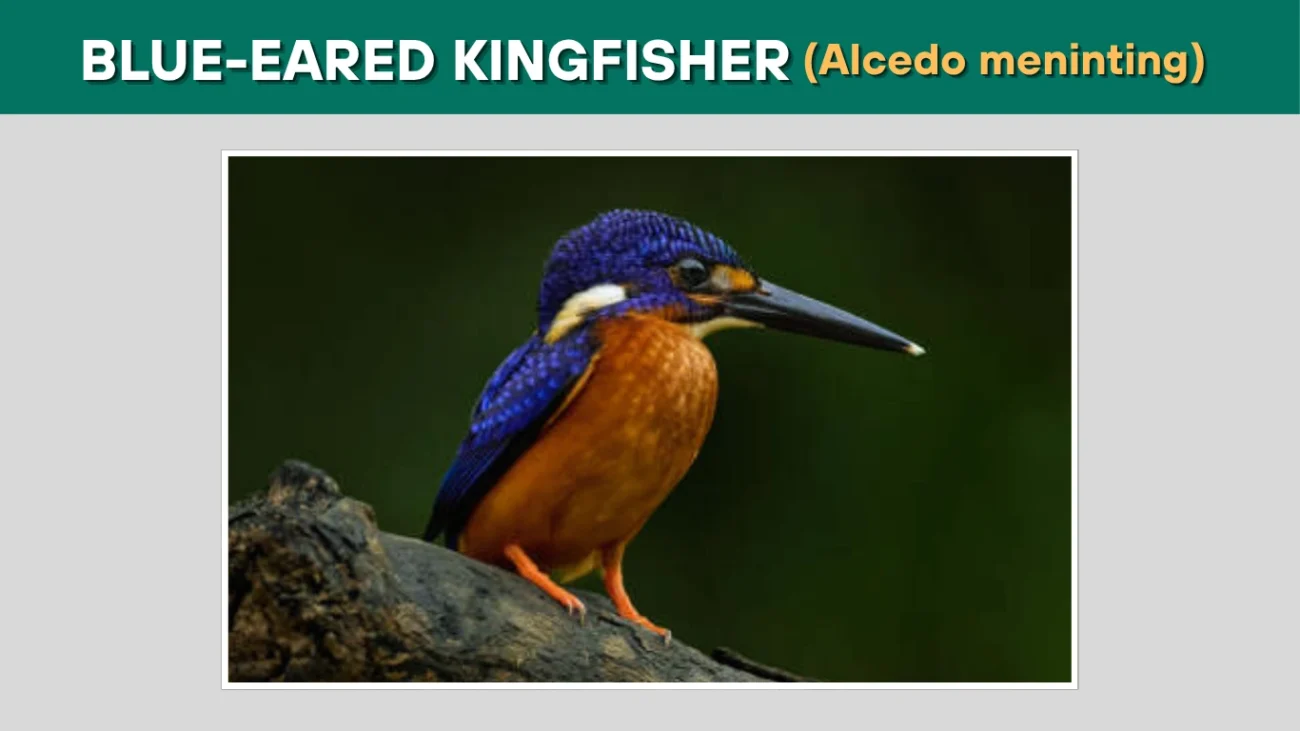
The Blue-eared Kingfisher is a small, brilliantly colored bird found in South and Southeast Asia. It closely resembles the Common Kingfisher but can be distinguished by its darker blue upperparts and absence of orange behind the eye.
Identification
- Length: 16 cm
- Wingspan: Around 25 cm
- Weight: 32–40 grams
- Bill: Long, black, slightly thicker than Common Kingfisher
- Legs: Bright red-orange
- Eyes: Deep black
- Tail: Short and squared
Color Pattern and Growth
Juveniles are darker and duller than adults, often showing a grayish tint on the underparts. As they mature, they develop deeper blue upperparts and a richer rufous tone on the belly. Lacks the orange ear covert streak seen in Common Kingfishers.
Habitat
Prefers forest streams, shaded rivers, and quiet lowland wetlands. Often found in dense vegetation close to clean, slow-flowing freshwater habitats.
Hunting and Diet
Feeds primarily on small fish, tadpoles, and aquatic insects. Uses a perch-hunting method—diving straight into the water after spotting prey from low branches.
Nesting
Excavates a tunnel in soft riverbanks or muddy banksides. Both sexes share incubation and feeding. May breed twice a year in favorable conditions.
3. Cerulean Kingfisher (Alcedo coerulescens)
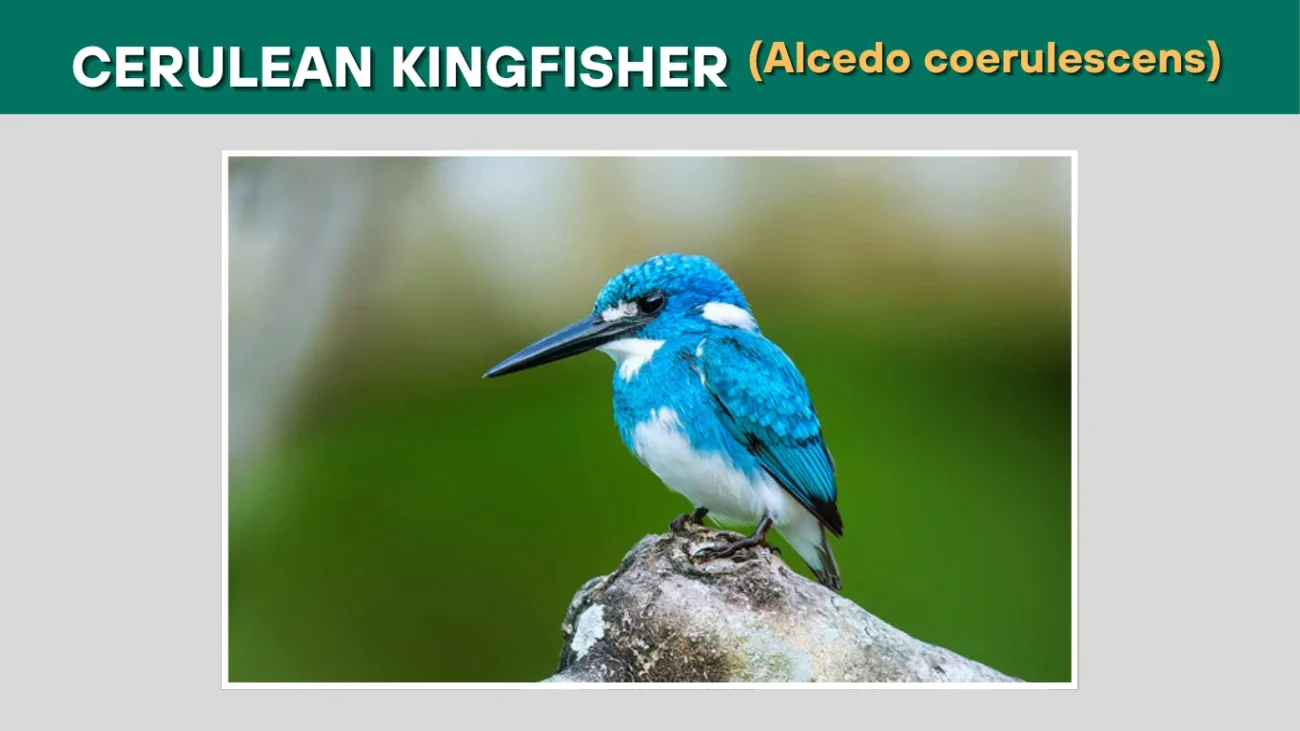
Endemic to Indonesia, the Cerulean Kingfisher is a vivid, small species known for its striking powder-blue coloring and preference for coastal lowland habitats.
Identification
- Length: 15–16 cm
- Wingspan: 23–25 cm
- Weight: 30–36 grams
- Bill: Long, straight, dark with pale base
- Legs: Bright red
- Eyes: Round, black
- Tail: Compact and square
Color Pattern and Growth
Adults display a pale sky-blue upper body with less orange than related species. Juveniles show lighter shades of blue and less defined contrast. Underparts can appear whitish compared to the richer orange in other kingfishers.
Habitat
Found near mangroves, tidal streams, and coastal rivers in Java and Sumatra. Prefers brackish and slow-moving waters with sparse human disturbance.
Hunting and Diet
Feeds on small fish, crabs, and aquatic insects. Hunts using perch-to-dive technique, often from low mangrove branches or stilt roots.
Nesting
Nests in earth banks, often close to water. Both male and female dig the tunnel and care for the young. One or two broods may be raised each year depending on food supply.
4. Azure Kingfisher (Ceyx azureus)

The Azure Kingfisher is a striking, small kingfisher native to Australia and parts of New Guinea. Known for its rich royal blue upperparts and reddish underparts, it is commonly seen darting low over rivers and creeks.
Identification
- Length: 17–19 cm
- Wingspan: 25–29 cm
- Weight: 30–35 grams
- Bill: Long, black, slightly downcurved
- Legs: Bright orange-red
- Eyes: Small and dark
- Tail: Very short
Color Pattern and Growth
Juveniles are paler with a less intense blue hue and more buff-toned underparts. Adults exhibit deep cobalt-blue upperparts with a distinct white neck patch and rufous to orange chest. The intensity of the blue deepens with age.
Habitat
Prefers slow-flowing streams, forest rivers, and shaded freshwater wetlands. Often found in tropical and subtropical forests close to water.
Hunting and Diet
Feeds on small fish, aquatic insects, and larvae. Hunts from low perches, diving swiftly into the water to snatch prey.
Nesting
Digs a tunnel in vertical riverbanks or soft mud walls. The nesting chamber is unlined. Both parents incubate eggs and feed the young.
5. Bismarck Kingfisher (Ceyx websteri)

Found only in the Bismarck Archipelago of Papua New Guinea, the Bismarck Kingfisher is a rare forest stream specialist with vivid plumage and a shy nature.
Identification
- Length: 13–14 cm
- Wingspan: Approx. 20–22 cm
- Weight: 25–28 grams
- Bill: Shorter than most Ceyx species, dark and thick
- Legs: Reddish
- Eyes: Dark brown
- Tail: Stubby and square
Color Pattern and Growth
Adults display bright azure-blue upperparts and deep orange underparts with a small white throat patch. Juveniles appear duller, with brownish tones and less vibrant blue. Plumage brightens with age and health.
Habitat
Inhabits forested streams and freshwater wetlands, usually in lowland or hilly tropical areas. Avoids open or disturbed habitats.
Hunting and Diet
Consumes small freshwater invertebrates, fish fry, and aquatic larvae. Hunts in shaded stream areas with overhanging foliage for cover.
Nesting
Likely nests in streamside banks or rotting tree roots. Specific breeding habits remain poorly documented due to the bird’s elusive behavior.
6. Papuan Kingfisher (Ceyx solitarius)

The Papuan Kingfisher is a vibrant, forest-dwelling bird native to New Guinea. It is often found near streams and rivers in lowland rainforests and is known for its brilliant blue and orange coloration.
Identification
- Length: 14–16 cm
- Wingspan: 22–25 cm
- Weight: 28–32 grams
- Bill: Dark, sturdy, and straight
- Legs: Bright reddish-orange
- Eyes: Black and round
- Tail: Short and square
Color Pattern and Growth
Adults display deep cobalt-blue upperparts with a white throat and rich orange underparts. Juveniles are duller with paler blue and buff-colored underparts. The adult plumage develops within weeks of fledging.
Habitat
Prefers densely vegetated, lowland tropical rainforests near clean, freshwater streams and creeks. Typically found in remote and undisturbed forested regions.
Hunting and Diet
Feeds on small fish, aquatic insects, and invertebrates. Uses a perch-to-dive hunting technique, often from low branches overhanging streams.
Nesting
Nests in earthen banks or rotting tree trunks near water. Both sexes contribute to burrow excavation, incubation, and chick feeding.
7. Moluccan Dwarf Kingfisher (Ceyx lepidus)
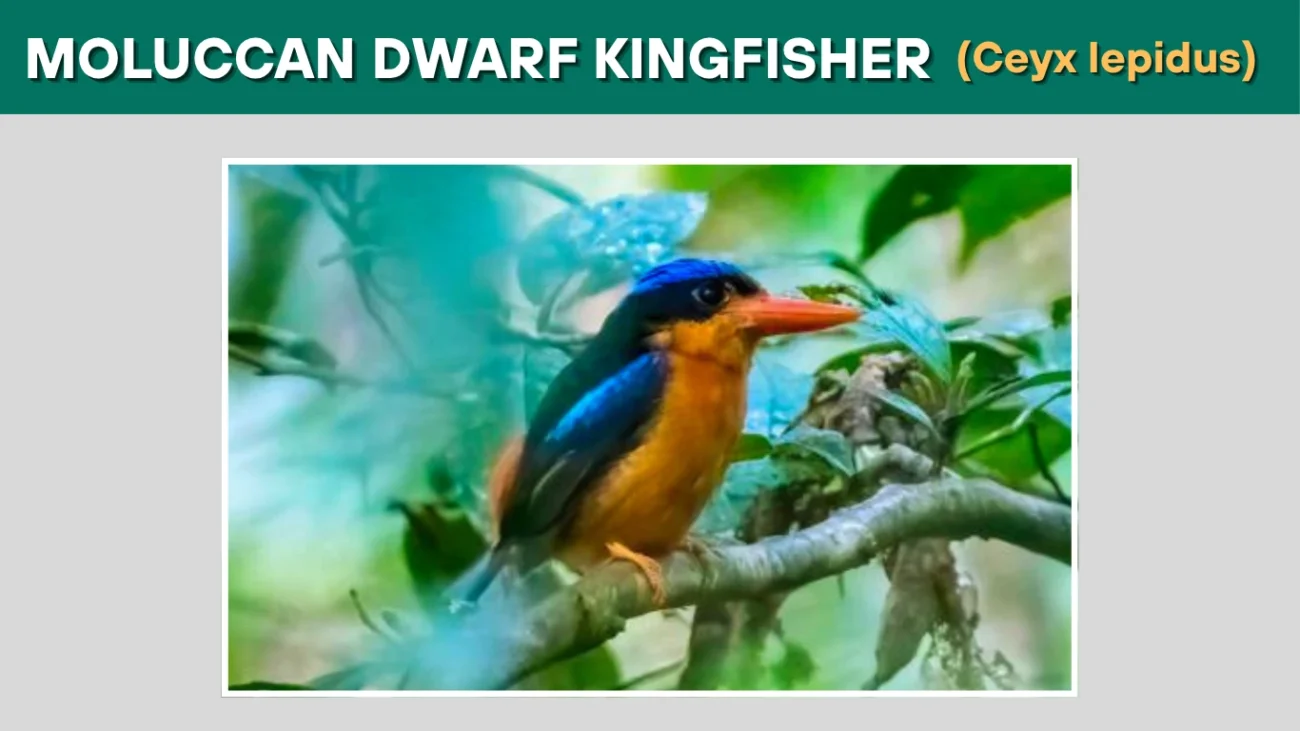
Endemic to the Moluccas (Maluku Islands) in Indonesia, this tiny, elusive kingfisher is one of the region’s most brilliantly colored birds, typically found near forest streams.
Identification
- Length: 13–14 cm
- Wingspan: 20–22 cm
- Weight: 20–26 grams
- Bill: Short, dark, and pointed
- Legs: Bright red
- Eyes: Black
- Tail: Short and rounded
Color Pattern and Growth
Adults show vivid royal blue upperparts with orange to rufous underparts and a small white throat patch. Juveniles are duller and more brownish in tone. Coloration sharpens as the bird matures.
Habitat
Lives in dense lowland rainforests, typically near small forest streams and shaded wetlands. Prefers remote, undisturbed areas with plenty of cover.
Hunting and Diet
Feeds on insects, larvae, and tiny fish. It uses low perches close to water and dives swiftly to catch prey.
Nesting
Nesting habits include burrows in riverbanks or soft mud walls. Due to its remote habitat, its breeding behavior is not well documented but is believed to be similar to related species.
8. Sulawesi Dwarf Kingfisher (Ceyx fallax)

Native to the Indonesian island of Sulawesi, the Sulawesi Dwarf Kingfisher is a forest-dwelling bird known for its tiny size and vivid plumage. It’s often heard before it’s seen, flitting rapidly through dense foliage near streams.
Identification
- Length: 13–14 cm
- Wingspan: Around 21 cm
- Weight: 22–27 grams
- Bill: Short, dark, and stout
- Legs: Bright red-orange
- Eyes: Round and black
- Tail: Very short
Color Pattern and Growth
Adults feature deep blue upperparts with bright orange underparts and a white throat. Juveniles are lighter in color and may lack the full vibrancy of adult plumage. They gradually gain full coloration as they mature.
Habitat
Found in subtropical or tropical moist lowland forests, often near streams and quiet freshwater. Prefers dense, shaded environments with minimal human disturbance.
Hunting and Diet
Feeds on insects, spiders, and small aquatic prey. Hunts by perching close to water or damp forest ground and pouncing on moving targets.
Nesting
Burrows are excavated in earth banks or rotting logs. Both parents participate in incubation and care of the young. Nesting activity peaks during the rainy season.
9. Philippine Dwarf Kingfisher (Ceyx melanurus)
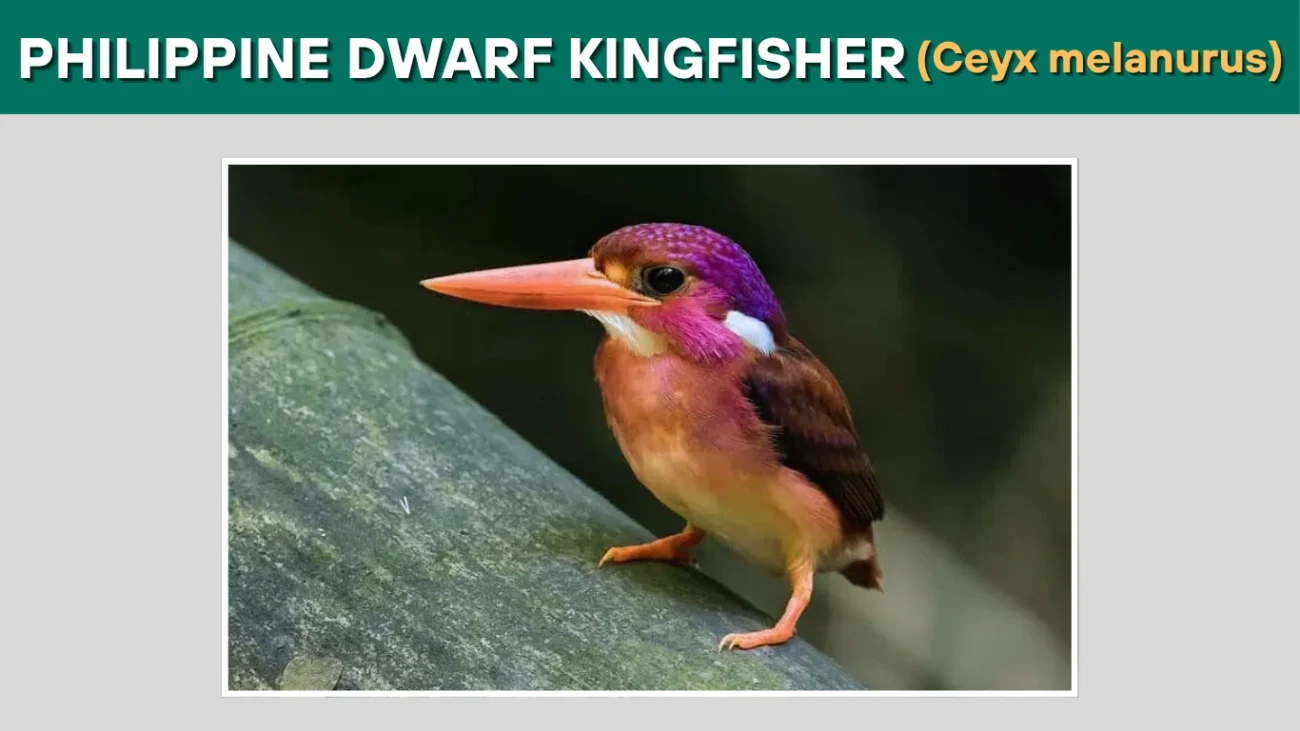
The Philippine Dwarf Kingfisher is a rare and vibrant species endemic to the Philippines. Known for its unique coloring and secretive behavior, it inhabits dense forests and mountain regions.
Identification
- Length: 13–14 cm
- Wingspan: 20–22 cm
- Weight: 22–26 grams
- Bill: Dark and compact
- Legs: Red-orange
- Eyes: Black and large relative to head
- Tail: Short and rounded
Color Pattern and Growth
Adults have vivid orange to rufous underparts, with electric blue upperparts and dark tail feathers. Juveniles are duller, with faded blues and lighter orange tones. Color deepens as the bird matures and molts.
Habitat
Found in tropical moist lowland and montane forests, often far from water sources. Prefers thick forest canopies and remote, shaded areas with limited disturbance.
Hunting and Diet
Diet consists mostly of insects and other invertebrates. Hunts from low perches within the forest, diving onto the forest floor or among leaves for prey.
Nesting
Likely nests in earthen banks or decaying trees. Though detailed data is limited, nesting behavior is presumed similar to other Ceyx species, with both sexes involved in raising the young.
10. South Philippine Dwarf Kingfisher (Ceyx mindanensis)
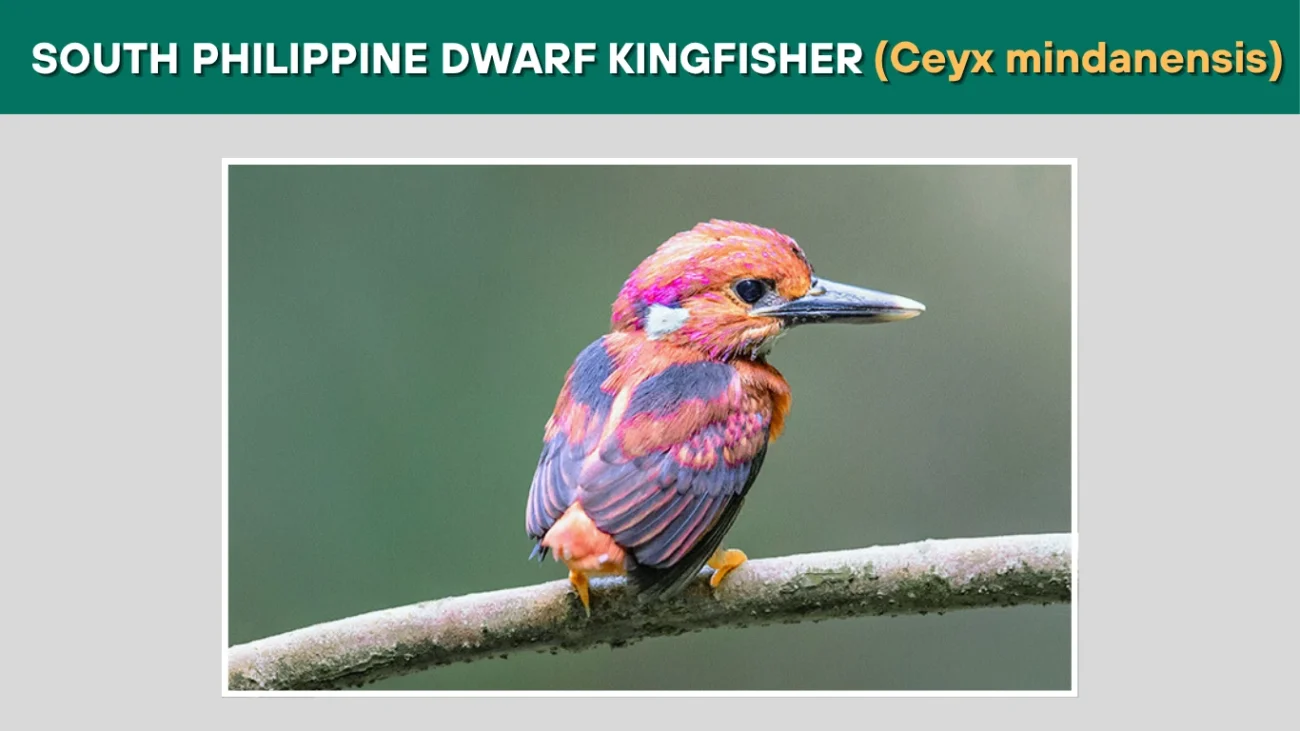
Endemic to the southern Philippines, particularly Mindanao, this small kingfisher was once grouped with Ceyx melanurus but is now recognized as a separate species. It’s known for its elusive nature and deep forest habitat.
Identification
- Length: 13–14 cm
- Wingspan: 20–22 cm
- Weight: 22–26 grams
- Bill: Short, dark, slightly broader
- Legs: Bright reddish-orange
- Eyes: Large and dark
- Tail: Short and rounded
Color Pattern and Growth
Adults have deep orange underparts with a slightly violet-blue crown and rich blue upperparts. Juveniles appear faded and dull, lacking full vibrancy. Their colors become more intense with age and diet.
Habitat
Resides in subtropical or tropical moist lowland forests, especially in undisturbed areas far from human activity. Usually found near shaded gullies or streams within dense jungle.
Hunting and Diet
Feeds primarily on insects, beetles, and forest invertebrates. Hunts by darting from low branches or foliage to grab prey on the forest floor or in shallow waters.
Nesting
Burrows into earthen banks or rotting wood, especially during the wet season. Both parents assist in incubating and feeding the chicks.
11. Rufous-backed Kingfisher (Ceyx rufidorsa)

This dazzling species, found across Southeast Asia, was once grouped with the Black-backed Kingfisher but is now treated as a separate species due to its rufous back and distinct range.
Identification
- Length: 13–14 cm
- Wingspan: 21–23 cm
- Weight: 23–28 grams
- Bill: Long, reddish-orange
- Legs: Bright red
- Eyes: Black
- Tail: Small and squared
Color Pattern and Growth
Adults are bright orange below with rich orange-rufous upperparts and electric violet on the crown and wings. Juveniles display lighter shades and less defined coloration, developing full vibrancy with age.
Habitat
Prefers lowland tropical forests near small streams and wetlands. Favors quiet, densely vegetated areas in countries like Malaysia, Thailand, and Indonesia.
Hunting and Diet
Diet consists of small fish, aquatic insects, and forest invertebrates. It hunts by watching from low perches and pouncing quickly on prey near the forest floor or streamside.
Nesting
Burrows are made in riverbanks, termite mounds, or rotten logs. Nesting occurs mainly in the rainy season, with both sexes involved in chick-rearing.
12. Black-backed Kingfisher (Ceyx erithaca)
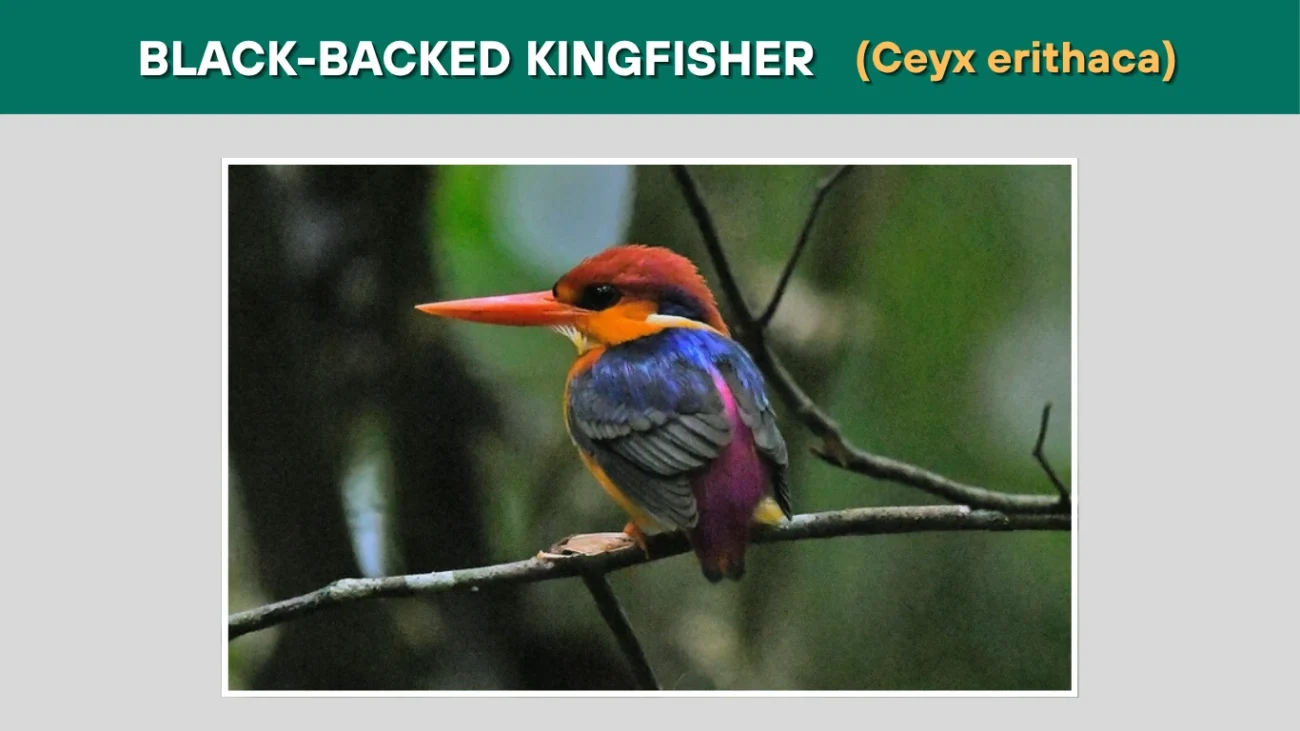
Also known as the Oriental Dwarf Kingfisher, this species is one of the most colorful kingfishers in Asia. It’s found across the Indian subcontinent and Southeast Asia and is admired for its vibrant mix of hues.
Identification
- Length: 13 cm
- Wingspan: 20–22 cm
- Weight: 20–26 grams
- Bill: Long, red-orange
- Legs: Bright red
- Eyes: Black and round
- Tail: Very short
Color Pattern and Growth
Adults feature a brilliant combination of orange underparts, purplish-blue crown, deep blue wings, and a black patch on the back. Juveniles are paler and may have less distinct color contrasts. Full vibrancy is reached within weeks of fledging.
Habitat
Thrives in dense tropical forests, especially near streams, small rivers, or damp ravines. It prefers lowland evergreen forest and is often active during the monsoon.
Hunting and Diet
Feeds on insects, small fish, frogs, and crustaceans. Hunts by diving from low perches close to water or the forest floor.
Nesting
Excavates nesting burrows in earthen banks or rotten tree stumps. Breeding occurs during the rainy season, and both parents share incubation and chick-feeding duties.
13. Sangihe Dwarf Kingfisher (Ceyx sangirensis)
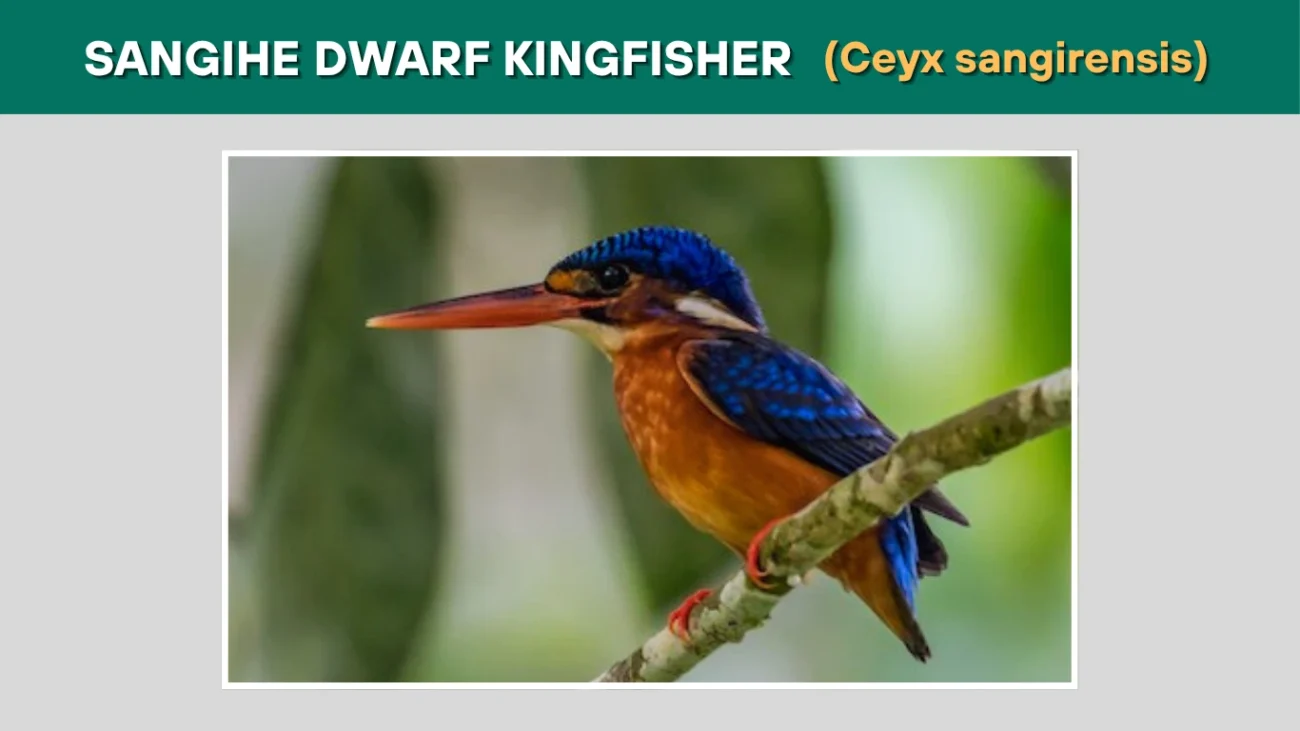
This critically endangered kingfisher is found only on Sangihe Island in Indonesia. It is extremely elusive and resides in a restricted, forested range that’s rapidly declining due to habitat loss.
Identification
- Length: 13–14 cm
- Wingspan: Approx. 20 cm
- Weight: 22–26 grams
- Bill: Thick, red-orange
- Legs: Reddish
- Eyes: Large and dark
- Tail: Short
Color Pattern and Growth
Adults show rich orange underparts and deep blue upperparts with a purplish hue on the head and wings. Juveniles are noticeably duller with less contrast. Color deepens gradually with maturity.
Habitat
Restricted to lowland and hill rainforests on Sangihe Island, usually near moist areas and shaded undergrowth. Prefers dense, undisturbed vegetation.
Hunting and Diet
Feeds mainly on forest insects and small invertebrates. Hunts from low perches in the undergrowth, darting quickly onto prey in leaf litter or low vegetation.
Nesting
Likely nests in burrows within soil banks or decaying logs, though breeding behavior is poorly documented due to its rarity and limited sightings.
14. Sula Dwarf Kingfisher (Ceyx wallacii)
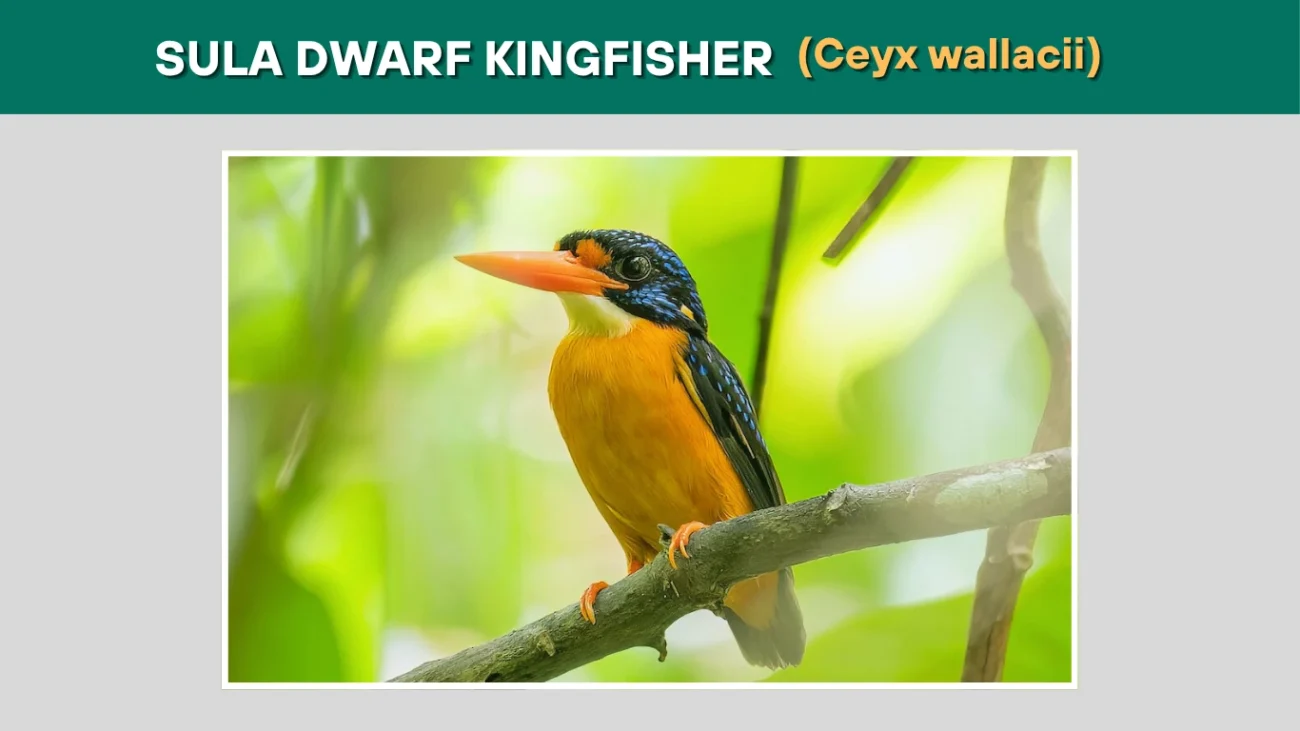
Endemic to the Sula Islands in Indonesia, the Sula Dwarf Kingfisher is a small, forest-dwelling bird known for its striking plumage and secretive behavior. It was previously grouped under the rufidorsa complex but is now recognized as a distinct species.
Identification
- Length: 13–14 cm
- Wingspan: 20–22 cm
- Weight: 22–26 grams
- Bill: Short, deep red
- Legs: Bright red
- Eyes: Black and round
- Tail: Very short
Color Pattern and Growth
Adults exhibit vibrant orange underparts, reddish-orange back, and deep blue-violet wings and crown. Juveniles are duller and may lack the full brightness and contrast of adults. Plumage matures rapidly post-fledging.
Habitat
Found in moist lowland and hill forests, often near streams or damp forest floors. Prefers dense vegetation and is rarely seen in open or disturbed areas.
Hunting and Diet
Feeds primarily on insects and other small forest invertebrates. It hunts by scanning from low perches and making rapid dives to catch prey on the forest floor or shallow stream edges.
Nesting
Burrows are typically excavated in soil banks or decaying wood. Nesting details remain limited but are believed to follow similar patterns to other Ceyx species.
15. Obi Dwarf Kingfisher (Ceyx cajeli)
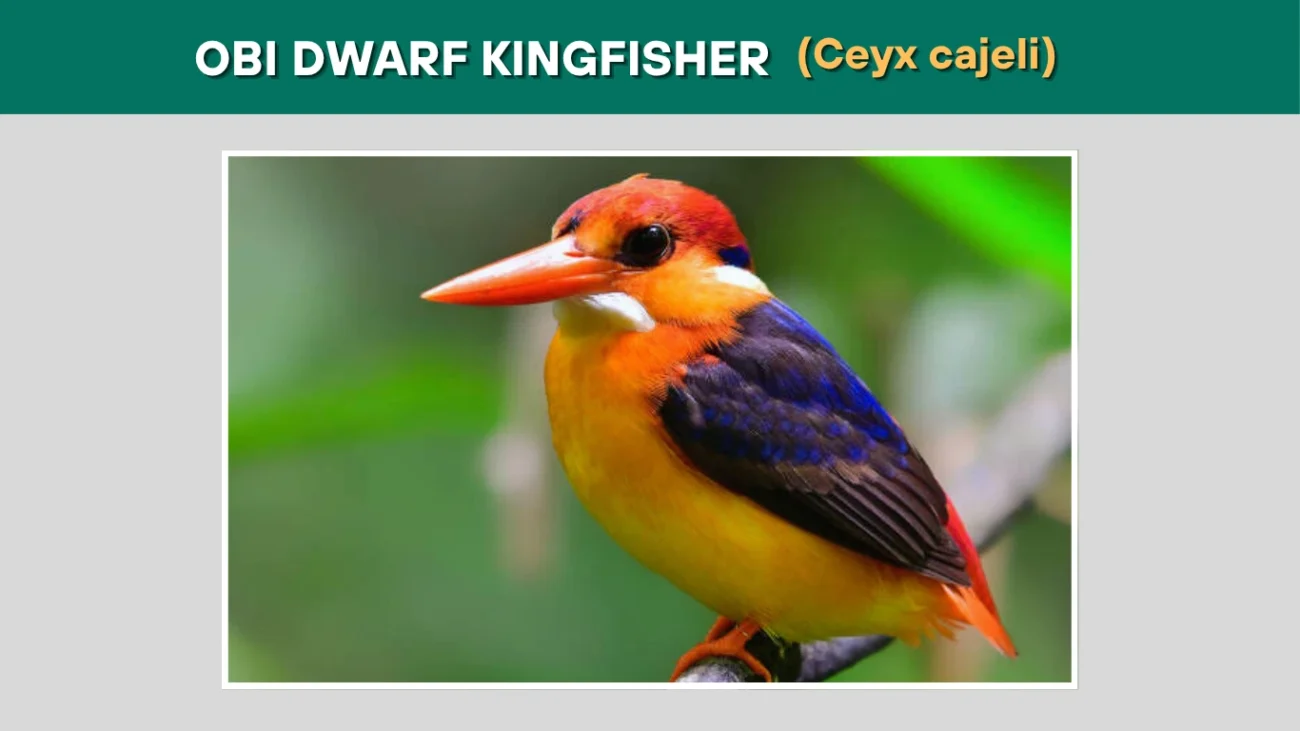
Native to Obi Island in the Maluku Islands of Indonesia, the Obi Dwarf Kingfisher is a vibrant, tiny bird restricted to a very narrow forest habitat. It was split from the rufidorsa group based on vocal and plumage differences.
Identification
- Length: 13–14 cm
- Wingspan: 20–21 cm
- Weight: 21–25 grams
- Bill: Thick, red-orange
- Legs: Reddish-orange
- Eyes: Dark
- Tail: Compact and squared
Color Pattern and Growth
Adult plumage includes bright orange underparts, reddish back, and deep violet-blue wings and crown. Juveniles are less vibrant with a more muted color tone. Brightness intensifies with age and good diet.
Habitat
Inhabits primary and mature secondary lowland forests, typically near damp or stream-filled areas. Strongly prefers undisturbed forest interior.
Hunting and Diet
Primarily insectivorous, it feeds on beetles, spiders, and small aquatic insects. Uses low branches and foliage to ambush prey on forest floor or shallow water edges.
Nesting
Believed to nest in burrows dug into earthen banks or rotten logs. Specific nesting data is scarce, but likely similar to closely related species within the Ceyx group.
16. Buru Dwarf Kingfisher (Ceyx cajeli wallacii)
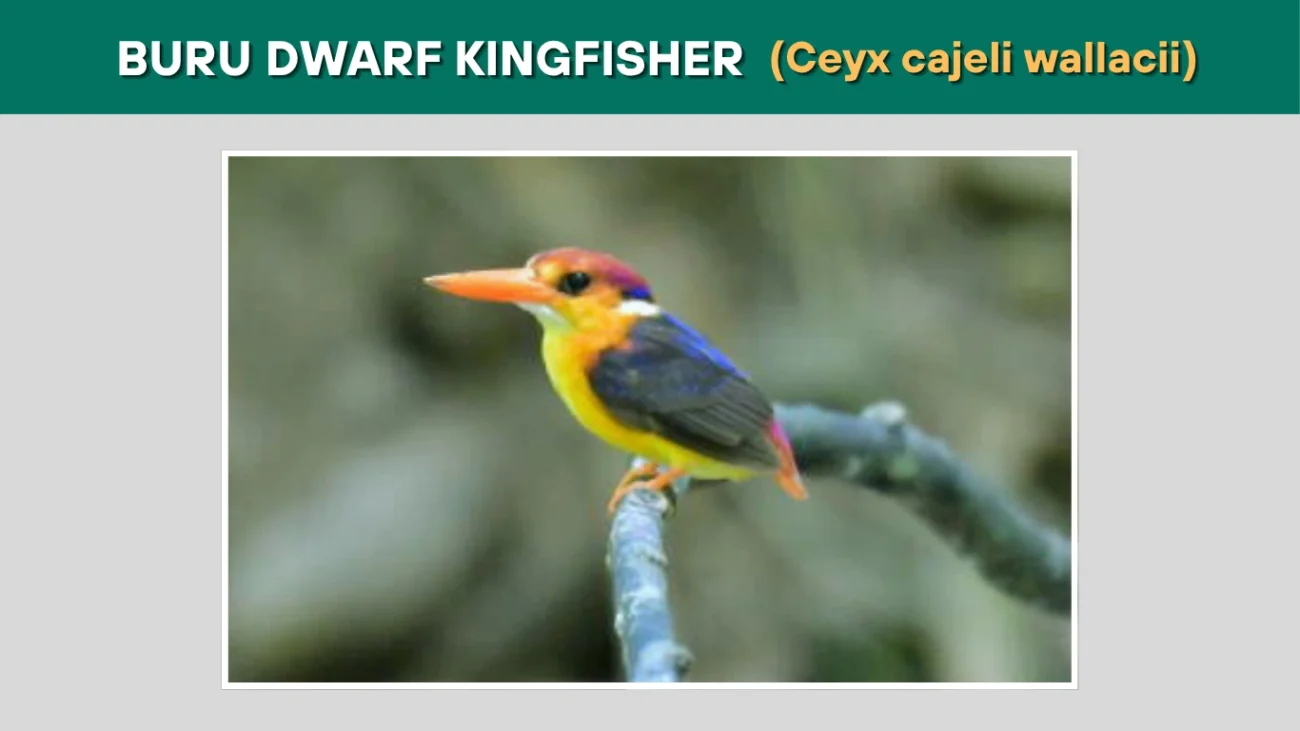
Found on Buru Island in Indonesia, the Buru Dwarf Kingfisher is a subspecies of Ceyx cajeli and shares many features with its relatives. It’s known for its brilliant plumage and preference for dense, humid forests.
Identification
- Length: 13–14 cm
- Wingspan: 20–21 cm
- Weight: 22–26 grams
- Bill: Short, stout, red-orange
- Legs: Bright red
- Eyes: Round and black
- Tail: Short and squared
Color Pattern and Growth
Adults display rich orange underparts with a reddish-orange back and violet-blue crown and wings. Juveniles show a duller color pattern with more brownish tones, which sharpen as they mature.
Habitat
Prefers lowland rainforest and montane forest interiors, often near small streams or damp forest floors. Avoids human-disturbed areas.
Hunting and Diet
Feeds on insects, small invertebrates, and aquatic larvae. It watches from low perches and swiftly captures prey from the forest floor or stream edges.
Nesting
Nesting occurs in tunnels dug into banks or rotting logs. Details are limited, but behavior is presumed consistent with other Ceyx species.
17. Seram Dwarf Kingfisher (Ceyx cajeli serami)
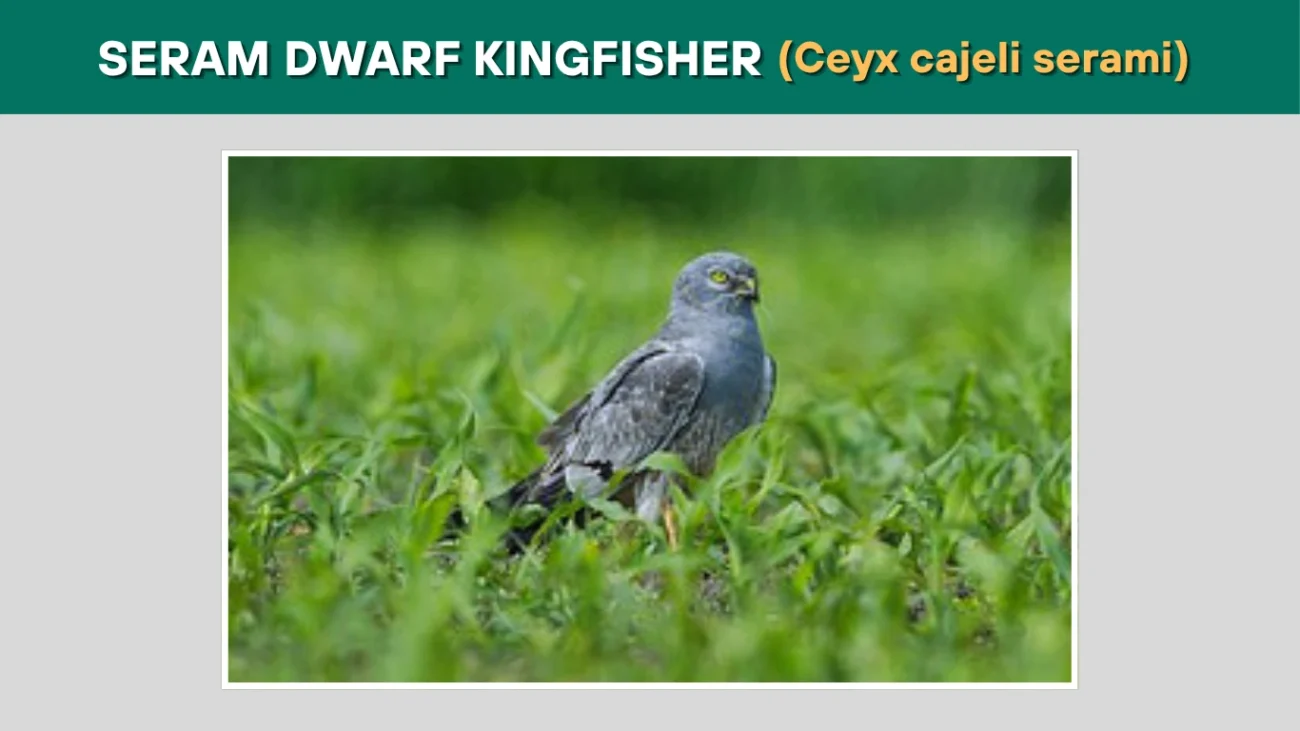
Endemic to Seram Island in the Maluku Islands, the Seram Dwarf Kingfisher is a colorful and secretive forest bird. Like others in its group, it was once grouped with Ceyx erithaca but is now recognized for its distinct features.
Identification
- Length: 13–14 cm
- Wingspan: 20–22 cm
- Weight: 22–26 grams
- Bill: Deep red, slightly curved
- Legs: Bright orange-red
- Eyes: Dark and large
- Tail: Very short
Color Pattern and Growth
Adult birds have deep orange bellies, reddish backs, and bright blue-violet wings and crowns. Juveniles are duller with less contrast. The full color palette develops rapidly after fledging.
Habitat
Lives in dense, humid lowland forests and foothills, especially near freshwater sources. Prefers undisturbed forest interiors with thick undergrowth.
Hunting and Diet
Diet includes forest insects, spiders, and aquatic invertebrates. Hunts from low, shaded perches and makes quick dives to capture prey.
Nesting
Digs burrows in stream banks or fallen logs. Specific nesting behavior is not well-documented but is expected to be similar to other island dwarf kingfishers.
18. Palawan Dwarf Kingfisher (Ceyx melanurus lepidus)
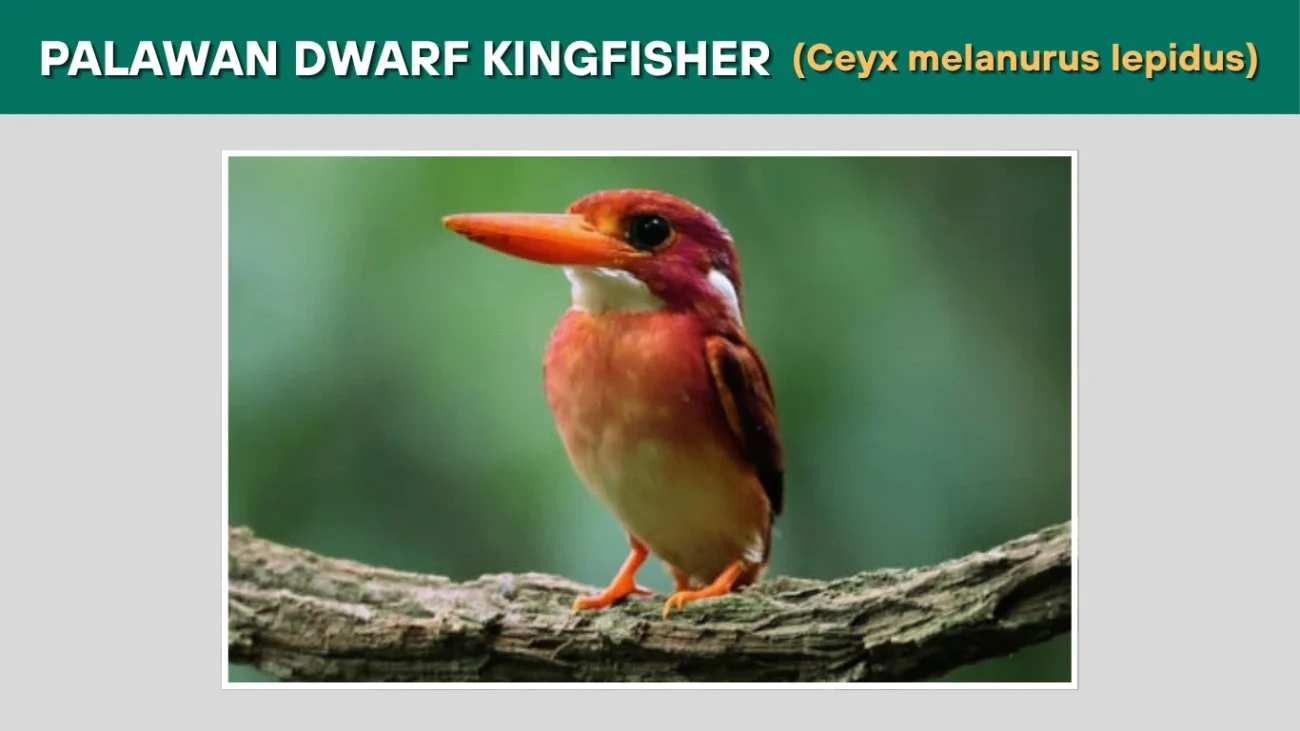
Native to Palawan Island in the Philippines, the Palawan Dwarf Kingfisher is a subspecies of Ceyx melanurus. It is notable for its vivid coloration and elusive behavior in dense forest habitats.
Identification
- Length: 13–14 cm
- Wingspan: 20–22 cm
- Weight: 21–25 grams
- Bill: Short, red-orange
- Legs: Bright reddish-orange
- Eyes: Black and rounded
- Tail: Very short
Color Pattern and Growth
Adults feature a rufous-orange belly, blue-violet wings, and a reddish crown. Juveniles have a duller, brownish appearance with less contrast. Plumage brightens as the bird matures, typically within a few weeks post-fledging.
Habitat
Occupies lowland and hill forests with heavy canopy cover, often near streams or wet forest floors. Avoids open and disturbed areas.
Hunting and Diet
Feeds on insects, spiders, and small aquatic organisms. Uses short flights from low perches to snatch prey from leaf litter or shallow water.
Nesting
Nests in burrows excavated into stream banks or rotting wood. Both male and female likely take part in incubation and chick rearing.
19. Biak Kingfisher (Ceyx mulcatus)
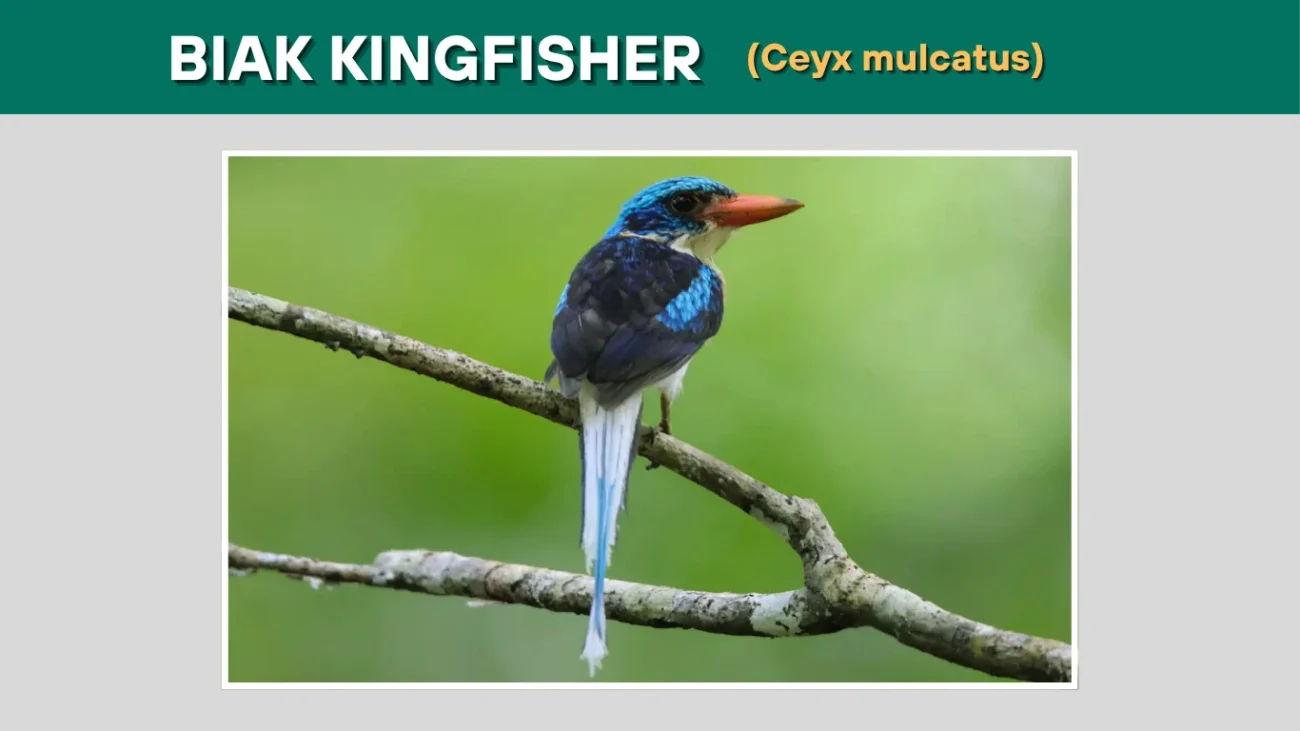
Endemic to Biak Island in Papua, Indonesia, the Biak Kingfisher is a rare and localized species. It is part of a group of dwarf kingfishers split from the former Ceyx erithaca complex.
Identification
- Length: 13–14 cm
- Wingspan: 20–22 cm
- Weight: 22–27 grams
- Bill: Stout, red-orange
- Legs: Deep red
- Eyes: Large and black
- Tail: Short and squared
Color Pattern and Growth
Adults have orange underparts, red upper back, and striking violet-blue wings and crown. Juveniles appear washed out, with muted hues that become vibrant as they age.
Habitat
Inhabits lowland rainforests, especially near wet or marshy areas. Prefers thick vegetation and areas with minimal disturbance.
Hunting and Diet
Diet includes insects, caterpillars, and small aquatic prey. Hunts by scanning from low, shaded perches and striking quickly at moving targets.
Nesting
Likely nests in earthen banks or decaying tree stumps. Breeding behavior has not been thoroughly studied but follows the general dwarf kingfisher pattern.
20. North Solomons Dwarf Kingfisher (Ceyx meeki)

The North Solomons Dwarf Kingfisher is a vividly colored species endemic to the islands of Bougainville and Buka in Papua New Guinea. It was recognized as a distinct species following the split of the Ceyx erithaca complex.
Identification
- Length: 13–14 cm
- Wingspan: 20–21 cm
- Weight: 21–26 grams
- Bill: Thick, bright red
- Legs: Red-orange
- Eyes: Dark brown
- Tail: Short and squared
Color Pattern and Growth
Adults display glowing orange underparts, reddish upper back, and intense violet-blue wings and crown. Juveniles are paler with brownish tones, gaining full color saturation as they mature.
Habitat
Resides in tropical moist lowland forests, usually close to streams, wet ravines, or damp forest floors. Prefers secluded, undisturbed woodland.
Hunting and Diet
Feeds mainly on insects, beetles, and small aquatic prey. Hunts from low, shaded perches and darts rapidly to the ground or shallow water to catch prey.
Nesting
Nests in burrows carved into earth banks or rotting logs. Both parents are involved in incubation and feeding of chicks. Breeding season coincides with the local wet season.
21. Guadalcanal Dwarf Kingfisher (Ceyx nigromaxilla)
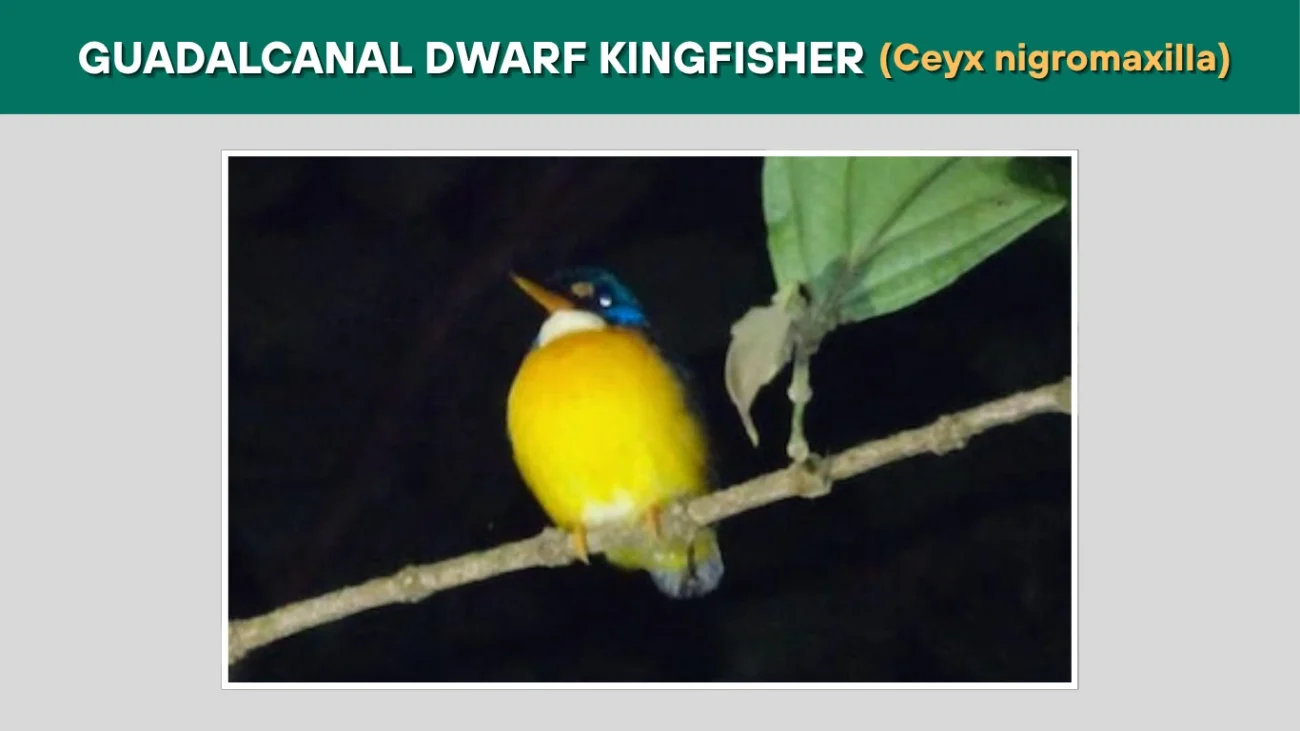
Endemic to Guadalcanal in the Solomon Islands, the Guadalcanal Dwarf Kingfisher is another species in the reclassified Ceyx group. It is rarely seen and dwells deep within forested areas.
Identification
- Length: 13–14 cm
- Wingspan: 20–22 cm
- Weight: 22–27 grams
- Bill: Red-orange with black maxilla
- Legs: Reddish
- Eyes: Black
- Tail: Short
Color Pattern and Growth
Adults exhibit deep orange underparts, a reddish back, and rich violet-blue wings and crown. The black upper mandible is a key identifying feature. Juveniles are duller with less defined color separation. Plumage develops fully within weeks of fledging.
Habitat
Prefers dense lowland rainforests, often near streams or shaded forest gullies. Avoids open or disturbed environments.
Hunting and Diet
Feeds on insects, spiders, and small aquatic life. Uses short flights from perches to ambush prey in leaf litter or shallow water.
Nesting
Burrows are dug into riverbanks or earthen walls. Nesting behavior is consistent with other dwarf kingfishers, with shared parental duties during breeding.
22. Bougainville Dwarf Kingfisher (Ceyx collectoris)
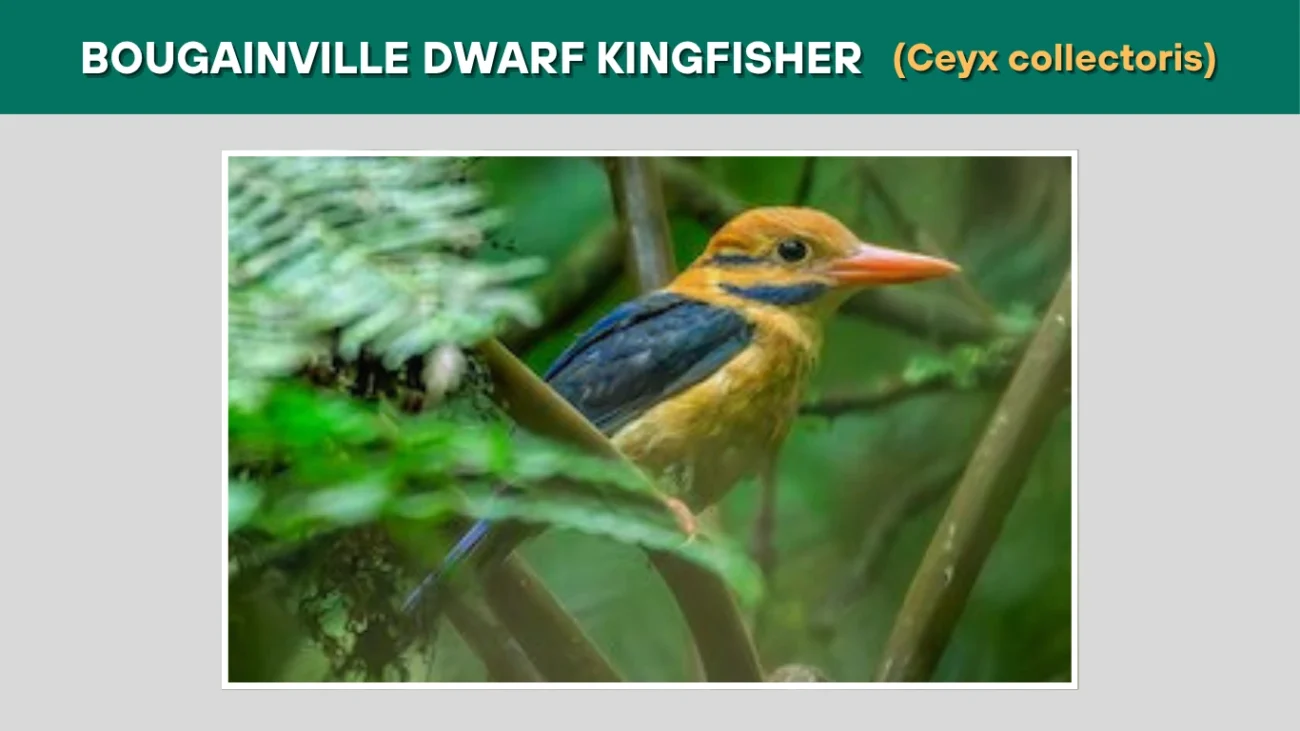
Native to Bougainville Island in Papua New Guinea, the Bougainville Dwarf Kingfisher is a forest specialist and was once grouped under Ceyx erithaca. It is now recognized as a distinct species due to differences in coloration and range.
Identification
- Length: 13–14 cm
- Wingspan: 20–22 cm
- Weight: 22–26 grams
- Bill: Bright red, thick and pointed
- Legs: Red-orange
- Eyes: Dark and prominent
- Tail: Short and squared
Color Pattern and Growth
Adults feature a vivid orange belly, reddish-orange back, and dark violet-blue wings and crown. A faint white patch may appear near the neck. Juveniles are duller and browner with softer contrasts. Color matures quickly during the fledgling stage.
Habitat
Inhabits dense lowland and foothill forests, especially near freshwater creeks and damp forest floors. It prefers shaded, undisturbed habitats and avoids open areas.
Hunting and Diet
Feeds primarily on terrestrial and aquatic insects, including ants, beetles, and larvae. Hunts from low perches, darting down to the ground or water to grab prey.
Nesting
Nests are built in narrow tunnels carved into soil banks or rotting tree trunks. Both sexes share duties from egg incubation to chick feeding. Breeding usually aligns with the rainy season when food is abundant.
23. Malaita Dwarf Kingfisher (Ceyx malaitae)
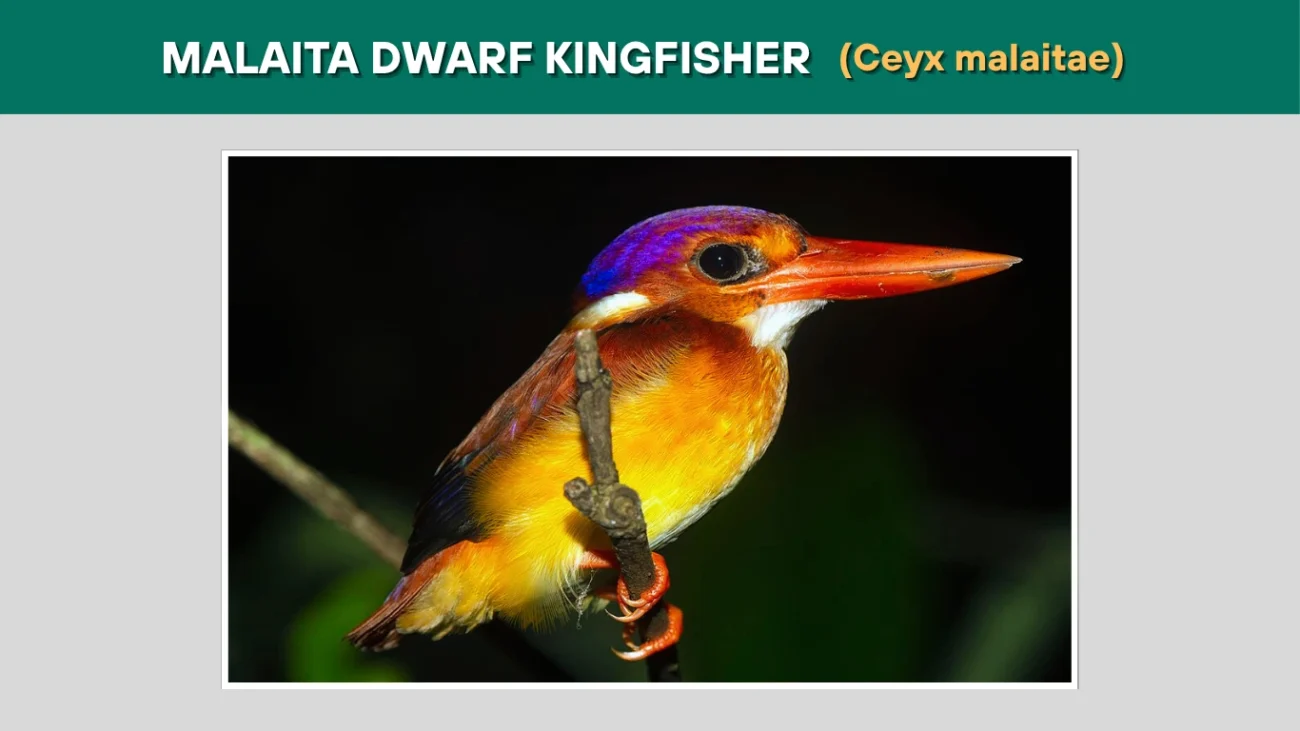
Endemic to Malaita Island in the Solomon Islands, the Malaita Dwarf Kingfisher is a highly localized species with rich, vibrant plumage and a strong dependence on intact rainforest ecosystems.
Identification
- Length: 13–14 cm
- Wingspan: 20–21 cm
- Weight: 21–25 grams
- Bill: Thick, reddish-orange
- Legs: Deep red
- Eyes: Large and black
- Tail: Very short and square
Color Pattern and Growth
Adults show brilliant orange underparts, a dark red to orange back, and metallic violet-blue on the wings and crown. Juveniles are duller, often with faded colors and less contrast. Plumage reaches full brightness within a month of fledging.
Habitat
Prefers pristine lowland rainforests and streamside vegetation. Typically found near shaded gullies and undisturbed forest interiors at low to mid elevations.
Hunting and Diet
Feeds on insects, small crustaceans, and aquatic larvae. Often perches low to the ground and launches rapid, short flights to snatch prey from water edges or forest litter.
Nesting
Digs nesting tunnels into earthen stream banks or old rotting logs. Breeding is poorly documented but likely follows similar patterns as other members of the Ceyx genus—cooperative nesting and feeding by both parents.
24. Makira Dwarf Kingfisher (Ceyx gentianus)
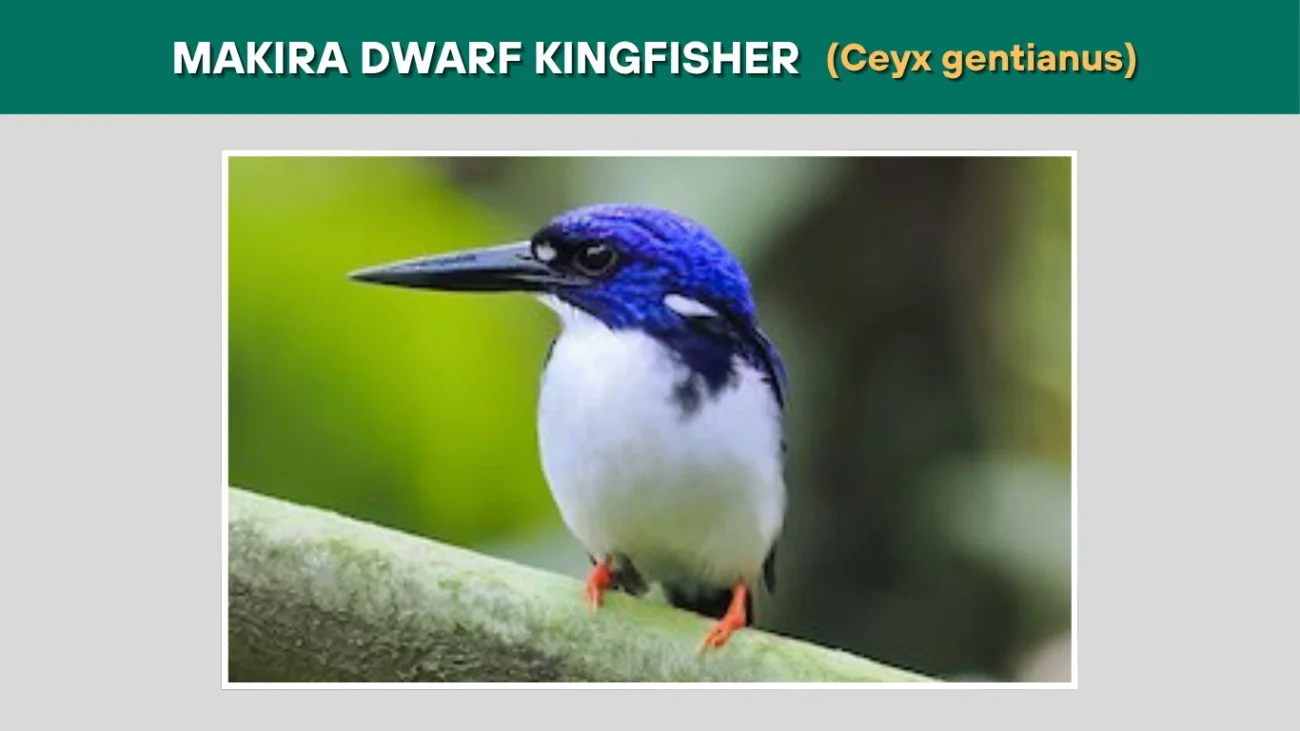
Endemic to Makira Island in the Solomon Islands, the Makira Dwarf Kingfisher is a vividly colored bird known for its strong territorial habits and reliance on dense forest ecosystems.
Identification
- Length: 13–14 cm
- Wingspan: 20–22 cm
- Weight: 22–26 grams
- Bill: Broad, red-orange
- Legs: Reddish
- Eyes: Deep black
- Tail: Very short
Color Pattern and Growth
Adults have deep orange underparts, a rufous to reddish back, and violet-blue wings and crown. The contrast is sharp and vibrant. Juveniles have lighter, more brown-toned plumage and develop full color vibrancy within a few weeks after fledging.
Habitat
Inhabits lowland and foothill rainforests with dense canopy and limited human disturbance. Typically found near forest streams, wet ravines, and damp gullies.
Hunting and Diet
Feeds on insects, caterpillars, and aquatic invertebrates. It hunts from low perches close to the ground or water, flying swiftly to snatch prey with high precision.
Nesting
Excavates burrows into earthen stream banks or decaying logs. Both parents share incubation and feeding duties. Nesting behavior is closely aligned with seasonal rainfall and prey abundance.
25. New Georgia Dwarf Kingfisher (Ceyx collectoris georgius)
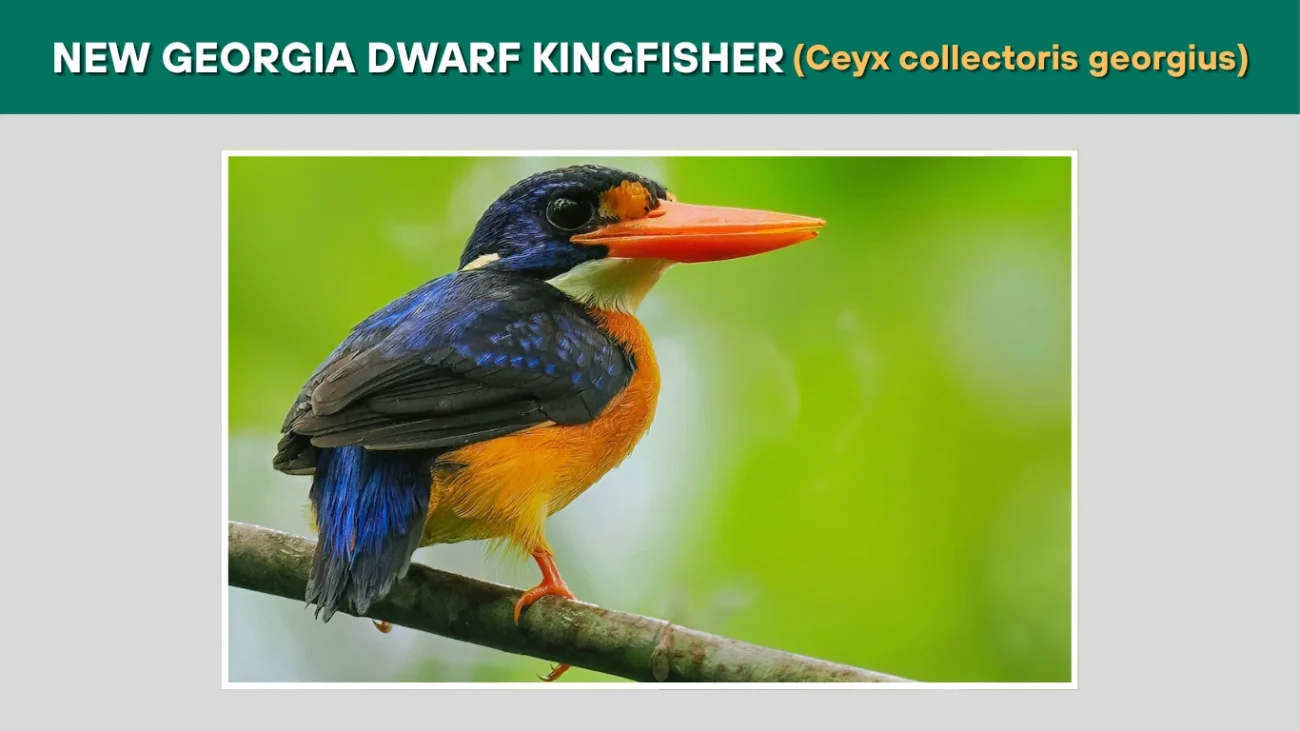
A subspecies of the Bougainville Dwarf Kingfisher, this bird is native to New Georgia in the Solomon Islands and is distinguished by subtle differences in coloration and call. It is found only in limited island habitats.
Identification
- Length: 13–14 cm
- Wingspan: 20–21 cm
- Weight: 21–25 grams
- Bill: Thick, bright red
- Legs: Orange-red
- Eyes: Dark and rounded
- Tail: Short and square
Color Pattern and Growth
Adult birds feature vivid orange underparts, reddish upper back, and bluish-violet crown and wings. Juveniles are muted in tone, with softer coloration that intensifies as the bird matures.
Habitat
Restricted to tropical moist forests on New Georgia Island. Found near small creeks, forested slopes, and wet areas with dense cover. Strongly avoids cleared or fragmented forest zones.
Hunting and Diet
Primarily insectivorous, feeding on beetles, larvae, and other small arthropods. Hunts from low branches, diving onto the ground or shallow water to capture prey.
Nesting
Likely nests in soil banks or fallen logs. Both sexes are involved in digging, incubating, and chick-rearing. Due to its restricted range, detailed nesting records are limited but presumed consistent with other Ceyx species.
26. Manus Dwarf Kingfisher (Ceyx dispar)
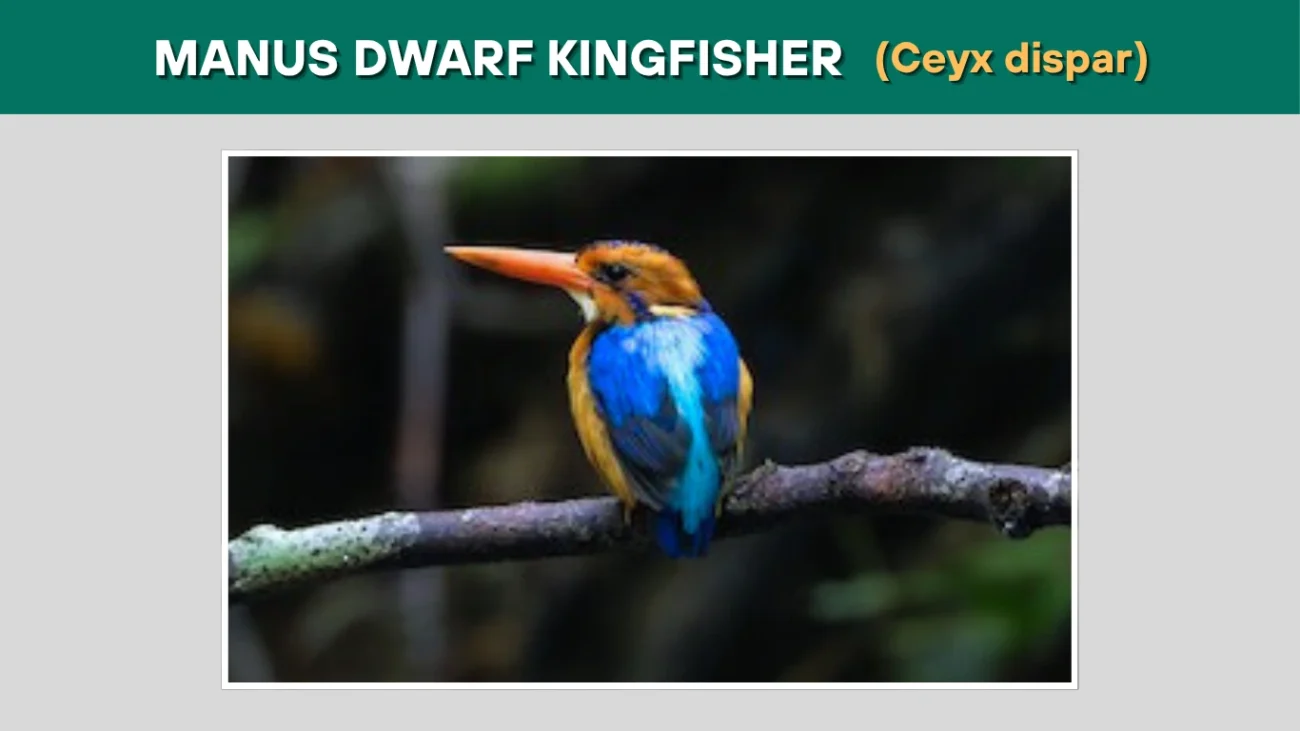
Endemic to Manus Island in Papua New Guinea, the Manus Dwarf Kingfisher is a rare and elusive forest bird with striking coloration and a limited range. It prefers undisturbed lowland rainforest habitats.
Identification
- Length: 13–14 cm
- Wingspan: 20–21 cm
- Weight: 21–26 grams
- Bill: Short, red-orange
- Legs: Bright red
- Eyes: Dark brown
- Tail: Very short and squared
Color Pattern and Growth
Adults display rich orange underparts, a rufous back, and bright violet-blue wings and crown. Juveniles are less vibrant, often appearing with brownish or buff tones. Plumage matures quickly after fledging.
Habitat
Found in lowland tropical rainforests, especially in shaded areas near creeks and moist forest floors. It avoids disturbed habitats and is highly sensitive to deforestation.
Hunting and Diet
Feeds mainly on insects, spiders, and aquatic invertebrates. Uses short, low-level flights from perches to catch prey on the ground or near water.
Nesting
Burrows are typically dug into soft earth banks or decaying wood. Both parents assist in nesting duties, though detailed breeding data is limited due to the bird’s secretive nature and remote range.
27. Rennell Dwarf Kingfisher (Ceyx rennellianus)

The Rennell Dwarf Kingfisher is found exclusively on Rennell Island in the Solomon Islands. It is another forest-dependent species with a very narrow distribution and is considered vulnerable due to habitat loss.
Identification
- Length: 13–14 cm
- Wingspan: 20–22 cm
- Weight: 22–27 grams
- Bill: Broad, red-orange
- Legs: Reddish
- Eyes: Black and rounded
- Tail: Short and stubby
Color Pattern and Growth
Adults feature vivid orange underparts, a reddish upper back, and intense violet-blue wings and crown. Juveniles are much duller, with muted color contrast and less definition. Plumage brightens fully within weeks of growth.
Habitat
Occupies dense rainforest interiors and moist forest edges on Rennell Island. Usually found near shaded creeks or ravines with dense undergrowth and a stable water source.
Hunting and Diet
Feeds on small insects, larvae, and forest-floor invertebrates. Hunts by perching low to the ground and making swift strikes toward moving prey.
Nesting
Excavates nests in soft earthen stream banks or decayed logs. Though rarely observed, nesting behaviors are consistent with other island dwarf kingfishers—shared incubation and chick feeding by both sexes.
28. New Ireland Dwarf Kingfisher (Ceyx mulcatus)

Endemic to New Ireland in Papua New Guinea, the New Ireland Dwarf Kingfisher is a forest-restricted species recognized for its brilliant colors and isolation from closely related populations.
Identification
- Length: 13–14 cm
- Wingspan: 20–21 cm
- Weight: 21–25 grams
- Bill: Short, red-orange
- Legs: Bright red
- Eyes: Large and black
- Tail: Very short and squared
Color Pattern and Growth
Adults exhibit intense orange underparts, a reddish to chestnut back, and deep violet-blue wings and crown. Juveniles have softer hues and paler plumage, which develop into vibrant adult colors with age.
Habitat
Prefers dense lowland tropical rainforests, often near water sources such as streams and damp forest floors. Avoids cleared or altered landscapes.
Hunting and Diet
Feeds mainly on insects, small invertebrates, and aquatic prey. Hunts from low forest perches, darting down to capture prey among leaves or water surfaces.
Nesting
Nesting typically occurs in soil banks or rotting logs. Although direct observations are limited, nesting behavior mirrors other Ceyx species, with shared duties between male and female.
29. Louisiade Kingfisher (Ceyx websteri)
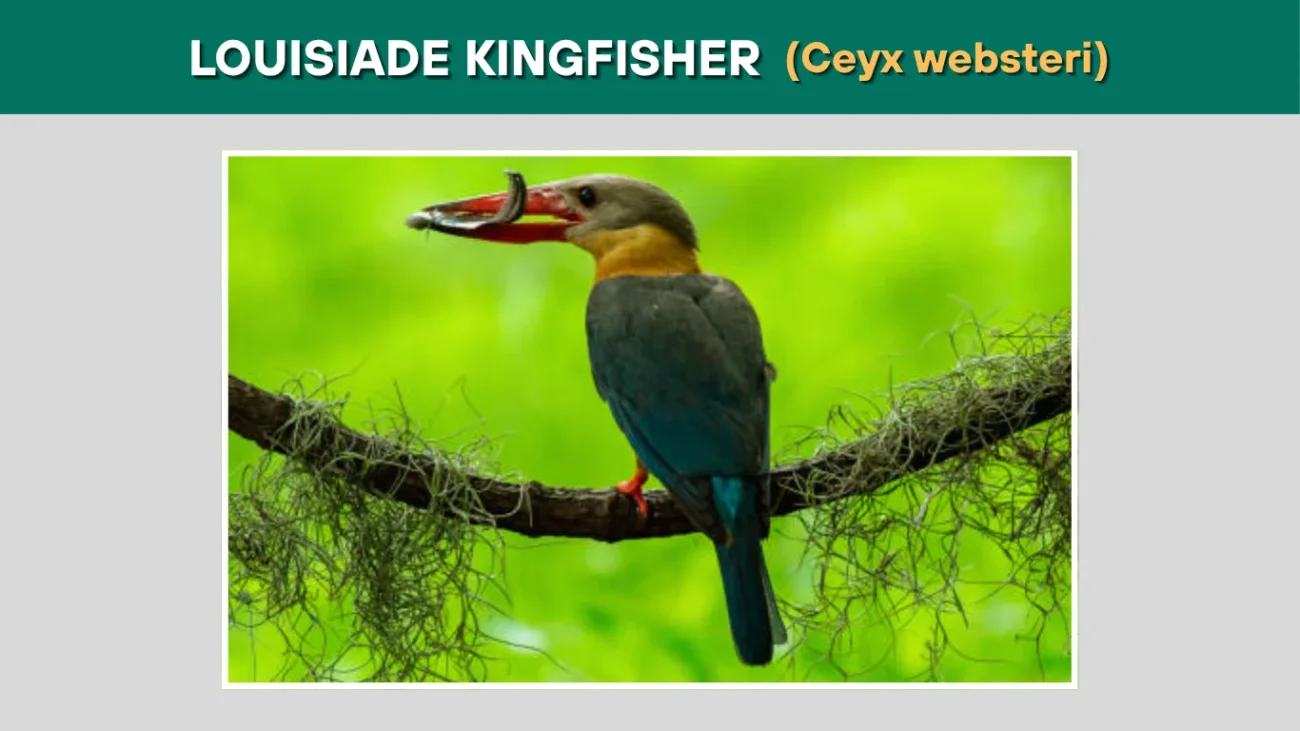
Native to the Louisiade Archipelago of Papua New Guinea, the Louisiade Kingfisher is a striking but little-studied bird. Its vibrant colors and restricted island range make it a unique species among Pacific kingfishers.
Identification
- Length: 13–14 cm
- Wingspan: 20–22 cm
- Weight: 22–26 grams
- Bill: Thick, bright red
- Legs: Reddish-orange
- Eyes: Dark brown
- Tail: Short and square
Color Pattern and Growth
Adults show a bright orange underside, reddish back, and vivid blue wings and crown. Juveniles have duller, less defined coloration. Full adult plumage develops within the first month post-fledging.
Habitat
Found in primary and secondary lowland forests near freshwater streams or damp areas. Prefers thick vegetation and remote, undisturbed habitats within the island group.
Hunting and Diet
Feeds on forest-floor insects, spiders, and small aquatic creatures. Hunts from shaded perches low in the understory, using quick dives to secure prey.
Nesting
Likely nests in earthen embankments or decayed wood, like other dwarf kingfishers. Nesting habits are inferred due to limited direct study, but both parents likely assist in rearing young.
30. New Hanover Kingfisher (Ceyx sp. nov.)

The New Hanover Kingfisher is an undescribed species known from New Hanover Island in Papua New Guinea. Though not yet formally named in scientific literature, it is recognized as a distinct taxon due to its unique vocal and plumage traits.
Identification
- Length: 13–14 cm
- Wingspan: 20–21 cm
- Weight: 22–26 grams
- Bill: Thick, red-orange
- Legs: Reddish
- Eyes: Dark and alert
- Tail: Short and squared
Color Pattern and Growth
Adult plumage includes vibrant orange underparts, reddish upper back, and deep blue-violet wings and head. Juveniles are duller, with brownish or faded tones. Plumage becomes more vivid with age and molting.
Habitat
Restricted to dense rainforests on New Hanover Island. Prefers lowland moist forests near freshwater streams or damp leaf-litter areas, avoiding open or degraded environments.
Hunting and Diet
Feeds on forest insects, larvae, and small aquatic prey. Uses low, shaded perches to ambush prey from short distances.
Nesting
Presumed to nest in earthen banks or rotting logs like its close relatives. Detailed breeding behavior remains undocumented due to its undescribed status and limited study.
31. Common Kingfisher (Western Subspecies – Alcedo atthis atthis)
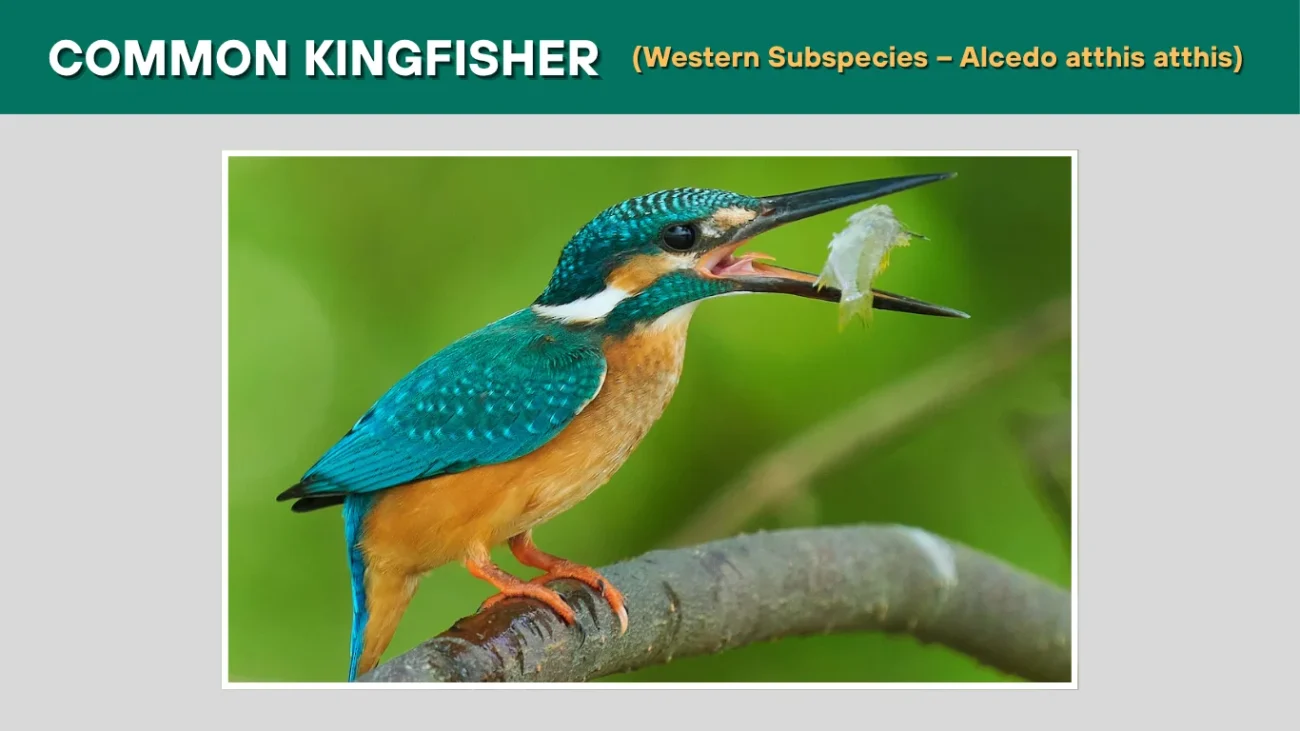
The western subspecies of the Common Kingfisher ranges across Europe and parts of North Africa. It’s the nominate form and is nearly identical to other A. atthis subspecies but with minor differences in plumage and distribution.
Identification
- Length: 16–17 cm
- Wingspan: 24–26 cm
- Weight: 34–46 grams
- Bill: Long, black (males), orange base (females)
- Legs: Bright reddish-orange
- Eyes: Dark and glossy
- Tail: Short, square
Color Pattern and Growth
Adults show a bright blue back, turquoise rump, and orange underparts. The crown is streaked with lighter blue. Juveniles are paler and slightly greenish-blue until full plumage develops a few weeks after fledging.
Habitat
Found near rivers, streams, ponds, and lakes with clean, still or slow-moving water. Prefers areas with natural banks and overhanging vegetation.
Hunting and Diet
Feeds on small fish, aquatic insects, and crustaceans. Hunts from perches and dives with precision to capture prey underwater.
Nesting
Burrows are dug into soft riverbanks, with both parents incubating and raising the chicks. Up to three broods may be raised during a breeding season.
32. Common Kingfisher (Eastern Subspecies – Alcedo atthis bengalensis)
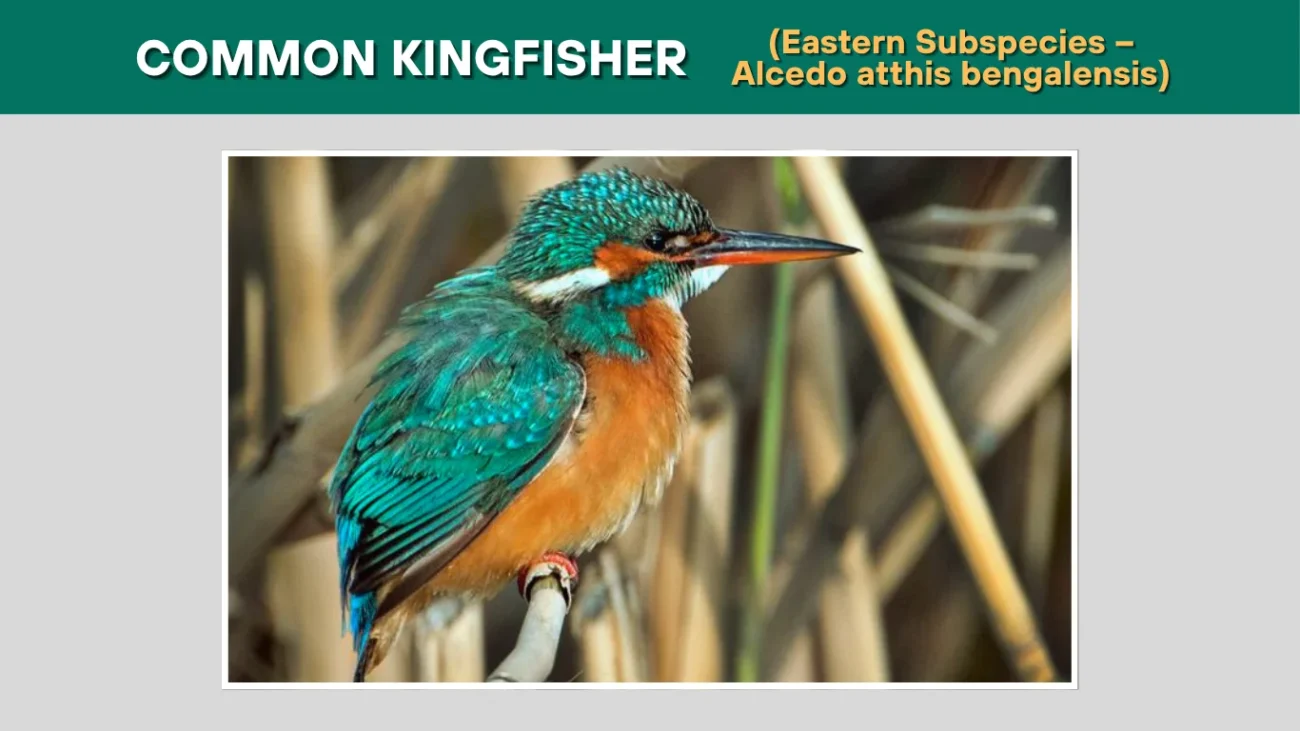
The eastern subspecies of the Common Kingfisher is widely distributed across South and Southeast Asia, from the Indian subcontinent to southern China and Indonesia. It is slightly smaller and brighter than the western form.
Identification
- Length: 15–16 cm
- Wingspan: 23–25 cm
- Weight: 32–42 grams
- Bill: Long and black in males; females have an orange base
- Legs: Bright orange-red
- Eyes: Dark, alert
- Tail: Short and squared
Color Pattern and Growth
Adults have a more vivid turquoise-blue back and wings compared to the western subspecies. The orange on the underparts is deeper, and the crown is marked with finer blue spots. Juveniles appear duller and less glossy, maturing into full color within a few weeks after fledging.
Habitat
Thrives in wetlands, rivers, and ponds across Asia, especially in tropical and subtropical climates. Prefers quiet, clean waters with plenty of perching spots and natural cover.
Hunting and Diet
Feeds mainly on small fish, aquatic insects, and larvae. Uses rapid perch-to-dive hunting, diving with precision to catch prey underwater.
Nesting
Builds nests in riverbanks by excavating tunnels. Breeding occurs during the warmer months, and both parents participate in incubation and feeding. Can raise multiple broods per season.