










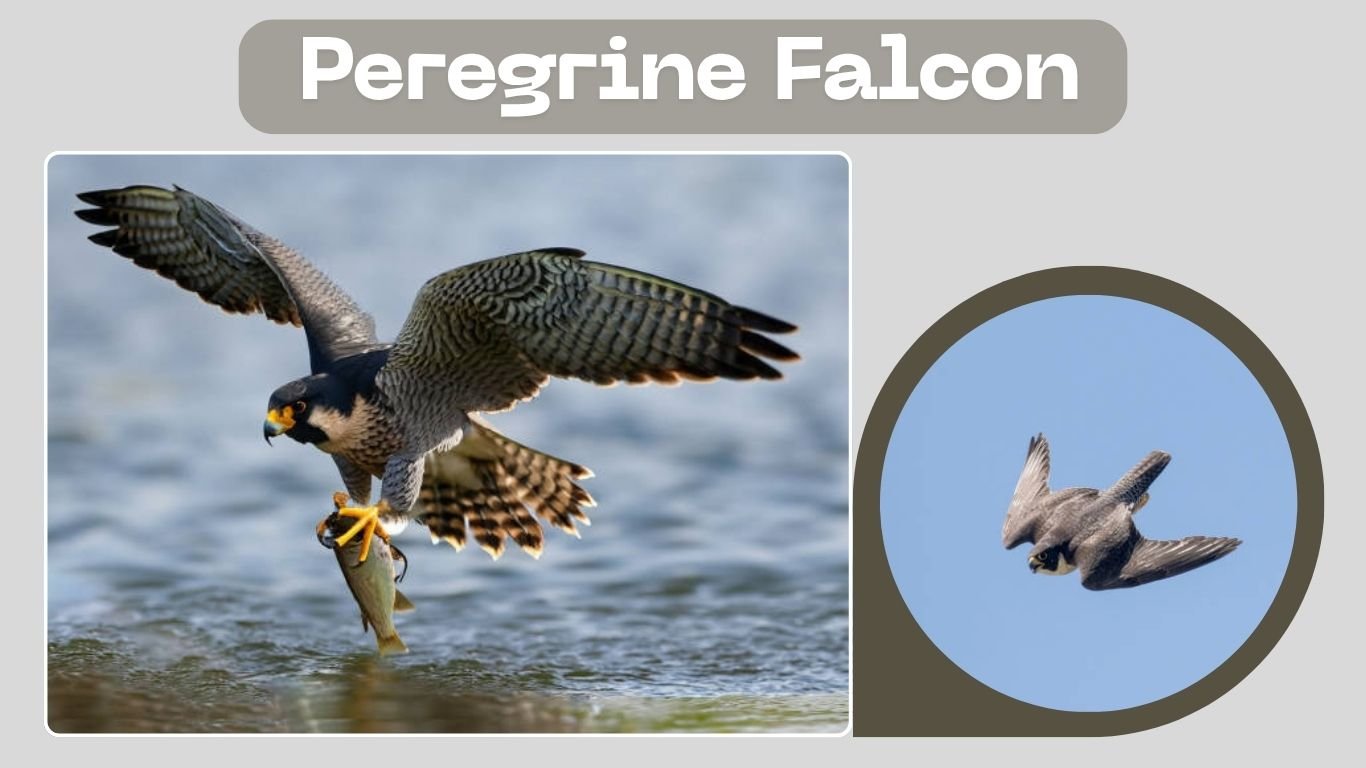
The Peregrine Falcon holds the crown as the fastest bird — and indeed, the fastest animal — on Earth. Known for its breathtaking diving speed that exceeds 240 miles per hour (386 km/h), this remarkable predator is an icon of precision and power in the skies. Found across every continent except Antarctica, the Peregrine Falcon has captivated scientists and bird enthusiasts alike for its astonishing agility, hunting skill, and resilience.
Identification – What Is a Peregrine Falcon?
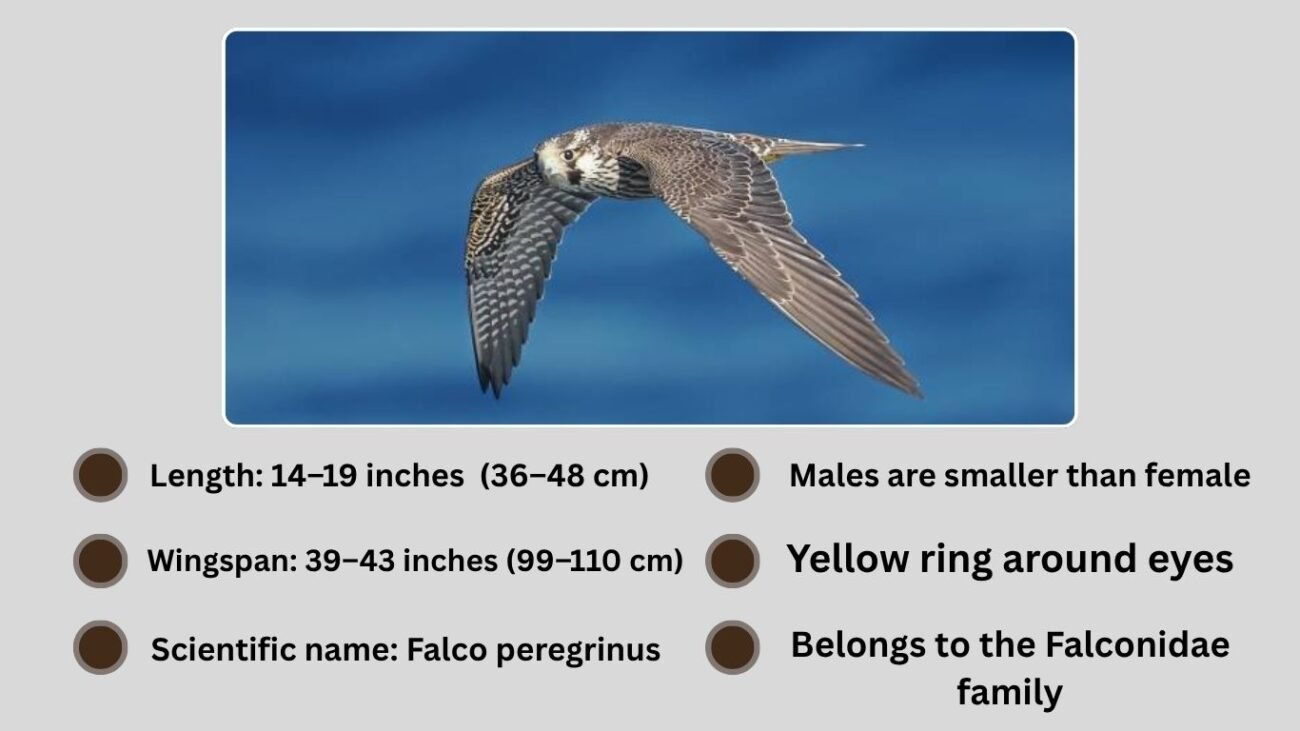
Physical Features and Size
- Medium-sized bird of prey with a sleek, muscular body built for speed.
- Length: 14–19 inches (36–48 cm); Wingspan: 39–43 inches (99–110 cm).
- Males are smaller than females (sexual dimorphism common in raptors).
- Distinctive slate-gray wings and barred white underparts.
- Notable black “mustache” mark on cheeks — a key identifying feature.
- Short, hooked beak designed for tearing prey.
- Yellow ring around eyes and legs adds contrast to their dark facial markings.
Classification and Family
- Scientific name: Falco peregrinus — meaning “wandering falcon.”
- Belongs to the Falconidae family, which includes kestrels, merlins, and gyrfalcons.
- Known for fast, agile flight with sharply pointed wings and a narrow tail.
- Found on every continent except Antarctica, highlighting its adaptability.
- Juveniles are brown and streaked compared to the gray-blue adults.
Speed and Flight Performance
How Fast Can a Peregrine Falcon Fly?

The Peregrine Falcon’s incredible speed is achieved during its characteristic hunting dive, known as the “stoop.” When folded into a teardrop shape, the falcon can reach speeds exceeding 240 mph (386 km/h), verified by radar tracking and high-speed cameras. In level flight, its speed is more moderate — around 55 mph (89 km/h) — but the true marvel is in its controlled descent. No other bird or animal on Earth comes close to this level of aerial velocity.
Swift vs. Falcon – Which Is Faster?
The Common Swift is often cited as one of the fastest birds in horizontal flight, capable of reaching speeds near 70 mph (113 km/h). However, the Peregrine Falcon dominates when it comes to diving speed. The key difference lies in movement type — swifts excel at sustained, level flying, while falcons specialize in gravity-assisted, high-speed dives used to ambush prey.
Why the Peregrine Falcon Is the Fastest Bird
Aerodynamic Design
Every aspect of the Peregrine Falcon’s anatomy is optimized for aerodynamic efficiency. Its streamlined body reduces air resistance, while its long, tapered wings generate lift with minimal drag. The shape allows the bird to maintain stability and control during steep dives. Its short, stiff feathers prevent turbulence and help it slice through the air effortlessly.
Muscular Power and Wing Dynamics
Beneath the feathers lies a powerful musculature — particularly in the chest and wings — that delivers rapid acceleration. The falcon’s breast muscles, or pectoralis major, are highly developed and enable strong downstrokes. Combined with a lightweight skeleton, these muscles allow the bird to maintain both speed and maneuverability during pursuit.
Vision and Targeting Ability
The Peregrine Falcon’s eyesight is among the sharpest in the animal kingdom. Its vision is estimated to be eight times stronger than that of humans, allowing it to spot prey from over two miles away. Specialized retinal receptors and a protective bony ridge help it focus precisely on targets even while diving at extreme speeds. This exceptional visual acuity ensures pinpoint accuracy during attacks.
Hunting Techniques and Behavior
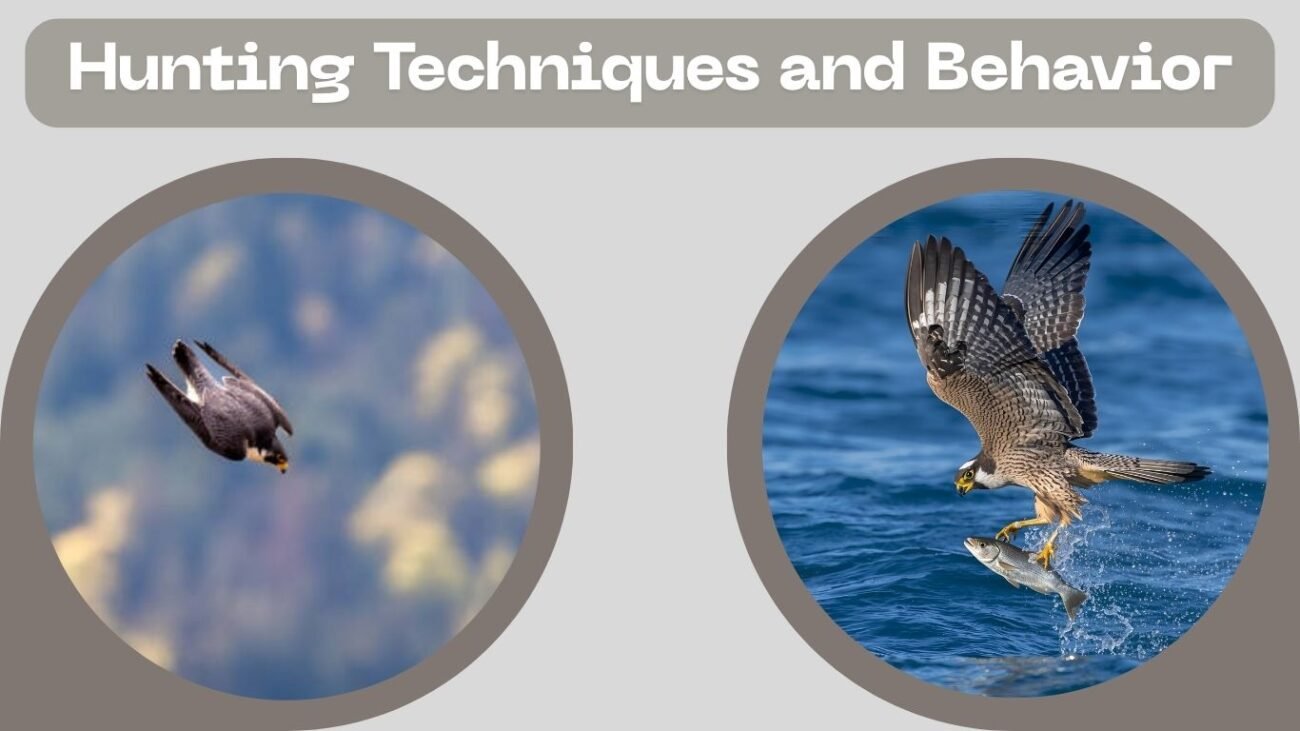
The Stoop – Deadly Dive Attack
The signature hunting move of the Peregrine Falcon is the “stoop,” a high-speed dive from great altitude. After ascending hundreds or even thousands of feet, the falcon tucks its wings close to its body and drops toward its target in a streamlined plunge. Using gravity and precision, it strikes unsuspecting prey — usually mid-air — with a clenched talon. The impact alone is often fatal, showcasing both the bird’s speed and deadly accuracy.
Intelligence and Strategy
Peregrine Falcons are not just fast; they are highly intelligent hunters. They assess wind direction, terrain, and prey movement before attacking. In urban environments, they may use tall skyscrapers as launch points for their stoops, mimicking the cliffs of their natural habitats. This adaptability demonstrates advanced problem-solving and environmental awareness — traits that make them apex aerial predators.
Habitat and Global Distribution
Where Peregrine Falcons Live
The Peregrine Falcon’s name, meaning “wanderer,” is fitting — it is found on every continent except Antarctica. Its range spans from coastal cliffs to mountain ranges, grasslands, deserts, and tundra. These falcons prefer open landscapes where they can easily spot prey and dive without obstruction.
Urban Adaptation
One of the most fascinating aspects of the Peregrine Falcon is its ability to adapt to modern cities. Skyscrapers, towers, and bridges provide excellent nesting spots that mimic their natural cliffside homes. Pigeons, starlings, and other urban birds offer a steady food supply. In many cities — including New York, London, and Chicago — peregrines have made a strong comeback after years of decline, symbolizing wildlife resilience amid urbanization.
Types of Falcons and Speed Comparison

Peregrine Falcon vs. Gyrfalcon and Saker Falcon
While the Peregrine Falcon is the undisputed speed champion, other falcons are also remarkable fliers. The Gyrfalcon (Falco rusticolus), the largest of the falcons, is built for strength rather than sheer speed. It relies on endurance to chase prey across the Arctic tundra. The Saker Falcon (Falco cherrug) is slightly slower but impressively agile, reaching speeds up to 200 mph (320 km/h) in dives. In contrast, the Peregrine Falcon combines both power and aerodynamics to dominate aerial pursuits.
Ranking the World’s Fastest Birds
When ranking the world’s fastest birds, the Peregrine Falcon always tops the list:
- Peregrine Falcon – 240+ mph (386+ km/h) during dives.
- Golden Eagle – Up to 200 mph (320 km/h).
- White-throated Needletail Swift – Around 105 mph (169 km/h) in level flight.
- Frigatebird – Fast and highly maneuverable over oceans.
- Spine-tailed Swift – A skilled flyer reaching impressive speeds.
Adaptations for Extreme Speed
Structural Adaptations
The Peregrine Falcon’s body has evolved to handle the immense physical forces of high-speed dives. Its stiff, narrow feathers resist fluttering and reduce drag, while specialized nostrils — shaped like tiny cones — control airflow to prevent lung damage. The bird’s head is slightly flattened, minimizing resistance during stoops. Even its talons are shaped to pierce prey efficiently during impact.
Physiological Adaptations
Internally, the Peregrine Falcon possesses a suite of adaptations tailored to speed. It has a large, efficient heart and a high oxygen absorption rate, enabling sustained flight and rapid acceleration. Its respiratory system delivers a constant flow of oxygen to the muscles, even when the bird’s body is compressed during dives. These biological systems ensure that the falcon can operate at full capacity while moving faster than a race car.
Records and Recognition
Official Speed Records
Modern technology has confirmed what falconers and naturalists have long known — no creature can match the Peregrine Falcon’s speed. Using GPS trackers and radar, scientists have recorded individuals diving at over 242 mph (389 km/h). This astonishing velocity has earned it a place in the Guinness World Records as the fastest bird and fastest member of the animal kingdom. Each dive, or stoop, is a marvel of nature’s engineering, blending instinct, precision, and raw power.
Symbolism and Cultural Significance
Throughout history, the falcon has symbolized speed, vision, and freedom. In ancient Egypt, falcons were sacred to the god Horus, representing the sky and divine kingship. In modern times, the Peregrine Falcon has become an emblem of resilience — recovering from near extinction to reclaim its place in the skies. Its image appears in sports logos, military insignias, and conservation campaigns worldwide.
Conservation and Survival
Threats to the Peregrine Falcon
Despite its strength and adaptability, the Peregrine Falcon faced a severe population decline during the mid-20th century. The main culprit was DDT, a pesticide that caused eggshell thinning, leading to reproductive failure. Habitat loss, hunting, and environmental pollution also contributed to its near disappearance in several regions, including North America and Europe.
Recovery and Protection Efforts
Thanks to rigorous conservation efforts, the Peregrine Falcon has made one of the most remarkable recoveries in wildlife history. After the 1970s ban on DDT, breeding programs and reintroduction initiatives helped rebuild populations. Organizations such as the Peregrine Fund and government wildlife agencies nurtured young falcons in captivity and released them into the wild. Today, the species has rebounded strongly, and in many countries, it is no longer listed as endangered. Its successful recovery is often cited as a model for global conservation efforts.
Key Takeaways
- The Peregrine Falcon is the fastest bird and animal on Earth, capable of diving at speeds over 240 mph (386 km/h).
- Its aerodynamic design, powerful muscles, and specialized respiratory system make it a supreme aerial predator.
- Found worldwide, the falcon thrives in both natural and urban environments.
- Once nearly extinct, it has recovered through dedicated conservation and global protection initiatives.
- It remains a symbol of power, resilience, and speed in both nature and human culture.
FAQs
How fast can a peregrine falcon dive?
The Peregrine Falcon can dive at speeds exceeding 240 mph (386 km/h). This incredible velocity is achieved during its hunting stoop, where it folds its wings and dives with precision to strike prey mid-air.
Is the peregrine falcon faster than a cheetah?
Yes, it is significantly faster. While a cheetah runs up to 75 mph (120 km/h) on land, the Peregrine Falcon’s dive speed more than triples that, making it the fastest living creature overall — though in air, not on ground.
Why is the peregrine falcon so fast?
Its streamlined shape, powerful wings, and specialized anatomy all contribute to its speed. Features like cone-shaped nostrils, stiff feathers, and efficient oxygen intake allow it to dive safely at extreme velocities.
Where can peregrine falcons be found?
Peregrine Falcons inhabit every continent except Antarctica. They nest on cliffs, coastlines, and increasingly on tall city structures such as skyscrapers, adapting remarkably well to urban life.
What is the difference between a swift and a falcon?
Swifts are masters of level flight, capable of sustaining high horizontal speeds. Falcons, on the other hand, dominate in vertical dives. The Peregrine Falcon’s stoop makes it the ultimate speed champion of the skies.


