











Hawks and falcons are among the most skilled hunters in the bird kingdom, often admired for their speed, precision, and intelligence. Though they share many similarities as raptors, these birds belong to entirely different families and exhibit distinct hunting styles, body structures, and behaviors. This article explores how to identify hawks and falcons, where they live, how they hunt, and what makes each species unique in the world of birds of prey.
Understanding Raptors: Hawks and Falcons Explained
Raptors, also known as birds of prey, are a group of carnivorous birds that hunt other animals using sharp talons, strong beaks, and keen eyesight. Both hawks and falcons fall under this category, but they belong to different scientific families.
- Hawks belong to the family Accipitridae, which also includes eagles and kites.
- Falcons, on the other hand, belong to the family Falconidae, closely related to kestrels and caracaras.
This taxonomic difference means that although hawks and falcons perform similar ecological roles, they evolved separately to master different hunting techniques. Hawks rely on strength and ambush, while falcons specialize in speed and agility.
Identification Features: How to Recognize a Hawk vs Falcon

- Wing Shape:
Hawks have broad, rounded wings designed for gliding and maneuvering through forests. Falcons have long, pointed wings built for speed and high-altitude dives. - Size and Build:
Hawks are generally stockier with muscular legs and chests, ideal for short bursts of power. Falcons are slimmer and more aerodynamic, with lighter frames that enhance agility in flight. - Eyes and Vision:
Both have exceptional eyesight, but hawks rely more on scanning wide areas from a perch, while falcons use forward-focused vision for tracking fast-moving prey mid-air. - Color:
Hawks often display brown or reddish tones with streaked undersides for camouflage in wooded areas. Falcons usually have slate-gray or bluish backs with bold facial markings, such as the Peregrine Falcon’s dark “helmet.”
Habitat and Distribution
Hawks and falcons both enjoy wide distributions across the globe, though their preferred habitats differ significantly.
Hawks often inhabit woodlands, grasslands, and agricultural regions, where trees offer perches for ambush hunting. They build nests high in trees or cliffs and frequently return to the same nesting sites year after year.
Falcons, however, prefer open landscapes—including cliffs, tundras, deserts, and even urban skyscrapers. The Peregrine Falcon, in particular, has adapted remarkably well to city life, nesting on tall buildings that mimic natural cliffs and hunting pigeons in crowded urban areas.
While both species can share the same regions, their hunting grounds rarely overlap due to these habitat preferences.
Behavior and Flight Patterns
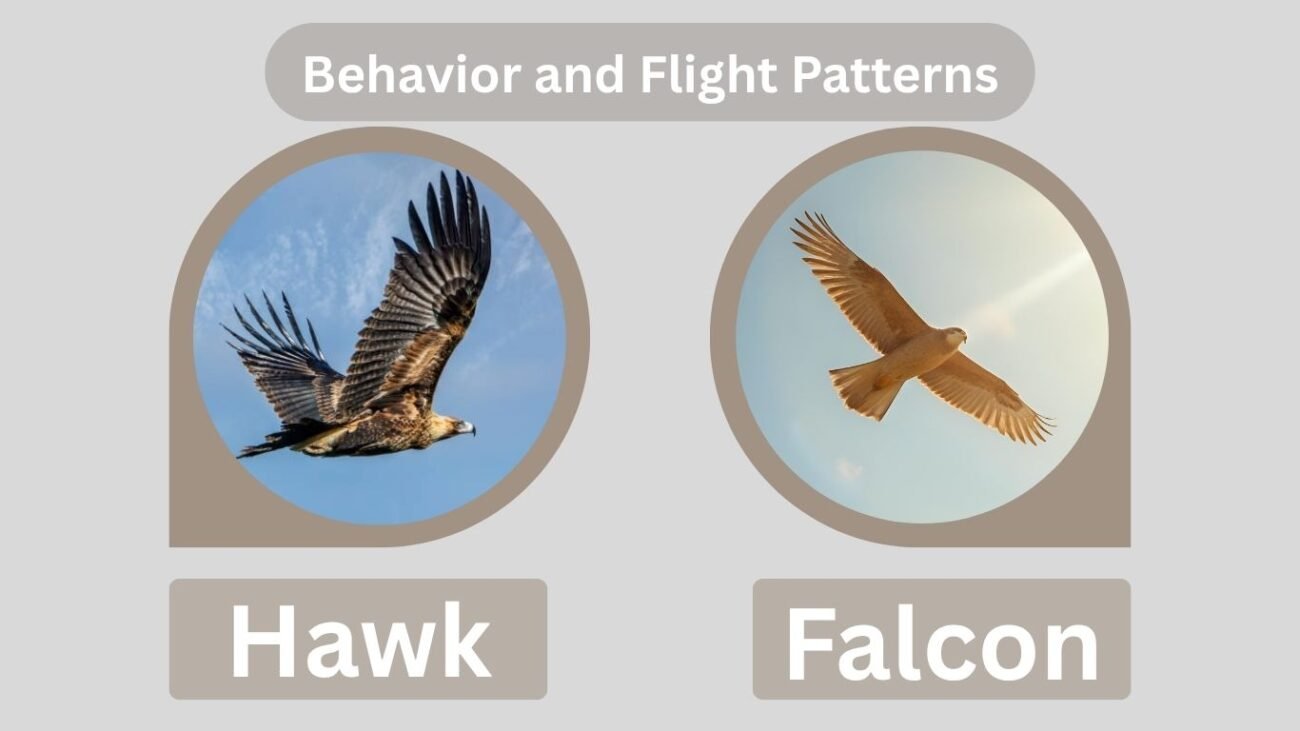
Behavioral differences between hawks and falcons are among the most visible traits separating them.
Flight Mechanics
- Hawks are known for their soaring flight. They use broad wings to glide effortlessly on thermal air currents, often circling patiently before striking from above. This flight style conserves energy while allowing them to scan large areas for prey.
- Falcons, on the other hand, are built for speed and agility. Their pointed wings allow for rapid flapping and swift directional changes. When hunting, falcons perform spectacular dives known as stoops, folding their wings to achieve tremendous speed before striking their prey mid-air.
Social and Breeding Behavior
Hawks are generally solitary, except during the breeding season. They form strong pair bonds, often mating for life, and share responsibilities in raising chicks. Falcons also show monogamous tendencies but are more territorial during breeding.
Both species build or claim elevated nesting sites to protect their eggs from predators. However, falcons tend to use ledges or cavities, while hawks construct large stick nests in trees.
Hunting Style and Predatory Skills
Hawks and falcons showcase contrasting hunting strategies, each reflecting their anatomy and environment.
Hunting Techniques
Hawks rely on stealth and ambush. They perch silently on branches or poles, scanning for small mammals or birds. Once prey is spotted, they swoop down in a burst of speed, grabbing it with powerful talons.
Falcons, meanwhile, hunt in flight. They pursue prey mid-air, relying on precision timing and acceleration. Their attacks are surgical—striking prey with their beak or talons at lightning speed, often killing instantly.
Speed and Power
The Peregrine Falcon holds the record as the fastest animal on Earth, capable of diving at over 200 miles per hour. This incredible speed gives falcons unmatched dominance in aerial hunting.
Hawks, while slower, make up for it with brute strength and tactical skill. They are exceptional at surprise attacks, particularly in dense habitats where maneuverability matters more than speed.
Diet and Feeding Habits
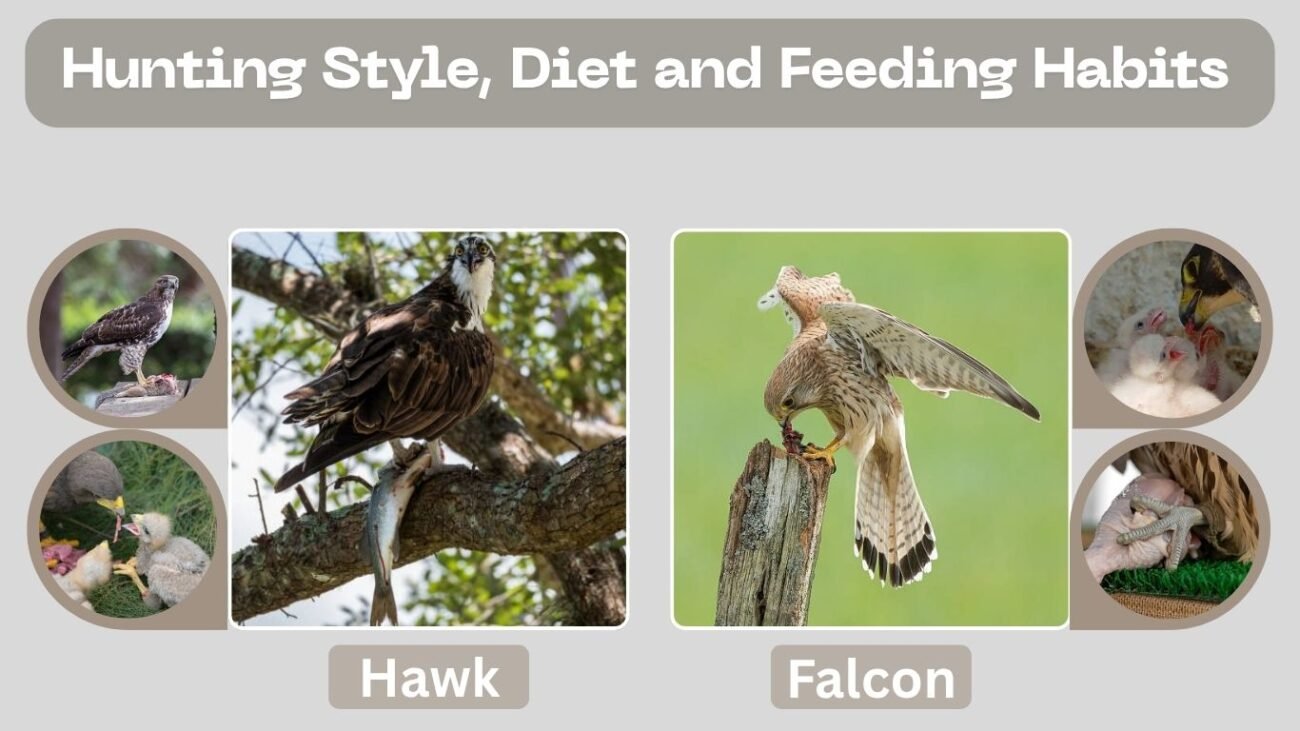
Both hawks and falcons are carnivorous birds of prey, but their diets differ slightly due to their hunting styles and habitats.
Hawks primarily feed on small mammals, such as rabbits, mice, squirrels, and occasionally other birds or reptiles. They use their strong talons to crush prey and their curved beaks to tear meat into manageable pieces. Hawks are patient hunters, often waiting for long periods before ambushing prey at close range.
Falcons, on the other hand, prefer smaller birds and insects. Their speed gives them a tremendous advantage in mid-air pursuits, allowing them to strike prey while it’s still flying. The Peregrine Falcon, for example, often hunts pigeons or doves, while smaller species like the American Kestrel catch insects on the wing.
Both raptors play a crucial role in controlling animal populations, maintaining balance in ecosystems by preventing overpopulation of small prey species.
Hawks vs Falcons: Intelligence and Adaptability
Intelligence and adaptability have helped both hawks and falcons thrive in diverse environments—from remote forests to bustling cities.
Hawks display exceptional learning abilities and problem-solving skills. They can adapt their hunting strategies based on terrain, weather, and available prey. Some species, like the Red-tailed Hawk, have even adjusted to urban settings, hunting rodents in parks and farmlands.
Falcons, especially the Peregrine Falcon, have demonstrated remarkable adaptability. Once endangered due to pesticide exposure, this species made a dramatic comeback by nesting on skyscrapers and bridges, mimicking natural cliff habitats. Their ability to coexist with human development makes them one of the most successful raptors in the modern world.
In terms of intelligence, falcons are known for precise aerial calculations, while hawks excel in observational hunting, reading ground movement with accuracy.
Cooper’s Hawk vs Peregrine Falcon (Case Study)
A direct comparison between the Cooper’s Hawk and the Peregrine Falcon offers a clear example of the differences between these two raptors.
Physical Differences
The Cooper’s Hawk has a shorter, rounded wing structure and a long tail for navigating dense woodlands. Its plumage is typically grayish-brown with a lighter underbelly. The Peregrine Falcon, by contrast, has sleek, pointed wings and a black “helmet” marking on its head, making it instantly recognizable.
Hunting Styles
Cooper’s Hawks rely on agility and ambush, darting through trees to catch smaller birds in flight or on the ground. Peregrine Falcons, however, hunt at high altitudes, diving at extreme speeds to strike prey mid-air with precision.
Habitat Preferences
Cooper’s Hawks are common in suburban areas with trees, while Peregrine Falcons prefer open spaces and tall structures. Their adaptability to city life has made both species increasingly visible to humans.
This comparison illustrates the broader divide between hawks and falcons—power and patience versus speed and precision.
Raptors vs Hawks vs Falcons

The term raptor is often used interchangeably with “hawk” or “falcon,” but it actually describes a broader group of predatory birds that includes eagles, owls, kites, and vultures.
Shared Characteristics
All raptors possess three essential traits: sharp talons, curved beaks, and extraordinary vision. These adaptations allow them to locate, capture, and consume prey efficiently.
Key Differences
- Hawks are medium-sized raptors known for strength and soaring flight.
- Falcons are built for speed, using aerodynamic bodies for quick strikes.
- Eagles are larger and more powerful, often hunting bigger prey.
- Owls differ by being nocturnal hunters with silent flight and acute hearing.
Understanding these distinctions helps birdwatchers identify species more accurately and appreciate the diversity within the raptor family.
Conservation and Ecological Role
Hawks and falcons play an essential role in maintaining ecological balance. By controlling populations of rodents, small birds, and insects, they help prevent crop damage and disease spread.
Unfortunately, these majestic birds have faced significant threats from habitat destruction, hunting, and pesticide use. During the mid-20th century, falcon populations declined drastically due to DDT, a pesticide that thinned eggshells. Conservation efforts, including pesticide bans and breeding programs, have since restored many populations—most notably the Peregrine Falcon, which now thrives worldwide.
Ongoing conservation programs focus on preserving nesting habitats, reducing pollution, and educating the public about the importance of birds of prey. Both hawks and falcons serve as bioindicators, meaning their presence reflects the overall health of ecosystems.
Key Takeaways
- Hawks and falcons are both raptors but belong to different families: Accipitridae (hawks) and Falconidae (falcons).
- Hawks are strong and strategic ambush predators, while falcons are fast, aerodynamic hunters that strike mid-air.
- The Peregrine Falcon is the world’s fastest bird, diving at over 200 mph.
- Both species are intelligent and adaptable, thriving even in urban areas.
- Conservation efforts have successfully restored many raptor populations worldwide.
FAQs
What is the main difference between hawks and falcons?
Hawks rely on soaring flight and powerful talons to ambush prey, while falcons are built for speed and use rapid dives to catch flying birds. They also belong to different scientific families and have distinct beak structures.
Which bird is faster, a hawk or a falcon?
The falcon—especially the Peregrine Falcon—is much faster. During its hunting dive, it can exceed speeds of 200 miles per hour, making it the fastest bird and one of the quickest animals on the planet.
Can hawks and falcons live in the same regions?
Yes. Many species share overlapping territories, particularly in North America and Europe. However, hawks prefer wooded areas, while falcons thrive in open fields, cliffs, and urban skylines.
Do hawks or falcons make better hunters?
Both are exceptional hunters in their respective niches. Hawks dominate with power and ambush, while falcons excel through speed and precision. Each is perfectly adapted to its environment and prey type.
Are hawks and falcons protected by law?
Yes. Most countries have laws protecting birds of prey. In the U.S., hawks and falcons are safeguarded under the Migratory Bird Treaty Act, making it illegal to harm, capture, or disturb them or their nests.


