







Falcons are remarkable birds of prey admired for their power, speed, and precision in flight. Yet, beyond their hunting skills lies another fascinating aspect of their lives — their nesting behavior. Unlike many birds, falcons don’t spend time weaving elaborate nests. Instead, they prefer simple, elevated spots that provide safety and visibility. These high perches, whether natural cliffs or city skyscrapers, serve as sanctuaries for breeding and raising their young.
Identifying a Falcon Bird Nest
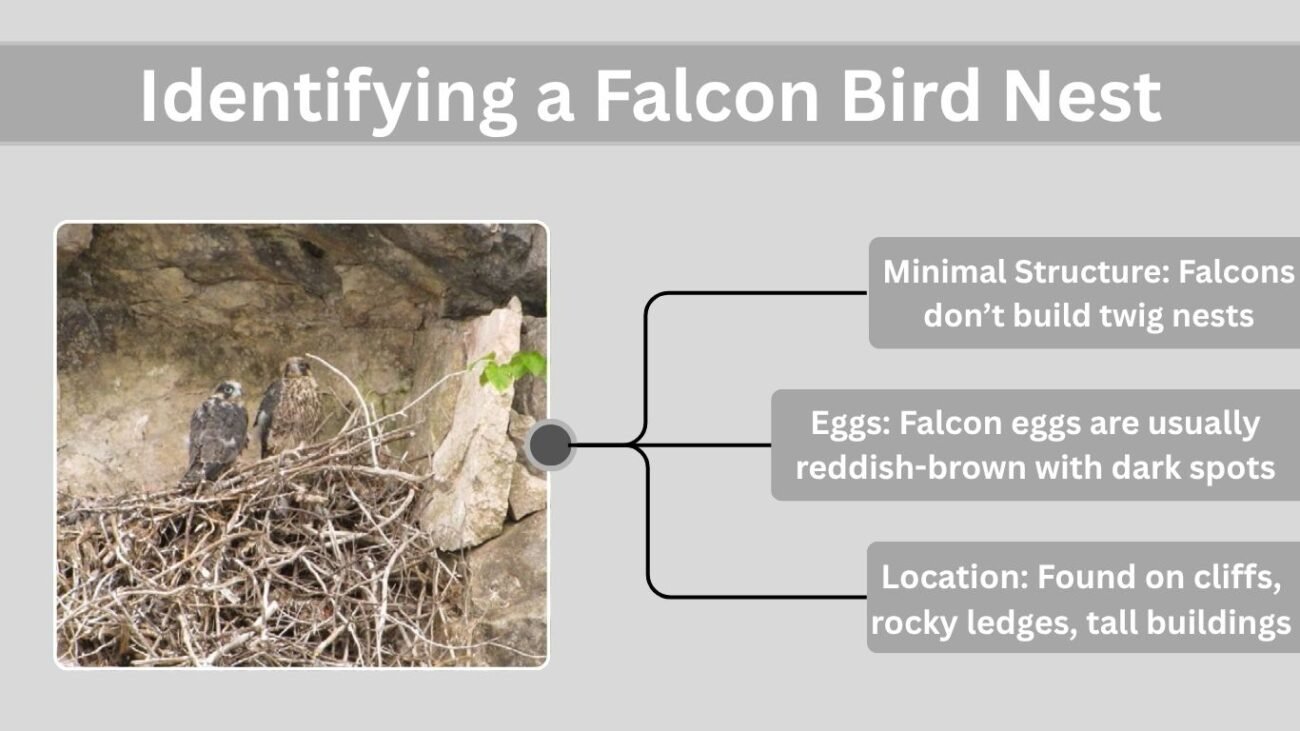
Falcon nests, known as eyries, are unique compared to most bird nests. They reflect the falcon’s adaptability, simplicity, and preference for safety over comfort. Here are the key features to help you identify one:
- Minimal Structure: Falcons don’t build twig nests. Their nests are usually shallow scrapes made in dirt, gravel, or sand on flat, elevated surfaces.
- High Location: Found on cliffs, rocky ledges, tall buildings, or bridges — anywhere offering wide visibility and protection from ground predators.
- No Added Materials: Falcons rarely use sticks, leaves, or feathers. The nest’s shape is formed naturally by the falcon’s body movements.
- Camouflaged Eggs: Falcon eggs are usually reddish-brown with dark spots, blending well with the rocky or gravel background.
- Simple Layout: The nest area may contain small bones or feathers from prey, showing evidence of feeding activity nearby.
- Strategic Positioning: Falcons choose locations with strong airflow and clear flight paths for easy takeoffs and landings.
- Reused Sites: Falcons often return to the same nesting site each year, cleaning or reshaping the scrape as needed.
- Defensive Behavior: If approached, falcons aggressively defend their nest, diving at intruders — a clear sign you’re near an active eyrie.
Where Falcons Build Their Nests
Natural Locations
In the wild, falcons select elevated sites that offer panoramic views of their surroundings. Cliffs, mountain ledges, and tall trees provide the perfect combination of safety and visibility. The height allows them to monitor for potential danger and hunt efficiently. These natural nests are often exposed to open air, as falcons rely on their agility and awareness to protect their young rather than concealment.
The most famous example is the peregrine falcon, which prefers cliff faces overlooking open landscapes or water. These elevated eyries allow falcons to launch into swift dives — called stoops — to hunt prey below.
Urban Environments
As cities have expanded, many falcon species, particularly peregrine falcons, have adapted to urban living. Skyscrapers, bridges, and church towers now serve as modern “cliffs.” These man-made structures mimic the falcon’s natural nesting environment and offer similar benefits — height, isolation, and broad views.
Urban falcons often use nesting boxes provided by conservation groups. For example, programs like the Cal Falcons Nest Cam at the University of California, Berkeley, and the Detroit Peregrine Project have enabled people worldwide to watch falcons nest and raise chicks in real-time. These initiatives not only help falcons survive in cities but also bring public awareness to their conservation.
How Falcons Prepare Their Nests
Unlike many birds that gather twigs, moss, and feathers, falcons take a simpler approach. The female creates a shallow hollow known as a scrape by shifting gravel or soil with her breast and legs. This scrape acts as the nest where she lays her eggs. No elaborate building materials are used — just the natural surface of the ledge or structure.
This minimalist strategy is surprisingly effective. The rough ground surface prevents eggs from rolling, and the open space allows easy airflow. Because falcons are fierce defenders of their nests, they rely more on vigilance and aggression than on physical barriers for protection.
Both male and female falcons share responsibilities during nesting. While the female incubates the eggs, the male hunts and delivers food. Once the chicks hatch, both parents work tirelessly to feed and protect them until they are ready to fly.
Falcon Nesting Season

Falcon nesting season typically begins in early spring, though timing varies depending on species and climate. For example, peregrine falcons in colder regions start later than those in temperate zones. During this time, pairs return to their previous nesting sites — often the same eyrie they used in past years. Falcons are known for their loyalty, both to their mates and to their nesting locations.
The female lays between 2 and 5 eggs, each speckled and camouflaged to blend with the nesting surface. Incubation lasts around 29 to 33 days. The female does most of the incubation, while the male provides food. When the chicks hatch, they are covered in soft white down and entirely dependent on their parents.
This stage is the most critical for the falcon family. The chicks, known as eyases, grow rapidly, doubling their weight within a week. Over the next few weeks, they develop feathers, gain strength, and start testing their wings by flapping on the nest edge. By about six weeks, they’re ready to take their first flight — a defining moment in their journey toward independence.
Falcon Chicks and Their Early Life
When falcon chicks, called eyases, first hatch, they are tiny, covered in soft white down, and completely dependent on their parents. During their first days, the female remains with them to provide warmth, while the male hunts and delivers food. Falcons primarily feed their chicks small birds or mammals, tearing the prey into bite-sized pieces.
Within two weeks, the chicks grow stronger and start to show juvenile feathers beneath their down. Around the fourth week, they become more active and start stretching their wings. By six to seven weeks old, the young falcons are ready for their first flight — a stage known as fledging. The parents continue to support them for several more weeks, teaching hunting and flying skills until they can survive independently.
This period is one of the most dangerous in a young falcon’s life. Many fail to survive their first few flights due to inexperience or bad weather. However, those that master flight quickly become efficient hunters, capable of reaching extraordinary speeds — especially peregrine falcons, which can dive at over 200 mph.
Human Support: Falcon Nesting Boxes

Artificial Nest Boxes
In urban and industrial areas, falcons often struggle to find suitable nesting spots. Conservationists have solved this problem by installing nesting boxes on tall buildings, towers, and bridges. These boxes mimic natural cliff ledges, lined with gravel or sand to provide comfort and prevent eggs from rolling.
Cities such as New York, London, and San Francisco have successfully used nesting boxes to restore urban falcon populations. Many of these boxes are equipped with live cameras, allowing scientists and nature enthusiasts to observe the entire nesting process — from egg laying to chick fledging — without disturbing the birds.
Conservation Impact
These efforts have been vital in recovering falcon numbers after their decline in the mid-20th century due to pesticides like DDT. The peregrine falcon, once nearly extinct in North America, has made a dramatic comeback thanks to protective laws and artificial nesting programs. Today, they symbolize successful wildlife recovery and coexistence with modern city life.
Predators and Nest Dangers
Even though falcons are apex aerial predators, their eggs and chicks face constant threats. In the wild, larger birds like owls, eagles, or ravens may prey on falcon eggs or young chicks. On the ground, mammals such as raccoons or foxes can pose dangers if nests are located in accessible areas.
Environmental hazards also endanger nests. Strong winds, heavy rain, and human disturbances (such as construction near nesting sites) can cause falcon parents to abandon their eggs. Light pollution in cities may disorient young falcons during their first flights, leading to collisions with glass windows or vehicles.
For this reason, wildlife groups carefully monitor known falcon nesting locations. Many cities even block off rooftops or towers during nesting season to ensure falcons breed undisturbed.
The Role of Falcon Nests in the Ecosystem
Falcons play an essential role in maintaining ecological balance. As skilled predators, they control populations of pigeons, doves, and small mammals. Their nesting sites often reflect the health of the environment — thriving falcon populations usually indicate clean air, stable food supplies, and healthy ecosystems.
In urban areas, falcon nests provide a natural solution to pest problems. Cities with active peregrine falcon populations have reported fewer pigeons and rodents, showcasing how top predators can coexist with humans to restore balance in built environments.
Additionally, falcon nest research contributes to science. Studying their breeding patterns helps biologists understand migration, climate impacts, and urban adaptation. Each nesting season provides valuable insights into how wildlife adjusts to modern challenges.
Key Takeaways
- Falcons do not build traditional nests; they make simple scrapes on cliffs, ledges, or buildings.
- Peregrine falcons often return to the same nest every year, showing site loyalty.
- Nesting boxes have become vital tools in global falcon conservation.
- Both parents share duties — the female incubates while the male provides food.
- Falcon nesting success symbolizes ecological balance and adaptation to human environments.
FAQs
1. Do falcons build nests like other birds?
No. Falcons rarely build stick nests. They scrape shallow hollows in dirt, gravel, or sand, typically on cliffs or tall structures. Their nests prioritize safety and visibility over decoration, making them highly practical for survival.
2. Where do peregrine falcons usually nest?
Peregrine falcons prefer cliffs, bridges, and skyscrapers that provide height and open surroundings. Urban falcons often use nesting boxes placed by conservationists, successfully raising chicks above busy cityscapes.
3. How many eggs does a falcon lay?
A female falcon generally lays between 2 and 5 eggs. Both parents share incubation for about a month until the chicks hatch. Afterward, they work together to feed and protect their young until fledging.
4. What is a falcon nesting box?
A nesting box is a human-made structure designed to replicate natural cliff ledges. Filled with gravel, it gives falcons a secure and comfortable place to lay eggs, especially in cities with limited natural habitats.
5. Do falcons return to the same nest each year?
Yes, many falcon pairs — particularly peregrines — show remarkable loyalty to their nesting sites. They often return to the same location annually, cleaning and reusing it for new broods, a behavior called site fidelity.


