




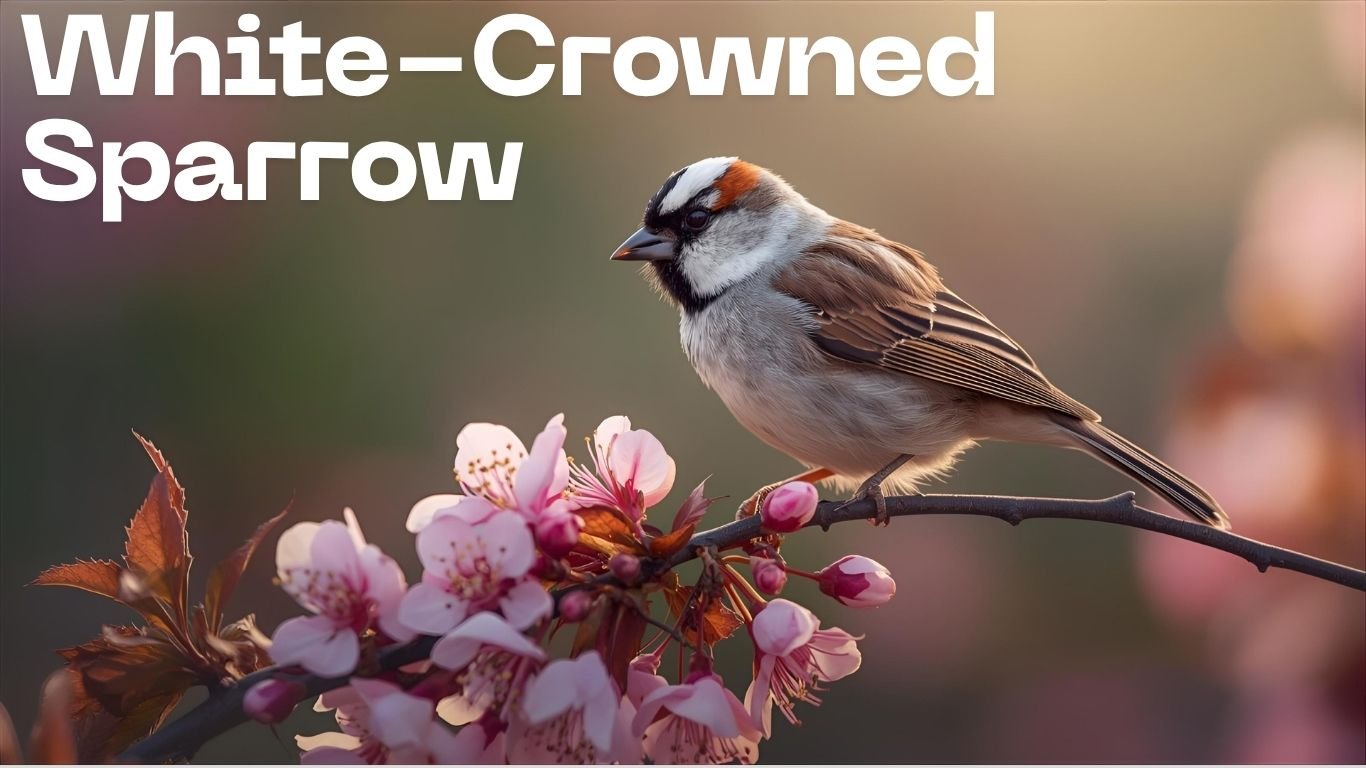
The White-crowned Sparrow (Zonotrichia leucophrys) is one of North America’s most recognizable songbirds, admired for its striking black-and-white striped crown and gentle nature. Found across a wide range of habitats—from Arctic tundra to suburban gardens—this bird embodies adaptability and endurance. Its calm temperament, distinctive look, and seasonal migrations make it a favorite among birdwatchers. In this guide, we’ll explore its identification, habitat, diet, nesting behavior, and ecological importance.
Identification and Overview

General Appearance
The White-crowned Sparrow is a small yet striking bird that stands out among North American sparrows. Key identification points include:
- Size: Medium-sized songbird, about 6–7 inches (15–18 cm) in length with a 9–10 inch (23–25 cm) wingspan.
- Crown: Bold black and white stripes across the head, extending from the forehead to the nape.
- Face and Underparts: Smooth gray face and breast with a light gray belly.
- Bill: Usually pinkish-orange or yellowish, though slightly darker in some subspecies.
- Back and Wings: Brown with fine streaks and two pale wing bars.
- Tail: Medium-length and slightly notched, typically brownish-gray.
- Legs and Feet: Pale brown to pink.
- Posture: Often perches upright and alert, giving a regal impression.
- Flight Pattern: Quick, low, and direct, often accompanied by a soft chip call.
- Common Search Variations: white-crowned sparrow, white crown sparrow, white crowned sparrow bird, white crowned sparrow pictures.
Scientific Classification and Subspecies
The White-crowned Sparrow belongs to the New World sparrow family (Passerellidae). Its full scientific name, Zonotrichia leucophrys, translates roughly to “banded hair,” referring to its signature striped crown.
Recognized subspecies include:
- Gambel’s White-crowned Sparrow (Z. l. gambelii) – Found in Alaska and the western U.S.; paler with a pink bill.
- Nuttall’s White-crowned Sparrow (Z. l. nuttalli) – Resident of coastal California; non-migratory and darker overall.
- Eastern White-crowned Sparrow (Z. l. leucophrys) – Breeds in central and eastern Canada; migrates long distances.
- Mountain White-crowned Sparrow (Z. l. oriantha) – Found in high mountain regions; smaller and darker.
- Puget Sound White-crowned Sparrow (Z. l. pugetensis) – Inhabits the Pacific Northwest with intermediate coloration.
Male vs Female and Juvenile Differences
Identifying males, females, and young birds can be subtle but rewarding:
- Adult Male: Bold crown stripes; slightly brighter plumage; more territorial and vocal during breeding.
- Adult Female: Nearly identical to males; slightly duller head pattern; more involved in incubation.
- Juvenile (Immature): Brown and tan crown stripes instead of black and white; overall duller with streaked chest.
- Fledglings: Softer plumage, smaller bills, and muted colors before their first molt.
- Behavioral Cues: Males tend to perch higher and display more actively, especially in spring.
Habitat and Distribution
Preferred Habitat
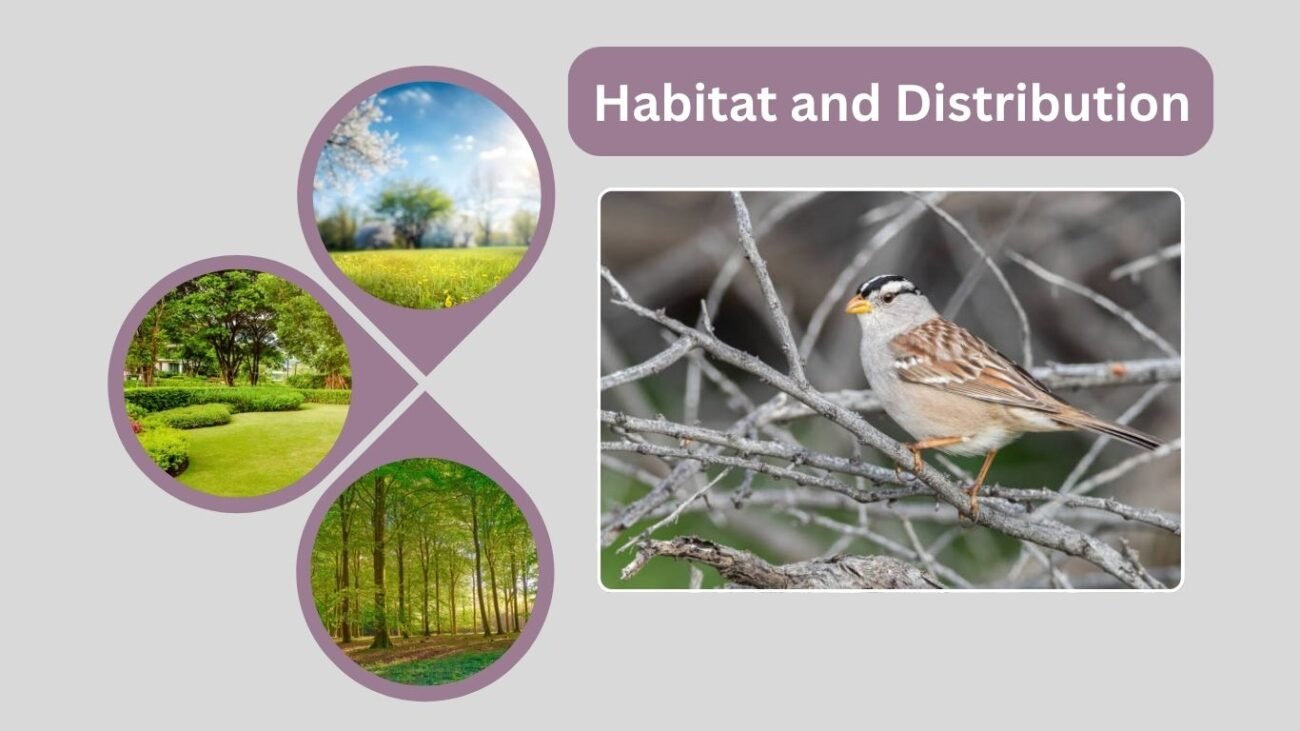
White-crowned Sparrows are versatile in their choice of habitat. They thrive in open woodlands, tundra edges, meadows, shrubby fields, and suburban gardens. During the breeding season, they prefer brushy or grassy areas with scattered shrubs that provide cover for nests. In winter, they often move to farmlands, backyards, and open fields where food is more accessible.
Their adaptability allows them to live in both rural and urban landscapes. Whether perched on a low fence or hopping through snow-dusted grass, they manage to find food and shelter almost anywhere.
Geographic Range and Migration Map
The species’ range extends across most of North America. Breeding populations are found in northern Canada, Alaska, and mountainous areas of the western United States. During winter, they migrate south to the southern U.S., Mexico, and even parts of Central America.
Non-migratory populations, such as Nuttall’s White-crowned Sparrow along the California coast, remain year-round in mild climates. Birds seen in Arizona, Oregon, Wisconsin, Ohio, and Ontario represent either migrants or winter residents. Occasionally, the species even appears as a rare visitor in the United Kingdom, delighting European birders.
Behavior and Characteristics
Daily Habits
These sparrows spend much of their day foraging on the ground, hopping, scratching, and pecking through leaves for food. They are most active during the early morning and late afternoon, when insect activity is highest. Despite their small size, they exhibit alertness and agility, often darting into cover at the slightest movement.
Social and Territorial Behavior
White-crowned sparrows are social during winter, forming small flocks that forage together in open areas. However, during the breeding season, they become highly territorial, especially males, who defend their nesting area vigorously from rivals. Pairs are generally monogamous during the breeding period, cooperating in feeding and raising their young.
Seasonal Patterns and Adaptations
The bird’s behavior shifts with the seasons. In colder months, it gathers in mixed-species flocks for protection and efficient foraging. Its thick feathers and stored fat reserves allow it to endure harsh winters. Migratory subspecies rely on strong orientation instincts, using the stars and landmarks to navigate long journeys between northern breeding grounds and southern wintering areas.
Diet and Feeding Habits
Primary Diet
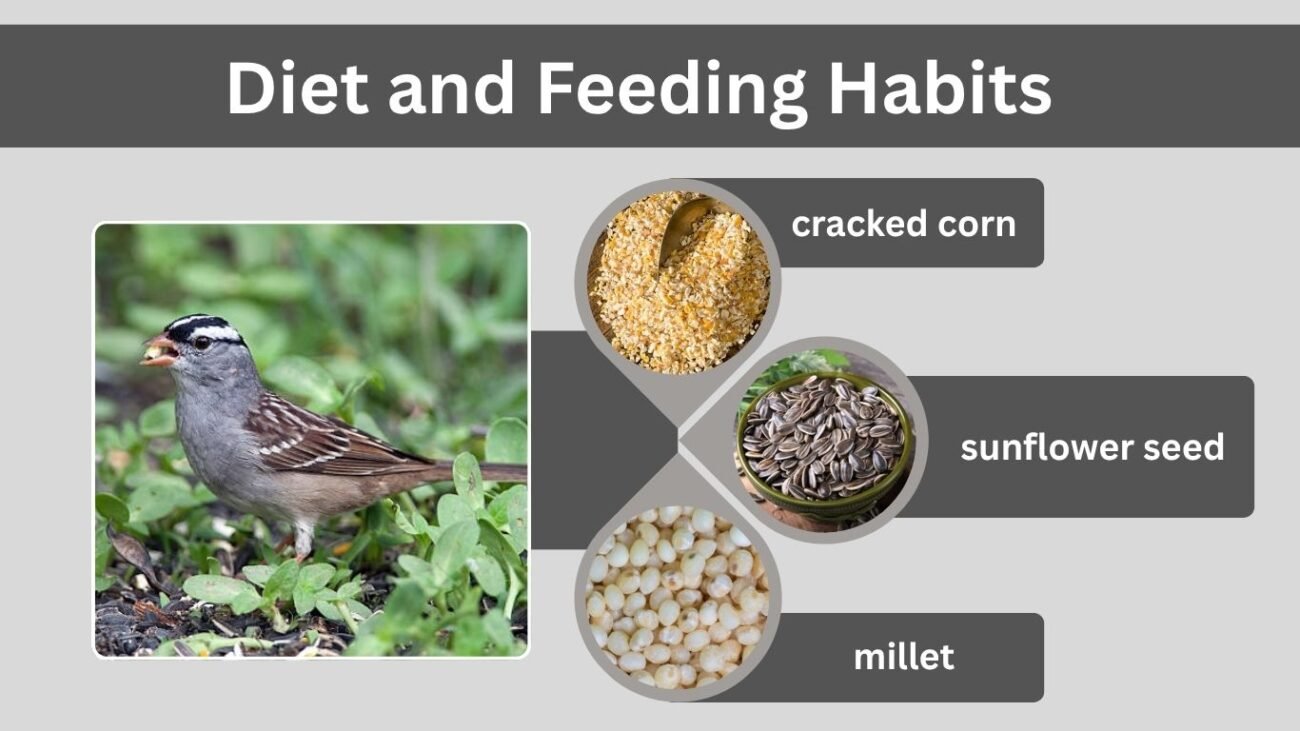
The White-crowned Sparrow has an omnivorous diet, feeding on a variety of seeds, grains, buds, and insects. During warmer months, it consumes beetles, caterpillars, and grasshoppers, which provide vital protein for breeding adults and growing chicks. In fall and winter, it shifts primarily to seeds and grains found on the ground.
Birdwatchers often attract these sparrows by offering cracked corn, millet, or black oil sunflower seeds at ground-level feeders. They prefer open areas with nearby cover, hopping out to feed and retreating to bushes when startled.
Seasonal Feeding Behavior
Feeding habits change dramatically with the seasons. In spring and summer, their insect-heavy diet fuels energy-intensive breeding and chick-rearing. In autumn and winter, when insects become scarce, sparrows rely on dried seeds, grains, and small fruits. Their adaptable diet enables survival across diverse climates—from the frozen tundra to desert scrublands.
Role in the Ecosystem
As both predator and prey, White-crowned Sparrows play an essential ecological role. By consuming large quantities of insects, they help control pest populations, especially during the breeding season. In turn, they serve as food for hawks, owls, snakes, and mammals. Their habit of eating and dispersing seeds supports native plant regeneration, maintaining the health of grassland and woodland ecosystems.
Nesting and Breeding
Nest Construction and Location
The White-crowned Sparrow’s nesting behavior is both fascinating and practical. The female usually builds the nest on or near the ground, concealed within thick grass or low shrubs to protect from predators. The structure is made of dry grasses, twigs, moss, and animal hair, carefully woven to create a soft inner cup. Some high-altitude or northern populations may nest slightly above ground on low branches to avoid flooding from melting snow.
These nests are usually located in quiet, undisturbed areas with plenty of ground cover. Once complete, the female lines the inside with soft materials such as feathers or fine grass to keep the eggs warm and secure.
Egg Characteristics and Incubation
A typical clutch contains three to five eggs, which are pale blue or greenish-blue with light brown speckles. The female takes on the responsibility of incubation, keeping the eggs warm for about 11 to 14 days. During this period, the male often stays nearby, defending the territory from intruders and alerting the female of potential danger.
After hatching, both parents feed the chicks a diet rich in insects to promote rapid growth. The young fledge within 8 to 10 days, leaving the nest while still dependent on their parents for several more weeks. In warmer regions, pairs may raise two broods in a single breeding season.
Breeding Season Behavior
The breeding season generally spans May through August, depending on latitude. In the northernmost parts of their range, nesting begins shortly after snowmelt. Males become more vocal and territorial, using displays and calls to mark their boundaries. Courtship involves gentle chases and feeding behavior, strengthening the pair bond.
White-crowned Sparrows show remarkable parental coordination. Both adults share feeding duties, bringing insects and larvae to the nestlings. This teamwork ensures a high success rate in chick survival, even in unpredictable climates.
Migration and Seasonal Movements
Migration Patterns
Migration is a key aspect of the White-crowned Sparrow’s life cycle. Northern populations undertake long-distance migrations, sometimes traveling thousands of miles between breeding and wintering grounds. These birds begin their southward journey in late September to early October, reaching the southern United States and Mexico by early winter.
Come April or May, they return north to their breeding territories, often using the same routes each year. Their strong homing instincts guide them across vast landscapes, ensuring they arrive at familiar nesting sites.
Factors Influencing Migration
Several environmental factors trigger migration. Daylight length, temperature changes, and food availability are key cues. When daylight shortens and insect numbers decline, sparrows instinctively begin their journey southward. Favorable wind currents and rich stopover habitats aid their travel.
Researchers have found that these birds navigate using a combination of celestial orientation and magnetic fields, allowing them to travel accurately even across great distances.
Wintering Grounds
During winter, White-crowned Sparrows can be found in open fields, farmlands, and residential gardens across the southern U.S., Mexico, and parts of Central America. They often form mixed-species flocks, feeding alongside juncos and towhees. Coastal and desert populations adapt easily to new food sources, proving their versatility and resilience.
Similar Birds and Confusion Species
White-Crowned Sparrow vs. White-Throated Sparrow
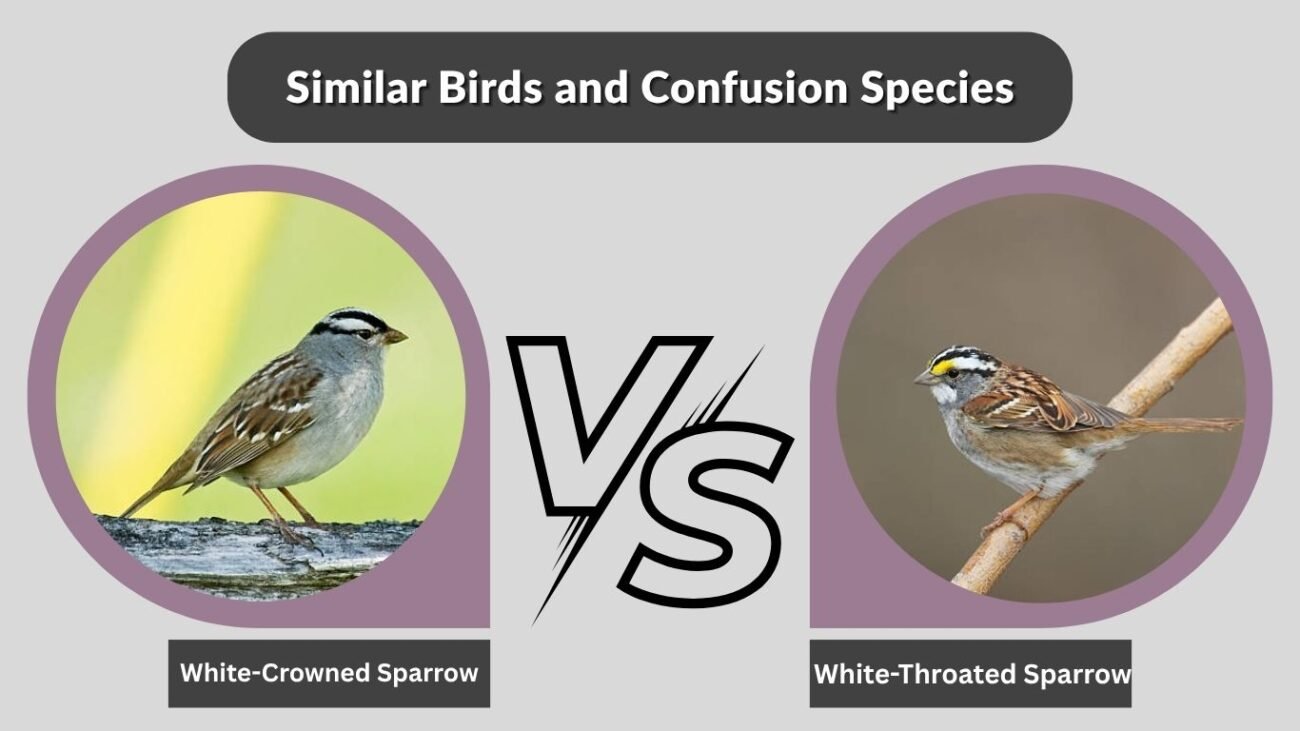
At first glance, the White-crowned and White-throated Sparrows look quite similar, but a few key traits set them apart:
- Head markings: The White-crowned Sparrow has bold black-and-white stripes with a gray face, while the White-throated has yellow patches near the eyes and a distinct white throat patch.
- Bill color: White-crowned Sparrows typically have pink or yellowish bills, whereas White-throateds have darker bills.
- Song and range: The White-throated Sparrow’s song is a slower, plaintive “Old Sam Peabody,” while the White-crowned’s tone is clearer and more whistled.
Both species often share overlapping ranges during migration, making them a fun identification challenge for birdwatchers.
Other Look-Alike Species
Other sparrows that resemble the White-crowned include:
- House Sparrow: Stockier body, gray crown, and absence of bold head stripes.
- Chipping Sparrow: Smaller, with a rusty-red cap and black eye line.
- Golden-crowned Sparrow: Features a yellow crown instead of white.
Learning these subtle differences helps birders identify sparrows accurately in diverse habitats.
Predators and Threats
Natural Predators
White-crowned sparrows face threats from a variety of predators, including hawks, snakes, jays, owls, and domestic cats. Their eggs and chicks are also vulnerable to predation by rodents and crows. By nesting in dense vegetation and keeping a low profile, they reduce the risk of being discovered.
Human-Related Challenges
Habitat loss due to urban expansion and agricultural development poses a growing concern. Window collisions and pesticide exposure also contribute to mortality. Light pollution can interfere with migration cues, confusing birds that rely on starlight for navigation.
Conservation Status
Fortunately, the White-crowned Sparrow is listed as a species of Least Concern by the IUCN. Its populations remain stable thanks to its adaptability and broad range. Protection under the Migratory Bird Treaty Act helps safeguard this species from hunting and trade. Maintaining bird-friendly habitats and reducing pesticide use are essential for continued stability.
Ecological Role and Importance
Contribution to Ecosystems
White-crowned Sparrows serve vital roles in their ecosystems. By eating large numbers of insects, they naturally control pest populations that might otherwise damage crops or native plants. Their seed consumption and dispersal help promote vegetation growth and restore disturbed habitats.
Indicator Species
Because they are sensitive to changes in habitat quality and food availability, White-crowned Sparrows act as bioindicators of environmental health. A decline in their numbers often signals broader ecological stress, such as pollution or habitat degradation.
Cultural and Symbolic Meaning
Symbolism and Spiritual Meaning
The White-crowned Sparrow’s pure black-and-white markings symbolize clarity, purity, and balance. Many cultures view the bird as a sign of renewal, representing freedom of thought and the beauty of simple living. Its seasonal migrations are also seen as metaphors for life’s cycles and resilience in the face of change.
Appearance in Art and Literature
Artists and poets often depict the White-crowned Sparrow as a symbol of harmony with nature. Its understated beauty and gentle presence have inspired writers to capture its essence as a quiet, contemplative figure within the natural world.
Fascinating Facts about the White-Crowned Sparrow
- Average lifespan: up to 10 years in the wild.
- Juveniles learn songs by listening to nearby adults during early development.
- They can fly up to 300 miles in a single migration at night.
- Adaptable to both human settlements and remote wilderness areas.
- Known to have regional “dialects” in their songs, passed down through generations.
Key Takeaways
- Easily identified by bold black-and-white crown stripes.
- Found across North America in varied habitats.
- Diet shifts from insects in summer to seeds in winter.
- Builds ground nests and shows strong parental cooperation.
- Plays essential ecological and symbolic roles in nature.
FAQs
What is the scientific name of the White-crowned Sparrow?
The scientific name is Zonotrichia leucophrys. It belongs to the New World sparrow family and is known for its distinct black-and-white striped head and widespread North American presence.
How can you tell male and female White-crowned Sparrows apart?
Males and females look nearly identical, but males may display slightly brighter crown markings and more territorial behavior during breeding. Visual differences are subtle, so behavior is often a better clue.
Where do White-crowned Sparrows live throughout the year?
They breed in Alaska, Canada, and the northern U.S., then migrate south to winter in the southern U.S. and Mexico. Coastal California and desert populations may remain year-round.
What do White-crowned Sparrows eat?
They eat seeds, grains, and insects. During breeding, they rely heavily on insects for protein, while in winter they shift to seeds and small fruits, often visiting backyard feeders.
Are White-crowned Sparrows considered rare?
No, they are quite common and widespread. Although habitat loss and window collisions pose risks, their adaptable nature has helped them maintain a stable population across North America.