











The Crown-of-Thorns starfish (COTS) is one of the most striking and controversial creatures found on Indo-Pacific coral reefs, especially the Great Barrier Reef. Famous for its long venomous spines and appetite for coral, this starfish becomes a serious ecological threat during population outbreaks. Understanding its biology, predators, dangers to humans, and role in reef decline helps explain why it attracts so much scientific attention—and even appearances in children’s shows like Octonauts.
What Is the Crown of Thorns Starfish?
The Crown-of-Thorns starfish (Acanthaster planci) is a large, many-armed sea star known for its sharp, toxin-covered spines resembling a thorny crown. Classified under the phylum Echinodermata and class Asteroidea, it is closely related to sea urchins and sand dollars.
These starfish typically measure 25–35 cm across, though some individuals exceed 60 cm. Their bodies are soft but heavily armed with long, venomous spines used for protection. Colors range from purple and blue to red and mottled gray, helping them blend into coral structures.
Identification Features

Key features that help identify the Crown-of-Thorns starfish include:
- Long, sharp, venomous spines covering the upper surface
- 14–21 arms instead of the usual 5 of other starfish
- Bright or mottled coloration (blue, purple, red, brown, gray)
- Thousands of tube feet for gripping coral
- A soft, flexible body despite its spiny armor
- Radial symmetry typical of echinoderms
These characteristics make it one of the most visually distinctive starfish species on Earth.
Habitat and Global Distribution
COTS inhabits coral reefs across the tropical Indo-Pacific region, including:
- Australia’s Great Barrier Reef
- Fiji and Samoa
- The Coral Triangle (Indonesia, Philippines, Papua New Guinea)
- Hawaii
- Northern Indian Ocean reefs
They prefer warm, nutrient-rich waters where coral is abundant. Areas with reduced predator populations—often due to overfishing—tend to experience more frequent outbreaks.
Lifespan, Growth, and Life Cycle
Crown-of-Thorns starfish typically live 5–15 years, depending on food availability and environmental conditions.
Life Cycle Stages
- Larval Stage (Planktonic):
After spawning, fertilized eggs drift as larvae for several weeks. High nutrient levels increase larval survival. - Juvenile Stage:
Juveniles initially feed on algae before transitioning to coral once their digestive systems mature. - Adult Stage:
Adults reach reproductive maturity around 2–3 years. One female can release tens of millions of eggs during a single spawning event.
Because survival rates skyrocket in nutrient-rich waters, outbreaks can develop rapidly.
Crown of Thorns Starfish Diet and Feeding Behavior

What Do They Eat?
COTS are specialized coral predators. They primarily eat:
- Hard coral polyps
- Fast-growing corals such as Acropora and Pocillopora
- Occasionally algae during early developmental phases
How They Feed
Crown-of-Thorns starfish feed by extending their stomach out of their mouth onto the coral surface. Digestive enzymes dissolve the coral tissue, leaving behind white “feeding scars.” An adult can consume up to 6 square meters of coral per year, and during outbreaks, this destruction multiplies across the reef.
Relationship With Coral Reefs
Under normal conditions, COTS contribute to reef diversity by preventing fast-growing corals from monopolizing reef space. Their selective feeding maintains ecological balance.
However, when populations surge far beyond natural levels, their impact becomes overwhelmingly negative.
Outbreaks: Causes, Effects, and Global Concerns
What Is a COTS Outbreak?
An outbreak occurs when starfish populations grow to levels capable of destroying coral faster than reefs can recover. Densities of more than 30 starfish per hectare qualify as an outbreak.
Causes of Outbreaks
Several environmental and human-driven factors contribute:
- Agricultural runoff increasing nutrients, boosting plankton → higher larval survival
- Overfishing of predators, especially giant tritons and certain reef fish
- Climate change, which increases water temperatures and coral stress
- Natural population cycles occurring every several decades
Effects on Coral Reefs
During severe outbreaks, COTS can consume 40% or more of the live coral cover on the Great Barrier Reef. Coral loss leads to:
- Declining reef biodiversity
- Weakened reef structure
- Reduced fish populations
- Long-term damage that takes decades to reverse
Outbreaks in the Great Barrier Reef
The Great Barrier Reef has experienced multiple outbreaks since the 1960s. Today, it remains one of the most closely monitored marine ecosystems, supported by large-scale control efforts to mitigate COTS damage.
Predators of the Crown of Thorns Starfish

Despite their venomous defenses, several species prey on COTS, especially juveniles or injured individuals:
- Giant triton snail (Charonia tritonis)
- Napoleon wrasse
- Titan triggerfish
- Pufferfish and porcupinefish
- Painted shrimp
- Some crabs
The high toxicity and sharp spines make them difficult prey, which is one reason outbreaks can happen when predator numbers fall.
Are Crown of Thorns Starfish Invasive?
COTS are native to Australia and the Indo-Pacific, so they are not invasive in the traditional sense. However, when their populations explode due to human impacts or environmental changes, they behave like an invasive species, causing large-scale ecological damage.
Dangers to Humans: Venom, Stings & Treatment
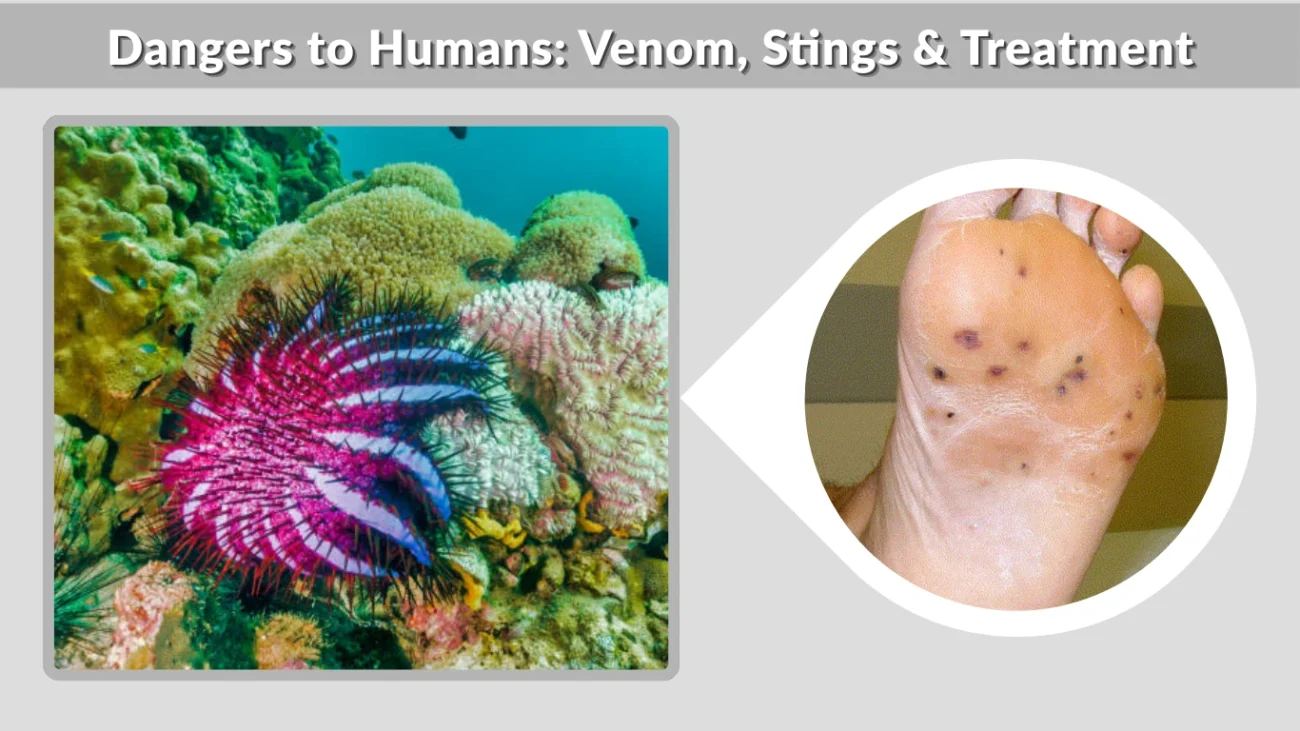
Are Crown of Thorns Starfish Poisonous?
Yes. Their spines contain venom that causes pain, swelling, and prolonged wounds. While not deadly, the toxin can lead to infection if spine fragments remain in the skin.
Sting Symptoms
Common reactions include:
- Immediate, intense pain
- Redness and swelling
- Nausea or vomiting
- Persistent sores
- Risk of secondary infection
Sting Treatment
Recommended steps include:
- Carefully remove visible spines
- Immerse the wound in hot water
- Apply antiseptic
- Seek medical attention, especially if fragments remain
- Antibiotic treatment may be needed
Can a Crown of Thorns Starfish Kill a Human?
There are no recorded fatalities, but stings can be medically serious and require proper care.
Can Humans Eat Them?
Technically possible—but extremely dangerous and not advised. Their venom, spines, and potential toxicity make them unsuitable as food.
Economic and Environmental Impact
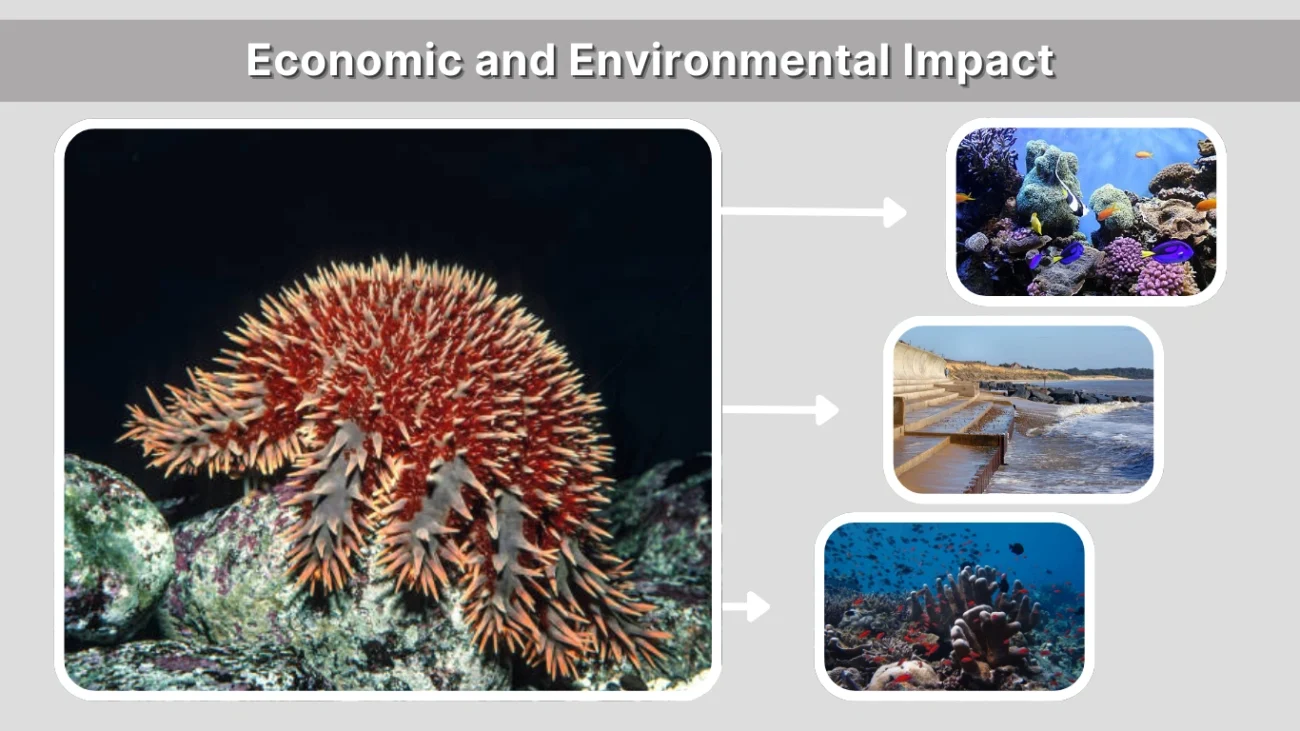
Coral loss caused by COTS outbreaks affects more than biodiversity. It also impacts:
- Tourism industries
- Reef-dependent fisheries
- Coastal protection
- Long-term reef restoration budgets
The economic cost of COTS outbreaks to Australia alone reaches into the hundreds of millions.
Control & Removal Programs
Marine researchers and divers use several methods to control outbreaks:
- Manual removal by trained divers
- Vinegar or bile salt injections to humanely kill individuals
- Autonomous robot systems like the COTSbot
- Restoration of predator populations (e.g., protecting giant tritons)
These programs are effective, but labor-intensive, requiring ongoing funding and monitoring.
Adaptations and Evolutionary Traits
The Crown-of-Thorns starfish possesses several remarkable adaptations that allow it to thrive—even in challenging reef environments.
Venomous Spines
The long, sharp spines covering its body are coated in a potent venom. These spines deter most predators and offer exceptional protection while the starfish feeds openly on coral.
Regenerative Abilities
Like many echinoderms, COTS can regrow lost arms. This ability allows them to survive predator attacks or damage from rough reef surfaces. A single individual can lose multiple arms yet fully regenerate them in time.
High Reproductive Rate
One of their most significant evolutionary advantages is extreme fecundity. A single female may release tens of millions of eggs in a single spawning event, ensuring that even if survival rates are low, enough larvae survive to maintain the species.
Efficient Coral Digestion
Their everted stomach mechanism allows them to digest coral polyps externally. This unique method lets them feed on hard coral that few other predators can consume.
These adaptations explain why COTS populations can grow explosively and why controlling outbreaks is so challenging.
Crown of Thorns Starfish in Pop Culture
Octonauts Connection
The Crown-of-Thorns starfish gained popularity among children through episodes of the animated series Octonauts, where the characters encounter a crown-of-thorns outbreak. The show highlights the starfish’s coral-eating habits, spiny appearance, and the importance of maintaining reef balance. This exposure has led to increased interest in COTS toys, including plush figures and educational play sets.
Educational Impact
While simplified for young audiences, the Octonauts portrayal provides a useful entry point for understanding real-world marine conservation issues. Many kids first learn about coral reefs and starfish ecology through this episode.
Interesting Facts About the Crown of Thorns Starfish
Here are several noteworthy and surprising facts about this species:
- One of the world’s largest starfish, reaching over 60 cm across.
- May have 21 or more arms, far more than typical 5-armed starfish.
- Can regenerate multiple arms even after severe injury.
- During outbreaks, they consume more coral than storms or bleaching events.
- One adult can eat up to 6 square meters of coral per year.
- They move via thousands of tiny tube feet powered by a water vascular system.
- Outbreaks can persist for years, spreading across hundreds of kilometers of reef.
- Their feeding scars leave stark white patches on coral surfaces.
- Juveniles eat algae before transitioning to coral—an adaptation that boosts survival.
- They are native, not invasive, but act invasive when populations surge unnaturally.
These facts show how unique and ecologically impactful COTS truly are.
Comparison Table
Crown of Thorns Starfish vs Regular Starfish
| Feature | Crown of Thorns Starfish | Normal Starfish |
| Arms | 14–21+ | Typically 5 |
| Defense | Long venomous spines | Small, non-venomous spines |
| Diet | Coral polyps | Mollusks, detritus, algae |
| Habitat | Indo-Pacific reefs | Worldwide oceans |
| Ecological Impact | Can destroy coral reefs in outbreaks | Minimal |
| Feeding Method | External stomach digestion on coral | Varies by species |
| Coloration | Bright purples, reds, greens | Usually muted tones |
| Behavioral Risk | Dangerous to handle | Safe to handle |
This comparison highlights why the Crown-of-Thorns starfish is so biologically and ecologically distinct from typical sea stars.
FAQs
What does the Crown-of-Thorns starfish eat?
COTS primarily feed on hard coral polyps, especially fast-growing species like Acropora. They digest coral tissue by extending their stomach over the surface, leaving behind white scars. Juveniles begin their lives eating algae, shifting to coral only after achieving enough size to digest it efficiently.
Are Crown of Thorns starfish poisonous to humans?
Yes. Their spines contain venom that can cause significant pain, swelling, and long-lasting wounds. While not lethal, the injuries can become infected if spine fragments remain. Handling them without protective equipment is dangerous, and medical treatment is recommended for any sting.
Why are they destroying the Great Barrier Reef?
Large-scale outbreaks allow COTS to consume coral faster than it can regenerate. Nutrient runoff, declining predators, and environmental stress contribute to population explosions. During outbreaks, these starfish can devour vast stretches of coral, significantly harming the Great Barrier Reef’s health and resilience.
What eats a Crown of Thorns starfish?
Only a few specialized predators are capable of consuming COTS despite their venomous spines. These include the giant triton snail, Napoleon wrasse, pufferfish, and certain crabs and shrimp. Predator decline is one reason population outbreaks have become more common in recent decades.
Are Crown of Thorns starfish invasive in Australia?
They are native to Australian waters, but under certain conditions—such as increased nutrients or reduced predators—they behave like an invasive species. When populations surge, they cause widespread coral destruction, prompting large-scale control programs to protect ecosystems like the Great Barrier Reef.


