








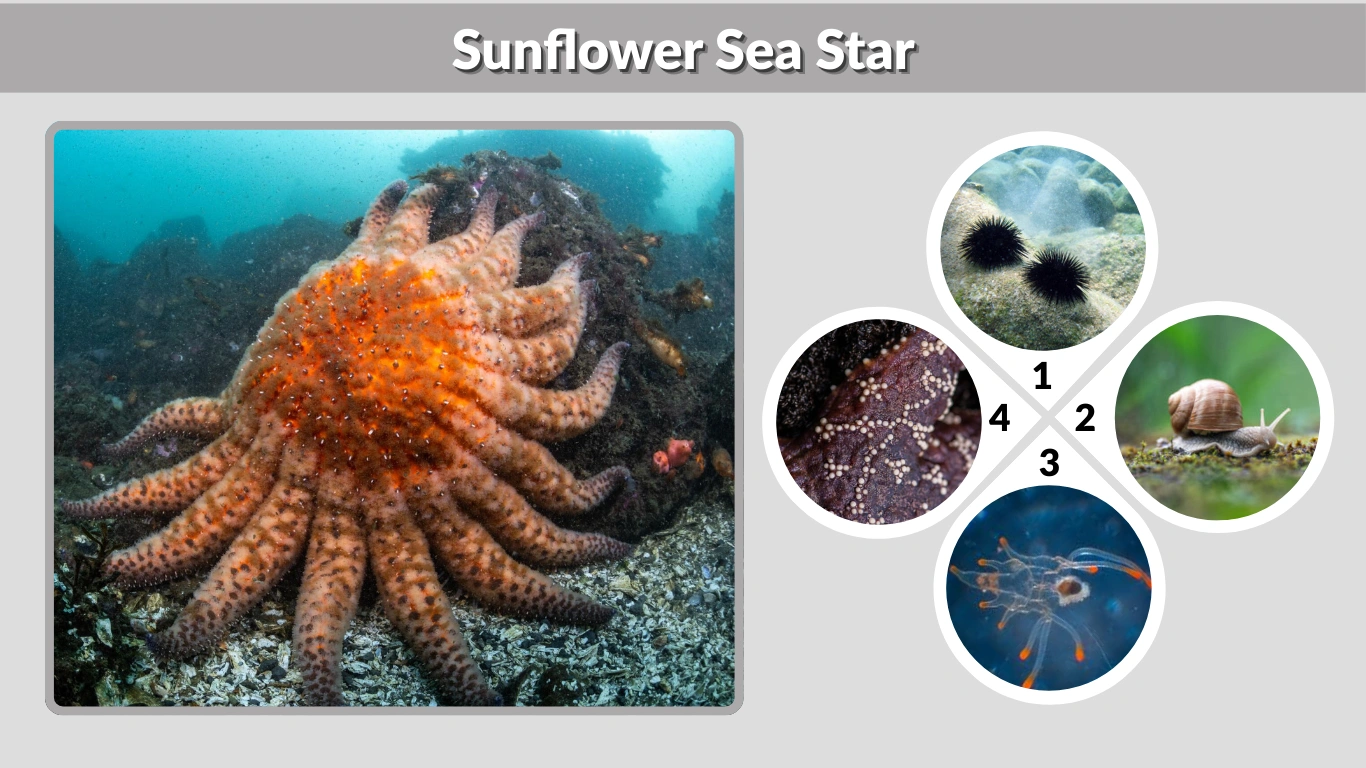
The sunflower sea star is one of the most remarkable marine predators in the Pacific Ocean. Known for its impressive size, vibrant colors, and ecological importance, this species plays a major role in maintaining healthy kelp forests. Its speed, adaptability, and unusual biology have made it both fascinating to scientists and essential to coastal ecosystems. Sadly, its population has declined dramatically in recent years, making conservation more urgent than ever.
Identification Characteristics

Here are the key features used to identify a sunflower sea star:
- Possesses 16–24 arms, depending on age and growth stage
- Has a large, soft, flexible central disc
- Contains thousands of tube feet used for gripping and movement
- Displays vivid colors: orange, purple, red, brown, pink
- Moves faster than most sea stars—up to 1 meter per minute
- Typically lacks spines, giving it a smooth texture
- Arms appear petal-like, forming a “sunflower” shape when spread
These characteristics make the sunflower sea star unmistakable, especially when compared to spiny species like the crown-of-thorns starfish.
Size, Range & Habitat
How Big Do They Get?
The sunflower sea star is among the largest starfish species ever recorded. Adults can reach:
- Diameter: up to 1 meter (3.3 feet)
- Weight: several kilograms
- Arm span: varies depending on maturity and arm regeneration
Their size increases with age, and individuals living in colder, nutrient-rich waters often grow the largest.
Geographic Distribution
Sunflower sea stars inhabit the northeastern Pacific Ocean, including:
- Alaska
- British Columbia
- Washington
- Oregon
- Northern and central California
They do not live in tropical regions. Their distribution closely matches cold, kelp-dominated marine ecosystems.
Preferred Habitat
These sea stars thrive in:
- Kelp forests
- Rocky reefs
- Eelgrass beds
- Sandy or muddy bottoms near abundant prey
They typically live from shallow intertidal zones down to depths of 1,400 feet. While they can tolerate a variety of substrates, they favor areas with large populations of sea urchins, clams, and snails.
Behavior & Adaptations
Movement and Speed
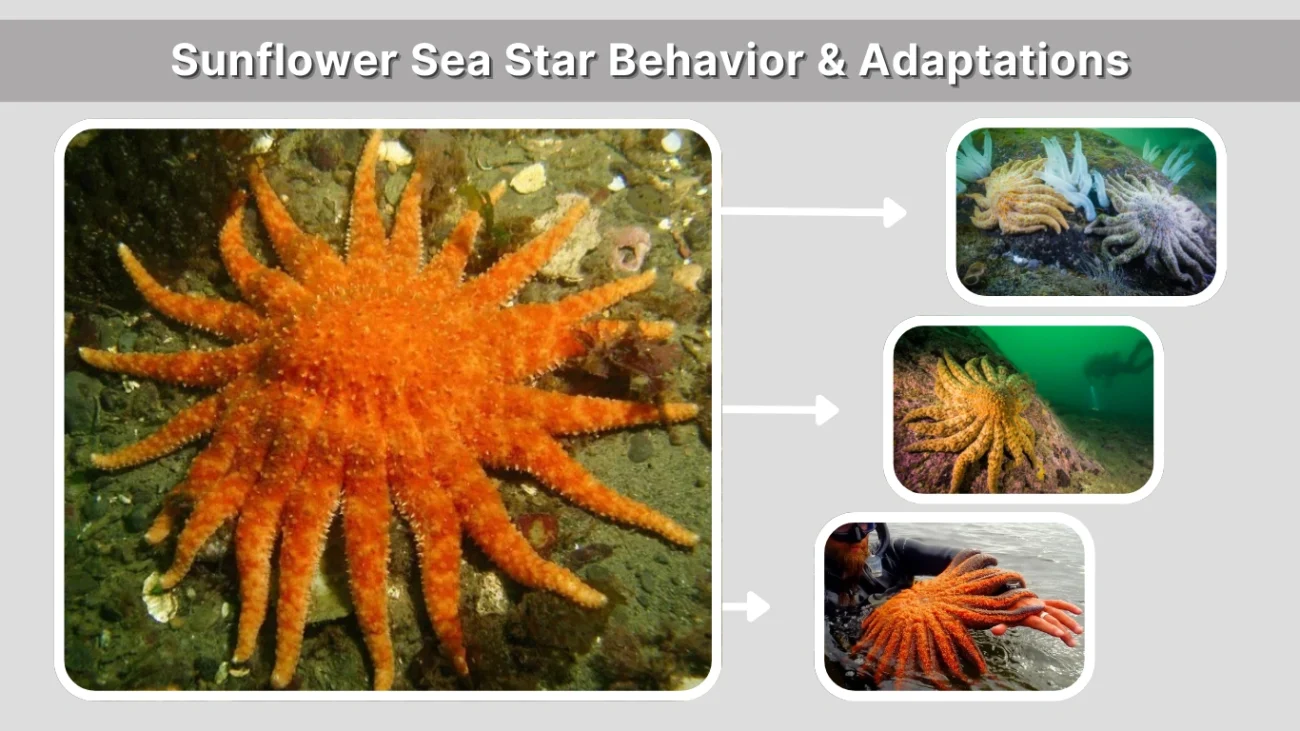
One of the most fascinating traits of the sunflower sea star is its speed. While most sea stars move slowly, this species is capable of rapid, coordinated motion using its 15,000–20,000 tube feet. Its soft body allows it to glide over rocks, sand, and kelp at speeds up to one meter per minute, making it an efficient predator.
Sensory Capabilities
Sunflower sea stars lack eyes as humans know them, but each of their many arms ends with a light-sensitive eye spot. They also rely heavily on chemical sensing—detecting prey through dissolved cues in the water. This combination allows them to locate food even in cloudy or dark environments.
Defense and Survival Strategies
Although they lack hard protective spines, they have several defenses:
- Rapid escape: They can flee quickly from predators such as large fish or otters.
- Regeneration: Lost arms can regrow completely, a major survival advantage.
- Soft camouflage: Their flexible, colorful bodies blend into kelp and reef environments.
These adaptations help them survive in competitive coastal ecosystems.
Ecological Importance
The sunflower sea star is considered a keystone species because of its control over sea urchin populations. Without them, urchins multiply rapidly and overgraze kelp forests, transforming rich habitats into “urchin barrens.” Their presence is a critical factor in maintaining biodiversity along the Pacific coast.
Diet & Feeding
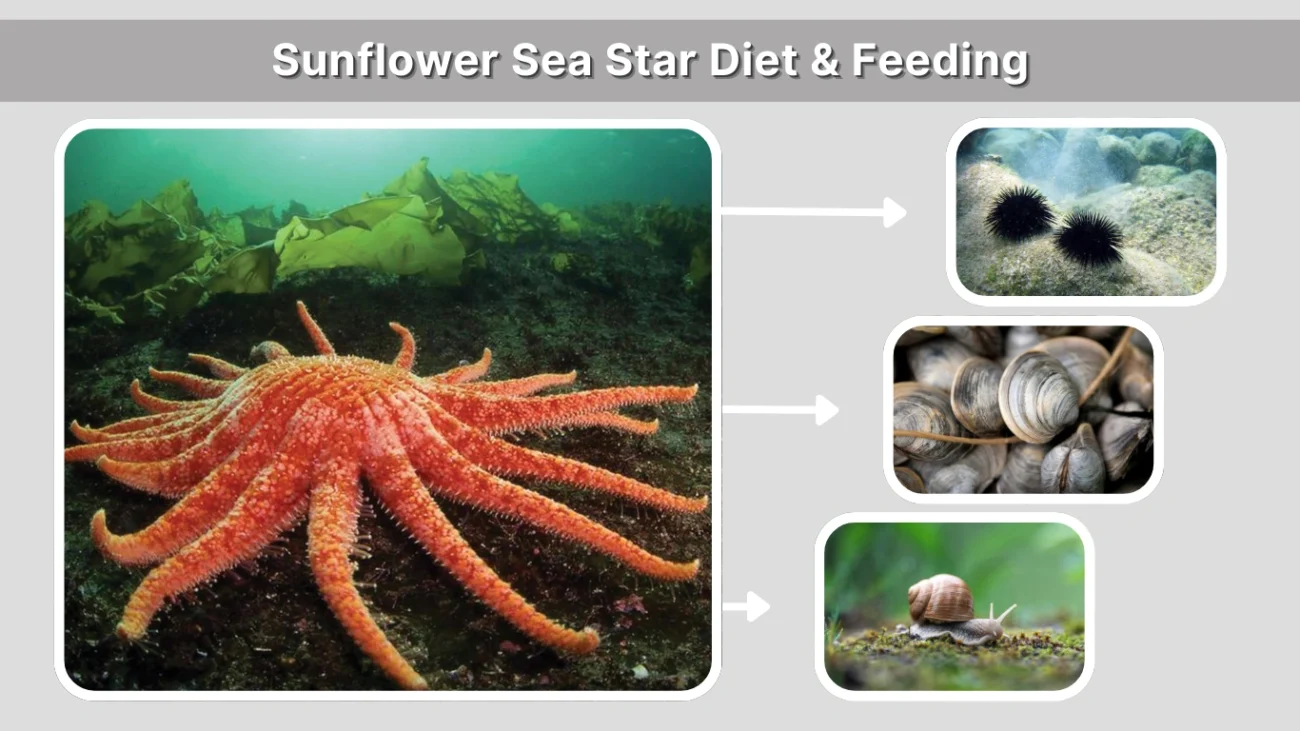
What Do Sunflower Sea Stars Eat?
These sea stars are fierce predators. Their diet includes:
- Sea urchins
- Clams
- Snails
- Mussels
- Crabs
- Dead fish and carrion
They especially target sea urchins, making them essential for kelp forest health.
How They Eat
Sunflower sea stars use thousands of tube feet to grab and immobilize prey. Once secured, they perform one of the most extraordinary feeding behaviors in the animal kingdom: they eject their stomach out of their body.
This external stomach envelopes prey, secretes digestive enzymes, and absorbs nutrients before retracting back inside.
Predator–Prey Relationships
They are both predators and prey. Animals that may eat sunflower sea stars include:
- Sea otters
- Large fish
- Sea lions
- Occasionally great blue herons
Their soft, flexible bodies make them vulnerable, but their speed and regeneration provide significant survival benefits.
“Eating Sunflower Sea Star” Clarification
Humans do not eat sunflower sea stars. Their bodies are not edible, and their ecological value far outweighs any potential human use.
Reproduction & Life Cycle

How They Reproduce
Sunflower sea stars reproduce through broadcast spawning, releasing eggs and sperm into the water. Fertilization occurs externally, and millions of gametes increase the odds of successful reproduction.
Early Life Stages
After fertilization:
- The embryo develops into a tiny larva
- Larvae drift as plankton for weeks
- They settle onto the seafloor and metamorphose into juvenile sea stars
- Growth continues as they develop more arms
Lifespan
Although difficult to measure, scientists estimate that sunflower sea stars live 10–15 years in the wild, depending on environmental conditions.
Sunflower Sea Star Wasting Disease

What Is Sea Star Wasting Disease?
Sea star wasting disease (SSWD) is one of the most devastating marine wildlife epidemics ever recorded. It causes lesions, disintegration of body tissue, loss of limbs, and ultimately death. The disease spreads rapidly, especially in warmer waters, and affects multiple sea star species—but the sunflower sea star has been hit the hardest. It is believed that a densovirus may be involved, but environmental stressors such as rising ocean temperatures accelerate the outbreak.
Impact on Sunflower Sea Star Populations
Since 2013, this disease has caused a more than 90% population collapse across the sunflower sea star’s range. Some regions have seen local extinction, particularly in California and parts of British Columbia. Once-common areas that hosted millions of individuals are now nearly empty. Before 2010, population estimates exceeded tens of millions; today, estimates may be fewer than a million scattered survivors across thousands of miles of coast.
This collapse has led to an explosion of sea urchin populations, which graze aggressively on kelp forests. In areas where sunflower sea stars have disappeared, kelp cover has dropped dramatically, resulting in degraded marine ecosystems.
Causes and Contributing Factors
Scientists believe the disease is caused by a combination of:
- A densovirus affecting sea star tissue
- Warming ocean temperatures
- Environmental stress
- Reduced genetic diversity
- Pollutants that weaken immune systems
The rapid decline shows how quickly marine diseases can transform an ecosystem when keystone predators disappear.
Recovery Challenges
Even though a few populations remain, recovery is extremely difficult. Sunflower sea stars reproduce slowly, and their larvae face high predation. Warmer waters continue to encourage disease, making natural recovery unpredictable. Restoration efforts now focus on captive breeding and reintroduction strategies to prevent the species from disappearing entirely.
Conservation Status
Are Sunflower Sea Stars Endangered?
The International Union for Conservation of Nature (IUCN) lists the sunflower sea star as Critically Endangered, placing it at severe risk of extinction. This is due to the catastrophic population decline caused by sea star wasting disease, habitat changes, and climate-related factors. Their status reflects an urgent need for conservation action.
Why They Are Endangered
Major threats include:
- Sea star wasting disease
- Ocean warming
- Habitat loss, especially kelp forests
- Overpopulation of sea urchins due to predator imbalance
- Slow recovery rate
Because they serve as an apex predator for sea urchins, their decline has allowed urchin populations to grow unchecked, worsening habitat degradation.
Conservation Efforts
Active conservation programs include:
- Captive breeding: Laboratories and aquariums are working to produce healthy individuals for reintroduction trials.
- Disease research: Scientists study the virus and conditions that increase outbreaks.
- Kelp restoration: By restoring kelp forests, ecosystems become more suitable for sea stars to return.
- Reintroduction studies: Small test groups are being released into carefully monitored coastal zones to measure survival rates.
These efforts aim to stabilize populations and restore the ecological balance along the Pacific coast.
What People Can Do
Although conservation is largely scientific and policy-driven, individuals can help by:
- Supporting marine conservation organizations
- Reducing pollution and plastics that harm coastal waters
- Advocating for climate action
- Learning about coastal ecosystems and sharing awareness
Small steps contribute to broader environmental recovery when public education is prioritized.
Interesting Facts About Sunflower Sea Stars
The sunflower sea star is full of unique traits that make it one of the most fascinating marine invertebrates.
- It possesses up to 24 arms, one of the highest arm counts among starfish.
- It can move extremely fast—an impressive ability for a sea star.
- Some individuals display bright hues of orange, purple, pink, or red.
- It has thousands of tube feet, allowing strong suction and smooth locomotion.
- It plays a critical role in preventing urchin overpopulation.
- It can regenerate lost arms if injured or attacked.
- Juveniles start with fewer arms and develop more as they grow.
- It is considered one of the most important predators in kelp forest ecosystems.
These features make the sunflower sea star both scientifically valuable and ecologically essential.
Coral Island Game Section: Sunflower Sea Star
What the Sunflower Sea Star Is in Coral Island
In the video game Coral Island, the sunflower sea star appears as a collectible ocean creature. Players can catch, donate, sell, or use it to complete quests. Its bright appearance makes it one of the more recognizable ocean finds in the game.
Where to Find the Sunflower Sea Star in Coral Island
Players can typically find the sunflower sea star in:
- Shallow sea zones
- Coral reef areas
- Regions with bright sea life
- Certain seasonal or timed conditions
It may not spawn constantly, making timing important.
Tips for Collecting It
To increase the chances of finding this creature:
- Search during seasons with high marine activity
- Explore deeper areas once upgrades are unlocked
- Check during transitions between in-game day and evening
- Use speed upgrades to catch it before it disappears
Rare variants such as purple or giant sunflower sea star types may also appear depending on the game settings.
Human Interaction and Predators
Animals That Eat Sunflower Sea Stars
Even though the sunflower sea star is a major predator, it still has natural enemies. These include:
- Sea otters
- Large fish
- Sea lions
- Occasionally seabirds, such as great blue herons
Predation typically targets juveniles or weakened adults.
Trade and Aquarium Information
Sunflower sea stars are not commonly sold due to:
- Their large size
- Specialized care requirements
- Their endangered conservation status
- Restrictions on collecting wild individuals
Aquariums that keep them often rely on captive breeding programs to avoid harming wild populations.
Scientific Research and Lab Studies
Research focuses on:
- Studying genetics to improve disease resistance
- Understanding larval development
- Identifying environmental conditions that support recovery
- Experimenting with controlled reintroduction in the wild
These efforts help shape future conservation strategies and may eventually restore the species.
FAQs
How many arms does a sunflower sea star have?
Most adults have 16–24 arms. Juveniles start with fewer and add more as they grow. Their high arm count increases their mobility, improves their ability to grasp prey, and gives them an advantage when regenerating lost limbs after injury or predation.
How does a sunflower sea star protect itself?
This species relies on rapid movement, camouflage, flexibility, and regeneration. Rather than using spines, it escapes predators by gliding quickly away. If attacked, it can shed an arm and grow it back later. Its soft body also helps it blend into kelp and rocky habitats.
Why are sunflower sea stars endangered?
The overwhelming cause is sea star wasting disease, which has wiped out about 90% of the population. Climate change, warming seas, and habitat degradation make recovery difficult. With declining numbers, their ecological role as urchin predators is also weakened, causing further ecosystem imbalance.
What does the sunflower sea star eat?
It primarily eats sea urchins but also feeds on clams, snails, mussels, crabs, and dead fish. It uses thousands of tube feet to capture prey and then digests food externally by pushing its stomach out of its body to break down tissue.
Where do sunflower sea stars live?
They inhabit the cold northeastern Pacific Ocean from Alaska to California. Their preferred habitats include kelp forests, rocky reefs, eelgrass beds, and subtidal zones. They can be found from shallow tide pools to deep waters up to 1,400 feet below the surface.


