











Gibbons are small, acrobatic apes known for their incredible brachiation, musical calls, and strong family bonds. Found across Southeast Asia, these primates live high in the forest canopy and rarely touch the ground. With 17 recognized species, gibbons show remarkable diversity in appearance, behavior, and vocalizations. Many of them face serious threats from habitat loss, making understanding each species essential for conservation and awareness.
1. Western Hoolock Gibbon

The Western Hoolock Gibbon is one of the 17 species of gibbons, known for its loud songs, brachiating (arm-swinging) movement, and presence in the forests of India, Bangladesh, and Myanmar. It is an endangered primate distinguished by its striking coloration and strong family bonds.
Identification
- Medium-sized gibbon with long arms
- Males: jet-black fur with white brows
- Females: brownish-buff fur
- No tail (like all apes)
- Highly agile tree-dweller
Habitat
The Western Hoolock Gibbon occupies tropical and subtropical forests, especially evergreen and semi-evergreen habitats. It relies heavily on dense canopy cover, spending almost its entire life in trees. These primates prefer undisturbed forest corridors to move freely without descending to the ground.
Behaviors
Western Hoolock Gibbons are diurnal, social, and monogamous. They live in small family groups consisting of a mated pair and their offspring. Their iconic morning songs help strengthen pair bonds and mark territory. They travel using brachiation, allowing them to swing swiftly between branches with incredible precision.
Diet
Their diet is primarily frugivorous, consisting mainly of ripe fruits, supplemented with leaves, flowers, and small insects. They play an important ecological role as seed dispersers within their forest ecosystems.
Lifecycle
Western Hoolock Gibbons reach maturity around 6–8 years of age. Females typically give birth to one infant after a 7-month gestation period. Young gibbons stay with their parents for several years before dispersing to form their own family units. Their lifespan in the wild can extend up to 25–30 years.
2. Eastern Hoolock Gibbon

The Eastern Hoolock Gibbon is closely related to the Western species and is found mainly in northeastern India, Myanmar, and parts of China. Known for its distinct vocalizations and striking sexual dimorphism, it lives high in the forest canopy and is considered endangered due to habitat loss.
Identification
- Medium-sized gibbon with long limbs
- Males: black fur with white eyebrows
- Females: lighter brown or buff-colored fur
- No tail; true ape anatomy
- Strong brachiator, rarely comes to the ground
Habitat
This species inhabits subtropical and tropical broadleaf forests, preferring dense canopy layers that allow continuous movement. It thrives in evergreen and semi-evergreen forests with tall, mature trees. The Eastern Hoolock Gibbon typically avoids disturbed areas and relies on intact habitat for survival.
Behaviors
Eastern Hoolock Gibbons are monogamous and form stable family units. They communicate through loud duet calls, mainly during early morning hours. Their locomotion is almost entirely arboreal, using brachiation to travel quickly between trees. They exhibit territorial behavior and maintain strong pair bonds.
Diet
Their diet consists mostly of fruits, complemented with young leaves, flowers, and occasional insects. This frugivorous feeding behavior also makes them key seed dispersers, contributing to forest regeneration.
Lifecycle
Maturity is reached between 6–8 years of age. Females give birth to a single infant after a gestation period of around 7 months. Juveniles stay with their parents for several years before dispersing to start their own families. The species may live up to 25–30 years in the wild.
3. White-cheeked Gibbon

The White-cheeked Gibbon is a highly vocal and visually distinct gibbon species found in Vietnam, Laos, and southern China. Known for its striking sexual dichromatism and powerful territorial calls, it is critically endangered due to habitat destruction.
Identification
- Males: jet-black fur with bright white cheek patches
- Females: golden or light buff fur
- No tail; long arms for brachiation
- Slender body and lightweight frame
- Both sexes have loud, complex vocal songs
Habitat
This species resides in subtropical and tropical evergreen forests. It prefers tall, mature forests with dense canopy pathways that allow uninterrupted arboreal travel. The White-cheeked Gibbon avoids degraded areas and requires large, connected habitats.
Behaviors
White-cheeked Gibbons are monogamous, living in small family units that defend territory through morning duets. They are active during daylight and use brachiation as their primary movement style. Their communication repertoire includes calls, hoots, and complex songs used for bonding and defense.
Diet
Their diet is dominated by fruits, especially figs, supplemented with shoots, leaves, and insects. Their fruit-heavy diet makes them important agents of seed dispersal.
Lifecycle
They reach adulthood around age 6–8. A single infant is born after a roughly 7-month gestation. Juveniles remain with their parents for several years before dispersing. Lifespan can reach 25–30 years in the wild.
4. Northern White-cheeked Gibbon

The Northern White-cheeked Gibbon is one of the most endangered primates in the world. Found in northern Vietnam, Laos, and parts of China, it is known for its striking coloration, loud calls, and strict arboreal lifestyle.
Identification
- Males: glossy black fur with bright white cheek patches
- Females: yellowish-gold fur with darker crown
- Extremely long arms relative to body size
- Lightweight, agile body built for swinging
- No tail, typical of apes
Habitat
Northern White-cheeked Gibbons inhabit dense, evergreen forests at mid to high elevations. They rely on closed canopy corridors for movement, rarely descending to the forest floor. They prefer protected, old-growth habitats with abundant fruiting trees.
Behaviors
These gibbons are diurnal, monogamous, and territorial. They perform loud morning duets that can travel over great distances. Their locomotion is almost entirely brachiation, allowing fast and efficient tree-to-tree travel. Family groups usually consist of a mated pair and their offspring.
Diet
Their diet is highly frugivorous, consisting mainly of ripe fruits, with supplemental leaves, shoots, flowers, and insects. Seasonal fruit availability influences their movement patterns.
Lifecycle
They reach maturity around 7–8 years. Females give birth to one infant after a gestation of about 7 months. Infants cling to their mothers for long periods and stay with the family for several years. Their lifespan is about 25–30 years in the wild.
5. Southern White-cheeked Gibbon

The Southern White-cheeked Gibbon is a visually striking species found mainly in Laos, Vietnam, and parts of Cambodia. Known for its loud territorial calls and strong sexual color differences, it is endangered due to rapid forest loss.
Identification
- Males: black fur with bold white cheek patches
- Females: golden or buff-colored fur
- Long arms adapted for brachiation
- No tail; true ape morphology
- Lightweight and agile canopy dweller
Habitat
This species lives in evergreen and semi-evergreen forests, preferring dense, continuous canopy layers for movement. It thrives in mature forest habitats with abundant fruiting trees and avoids heavily disturbed zones.
Behaviors
Southern White-cheeked Gibbons form monogamous family units and communicate through complex morning duets. They are highly territorial and spend nearly their entire lives in trees. Their swinging locomotion allows efficient travel across wide areas.
Diet
Their diet consists largely of fruits, especially figs, along with young leaves, shoots, flowers, and occasional insects. Their fruit-eating habits make them important seed dispersers in forest ecosystems.
Lifecycle
They mature at about 6–8 years of age. Females give birth to one infant after a gestation period of roughly 7 months. Offspring remain with their parents for several years before forming their own groups. Lifespan is typically 25–30 years in the wild.
6. Pileated Gibbon

The Pileated Gibbon is found in Cambodia, Thailand, and parts of Laos. It is easily recognized by its unique head coloration and loud, melodious territorial calls. The species is endangered due to habitat fragmentation and hunting.
Identification
- Males: black fur with a distinctive white face ring
- Females: cream or buff-colored fur with a black cap
- Slender, long-armed body ideal for swinging
- No tail; lightweight arboreal ape
- Strong vocalizer with rich morning songs
Habitat
Pileated Gibbons inhabit evergreen and semi-evergreen forests, especially lowland and mountainous regions with strong canopy cover. They depend on large, undisturbed forest blocks and require continuous tree pathways for their arboreal movement.
Behaviors
They are monogamous and territorial, using morning duets to communicate and defend their range. Pileated Gibbons rely heavily on brachiation, traveling quickly through the canopy without touching the ground. They maintain close family bonds and show strong parental care.
Diet
Their diet is mainly composed of fruits, complemented by leaves, flowers, buds, and occasional insects. Seasonal fruit availability influences their feeding routes and daily movements.
Lifecycle
Reaching maturity around 6–8 years old, they reproduce slowly, giving birth to a single infant after a gestation of about 7 months. Juveniles remain in the family group for several years before dispersing. They typically live 25–30 years in the wild.
7. Agile Gibbon
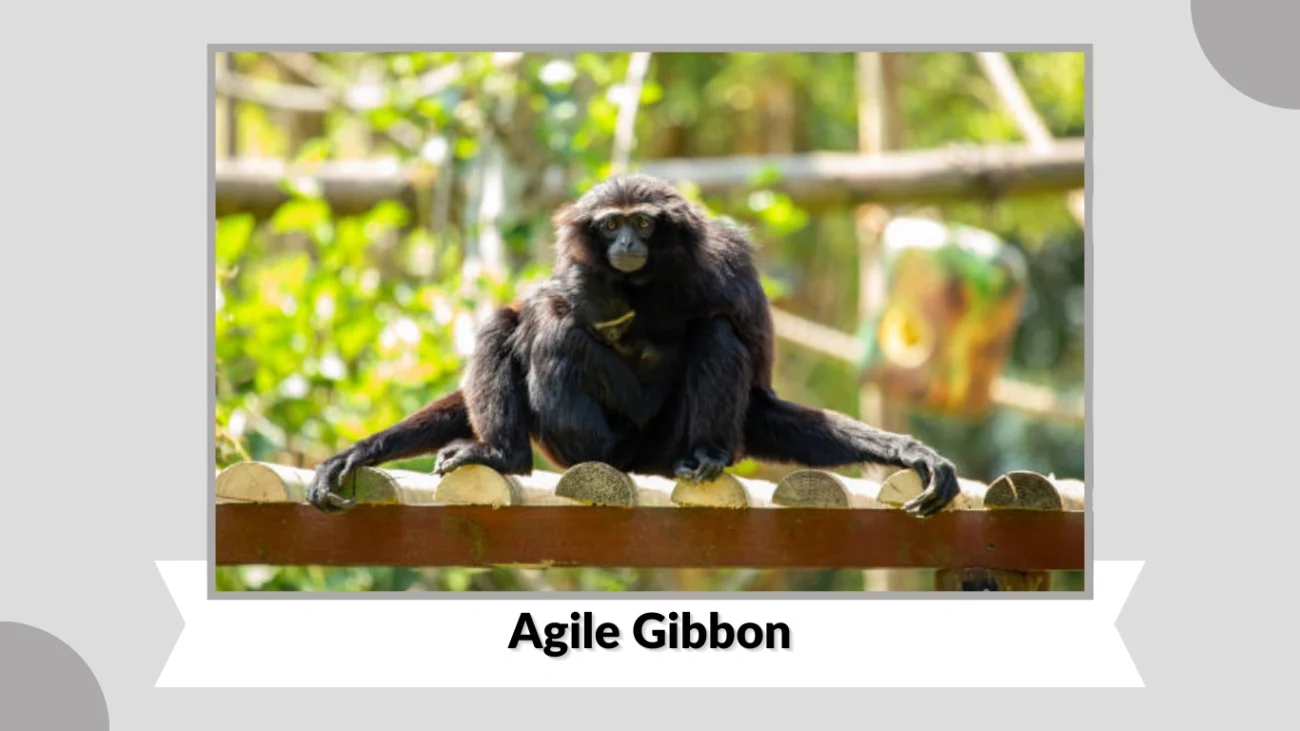
The Agile Gibbon is native to Sumatra, Borneo, and parts of the Malay Peninsula. Known for its incredible speed while brachiating, it is a highly arboreal primate that depends on dense tropical forests. Habitat loss continues to threaten this species.
Identification
- Coat color ranges from black to light brown
- Both sexes may have a white eyebrow stripe
- Slender body with extremely long arms
- No tail; typical ape structure
- Exceptionally fast and agile in treetops
Habitat
Agile Gibbons inhabit lowland and hill rainforests, preferring areas with closed canopy for unobstructed movement. They rely on mature forests with tall, fruit-bearing trees and avoid highly disturbed or fragmented habitats.
Behaviors
This species forms monogamous pairs and communicates through loud, resonant calls each morning. Agile Gibbons use brachiation almost exclusively, enabling long-distance travel through the canopy. They maintain tight family groups and show strong territoriality.
Diet
Their diet is primarily frugivorous, consisting of various fruits, especially figs. They also eat young leaves, shoots, flowers, and insects when fruit is scarce. Their foraging behavior helps maintain forest regeneration.
Lifecycle
Agile Gibbons reach maturity at around 7–8 years of age. Females give birth to a single infant after a gestation of about 7 months. The young remain with their parents for several years before moving on to form new families. Lifespan often reaches 25–30 years in the wild.
8. Bornean White-bearded Gibbon
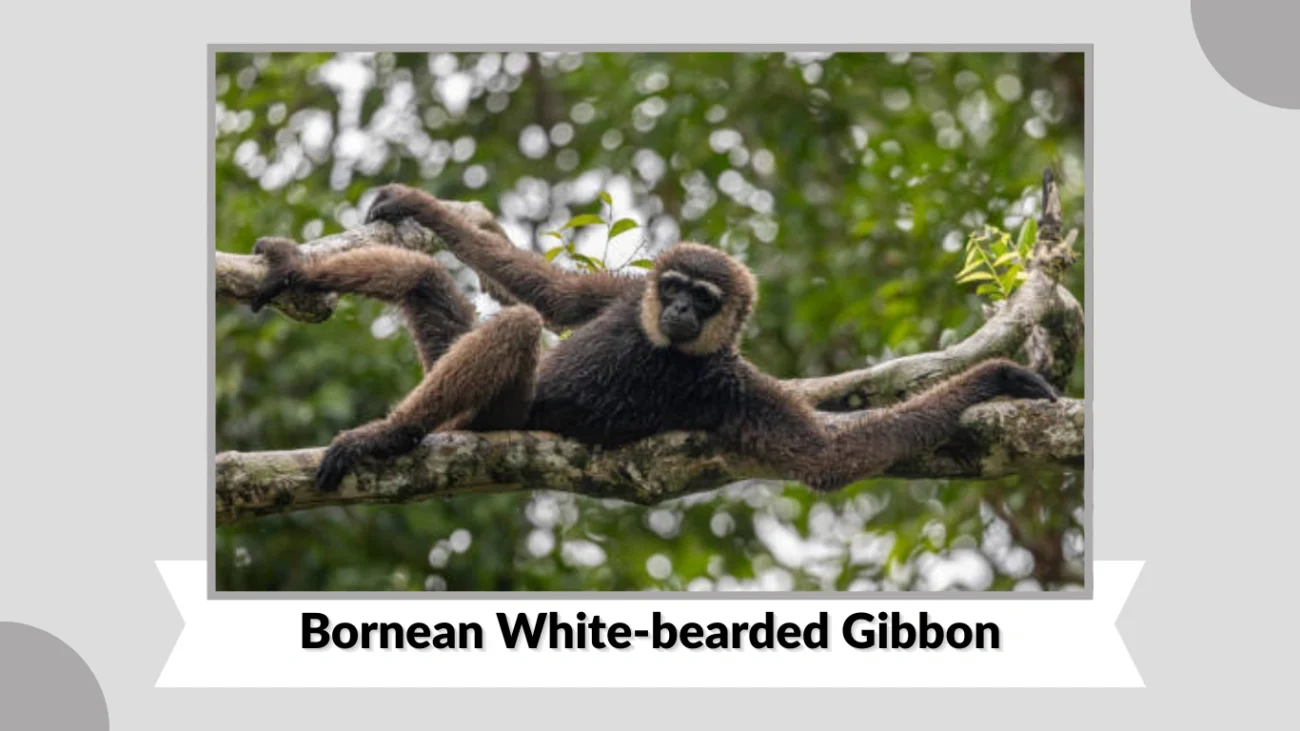
The Bornean White-bearded Gibbon is found exclusively on the island of Borneo. Named for its distinctive white beard and melodic song, it is one of the most easily recognized gibbons in the region. Deforestation continues to be its primary threat.
Identification
- Light brown to dark brown coat
- Prominent white beard on both sexes
- No tail; long arms for brachiation
- Slim, lightweight body built for speed
- Loud, echoing morning calls
Habitat
This species inhabits lowland and hill dipterocarp forests across Borneo. It prefers dense canopy layers with high connectivity, allowing continuous movement without descending to the forest floor. Primary forests are crucial for its survival.
Behaviors
Bornean White-bearded Gibbons live in monogamous pairs and produce coordinated duets at dawn to defend their territory. They spend nearly all of their lives in trees, traveling with effortless swinging motions. Family groups are tight-knit and highly territorial.
Diet
Their diet consists mainly of ripe fruits, supplemented by leaves, flowers, and some insects. They are key seed dispersers in Borneo’s rainforest ecosystems.
Lifecycle
Gibbons reach adulthood around 7–8 years old. Females give birth to one infant after a gestation of about 7 months. Young gibbons remain with their parents for several years before dispersing. Lifespan may reach 25–30 years in the wild.
9. Müller’s Gibbon

Müller’s Gibbon, also known as the Grey Gibbon, is native to the island of Borneo. It is one of the few gibbon species without clear sexual dimorphism, and its soft gray coloration distinguishes it from other regional primates. Deforestation is its primary threat.
Identification
- Soft gray or silver-colored fur
- Minimal or no white facial markings
- Males and females look very similar
- Long, slender arms ideal for brachiation
- Tail-less, lightweight arboreal ape
Habitat
Müller’s Gibbon inhabits lowland and hill rainforests, particularly dipterocarp forests in Borneo. It depends on dense canopy layers with tall, mature trees that provide continuous pathways for movement. It avoids fragmented habitats and rarely comes to the ground.
Behaviors
This species is diurnal, monogamous, and strongly territorial. Family groups typically consist of a pair and their offspring. Müller’s Gibbons communicate through coordinated songs at dawn, used for bonding and territory marking. They travel almost entirely through brachiation.
Diet
Their diet consists mainly of fruits, including figs, supplemented with tender leaves, flowers, buds, and occasional insects. Seasonal fruiting patterns influence their daily foraging routes.
Lifecycle
Müller’s Gibbons mature at around 7–8 years. Females give birth to one infant after a 7-month gestation period. Juveniles stay with the family for several years before dispersing. Lifespan in the wild ranges from 25–30 years.
10. Kloss’s Gibbon

Kloss’s Gibbon, also known as the Mentawai Gibbon or Bilou, is native to the Mentawai Islands of Indonesia. It is unique among gibbons for its entirely black coat and distinct vocal patterns. The species is vulnerable due to habitat loss and limited range.
Identification
- Entirely black fur in both sexes
- Smaller than many other gibbon species
- Very long arms and slender body
- No tail; lightweight arboreal primate
- Recognizable by its unique, haunting calls
Habitat
Kloss’s Gibbons inhabit tropical rainforests on the Mentawai Islands, preferring dense canopy cover in both lowland and hill forests. Their restricted island range makes them highly sensitive to habitat changes and deforestation.
Behaviors
They are monogamous and territorial, producing morning duets that differ from mainland gibbon species. Kloss’s Gibbons are strictly arboreal and use brachiation as their main form of travel. They maintain close-knit family groups and exhibit strong parental care.
Diet
Their diet is primarily composed of fruits, especially figs, along with leaves, young shoots, flowers, and insects. Foraging patterns depend on seasonal fruiting in their limited island habitat.
Lifecycle
These gibbons reach maturity at around 6–7 years. Females give birth to a single infant after a gestation of roughly 7 months. Young Kloss’s Gibbons stay with their families for several years before dispersing. Their typical lifespan ranges from 25–30 years in the wild.
11. Silvery Gibbon
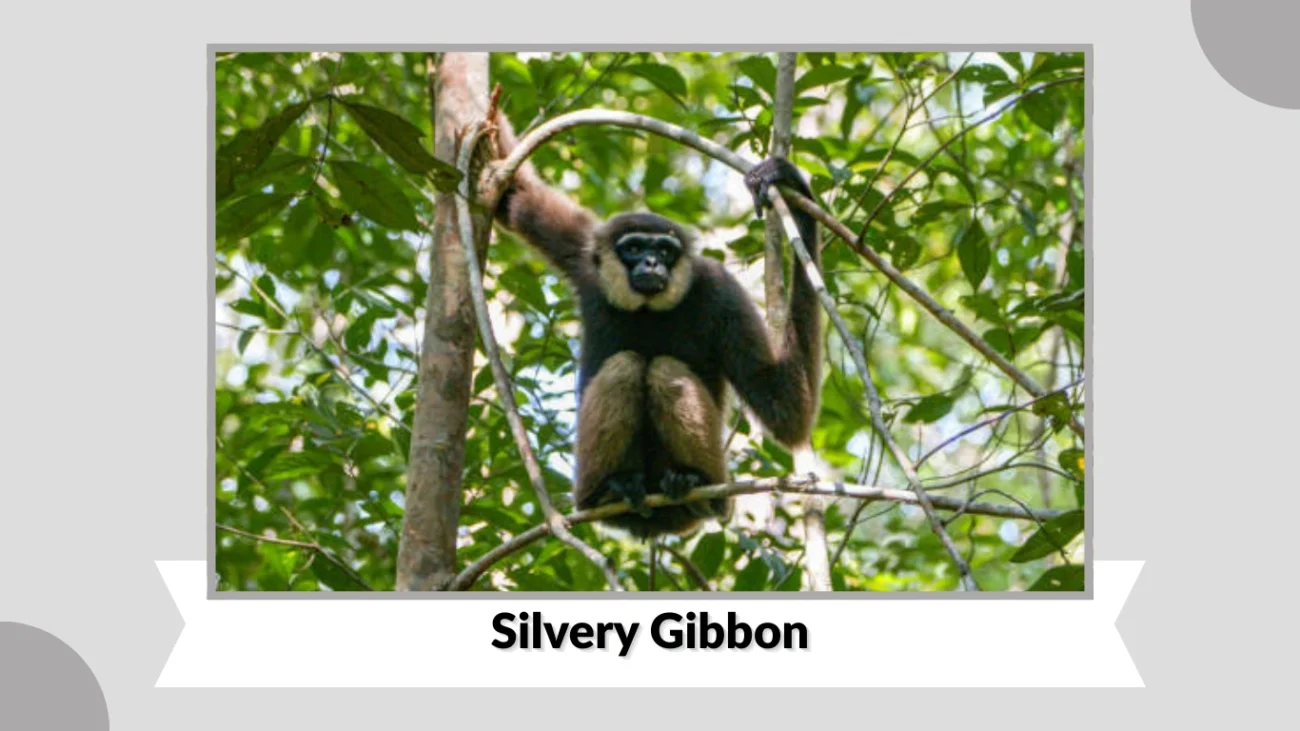
The Silvery Gibbon, also known as the Javan Silvery Gibbon, is found exclusively on the island of Java in Indonesia. Its silver-gray fur and gentle vocalizations make it one of the most recognizable gibbon species. It is critically endangered due to severe habitat fragmentation.
Identification
- Silver-gray or bluish-gray fur
- Dark face with lighter fur around the cheeks
- Long, slender arms adapted for brachiation
- No tail; lightweight and agile
- Softer, more melodic songs than many other gibbons
Habitat
Silvery Gibbons inhabit evergreen and semi-evergreen forests on Java, relying on dense canopy corridors for movement. They prefer upland and lowland forests with tall emergent trees and avoid heavily disturbed areas. Habitat loss from agriculture remains the primary threat.
Behaviors
This species forms monogamous pairs and defends small territories through morning duets. Silvery Gibbons spend almost their entire lives in the canopy, moving swiftly using brachiation. They show strong parental care and maintain stable family units.
Diet
Their diet is mostly frugivorous, consisting of ripe fruits, with supplementary leaves, flowers, and insects. They contribute significantly to seed dispersal within their forest ecosystems.
Lifecycle
Silvery Gibbons reach maturity around 6–8 years. Females give birth to one infant after a gestation period of about 7 months. Offspring remain with the family group for several years before dispersing. They typically live 25–30 years in the wild.
12. Javan Gibbon
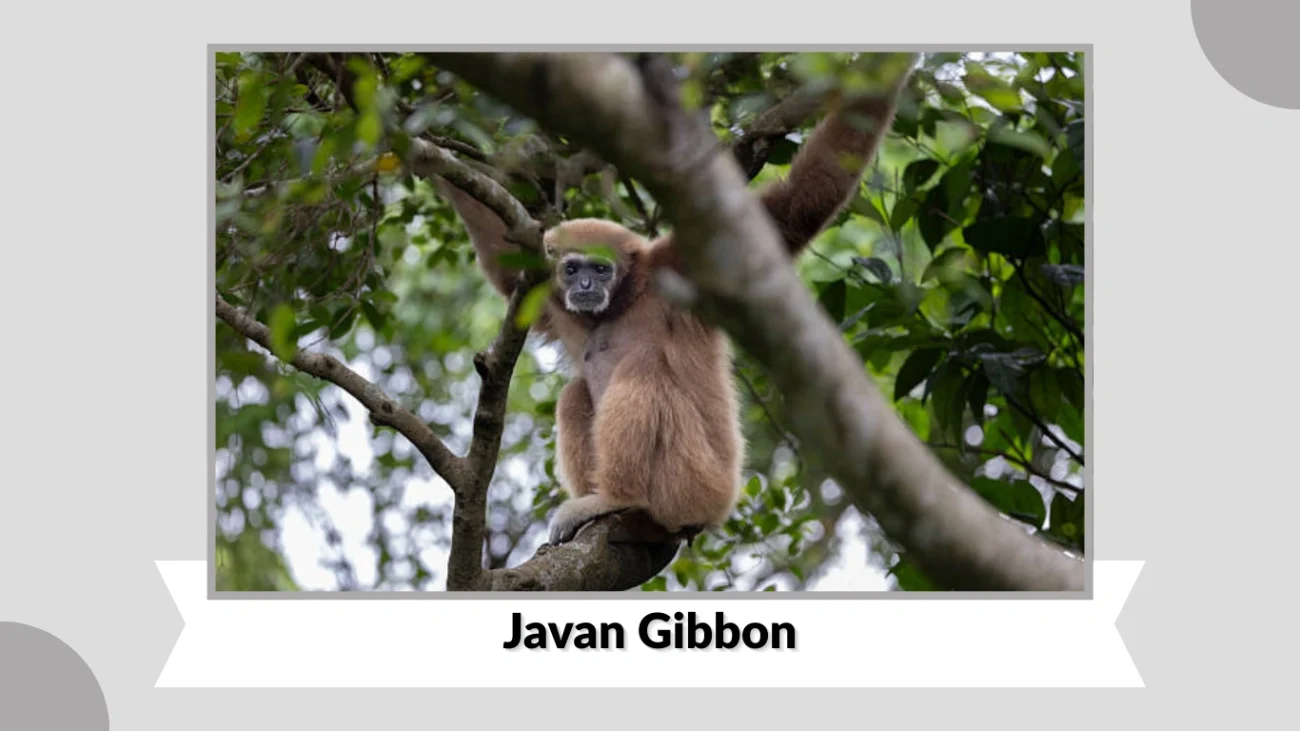
The Javan Gibbon, also called the Moloch Gibbon, is another species native to Java, Indonesia. Known for its soft gray coat and expressive facial features, it is one of the most endangered gibbons due to extreme habitat loss.
Identification
- Soft gray to silver-brown fur
- Dark face framed with lighter fur
- Very long arms for fast brachiation
- Small, lightweight, and tailless ape
- Notable for gentle vocal patterns and duets
Habitat
This species inhabits the remaining patches of rainforests in western and central Java. It depends on dense canopy layers, preferring mature secondary and primary forests. Its limited range makes it highly vulnerable to deforestation.
Behaviors
Javan Gibbons form monogamous families and perform morning duets to communicate and display territory. They remain almost entirely arboreal, traveling through the canopy with grace and precision. Their social structure centers around strong family bonds.
Diet
Their diet mostly consists of fruits, supplemented by leaves, flower buds, and occasional insects. They serve as important seed dispersers for many plant species.
Lifecycle
They reach maturity at 6–8 years of age. Females give birth to one infant after a roughly 7-month gestation period. The young stay with their parents for several years before leaving to start their own families. Their lifespan is around 25–30 years in the wild.
13. Siamang

The Siamang is the largest of all gibbon species, easily recognized by its huge throat sac which inflates during loud, echoing calls. Native to Sumatra and the Malay Peninsula, the Siamang is endangered due to habitat destruction and fragmentation.
Identification
- Entirely black fur
- Very large inflatable throat sac (gular sac)
- Long arms and powerful shoulders for brachiation
- Heavier and larger than all other gibbons
- Loud, resonating calls heard over long distances
Habitat
Siamangs inhabit lowland and montane rainforests in Sumatra and Peninsular Malaysia. They prefer dense, mature forests with tall canopy layers and avoid heavily disturbed areas. They require large territories due to their size and dietary needs.
Behaviors
Siamangs form monogamous family groups and produce deep, booming duets every morning. They are slower-moving than smaller gibbons but still proficient brachiators. Family cohesion is strong, and adults display cooperative parenting.
Diet
Their diet is more varied than other gibbons: fruits make up a smaller percentage, with more leaves, shoots, flowers, and insects included. This dietary flexibility allows them to thrive in diverse forest zones.
Lifecycle
Siamangs reach maturity around 7–9 years. Females give birth to a single infant after a gestation of about 7–8 months. Juveniles remain with their parents for several years before dispersing. Lifespan is approximately 30–35 years in the wild.
14. Black Crested Gibbon
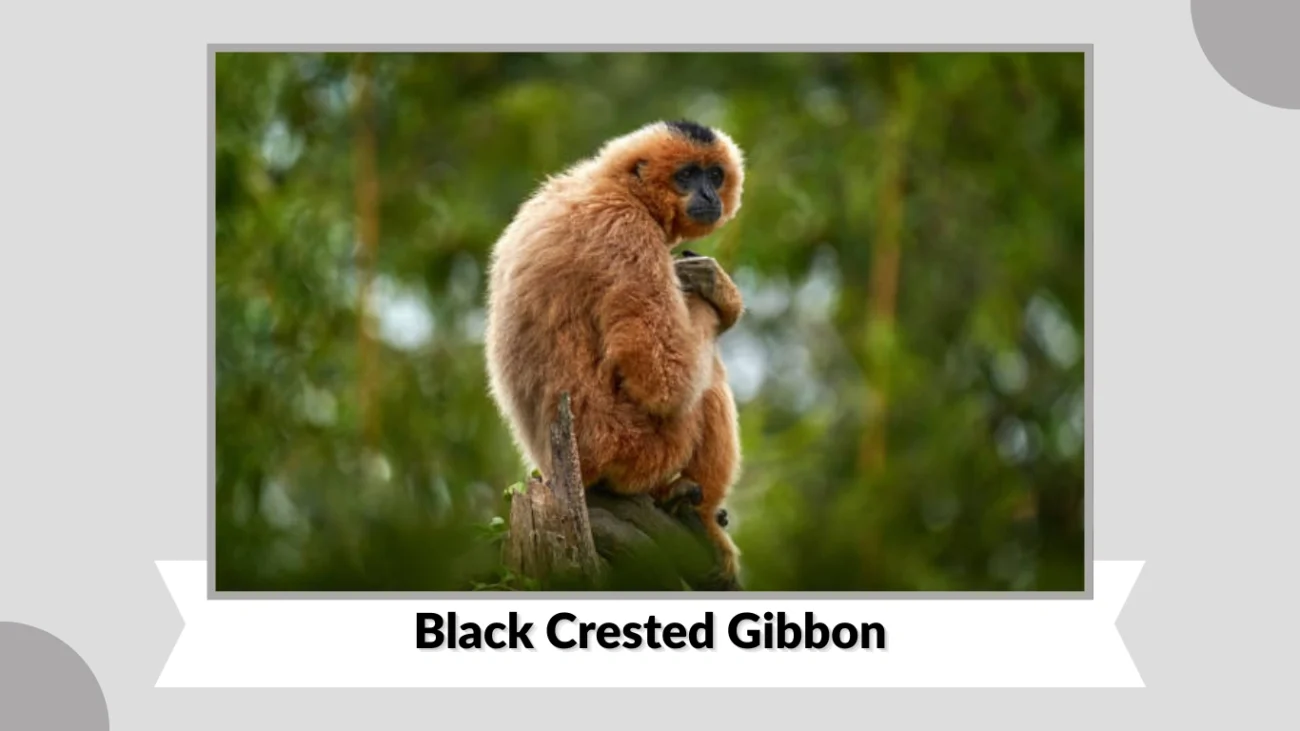
The Black Crested Gibbon, also known as the Lao Crested Gibbon, is found in Laos, Vietnam, and parts of China. Known for its marked sexual color differences and distinctive crest, it is critically endangered due to hunting and habitat loss.
Identification
- Males: glossy black fur with a tall crest
- Females: golden or buff fur with dark crown
- Long arms for graceful brachiation
- No tail; slender and lightweight
- Distinctive duet calls with rising and falling tones
Habitat
Black Crested Gibbons inhabit subtropical and tropical forests with dense canopy coverage. They prefer mountainous regions with mature trees that allow continuous arboreal travel. Habitat fragmentation has greatly reduced their range.
Behaviors
They form monogamous pairs and perform long, melodic duets at dawn to defend territories. These gibbons are extremely arboreal, rarely touching the ground. They show strong pair bonding and cooperative parenting.
Diet
Their primary diet consists of fruits, especially figs, along with leaves, buds, flowers, and occasional insects. Their frugivorous habits help maintain forest regeneration through seed dispersal.
Lifecycle
Maturity is reached around 6–8 years. Females give birth to one infant after a gestation of about 7 months. Young remain with their parents for several years before dispersing. They typically live 25–30 years in the wild.
15. Hainan Gibbon

The Hainan Gibbon is the rarest primate on Earth, found only on Hainan Island in China. With fewer than 40 individuals remaining, it is critically endangered and considered the world’s most threatened gibbon species. Its restricted range makes conservation extremely urgent.
Identification
- Males: black fur with slight crest
- Females: golden-yellow fur with dark facial markings
- Very long arms and slender body
- No tail; true ape anatomy
- Soft but distinct morning songs
Habitat
Hainan Gibbons inhabit tropical evergreen forests in the mountainous regions of Hainan Island. They prefer dense, continuous canopy cover for movement and rely on mature forests with fruit-bearing trees. Their extremely limited range makes them highly vulnerable to disturbance.
Behaviors
These gibbons form small monogamous family groups. Their vocalizations are softer and shorter than many other gibbon species, but still used for bonding and territory communication. They stay exclusively in the canopy, traveling through brachiation and maintaining strong pair bonds.
Diet
Their diet is highly frugivorous, consisting mostly of figs and other ripe fruits. They also consume shoots, leaves, flowers, and insects depending on seasonal availability.
Lifecycle
Maturity is reached around 6–8 years. Females give birth to one infant after a roughly 7-month gestation. Offspring remain with their parents until they are fully independent. Their lifespan is estimated to be around 25–30 years in the wild.
16. Cao Vit Gibbon
The Cao Vit Gibbon, also known as the Eastern Black Crested Gibbon, is one of the world’s rarest gibbon species, found only in a small border region between Vietnam and China. With extremely low population numbers, it is critically endangered.
Identification
- Males: shiny black fur with a crest on the head
- Females: golden fur with darker face and crown
- Long arms and lightweight body
- Hairless face with expressive features
- Loud, ringing morning duet calls
Habitat
Cao Vit Gibbons live in karst evergreen forests, a unique habitat of limestone hills and rugged terrain. They require thick canopy layers for safe arboreal movement and depend on intact forest ecosystems. Their tiny range makes habitat protection essential.
Behaviors
They form monogamous family units that call loudly at sunrise. Cohesive group behavior is important for survival in their limited habitat. They travel exclusively through the canopy using brachiation and seldom descend to the ground.
Diet
Their diet is dominated by fruits such as figs, supplemented with young leaves, flowers, and insects. Seasonal shifts in fruiting trees influence their movement and feeding patterns.
Lifecycle
Cao Vit Gibbons reaches maturity around 6–8 years. Females give birth to a single infant after a gestation of about 7 months. Offspring stay with parents for several years before dispersing. Their lifespan is roughly 25–30 years in the wild.
17. Yellow-cheeked Gibbon
The Yellow-cheeked Gibbon, also known as the Buff-cheeked Gibbon, is native to Vietnam, Laos, and Cambodia. It is easily recognized by its striking facial colors and powerful, echoing morning songs. This species is endangered due to rapid habitat loss and hunting pressures.
Identification
- Males: black fur with bright yellow or orange cheek patches
- Females: golden to buff-colored fur with darker crown
- Long arms adapted for fluid brachiation
- No tail; lightweight arboreal ape
- Loud, resonant calls that travel long distances
Habitat
Yellow-cheeked Gibbons inhabit tropical evergreen and semi-evergreen forests. They thrive in areas with dense canopy connectivity, which allows continuous arboreal travel. These gibbons prefer mature forest habitats and are sensitive to fragmentation.
Behaviors
They form monogamous family groups and are known for their elaborate morning duets, which include rising and falling notes that strengthen pair bonds and define territory. They spend nearly all their time in the treetops, moving gracefully through brachiation.
Diet
Their diet is mostly fruit-based, especially figs, but they also consume leaves, flowers, buds, and insects. They play a major ecological role as seed dispersers in their forest ecosystems.
Lifecycle
Yellow-cheeked Gibbons reach maturity around 6–8 years. Females typically give birth to one infant after a gestation of about 7 months. Offspring stay with their parents for several years before dispersing. Their lifespan is generally 25–30 years in the wild.


