











Sloths are unique, slow-moving mammals found in the tropical forests of Central and South America. Known for their gentle behavior, algae-tinted fur, and tree-dwelling lifestyles, these animals belong to two main families: three-toed sloths and two-toed sloths. Across these families, there are seven distinct species, each with its own appearance, habitat, and behaviors. This collection highlights all seven types for easy understanding and reference.
1. Pygmy Three-Toed Sloth

The pygmy three-toed sloth is the smallest and rarest sloth species on Earth, found only on a tiny island off the coast of Panama. Known for its gentle nature and slow movements, it lives primarily in mangrove forests, where its small size and unique coloring help it survive in an extremely limited habitat.
Identification
- Smallest of all sloth species
- Distinct pale face with dark eye mask
- Long limbs with three curved claws
- Gray-brown fur with a slight green tint from algae
- Slow, deliberate climbing style
Habitat & Range
The pygmy three-toed sloth is endemic to Isla Escudo de Veraguas, a small island in Panama. It lives almost exclusively in coastal red mangrove forests, spending most of its life in the upper canopy. Its restricted range makes it highly vulnerable to environmental changes.
Behavior
This species is extremely slow-moving, spending most of its time resting or feeding on mangrove leaves. It is solitary, peaceful, and descends to the ground only rarely. Like other sloths, it hosts algae in its fur, which provides camouflage and supports a miniature ecosystem of insects.
Conservation Status
The pygmy three-toed sloth is listed as Critically Endangered, with only a few hundred individuals remaining. Habitat loss, illegal hunting, and human disturbance pose serious threats. Conservation programs focus on habitat protection, limiting tourism impact, and scientific monitoring.
2. Maned Sloth

The maned sloth is recognized for the dark mane of long fur around its neck and shoulders. Found mainly in Brazil’s Atlantic Forest, it lives high in the canopy, moving slowly and relying heavily on dense, undisturbed forest habitat.
Identification
- Dark, shaggy mane around the neck
- Long limbs with three claws
- Gray-brown fur with coarse texture
- Shorter face and darker mask than other three-toed sloths
- Slender body adapted for hanging and climbing
Habitat & Range
The maned sloth inhabits the Atlantic coastal forests of Brazil, particularly in Espírito Santo, Bahia, and Minas Gerais. It prefers mature, continuous forest canopies where it can feed, rest, and travel with minimal ground contact.
Behavior
A solitary and slow-moving species, the maned sloth spends most of its life resting or feeding on leaves. It climbs cautiously, rarely descends, and blends well into the canopy due to its thick, dark mane.
3. Pale-Throated Sloth

The pale-throated sloth is known for its creamy or yellowish throat patch, which contrasts with its darker body fur. Found across northern South America, it is a quiet, tree-dwelling species that prefers dense rainforest canopies.
Identification
- Pale or yellowish throat patch
- Dark brown to gray body fur
- Three long curved claws on each forelimb
- Rounded face with a subtle mask pattern
- Slender build adapted for hanging in the canopy
Habitat & Range
This species occupies northern South American rainforests, including regions of Brazil, Guyana, Suriname, French Guiana, and Venezuela. It thrives in humid, densely vegetated forests with abundant leaf cover.
Behavior
The pale-throated sloth is solitary and extremely slow-moving, spending most of its time sleeping or feeding on leaves. It stays high in the canopy, where its pale throat and muted coloration help with camouflage.
4. Brown-Throated Sloth

The brown-throated sloth is the most widespread and commonly seen sloth species in the Americas. It is known for its warm brown throat patch, gentle expression, and remarkable adaptability across different forest types. Its slow movements, algae-tinted fur, and calm temperament make it a classic example of the three-toed sloth family.
Identification
- Brown or golden-brown throat patch
- Round face with a soft, gentle expression
- Gray-brown fur often tinted green from algae
- Distinct dark eye mask bordered by pale fur
- Three long claws on the forelimbs
- Medium-sized, sturdy body compared to other three-toed sloths
- Short tail and slightly domed head
Habitat & Range
The brown-throated sloth has a wide distribution across Central and South America. It inhabits forests in Nicaragua, Costa Rica, Panama, Colombia, Brazil, Venezuela, Ecuador, Peru, and Bolivia. It thrives in tropical rainforests but can also survive in secondary forests, fragmented habitats, and areas near human settlements where trees remain.
Behavior
This species is solitary, slow, and highly arboreal, spending nearly all its life in trees. It feeds mainly on tender leaves, buds, and shoots from numerous tree species, giving it more dietary flexibility than other sloths. The brown-throated sloth typically moves only when necessary, resting for up to 15–18 hours a day. Its greenish algae-covered fur provides excellent camouflage, and it descends to the ground mainly to defecate, often just once a week.
Conservation Status
Although currently listed as Least Concern, the species still faces threats from deforestation, road expansion, and habitat fragmentation. Some local populations are declining where forest cover has been heavily reduced, but overall the brown-throated sloth remains the most stable and abundant of all sloth species.
5. Linnaeus’s Two-Toed Sloth

Linnaeus’s two-toed sloth is one of the two species of two-toed sloths, easily recognized by its larger size, stronger limbs, and two prominent claws on each forelimb. Known for its nocturnal lifestyle and flexible diet, it thrives in several types of tropical forest and is one of the most commonly encountered sloths in captivity.
Identification
- Two large curved claws on each forelimb
- Longer, shaggier fur compared to three-toed sloths
- Pink or light-colored snout
- Large, powerful limbs built for climbing
- Body often tinted green from algae
- Prominent, rounded head with a gentle expression
Habitat & Range
This species inhabits northern South America, including Venezuela, Colombia, Ecuador, Peru, and parts of Brazil. It prefers tropical rainforests, cloud forests, and secondary forests, often using dense tree canopies for shelter and feeding. Its adaptability allows it to occur in a wider range of environments than most three-toed species.
Behavior
Linnaeus’s two-toed sloth is nocturnal, spending nights feeding on leaves, shoots, fruits, and sometimes even small animals—giving it a more varied diet than three-toed sloths. During the day, it rests curled in tree branches. It climbs with surprising strength, using its muscular limbs and flexible ankles. This species rarely descends to the ground and prefers dense canopy pathways.
Conservation Status
Currently listed as Least Concern, this species remains relatively stable across much of its range. However, habitat loss, forest fragmentation, and human disturbances continue to affect some populations. Captive individuals are common in wildlife centers and zoos, contributing to research and conservation awareness.
6. Hoffmann’s Two-Toed Sloth
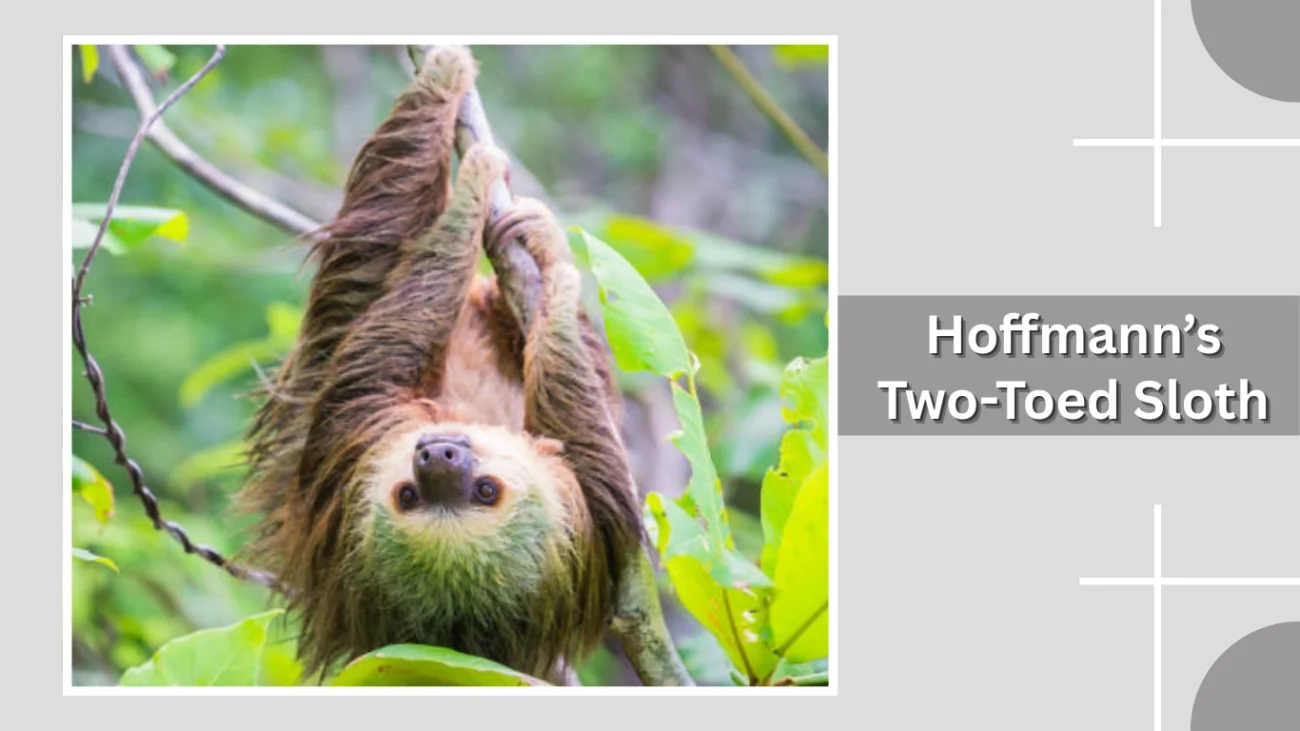
Hoffmann’s two-toed sloth is a widespread and adaptable species known for its strong limbs, shaggy fur, and nocturnal lifestyle. It occupies a broad range across Central and South America, thriving in various forest types and showing remarkable flexibility in diet and behavior.
Identification
- Two curved claws on each forelimb
- Thick, shaggy fur ranging from gray to beige
- Pinkish or dark snout depending on region
- Long limbs with powerful muscles for climbing
- Rounded head with small eyes and a gentle face
- Often carries green algae on fur for camouflage
Habitat & Range
Hoffmann’s two-toed sloth inhabits Central America through northern South America, including Honduras, Nicaragua, Costa Rica, Panama, Colombia, Ecuador, and parts of Peru. It lives in rainforests, cloud forests, dry forests, and secondary growth, thanks to its adaptability. This wide habitat tolerance contributes to its large and stable population.
Behavior
This species is primarily nocturnal, feeding at night on leaves, flowers, fruits, and occasionally small animals. It moves slowly but with great strength, often hanging upside down while resting or feeding. Hoffmann’s sloths are solitary, spending most of their time alone except during mating or when females care for a single offspring.
Conservation Status
Classified as Least Concern, Hoffmann’s two-toed sloth remains relatively secure due to its broad habitat range and adaptive diet. However, local populations are threatened by deforestation, road expansion, and illegal capture. Conservation efforts focus on maintaining forest corridors and reducing human–sloth conflicts.
7. Southern Maned Sloth

The southern maned sloth is closely related to the maned sloth but found farther south in Brazil’s Atlantic Forest region. It is recognized for its long, dark mane and its dependency on dense, mature forests. Like other three-toed sloths, it moves slowly, blends easily into foliage, and spends nearly its entire life in the canopy.
Identification
- Long, dark mane around the neck and shoulders
- Gray-brown body fur with coarse texture
- Three curved claws on each forelimb
- Small, rounded face with a subtle mask pattern
- Slender, lightweight build suited for canopy life
Habitat & Range
This species is found in the southern Atlantic Forest of Brazil, especially in Rio de Janeiro, São Paulo, and Paraná. It prefers old-growth, continuous forest canopies where it can travel through branches with minimal exposure to predators.
Behavior
The southern maned sloth is solitary and extremely slow-moving, resting for long periods and feeding mainly on leaves from select tree species. It rarely descends to the ground and relies heavily on intact forest corridors. Its dark mane provides camouflage, blending with shaded branches and dense foliage.
Conservation Status
Listed as Vulnerable, the southern maned sloth faces significant threats from habitat loss, road fragmentation, and expanding urban areas. Conservation actions include habitat preservation, forest corridor restoration, and monitoring of remaining populations.
FAQs
What is the difference between two-toed and three-toed sloths?
Three-toed sloths have three claws on their forelimbs and a more rounded face with a constant “smile,” while two-toed sloths have only two claws on the forelimbs, larger bodies, stronger limbs, and a more varied diet. They also differ in activity patterns—two-toed sloths are mostly nocturnal.
Where do sloths live?
All sloths live in the tropical forests of Central and South America. They prefer dense canopy environments where they can move between branches with minimal need to descend. Some species have very restricted ranges, such as the pygmy three-toed sloth found only on a single Panamanian island.
Why do sloths move so slowly?
Sloths have an extremely low metabolism, which helps conserve energy. Their diet of tough, low-calorie leaves requires slow digestion, so reduced movement helps them survive. Slow motion also serves as camouflage, making them harder for predators to detect.
How often do sloths come down from trees?
Most sloths descend to the ground only about once a week, primarily to defecate. They spend the rest of their time feeding, resting, and moving within the tree canopy. Coming down is risky, so they do it as little as possible.
Are any sloth species endangered?
Yes. Several sloth species face threats from deforestation and habitat fragmentation. The pygmy three-toed sloth is Critically Endangered, while the southern maned sloth is Vulnerable. Conservation efforts focus on protecting forest habitats and maintaining safe wildlife corridors.


