Hawaii is home to a colorful mix of native forest birds, introduced songbirds, and even escaped tropical parrots. Among them, red-headed species stand out for their striking appearance and unique behaviors. This guide explores 19 birds in Hawaii with red heads, including endemic honeycreepers, established exotics, and rare escapees—each identified by their bold crimson or scarlet crowns, making them some of the most eye-catching birds on the islands.
1. Apapane (Himatione sanguinea)

The ‘Apapane is a brilliantly red honeycreeper native to Hawaii. Found on most of the main islands, it thrives in high-elevation native forests and is one of the most abundant endemic bird species in Hawaii. This vibrant bird is essential for pollinating native flora, especially the ‘ōhi‘a lehua tree, which it frequents for nectar.
Appearance
The ‘Apapane displays a vibrant crimson-red body with contrasting black wings and tail. Its slightly down-curved bill is adapted for sipping nectar, and its small size and quick movements make it a lively presence in native forests.
Habitat
This species is typically found in wet and mesic native forests, especially above 1,000 meters in elevation. It prefers areas rich in blooming ‘ōhi‘a trees and is common in locations like Hakalau Forest National Wildlife Refuge and Volcanoes National Park.
Behavior
‘Apapane are highly active, social birds that often travel in small flocks. They are known for their quick, fluttery flight and varied vocalizations, which include whistles, buzzes, and trills. They are most frequently observed feeding on nectar, playing a key role in pollination.
Identification
- Crimson-red body with black wings and tail
- Slightly curved black bill
- Red extends through the head and chest
- Small and agile; often high in the canopy
- Frequently seen with yellow pollen on the forehead
- More compact and darker-winged than the similar ‘I‘iwi
2. ‘I‘iwi (Drepanis coccinea)
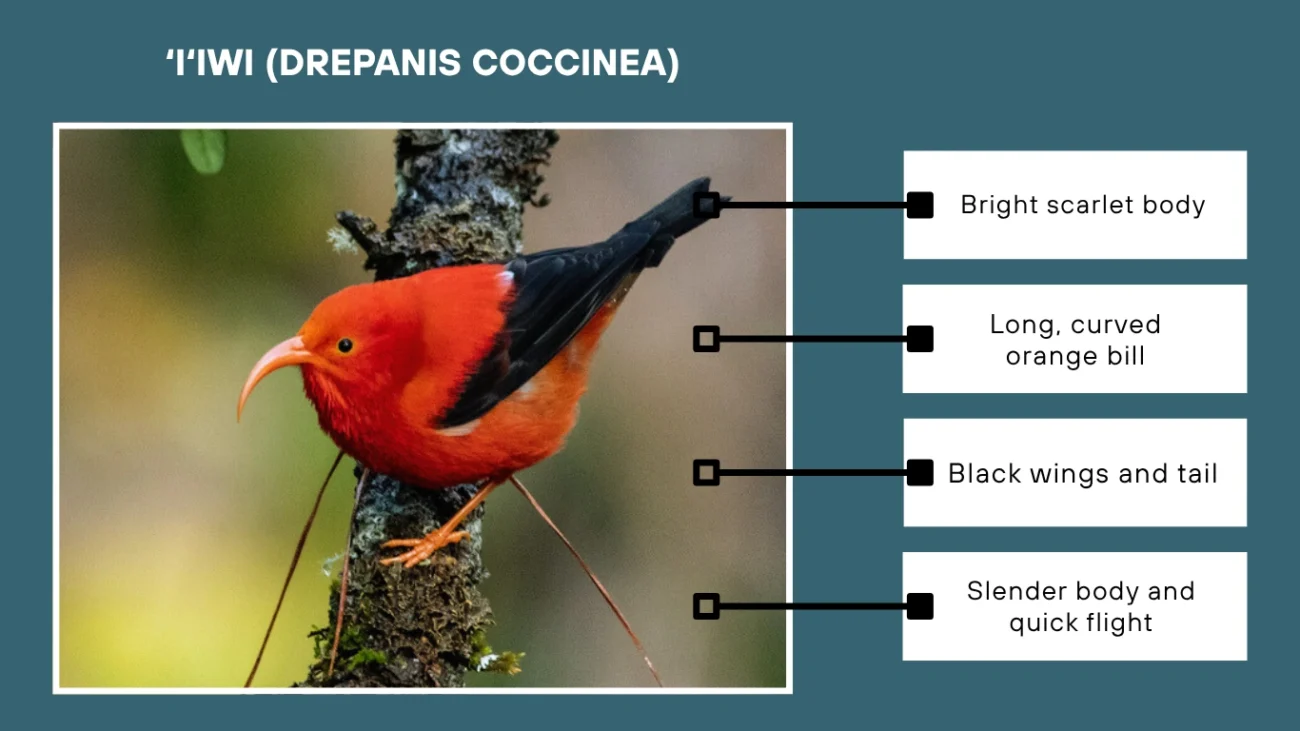
The ‘I‘iwi is one of the most iconic and visually stunning native Hawaiian honeycreepers. Found primarily on the islands of Hawaii, Maui, and Kauai, this bird is instantly recognizable due to its vivid red plumage and long, curved bill. It is a nectar feeder and plays a vital ecological role in pollination.
Appearance
The ‘I‘iwi boasts a brilliant scarlet body contrasted by black wings and tail. Its long, decurved orange bill is perfectly suited for feeding on native Hawaiian flowers like the curved blossoms of the lobelia.
Habitat
This species is mostly restricted to high-elevation native forests, often above 1,200 meters. It favors remote and undisturbed forest habitats where native plants like ‘ōhi‘a lehua are abundant.
Behavior
‘I‘iwi are often seen darting rapidly among flowers. Their flight is fast and undulating. Though less common than the ‘Apapane due to habitat loss and disease, they remain active and vocal in the areas they still occupy.
Identification
- Bright scarlet body
- Long, curved orange bill
- Black wings and tail
- Slender body and quick flight
- Loud, whistling call often heard before it’s seen
- Forages in curved tubular flowers like lobelia and lehua
3. Red-crested Cardinal (Paroaria coronata)
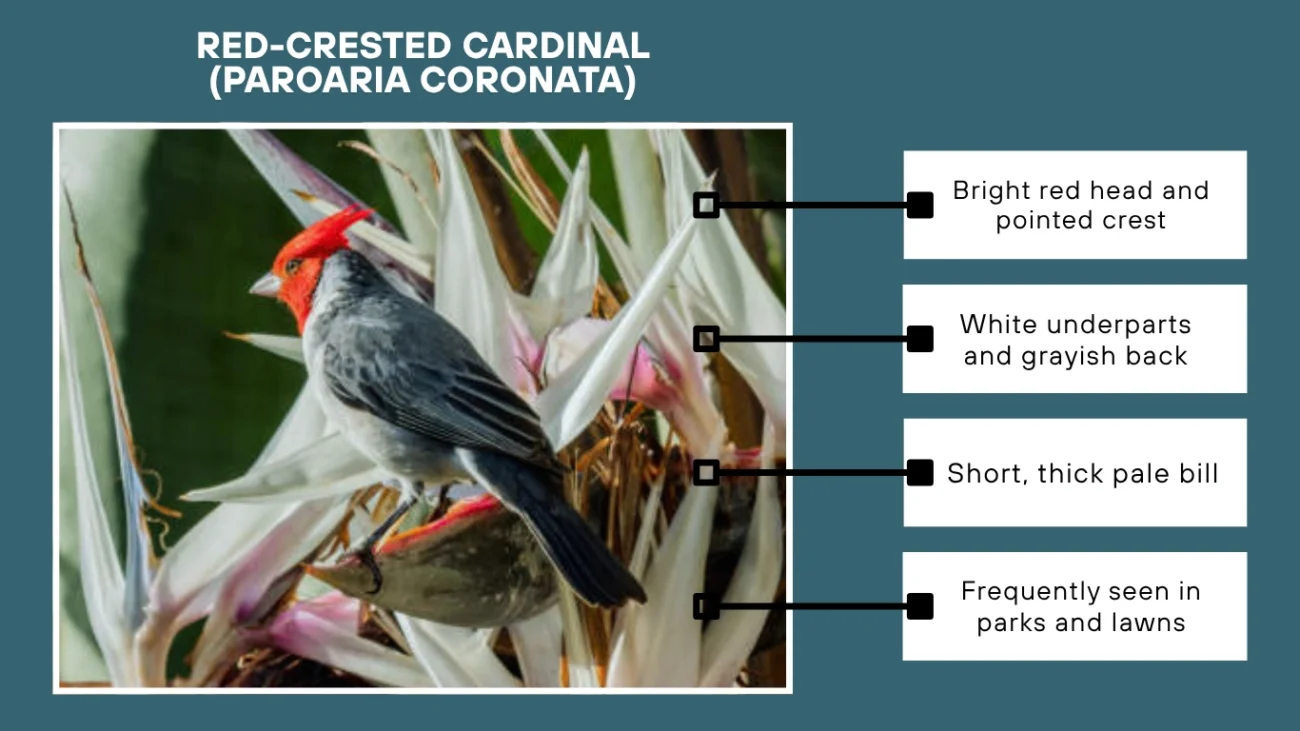
Despite its name, the Red-crested Cardinal is not a true cardinal. This South American native was introduced to Hawaii and has become widespread, especially on Oahu and other lowland areas. Its vivid red head makes it easy to spot in urban parks and gardens.
Appearance
This bird has a striking red head and crest, with a white belly and gray back. Its stout, pale bill and black collar line enhance its bold appearance.
Habitat
Red-crested Cardinals are commonly found in lowland urban, suburban, and coastal environments. They thrive in areas with open grassy spaces, trees, and shrubs.
Behavior
These cardinals are not shy and are often seen hopping on the ground in search of seeds. They can be quite tame, especially in areas frequented by people, and are often seen in pairs.
Identification
- Bright red head and pointed crest
- White underparts and grayish back
- Short, thick pale bill
- Frequently seen in parks and lawns
- Confident and ground-foraging behavior
- Often confused with Northern Cardinal but lacks red body
4. Northern Cardinal – Male (Cardinalis cardinalis)
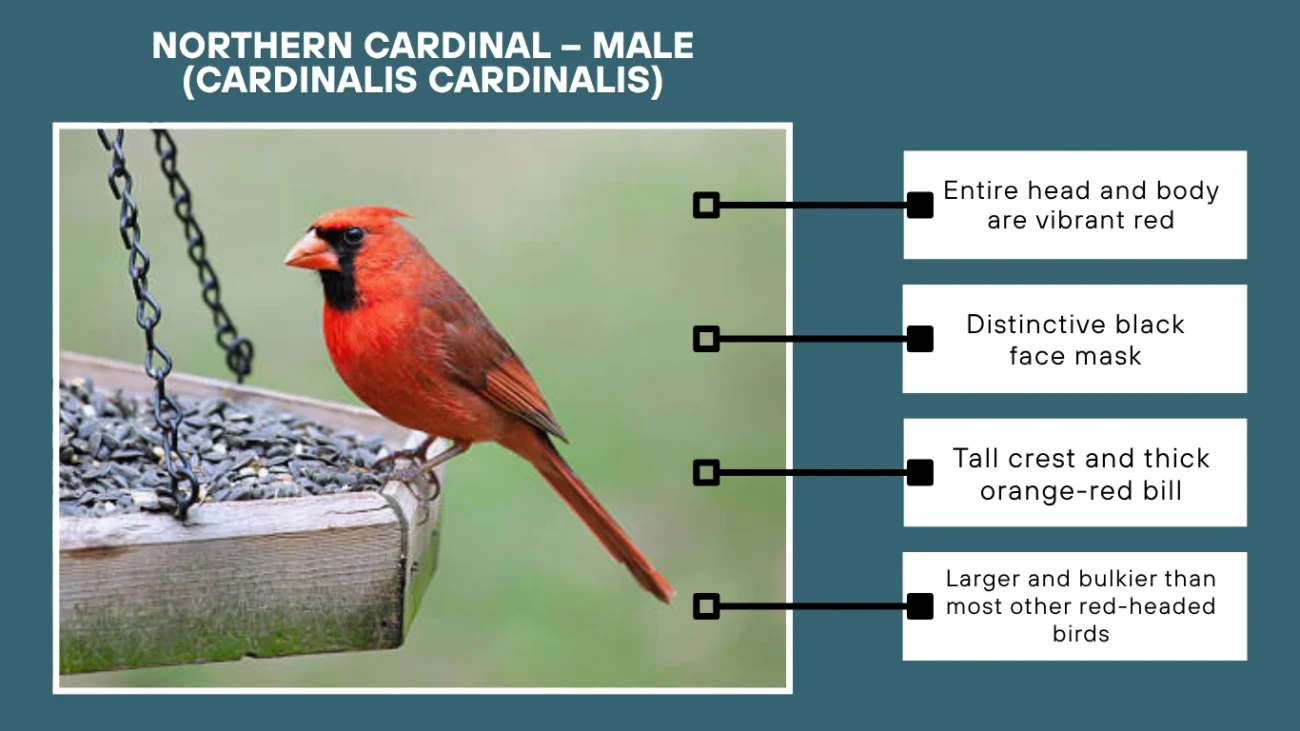
The Northern Cardinal is a well-known songbird introduced to Hawaii, now widespread in various habitats. The male is known for its fully red plumage, including its head, making it one of the most colorful birds seen across the islands.
Appearance
The male Northern Cardinal is completely red, with a prominent crest and a black mask around its bill. Its thick, conical beak is bright orange.
Habitat
It inhabits lowland forests, gardens, and residential areas. It adapts well to both native and non-native plant landscapes and is frequently seen around bird feeders.
Behavior
Males are territorial and often sing from treetops. Their calls are melodious, and they are especially active during dawn and dusk. Pairs can be seen feeding and nesting together throughout the year.
Identification
- Entire head and body are vibrant red
- Distinctive black face mask
- Tall crest and thick orange-red bill
- Larger and bulkier than most other red-headed birds
- Found year-round in urban and forested areas
- Frequently perches on fences, wires, and open branches
5. House Finch – Male (Haemorhous mexicanus)
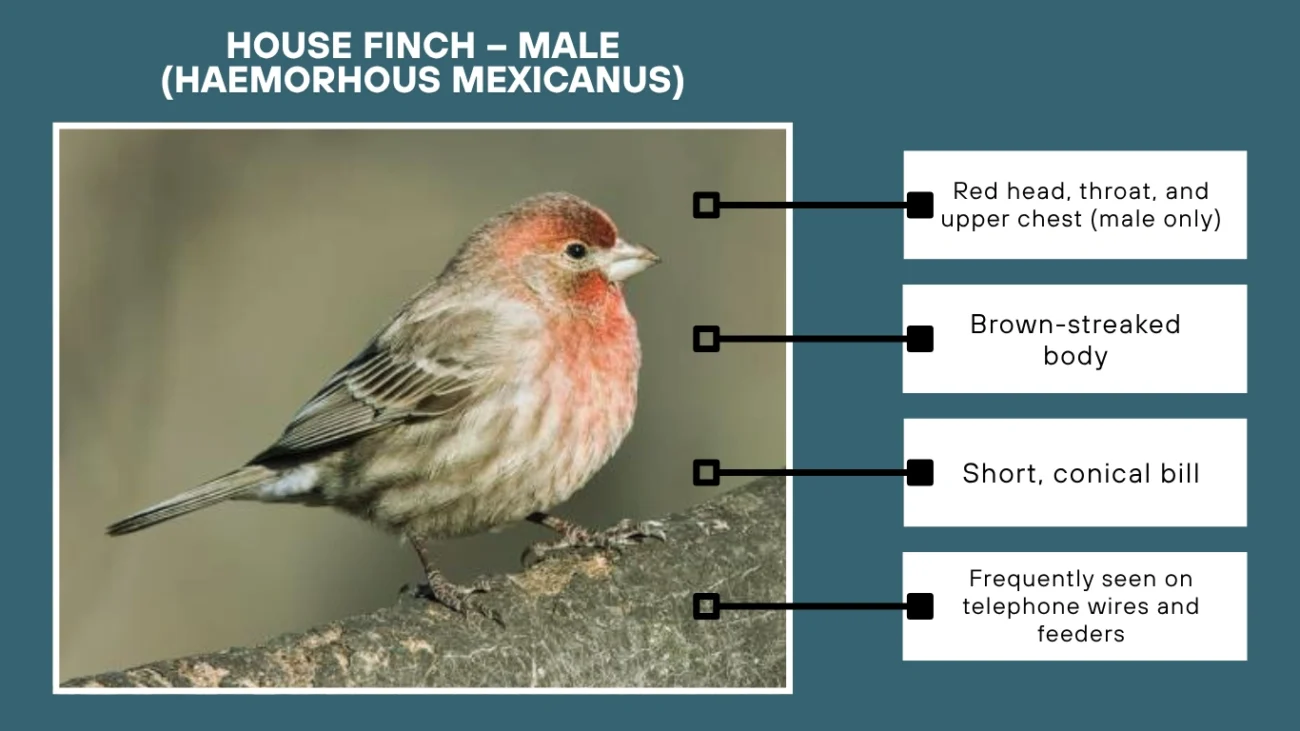
The male House Finch is an introduced species in Hawaii that displays a red head and throat, though the intensity of red can vary. Common in both urban and rural areas, it has adapted well to the Hawaiian Islands and is frequently seen at bird feeders.
Appearance
The male shows streaked brown plumage with red coloring on the head, throat, and chest. The female, by contrast, lacks red and is plain brown and streaked.
Habitat
House Finches inhabit urban gardens, coastal shrublands, parks, and forest edges. They thrive in both dry and mesic environments and are widespread across all major Hawaiian Islands.
Behavior
These social birds are often seen in flocks, especially around food sources. Males sing cheerful warbling songs, especially in the early morning.
Identification
- Red head, throat, and upper chest (male only)
- Brown-streaked body
- Short, conical bill
- Frequently seen on telephone wires and feeders
- Females are brown with no red
- Variable red shades—some individuals may appear orange or yellowish
6. Yellow-billed Cardinal (Paroaria capitata)
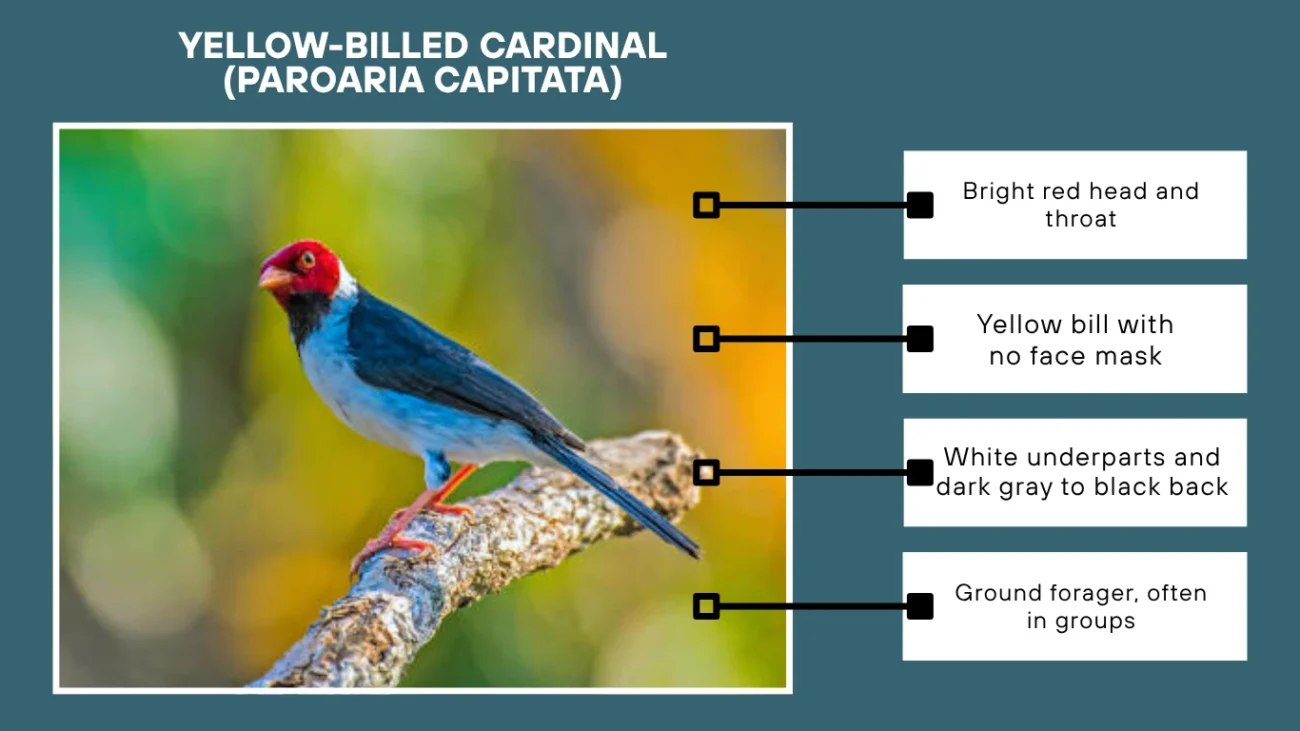
The Yellow-billed Cardinal, like its red-crested cousin, is a South American species introduced to Hawaii. It is now established in many parts of the Big Island and is admired for its vivid red face and striking coloration.
Appearance
This bird has a bold red head, white chest and belly, and black back. Its most unique feature is the bright yellow bill, which contrasts with the red facial plumage.
Habitat
It prefers lowland open areas near water sources, such as riverbanks, gardens, and parks. It is commonly seen on the Big Island, especially around Hilo and Kona.
Behavior
Often seen in small flocks, Yellow-billed Cardinals are ground feeders and can be quite bold around humans. They are frequently spotted bathing in shallow water and hopping around open lawns.
Identification
- Bright red head and throat
- Yellow bill with no face mask
- White underparts and dark gray to black back
- Ground forager, often in groups
- Lacks crest seen in Red-crested Cardinal
- Common near freshwater areas
7. Red Avadavat (Amandava amandava)
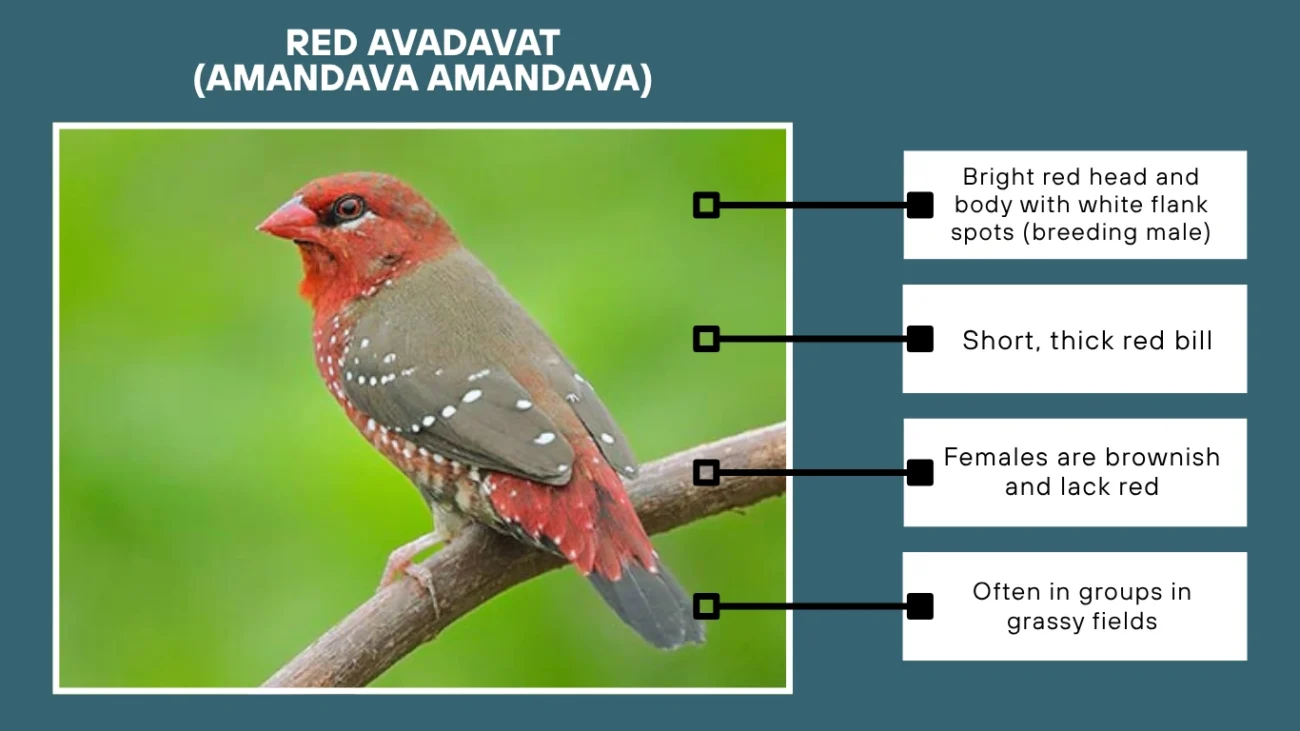
Also known as the Strawberry Finch, the Red Avadavat is a small, colorful finch introduced to Hawaii. Males exhibit a bright red head and body during the breeding season, making them one of the most vividly colored finches seen in grassy areas.
Appearance
The breeding male has a deep red head, chest, and body with white spots scattered across the flanks. Outside of breeding, both males and females appear duller with brown plumage.
Habitat
Prefers grasslands, sugarcane fields, and agricultural lands in lowland Hawaii. It is often found in open country with access to water and cover.
Behavior
These finches are social and usually found in flocks. They forage on the ground for seeds and small insects, often making short, quick flights between cover.
Identification
- Bright red head and body with white flank spots (breeding male)
- Short, thick red bill
- Females are brownish and lack red
- Often in groups in grassy fields
- Tiny size, fast fliers
- Red coloration fades outside breeding season
8. Saffron Finch (Sicalis flaveola)
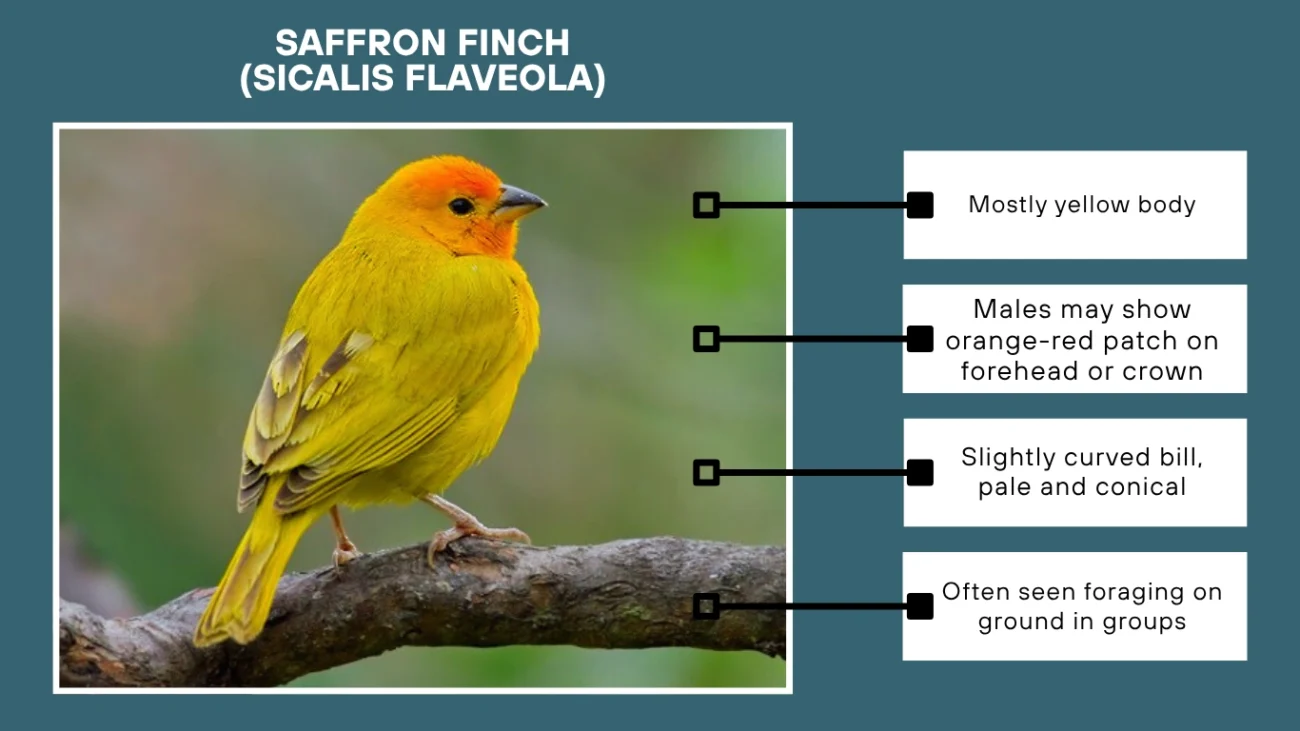
Though primarily yellow, some male Saffron Finches in Hawaii display reddish-orange coloring on the crown or forehead. This South American species has adapted to the Hawaiian environment and is frequently seen in open, grassy areas across the islands.
Appearance
The bird is mostly bright yellow with olive tones on the back. Males may show a reddish-orange patch on the head, especially on the crown or forehead, adding to their striking look.
Habitat
Saffron Finches are commonly found in open fields, lawns, parks, and roadsides. They are especially abundant in the leeward regions of the Big Island and Oahu.
Behavior
These finches are social and ground-feeding, often seen in loose flocks. They sing from open perches and are active during most of the day, especially in the early morning.
Identification
- Mostly yellow body
- Males may show orange-red patch on forehead or crown
- Slightly curved bill, pale and conical
- Often seen foraging on ground in groups
- Slightly larger than house finch
- Frequently perches on fences, wires, or shrubs
9. Red-headed Quelea (Quelea erythrops)
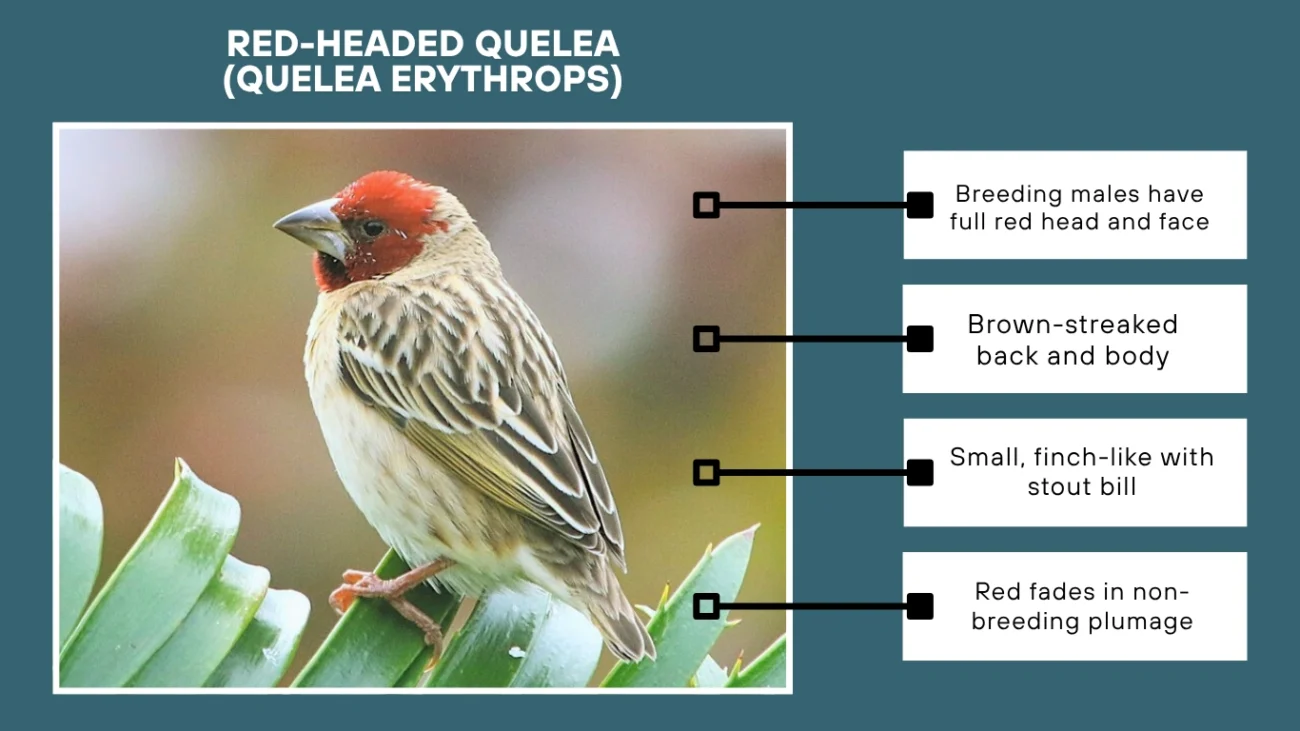
The Red-headed Quelea is a small, red-faced weaver finch sometimes seen in Hawaii as escapees or rare introductions. Although not widespread, it’s occasionally spotted near aviaries or suburban areas.
Appearance
This bird is small with a mostly brown, streaked body and a bold red head and mask in breeding males. Non-breeding individuals have less vivid coloring.
Habitat
Primarily seen in grasslands and agricultural fields when present, though rare in the wild in Hawaii. Most sightings occur near residential or aviary escape areas.
Behavior
It typically forms flocks and forages for seeds on the ground. Their social nature makes them conspicuous when moving in groups.
Identification
- Breeding males have full red head and face
- Brown-streaked back and body
- Small, finch-like with stout bill
- Red fades in non-breeding plumage
- Sometimes confused with Red Avadavat
- Uncommon in the wild; may be seen near aviaries
10. Red Bishop – Southern Red Bishop (Euplectes orix)
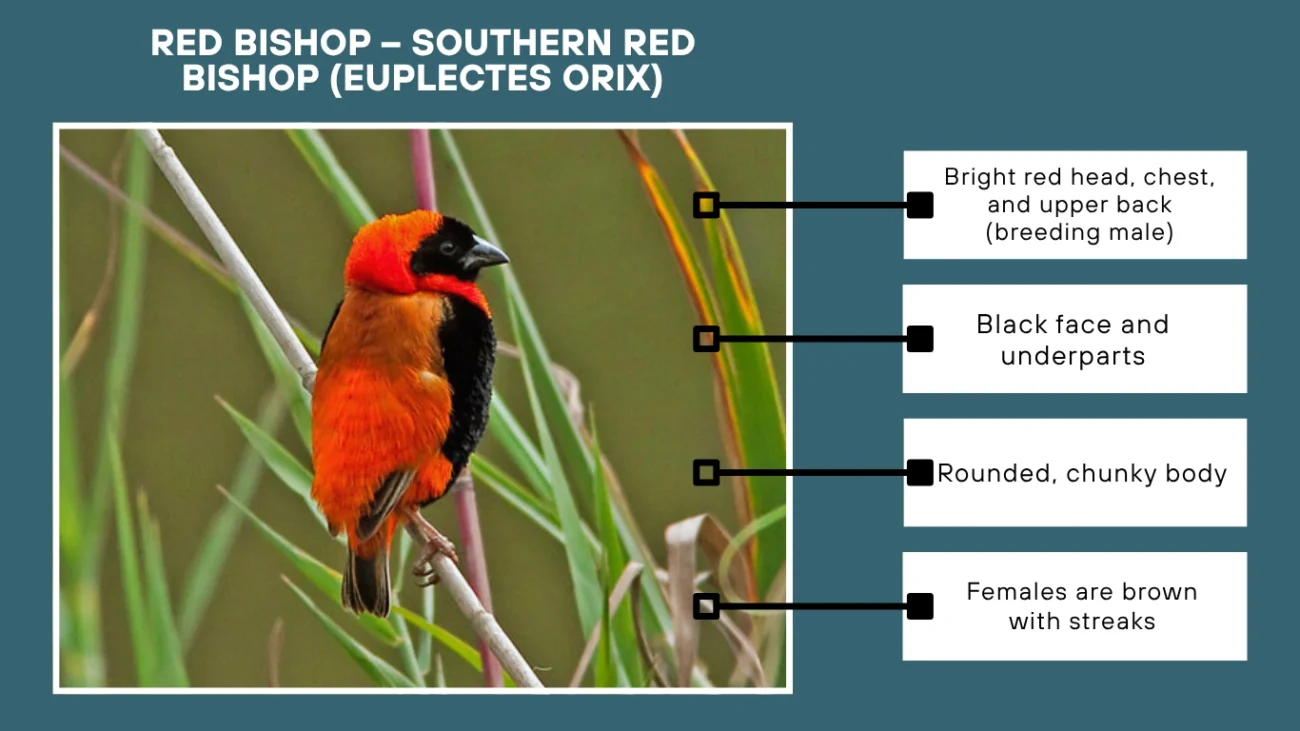
The Southern Red Bishop is a vibrant weaver species occasionally seen in Hawaii due to introductions or escapes. Breeding males have a brilliant red head and chest, contrasting with black on the face and body.
Appearance
The male displays a fiery red crown, head, and chest with black on the face and belly. The non-breeding plumage is dull brown. Females and juveniles are streaky and nondescript.
Habitat
When present, they are found in grasslands, wetland edges, and agricultural fields. Mostly seen on Oahu and the Big Island in limited numbers.
Behavior
Males are known for their fluttering display flights during the breeding season. They are social birds and forage on grass seeds, usually in flocks.
Identification
- Bright red head, chest, and upper back (breeding male)
- Black face and underparts
- Rounded, chunky body
- Females are brown with streaks
- Red coloration is seasonal
- Rarely seen but can occur near grasslands or sugarcane fields
11. Red Lory (Eos bornea)

The Red Lory is a brilliantly colored parrot native to Indonesia but occasionally seen in Hawaii as escaped or feral individuals. While not a widespread wild species, sightings are most common in urban or suburban areas where escaped pets adapt to local environments.
Appearance
This lory is almost entirely crimson red, including the head, with small patches of blue or violet on the wings and tail. It has a strong, curved orange bill and bright orange eyes.
Habitat
When present in Hawaii, Red Lories are seen in suburban areas, gardens, and near flowering trees. They prefer areas where nectar-rich blossoms are available, such as hibiscus and eucalyptus trees.
Behavior
Red Lories are energetic, vocal, and acrobatic. They climb with ease and often hang upside down while feeding. Escaped individuals may join flocks of other parrots or forage alone.
Identification
- Entire head and body a deep red
- Orange curved beak
- Small patches of blue on wings and thighs
- Loud screeching calls
- Frequently seen near flowering trees
- Escaped or feral—rare but locally noticeable
12. Crimson Rosella (Platycercus elegans)
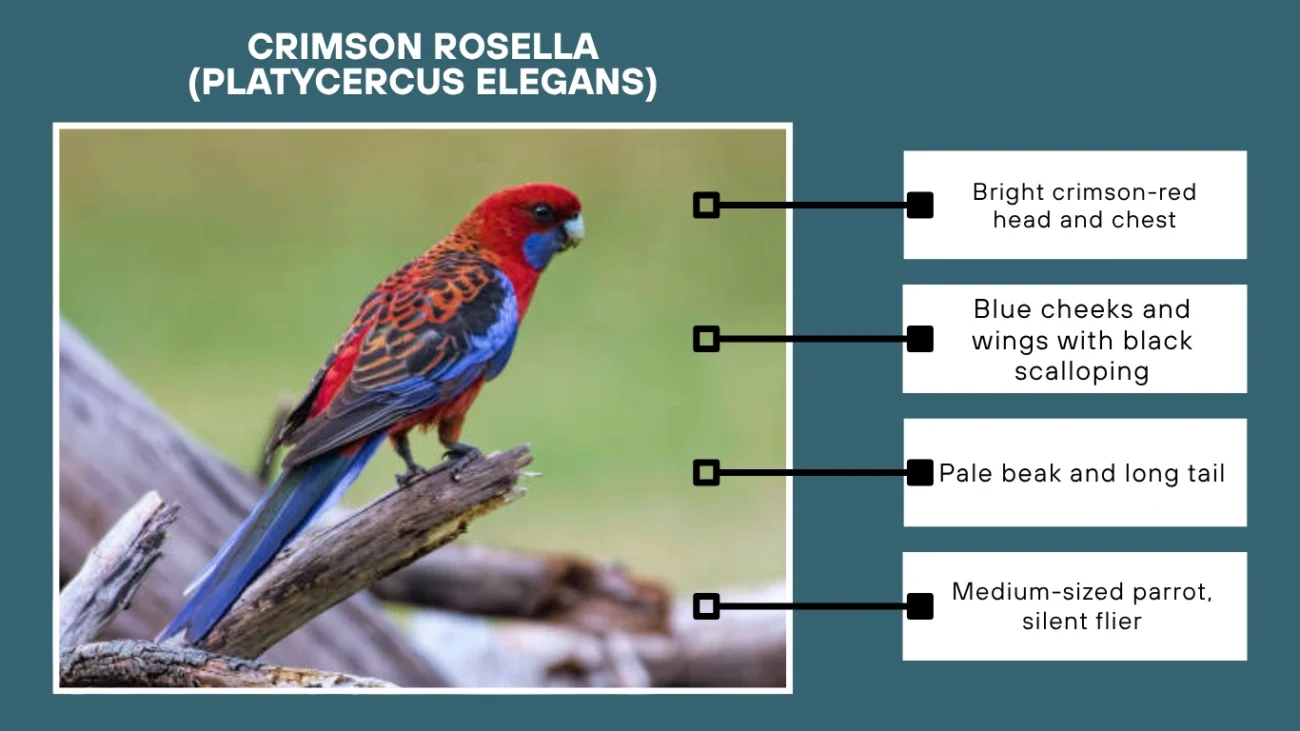
The Crimson Rosella is an Australian parrot species occasionally seen in Hawaii as an escaped pet. Though not naturally established, individual birds with striking red heads have been reported in urban areas.
Appearance
This parrot has a vivid red head, chest, and belly, with deep blue cheeks and black-edged blue on the wings and tail. It is medium-sized with a pale curved beak.
Habitat
In Hawaii, sightings typically occur in suburban gardens, forested parks, or near aviaries. The bird tends to stay close to flowering trees or fruiting shrubs when in the wild.
Behavior
Crimson Rosellas are calm and quiet compared to other parrots. They often perch still in tree canopies, feeding on fruits, seeds, and nectar. Escaped individuals are usually solitary or in pairs.
Identification
- Bright crimson-red head and chest
- Blue cheeks and wings with black scalloping
- Pale beak and long tail
- Medium-sized parrot, silent flier
- Escaped pet bird—uncommon in the wild
- May approach feeders with fruit or seed
13. Red-masked Parakeet (Psittacara erythrogenys)
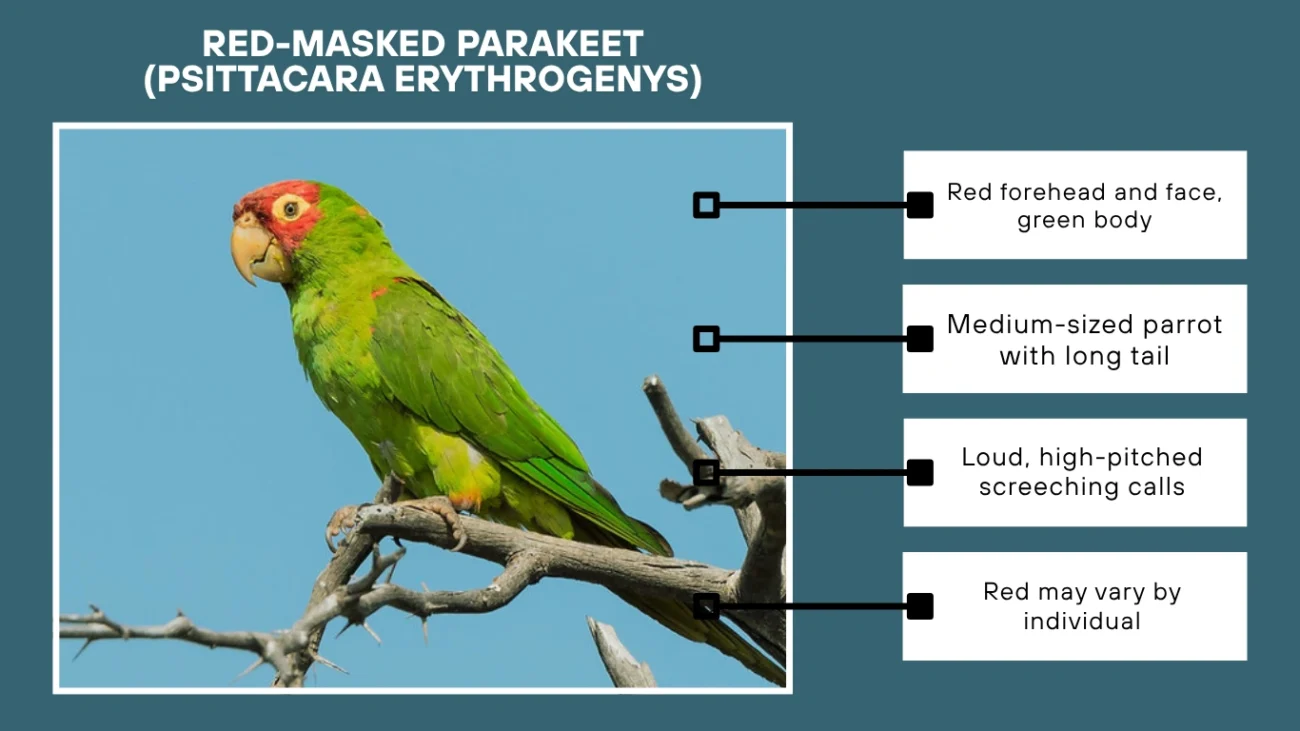
Also known as the Mitred Conure, the Red-masked Parakeet is an introduced parrot species with established feral populations in Hawaii, particularly on Oahu. It’s one of the few red-headed parrots commonly seen flying in noisy flocks.
Appearance
This bird has a bright green body with a distinct red face and forehead, sometimes extending around the eyes. Some individuals have additional red blotches on the chest and wings.
Habitat
Feral flocks are often seen in urban parks, botanical gardens, and residential neighborhoods with tall trees. They roost communally and favor areas with abundant fruits or flowers.
Behavior
Highly social and noisy, these parakeets travel in flocks and are most active in the early morning and late afternoon. They feed on fruits, flowers, and seeds.
Identification
- Red forehead and face, green body
- Medium-sized parrot with long tail
- Loud, high-pitched screeching calls
- Red may vary by individual
- Often seen in flocks flying between trees
- Commonly spotted on Oahu in the wild
14. Rose-faced Lovebird (Agapornis roseicollis)
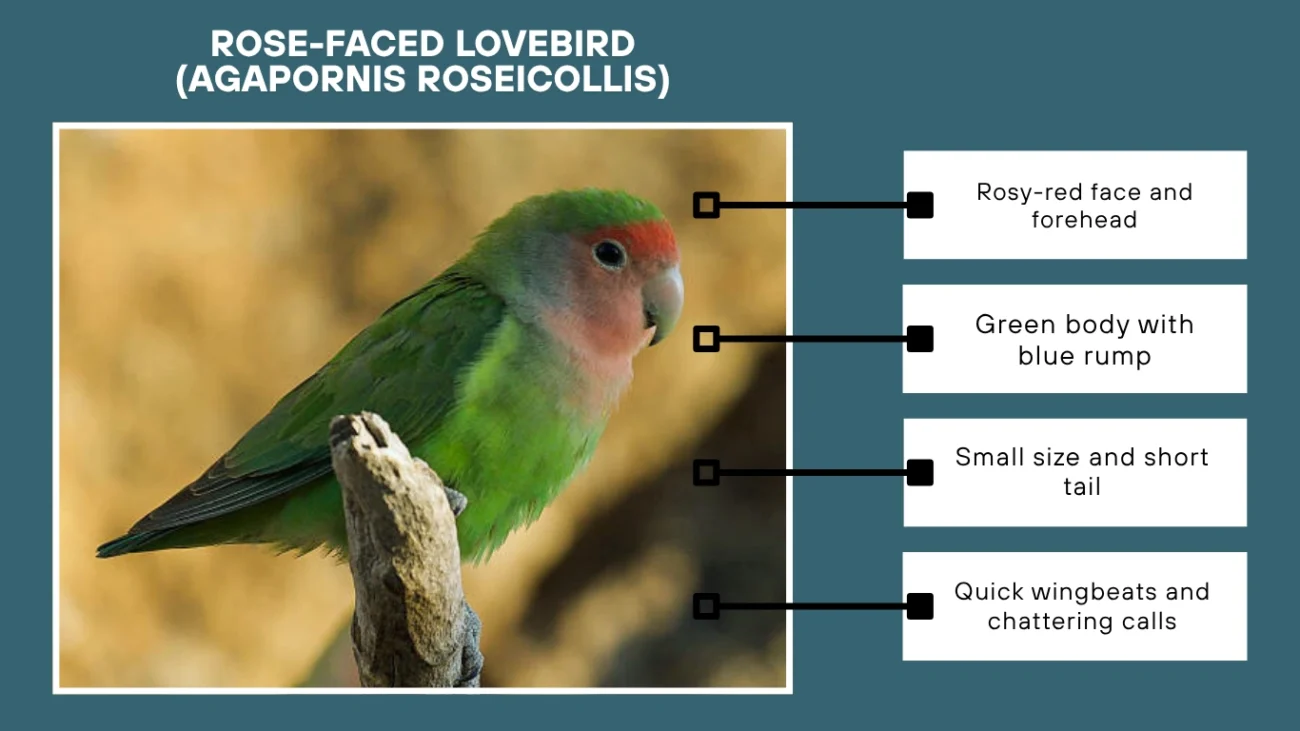
The Rose-faced Lovebird, also called the Peach-faced Lovebird, is a small, brightly colored parrot native to southwestern Africa but seen in Hawaii as an escaped pet. While not widespread, individuals have been reported around urban gardens and aviaries.
Appearance
This lovebird has a green body with a rosy-pink face and forehead, giving it the red-headed appearance. The intensity of red can vary, blending into orange or peach.
Habitat
Escapees are occasionally seen in residential neighborhoods, parks, or gardens—particularly where fruit trees and flowers are available. No stable wild populations are known, but individuals may survive short-term in the wild.
Behavior
Lovebirds are social, noisy, and curious. They often perch in pairs or small groups, foraging for seeds, fruits, and flowers.
Identification
- Rosy-red face and forehead
- Green body with blue rump
- Small size and short tail
- Quick wingbeats and chattering calls
- Often seen in pairs
- Escaped cage birds, not naturally established
15. Red-faced Parrotfinch (Erythrura psittacea)

Occasionally seen in Hawaii as an escaped cage bird, the Red-faced Parrotfinch is native to the South Pacific. Its striking red face and forehead distinguish it from other green-bodied finches.
Appearance
The bird has a mostly green body with a vivid red face, throat, and forehead. Some individuals may have red extending onto the crown. The bill is short and conical.
Habitat
Sightings occur near aviaries, gardens, or dense vegetation where food is available. They are not commonly seen in the wild but may survive temporarily after escape.
Behavior
These parrotfinches are shy and usually feed quietly in low shrubs or grasses. They prefer cover and are less likely to appear in open areas.
Identification
- Bright red face and forehead
- Green body and short tail
- Small, thick bill
- Often silent or with soft chirps
- Rare in the wild; escapee from captivity
- Forages close to ground in thick vegetation
16. Red-headed Gouldian Finch (Erythrura gouldiae)
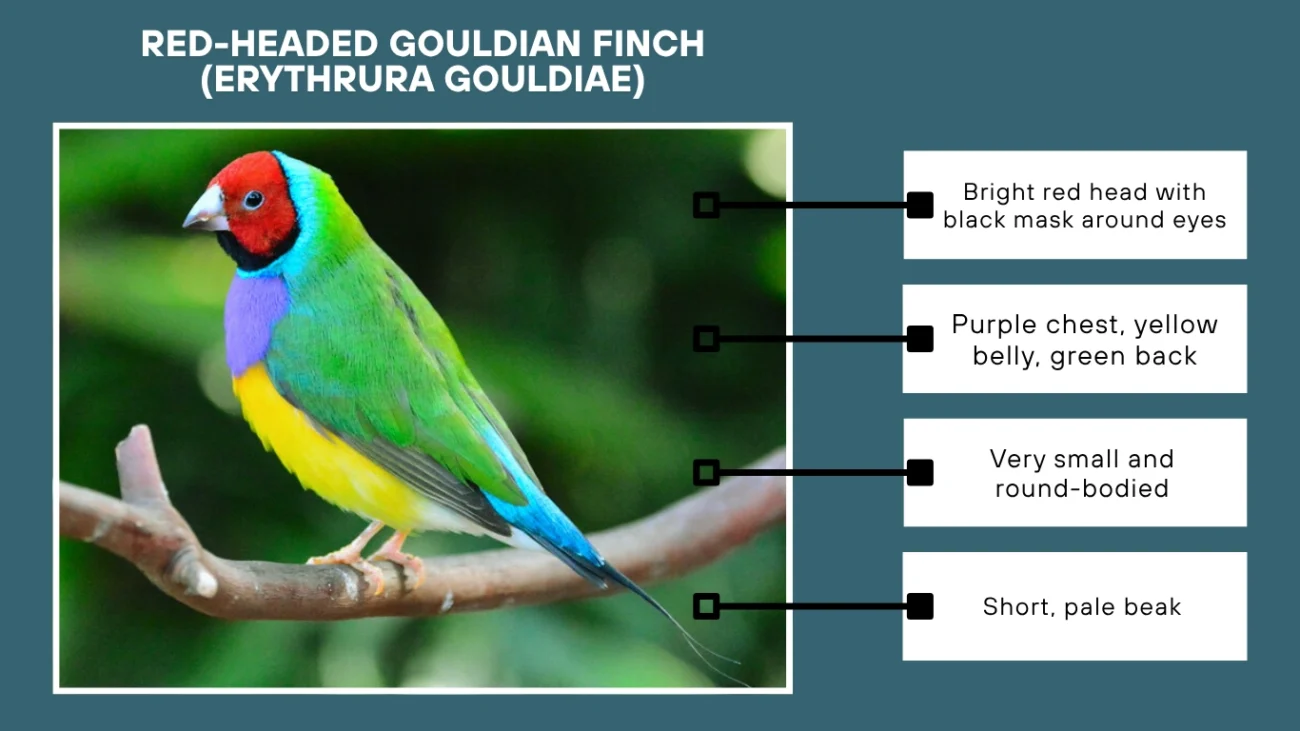
The Red-headed Gouldian Finch is a colorful Australian finch occasionally seen in Hawaii due to escaped pets. Its red-headed morph is the most common variant and is easily recognized by its vibrant face.
Appearance
This small finch features a brilliant red head, with a mix of purple chest, yellow belly, and green back. Other morphs include black-headed and orange-headed variants, but the red-headed one is most popular in captivity.
Habitat
While not established in the wild, sightings occur in suburban areas, near aviaries, or around well-vegetated yards. The finch’s survival in the wild depends on climate and food access.
Behavior
They are peaceful and sociable, often seen feeding quietly or resting on perches. Red-headed Gouldians prefer to stay near cover and are easily startled.
Identification
- Bright red head with black mask around eyes
- Purple chest, yellow belly, green back
- Very small and round-bodied
- Short, pale beak
- Extremely colorful and rare in the wild
- Typically seen near aviary escapes or backyard gardens
17. Chattering Lory (Lorius garrulus)
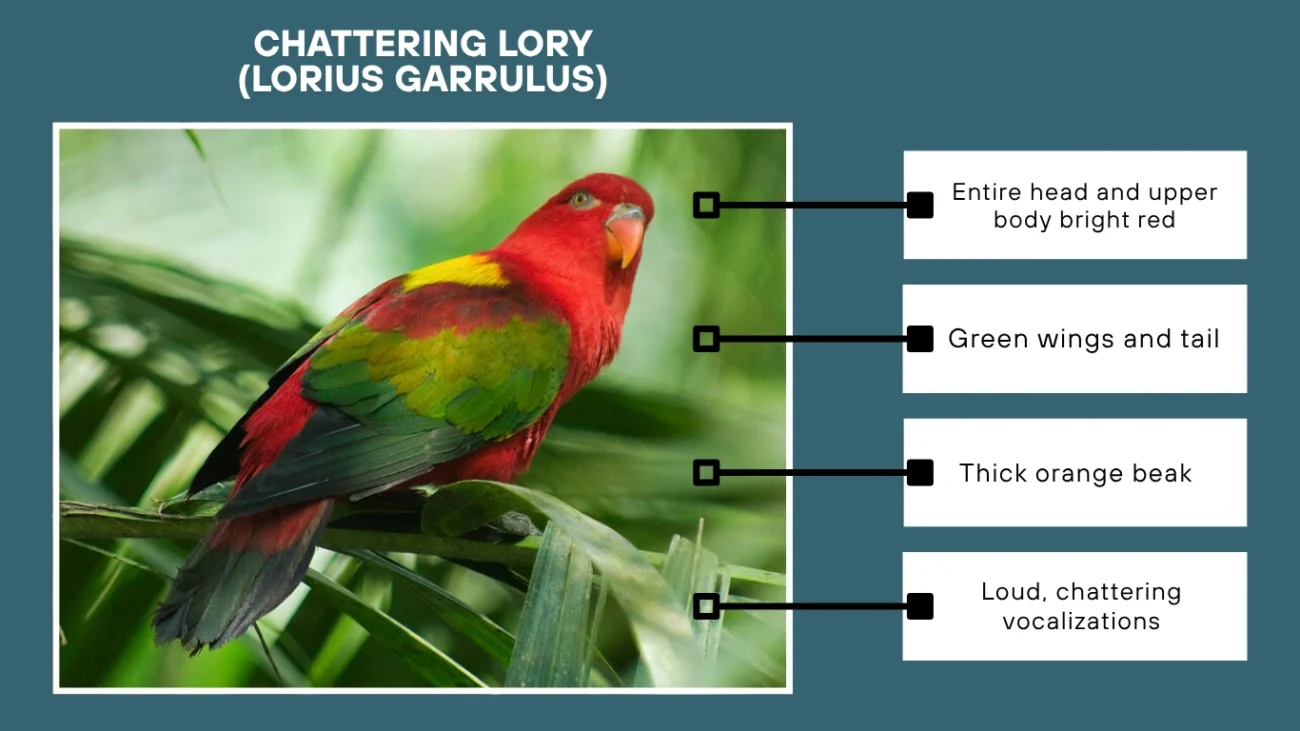
The Chattering Lory is a vibrant, red-headed parrot native to Indonesia, sometimes spotted in Hawaii as an escaped cage bird. Though not established in the wild, its loud calls and bold colors make it hard to miss when seen.
Appearance
This medium-sized parrot is predominantly bright red, including the head, with green wings and a yellow-orange beak. Some individuals also show yellow on the thighs or shoulders depending on subspecies.
Habitat
Occasional sightings occur in suburban areas with flowering trees or near aviaries. The species is not known to be established in Hawaii but can survive for short periods after escaping.
Behavior
Chattering Lories are known for their high-pitched screeches and playful behavior. They are acrobatic climbers and often seen hanging upside down to reach flowers or fruit.
Identification
- Entire head and upper body bright red
- Green wings and tail
- Thick orange beak
- Loud, chattering vocalizations
- Active and playful when seen
- Rare escapee in residential areas
18. Papuan Lorikeet (Charmosyna papou)

The Papuan Lorikeet is a striking, long-tailed parrot occasionally seen in Hawaii due to exotic bird trade escapes. While not naturally found in the islands, sightings have been recorded in urban areas.
Appearance
This lorikeet has a glossy crimson-red head and body, often with black or dark blue markings on the chest and back. The tail is long and graduated, giving it a unique silhouette in flight.
Habitat
Seen near homes with exotic bird collections or in urban neighborhoods. It prefers areas with flowering trees but is not part of Hawaii’s established bird populations.
Behavior
Active and vocal, this lorikeet feeds primarily on nectar and fruit. It may appear in trees with hibiscus or eucalyptus and is highly agile in flight.
Identification
- Deep red head and body with black accents
- Long, tapering tail
- Bright orange beak
- Unmistakable color contrast and elegant shape
- Escaped pet, not breeding in the wild
- Often solo or paired near flowering trees
19. Red-fronted Lorikeet (Charmosynopsis rubronotata)
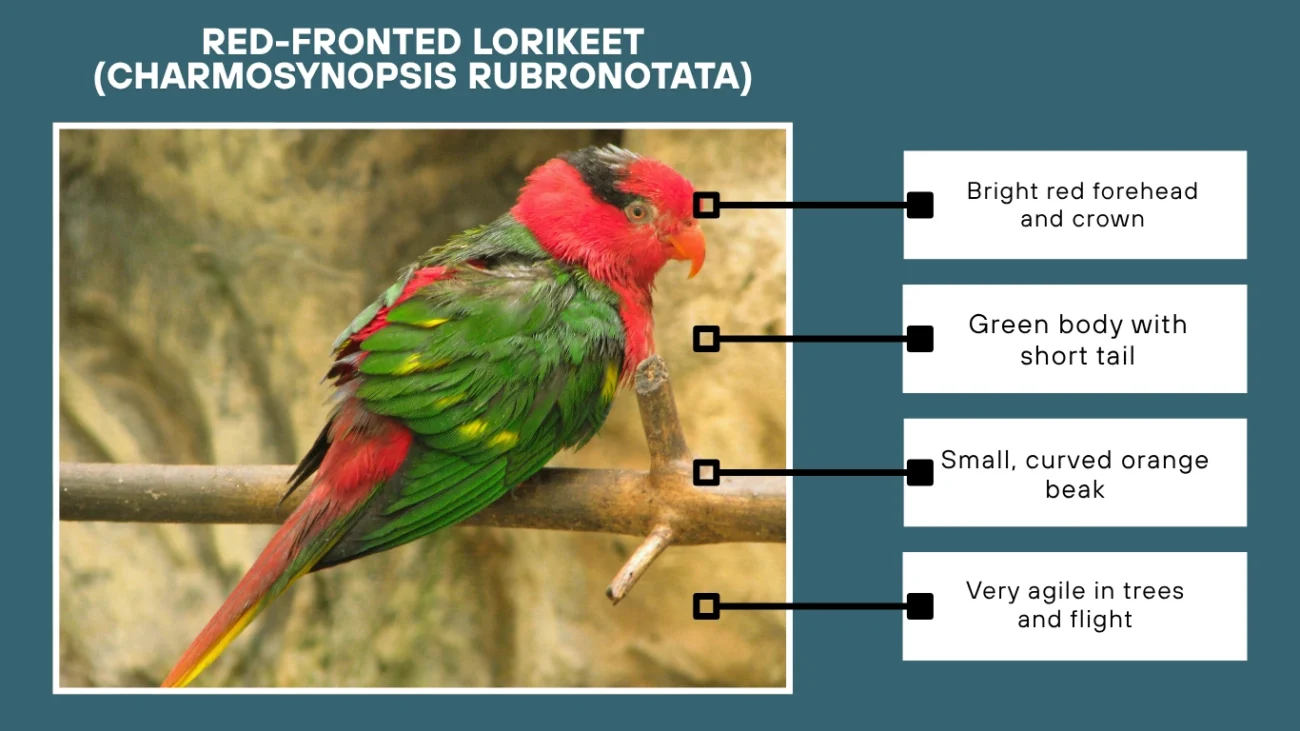
Another exotic parrot occasionally observed as an escapee in Hawaii, the Red-fronted Lorikeet features a vivid red patch on its head. Though rare, it may appear in the wild short-term after escaping captivity.
Appearance
Small and predominantly green, this lorikeet has a bright red forehead and face patch. The rest of the body is green with occasional red or yellow markings depending on the sex and subspecies.
Habitat
May be spotted near gardens, flowering trees, or aviary-adjacent areas. It’s not established in Hawaii, and wild sightings are sporadic.
Behavior
Feeds on nectar and fruits. Often energetic and quick-flying, it may be mistaken for other small parrots unless viewed up close.
Identification
- Bright red forehead and crown
- Green body with short tail
- Small, curved orange beak
- Very agile in trees and flight
- Escapee species, not naturally breeding
- Prefers flowering trees like hibiscus or bottlebrush