










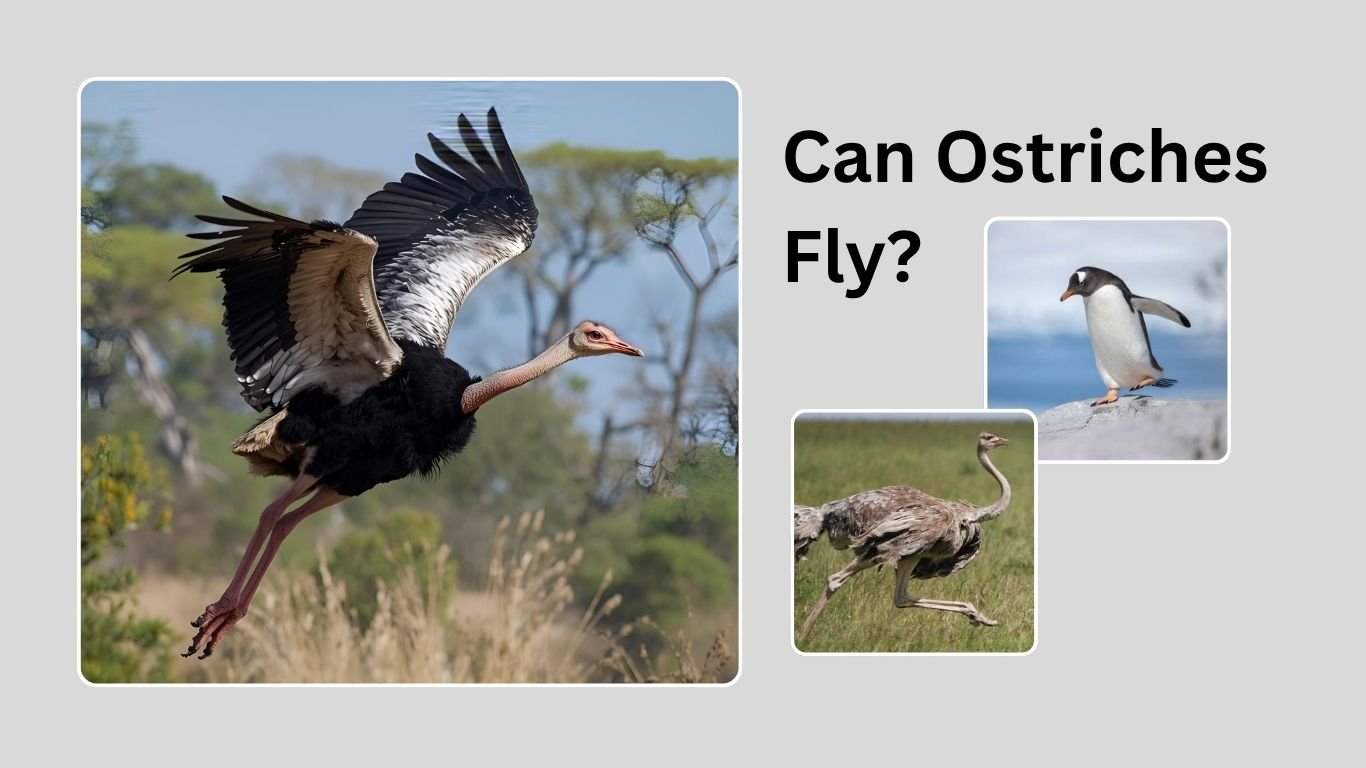
Ostriches are often admired for their tall stature, long legs, and graceful feathers, but one question continues to puzzle many people: can they fly? The simple answer is no — ostriches cannot fly. However, their inability to soar through the skies doesn’t make them any less extraordinary. Over millions of years, ostriches have evolved powerful bodies, incredible speed, and remarkable survival skills that make them true masters of the land rather than the air.
Can Ostriches Fly? The Short Answer
Ostriches belong to a group of birds known as ratites — large, flightless species that also include emus, rheas, and kiwis. These birds share several features that prevent them from flying, such as a flat breastbone and small wings relative to their massive bodies. Instead of taking flight, ostriches rely on running to escape danger and cover great distances across the African plains.
Despite having large feathers and wings that might suggest flight capability, these appendages serve entirely different purposes. Rather than generating lift, ostrich wings are used for balance, communication, and shade — traits that make them perfectly suited to life on the ground.
Why Ostriches Can’t Fly
Body Size and Wing Limitations
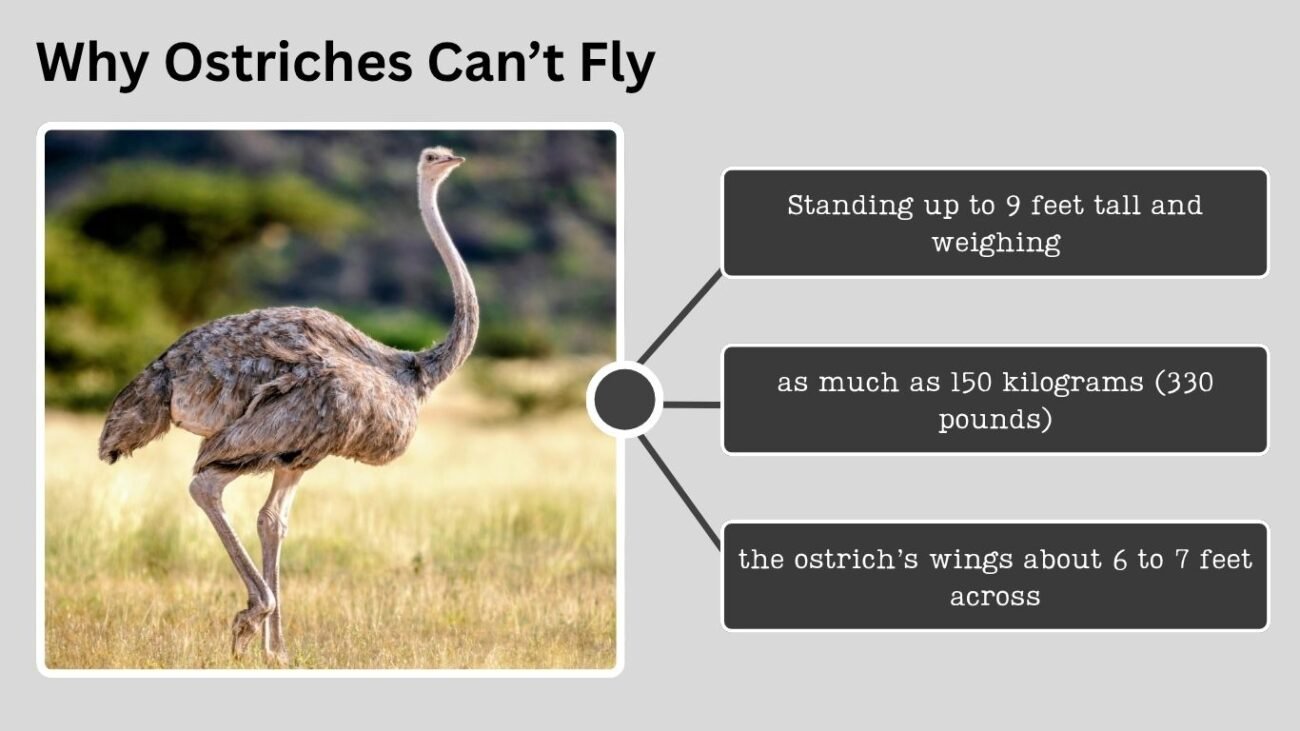
The most obvious reason ostriches can’t fly is their size. Standing up to 9 feet tall and weighing as much as 150 kilograms (330 pounds), they are simply too heavy for their wings to support. A bird’s ability to fly depends on the ratio between its body mass and wing surface area. In the case of ostriches, this ratio is far too high.
While an eagle’s wingspan may be longer than its body, allowing it to glide and soar effortlessly, the ostrich’s wings — about 6 to 7 feet across — are proportionally small. Even with strong flapping muscles, these wings could never produce enough lift to overcome gravity. Evolution instead favored longer, muscular legs, enabling ostriches to sprint rather than soar.
Skeletal and Muscle Structure
Another reason ostriches can’t fly lies in their bone structure. Flying birds have a keel-shaped breastbone, where powerful pectoral muscles attach to create the force needed for flight. Ostriches, however, have a flat breastbone, offering no such anchor point. Their bones are also denser than those of flying birds, adding weight and stability for running but eliminating the lightweight advantage needed for takeoff.
Instead of flight muscles, ostriches have extremely strong thigh and leg muscles, accounting for most of their body mass. These muscles give them explosive running power, allowing them to reach speeds of 43 miles per hour (70 km/h) — faster than most predators and even some vehicles.
Evolutionary Background
From Flying Ancestors to Ground Runners
Millions of years ago, the ancestors of modern ostriches were smaller and capable of flight. As climates and habitats changed, particularly across Africa, some birds began to adapt to open, grassy environments. With fewer trees and an abundance of land predators, speed and endurance became more valuable than flying ability. Over time, these birds evolved heavier bodies and longer legs, while their wings and chest muscles gradually reduced in size.
This process created the ratite family — a lineage of large, flightless birds adapted for ground living. Ostriches emerged as the largest and most powerful members of this group, using running as their primary means of survival rather than flight.
Flightless Bird Family (Ratites)
Ostriches share their flightless nature with several other birds worldwide. The emu from Australia, cassowary from New Guinea, rhea from South America, and kiwi from New Zealand all belong to the same evolutionary family. Despite living on different continents, these birds evolved similarly after their ancient ancestors spread across prehistoric landmasses.
What’s fascinating is that flightlessness developed as an adaptive advantage. In regions with few natural predators or open terrain, flying became unnecessary. Energy that would have been used for flight evolved instead into traits like stronger legs, better endurance, and greater reproductive success.
How Ostriches Adapt Without Flight
Built for Speed
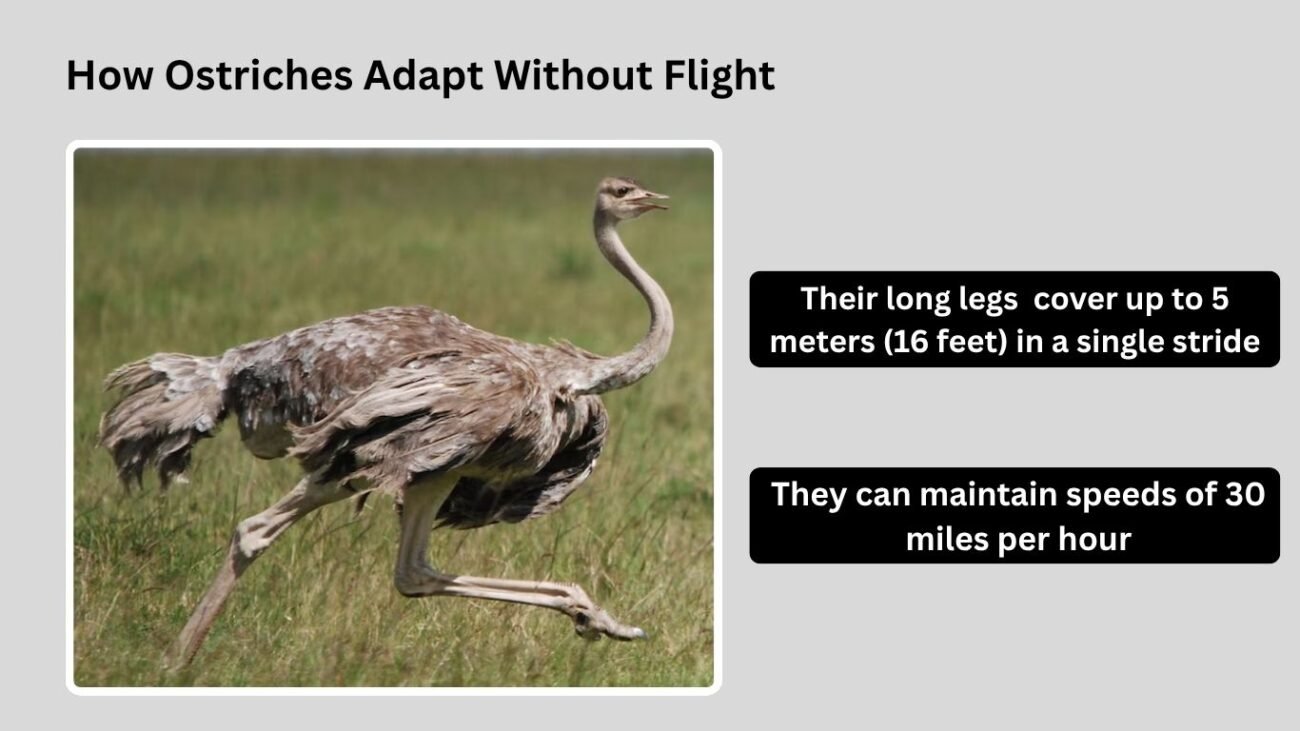
Although ostriches can’t fly, they are extraordinary runners. Their long, muscular legs and spring-like tendons allow them to cover up to 5 meters (16 feet) in a single stride. They can maintain speeds of 30 miles per hour for several minutes and sprint at 43 mph when escaping predators. This makes them the fastest two-legged animals on Earth.
Each foot has only two toes — unlike most birds, which have four — reducing drag and improving balance. The larger toe acts like a hoof, helping grip the ground during high-speed chases. Their agility and coordination make running their main survival mechanism, replacing what flying birds achieve through flight.
Defense and Survival Tactics
Ostriches are not defenseless despite being flightless. When cornered, they use their powerful legs to deliver kicks strong enough to injure or kill predators like lions or hyenas. Their long necks and large eyes — each about 2 inches across — provide excellent visibility over long distances. This heightened awareness allows them to spot threats early and react swiftly.
In addition, their plumage plays a role in camouflage. Females have grayish-brown feathers that blend with dry grass, while males sport bold black-and-white feathers used in courtship displays. Their wings, though not functional for flight, are incredibly expressive tools for communication and balance.
Why Do Ostriches Have Wings If They Can’t Fly?
It may seem strange that ostriches still have large, feathered wings despite being flightless, but nature rarely wastes a good feature. Ostrich wings play vital roles in balance, courtship, and temperature regulation—functions that help them thrive in open, sun-soaked environments.
Balance While Running
At high speeds, an ostrich’s wings act like rudders. By spreading or tilting their wings, they can change direction quickly while maintaining stability. This ability helps them zigzag across the savanna, outmaneuvering predators such as cheetahs. The wings also serve as stabilizers during sharp turns, keeping the bird upright even at full sprint.
Courtship and Display
During mating season, male ostriches use their wings to perform elaborate courtship dances. They spread their feathers wide, bow, and sway to impress potential mates. The contrasting black-and-white plumage of males creates a visual spectacle that signals strength and health. Females also use wing movements to communicate acceptance or rejection during these rituals.
Thermal Regulation
In the heat of the African plains, ostriches rely on their wings for shade and cooling. They spread them wide to block the sun or fan air across their bodies to regulate temperature. Parents often shade their chicks beneath their wings, protecting them from extreme sunlight and sudden cold nights.
Flightless Bird Comparison
Ostrich vs Emu
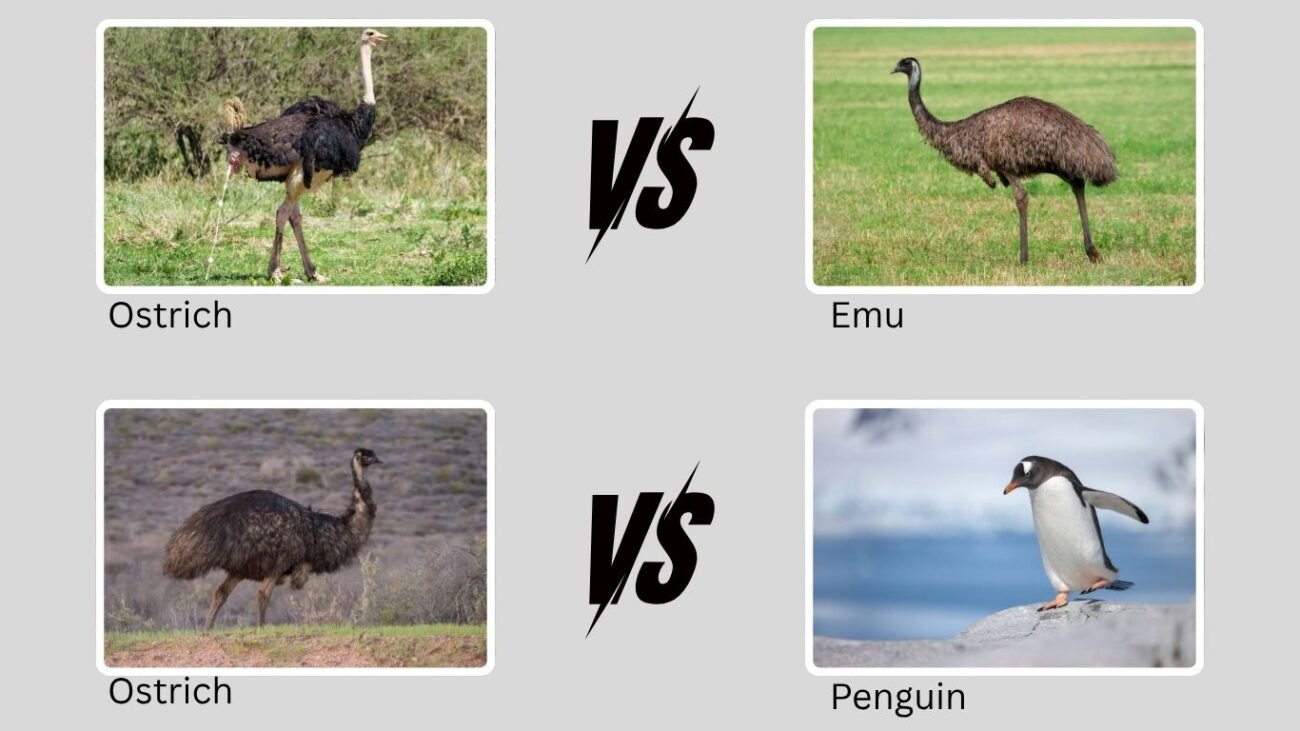
The ostrich and emu are often compared, and for good reason—they share a common ancestor. However, the ostrich is taller, heavier, and faster than the emu. Ostriches can sprint up to 70 km/h, while emus reach around 50 km/h. Both are adapted for running, but the ostrich’s longer stride and two-toed feet give it superior speed.
Another difference lies in behavior and environment. Ostriches live in Africa’s open grasslands, while emus inhabit Australia’s scrublands and forests. Emus have three toes, slightly smaller wings, and a fluffier feather texture for temperature control in cooler regions.
Ostrich vs Penguin and Kiwi
Penguins and ostriches are both flightless, but their adaptations serve opposite purposes. Penguins “fly” underwater, using their wings as flippers to propel themselves through the sea. Ostriches, by contrast, use their wings for balance and shade. Kiwis, on the other hand, have almost invisible wings and rely on their strong sense of smell to survive in dense forests.
All these birds belong to the ratite family, showcasing how evolution can shape similar traits in entirely different environments.
Common Myths and Curiosities
Can an Ostrich Ever Fly?
No — ostriches can’t fly under any natural circumstances. Their massive bodies, dense bones, and limited wing size make flight physically impossible. Even if an ostrich had stronger wings, its structure lacks the necessary keel bone and flight muscles to lift off. Evolution has fully committed ostriches to the ground, refining every feature for speed instead of air travel.
Can Baby Ostriches Fly?
No. Ostrich chicks are born flightless just like adults. They begin running within days of hatching, relying on camouflage and parental protection rather than wings. Their early running ability is crucial to survival in predator-rich environments.
Can a Turkey Fly Higher Than an Ostrich?
Technically, yes. Wild turkeys can fly short distances and reach heights of up to 100 feet in the air. Ostriches, however, cannot take off at all. This common question often appears in riddles and jokes, highlighting how unusual ostriches are among birds.
Can Ostriches and Emus Fly?
Neither species can fly. Both evolved strong legs and reduced wings as an adaptation to open habitats. However, ostriches remain faster, while emus are more endurance-based runners.
Anatomy and Physics of Flightlessness
Flying requires a balance between lightweight structure and powerful lift, but ostriches evolved in the opposite direction. Their bones are solid and dense, adding stability for running. The absence of a keel-shaped breastbone prevents the attachment of large flight muscles. Instead, most of their strength lies in their thighs, which provide ground propulsion rather than wing thrust.
Aerodynamically, the ostrich’s body mass-to-wing ratio makes flight impossible. To generate enough lift, an ostrich would need wings several times larger than its body, which would make running inefficient. Instead, natural selection favored the traits that allowed ostriches to escape on land rather than in the sky.
What Would Make Ostriches Able to Fly?
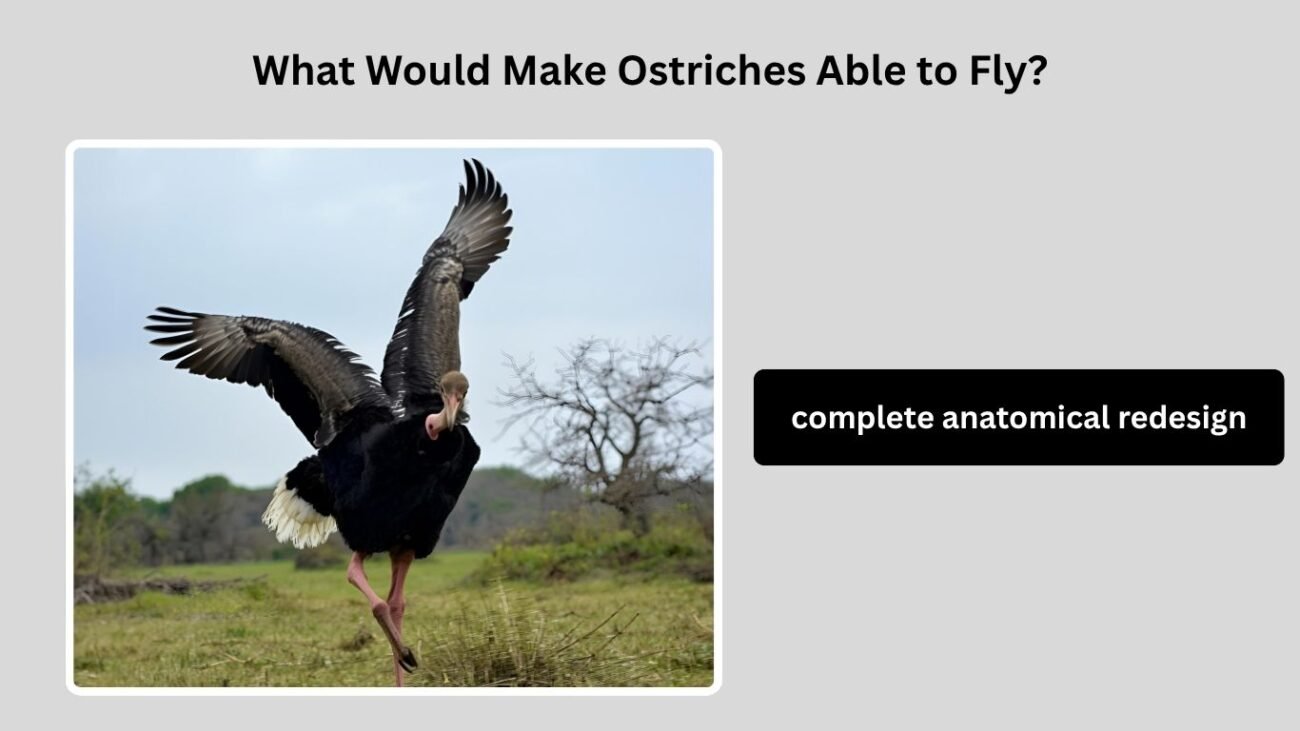
In theory, for ostriches to fly, they would need a complete anatomical redesign — lighter, hollow bones, larger wingspans, and stronger pectoral muscles. However, these adaptations would sacrifice their current advantages: speed, strength, and ground agility. Evolution shaped ostriches to dominate the ground, not the skies, so regaining flight is virtually impossible.
This trade-off showcases nature’s ingenuity — what they lost in flight, they gained in endurance, awareness, and survival power.
Ostrich Strengths Without Flight
Even without flight, ostriches are among the most capable birds in the animal kingdom.
- They are the tallest and heaviest living birds on Earth.
- Their eyesight rivals that of eagles, detecting movement miles away.
- Their kicks are strong enough to deter or kill predators.
- They can cover long distances efficiently, conserving energy in the hot desert climate.
Ostriches have adapted perfectly to life on the savanna, proving that flight isn’t the only measure of a bird’s success.
Fun Facts About Ostriches
- Each eye is about 2 inches wide, the largest of any land animal.
- Ostriches have three stomachs to help digest tough plants.
- A single stride can stretch over 16 feet (5 meters).
- Males roar like lions during courtship.
- Their eggs are the largest of any living bird and can weigh over 3 pounds.
FAQs
Can Ostriches Fly at All?
No. Their bodies are too heavy, and their wings are too small to generate lift. They are built for speed, not flight.
Why Do Ostriches Have Wings If They Can’t Fly?
Their wings help with balance, courtship displays, and temperature control. They use them like arms for running stability and communication.
Can Baby Ostriches Fly Later in Life?
No. Ostriches remain flightless from birth to adulthood. They are ground-adapted throughout their lives.
Can Penguins and Ostriches Fly?
Both are flightless, but penguins “fly” underwater while ostriches use their wings on land. Each evolved to dominate its own environment.
How Fast Can an Ostrich Run If It Can’t Fly?
Ostriches can run at speeds up to 43 miles per hour (70 km/h), using their speed and vision to escape predators with ease.


