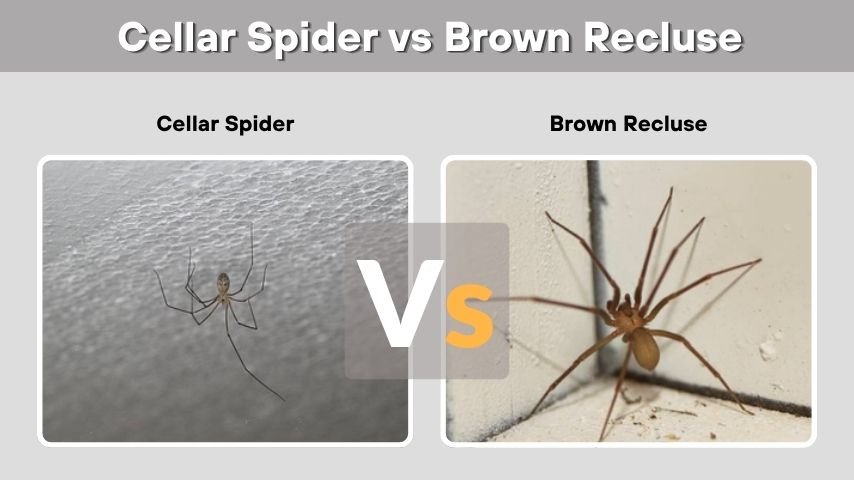
Cellar spider vs brown recluse identification can be confusing because both spiders may appear indoors, hide in quiet spaces, and look brownish at a quick glance. The easiest way to tell the difference is to compare leg length, body shape, markings, web behavior, and location. Cellar spiders have extremely long, delicate legs and messy webs, while brown recluse spiders are more compact, plain brown, and medically important.
Quick Answer: How to Tell the Difference
A cellar spider usually looks fragile, pale, and long-legged. Its legs are extremely thin and much longer than its body. It often hangs upside down in a messy web in basements, corners, garages, crawlspaces, or behind stored items.
A brown recluse looks more compact and solid. It has a tan to dark brown body, no stripes or bands on its legs, and may have a dark violin-shaped mark on the top front part of the body. It does not usually sit in open, messy corner webs like a cellar spider.
If you see a spider hanging in a loose, tangled web with very long threadlike legs, it is more likely a cellar spider. If you see a smooth, plain brown spider running or hiding in a box, shoe, closet, or garage, identification deserves more caution.
Cellar Spider vs Brown Recluse Comparison
The table below gives the fastest way to compare the two spiders. Do not rely on just one feature. A correct identification usually comes from combining body shape, legs, markings, web behavior, and location.
| Feature | Cellar Spider | Brown Recluse |
| Legs | Extremely long, thin, delicate legs | Long but more proportionate legs |
| Body shape | Small, fragile-looking body | Compact, smooth, oval body |
| Color | Pale tan, yellowish, grayish, or light brown | Tan, golden brown, or dark brown |
| Markings | May have a gray mark, but no true recluse violin pattern | Often has a dark fiddle or violin-shaped mark |
| Eyes | Usually not useful for casual ID | Six eyes in three pairs, but needs close magnification |
| Web | Messy, irregular cobwebs in corners | Does not make open corner webs |
| Common location | Basements, ceilings, crawlspaces, corners | Boxes, closets, garages, woodpiles, undisturbed storage |
| Bite concern | Not known as a health hazard | Bite can be medically significant |
Cellar Spider vs Brown Recluse Look at the Legs First
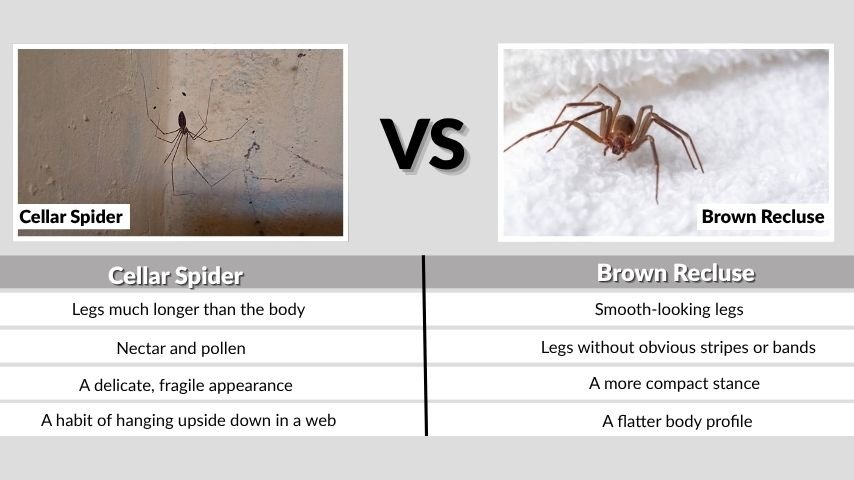
Leg length is one of the easiest clues. Cellar spiders are famous for their extremely long, thin legs. Their legs often look oversized compared with the small body. This is why many people call them “daddy longlegs,” although that nickname is also used for other animals.
Brown recluse spiders also have legs, of course, but their legs look more balanced with the body. They do not have the same delicate, threadlike, stretched-out appearance as a cellar spider.
Cellar Spider Leg Clues
A cellar spider often has:
- Very thin legs
- Legs much longer than the body
- A delicate, fragile appearance
- A habit of hanging upside down in a web
- A loose, shaky movement when disturbed
When disturbed, cellar spiders may vibrate rapidly in their webs. This shaking behavior can make them look blurry or hard to see.
Brown Recluse Leg Clues
A brown recluse usually has:
- Smooth-looking legs
- Legs without obvious stripes or bands
- A more compact stance
- A flatter body profile
- A quick hiding response
A key point is that brown recluse legs are generally plain. If the spider has strongly banded or striped legs, it is probably not a brown recluse.
Cellar Spider vs Brown Recluse Check the Body Shape and Size
Body shape is another helpful difference. Cellar spiders have small, narrow or rounded bodies with very long legs. They often look lightweight and almost transparent.
Brown recluse spiders look sturdier. Their body is usually plain brown and smoother. The body may be around 8 to 10 mm long, not counting the legs. They are not giant spiders, but they may look alarming because of their reputation.
Why Size Can Mislead You
Size alone is not enough. A cellar spider’s leg span can make it look large even though the body is small. A brown recluse may look smaller overall but more solid. Many harmless house spiders can also be brown, so size should be used with other clues.
When comparing cellar spider vs brown recluse, the body-to-leg ratio is more useful than total size. A tiny body with exaggerated legs points toward a cellar spider. A compact brown body with proportionate legs requires more careful checking.
Cellar Spider vs Brown Recluse Study the Markings Carefully
The violin-shaped mark is the feature most people associate with brown recluse spiders. It appears on the cephalothorax, which is the front body section behind the eyes. The “neck” of the violin points toward the abdomen.
However, the violin mark is not always easy to see. Lighting, angle, spider age, and color can make it unclear. Some non-recluse spiders may also have dark markings that people mistake for a violin.
Brown Recluse Marking Clues
A possible brown recluse may show:
- A dark violin or fiddle-shaped mark
- A plain brown abdomen
- Legs without stripes or bands
- Fine hairs rather than heavy spines
- A smooth, uniform look
The lack of markings is also important. Brown recluse spiders generally do not have striped legs or patterned abdomens. If the abdomen has obvious spots, stripes, or bold patterns, it is likely something else.
Cellar Spider Marking Clues
Cellar spiders may be pale tan, yellowish, grayish, or light brown. Some have a gray mark on the body, but they do not have the classic brown recluse look. Their long legs and web behavior are usually stronger clues than body markings.
Consider Where You Found the Spider
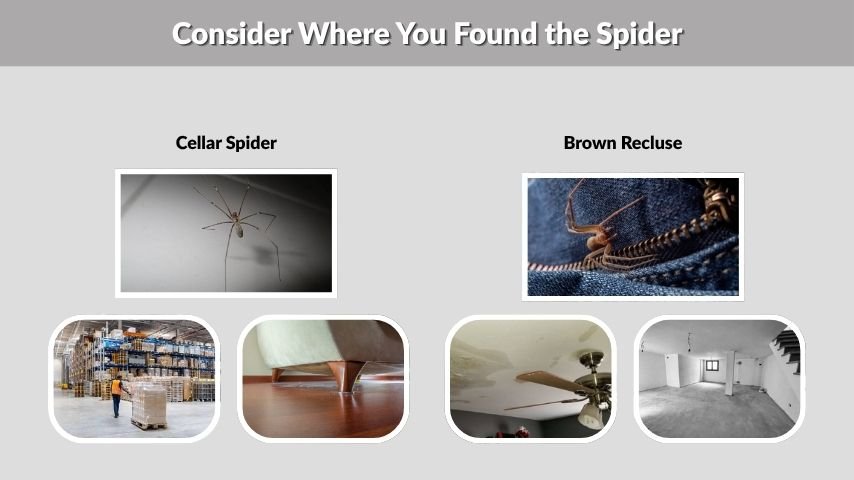
Location matters. A cellar spider is commonly seen in webs. It often stays in corners, ceilings, basements, crawlspaces, garages, and other quiet indoor areas. You may see several in the same room if there are insects for them to eat.
A brown recluse is more likely to hide than sit in a visible web. It prefers dark, quiet, undisturbed places. It may be found behind boxes, inside storage areas, in closets, under furniture, in garages, or near woodpiles.
Indoor Clues That Suggest a Cellar Spider
The spider is more likely a cellar spider if:
- It is hanging in a messy corner web
- It has very long, thin legs
- It is near ceilings, pipes, windows, or corners
- It shakes or vibrates when disturbed
- It appears pale and fragile
Indoor Clues That Need More Caution
Be more cautious if:
- The spider is plain brown and compact
- It was found inside a shoe, glove, box, or clothing
- It was hiding rather than sitting in a web
- It has no leg bands or bright markings
- You live in an area where brown recluse spiders are established
If you live outside the brown recluse’s normal range, a recluse is less likely, though transported spiders can occasionally appear.
Web Behavior Gives a Big Hint
This is one of the easiest differences for homeowners. Cellar spiders build irregular, messy cobwebs. These webs may collect dust and appear in corners, ceilings, basements, garages, or behind seldom-moved objects.
Brown recluse spiders do make silk, but they are not usually seen hanging in open, messy ceiling webs. They are reclusive hunters that stay hidden. If the spider is calmly hanging in a loose web above your washer, in a basement corner, or behind a shelf, it is much more likely to be a cellar spider.
Cellar Spider vs Brown Recluse Bite Risk and Safety
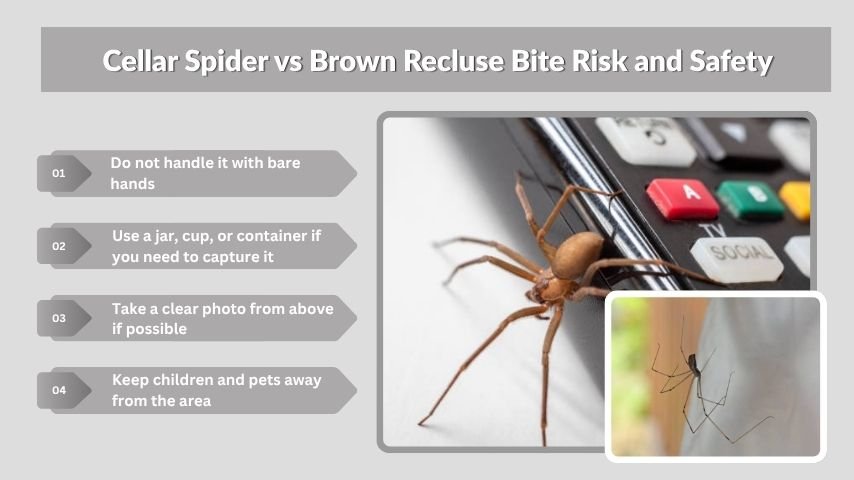
Cellar spiders are not considered a health hazard to people. They can be annoying because their webs collect dust, but they are also beneficial because they eat insects and other small arthropods.
Brown recluse spiders are different. They are medically important because their bite can sometimes cause serious skin symptoms. That said, they are not aggressive. Bites usually happen when the spider is trapped against skin, such as inside clothing, bedding, gloves, or shoes.
What to Do if You Are Unsure
If you cannot identify the spider safely:
- Do not handle it with bare hands
- Use a jar, cup, or container if you need to capture it
- Take a clear photo from above if possible
- Keep children and pets away from the area
- Contact a pest professional or local extension office for identification
- Wear gloves when moving stored boxes or clutter
If someone was bitten and symptoms worsen, seek medical advice. Do not diagnose a bite based only on the spider’s appearance unless the spider was clearly seen and identified.
How to Remove Cellar Spiders
Cellar spiders are usually controlled by reducing webs, clutter, and insects. Since they are not known as a health hazard, many people simply remove webs and relocate individual spiders when possible.
Helpful steps include:
- Vacuum webs from corners, ceilings, and behind furniture
- Reduce clutter in basements and storage rooms
- Seal cracks and gaps around windows and doors
- Install tight-fitting door sweeps
- Reduce indoor insects that attract spiders
- Keep seldom-used areas cleaner and drier
If cellar spiders keep returning, the issue may be that the area provides food, shelter, and undisturbed web-building spots.
How to Reduce Brown Recluse Risk
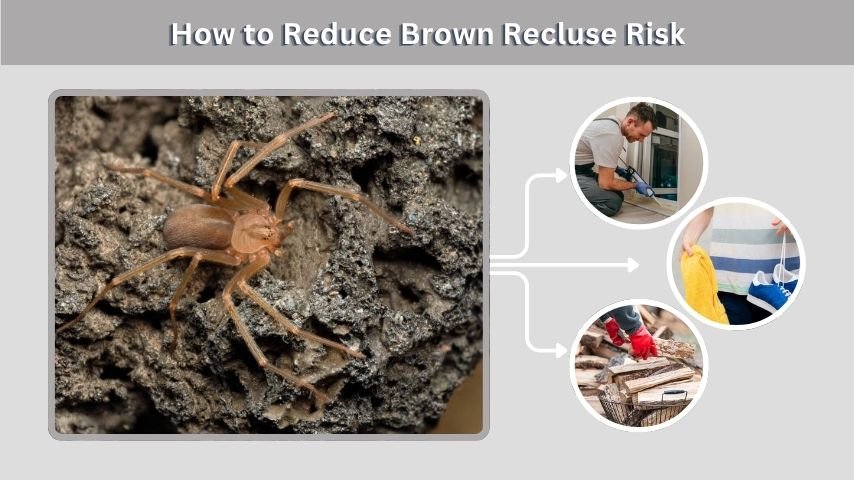
Brown recluse prevention focuses on reducing hiding places and avoiding accidental contact. Because bites can happen when spiders are pressed against skin, careful habits are important in areas where they are common.
Practical prevention tips include:
- Shake out shoes, gloves, towels, and clothing before use
- Wear gloves when moving boxes, firewood, or stored items
- Store belongings in sealed plastic bins instead of cardboard boxes
- Move beds away from walls and remove bed skirts if needed
- Reduce clutter in closets, garages, sheds, and basements
- Seal cracks around foundations, doors, and windows
- Use sticky traps to monitor spider activity
If you suspect a serious brown recluse infestation, consider professional pest control. Correct identification should come before treatment because many harmless spiders are mistaken for recluses.
Common Mistakes When Comparing These Spiders
Many people misidentify spiders because they focus on color alone. Brown is a common spider color, so a brown spider is not automatically a brown recluse. Likewise, long legs do not automatically mean danger.
Another mistake is assuming every violin-like mark means brown recluse. Some spiders have markings that look similar from certain angles. The more reliable clues are a combination of plain body color, unbanded legs, six-eye arrangement, region, and hiding behavior.
The biggest mistake is ignoring web behavior. A spider hanging in a messy web with very long, delicate legs is usually a cellar spider, not a brown recluse.
FAQs
How can I quickly tell a cellar spider from a brown recluse?
Look at the legs and web. A cellar spider has extremely long, thin legs and usually hangs in a messy, irregular web. A brown recluse is more compact, plain brown, and usually hides instead of sitting in an open corner web. Body shape and behavior are often easier clues than color.
Do cellar spiders have a violin mark like brown recluse spiders?
Some cellar spiders may have body markings, but they do not have the classic brown recluse identification pattern. A brown recluse may have a dark violin-shaped mark on the front body section, with the neck pointing toward the abdomen. Still, markings alone can be misleading, so check legs, web, and location too.
Are cellar spiders dangerous like brown recluse spiders?
No, cellar spiders are not known to be a health hazard to people. They are mostly a nuisance because their webs collect dust. Brown recluse spiders are medically important because their bites can sometimes cause serious symptoms, although they are not aggressive and usually bite only when trapped against skin.
What spider is most often mistaken for a brown recluse?
Many brown house spiders are mistaken for brown recluses, including cellar spiders, wolf spiders, funnel weavers, nursery web spiders, and southern house spiders. Misidentification often happens because people focus only on brown color or a vague marking. True brown recluse identification requires several features, not one clue.
Should I kill a spider if I think it is a brown recluse?
Avoid touching it with bare hands. If you need identification, safely capture it in a container or take a clear photo. If you live in a brown recluse area and keep finding plain brown spiders indoors, use sticky traps and consider a pest professional or extension office for accurate identification and control advice.