











Mallard ducks are among the most recognizable and widespread duck species in the world. While the vibrant green head of the male often grabs attention, the female mallard duck plays an equally important and fascinating role in nature. With her mottled brown feathers, sharp instincts, and maternal care, the female mallard is a master of camouflage and survival.
In this detailed guide, we’ll explore everything about female mallard ducks—from how to identify them, their unique behaviors and sounds, nesting habits, to how they differ from males and other similar-looking ducks. Whether you’re a birdwatcher, wildlife enthusiast, or just curious, this article will give you a clear understanding of what a female mallard duck looks like, how she lives, and how to tell her apart from others.
What Is a Female Mallard Duck Called?
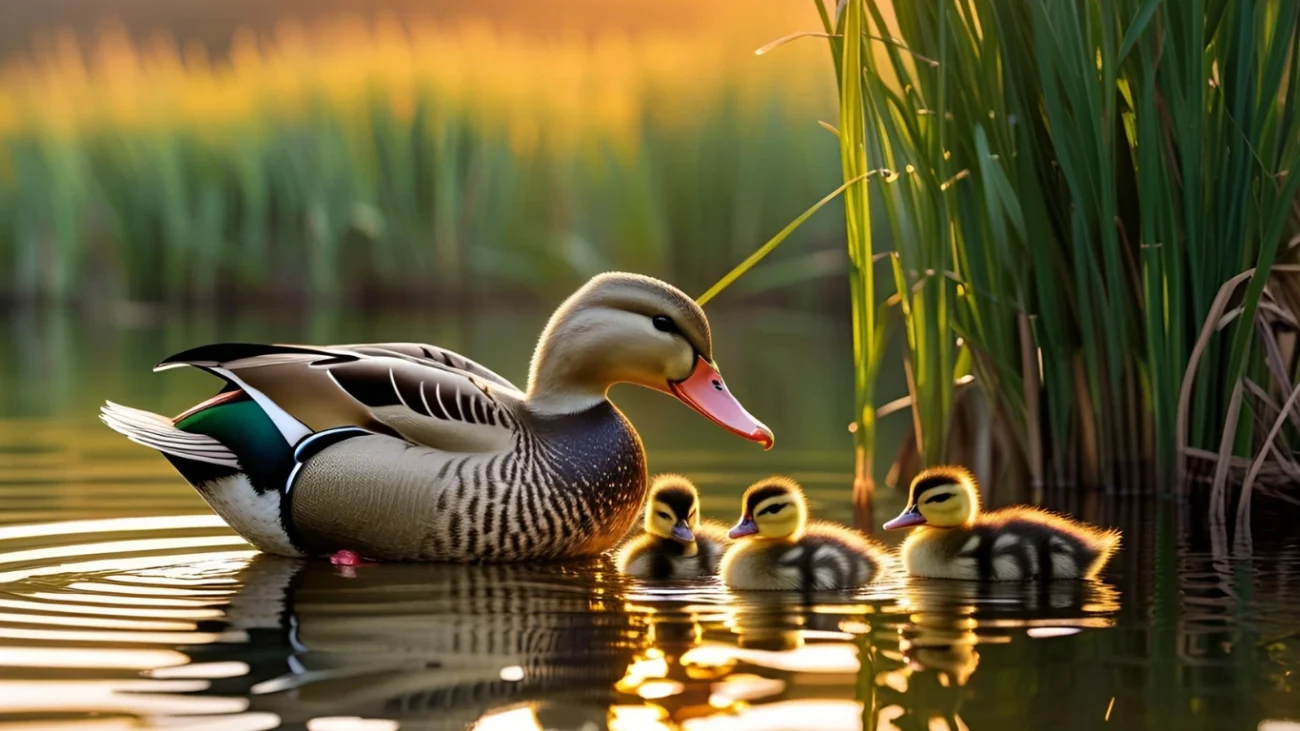
When referring to a female mallard duck, the correct term is simply “hen.” In duck terminology, males are called “drakes” and females are called “hens.” This naming convention is common across many duck species, not just mallards.
While both male and female mallards are referred to collectively as “mallard ducks,” many people wonder whether “mallard” refers only to the male due to his striking appearance. However, both sexes belong to the same species: Anas platyrhynchos. The term “mallard” is not gender-specific—it applies to the entire species.
Is the Term “Female Mallard” Redundant?
Technically, yes. When you say “female mallard,” you’re specifying the sex of a bird already known as a mallard. But for identification purposes, especially for new birders or in educational materials, saying “female mallard duck” is perfectly acceptable and helps clearly distinguish from the more colorful male.
Summary
- Species name: Mallard (Anas platyrhynchos)
- Female mallard is called: Hen
- Male mallard is called: Drake
- Using ‘female mallard duck’ is helpful when distinguishing between the sexes, especially for beginners or when describing photos and field observations.
How to Identify a Female Mallard Duck

The female mallard duck is often overlooked due to her subtle, camouflaged appearance, especially when compared to the vibrant, glossy green-headed male. However, her distinctive traits are just as fascinating and crucial for survival, particularly when nesting and raising ducklings. Here’s how to identify a female mallard in the wild.
Physical Appearance and Size
Female mallards have a mottled brown body, designed to blend in with natural surroundings. This plumage provides excellent camouflage during nesting. Their average body length ranges from 20 to 26 inches, and they typically weigh between 2 and 3 pounds, similar to the male.
- Head: Brown with a slightly darker crown
- Eyes: Dark with a thin eye stripe running behind the eyes
- Bill: Usually orange with dark blotches or entirely dark brown
- Neck and Chest: Covered in streaky brown feathers
Feather Color and Wing Patterns
One of the easiest ways to confirm a female mallard is by looking at the wings in flight or at rest. Both males and females have a distinctive iridescent blue patch called a speculum on their wings, bordered with white. In females, this speculum stands out more due to their otherwise muted feather colors.
- Back and flanks: Mottled brown with layered patterns
- Tail: Brown and slightly pointed
- Legs and feet: Bright orange
Juvenile and Young Female Mallards
Juvenile female mallards resemble adult females but are usually lighter in color and fluffier. Their bill may appear duller, and they lack the full structure of an adult’s feathers. As they mature, their patterns and contrast deepen.
Rare Color Variations
While the typical female mallard is brown, rare albino or leucistic individuals may appear white or pale. These are genetic anomalies and stand out sharply against wild environments, making them more vulnerable to predators.
Summary Checklist for Identification
- Brown mottled body with camouflage pattern
- Orange bill with dark patches
- Blue wing patch (speculum) with white borders
- Orange legs and webbed feet
- Loud, distinct quack (especially when alert)
Knowing these key traits will help you confidently identify a female mallard in your backyard, pond, or local wetland.
Male vs Female Mallard Duck: Key Differences

While male and female mallard ducks belong to the same species, they look quite different—especially during the breeding season. Understanding the differences between a drake (male) and a hen (female) is essential for birdwatchers and anyone interested in wildlife observation.
Color and Plumage
This is the most noticeable distinction:
- Male Mallard (Drake):
- Shiny green head
- White ring around the neck
- Chestnut-brown chest
- Grayish body
- Bright yellow bill
- Shiny green head
- Female Mallard (Hen):
- Overall mottled brown body
- Slightly darker eye stripe
- Orange and brown blotchy bill
- Same blue wing patch (speculum) as the male
- Overall mottled brown body
The male’s vibrant colors help attract mates during the breeding season, while the female’s earth-toned plumage provides camouflage, especially when nesting.
Size and Body Shape
- Both sexes are similar in size, though males are often slightly heavier and longer.
- Males may appear sleeker due to their smoother feather patterns and brighter coloring.
- Females have a more rugged, coarse feather texture due to the mottling.
Voice and Calls
- Female mallards have the loud, classic “quack” heard in parks and ponds.
- Males have a softer, raspier call that is less frequent and less recognizable.
Seasonal Changes
During the summer molting season, male mallards lose their bright plumage and enter what’s called eclipse plumage—a brown coloration similar to females. This can make it harder to tell them apart, though the male’s yellowish bill and slightly sleeker build may still help with ID.
Male Vs Female Mallard
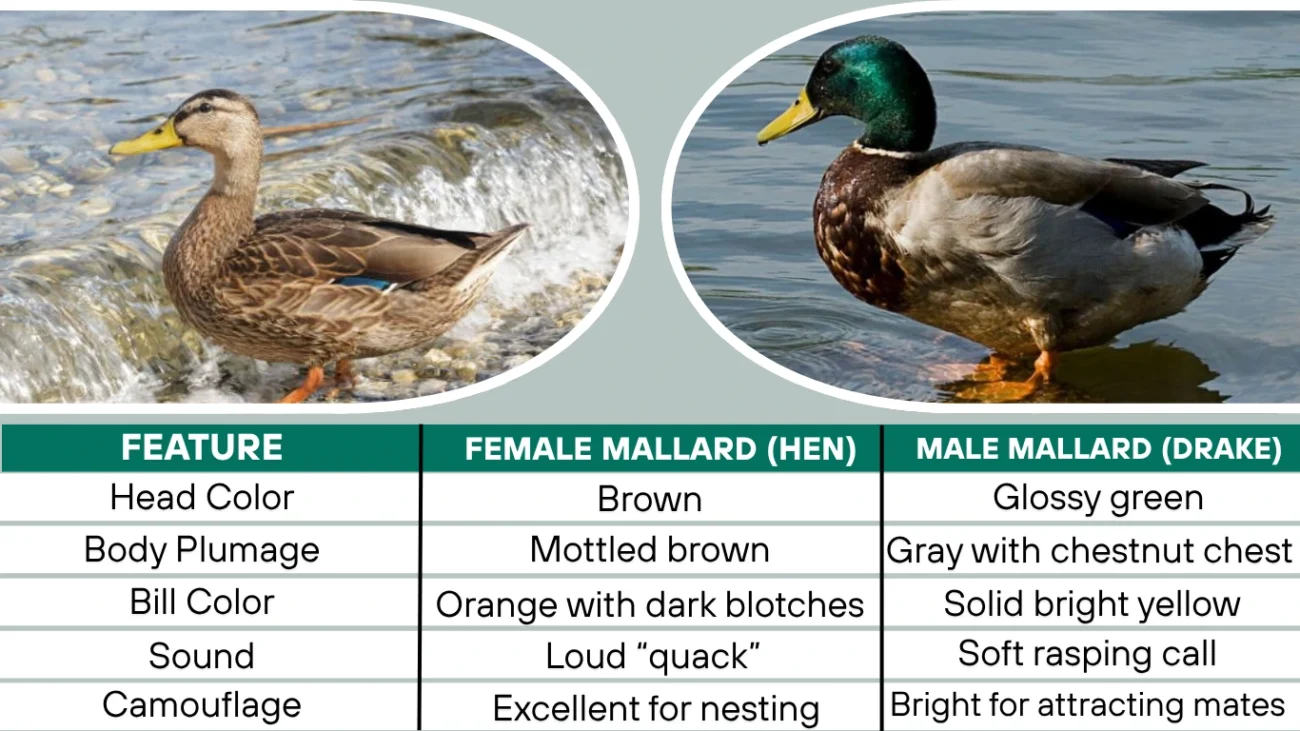
| Feature | Female Mallard (Hen) | Male Mallard (Drake) |
| Head Color | Brown | Glossy green |
| Body Plumage | Mottled brown | Gray with chestnut chest |
| Bill Color | Orange with dark blotches | Solid bright yellow |
| Sound | Loud “quack” | Soft rasping call |
| Camouflage | Excellent for nesting | Bright for attracting mates |
| Size | Slightly smaller or similar | Slightly larger |
By comparing these traits, you can quickly distinguish between male and female mallards—whether on the water, in flight, or tending to ducklings.
Behavior of the Female Mallard Duck
Female mallard ducks are more than just quiet companions to the vibrant males—they play a crucial role in the survival and continuity of the species. From selecting mates to building nests and caring for their young, their behavior is both fascinating and essential.
Feeding and Foraging Habits
Female mallards are dabbling ducks, meaning they feed by tipping forward in shallow water to graze on aquatic vegetation, insects, snails, and crustaceans. They also forage on land for seeds and grains.
- Often seen feeding in the early morning and late afternoon
- More cautious than males while feeding, especially during nesting season
Social Behavior and Mating
During mating season (early spring), females are responsible for choosing a mate. They are typically pursued by multiple drakes and will assess males based on their plumage, courtship behavior, and vocal displays.
- Mating groups may include multiple males competing for one female
- A female often mates with just one male per season but may be followed by others
Nesting and Maternal Instincts
Female mallards take full charge of nest building, egg incubation, and raising ducklings. Nests are typically made in concealed locations on the ground near water, using grass, leaves, and their own down feathers.
- Lay 8–13 eggs per clutch
- Incubation lasts about 26–30 days
- Ducklings can swim within 24 hours of hatching but stay close to the mother for protection
Defensive Behavior
While not aggressive like some bird species, females will become defensive and feign injury (a broken-wing act) to lure predators away from their nest or ducklings.
Female Mallards in Social Groups
Outside the breeding season, female mallards may form small flocks with other females or juveniles. They tend to be less dominant than males in mixed groups but are often more alert and responsive to threats.
Female Mallard Duck Sounds and Calls

One of the most recognizable duck sounds in nature is the loud, classic “quack”—and that sound almost always comes from the female mallard duck. Males are much quieter, which makes the female’s voice a useful tool for identification.
The Classic Quack
The female mallard produces a loud, harsh quack-quack-quack sound, often repeated several times. This call is used in various situations:
- Contact calls: Used to stay in touch with ducklings or other ducks
- Alert calls: A loud, sharp quack when disturbed or threatened
- Flight calls: A series of quacks made when taking off or flying overhead
- Mating calls: Lower and more rhythmic during breeding season
This vocalization can often be heard near wetlands, ponds, or even urban parks where mallards gather. It is the primary sound people associate with ducks in general.
Male vs Female Calls
- Female mallard: Loud, raspy, and repetitive quack
- Male mallard: Soft, muffled rasping noise, not easily heard unless up close
Because of these differences, birdwatchers often use sound as an early clue to spot a nearby female.
Mating and Nesting Sounds
During courtship, the female may respond to male displays with gentler quacks or short vocalizations. When nesting or guarding ducklings, her tone may change to a lower or faster-paced rhythm, signaling caution to her young or warning to outsiders.
Female Mallard Duck in Flight

Though not as brightly colored as the males, female mallard ducks are strong, agile fliers. Their flight behavior and wing markings make them just as easy to spot—if you know what to look for.
How to Recognize a Female Mallard in Flight
When a female mallard takes to the air, she shows off several key features:
- Overall brown body with mottled feather patterns
- A distinct blue-purple wing patch (speculum) bordered by white, visible on both wings
- Orange feet and legs tucked tightly against the body
- Rapid wingbeats, steady and controlled flight
While her colors don’t shine like the male’s iridescent plumage, the contrasting wing patch makes her stand out in flight.
Behavior During Flight
- Females often take off straight from the water with a strong push and rapid wing motion
- During nesting season, they may fly low over land or water while searching for food or checking on their ducklings
- They usually fly in small groups or with their young, especially after the ducklings become mobile
Role of Flight in Parental Duties
Flight allows the female to scout for food, evade predators, and even perform distraction flights if her nest or ducklings are threatened. She may act as if she’s injured, flapping awkwardly away to lure danger away from her young.
Female Mallard Duck and Ducklings

After mating, the female mallard assumes full responsibility for nesting and raising her young. Her behavior during this period is one of the most remarkable examples of parental care among wild birds.
Nesting and Egg-Laying
- Female mallards build nests on the ground, often near water but hidden in grass, reeds, or brush.
- Nests are constructed with natural materials like grass and leaves and lined with down feathers plucked from the female’s own body.
- A typical clutch contains 8 to 13 eggs, laid one per day.
- The female incubates the eggs for about 26 to 30 days without the male’s help.
Caring for Ducklings
Once the eggs hatch, the ducklings are precocial—they are born with down feathers and are able to walk and swim within a day. The mother leads them to water soon after hatching.
- Ducklings remain with the mother for 6 to 8 weeks.
- She protects them from predators, teaches them how to forage, and keeps them warm at night.
- The ducklings learn by following her closely, forming what is often seen as a line of ducklings waddling or swimming behind their mother.
Identifying Baby Female Mallards
Young ducklings are hard to sex at birth. As they grow, female ducklings begin to show their mottled brown coloring, but full identification usually isn’t clear until they reach juvenile plumage around 2 months old.
Visual Gallery: Female Mallard Duck Photos and Drawings
Images are a powerful way to understand and identify female mallard ducks, especially because of their more subtle coloring compared to males. Here’s how to distinguish them in pictures and what visual products exist for bird lovers.
Real-Life Photos of Female Mallards
In field photos:
- Look for mottled brown feathers
- Note the blue speculum on the wings
- Identify the orange-and-black bill and orange feet
- Often seen near water or guiding ducklings
Artistic and Product Representations
- Drawings and wildlife illustrations typically emphasize the feather texture and natural camouflage.
- Plush toys and stuffed animals are often modeled after female mallards, with brown bodies and soft, realistic coloring.
Image Comparison with Males
When shown side by side:
- The male’s bright colors contrast sharply with the female’s earth tones.
- Visual guides help clarify differences in plumage, bill shape, and size.
Female Mallard Duck Comparison with Other Ducks
Because of their brown coloring, female mallards are sometimes confused with other duck species, especially those that also lack bright plumage. Here’s how they compare to some lookalikes.
Female Mallard vs. American Black Duck
- The black duck is darker overall, with less contrast between feather patterns.
- The blue speculum on black ducks lacks the white borders seen on mallards.
- Bills are more olive or greenish in black ducks, while female mallards often have orange with dark patches.
Female Mallard vs. Mottled Duck
- Mottled ducks are very similar, but their plumage is a little more uniform and warm-toned.
- The speculum may be less vibrant and bordered differently.
- Habitat overlap can cause confusion, especially in the southeastern U.S.
Ducks That Look Like Female Mallards
- Juvenile male mallards (before getting full color)
- Gadwalls and female Northern Pintails at a glance
- Domestic breeds descended from mallards
Female Black Duck vs Mallard
- The female black duck has a more uniform dark brown tone with less definition between feather edges.
- Mallards are more speckled and contrast-rich in pattern.
FAQs About Female Mallard Ducks
Are there female mallard ducks?
Yes, absolutely. Like all sexually dimorphic bird species, mallards consist of both males and females. Female mallards, often referred to as hens, make up half of any mallard population. While males (drakes) are easy to identify due to their green heads and vibrant colors, females play a crucial role in nesting, raising ducklings, and maintaining the species. Their brown coloring provides natural camouflage, especially during the breeding season.
Are mallard ducks male or female?
The term “mallard duck” applies to the species as a whole, which includes both males and females. Males are called drakes and are known for their colorful appearance, while females are called hens and have more subdued, camouflaged plumage. So when someone refers to a “mallard duck,” they could be speaking about either sex unless otherwise specified. To identify the gender, one must observe physical features like coloration and vocal behavior.
What color are female mallard ducks?
Female mallard ducks are primarily mottled brown in color, which helps them blend into their natural environment—especially during nesting. They have darker streaks and spots across their body, a slightly darker cap or crown on their head, and a distinctive blue wing patch (speculum) bordered in white. Their bills are usually orange with dark blotches. This earth-toned coloring is essential for camouflage and distinguishes them from the brightly colored males.
What do you call a female mallard duck?
A female mallard duck is simply called a hen. This term is commonly used for female ducks across species. While “mallard” refers to the species as a whole, specifying “hen” helps indicate the bird’s sex. In birding or wildlife studies, you might hear the terms “female mallard” or “hen mallard” used interchangeably to describe the more subtly colored, maternal half of the mallard pair.
Which mallard duck is female?
In a group of mallards, the female is the one with brown mottled feathers, an orange-and-black bill, and a louder, more distinctive quack. She lacks the green head, white neck ring, and grayish body seen on the male (drake). Females also exhibit more cautious behavior, especially around nests and ducklings. One of the easiest ways to spot a female is by her camouflaged appearance and her role in tending to young.
Are male mallard ducks smaller than females?
Generally, male mallard ducks are slightly larger than females, though the difference is subtle. Males often have longer bodies, a more upright posture, and a heavier build. However, in the field, size alone can be misleading due to posture, feather puffing, or age differences. The more reliable indicators of sex are coloration, voice, and behavior. Males also tend to have broader heads and brighter bills compared to females.
Can a male wood duck court a female mallard?
Although rare, inter-species courtship can occur in ducks. A male wood duck may attempt to court a female mallard, especially in areas where ducks of different species coexist. While courtship behavior might happen, successful mating and hybrid offspring are extremely uncommon between wood ducks and mallards due to differences in courtship rituals, nesting behavior, and genetic compatibility. Most ducks naturally choose mates within their own species.
How to tell a baby mallard duck’s gender?
It’s difficult to determine the sex of baby mallard ducks (ducklings) by sight alone. Both male and female ducklings look nearly identical—soft, fuzzy, and yellowish-brown. As they age, males start to show signs of brighter plumage and yellow bills, while females retain their darker brown coloring and develop an orange-and-brown bill. True visual gender differences typically appear after several weeks, once juvenile feathers begin to grow in.


