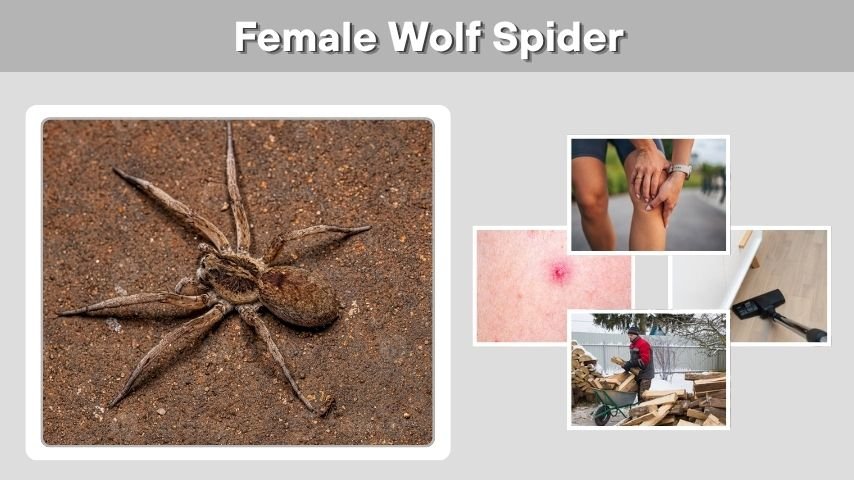
A female wolf spider can look intimidating because she is often larger, stockier, and sometimes seen carrying an egg sac or many tiny spiderlings on her back. These spiders are fast ground hunters, not web-building pests, and they are usually more useful than harmful. This guide explains how to identify a female wolf spider, how she differs from a male, and what to do if you find one indoors.
What Is a Female Wolf Spider?
A female wolf spider is an adult female from the spider family Lycosidae. Wolf spiders are active hunters that chase insects instead of building sticky webs to catch prey. They are common in gardens, lawns, fields, forests, basements, garages, sheds, and around outdoor lights where insects gather.
The female wolf spider is especially recognizable during reproduction. She may carry a round egg sac attached near the rear of her body, and after hatching, the young spiderlings may ride on her back. The University of Minnesota Extension notes that females carry egg sacs attached to their spinnerets, and newly hatched spiderlings ride on the female’s abdomen.
Why Female Wolf Spiders Get Attention
Female wolf spiders attract more attention than males because they are often larger and more noticeable. A female carrying an egg sac or babies can also look alarming to homeowners, even though this behavior is normal.
People commonly search for female wolf spiders because they want to know:
- What a female wolf spider looks like
- Whether it is male or female
- Whether a female wolf spider is pregnant
- What the egg sac means
- Whether a female wolf spider bite is dangerous
- How to move one away safely
- Whether babies on her back will infest the house
Female wolf spiders are not aggressive toward people. They usually run away when disturbed and bite only if trapped, handled, or pressed against the skin.
What Does a Female Wolf Spider Look Like?
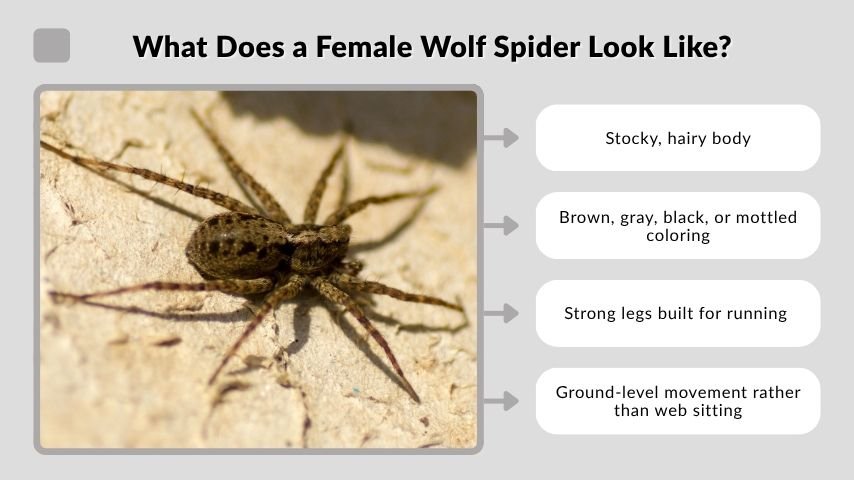
A female wolf spider usually has a sturdy, hairy body, strong legs, and brown, gray, black, tan, or patterned coloring. Many have stripes, bands, or chevron-like markings that help them blend into soil, leaves, mulch, and bark.
Wolf spiders are best identified by their body shape, ground-hunting behavior, and eye arrangement. The University of Minnesota Extension describes the wolf spider eye pattern as one row of four eyes, followed by two rows of two eyes.
Common Identification Features
Look for these clues when identifying a female wolf spider:
- Stocky, hairy body
- Brown, gray, black, or mottled coloring
- Strong legs built for running
- Ground-level movement rather than web sitting
- Large central eyes compared with many spiders
- Egg sac attached behind the body
- Spiderlings riding on her back after hatching
A female without an egg sac can be harder to confirm. In that case, size, body shape, pedipalps, and behavior are more useful clues.
Female Wolf Spider Size
Female wolf spider size depends on species. Some are small, while large species can look very intimidating. Many common wolf spiders are around 1/4 inch to over 1 inch long, depending on species and maturity. The University of Minnesota Extension gives wolf spiders a general size range of 1/4 inch to 1 or more inches long.
Females are often larger and heavier-bodied than males. This is especially noticeable in species like the Carolina wolf spider, where females are known for their larger body size.
Male vs Female Wolf Spider
The difference between a male and female wolf spider is one of the biggest keyword clusters. Many people see a spider in the house or garden and want to know whether it is male or female. The easiest signs are body size, pedipalps, and reproductive behavior.
A female wolf spider is usually larger, rounder, and heavier. A male wolf spider is often smaller, slimmer, leggier, and more likely to wander while searching for a mate.
| Feature | Female Wolf Spider | Male Wolf Spider |
|---|---|---|
| Body shape | Larger, rounder, heavier abdomen | Smaller, slimmer body |
| Pedipalps | Slimmer, less bulbous tips | Enlarged, club-like tips in adult males |
| Egg sac | Can carry egg sac | Does not carry egg sac |
| Babies | Can carry spiderlings on back | Does not carry babies |
| Behavior | Hunts and protects young | Often wanders to find females |
| Indoor sightings | May enter by accident | Often seen wandering during mating periods |
Male vs Female Wolf Spider Pedipalps
Pedipalps are small appendages near the spider’s mouthparts. In adult male wolf spiders, the pedipalps often look enlarged or swollen at the tips. They may look like tiny boxing gloves. These structures are used in reproduction.
Female wolf spiders do not have the same swollen pedipalp tips. Their pedipalps are generally slimmer and less club-shaped. However, immature males can be difficult to separate from females without close examination, so it is best not to rely on one feature alone.
Female vs Male Wolf Spider Size
Female wolf spiders are generally larger than males, but size alone is not perfect. A young female may be smaller than an adult male of another species. Species, age, and nutrition all affect size.
Use size together with other clues. If the spider is carrying an egg sac or spiderlings, it is female. If the spider has swollen pedipalps and a slimmer body, it is likely an adult male.
Female Wolf Spider Egg Sac
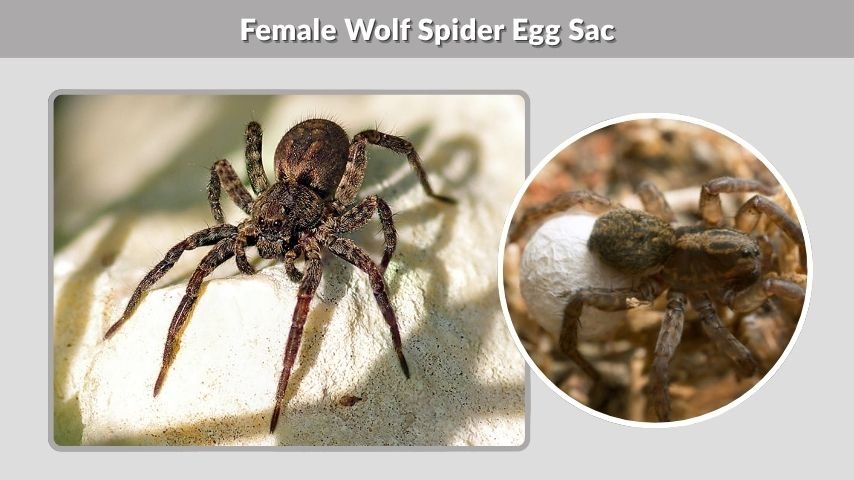
A female wolf spider with an egg sac is one of the easiest to identify. Unlike many spiders that leave egg sacs hidden in webs or protected corners, female wolf spiders carry the egg sac with them.
The egg sac is usually round and attached near the spinnerets at the back of the abdomen. It may be white, cream, tan, gray, or slightly bluish depending on species and age. Utah State University Extension also notes that female wolf spiders carry egg sacs on their spinnerets and spiderlings on their back.
What the Egg Sac Means
An egg sac means the female has produced eggs and is protecting them. She will continue hunting and moving while carrying the sac. If the sac is removed or damaged, the spider may try to recover it.
A female wolf spider with an egg sac may be more defensive than usual, but she is not looking to attack people. She is focused on survival and protecting her young.
Should You Kill a Female Wolf Spider With an Egg Sac?
It is usually better not to kill a female wolf spider, especially outdoors. Wolf spiders eat insects and other small pests, so they can be beneficial in gardens and yards.
If she is indoors, the safest option is to remove her carefully. Place a container over the spider, slide stiff paper or cardboard underneath, and release her outside away from doors and windows. Avoid crushing a female carrying an egg sac or babies, because that may scatter spiderlings and create more stress.
Female Wolf Spider With Babies
A female wolf spider with babies on her back can surprise anyone. This is normal wolf spider behavior. After the egg sac opens, the spiderlings climb onto the mother’s abdomen and ride there until they are ready to disperse.
The University of Florida IFAS notes that spiderlings live on the backs of female wolf spiders until they are able to hunt on their own. This behavior is one of the clearest signs that the spider is female.
How Many Babies Can a Female Wolf Spider Have?
The number of babies depends on the species, the size of the female, and environmental conditions. A female may carry dozens of spiderlings, and in some cases many more. To the human eye, they may look like a moving gray or brown layer across her back.
Most baby wolf spiders do not survive to adulthood. They disperse, hunt tiny prey, and face predators, weather, and competition.
How Long Does a Female Wolf Spider Carry Her Spiderlings?
The exact time varies by species and conditions, but the spiderlings usually remain on the mother for a short early period before dispersing. They stay with her while they are most vulnerable and leave when they are better able to survive on their own.
If you see a female wolf spider with babies inside your house, do not spray or smash her. Use a container if possible, or contact a pest professional if you are uncomfortable handling the situation.
Female Wolf Spider Bite
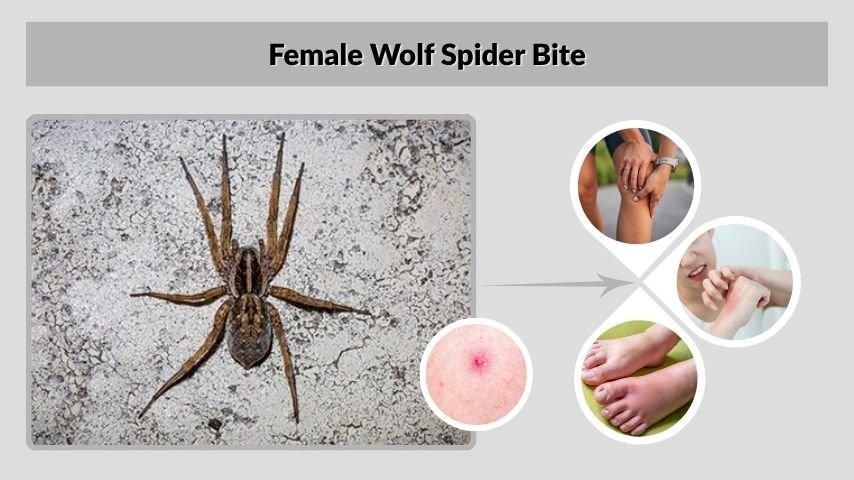
A female wolf spider can bite, but she is not aggressive toward humans. Most bites happen when the spider is accidentally trapped against skin, picked up, or disturbed in shoes, clothing, bedding, boxes, or garden materials.
Cleveland Clinic describes wolf spider bites as typically harmless, although they can break the skin and cause redness, pain, and swelling. Wolf spiders are venomous, but they are not considered medically dangerous for most healthy people.
Female Wolf Spider Bite Symptoms
A bite may cause:
- Sharp or stinging pain
- Redness around the bite
- Mild swelling
- Itching or irritation
- Tenderness
- A small puncture mark or two fang marks
- Temporary discomfort
Seek medical advice if pain worsens, swelling spreads, symptoms last longer than expected, or the person has trouble breathing, dizziness, fever, severe rash, or signs of infection.
What to Do After a Bite
Basic first aid can help with mild symptoms:
- Wash the area with soap and water.
- Apply a cold pack wrapped in cloth.
- Avoid scratching the bite.
- Keep the area clean.
- Use over-the-counter pain relief if appropriate.
- Get medical help if symptoms are severe or unusual.
Do not try to identify a bite from the mark alone. Many insect bites, skin infections, and allergic reactions can look similar.
Carolina Wolf Spider Female
The Carolina wolf spider, known scientifically as Hogna carolinensis, is one of the most searched species in this keyword set. It is often called the largest wolf spider in North America. Females are typically larger than males, which makes them more noticeable.
Many people search for “Carolina wolf spider female” because this species can look large and intimidating. It is usually brown or mottled, ground-dwelling, and adapted for hunting rather than web trapping.
Carolina Wolf Spider Male vs Female
Female Carolina wolf spiders are generally larger and bulkier. Males are usually smaller and may show more obvious mating-related structures, including enlarged pedipalps as adults.
If you see a large wolf spider in a burrow or on open ground, it may be a female Carolina wolf spider, depending on your region. A female with an egg sac or babies is easier to confirm.
Rabid Wolf Spider Male vs Female
The rabid wolf spider is another commonly searched species. Despite the name, it does not carry rabies. The name comes from its quick movement and appearance, not from disease.
Female rabid wolf spiders are usually larger and heavier-bodied than males. Like other wolf spiders, females may carry an egg sac and later spiderlings. Males are typically slimmer and may wander more while looking for mates.
Female Rabid Wolf Spider
A female rabid wolf spider may have bold striping and a sturdy body. If she carries an egg sac, the identification as female is clear. If not, look at body shape, pedipalps, and size, but remember that exact identification can be difficult without a close, safe view.
How to Identify a Female Wolf Spider Safely
You do not need to touch a spider to identify it. Use observation from a safe distance. A flashlight and a clear photo can help.
Try this process:
- Check whether it is carrying an egg sac.
- Look for spiderlings on the back.
- Observe whether it runs on the ground instead of sitting in a web.
- Look for a stocky, hairy body.
- Compare the pedipalps if you can see them clearly.
- Note the location, such as lawn, basement, garage, or garden bed.
- Avoid handling it with bare hands.
If you want identification help, take a photo from above and from the side if safe. Do not risk a bite for a closer picture.
How to Drive a Female Wolf Spider Away
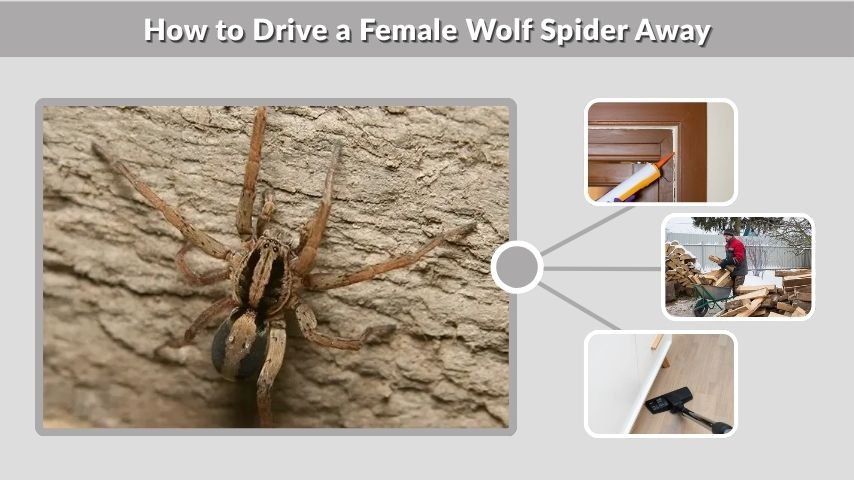
If the spider is outdoors, leaving it alone is usually best. Wolf spiders help reduce insects and generally do not harm people. If the spider is indoors, remove it gently or reduce the conditions that attract spiders.
Helpful prevention steps include:
- Seal gaps around doors and windows.
- Repair screens.
- Reduce clutter in basements, garages, and sheds.
- Shake out shoes and gloves before use.
- Move firewood and debris away from the home.
- Reduce outdoor lights that attract insects.
- Vacuum corners and storage areas regularly.
- Control insects that serve as spider food.
Avoid overusing indoor pesticides. They may not solve the source of the problem and can create unnecessary chemical exposure.
FAQs
How can you tell if a wolf spider is female?
A wolf spider is female if she is carrying an egg sac or has baby spiderlings on her back. Without those clues, look for a larger, rounder body and slimmer pedipalps. Adult males usually have swollen, club-like pedipalp tips, while females are often bulkier.
Are female wolf spiders bigger than males?
Yes, female wolf spiders are generally larger and heavier-bodied than males. However, size alone is not always enough for identification because different species vary. A small adult female of one species may be similar in size to a male of another species.
What does a female wolf spider egg sac look like?
A female wolf spider egg sac is usually a round silk ball attached near the back of her abdomen. It may look white, cream, gray, tan, or bluish depending on species and age. This attached egg sac is one of the clearest signs that the spider is female.
Is a female wolf spider with babies dangerous?
A female wolf spider with babies may look frightening, but she is not hunting people. She may bite if trapped or handled, so avoid touching her. If she is indoors, use a container and cardboard to move her outside, or call pest control if needed.
Do female wolf spiders bite?
Female wolf spiders can bite, but bites are uncommon and usually happen when the spider is handled or pressed against skin. Most bites cause temporary pain, redness, swelling, or itching. Seek medical help if symptoms are severe, spreading, infected, or involve allergic reactions.