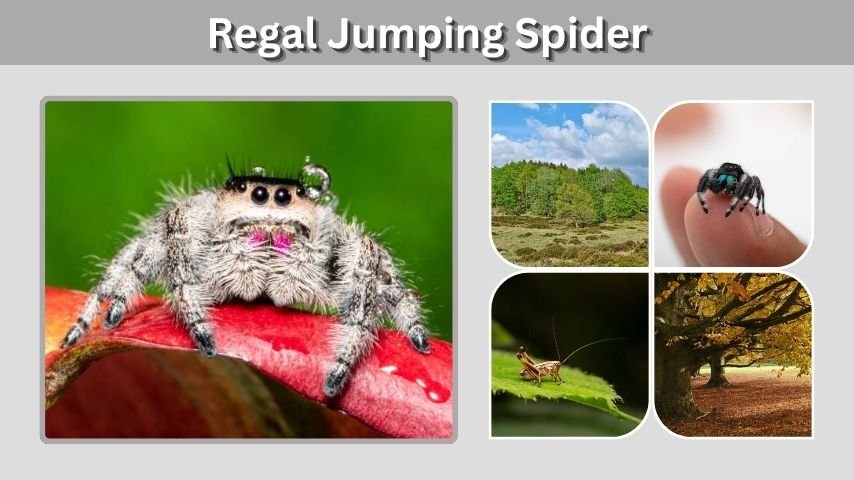
The regal jumping spider is one of the most charming spiders you can find in North America. Known scientifically as Phidippus regius, this small but bold arachnid is famous for its large eyes, fuzzy body, curious behavior, and impressive jumping ability. Unlike many spiders that depend mainly on webs to catch prey, the regal jumping spider actively hunts, stalks, and pounces with surprising precision.
What Is a Regal Jumping Spider?
The regal jumping spider is a species of jumping spider in the family Salticidae. Jumping spiders are known for their excellent eyesight, active hunting style, and alert, almost curious movements. The regal jumping spider stands out because of its relatively large size, colorful appearance, and popularity among spider enthusiasts.
This spider is native to warm regions, especially the southeastern United States, the Bahamas, and parts of the Caribbean. It is often associated with Florida, where it is commonly seen on walls, fences, vegetation, and outdoor structures.
Scientific Classification
The regal jumping spider belongs to a large and diverse family of spiders. Its scientific name is Phidippus regius, and the word “regius” means royal or regal, which fits its bold look and impressive presence.
Here is a quick overview:
| Feature | Details |
|---|---|
| Common Name | Regal Jumping Spider |
| Scientific Name | Phidippus regius |
| Family | Salticidae |
| Native Range | Southeastern U.S., Bahamas, Greater Antilles |
| Average Size | About 0.6 to 2.2 cm |
| Diet | Flies, moths, crickets, small insects |
| Hunting Style | Active stalking and jumping |
| Temperament | Curious, alert, generally non-aggressive |
Regal Jumping Spider Appearance
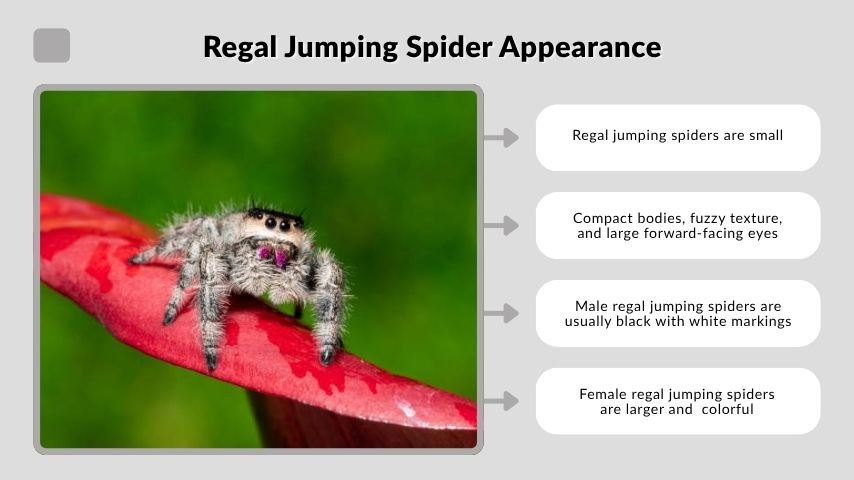
Regal jumping spiders are small, but they are visually striking. Their compact bodies, fuzzy texture, and large forward-facing eyes give them a look that many people find surprisingly cute.
Male Appearance
Male regal jumping spiders are usually black with white markings. They often have bold patterns on the abdomen and may have iridescent chelicerae, which are the mouthparts near the fangs. These chelicerae can shine in shades of green, blue, or violet depending on the light.
Males tend to look sleeker and darker than females. Their front legs may appear longer or more dramatic, especially during movement or courtship displays.
Female Appearance
Female regal jumping spiders are often larger and more colorful than males. Their bodies can show shades of gray, orange, tan, brown, or cream. Many females have attractive patterns on the abdomen, and some display bright orange coloration that makes them especially popular among keepers.
Females are generally bulkier and may live longer than males. Their wider body shape also makes them easier to identify once mature.
Juvenile Appearance
Young regal jumping spiders can look quite different from adults. Juveniles are usually lighter in color and may develop their adult markings gradually over several molts. Because jumping spiders change appearance as they grow, identifying young spiders can sometimes be difficult.
Natural Habitat and Distribution
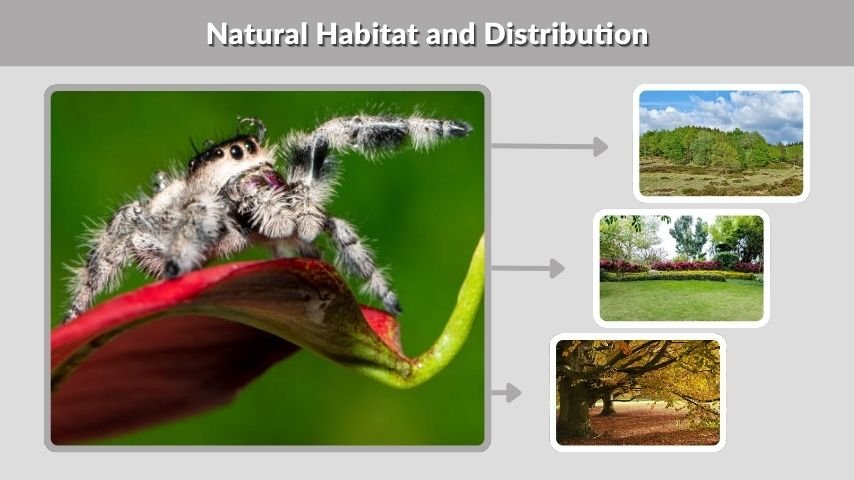
Regal jumping spiders prefer warm, open environments where they can hunt during the day. They are commonly found in places with plenty of sunlight, insects, and surfaces for climbing.
Where They Live in the Wild
In the wild, regal jumping spiders may be found in:
- Fields and open woodlands
- Gardens and shrubs
- Palm fronds and palmettos
- Fences and building walls
- Outdoor sheds and wooden structures
- Tree bark and sunny vegetation
They do not usually rely on large prey-catching webs. Instead, they use silk for safety lines, resting shelters, molting spaces, and egg sacs. At night, they often retreat into small silk shelters where they can rest safely.
Geographic Range
The regal jumping spider is most strongly associated with the southeastern United States, particularly Florida. It is also found in the Bahamas and the Greater Antilles. Its preference for warm climates explains why it is most abundant in southern regions.
Behavior of the Regal Jumping Spider
Regal jumping spiders are active, alert, and highly visual hunters. Their behavior is one of the main reasons people find them so fascinating.
Excellent Vision
Jumping spiders have some of the best vision among spiders. Their large front eyes allow them to judge distance, recognize movement, and focus on prey. When a regal jumping spider notices something interesting, it may turn its body toward the object and appear to watch it closely.
This behavior can make them seem more interactive than many other spiders. They may track your hand, follow movement outside their enclosure, or pause as if studying their surroundings.
Hunting Style
Regal jumping spiders do not wait passively in a web. They hunt by sight. Once they spot prey, they slowly move closer, calculate the distance, attach a silk safety line, and leap.
Their hunting process usually includes:
- Watching the prey carefully
- Moving slowly into position
- Attaching silk as a safety anchor
- Jumping with accuracy
- Grabbing and subduing the insect
This active hunting style makes them exciting to observe, especially when they are feeding.
Jumping Ability
As their name suggests, jumping spiders are skilled leapers. Their jumps are not random; they are controlled and purposeful. They use jumping to catch prey, escape danger, and move between surfaces.
Before jumping, they often attach a silk dragline. This works like a safety rope. If the spider misses its target or falls, the silk helps prevent serious injury.
Diet and Feeding Habits
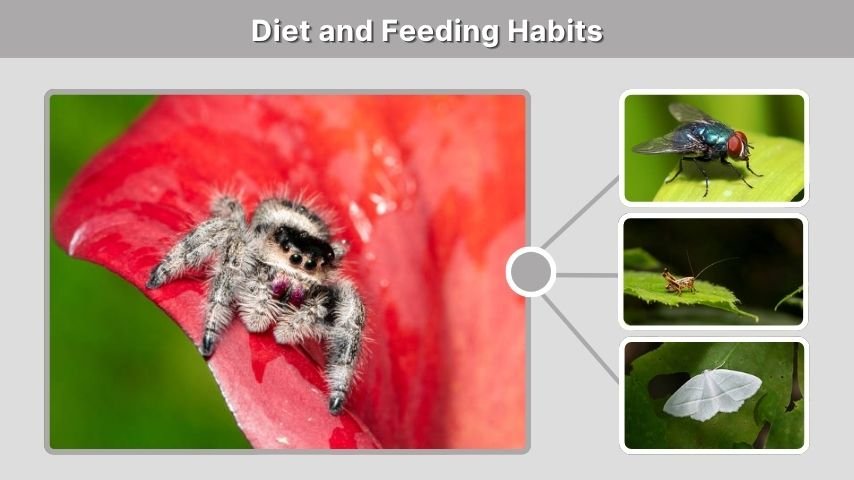
Regal jumping spiders are carnivorous and eat small insects. In the wild, they help control populations of flies, moths, mosquitoes, and other small arthropods.
What They Eat
Common prey includes:
- Flies
- Small crickets
- Moths
- Roaches
- Fruit flies for juveniles
- Small mealworms in captivity
- Other appropriately sized insects
A good rule is to offer prey that is no larger than the spider’s body length. Oversized prey can stress or injure the spider.
Feeding in Captivity
Pet regal jumping spiders usually eat every few days, depending on their age, size, and appetite. Younger spiders often eat more frequently because they are growing. Adults may eat less often, especially before molting or after a large meal.
Remove uneaten prey if the spider does not show interest. Crickets and other insects can harm a spider, especially when it is molting.
Are Regal Jumping Spiders Dangerous?
Regal jumping spiders are not considered dangerous to humans. They are venomous, like most spiders, but their venom is meant for small prey, not people. They are generally shy or curious rather than aggressive.
Do They Bite?
A regal jumping spider may bite if it is trapped, squeezed, or handled roughly. However, bites are uncommon. If a bite happens, it may feel similar to a mild bee sting for some people, though reactions can vary.
People with allergies or unusual symptoms should seek medical advice. In general, the best approach is to avoid stressing the spider and handle it gently, if handling is necessary at all.
Are They Good Around Homes?
Regal jumping spiders can be beneficial around homes and gardens because they eat pest insects. They do not infest houses like some household pests, and they do not build messy webs across large areas.
Regal Jumping Spider as a Pet
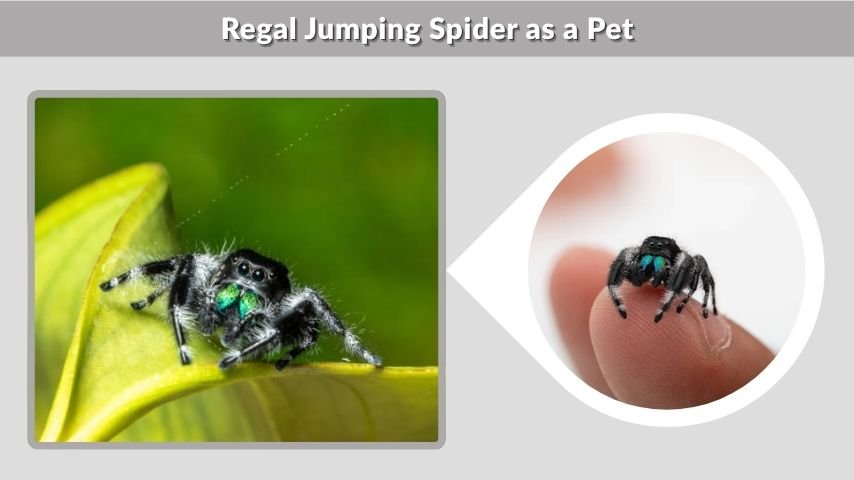
The regal jumping spider has become one of the most popular pet jumping spiders. Its small size, beautiful appearance, and curious personality make it appealing to beginners and experienced keepers.
Why People Keep Them
Many people enjoy regal jumping spiders because they are:
- Small and easy to house
- Visually attractive
- Active during the day
- Interesting to watch while hunting
- Generally calm when treated gently
They do not need a large enclosure, but they do need the right setup to stay healthy.
Enclosure Setup
A regal jumping spider enclosure should be taller than it is wide because these spiders enjoy climbing. Good ventilation is important, but openings should be small enough to prevent escape.
Useful enclosure items include:
- Twigs or cork bark for climbing
- Artificial or live plants
- Small hides near the top
- Cross-ventilation
- A secure lid
- Soft decorations that reduce fall risk
Avoid sharp objects or excessive open height with hard flooring. Although they are good climbers, falls can still be dangerous, especially for older or heavy-bodied spiders.
Temperature and Humidity
Regal jumping spiders prefer warm conditions. A comfortable room-temperature environment is usually suitable, but they should be protected from cold drafts and overheating. Light misting can help provide drinking droplets, but the enclosure should not stay wet.
Good ventilation prevents mold and helps keep the spider healthy.
Molting and Growth
Like all spiders, regal jumping spiders grow by molting. Molting is the process of shedding the old exoskeleton so the spider can grow a new one.
Signs of Molting
Before a molt, a regal jumping spider may:
- Refuse food
- Stay hidden
- Build a thicker silk retreat
- Move less than usual
- Appear dull in color
During this time, it is important not to disturb the spider. Do not offer live prey during molting, because feeder insects can injure a vulnerable spider.
After Molting
After a molt, the spider’s new exoskeleton is soft. Wait until the spider becomes active again before feeding. This may take a few days, depending on the spider’s age and size.
Lifespan of a Regal Jumping Spider
Regal jumping spiders do not live as long as many larger pet arachnids. Their lifespan is usually measured in months to a couple of years, depending on sex, care, and individual health.
Females generally live longer than males. Males often mature faster and may become more focused on finding a mate once adult. Females may remain active and healthy for a longer period with good care.
Breeding and Egg Sacs
Female regal jumping spiders can produce egg sacs after mating. In some cases, females may already be gravid when acquired from the wild or from a seller.
A female will usually build a thick silk retreat for her eggs. She may guard the sac and refuse food for a period. Once spiderlings hatch, they are extremely small and need tiny prey such as fruit flies.
Breeding should only be attempted by keepers who are prepared to care for many spiderlings. A single egg sac can produce a large number of babies, and each will eventually need space, food, and careful monitoring.
Common Care Mistakes
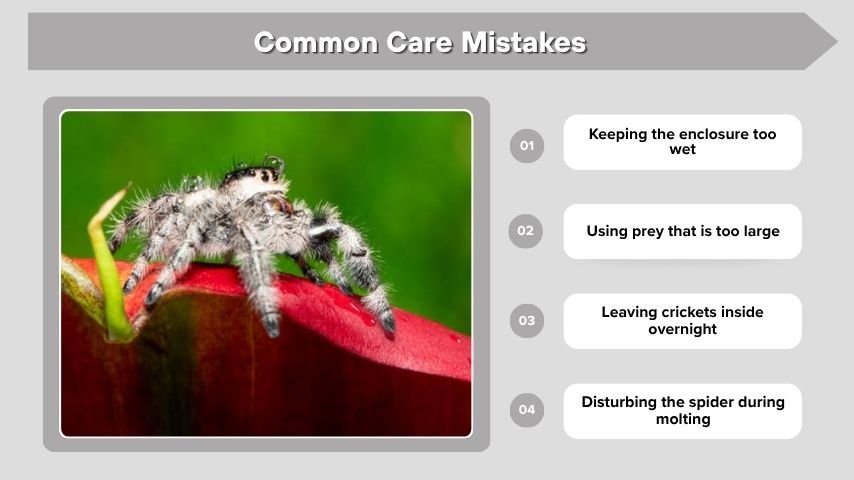
Regal jumping spiders are fairly simple to keep, but mistakes can still cause stress or health problems.
Avoid these common issues:
- Keeping the enclosure too wet
- Using prey that is too large
- Leaving crickets inside overnight
- Disturbing the spider during molting
- Providing poor ventilation
- Handling too often or too roughly
- Placing the enclosure in direct hot sunlight
A simple, clean, well-ventilated enclosure with proper feeding is usually better than an overly complicated setup.
How to Identify a Regal Jumping Spider
Identifying a regal jumping spider is easiest when the spider is mature. Look for a compact body, large front-facing eyes, fuzzy appearance, and bold markings.
Males are often black and white with shiny blue-green or violet mouthparts. Females are usually larger and may be gray, tan, brown, or orange with patterned abdomens.
Because several jumping spiders can look similar, location can also help. If the spider is found in Florida or another southeastern region, Phidippus regius becomes a strong possibility.
Benefits of Regal Jumping Spiders in Nature
Regal jumping spiders play an important ecological role. As predators, they help control insect populations. They feed on flies, moths, mosquitoes, and other small insects, making them useful in gardens and natural habitats.
They are also part of the food chain. Birds, reptiles, larger spiders, and other predators may feed on them. Their presence supports a balanced ecosystem.
FAQs
Are regal jumping spiders friendly?
Regal jumping spiders are not friendly in the human sense, but they are often calm, curious, and non-aggressive. Many will watch movement and explore their surroundings. They should still be handled gently and only when necessary, because they are small and delicate.
Can a regal jumping spider hurt you?
A regal jumping spider is not considered dangerous to humans. It can bite if squeezed or threatened, but bites are uncommon. Most people experience little to no serious reaction. Anyone with strong swelling, pain, or allergic symptoms should seek medical advice.
What do regal jumping spiders eat?
Regal jumping spiders eat small insects such as flies, moths, crickets, roaches, and fruit flies. In captivity, they should be offered prey that is appropriately sized. Juveniles need tiny prey, while adults can handle larger feeder insects.
How long do regal jumping spiders live?
Their lifespan is relatively short compared with many pets. Females usually live longer than males and may survive around one to two years with good care. Males often mature faster and may have shorter adult lives.
Do regal jumping spiders need a web?
Regal jumping spiders do not use webs to trap prey. Instead, they hunt by sight and jump on insects. However, they do use silk to build sleeping retreats, protect egg sacs, create molting shelters, and attach safety lines before jumping.