Botflies (family Oestridae) are parasitic flies known for their unique and often disturbing life cycles. Found worldwide, these insects target mammals—including humans, horses, cattle, deer, and rodents—as hosts for their larvae. While adults resemble bees and rarely feed, their larvae thrive within host tissues. This guide explores 15 types of botflies, highlighting their identification, habitat, behavior, diet, and lifecycle.
1. Dermatobia hominis (Human Botfly)

The human botfly (Dermatobia hominis) is one of the most well-known species of botflies, primarily affecting humans and other mammals in tropical regions of Central and South America. It is infamous for its unique method of parasitism, where larvae develop under the host’s skin, causing painful swellings.
Identification
- Medium-sized fly with a robust body, measuring about 12–18 mm in length.
- Covered in dense hairs, giving a bumblebee-like appearance.
- Metallic blue to greenish body with yellowish legs.
- Adults do not feed; their sole purpose is reproduction.
Habitat
This species thrives in tropical and subtropical forests of Central and South America, especially in areas with abundant mammals as hosts. They are commonly found in rural, forested, and agricultural zones.
Behavior
The female does not lay eggs directly on the host. Instead, it captures other insects (such as mosquitoes or ticks) and attaches its eggs to them. When the carrier insect lands on a warm-blooded host, the eggs hatch, and the larvae penetrate the skin.
Diet
Adult human botflies do not eat. The larvae, however, feed on host tissue fluids while embedded under the skin, creating boil-like lesions.
Lifecycle
The lifecycle consists of four main stages:
- Eggs – Laid on blood-feeding insects.
- Larvae – Invade the host’s skin, feeding and growing for 5–10 weeks.
- Pupae – Drop to the soil to pupate for several weeks.
- Adult fly – Emerges to mate and restart the cycle, living only a few days.
2. Gasterophilus intestinalis (Horse Stomach Botfly)

The horse stomach botfly (Gasterophilus intestinalis) is one of the most common equine parasites. It targets horses and related animals, where its larvae attach to the stomach lining, potentially causing digestive irritation and other health issues.
Identification
- Medium to large fly, measuring about 12–16 mm in length.
- An adult resembles a honeybee with a hairy body.
- Dark brown to black coloration with yellowish markings.
- Distinctively loud buzzing flight when near horses.
Habitat
This species is found worldwide in temperate and tropical regions where horses are kept. It thrives in pastures, stables, and grasslands where equines graze.
Behavior
Females lay eggs on the hairs of horses, particularly on the forelegs and shoulders. When the horse licks or bites the area, the warmth and moisture stimulate hatching, and the larvae migrate into the horse’s mouth, later moving to the stomach.
Diet
Adults do not feed. Larvae feed on host stomach secretions and tissue fluids, attaching themselves firmly to the stomach lining.
Lifecycle
The lifecycle includes:
- Eggs – Deposited on horse hairs.
- Larvae – Enter the mouth and migrate to the stomach.
- Pupae – Leave the host via feces and pupate in the soil.
- Adult fly – Emerges after pupation to mate and restart the cycle.
3. Gasterophilus nasalis (Horse Throat Botfly)

The horse throat botfly (Gasterophilus nasalis) is another common equine parasite. Its larvae settle in the horse’s mouth and migrate to the gastrointestinal tract, potentially leading to throat irritation and digestive issues.
Identification
- Slightly smaller than G. intestinalis, averaging 10–14 mm in length.
- Adults resemble bees, with hairy, yellow-brown bodies.
- Eggs are pale yellow and usually attached to hairs on the horse’s jaw, lips, or throat area.
- Buzzing flight that disturbs horses, especially around the face and head.
Habitat
This species is found in temperate to subtropical regions worldwide, particularly in areas where horses are bred and raised. They are often present in meadows, paddocks, and near water sources where horses congregate.
Behavior
The female lays eggs on hairs near the horse’s mouth and throat. When the horse licks these areas, larvae hatch and invade the oral cavity, embedding themselves in the gums, tongue, or throat. From there, they travel into the stomach and intestines.
Diet
Adults do not feed. Larvae survive by consuming tissue secretions and fluids from the host’s digestive tract, often attaching firmly to mucous membranes.
Lifecycle
The lifecycle stages are:
- Eggs – Deposited near the horse’s lips and jaw.
- Larvae – Enter the mouth and migrate through the oral tissues.
- Pupae – Shed via feces and pupate in the soil.
- Adult fly – Emerges to mate, living only long enough to reproduce.
4. Gasterophilus haemorrhoidalis (Horse Rectal Botfly)
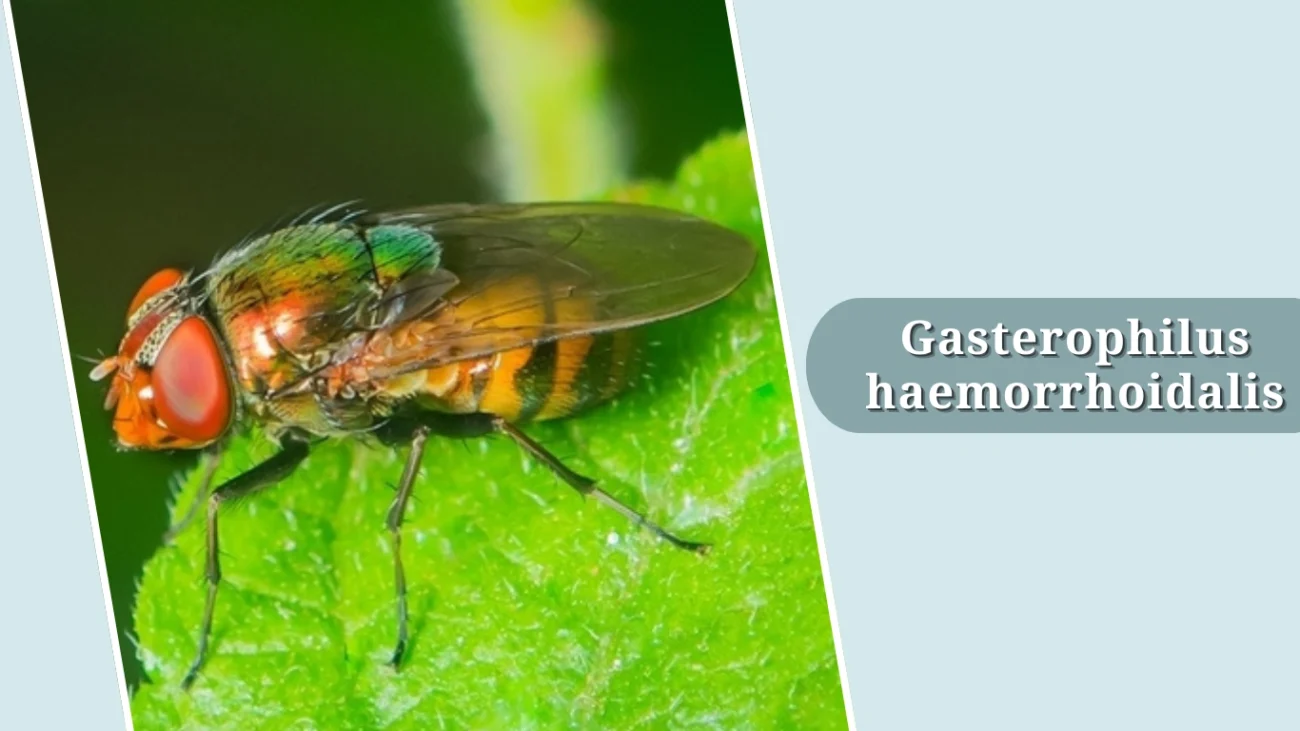
The horse rectal botfly (Gasterophilus haemorrhoidalis) is a less common but notable species that infests horses and other equids. Its larvae target the lips, tongue, and rectal regions, often causing discomfort and irritation.
Identification
- Medium-sized fly, about 12–14 mm in length.
- The body resembles a bee, with dense yellow-brown hairs.
- Eggs are reddish-orange, unlike the pale eggs of other Gasterophilus species.
- Frequently lays eggs around the lips, nostrils, and sometimes near the anus.
Habitat
This species is found in various equine habitats, especially in temperate and subtropical climates. It thrives in stables, grasslands, and rural areas where horses graze.
Behavior
The female botfly lays its reddish eggs near the horse’s mouth, nostrils, and lips. When licked, the larvae hatch and migrate through the horse’s mouth and throat. In later stages, some larvae attach within the rectum or nearby tissues.
Diet
Adults do not feed. Larvae consume tissue fluids and secretions from the horse’s digestive and rectal linings, sometimes leading to inflammation and discomfort.
Lifecycle
The lifecycle follows this sequence:
- Eggs – Laid near lips, nostrils, or rectal region.
- Larvae – Hatch and move into the oral cavity, then to the stomach or rectum.
- Pupae – Passed out with feces and pupate in the soil.
- Adult fly – Emerges, mates, and restarts the cycle.
5. Gasterophilus pecorum
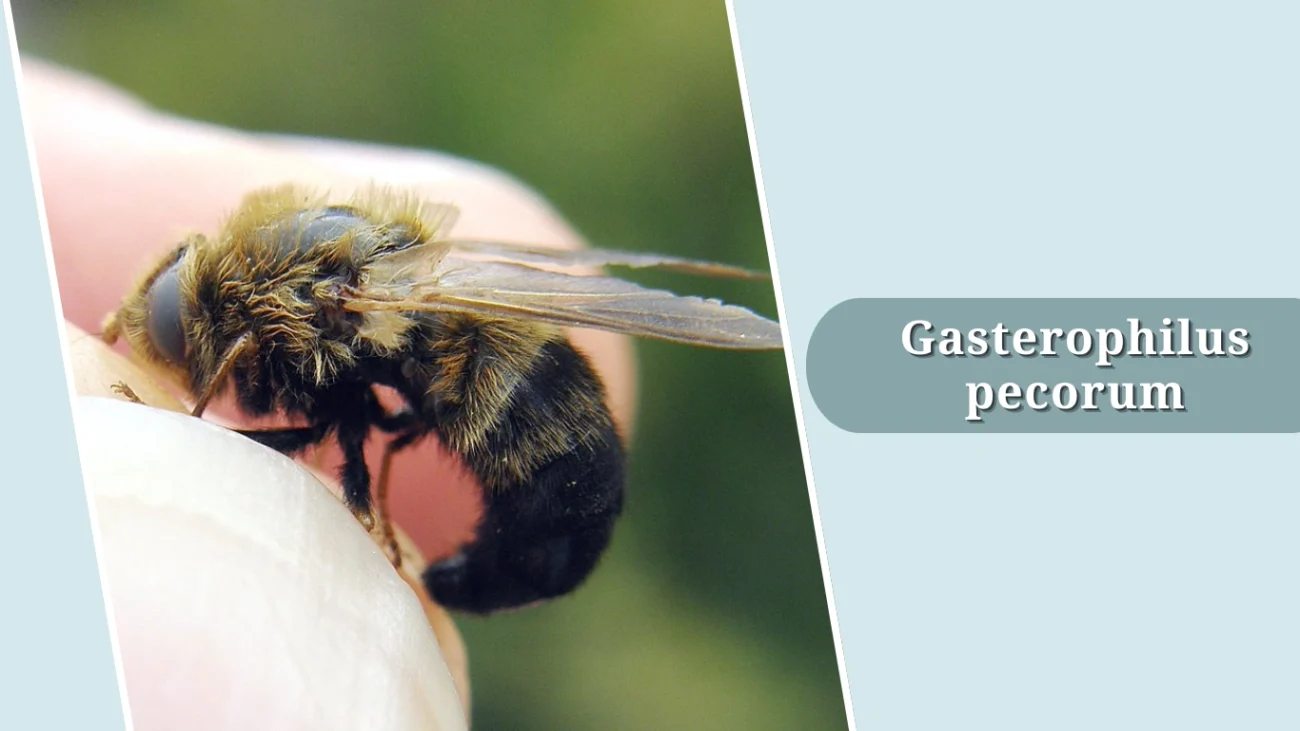
The botfly Gasterophilus pecorum is another parasite of horses and other equids, but it is less frequently encountered compared to the more common Gasterophilus intestinalis and Gasterophilus nasalis. This species is known for its unusual egg-laying habits.
Identification
- Medium-sized fly, averaging 12–15 mm long.
- Hairy body resembling a bee, with yellow-brown coloration.
- Eggs are whitish to yellow and are laid in clusters, unlike most other species.
- Adults have a fast, buzzing flight pattern, often near grazing horses.
Habitat
This species is mainly found in grasslands, pastures, and steppe regions. Unlike other Gasterophilus species that lay eggs directly on the horse’s body, G. pecorum lays its eggs on vegetation, especially on grasses consumed by horses.
Behavior
Females lay eggs on grass stalks or other plants instead of directly on the host. When horses graze, they ingest the eggs, and the larvae hatch in the mouth or esophagus, later migrating to the stomach and intestines.
Diet
Adults do not feed. Larvae rely on secretions and fluids from the lining of the host’s stomach and intestines, attaching to mucous membranes to survive.
Lifecycle
The lifecycle includes:
- Eggs – Laid on grass or plants in grazing areas.
- Larvae – Ingested by horses, develop in the mouth and digestive tract.
- Pupae – Shed in feces, pupate in the soil.
- Adult fly – Emerges, mates, and continues the cycle.
6. Gasterophilus inermis

The botfly Gasterophilus inermis is another parasite of horses, though less common than G. intestinalis or G. nasalis. It is known for its distinct larval development within the host’s oral and digestive regions.
Identification
- Adult size ranges from 10–14 mm in length.
- Hairy, bee-like appearance with brownish-yellow tones.
- Eggs are pale yellow and usually laid around the lips and oral region of horses.
- Larvae are smaller than those of other Gasterophilus species, with a smoother appearance.
Habitat
This species inhabits pastures, meadows, and equine stables in temperate regions. It thrives in areas where horses graze and are in close contact with vegetation that facilitates egg transfer.
Behavior
Females deposit eggs near the horse’s lips, and the larvae hatch when stimulated by licking and moisture. The larvae invade the oral cavity and pharynx before moving down into the stomach, where they develop further.
Diet
Adults do not feed. Larvae consume tissue fluids and secretions from the horse’s oral cavity and stomach lining, potentially causing irritation or minor lesions.
Lifecycle
The lifecycle proceeds as follows:
- Eggs – Attached near the lips or oral area.
- Larvae – Hatch and migrate to the mouth and stomach.
- Pupae – Excreted with feces and pupate in the soil.
- Adult fly – Emerges after pupation, survives briefly to mate and reproduce.
7. Gasterophilus nigricornis

The botfly Gasterophilus nigricornis is another equine parasite in the Gasterophilus genus. It is less widespread than the more common species but still plays a role in infesting horses and other equids, particularly in certain geographic ranges.
Identification
- Medium-sized adult fly, about 12–15 mm long.
- Hairy, bee-like appearance with a dark brown to black body.
- Distinctive black antennae (the name nigricornis means “black-horned”).
- Eggs are yellowish and typically placed on the inner forelegs and chest areas of horses.
Habitat
This species occurs in temperate to subtropical climates, often in grasslands, pastures, and rural equine environments. Its distribution is more limited compared to G. intestinalis or G. nasalis.
Behavior
Females lay eggs on the hairs of horses, especially on the forelegs and chest. When the horse licks these regions, the larvae hatch and migrate into the oral cavity. They later pass into the digestive tract, where they continue to develop.
Diet
Adults do not feed. Larvae feed on tissue secretions and fluids within the horse’s mouth and gastrointestinal lining, which may cause localized irritation.
Lifecycle
The lifecycle follows a pattern similar to other Gasterophilus species:
- Eggs – Deposited on forelegs and chest hairs of horses.
- Larvae – Hatch in the mouth, migrate to the digestive tract.
- Pupae – Leave the body through feces and pupate in soil.
- Adult fly – Emerges, mates, and lays eggs, living only a short time.
8. Cephenemyia trompe (Reindeer Botfly)
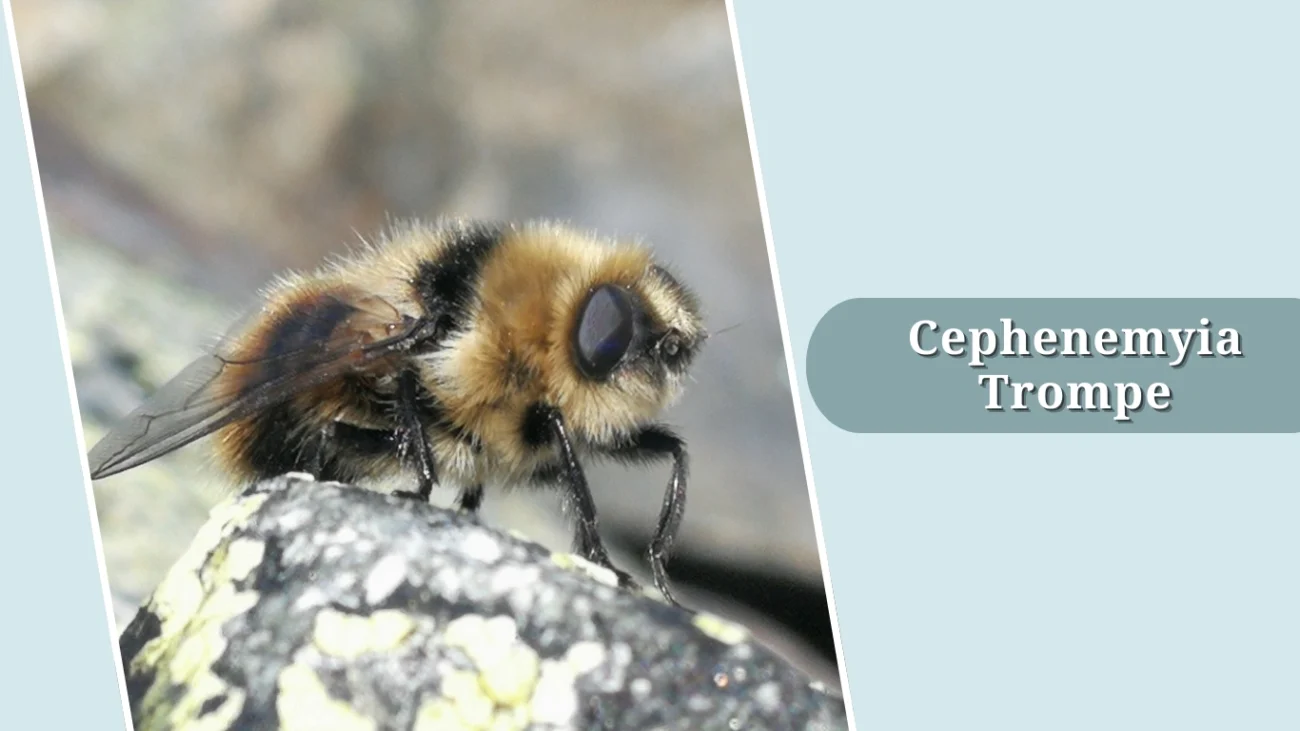
The reindeer botfly (Cephenemyia trompe) is a well-known parasite of reindeer and caribou. It is adapted to survive in Arctic and sub-Arctic climates, where it causes significant irritation and stress to its hosts.
Identification
- Adult size is about 12–15 mm in length.
- Hairy, bumblebee-like body with yellow-brown to gray coloration.
- Eggs are not laid on the host’s body but instead the female ejects live larvae directly into the nostrils of reindeer.
- Larvae are pale, elongate, and adapted for burrowing in nasal passages.
Habitat
This species inhabits Arctic and sub-Arctic tundra regions, particularly in northern Europe, Siberia, Alaska, and Canada. It is closely tied to the distribution of reindeer and caribou.
Behavior
Instead of laying eggs, the female deposits living larvae directly into the host’s nostrils while in flight. The larvae migrate into the nasal passages and throat, where they develop, causing discomfort and sometimes respiratory problems.
Diet
Adults do not feed. Larvae survive on mucus, tissue secretions, and fluids within the nasal cavities and throat of reindeer.
Lifecycle
The lifecycle involves:
- Larvae (1st stage) – Deposited directly into the nostrils.
- Larvae (2nd–3rd stages) – Develop in nasal passages and throat over several months.
- Pupae – Ejected when the reindeer sneezes or coughs them out; they pupate in soil.
- Adult fly – Emerges, mates quickly, and repeats the cycle.
9. Cephenemyia stimulator (Roe Deer Botfly)

The roe deer botfly (Cephenemyia stimulator) is a parasite that specifically targets roe deer, infesting their nasal passages and throat. It is a close relative of the reindeer botfly but has a distribution more centered in Europe.
Identification
- Adult flies measure about 10–14 mm in length.
- Dense, hairy body resembling a small bumblebee.
- Brown to gray coloration with lighter patches.
- Females eject live larvae into the nostrils of roe deer instead of laying eggs externally.
Habitat
This species is found in woodlands, grasslands, and rural areas across Europe, particularly where roe deer populations are common. It thrives in temperate forests and open meadows.
Behavior
The female hovers near roe deer and ejects live larvae directly into their nostrils. The larvae migrate into the nasal passages and pharynx, causing irritation, breathing difficulties, and in heavy infestations, reduced feeding and overall stress.
Diet
Adults do not feed. Larvae feed on nasal mucus and secretions, sometimes causing inflammation or infections in the nasal and throat tissues.
Lifecycle
The lifecycle is similar to other Cephenemyia species:
- Larvae (1st stage) – Deposited directly into the nostrils of roe deer.
- Larvae (2nd–3rd stages) – Develop within nasal passages and throat.
- Pupae – Expelled through sneezing or coughing, pupate in the soil.
- Adult fly – Emerges, mates, and restarts the cycle, living only briefly.
10. Cephenemyia ulrichii (Moose Botfly)

The moose botfly (Cephenemyia ulrichii) is a nasal parasite that specifically targets moose. Like other members of the Cephenemyia genus, it is well-adapted to its host and can cause respiratory discomfort during infestations.
Identification
- Adults measure 12–16 mm in length.
- Dense, hairy body with a yellowish-brown to grayish coloration.
- Strong resemblance to bumblebees in both appearance and flight.
- Females eject live larvae directly into the nostrils of moose.
Habitat
This species is distributed in northern Europe, Scandinavia, and parts of Russia, inhabiting boreal forests and sub-Arctic regions where moose are common.
Behavior
The female fly hovers near moose and ejects live larvae into the nostrils. The larvae migrate into the nasal cavities and throat, causing irritation and sometimes labored breathing. Heavily infested moose may show restlessness and frequent head shaking.
Diet
Adults do not feed. Larvae survive on nasal secretions and tissue fluids within the nasal passages and pharynx of moose.
Lifecycle
The lifecycle includes:
- Larvae (1st stage) – Deposited directly in the nostrils.
- Larvae (2nd–3rd stages) – Grow in nasal passages and throat.
- Pupae – Expelled by sneezing/coughing, pupate in soil.
- Adult fly – Emerges, mates, and continues the cycle, living briefly.
11. Oestrus ovis (Sheep Botfly)
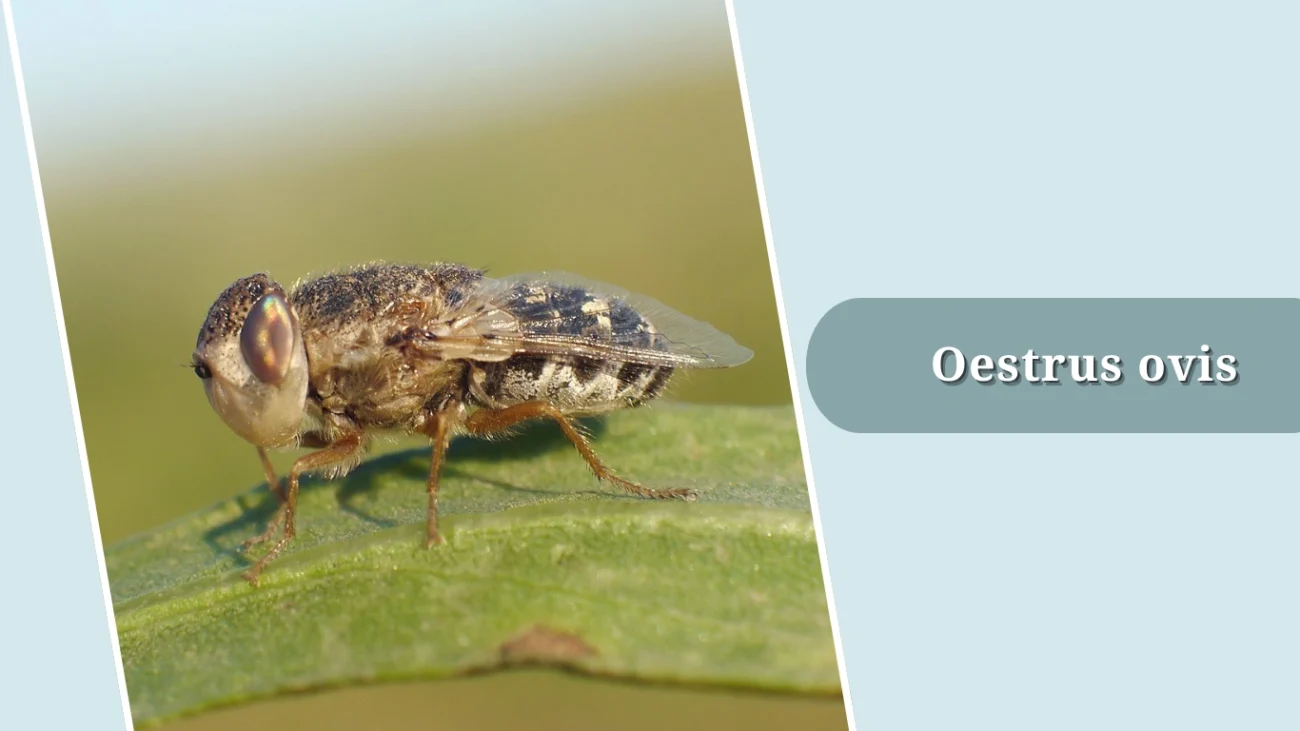
The sheep botfly (Oestrus ovis) is a well-known parasite of sheep and goats. It is notorious for causing nasal infestations, leading to respiratory discomfort and reduced productivity in livestock.
Identification
- Adult size is about 10–12 mm in length.
- Grayish, hairy body with dark spots, resembling a small housefly.
- Short antennae and large compound eyes.
- Females are viviparous, ejecting live larvae rather than laying eggs.
Habitat
This species occurs worldwide, particularly in warm and temperate regions. It is especially common in sheep-raising areas across Europe, Africa, Asia, and the Americas.
Behavior
The female fly hovers near sheep or goats and ejects live larvae into their nostrils. The larvae then migrate into the nasal passages and sinuses, where they cause irritation and inflammation. Infested animals often sneeze, shake their heads, or rub their noses on the ground.
Diet
Adults do not feed. Larvae survive on nasal mucus, secretions, and tissue fluids of the host. In severe infestations, they may cause breathing difficulties and secondary infections.
Lifecycle
The lifecycle consists of:
- Larvae (1st stage) – Deposited directly into nostrils.
- Larvae (2nd–3rd stages) – Grow within nasal passages and sinuses.
- Pupae – Expelled by sneezing, pupate in soil.
- Adult fly – Emerges, mates, and reproduces, living only long enough to complete the cycle.
12. Hypoderma bovis (Cattle Warble Fly)

The cattle warble fly (Hypoderma bovis) is a major parasite of cattle, causing significant economic losses in livestock industries. Its larvae form large swellings, known as “warbles,” under the skin of the host.
Identification
- Adult flies measure 12–15 mm in length.
- Bee-like in appearance, with a hairy yellow-brown body and black patches.
- Strong, noisy flight that frightens cattle.
- Eggs are laid singly on the hairs of cattle, especially on the lower body and legs.
Habitat
This species is found in temperate regions across Europe, Asia, and North America, particularly in areas of intensive cattle farming. It thrives in pastures, grazing lands, and rural agricultural zones.
Behavior
Female flies deposit eggs on the hairs of cattle. Once hatched, larvae penetrate the skin and migrate through connective tissues, eventually settling along the animal’s back, where they create subcutaneous swellings (warbles).
Diet
Adults do not feed. Larvae survive by consuming tissue fluids and connective tissues of the host, which often leads to weight loss, hide damage, and reduced milk production in cattle.
Lifecycle
The lifecycle proceeds as follows:
- Eggs – Laid on cattle’s hair, especially lower body.
- Larvae – Hatch, penetrate skin, and migrate through the body to the back.
- Pupae – Exit through breathing holes, fall to soil, and pupate.
- Adult fly – Emerges, mates, and lays eggs, living only a short time.
13. Hypoderma lineatum (Common Cattle Grub)

The common cattle grub (Hypoderma lineatum) is another economically important parasite of cattle, closely related to Hypoderma bovis. Its larvae also form warbles under the skin, but with slightly different migration routes inside the host.
Identification
- Adult flies measure about 12–15 mm in length.
- Resembles a bee, with yellowish hairs on the thorax and dark bands on the abdomen.
- Females are strong fliers and cause panic in cattle when hovering.
- Eggs are whitish and glued in rows to cattle hairs, especially on the legs and lower body.
Habitat
This species occurs widely in North America, Europe, and parts of Asia, particularly in cattle-grazing regions. It thrives in pastures, grasslands, and rural farms.
Behavior
Female flies lay eggs on the hairs of cattle. After hatching, larvae burrow into the skin and migrate through connective tissues, usually passing through the esophagus before settling beneath the skin of the back.
Diet
Adults do not feed. Larvae consume host tissue fluids and connective tissues, which leads to irritation, tissue damage, and reduced productivity in cattle.
Lifecycle
The lifecycle follows these stages:
- Eggs – Laid on hairs of cattle’s legs and underbelly.
- Larvae – Penetrate skin, migrate via connective tissues and esophagus, then move to the back.
- Pupae – Exit through breathing holes in the skin, drop to the ground, and pupate.
- Adult fly – Emerges, mates, and restarts the cycle, living only a few days.
14. Cuterebra emasculator (Squirrel Botfly)

The squirrel botfly (Cuterebra emasculator) is a parasite of squirrels, chipmunks, and other small rodents in North America. It is most infamous for developing in the genital region of squirrels, which gave rise to its species name emasculator.
Identification
- Adult flies measure 15–20 mm in length.
- Large, robust body with dense gray to black hairs.
- Strong resemblance to bumblebees in both color and size.
- Eggs are deposited near rodent burrows and runways rather than directly on the host.
Habitat
This species is common in North American forests, woodlands, and suburban areas, wherever squirrels and chipmunks are abundant. It is especially active during late summer and early autumn.
Behavior
Females lay eggs near rodent nests or burrow entrances. When a host passes by, body heat stimulates the eggs to hatch, and larvae attach to the fur. They then burrow into the host’s skin, typically in the genital or abdominal region, where they develop beneath the skin.
Diet
Adults do not feed. Larvae consume tissue fluids and host cells, creating a warble-like swelling under the skin, with a breathing hole at the surface.
Lifecycle
The lifecycle consists of:
- Eggs – Deposited near rodent nests and burrows.
- Larvae – Hatch, attach to the host, and burrow under the skin.
- Pupae – Leave the host through the breathing hole, fall to the ground, and pupate.
- Adult fly – Emerges, mates, and deposits eggs, living only briefly.
15. Cuterebra fontinella (Mouse Botfly)
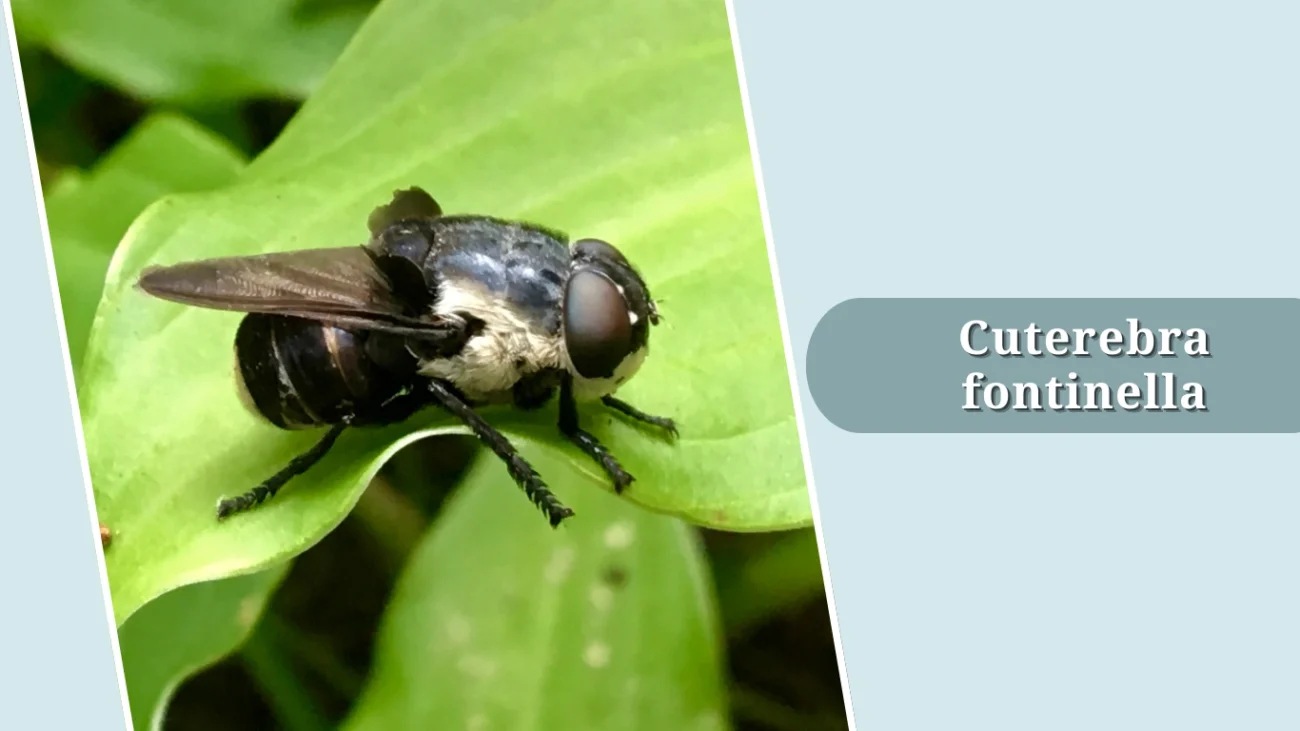
The mouse botfly (Cuterebra fontinella) is a parasite of mice and other small rodents in North America. It is one of the most studied species of Cuterebra because of its common occurrence in wild rodent populations.
Identification
- Adult size ranges from 12–18 mm in length.
- Stout, hairy body with black and gray coloration, bee-like in appearance.
- Eggs are laid in the environment near rodent burrows and runways rather than directly on the host.
- Larvae are pale and thick-bodied, specialized for subcutaneous development.
Habitat
This species inhabits woodlands, grasslands, and suburban areas across North America, particularly where populations of white-footed mice and deer mice are abundant.
Behavior
Females deposit eggs near rodent nests and travel paths. When a mouse brushes past, the warmth and movement trigger the eggs to hatch. The larvae attach to the fur, then burrow under the skin, forming characteristic swellings (warbles).
Diet
Adults do not feed. Larvae live subcutaneously, feeding on tissue fluids and host cells, causing boil-like swellings with an air hole for respiration.
Lifecycle
The lifecycle includes:
- Eggs – Laid near rodent burrows and paths.
- Larvae – Hatch, penetrate the host’s skin, and develop subcutaneously.
- Pupae – Exit from the warble, drop to the soil, and pupate.
- Adult fly – Emerges, mates, and continues the cycle, living only long enough to reproduce.