


White storks are tall, graceful birds known for their long legs, wide wings, and white plumage. While the term “white stork” often refers to a single species, several stork species around the world have mostly white bodies with black flight feathers or unique features. This guide introduces 8 types of white or mostly white storks, with simple identification tips and visual traits to help you recognize each one.
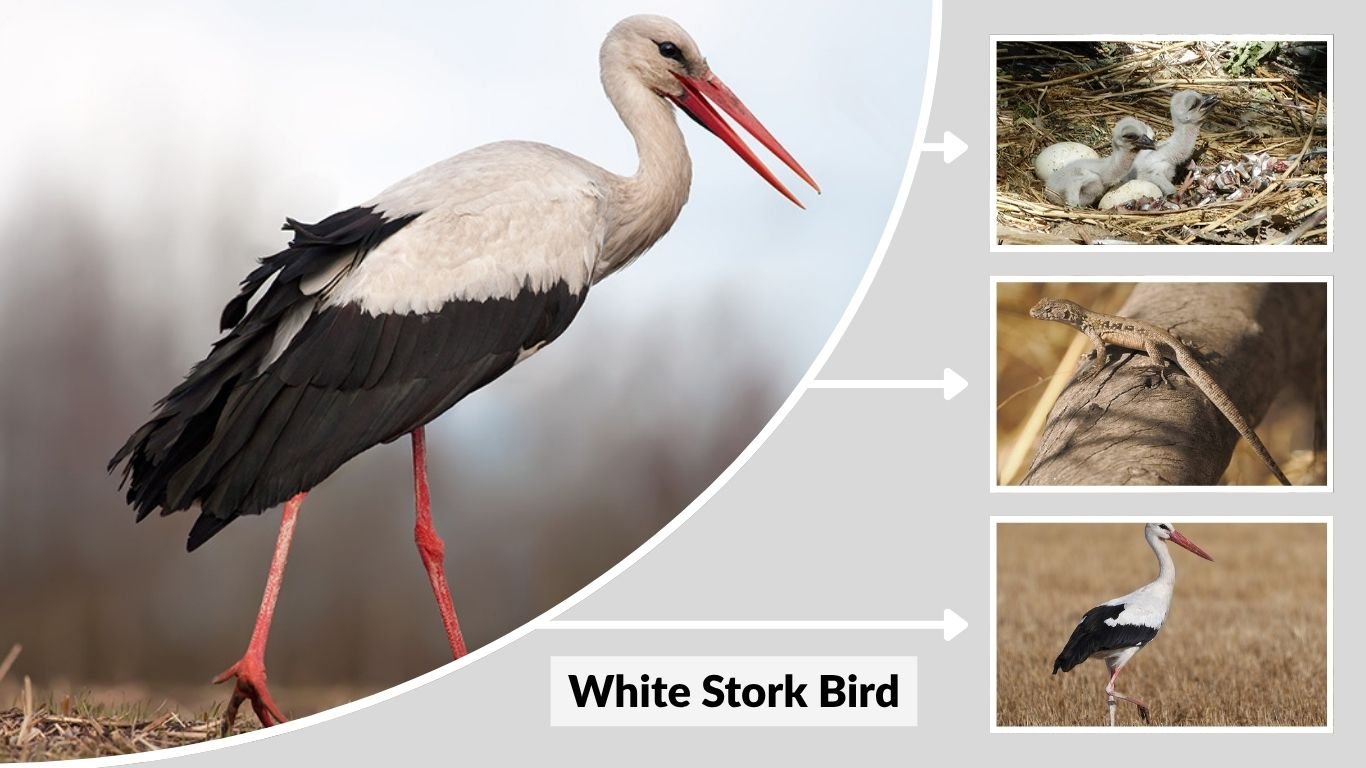
1. White Stork (Ciconia ciconia)

The White Stork is one of the most well-known stork species, often associated with folklore, migration, and nesting on rooftops. It breeds in Europe and western Asia and winters in Africa.
Identification
- Bright white body with black flight feathers
- Long red legs and pointed red bill
- Wingspan: about 2 meters
- Stands around 100–115 cm tall
- Flies with neck and legs fully extended
Behavior
White Storks are social during migration and nesting but feed alone. They build large stick nests on trees, rooftops, or platforms and return to the same site every year. Pairs often stay together for multiple breeding seasons.
Habitat
Found in open farmlands, wet meadows, riverbanks, and villages. Frequently seen near human settlements and protected areas in Europe and Africa. Prefers flat landscapes with nearby water and feeding grounds.
Hunting and Diet
White Storks are opportunistic feeders. They hunt by walking slowly through fields or shallow water, using their sharp eyesight and long bill to catch prey. Their diet includes:
- Insects (grasshoppers, beetles, crickets)
- Frogs and toads
- Small snakes and lizards
- Fish and small mammals (like mice or voles)
- Earthworms and occasionally bird chicks or eggs
They do not dive or chase prey in flight—most food is caught on the ground or just below the water surface.
2. Oriental Stork (Ciconia boyciana)

The Oriental Stork is a large, mostly white stork found in East Asia. It looks very similar to the White Stork but is slightly larger and has a black bill. It is considered a symbol of happiness and longevity in some Asian cultures.
Identification
- White plumage with black flight feathers and tail
- Long black bill (unlike the red bill of the White Stork)
- Long red legs
- Wingspan: up to 2.2 meters
- Body length: around 110–130 cm
Behavior
Generally solitary or in pairs. Builds large nests high in trees or on man-made platforms. Very shy in the wild. Breeding pairs show strong site loyalty and raise 2–4 chicks per season.
Habitat
Found near wetlands, lakes, rice paddies, and floodplains in eastern Russia, China, Korea, and Japan. Winters in southern China and Vietnam. Requires undisturbed, clean wetlands for survival.
Hunting and Diet
Feeds in shallow water and wet grasslands. Hunts by walking slowly and striking quickly with its bill. Diet includes:
- Fish and frogs
- Crabs and snails
- Aquatic insects
- Small reptiles and occasionally rodents
Often hunts alone and is most active in early morning or late afternoon.
3. Maguari Stork (Ciconia maguari)

The Maguari Stork is a large, mostly white stork native to South America. It is often seen in open wetlands and grasslands and is sometimes mistaken for the White Stork due to similar coloring.
Identification
- White body with black flight feathers and tail
- Red-pink legs
- Grayish bill with a dark tip
- Bare reddish skin around the eyes
- Wingspan: around 1.5–1.7 meters
Behavior
Usually solitary or in small groups. Nests in low vegetation, often on the ground or low shrubs. Known to be quieter and less social than other storks during the breeding season.
Habitat
Found in marshes, flooded savannas, wet grasslands, and rice fields across Argentina, Brazil, Paraguay, and Bolivia. Prefers areas with standing water and tall grasses.
Hunting and Diet
Feeds by wading in shallow water or flooded fields, picking prey from the surface. Diet includes:
- Small fish and frogs
- Insects (especially grasshoppers and beetles)
- Snakes and small mammals
- Earthworms and crustaceans
Often seen hunting after rains when prey is most active.
4. Wood Stork (Mycteria americana)
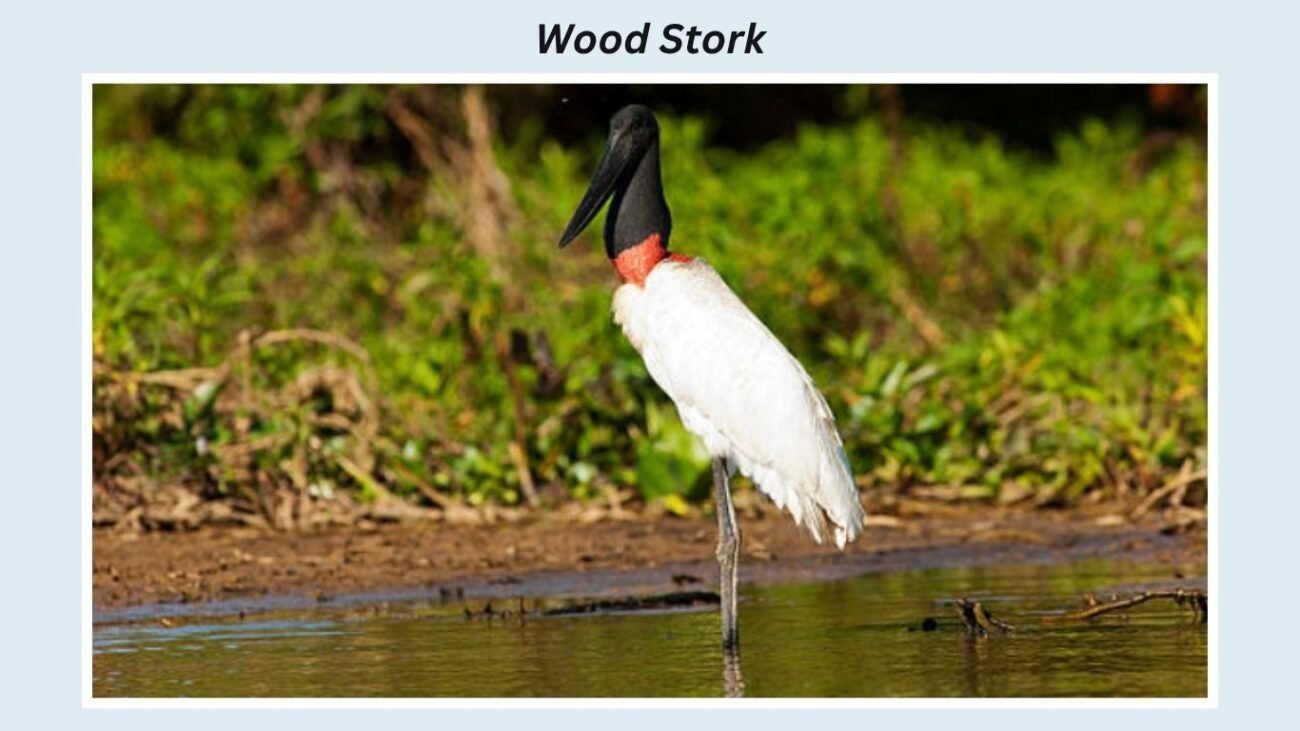
The Wood Stork is the only stork species that breeds in North America. It is mostly white but has a bald, dark head and thick bill. Common in the southeastern U.S., it’s also found in Central and South America.
Identification
- White body with black flight feathers and tail
- Bald, dark gray head and neck
- Long, thick, down-curved bill
- Black legs, often with pinkish feet
- Wingspan: up to 1.8 meters
Behavior
Often found in groups near wetlands. Nests in colonies high in trees, often near water. Flies gracefully in thermals and glides with wings flat. Uses tactile hunting—snapping its bill shut when prey touches it.
Habitat
Found in swamps, mangroves, flooded forests, and marshes. Breeding sites are usually in areas where water levels drop during nesting, concentrating fish for feeding.
Hunting and Diet
Feeds mainly in shallow water, using its open bill like a trap. Diet includes:
- Small fish (main food source)
- Frogs and tadpoles
- Crustaceans
- Insects and small reptiles
It feeds more actively when water levels are low and fish are easier to catch.
5. Painted Stork (Mycteria leucocephala)

The Painted Stork is a large and colorful stork found across the Indian Subcontinent and parts of Southeast Asia. Its pink feathers and long yellow bill make it easy to recognize.
Identification
- Mostly white body with pink tertial feathers
- Black and white barring on wings
- Long yellow bill, slightly curved at the tip
- Bare orange face and forehead
- Reddish legs
- Wingspan: about 1.5–1.7 meters
Behavior
Highly social—often feeds and nests in large groups. Builds nests in colonies, often with other waterbirds. Frequently seen standing still in shallow water while hunting.
Habitat
Inhabits shallow wetlands, lakes, marshes, rice fields, and riverbanks. Commonly seen near human settlements in India, Sri Lanka, and Bangladesh.
Hunting and Diet
Feeds by sweeping its bill side-to-side in shallow water to catch prey. Diet includes:
- Small fish and frogs
- Crabs and snails
- Aquatic insects
- Occasionally worms and tadpoles
Most active in the morning and late afternoon. Feeds in lines or groups during breeding season.
6. Milky Stork (Mycteria cinerea)

The Milky Stork is a rare and declining stork species native to Southeast Asia. It looks similar to the Painted Stork but has a cleaner white appearance and is more sensitive to habitat disturbance.
Identification
- Mostly white body with black flight feathers
- Slight pink wash on the back and wings
- Yellow, slightly curved bill
- Bare reddish-orange face and legs
- Wingspan: about 1.5–1.6 meters
Behavior
Often seen in small groups or pairs. Breeds in colonies, usually near mangroves or flooded forests. Shy around humans and avoids busy areas. Builds large stick nests in trees close to water.
Habitat
Found in coastal wetlands, mangrove forests, mudflats, and tidal swamps of Malaysia, Sumatra, and Borneo. Prefers quiet, undisturbed areas with shallow feeding grounds.
Hunting and Diet
Feeds by slowly wading through water, using its bill to detect prey. Diet includes:
- Small fish
- Frogs and crustaceans
- Aquatic insects
- Mudskippers and small invertebrates
Feeding is done during low tide in estuaries or tidal creeks.
7. Yellow-billed Stork (Mycteria ibis)

The Yellow-billed Stork is a striking wading bird found throughout sub-Saharan Africa and Madagascar. It’s graceful, social, and often seen feeding in shallow wetlands with other waterbirds.
Identification
- White body with black flight feathers
- Long, down-curved yellow bill
- Bare red face and forehead
- Pinkish legs that turn bright red in breeding season
- Wingspan: about 1.5–1.7 meters
Behavior
Feeds actively in shallow water, often seen sweeping its bill side to side. Nests in large colonies, sometimes with spoonbills and herons. Breeds during or after the rainy season when food is abundant.
Habitat
Inhabits freshwater marshes, lakeshores, riverbanks, and floodplains. Prefers open wetlands with plenty of fish and amphibians.
Hunting and Diet
Hunts by touch while walking through water. Diet includes:
- Small fish and tadpoles
- Frogs and insects
- Crabs and aquatic worms
- Occasionally small reptiles and snails
Feeds alone or in groups, often spaced out to avoid competition.
8. Jabiru (Jabiru mycteria)

The Jabiru is the tallest flying bird in Central and South America. It’s known for its strong build, enormous bill, and towering presence in wetlands. Its name comes from a Tupi–Guarani word meaning “swollen neck.”
Identification
- White body with black head and neck
- Bare skin on neck with a large red pouch at the base
- Massive, thick, black upturned bill
- Long black legs
- Wingspan: up to 2.8 meters
- Height: about 120–140 cm
Behavior
Usually solitary or in pairs, but may gather in small groups when feeding. Pairs often mate for life and build massive stick nests in tall trees. They return to the same nest year after year, adding new layers each season.
Habitat
Found in wetlands, marshes, riverbanks, and flooded savannas across Brazil, Paraguay, Nicaragua, Honduras, and northern Argentina. Prefers open, shallow freshwater habitats with minimal human disturbance.
Hunting and Diet
Feeds in shallow waters, walking slowly and jabbing at prey with its powerful bill. Diet includes:
- Fish (main food source)
- Frogs and small reptiles
- Crustaceans and mollusks
- Small mammals and carrion when available
Jabirus are opportunistic feeders and play a key role in keeping wetland ecosystems healthy.
FAQs
Are white storks and oriental storks the same species?
No. While they look similar, the White Stork (Ciconia ciconia) and Oriental Stork (Ciconia boyciana) are two different species. The Oriental Stork is slightly larger and has a black bill, while the White Stork has a red bill.
Do white storks migrate?
Yes. White Storks are long-distance migratory birds. They breed in Europe and western Asia and migrate to sub-Saharan Africa for the winter, covering thousands of kilometers along safe land routes that provide thermal currents.
What do white storks eat?
White Storks are opportunistic hunters. They eat a variety of prey, including insects, frogs, snakes, small mammals, earthworms, and even small birds or fish. They hunt mostly by walking through fields or shallow water.
Where do white storks build their nests?
White Storks build large stick nests on rooftops, trees, poles, or specially built platforms. These nests are reused and enlarged each year, sometimes weighing over 500 kg.
Are white storks endangered?
No, the White Stork is currently listed as Least Concern by the IUCN. However, habitat loss, pollution, and power lines pose threats in some regions. Conservation efforts in Europe have helped populations recover in many areas.