











The green heron is one of North America’s most intriguing wading birds—compact, secretive, and intelligent. Its dark green crown, chestnut neck, and blue-gray plumage make it a standout in wetlands, yet it’s often confused with bitterns, night herons, and even its larger cousin, the great blue heron. Subtle distinctions also exist between male and female green herons. Understanding these differences helps birdwatchers accurately identify this small yet remarkable bird in the wild.
Identification of the Green Heron
Species Overview
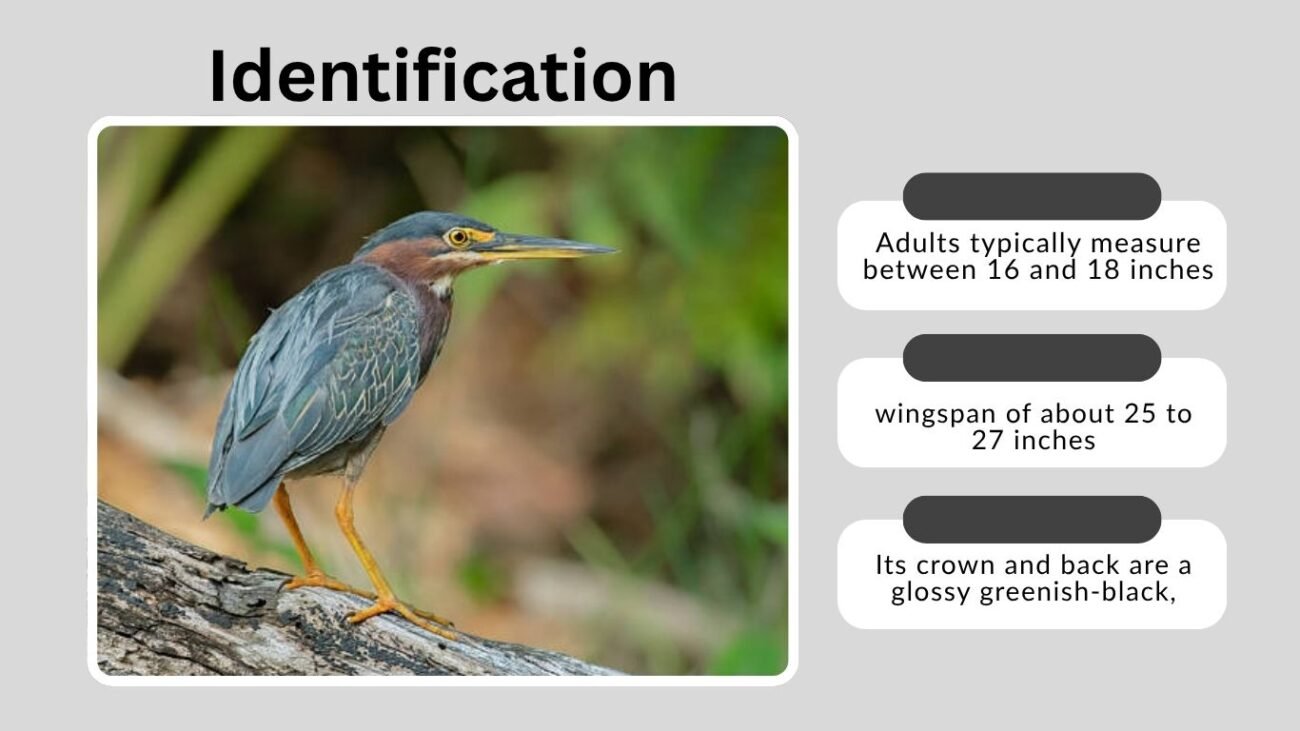
The green heron (Butorides virescens) is a small member of the heron family, found throughout North, Central, and parts of South America. Adults measure about 16–18 inches long with a wingspan of 25–27 inches, making them one of the smallest herons in the Western Hemisphere. Despite their size, their behavior and hunting methods are sophisticated, often involving tool use — such as dropping insects or twigs on the water to lure fish.
Appearance
Green herons have an elegant combination of colors. Their head and back appear dark greenish-black, while their neck and chest are a deep chestnut brown. The wings shine with iridescent blue-green tones that glimmer in sunlight. Their eyes are yellow, and their legs range from yellow to orange, becoming brighter during breeding. The posture is usually hunched, giving them a compact, stocky appearance that contrasts with taller herons.
Green Heron Male vs Female
Physical Differences
At first glance, males and females appear identical, but small variations set them apart.
- Males are slightly larger and heavier, often with richer coloration during breeding. Their green and blue tones appear deeper and more glossy, especially when sunlight hits their plumage.
- Females are smaller, with softer, lighter hues and shorter head plumes.
- The male’s bill is thicker and longer, used effectively for nest defense and foraging, while the female’s bill appears slightly finer.
| Feature | Male | Female |
| Size | Larger, bulkier | Smaller, slimmer |
| Plumage | Richer green and chestnut | Paler tones |
| Crest | Longer during breeding | Shorter and smoother |
| Legs | Brighter orange in spring | Lighter yellow-orange |
| Behavior | Territorial and vocal | Nurturing and calm |
Behavioral Roles
During the breeding season, males arrive first at nesting areas and choose suitable trees or shrubs near water. They defend these territories aggressively with loud squawks and wing displays. Courtship involves stick-offering rituals—a male presents a twig to a female as part of bonding. Once paired, both work together to construct the nest and share incubation duties.
The male often takes daytime shifts, while the female incubates at night. Both feed the chicks, proving that cooperation is central to their reproductive success.
Green Heron vs Least Bittern
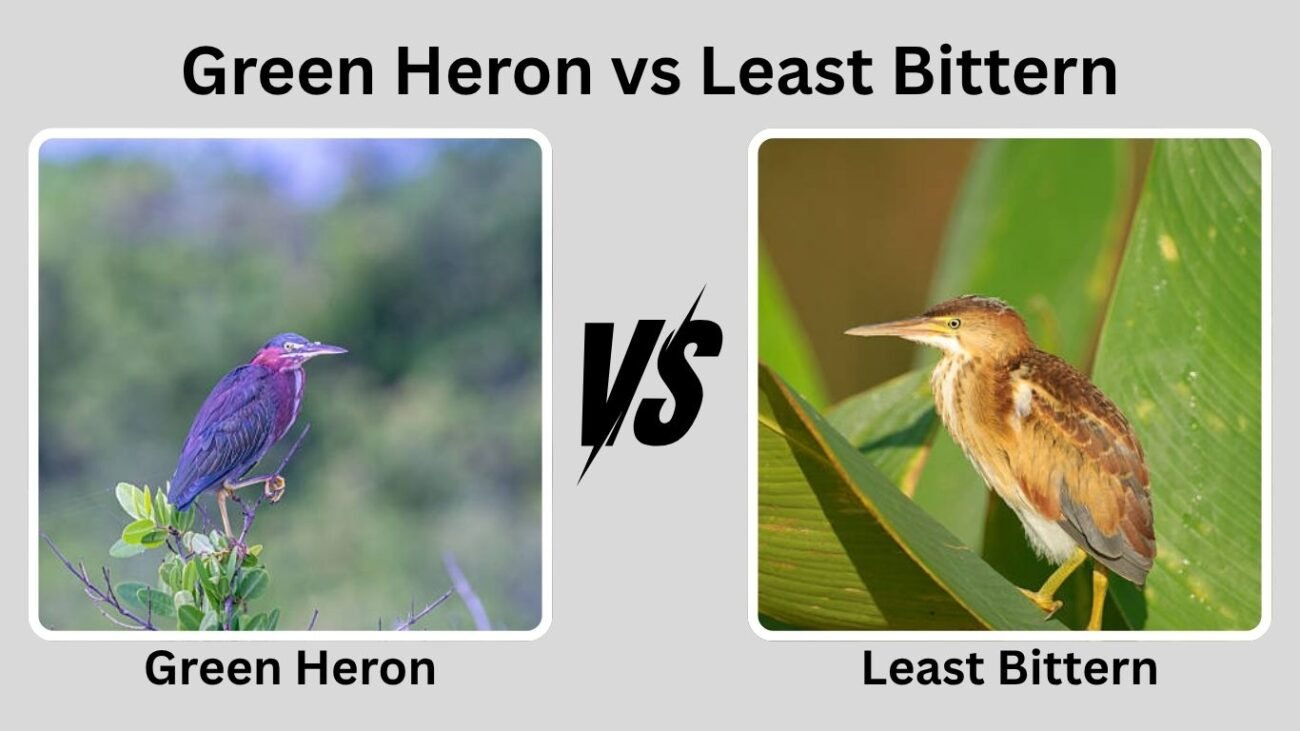
The least bittern (Ixobrychus exilis) is often mistaken for a green heron because of its small size and secretive behavior, but the two species are easy to tell apart once their traits are compared.
| Feature | Green Heron | Least Bittern |
| Size | 16–18 inches | 11–13 inches |
| Color | Dark green crown, chestnut neck | Buff, tan, and brown tones |
| Behavior | Solitary, hunts from perches | Hides among reeds |
| Flight | Strong and direct | Fluttery, weak flight |
| Call | Sharp “skeow” | Soft “coo-coo” or “reek” sounds |
The least bittern is smaller and paler, spending most of its life among dense cattails. The green heron, by contrast, prefers more open areas with low vegetation and visible water. While both are patient hunters, the green heron’s posture is more horizontal and deliberate.
Green Heron vs American Bittern
The American bittern (Botaurus lentiginosus) is much larger and heavily camouflaged, often standing upright among reeds to blend into its surroundings. In contrast, the green heron crouches low and relies on stealth.
| Feature | Green Heron | American Bittern |
| Height | 16–18 inches | 24–33 inches |
| Plumage | Green-blue and chestnut | Brown and tan with vertical streaks |
| Habitat | Wooded ponds, marsh edges | Open wetlands and tall reeds |
| Behavior | Perches and stalks | Stands motionless upright |
| Call | Harsh “kyow” or “skeow” | Deep booming “oonk-ka-loonk” call |
The bittern’s booming call resonates through marshes, while the green heron’s sharp cry cuts through forested wetlands. Both species rely on camouflage but in opposite ways: the bittern through coloration, the green heron through shadows and stillness.
Green Heron vs Blue Heron
The great blue heron (Ardea herodias) is a familiar giant of North American wetlands, often mistaken for a “large version” of the green heron. However, they differ dramatically in size and habitat preference.
| Feature | Green Heron | Great Blue Heron |
| Height | 16–18 inches | 42–52 inches |
| Wingspan | 25–27 inches | Up to 72 inches |
| Color | Green-blue and chestnut | Gray-blue with white head |
| Behavior | Solitary, secretive | Gregarious, often seen in groups |
| Habitat | Forested wetlands | Open lakes and coastlines |
While the great blue heron dominates open wetlands and shorelines, the smaller green heron thrives in secluded creeks and ponds with dense vegetation. Both share similar hunting styles—standing motionless before striking—but the green heron often uses bait, displaying greater cognitive flexibility.
Green Heron vs Night Heron
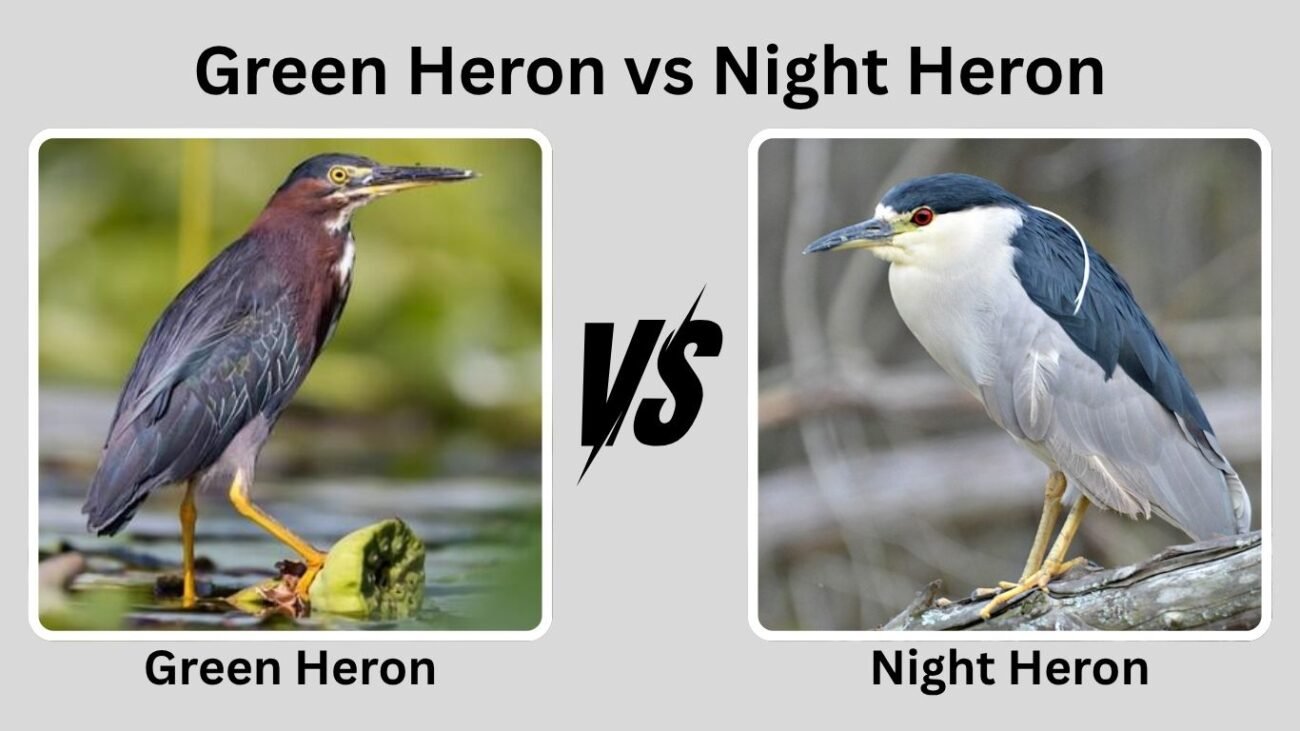
The black-crowned night heron (Nycticorax nycticorax) is one of the most common species mistaken for the green heron. While both share similar stocky builds and short necks, they differ in color, activity, and size.
- Green herons are smaller, more colorful, and mainly active during the day.
- Night herons are larger, pale gray and white, and mostly nocturnal hunters.
| Feature | Green Heron | Black-crowned Night Heron |
| Size | 16–18 inches | 23–28 inches |
| Eyes | Yellow | Red |
| Plumage | Greenish crown, chestnut neck | Black crown, white underparts |
| Behavior | Diurnal (daytime hunter) | Nocturnal |
| Call | Sharp “skeow” | Harsh “quawk” sound |
Night herons also have heavier necks and lack the iridescent green sheen seen on green herons. When seen together, the size difference is immediately apparent — the night heron is nearly twice as large.
Green Heron vs Little Blue Heron
The little blue heron (Egretta caerulea) is another species frequently compared to the green heron due to its similar hue. However, the differences become clear in both color uniformity and posture.
| Feature | Green Heron | Little Blue Heron |
| Adult Color | Greenish-blue head, chestnut neck | Uniform slate-blue body |
| Juvenile Color | Brown and streaked | Completely white |
| Size | 16–18 inches | 24 inches |
| Feeding Style | Ambush from perches | Slow wading in open water |
Little blue herons have a smoother, evenly colored plumage and are taller with longer necks. The green heron’s shorter body and hunched pose make it look more compact and stealthy, especially when hunting from a branch or log.
Green Heron vs Striated (Green-backed) Heron
The striated heron (Butorides striata) — sometimes called the green-backed heron — is the tropical counterpart of the green heron. They share nearly identical features, and some scientists consider them subspecies of the same lineage.
- The striated heron is found in South America, Africa, and Asia, whereas the green heron is primarily a North American species.
- The striated heron has a slightly grayer tone and a shorter crest but otherwise mirrors its North American relative in size and behavior.
- Both species are known for their tool use and solitary feeding style, often seen quietly waiting near mangroves or creeks.
Green Heron vs Tricolored Heron
The tricolored heron (Egretta tricolor) is taller, slimmer, and lighter in coloration than the green heron. It inhabits open marshes and estuaries, often foraging in shallow saltwater flats.
| Feature | Green Heron | Tricolored Heron |
| Height | 16–18 inches | 24–26 inches |
| Color | Dark green and chestnut | Blue-gray with white belly |
| Body Shape | Short and stocky | Slender and long-necked |
| Habitat | Forested ponds | Coastal wetlands |
The tricolored heron is graceful and active, often wading through water in search of prey. The green heron, in contrast, is a motionless hunter — patient, hidden, and silent.
Green Heron vs Kingfisher
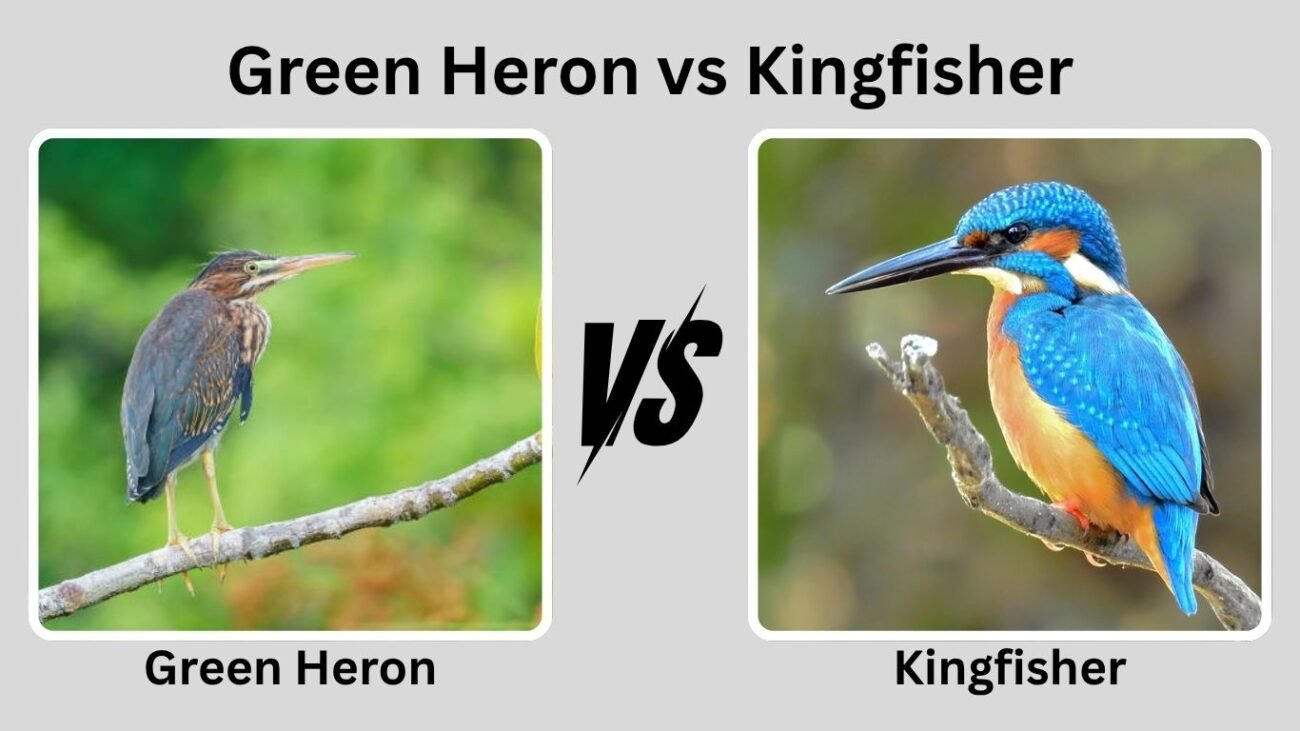
Though not related, belted kingfishers (Megaceryle alcyon) and green herons often share habitats. Both hunt for fish near shallow waters but differ greatly in form and method:
- The kingfisher dives from above, using speed and precision.
- The green heron strikes horizontally, standing still until the perfect moment.
Kingfishers are stockier with large heads and crests, short tails, and a loud rattling call. Green herons, by contrast, are slimmer and rely on stealth over speed.
Juvenile vs Adult Green Heron
Juvenile green herons can easily be mistaken for small bitterns or immature night herons due to their streaked plumage. The differences, however, become evident upon close inspection.
| Feature | Juvenile | Adult |
| Plumage | Brown-streaked chest, dull back | Glossy green-blue back, chestnut neck |
| Eyes | Dull yellow | Bright yellow-orange |
| Bill | Shorter and yellowish | Longer and darker |
| Crest | Absent | Prominent during display |
Juveniles typically appear more timid and clumsy, while adults move with calculated precision, reflecting their experience as stealth hunters.
FAQs
How can you tell a male from a female green heron?
Males are slightly larger with darker plumage and longer crests during breeding season. Females are smaller, paler, and have softer tones on the neck and wings.
What’s the difference between a green heron and a least bittern?
The least bittern is smaller and buff-colored, living deep within reeds. The green heron is darker, stockier, and hunts in open water margins.
Is the green heron related to the blue heron?
Yes, both are herons, but the green heron is much smaller and favors wooded wetlands, while the great blue heron dominates open lakes and coastal areas.
Do green herons and night herons look alike?
They share a similar shape, but green herons have bright yellow eyes, iridescent plumage, and are active during the day. Night herons are larger, red-eyed, and mostly nocturnal.
Are green-backed herons and green herons the same species?
Almost. The green-backed heron, also known as the striated heron, is a close relative found in tropical regions and is considered by some experts a subspecies of the green heron.


