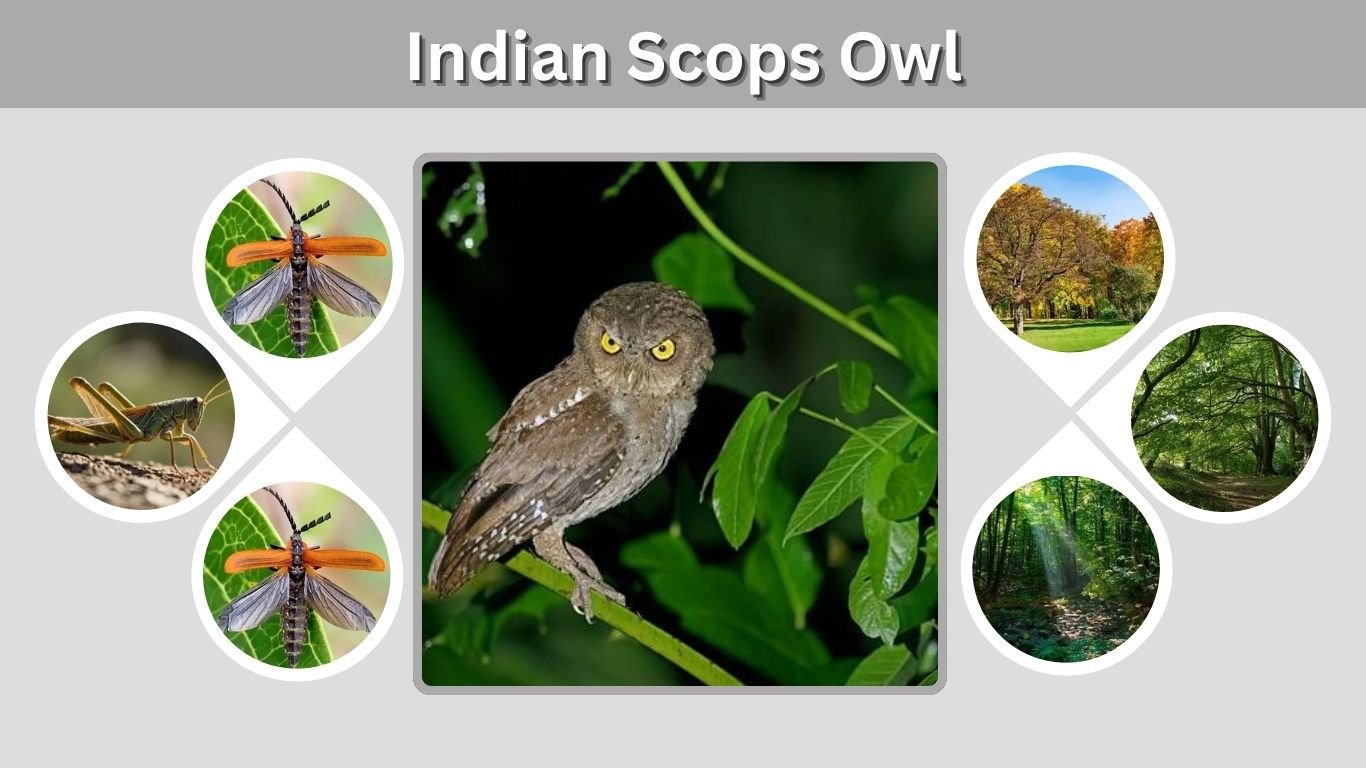
The Indian scops owl is a small, secretive owl known for bark-like plumage, prominent ear tufts, and a repetitive nighttime call. Scientifically named Otus bakkamoena, it lives across much of the Indian subcontinent in forests, orchards, plantations, and tree-filled settlements. Although often heard after dark, it can be surprisingly difficult to see because it rests motionless against trunks or inside tree cavities during daylight. This guide covers its size, colors, habitat, diet, breeding, call, identification, legal status, and differences from the collared scops owl.
Indian Scops Owl Identification and Size
The Indian scops owl belongs to the typical owl family, Strigidae. It has a compact body, rounded head, short tail, and feather tufts that resemble pointed ears. Its complex pattern of brown, grey, black, and buff feathers provides excellent camouflage against tree bark. Males and females look similar, although females may be slightly larger.
Quick Facts
- Scientific name: Otus bakkamoena
- Family: Strigidae
- Body length: Approximately 20–22 cm
- Weight: About 125–152 grams
- Wingspan: Approximately 60.5–66 cm
- Activity: Nocturnal
- Main color forms: Grey-brown and rufous
- Conservation status: Least Concern
These measurements make it a relatively small owl, although it is not the smallest member of the scops owl group.
Identification Features
- Small but clearly visible feathered ear tufts
- Rounded head and compact body
- Pale grey, buff, brown, or rufous facial disc
- Dark border surrounding the facial disc
- Brown, hazel-brown, or occasionally orange-toned eyes
- Grey-brown or reddish-brown upperparts
- Buff underparts with dark vertical streaks
- Pale spots and broken markings across the wings
- Short, hooked bill and strongly clawed feet
When alarmed, the owl may stretch its body, flatten its feathers, narrow its eyes, and remain motionless. This posture makes it resemble a broken branch rather than a living bird.
Color Morphs
Two principal color forms occur. The grey-brown morph is covered with ash-grey, brown, black, and cream markings. The rufous morph has warmer reddish-brown plumage. Both forms have streaked underparts and patterned wings.
Color alone should not be used for identification because lighting, age, feather wear, and individual variation can change the bird’s appearance. Facial markings, body proportions, location, and call are more reliable when considered together.
Habitat and Geographic Distribution
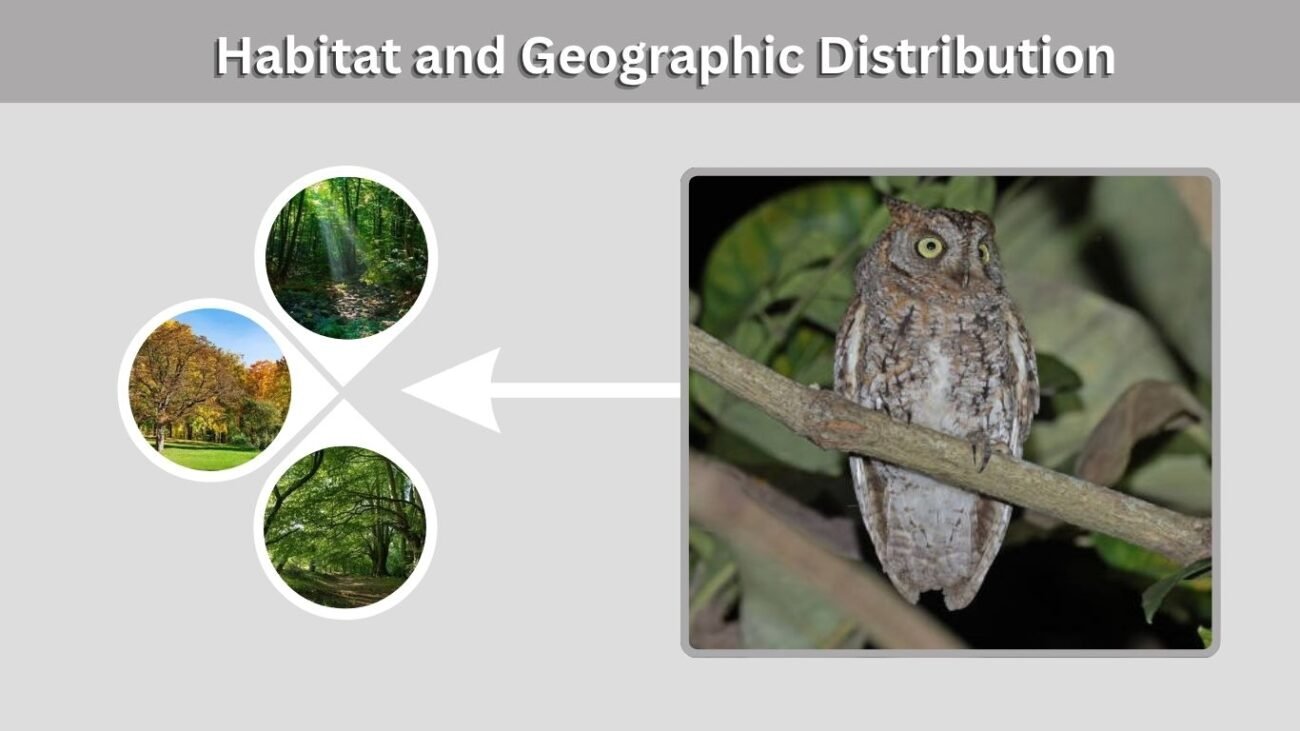
Despite its name, the Indian scops owl is not restricted to India. Its range extends across parts of the Indian subcontinent, including Pakistan, Nepal, Sri Lanka, and surrounding areas. It is adaptable enough to occupy natural forests and human-modified landscapes, provided mature trees, suitable roosting cover, nesting cavities, and sufficient prey remain available.
Natural Habitat
Indian scops owls occur in dry and moist woodland, deciduous forest, wooded riverbanks, forest edges, scrub with mature trees, and open countryside. They usually favor habitats that combine trees with clear hunting spaces.
The species may also live in plantations, orchards, cultivated land, large gardens, parks, village groves, and quiet urban neighborhoods. Its presence near houses does not necessarily mean it is lost; tree-filled settlements can provide insects, rodents, geckos, nesting holes, and sheltered daytime roosts.
Daytime Roosting Places
During daylight, the owl normally rests inside a tree hollow, against a thick trunk, on a shaded branch, or among dense leaves. It may use the same general roosting area repeatedly when the location remains undisturbed.
Its plumage blends closely with bark, making a resting owl extremely difficult to detect. Small birds sometimes reveal its location by gathering nearby and producing alarm calls, a behavior known as mobbing.
Call, Sound and Nighttime Behavior
The Indian scops owl becomes active around dusk and remains active during the night. Because it is often hidden by darkness and foliage, its call is usually noticed before the bird itself. Calling allows individuals to advertise territory, remain in contact with mates, and communicate without leaving a concealed perch.
What Does an Indian Scops Owl Sound Like?
Its usual call is a soft, low, single note often written as “whuk,” “wut,” or “wheoo.” The note may sound surprisingly frog-like and is repeated at regular intervals.
The sound is not the familiar multi-note hooting associated with some larger owls. A single bird may continue calling for long periods, while neighboring owls sometimes respond from different trees. Females can produce a slightly lower-pitched call than males.
Hunting Behavior
The owl usually hunts from a perch. It watches and listens for movement before flying down to seize prey with its talons. Its facial disc helps direct sounds toward its ears, allowing it to locate small animals in low light.
After capturing prey, the owl may return to a branch before swallowing it. Indigestible materials, including insect shells, fur, teeth, and bones, can later be expelled as compact pellets.
Diet, Breeding and Young Owls
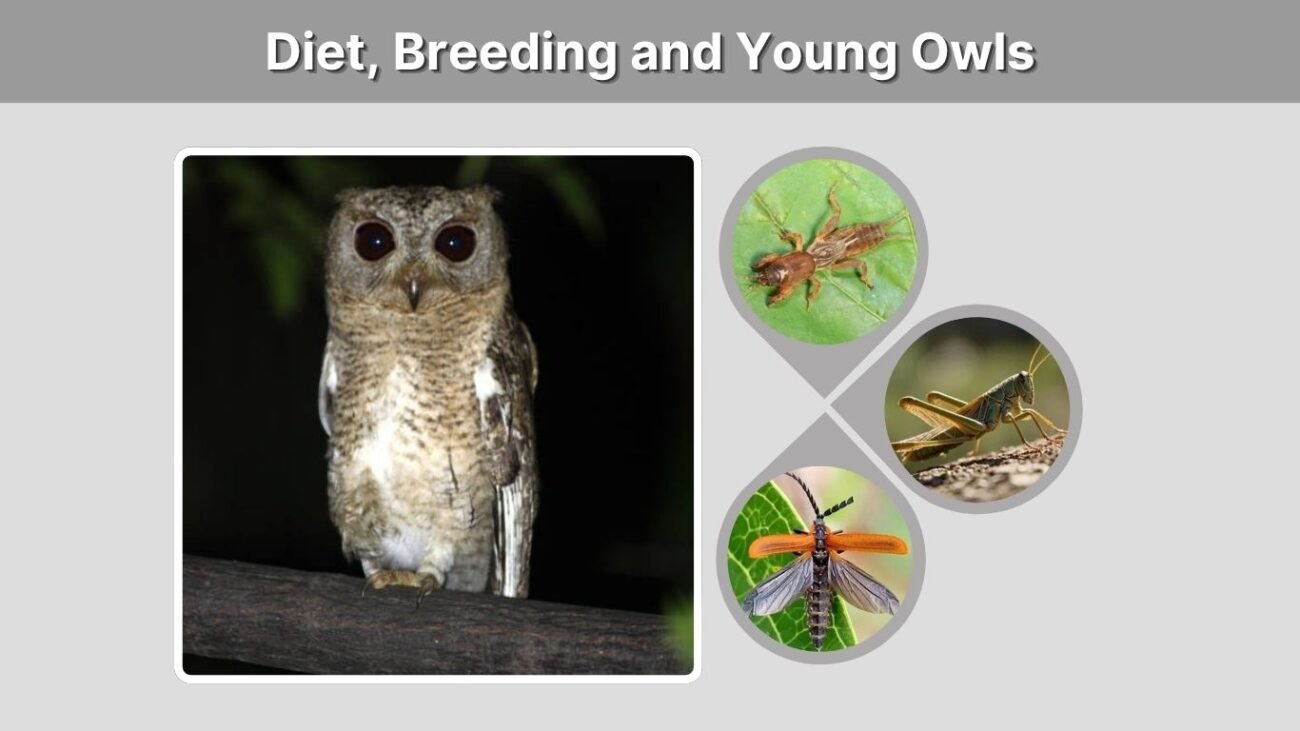
Although insects form an important part of its diet, the Indian scops owl is an opportunistic predator. Its exact food varies according to season, habitat, and prey availability. Breeding usually depends on existing cavities because the owl does not construct a conventional stick nest. Older trees are therefore valuable feeding, nesting, and roosting resources.
Common Foods
- Beetles
- Grasshoppers
- Crickets
- Moths and other flying insects
- Insect larvae
- Small rodents
- Geckos and other small lizards
- Small birds
- Occasionally other small vertebrates
By consuming insects and rodents, the owl can help control animals that damage crops or enter homes and storage areas.
Nesting and Eggs
Indian scops owls primarily nest inside natural tree hollows. They may also use abandoned structures or other protected cavities when suitable trees are unavailable. The female generally lays a small clutch, with one widely cited account reporting two or three eggs.
Incubation lasts approximately 25–27 days. Detailed scientific information about the species’ complete nesting cycle and development of its young remains limited compared with better-studied owl species.
Juveniles and Lifespan
A juvenile Indian scops owl may appear fluffier, rounder, and less sharply patterned than an adult. Young owls found on low branches are not always abandoned; fledglings often leave their nest cavity before becoming completely independent, while their parents continue feeding them nearby.
Reliable, species-specific information about maximum wild lifespan is limited. Lifespan estimates given for unrelated scops owl species should not automatically be presented as exact figures for Otus bakkamoena.
Indian Scops Owl as a Pet, Price and Legal Status
Indian scops owls are wild predators rather than domesticated companion birds. They require specialized food, space, nocturnal routines, veterinary knowledge, and opportunities to perform natural behaviors. Keeping one in an ordinary cage can cause injury, malnutrition, stress, feather damage, and abnormal behavior. Legal restrictions are another major consideration.
Can an Indian Scops Owl Be Kept as a Pet?
In India, the answer is no for ordinary private pet ownership. All owl species found in India are protected under the Wild Life (Protection) Act, making hunting, capturing, possessing, exploiting, or trading them punishable offenses.
Owls are also regulated through CITES, which controls international wildlife trade. Rules outside India vary, but legal possession or movement may require permits, proof of captive breeding, and official documentation.
Indian Scops Owl Price and Sale Listings
There is no legitimate standard pet price for a wild Indian scops owl in India because its capture and sale are prohibited. Online advertisements claiming to offer an Indian scops owl “for sale” may involve misidentified birds, scams, missing documentation, or illegal wildlife trafficking.
People should not purchase, transport, or attempt to raise a wild owl. Suspicious sales should be reported to the appropriate wildlife or forest authority.
Conservation Status
The Indian scops owl is currently classified as Least Concern and is considered relatively widespread. Nevertheless, individual populations can be affected by the loss of mature trees, removal of nesting cavities, pesticide use, road collisions, disturbance, and illegal capture.
Protecting old trees, reducing unnecessary pesticide use, preserving wooded gardens, and preventing wildlife trafficking can support the species even where it remains locally common.
Indian Scops Owl vs Collared Scops Owl
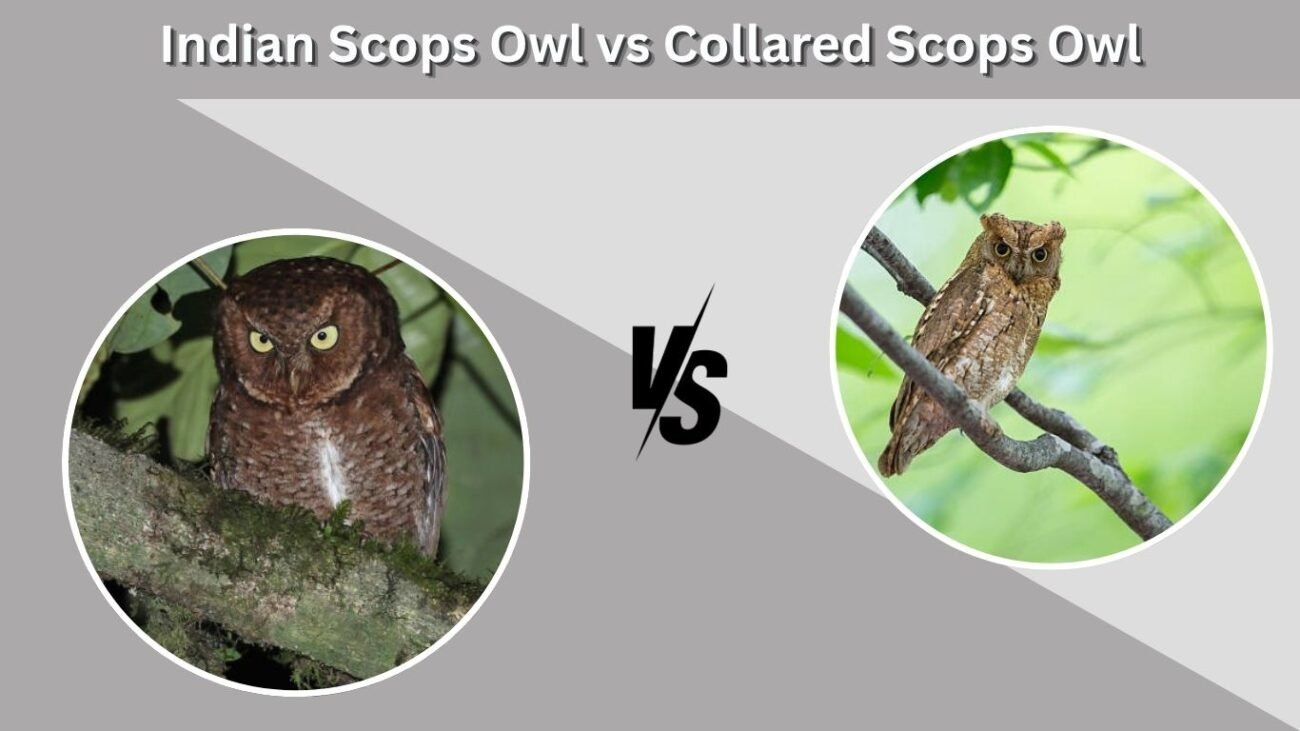
The Indian and collared scops owls were historically treated as part of a broader species complex. They are now generally recognized as separate species: Otus bakkamoena and Otus lettia. Their appearances overlap considerably, so a confident identification may require attention to body size, eye color, geographic range, and especially vocalizations.
Key Differences
- Indian scops owl: Usually about 20–22 cm long.
- Collared scops owl: Commonly about 23–25 cm long.
- Indian scops owl call: Usually a repeated single “whuk” or “wut.”
- Collared scops owl call: Commonly described as a quiet paired “goog-gook.”
- Indian scops owl range: Concentrated across much of peninsular and central South Asia.
- Collared scops owl range: More strongly associated with northern and northeastern regions extending farther into continental Asia.
- Field identification: Vocal differences are usually more dependable than plumage alone.
Size can be difficult to judge without a direct comparison. Calls and verified location records are therefore especially valuable when separating the two species.
FAQs
The following answers address common questions about the Indian scops owl’s danger, call, daytime activity, young birds, and presence near homes. Because it is nocturnal and heavily camouflaged, people frequently hear this owl without seeing it or mistake a resting adult for a young or injured bird.
Is the Indian scops owl dangerous?
The Indian scops owl normally avoids people and is not considered dangerous. However, any wild owl may use its talons or bill when captured, cornered, or handled. Observe it from a respectful distance and contact a trained wildlife rescuer when intervention is genuinely necessary.
Why does an Indian scops owl call repeatedly?
Repeated calling is mainly used for territorial advertisement and communication between owls. Its low, single note may continue for extended periods after dark. The call can be mistaken for a frog because it lacks the long, recognizable hooting pattern associated with many larger owl species.
Why is an Indian scops owl sitting near my house?
Tree-filled gardens and neighborhoods can provide safe roosting branches, tree cavities, insects, geckos, and rodents. An owl sitting near a house is usually resting or hunting rather than seeking human help. Keep pets away and avoid disturbing its perch.
What should I do after finding a baby Indian scops owl?
Do not immediately remove a young owl from the area. A feathered fledgling on a branch may still be cared for by adults. Keep people and pets away. Contact a wildlife rescue organization when the bird is visibly injured, trapped, weak, or in immediate danger.
Is the Indian scops owl rare?
The species is not globally considered rare and is classified as Least Concern. However, it can appear uncommon because it is nocturnal, quiet while roosting, and extremely well camouflaged. Local numbers may also decline where mature trees and nesting cavities are removed.