Woodpeckers are some of the most fascinating birds in the world, known for their unique drumming, bold colors, and tree-climbing skills. With over 45 types found globally, each species has its own look, behavior, and habitat. In this guide, you’ll discover all known types of woodpeckers—along with key details like how to identify them, what they eat, and where they live.
1. Downy Woodpecker

The Downy Woodpecker is the smallest woodpecker species in North America. Despite its small size, it’s a common and widespread bird found in woodlands, parks, and backyards. It is often mistaken for the Hairy Woodpecker due to its similar appearance but can be distinguished by its shorter bill.
Identification
- Small size (about 5.5 to 7 inches)
- White underparts
- Black wings with white spots
- Black-and-white striped head
- Males have a small red patch on the back of the head
- Short, stubby bill
Nesting
Downy Woodpeckers nest in tree cavities that they excavate themselves. They prefer dead or decaying wood. The female lays 3–8 white eggs, and both parents take turns incubating them.
Diet
Their diet includes insects, especially beetle larvae, ants, and caterpillars. They also eat seeds and berries, and are frequent visitors at suet feeders in winter.
Habitat and Behaviors
They are found in deciduous forests, mixed woodlands, orchards, urban parks, and suburban backyards. Downy Woodpeckers are agile climbers and often seen moving up and down tree trunks and branches. They communicate through short, sharp calls and drumming on wood surfaces to mark territory and attract mates.
Lifecycle and Lifespan
Breeding starts in spring, with males drumming to claim nesting territory. After mating, the pair excavates a cavity and raises one brood per year. Eggs hatch in about 12 days, and the young fledge in another 18–21 days. In the wild, they can live up to 11 years, though the average lifespan is shorter due to predation and environmental threats.
2. Hairy Woodpecker
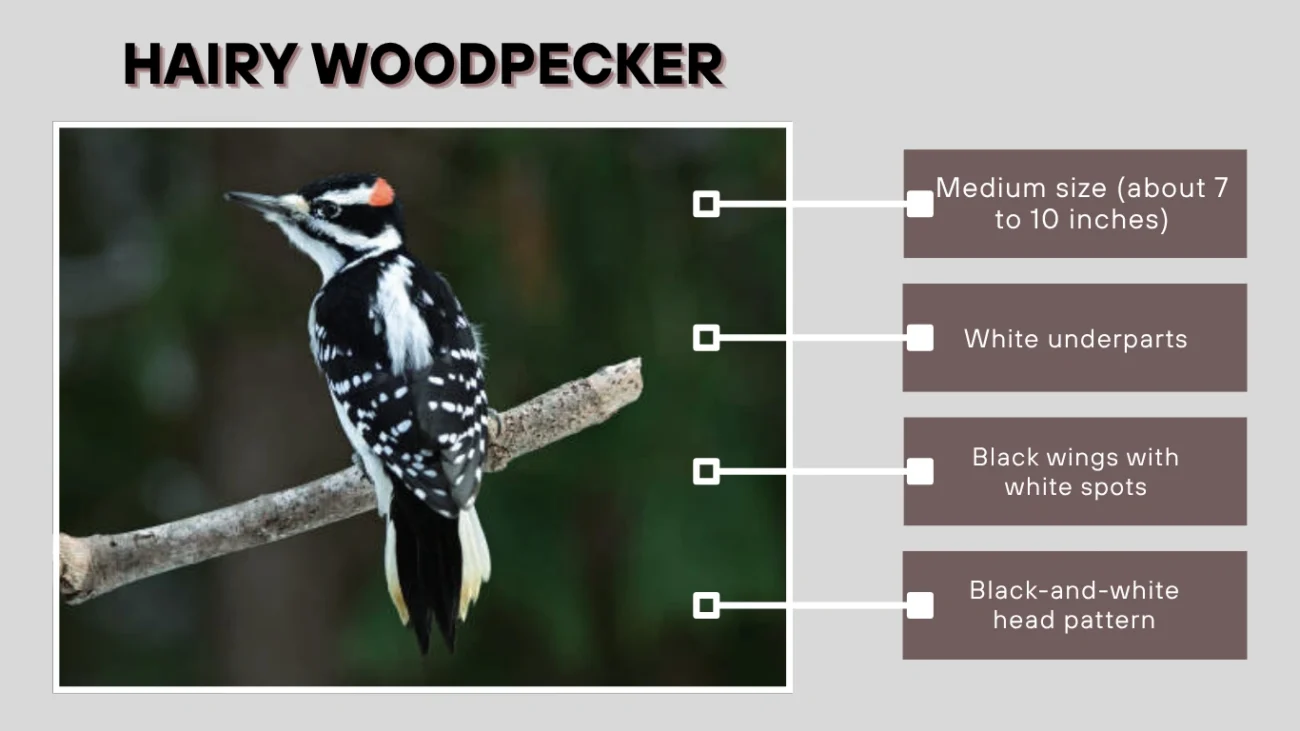
The Hairy Woodpecker closely resembles the Downy Woodpecker but is larger and has a longer bill. It is a widespread species found in forests and woodlands across North America and is known for its strong drumming sounds.
Identification
- Medium size (about 7 to 10 inches)
- White underparts
- Black wings with white spots
- Black-and-white head pattern
- Males have a red patch on the back of the head
- Long, chisel-like bill
Nesting
Hairy Woodpeckers nest in dead trees or branches, creating a deep cavity for laying 3–6 white eggs. Both parents incubate the eggs and care for the chicks.
Diet
Their diet is mostly insects, especially wood-boring beetle larvae and ants. They also consume fruits, nuts, and occasionally sap.
Habitat and Behaviors
They are typically found in mature forests, wooded parks, and forest edges. Hairy Woodpeckers are bold and active, often seen pecking loudly on tree trunks. They use their long bill to dig deep into wood for insects.
Lifecycle and Lifespan
Breeding begins in early spring. After excavation and egg laying, the young are fed by both parents. Fledging occurs in about 28–30 days. Their average lifespan in the wild ranges from 4 to 15 years.
3. Pileated Woodpecker

The Pileated Woodpecker is one of the largest woodpecker species in North America. Known for its striking red crest and powerful pecking, it is often associated with deep, mature forests.
Identification
- Large size (about 16 to 19 inches)
- Solid black body with white stripes on the face and neck
- Bright red crest on top of the head
- Long, strong bill
- Males have a red stripe on the cheek
Nesting
They create large rectangular cavities in dead trees. The female typically lays 3–5 eggs, and both parents share incubation and chick-feeding duties.
Diet
Their primary food sources are carpenter ants and wood-boring beetles. They also eat fruits, nuts, and berries.
Habitat and Behaviors
Pileated Woodpeckers prefer large tracts of mature hardwood or mixed forests with plenty of dead trees. They are solitary and highly territorial. Their loud, echoing calls and heavy drumming are key traits.
Lifecycle and Lifespan
Breeding occurs in late winter to early spring. After nesting, the young leave the nest about 24–28 days after hatching. They can live more than 10 years in the wild, though most live fewer years due to predation and environmental stress.
4. Red-bellied Woodpecker
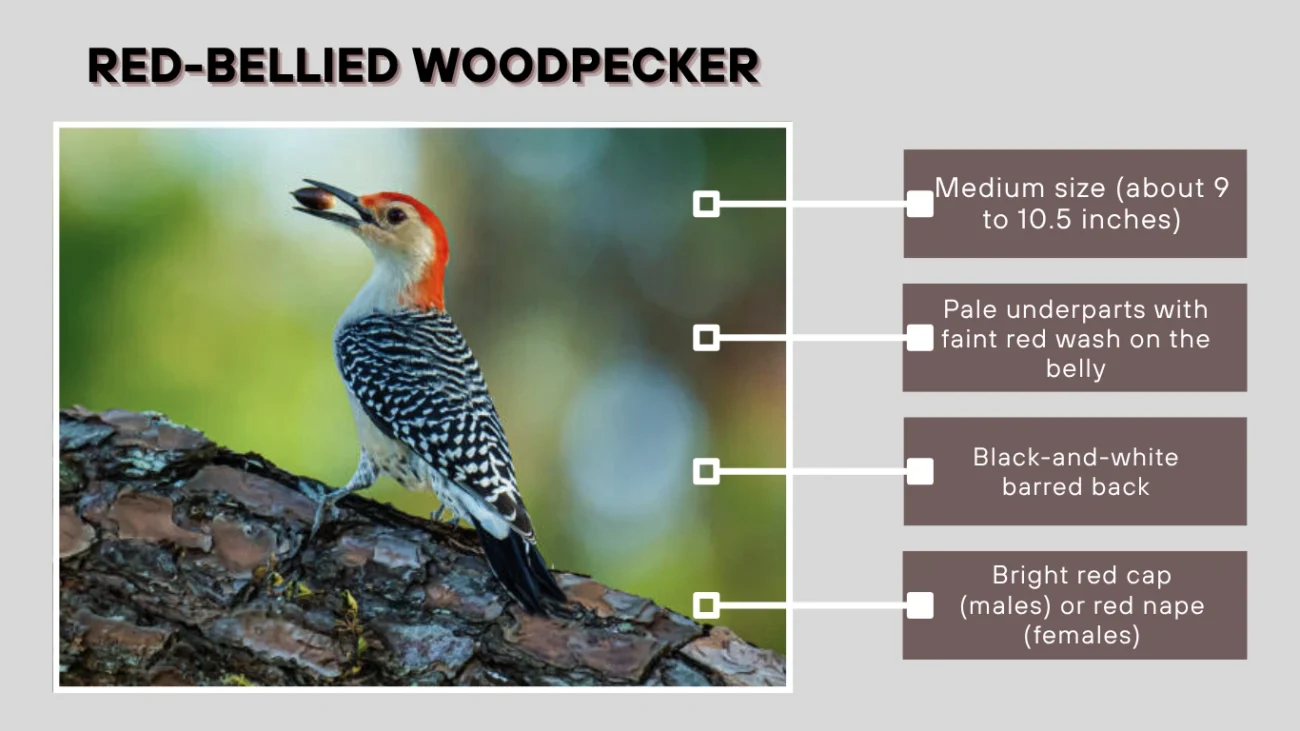
The Red-bellied Woodpecker is a medium-sized bird commonly found in the eastern United States. Despite its name, the red patch on its belly is often faint, while its bright red crown and nape are more noticeable.
Identification
- Medium size (about 9 to 10.5 inches)
- Pale underparts with faint red wash on the belly
- Black-and-white barred back
- Bright red cap (males) or red nape (females)
- Pale face with a long, straight bill
Nesting
They excavate cavities in dead trees or limbs. The female lays 4–5 white eggs, and both parents take part in incubation and feeding.
Diet
They feed on insects, fruits, seeds, and nuts. They’re also known to visit bird feeders and occasionally catch small lizards or nestlings.
Habitat and Behaviors
They inhabit woodlands, forests, and suburban areas with large trees. Red-bellied Woodpeckers are vocal, using loud calls to communicate and drumming to mark territory.
Lifecycle and Lifespan
They begin breeding in spring. The chicks fledge about 24–27 days after hatching. In the wild, they typically live 6–12 years.
5. Red-headed Woodpecker
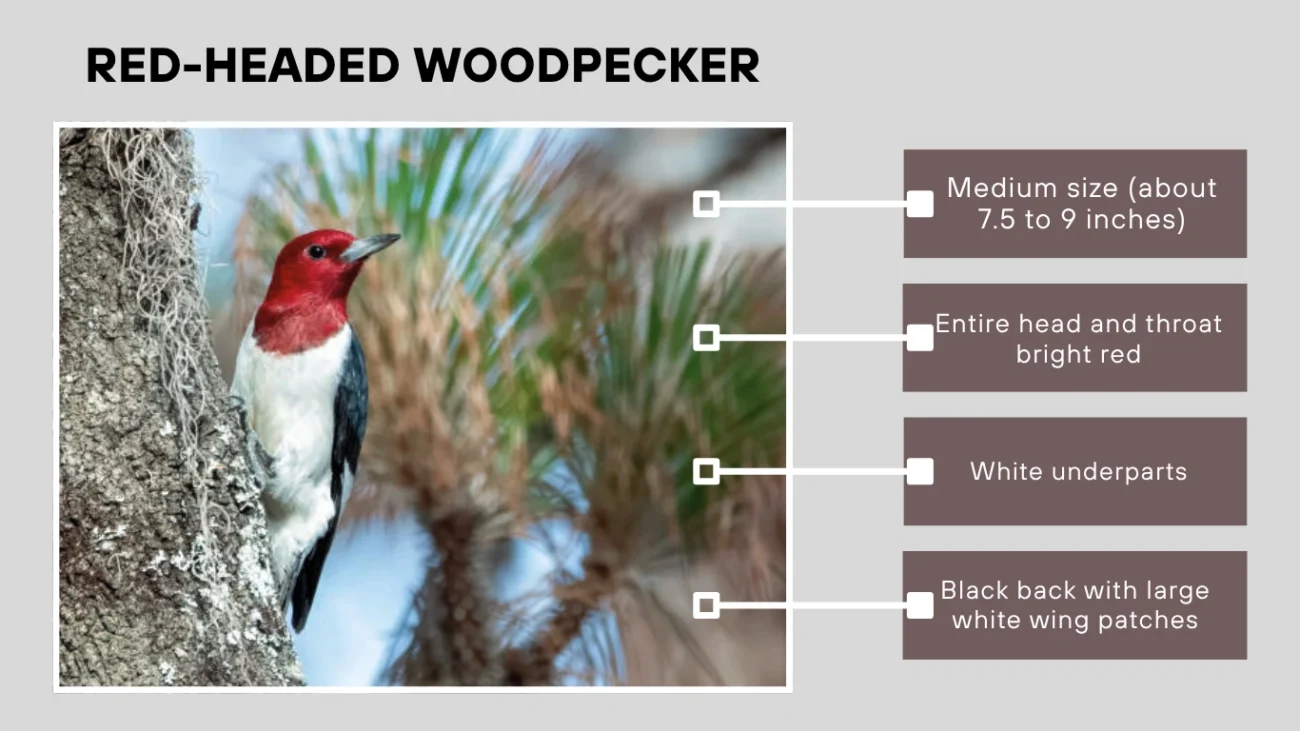
The Red-headed Woodpecker is a striking bird with a bold red head and contrasting black-and-white body. It’s known for its strong territorial behavior and unique habit of storing food.
Identification
- Medium size (about 7.5 to 9 inches)
- Entire head and throat bright red
- White underparts
- Black back with large white wing patches
- Short tail and strong, straight bill
Nesting
They nest in tree cavities, fence posts, and utility poles. Clutches usually contain 4–7 eggs. Both parents share all nesting duties.
Diet
Their diet includes insects, nuts, seeds, fruits, and even small rodents. They are one of the few woodpecker species that store food, especially in tree crevices.
Habitat and Behaviors
Found in open woodlands, orchards, and savannas. They are agile fliers and often catch insects in midair. Their loud calls and aggressive defense of nesting areas are notable.
Lifecycle and Lifespan
Breeding begins in late spring. Fledglings leave the nest in about 27–31 days. They can live over 9 years in the wild, though many live shorter lives.
6. Northern Flicker
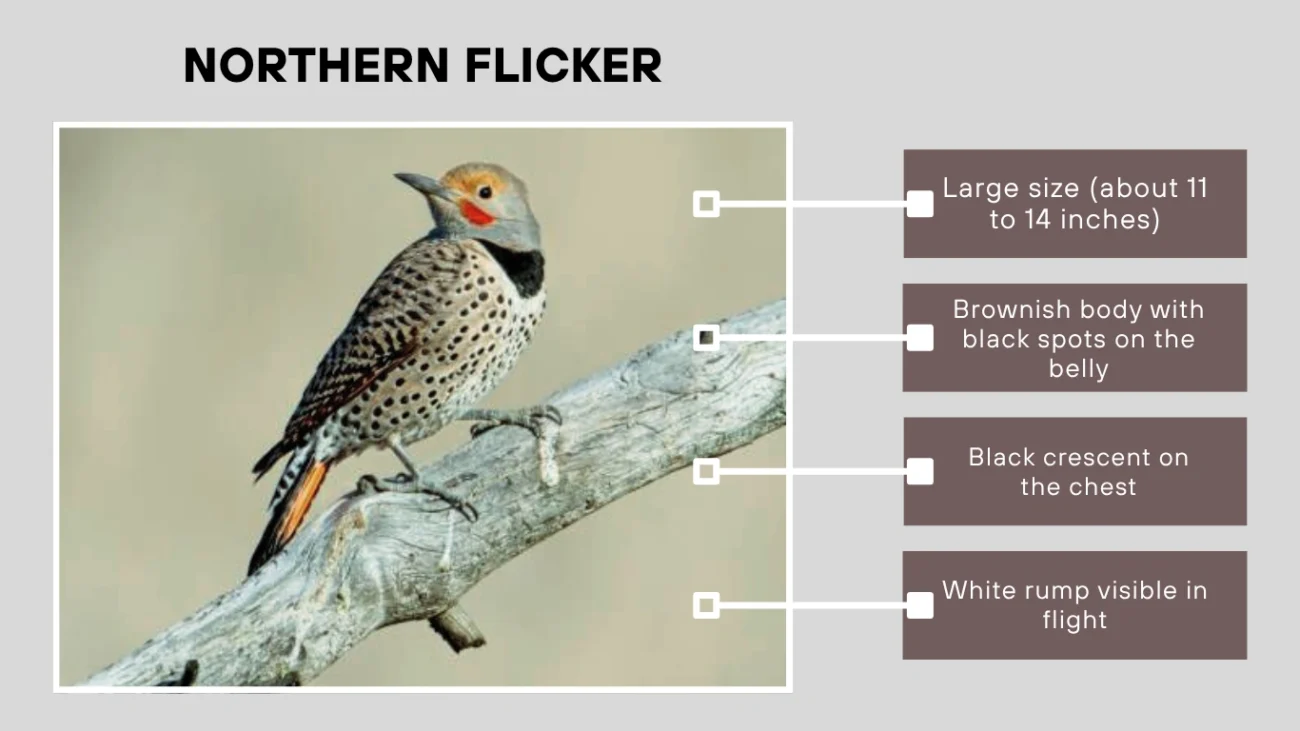
The Northern Flicker is a large, brownish woodpecker with a distinctive spotted belly and a loud, ringing call. Unlike most woodpeckers, it spends a lot of time on the ground searching for ants.
Identification
- Large size (about 11 to 14 inches)
- Brownish body with black spots on the belly
- Black crescent on the chest
- White rump visible in flight
- Males have a red (Western) or black (Eastern) mustache stripe
- Yellow or red underwings and tail (depending on region)
Nesting
They nest in tree cavities, using both natural and excavated sites. The female lays 5–8 eggs, and both parents participate in incubation and chick-rearing.
Diet
Primarily feeds on ants and beetles, often foraging on the ground. Also eats fruits, seeds, and occasionally visits feeders.
Habitat and Behaviors
Found in open woodlands, forest edges, and suburban areas. They have a rolling flight pattern and are known for their loud “wick-a-wick” calls and ground feeding behavior.
Lifecycle and Lifespan
Breeding begins in spring. Chicks fledge about 24–27 days after hatching. Northern Flickers live around 5 to 9 years in the wild.
7. Yellow-bellied Sapsucker
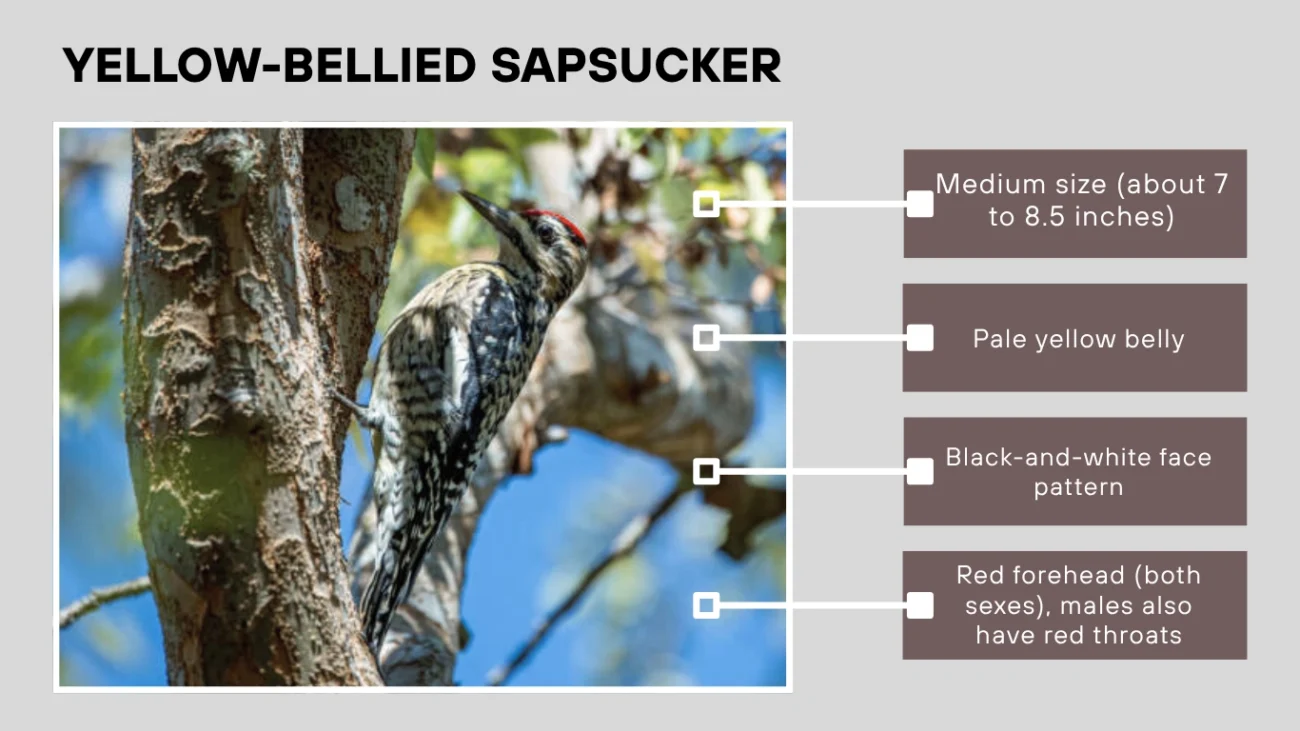
The Yellow-bellied Sapsucker is a migratory woodpecker known for drilling neat rows of holes in trees to feed on sap and insects.
Identification
- Medium size (about 7 to 8.5 inches)
- Pale yellow belly
- Black-and-white face pattern
- Red forehead (both sexes), males also have red throats
- White wing patch and barred flanks
- Straight, pointed bill
Nesting
They nest in live or dead deciduous trees. Females lay 4–6 white eggs, and both sexes share incubation and feeding duties.
Diet
Feeds on tree sap, insects attracted to the sap, and small fruits. Known for creating sap wells in trees and revisiting them regularly.
Habitat and Behaviors
Prefers young forests, especially birch, maple, and aspen. Often seen perched vertically or flying in an undulating pattern. Their drumming has a distinct irregular rhythm.
Lifecycle and Lifespan
Breeding starts in early spring. Fledging occurs around 25–29 days after hatching. Lifespan in the wild typically ranges from 4 to 7 years.
8. Lewis’s Woodpecker
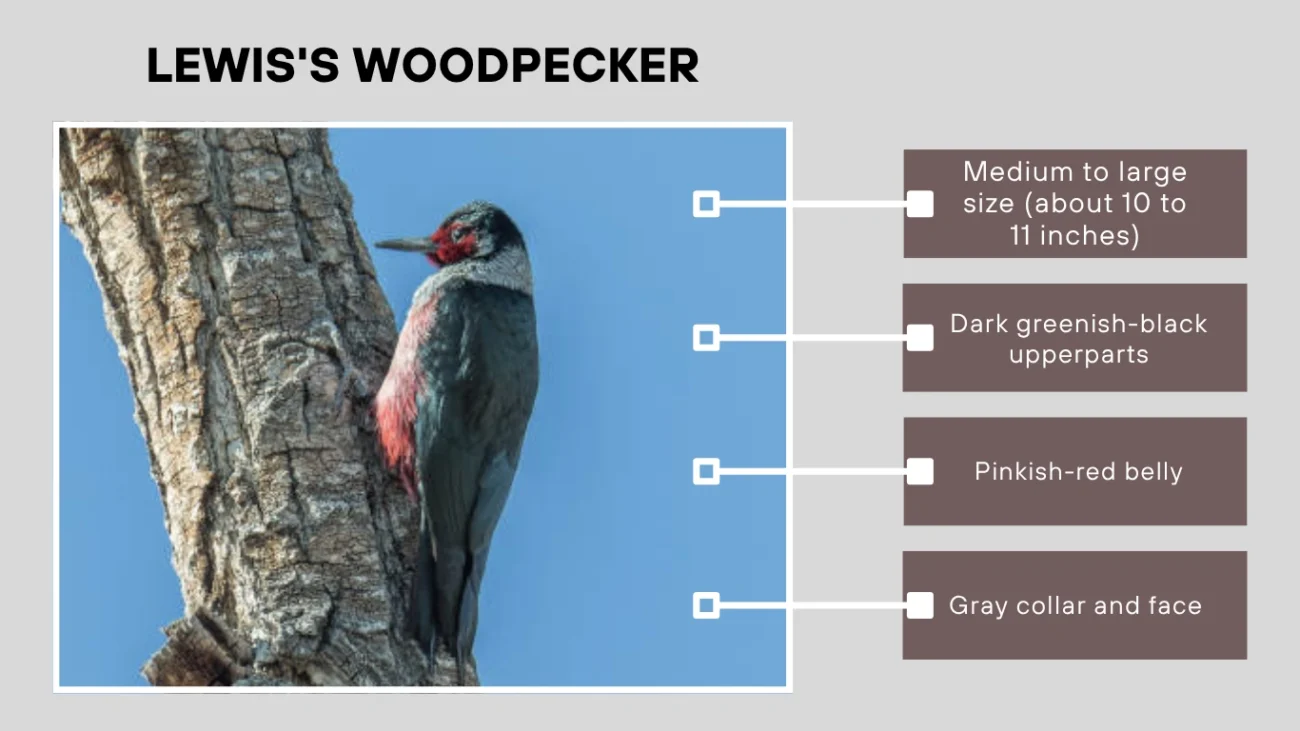
Lewis’s Woodpecker is a unique and colorful woodpecker with dark green and pinkish hues. It behaves more like a flycatcher than a typical woodpecker, often catching insects in flight.
Identification
- Medium to large size (about 10 to 11 inches)
- Dark greenish-black upperparts
- Pinkish-red belly
- Gray collar and face
- Red eyes
- Rounded wings and long tail
Nesting
They nest in cavities in dead trees, often old cottonwoods or pines. The female lays 5–9 eggs, and both parents help incubate and raise the young.
Diet
Feeds on flying insects, berries, and nuts. Often catches insects mid-air, especially during summer.
Habitat and Behaviors
Found in open pine forests, burned forests, and oak woodlands. They glide and flycatch gracefully, unlike most woodpeckers. Often perch quietly and move slowly.
Lifecycle and Lifespan
Breeding occurs in late spring. Chicks fledge after about 28–30 days. In the wild, they are believed to live up to 10 years, though specific data is limited.
9. Acorn Woodpecker
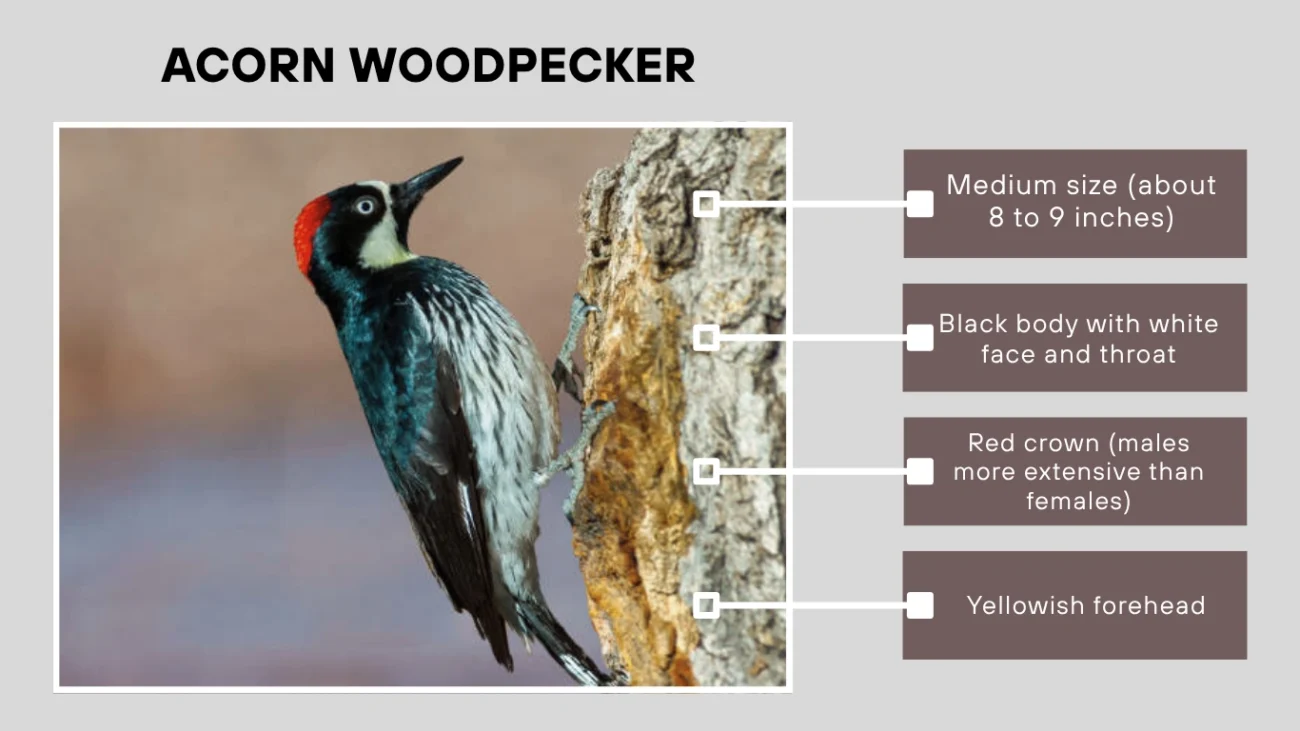
The Acorn Woodpecker is famous for storing thousands of acorns in holes drilled into trees or wooden structures. It lives in cooperative family groups.
Identification
- Medium size (about 8 to 9 inches)
- Black body with white face and throat
- Red crown (males more extensive than females)
- Yellowish forehead
- White rump and wing patches visible in flight
Nesting
They nest communally in tree cavities. Multiple adults help feed the young, with 3–7 eggs laid per clutch.
Diet
Primarily feeds on acorns, which they store in “granary trees.” Also eats insects, fruits, and sap.
Habitat and Behaviors
Common in oak woodlands, mixed forests, and even urban areas with large trees. Highly social, vocal, and known for their “waka-waka” calls and drumming.
Lifecycle and Lifespan
Breeding can be cooperative, with multiple breeders per group. Young fledge about 30 days after hatching. They can live over 10 years in the wild.
10. Gila Woodpecker
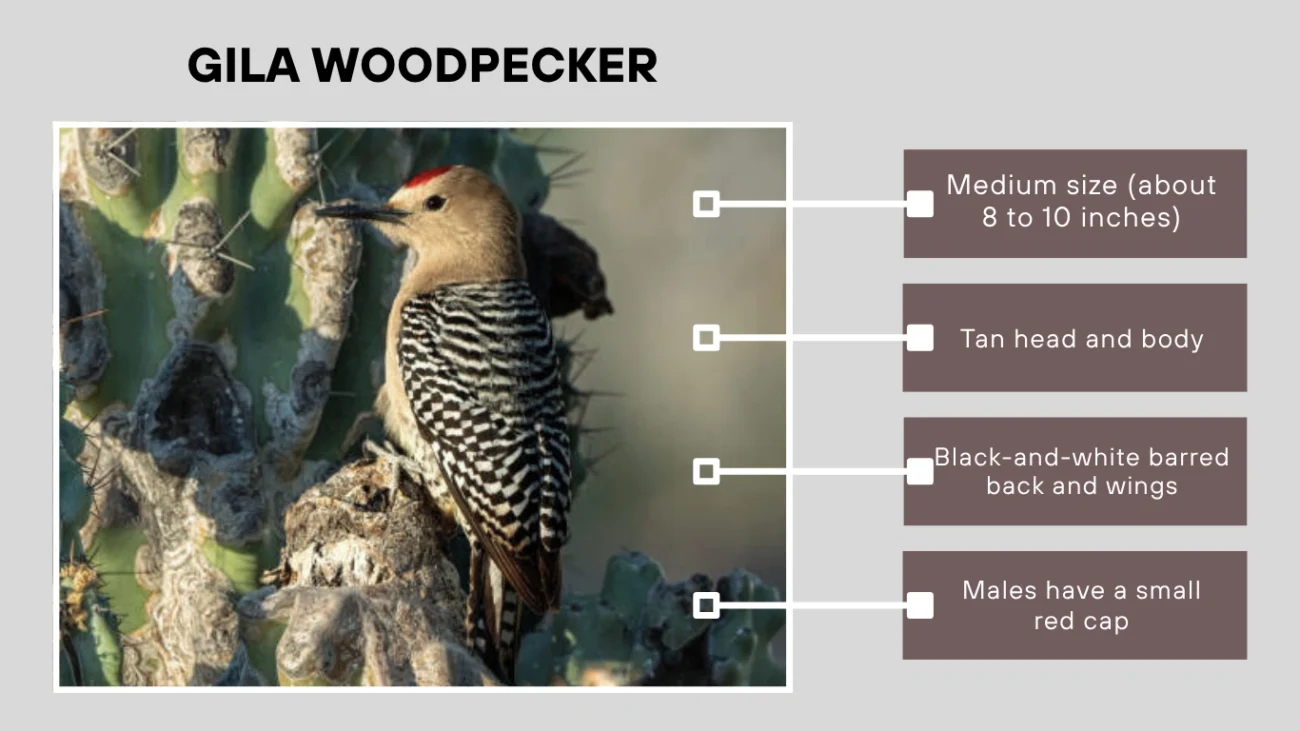
The Gila Woodpecker is a desert-dwelling species commonly found in the southwestern United States and Mexico. It is well adapted to arid environments and often nests in saguaro cacti.
Identification
- Medium size (about 8 to 10 inches)
- Tan head and body
- Black-and-white barred back and wings
- Males have a small red cap
- Long, pointed bill
- Pale gray face and throat
Nesting
They excavate cavities in saguaro cacti or dead trees. The female lays 3–5 white eggs. Both parents share incubation and chick-rearing responsibilities.
Diet
Feeds on insects, fruits, seeds, and cactus fruits. Also visits feeders for suet or nectar.
Habitat and Behaviors
Common in deserts, especially areas with saguaros and mesquite trees. Gila Woodpeckers are noisy and active, often seen climbing cacti or trees and making rolling calls.
Lifecycle and Lifespan
Breeding starts in spring. Fledging occurs in about 25–28 days. They live around 8–10 years in the wild.
11. Golden-fronted Woodpecker

The Golden-fronted Woodpecker is a striking species found in Texas, Mexico, and Central America. Its golden and red markings make it easy to identify in its southern range.
Identification
- Medium size (about 8.5 to 10 inches)
- Black-and-white barred back
- Pale gray face and underparts
- Golden-yellow nape and patch above bill
- Males have a red crown
- Long, straight bill
Nesting
Nests are built in tree cavities, utility poles, or fence posts. Females lay 4–7 eggs. Both parents incubate and feed the chicks.
Diet
Eats insects, berries, fruits, seeds, and occasionally small reptiles. Also visits feeders for suet and fruits.
Habitat and Behaviors
Found in open woodlands, scrublands, and suburban areas. They are vocal, drumming frequently and giving sharp “chur” calls. Often seen perched on utility poles or flying between trees.
Lifecycle and Lifespan
Breeding occurs in late spring. Young birds fledge about 28 days after hatching. Golden-fronted Woodpeckers typically live 5–8 years in the wild.
12. Arizona Woodpecker
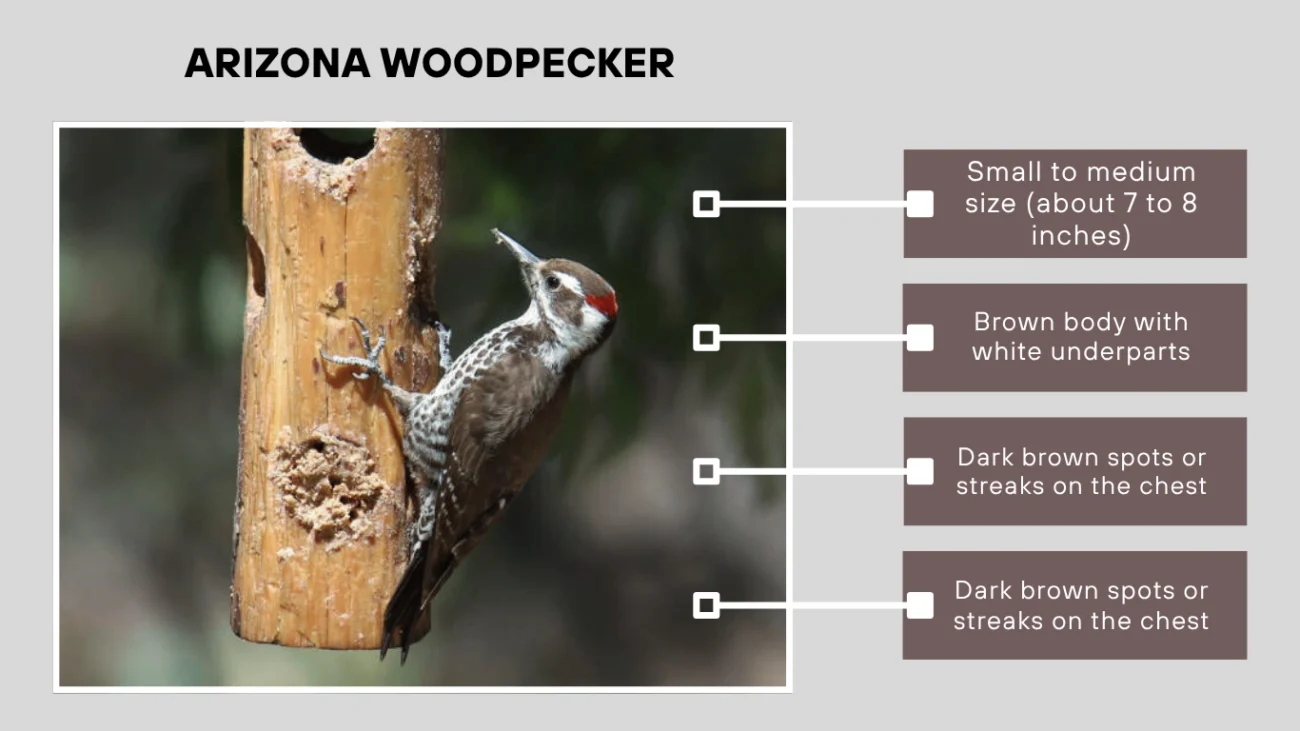
The Arizona Woodpecker is a brown-colored woodpecker native to mountainous pine and oak forests of the southwestern United States and Mexico. Its unique coloration sets it apart from most North American woodpeckers.
Identification
- Small to medium size (about 7 to 8 inches)
- Brown body with white underparts
- Dark brown spots or streaks on the chest
- Dark brown spots or streaks on the chest
- Males have a small red patch on the back of the head
- Straight, pointed bill
Nesting
They excavate cavities in dead trees or limbs. Females lay 3–4 white eggs, with both parents sharing incubation and feeding duties.
Diet
Feeds mainly on insects, especially beetle larvae, ants, and termites. Also consumes berries and seeds.
Habitat and Behaviors
Prefers oak and pine-oak woodlands in mountainous areas. Arizona Woodpeckers are quiet and elusive, often moving through tree trunks with a slow, creeping motion.
Lifecycle and Lifespan
Breeding occurs in spring. The young leave the nest about 25–28 days after hatching. Lifespan in the wild is not well-documented but is estimated around 5–7 years.
13. Nuttall’s Woodpecker
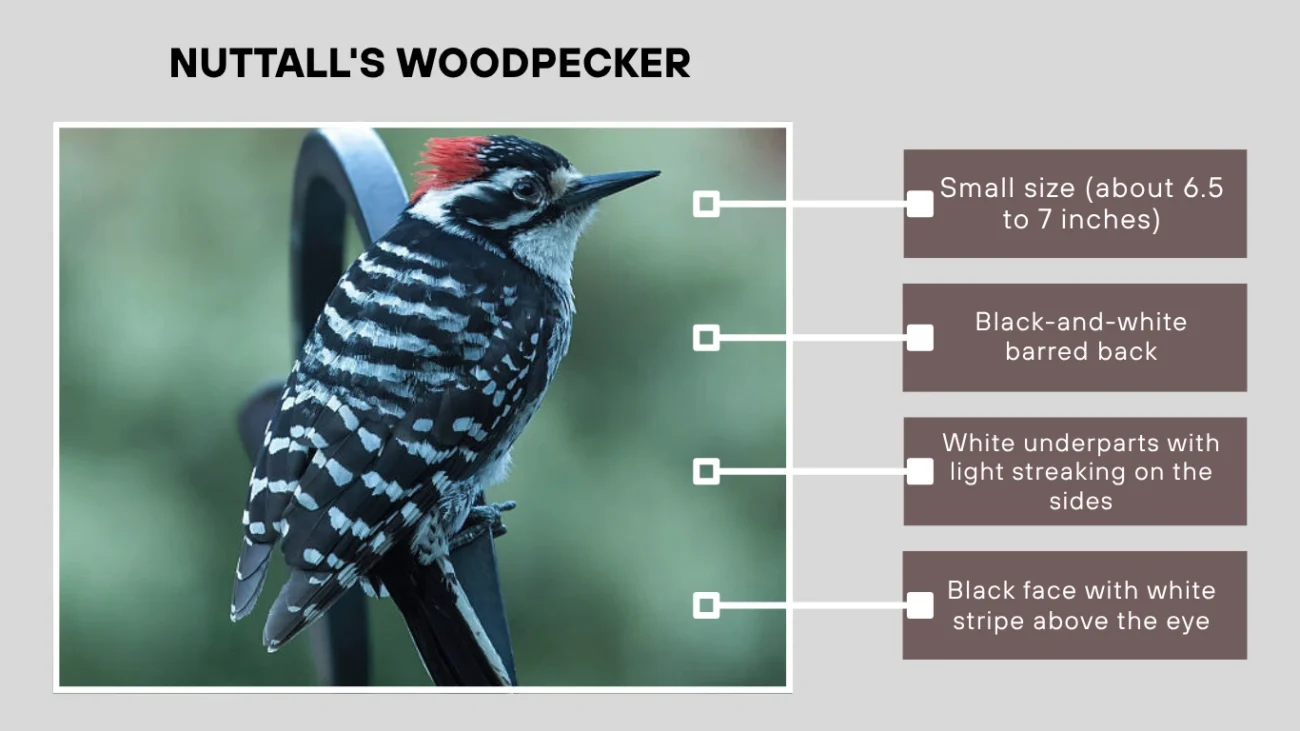
Nuttall’s Woodpecker is a small woodpecker species endemic to California. It is often found in oak woodlands and riparian corridors and is known for its rapid drumming.
Identification
- Small size (about 6.5 to 7 inches)
- Black-and-white barred back
- White underparts with light streaking on the sides
- Black face with white stripe above the eye
- Males have a red crown patch
- Short, sharp bill
Nesting
Nests are excavated in dead branches or snags. Females lay 3–6 white eggs. Both parents share in incubation and feeding.
Diet
Primarily feeds on insects such as beetles, ants, and larvae. Also eats acorns, berries, and seeds.
Habitat and Behaviors
Restricted to oak woodlands and sycamore groves, especially in central and southern California. Agile and quick-moving, they are frequently seen darting between branches and drumming loudly.
Lifecycle and Lifespan
Breeding begins in early spring. The fledging period lasts about 23–26 days. Nuttall’s Woodpeckers are believed to live 5–8 years in the wild.
14. Ladder-backed Woodpecker
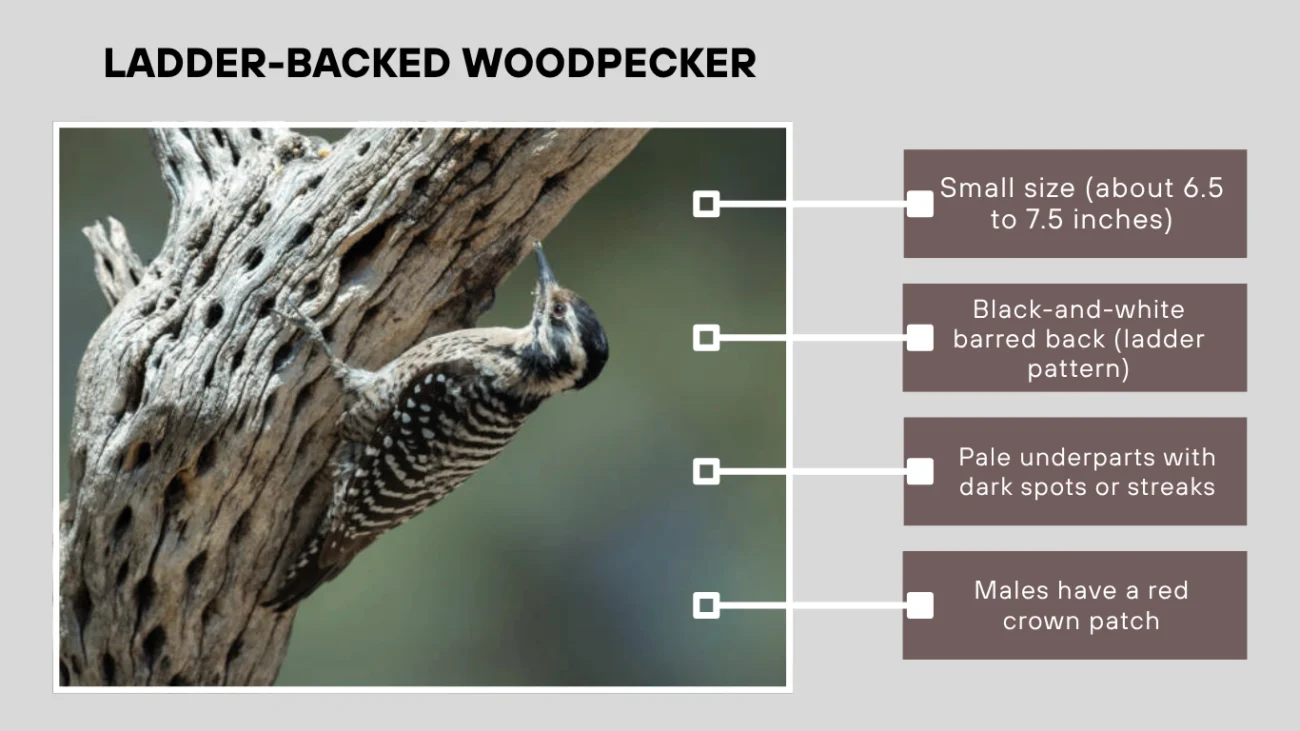
The Ladder-backed Woodpecker is a small desert-adapted species found across the southwestern United States and Mexico. It is named for the ladder-like black bars on its back.
Identification
- Small size (about 6.5 to 7.5 inches)
- Black-and-white barred back (ladder pattern)
- Pale underparts with dark spots or streaks
- Males have a red crown patch
- Whitish face with black markings
- Thin, straight bill
Nesting
They nest in cavities of dead branches or cactus. Females lay 3–7 white eggs. Both parents assist with incubation and feeding.
Diet
Feeds on insects such as beetles, ants, and caterpillars. Also eats cactus fruits, berries, and seeds.
Habitat and Behaviors
Common in deserts, scrublands, and open woodlands with mesquite or cactus. They move quickly on branches and trunks and use soft tapping or short drumming to communicate.
Lifecycle and Lifespan
Breeding starts in spring. Young birds leave the nest in about 22–26 days. Typical lifespan in the wild is 4–6 years.
15. White-headed Woodpecker
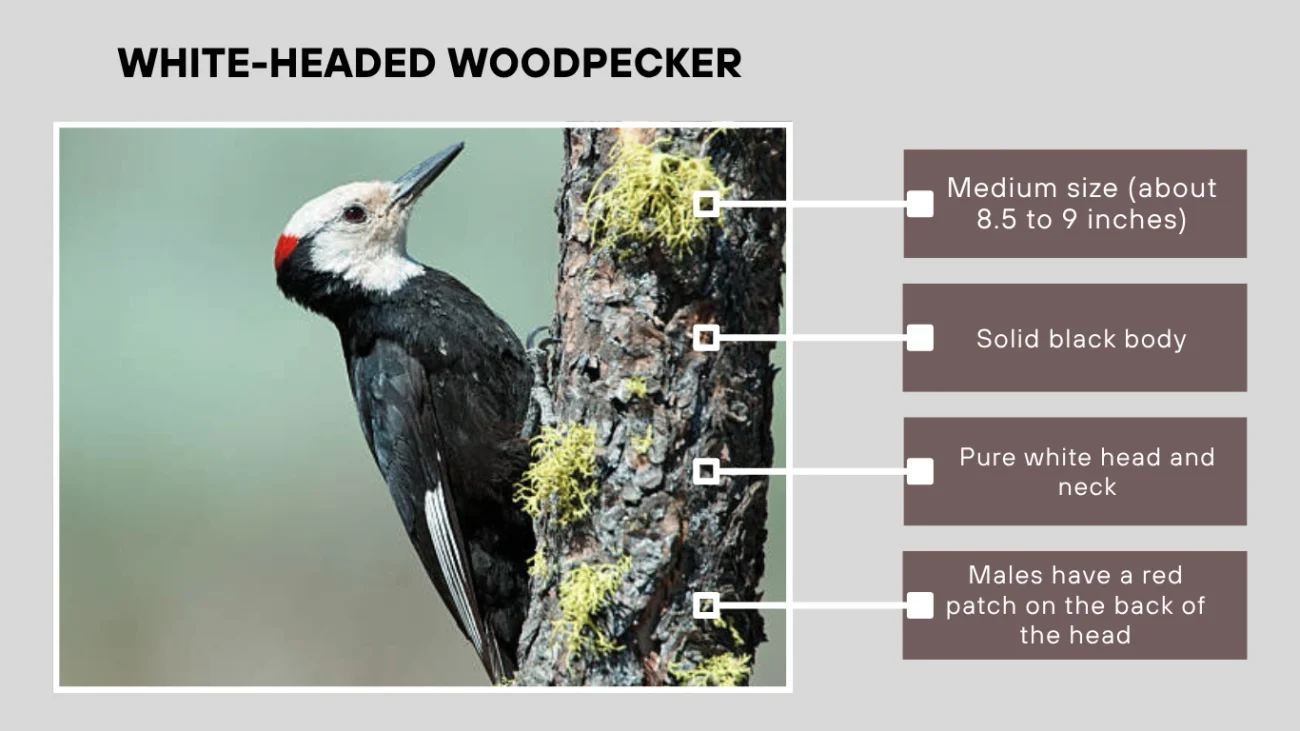
The White-headed Woodpecker is a striking black-and-white woodpecker found in mountainous conifer forests of the western United States. It relies heavily on pine seeds for food.
Identification
- Medium size (about 8.5 to 9 inches)
- Solid black body
- Pure white head and neck
- Males have a red patch on the back of the head
- Black wings with white patches
- Stout, pointed bill
Nesting
They excavate nest cavities in dead pine trees or snags. Females lay 3–6 white eggs, with both parents involved in nesting duties.
Diet
Primarily eats pine seeds, especially from ponderosa and Jeffrey pines. Also feeds on insects found under bark.
Habitat and Behaviors
Found in high-elevation coniferous forests, especially areas dominated by large pines. They are quiet and deliberate in movement, often seen clinging to pine trunks or feeding on cones.
Lifecycle and Lifespan
Breeding occurs from May to July. Fledging takes place after 26–28 days. Estimated lifespan in the wild is 5–8 years.
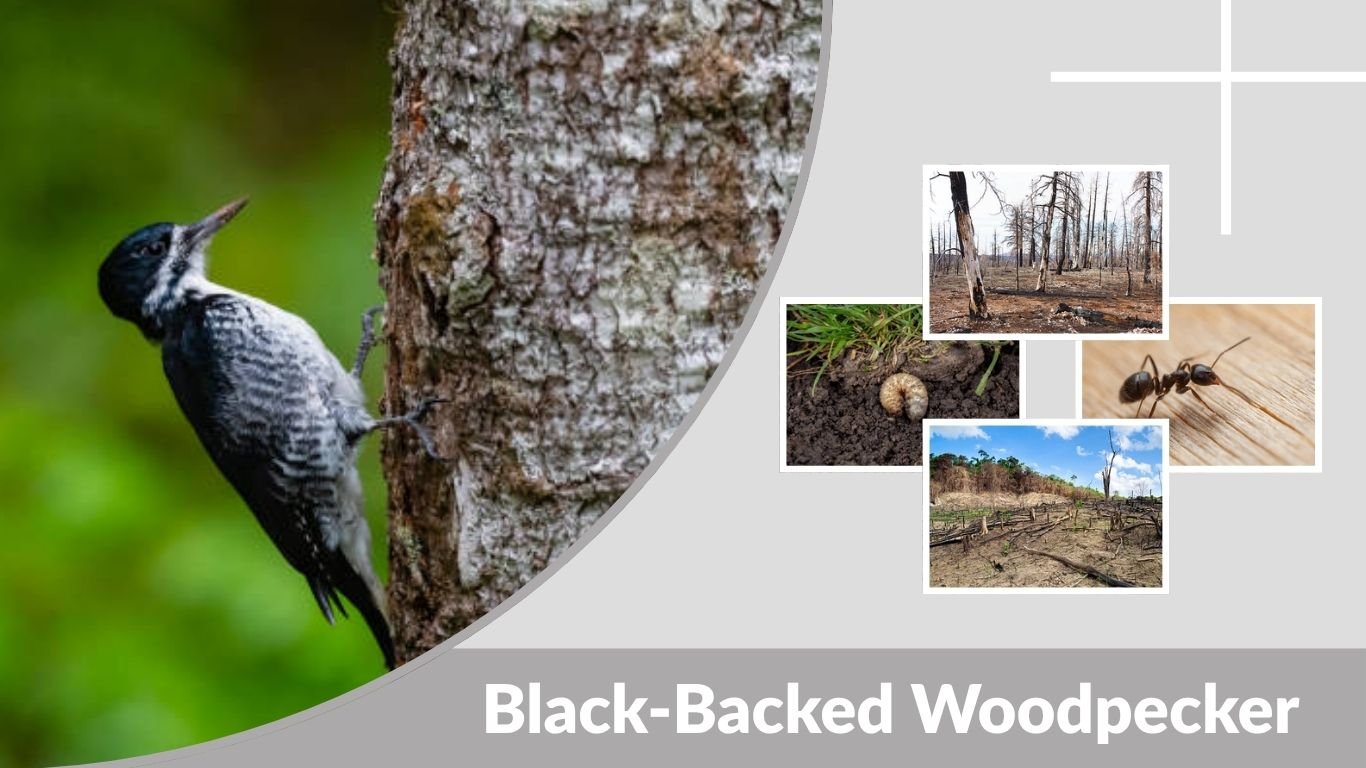
16. Black-backed Woodpecker
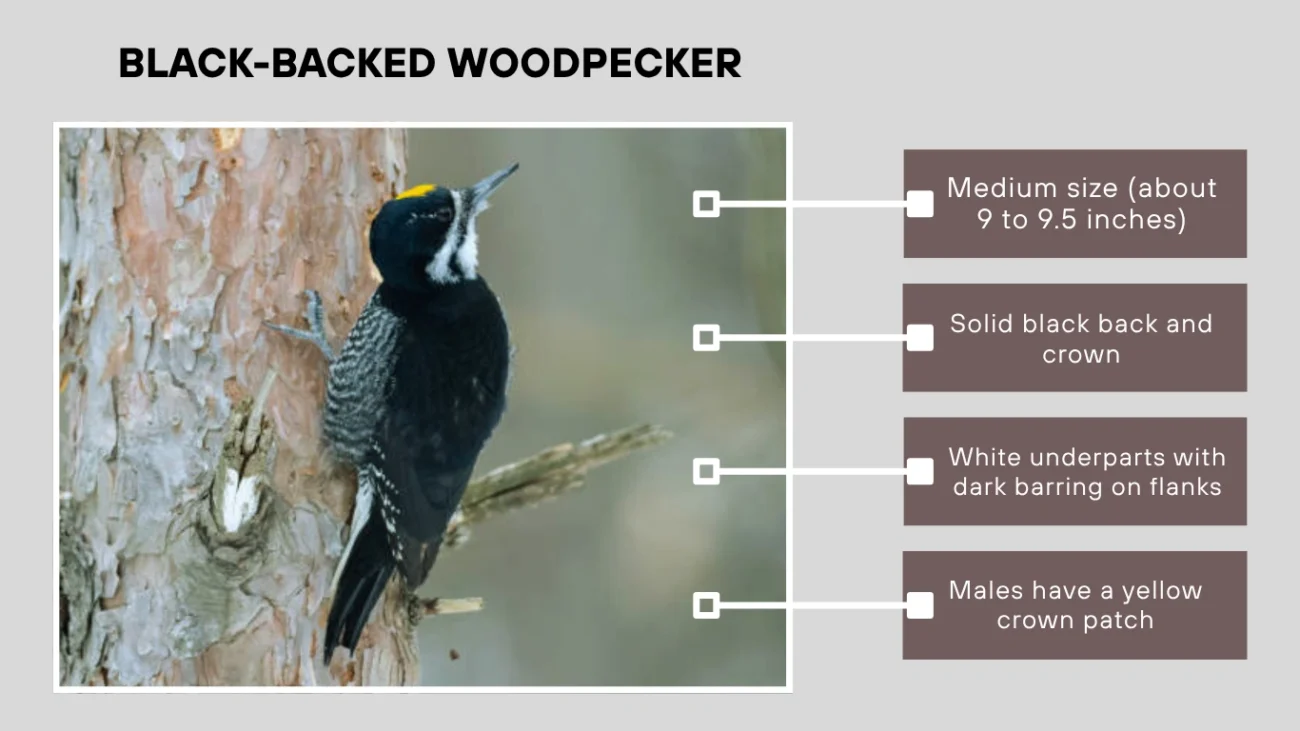
The Black-backed Woodpecker is a specialist of burned forests, where it feeds on beetle larvae in recently dead trees. Its dark plumage helps it blend into charred wood.
Identification
- Medium size (about 9 to 9.5 inches)
- Solid black back and crown
- White underparts with dark barring on flanks
- Males have a yellow crown patch
- White facial stripe
- Short, strong bill
Nesting
They excavate nests in fire-killed trees or dead conifers. The female lays 3–4 eggs, and both parents care for the chicks.
Diet
Feeds primarily on wood-boring beetle larvae found in burned or dead trees. Also eats ants and other insects.
Habitat and Behaviors
Inhabits recently burned boreal and montane forests. Very quiet and inconspicuous, it chips bark off trees to reach insects. Prefers isolated, post-fire habitats.
Lifecycle and Lifespan
Breeding starts in late spring. Fledging occurs after about 24–27 days. Lifespan is estimated at 4–8 years in the wild.
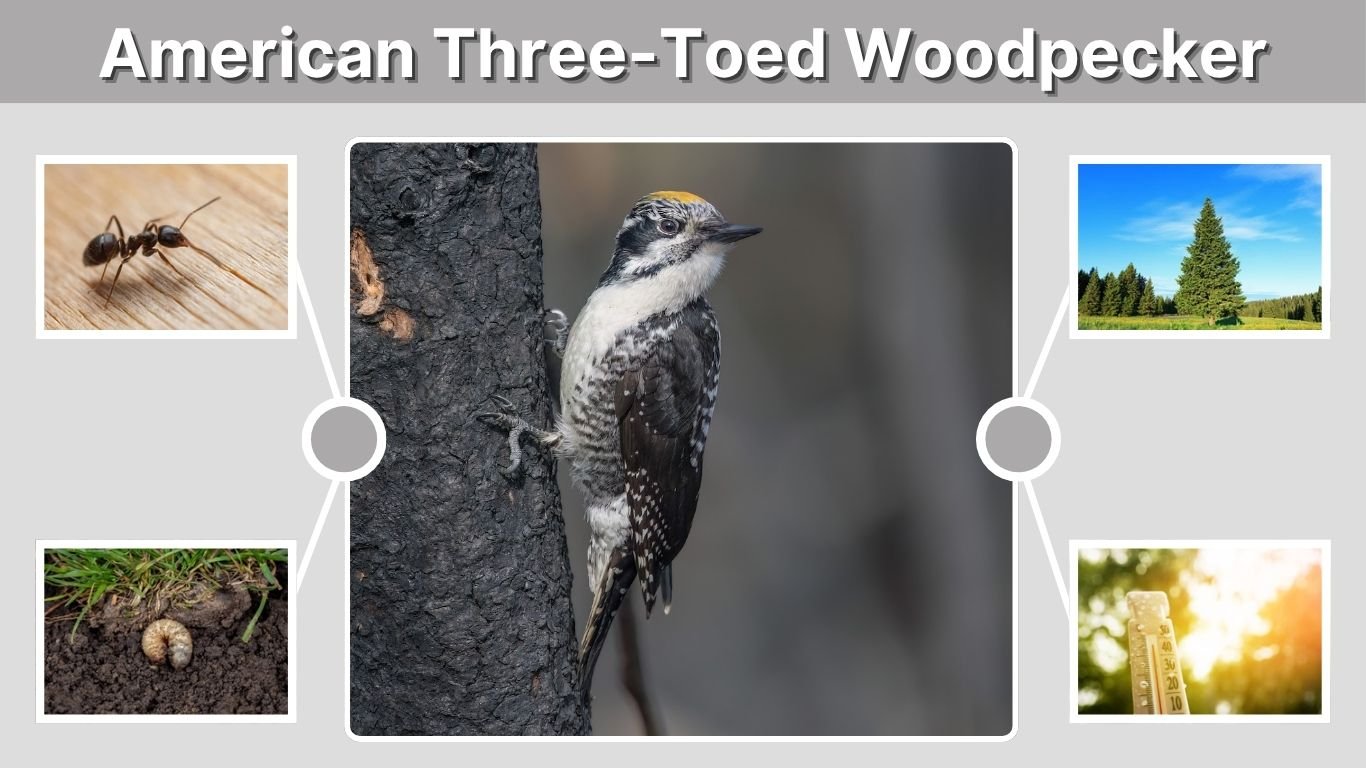
17. American Three-toed Woodpecker
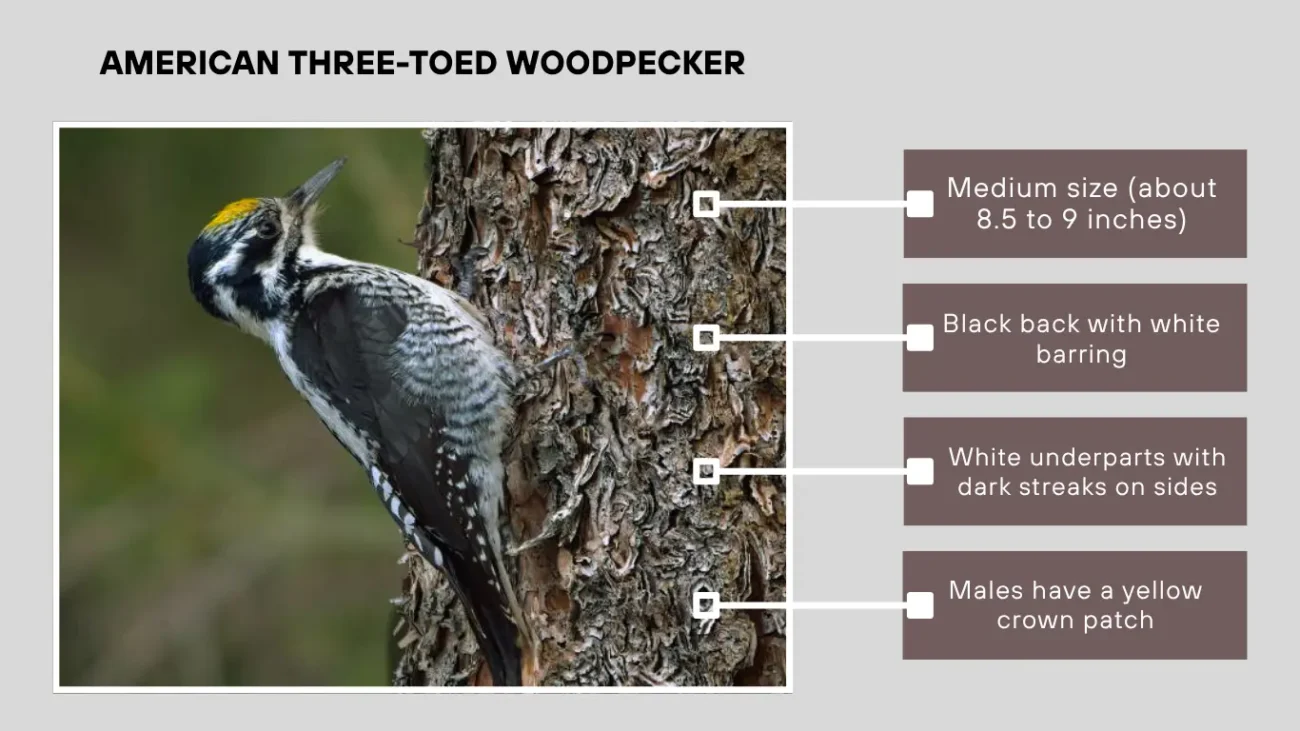
The American Three-toed Woodpecker is a quiet, unobtrusive bird found in boreal and mountain forests. Its three toes (instead of the usual four) help it cling vertically to tree trunks.
Identification
- Medium size (about 8.5 to 9 inches)
- Black back with white barring
- White underparts with dark streaks on sides
- Males have a yellow crown patch
- White face with black mustache stripe
- Only three toes (two front, one back)
Nesting
They nest in cavities in coniferous trees, often in areas affected by insect outbreaks or fire. Clutch size is 3–6 eggs, with both parents involved in care.
Diet
Primarily eats bark beetle larvae and other wood-boring insects. Also consumes ants and some fruits.
Habitat and Behaviors
Found in mature spruce and fir forests, especially those with dying trees. Moves slowly and quietly, often flaking bark to reach insects.
Lifecycle and Lifespan
Breeding begins in spring. Chicks fledge about 25–28 days after hatching. They are thought to live 4–6 years in the wild.
18. Ivory-billed Woodpecker
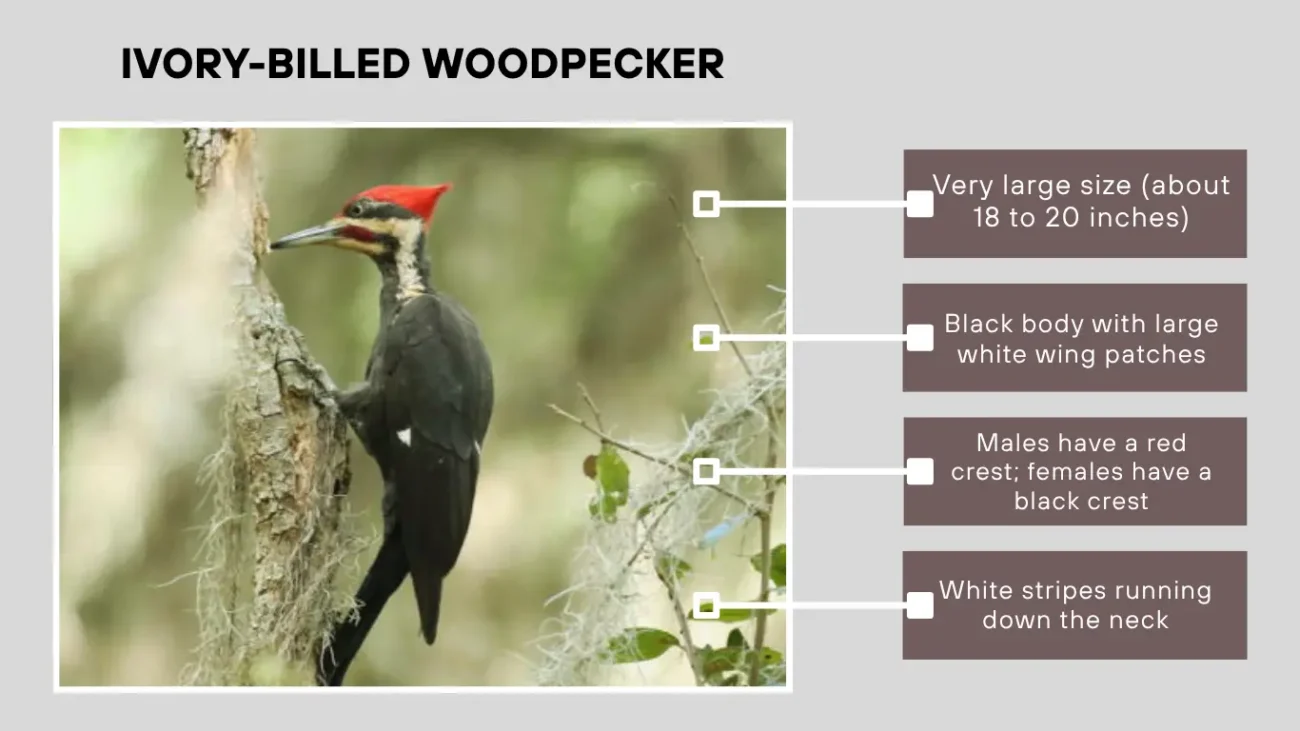
The Ivory-billed Woodpecker was once the largest woodpecker in North America and is now considered critically endangered or possibly extinct. It inhabited southern swamps and bottomland forests.
Identification
- Very large size (about 18 to 20 inches)
- Black body with large white wing patches
- Males have a red crest; females have a black crest
- White stripes running down the neck
- Long, pale ivory-colored bill
Nesting
Nests were built in large dead trees in swampy areas. The female laid 1–3 eggs, with both parents sharing responsibilities. Nesting behavior was rarely observed in the wild.
Diet
Fed on large beetle larvae found in dead and decaying trees. Also ate fruits and nuts.
Habitat and Behaviors
Inhabited old-growth bottomland forests and swamps with abundant dead wood. It was a strong flier and extremely wary of humans. Its “double-knock” drumming was distinctive.
Lifecycle and Lifespan
Little is known due to lack of recent observations. Breeding was believed to occur in late winter. Lifespan in the wild was estimated at around 10–15 years.
19. Pale-billed Woodpecker
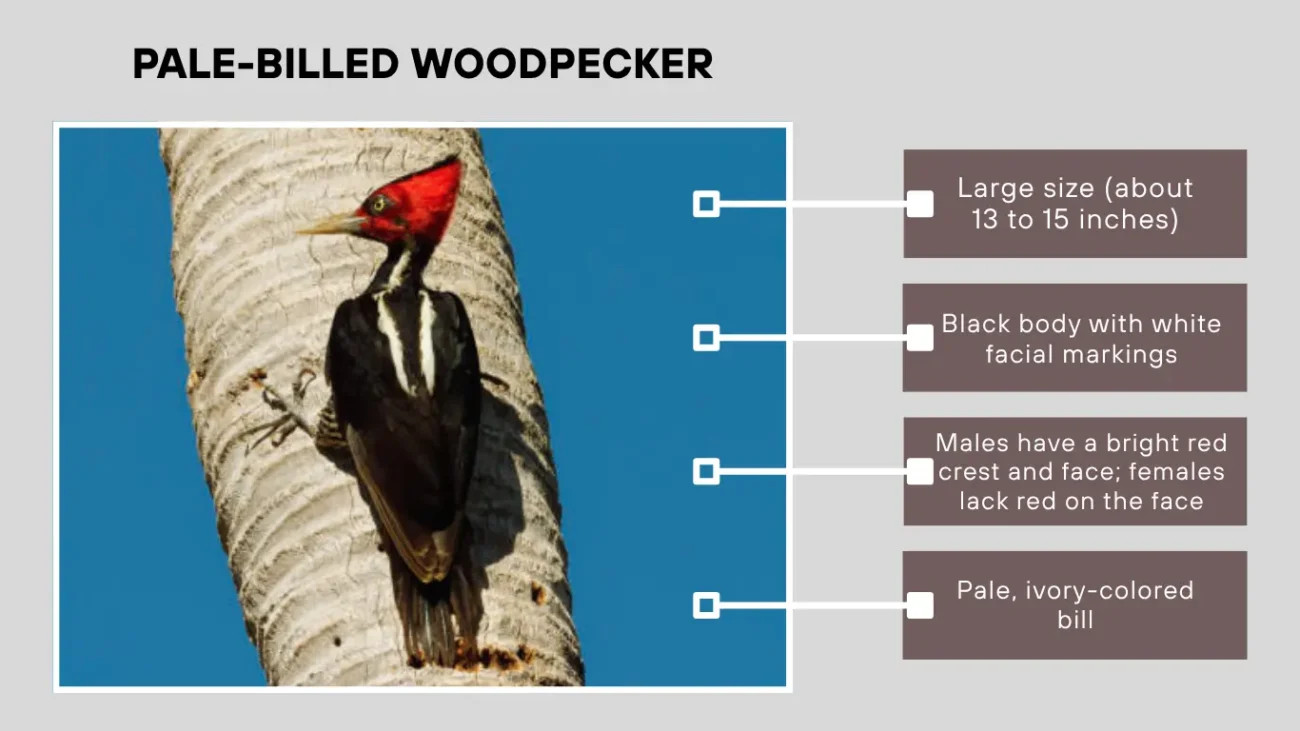
The Pale-billed Woodpecker is a large, striking bird native to Central America. It resembles the Ivory-billed Woodpecker but is slightly smaller and more common in its range.
Identification
- Large size (about 13 to 15 inches)
- Black body with white facial markings
- Males have a bright red crest and face; females lack red on the face
- Pale, ivory-colored bill
- Long neck and stout build
Nesting
Nests are excavated in large tree trunks in tropical forests. Females lay 2–4 eggs, with both parents sharing duties from incubation to chick feeding.
Diet
Feeds mainly on beetle larvae, ants, termites, and other insects. Occasionally eats fruits and seeds.
Habitat and Behaviors
Lives in humid tropical forests, especially lowland rainforests. Pale-billed Woodpeckers are strong and noisy foragers, often heard before they are seen.
Lifecycle and Lifespan
Breeding season varies by region. Fledging occurs after about 28–30 days. The species is believed to live up to 10 years or more in the wild.
20. Lineated Woodpecker
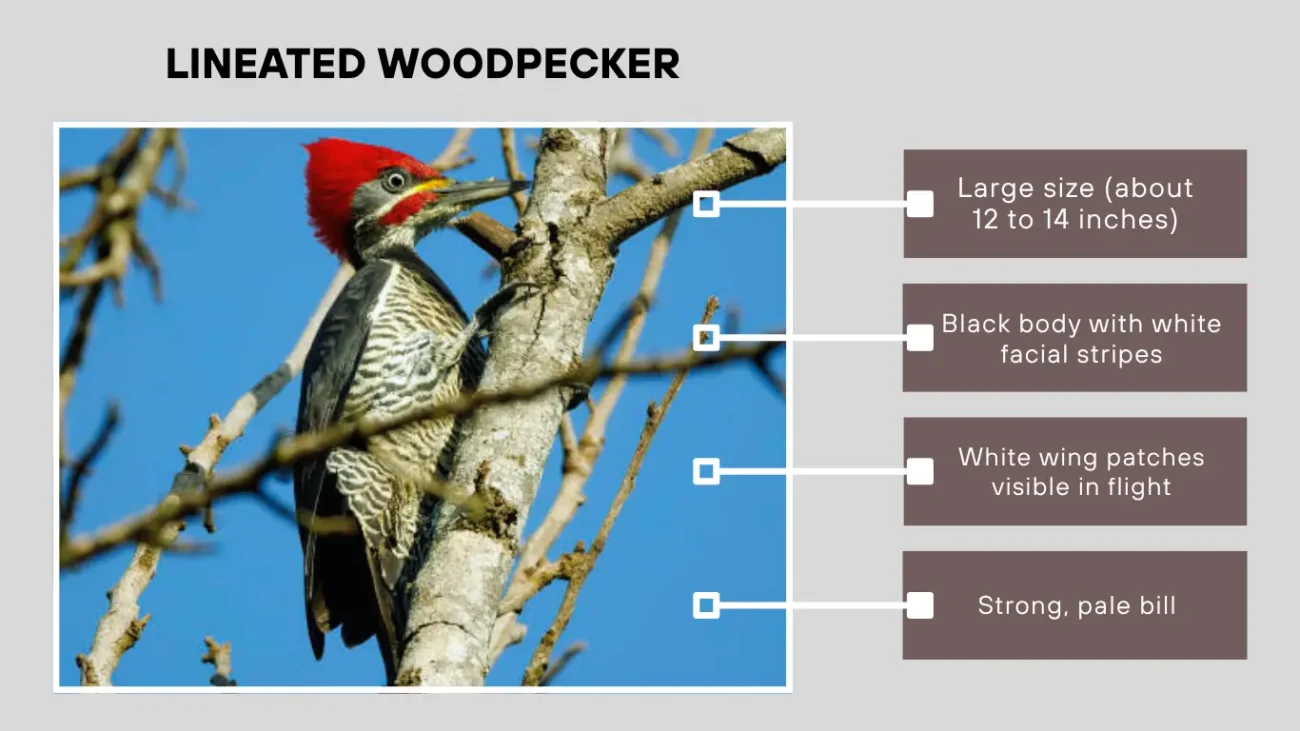
The Lineated Woodpecker is a large, striking species native to Central and South America. It closely resembles the Pileated Woodpecker in size and behavior.
Identification
- Large size (about 12 to 14 inches)
- Black body with white facial stripes
- Males have a red crest and red cheek stripe; females lack red on the cheek
- White wing patches visible in flight
- Strong, pale bill
Nesting
They nest in tree cavities, usually excavated in dead or decaying wood. Clutch size is typically 2–4 eggs, with both parents involved in incubation and feeding.
Diet
Primarily feeds on wood-boring insects, ants, and termites. Also eats fruits, nuts, and seeds.
Habitat and Behaviors
Inhabits tropical forests, forest edges, plantations, and semi-open areas. Loud and active, often heard drumming or giving sharp, laughing calls.
Lifecycle and Lifespan
Breeding occurs during the dry season, depending on the region. Chicks fledge in about 28–30 days. Expected lifespan is around 8–10 years in the wild.
21. Crimson-crested Woodpecker
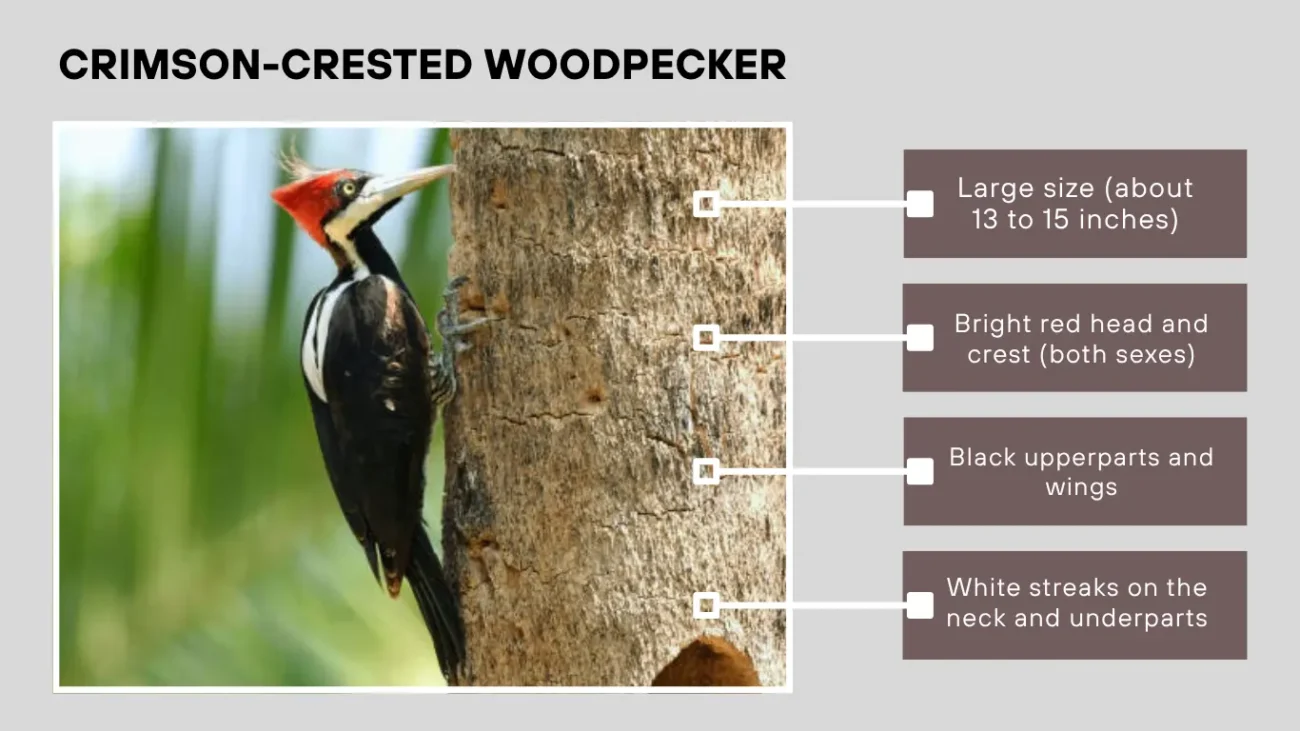
The Crimson-crested Woodpecker is one of the largest woodpeckers in South America. It is bold and colorful, with a loud call and strong presence in tropical forests.
Identification
- Large size (about 13 to 15 inches)
- Bright red head and crest (both sexes)
- Black upperparts and wings
- White streaks on the neck and underparts
- Strong, pale bill
Nesting
They excavate deep cavities in large dead trees. Clutch size is usually 2–3 eggs. Both parents participate in incubation and chick-rearing.
Diet
Feeds on wood-boring beetles, ants, termites, and larvae. Also consumes fruit and seeds.
Habitat and Behaviors
Found in lowland tropical forests, forest edges, and mature woodland. Loud and aggressive foragers, they are often seen in pairs or family groups.
Lifecycle and Lifespan
Breeding typically aligns with the dry season. Young fledge after about 30 days. Lifespan in the wild is estimated at 10 years or more.
22. Great Spotted Woodpecker

The Great Spotted Woodpecker is a common and widespread species across Europe and parts of Asia. It is known for its distinctive black, white, and red plumage and rhythmic drumming.
Identification
- Medium size (about 8.5 to 9 inches)
- Black upperparts with white shoulder patches
- White underparts
- Red patch under the tail
- Males have a red nape; juveniles have red crown
- Strong, chisel-like bill
Nesting
Nests are built in tree cavities, often in decaying trunks. Females lay 4–7 white eggs. Both parents share incubation and feeding duties.
Diet
Feeds on insects, larvae, seeds, and nuts. Will also take bird eggs and nestlings during breeding season. Commonly visits bird feeders.
Habitat and Behaviors
Found in woodlands, parks, gardens, and orchards. Active drummers with a loud, sharp “kik” call. Often seen clinging to tree trunks or branches.
Lifecycle and Lifespan
Breeding occurs from April to June. Chicks fledge in about 20–24 days. Average lifespan is 5–7 years, with some living over 10 years.
23. Lesser Spotted Woodpecker
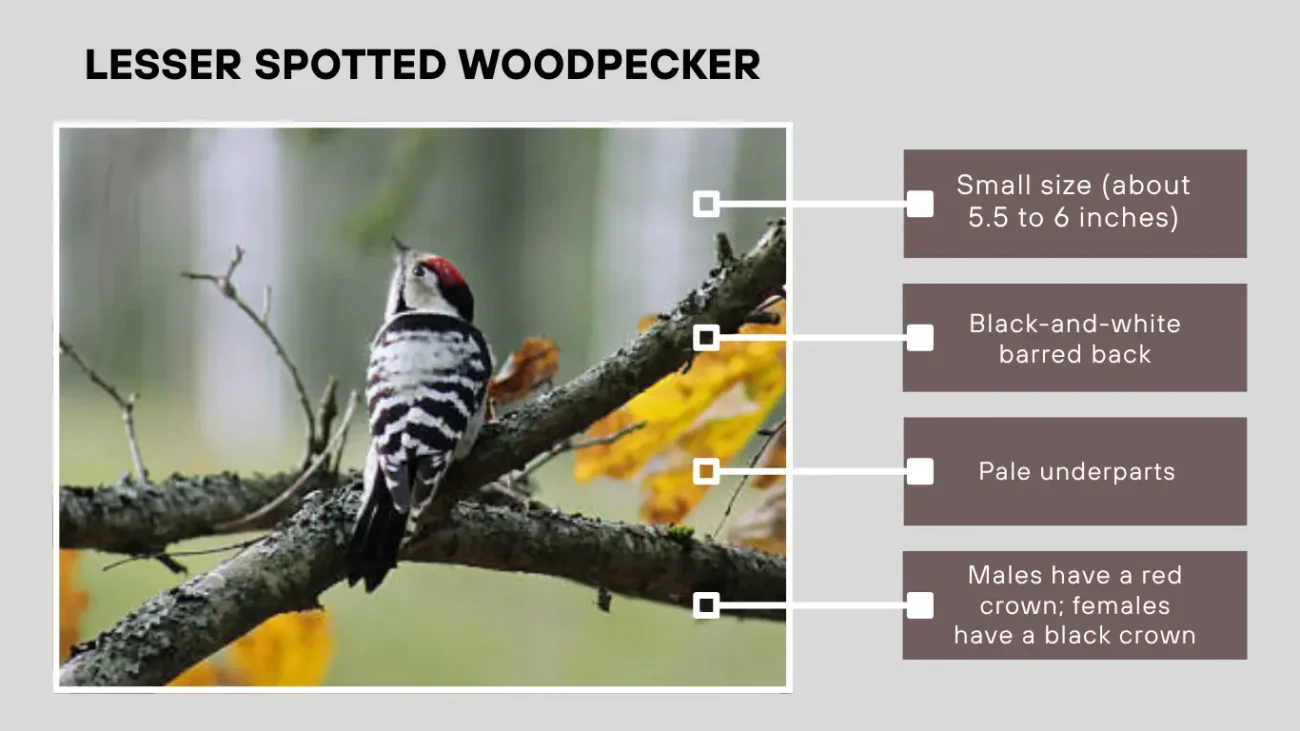
The Lesser Spotted Woodpecker is the smallest woodpecker in Europe. It is elusive and quiet, often going unnoticed despite its widespread presence.
Identification
- Small size (about 5.5 to 6 inches)
- Black-and-white barred back
- Pale underparts
- Males have a red crown; females have a black crown
- No red on the underparts
- Thin, straight bill
Nesting
Nests are made in dead tree trunks or branches. Females lay 5–7 eggs. Both parents are involved in raising the young.
Diet
Eats small insects, spiders, and larvae. Occasionally feeds on seeds and sap.
Habitat and Behaviors
Prefers old deciduous woodlands, especially with birch and alder. Quiet and secretive, it moves quickly through tree canopies and is rarely seen on the ground.
Lifecycle and Lifespan
Breeding starts in early spring. Chicks fledge about 20–23 days after hatching. They typically live around 4–6 years in the wild.
24. Middle Spotted Woodpecker
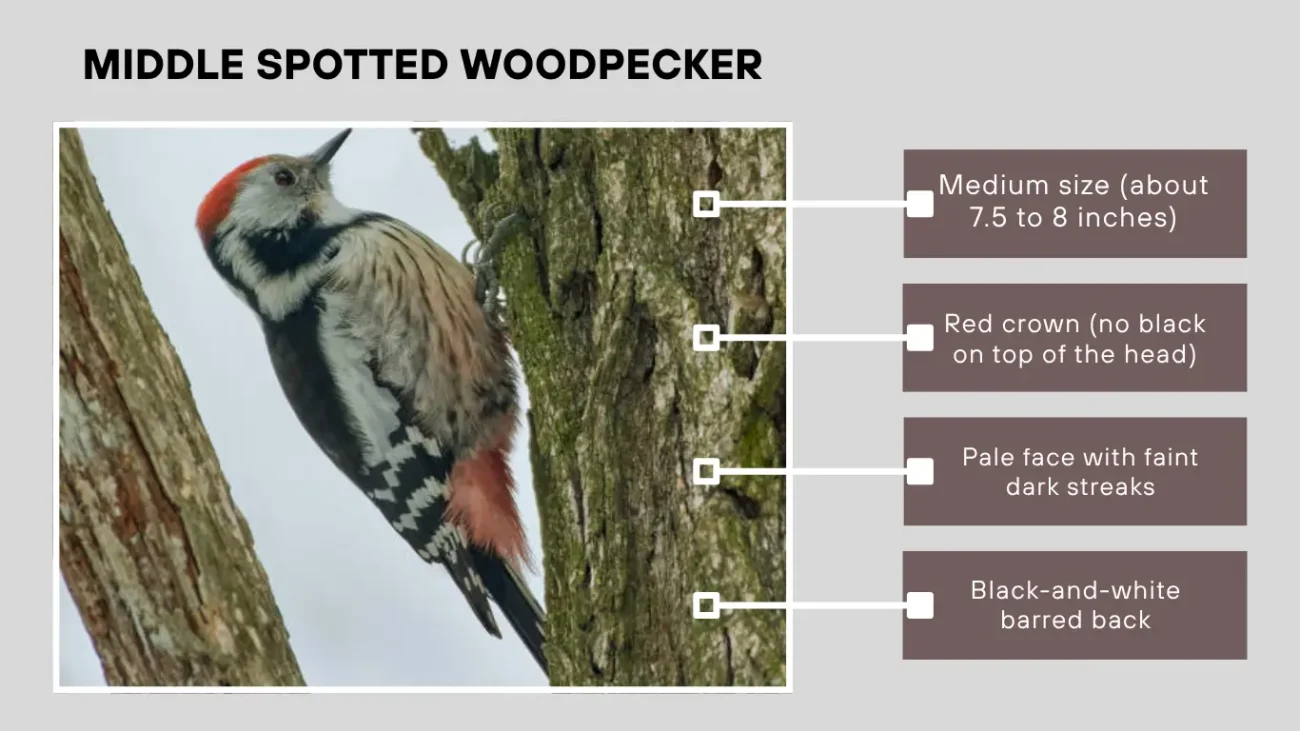
The Middle Spotted Woodpecker is a medium-sized European species that favors mature oak forests. It is less common than the Great or Lesser Spotted Woodpeckers and has a distinctive red crown.
Identification
- Medium size (about 7.5 to 8 inches)
- Red crown (no black on top of the head)
- Pale face with faint dark streaks
- Black-and-white barred back
- Lacks the red nape seen in Great Spotted Woodpecker
Nesting
Nests in old deciduous trees, especially oaks. The female lays 4–7 eggs, and both parents incubate and raise the young.
Diet
Feeds mostly on insects, especially larvae found under tree bark. Also eats sap, seeds, and small fruits.
Habitat and Behaviors
Prefers mature oak and mixed forests with standing deadwood. Not very vocal but performs light drumming and has a soft “keh-keh” call. Often seen climbing branches instead of trunks.
Lifecycle and Lifespan
Breeding begins in April or May. Fledging occurs around 22–24 days after hatching. The average lifespan is 5–7 years.
25. Green Woodpecker
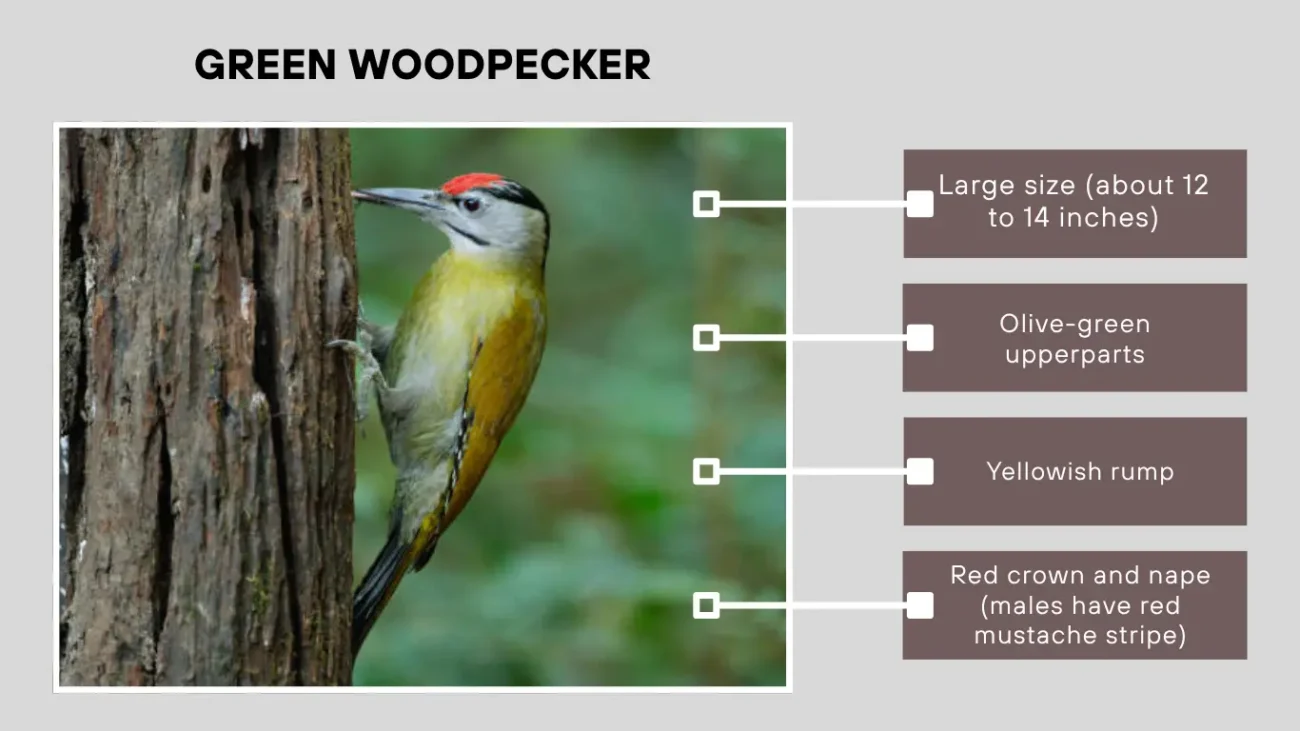
The Green Woodpecker is a large, colorful woodpecker found across Europe and western Asia. It is notable for its loud, laughing call and ground-feeding behavior.
Identification
- Large size (about 12 to 14 inches)
- Olive-green upperparts
- Yellowish rump
- Red crown and nape (males have red mustache stripe)
- Pale face with black eye patches
- Long tail and bill
Nesting
They excavate nests in softwood trees or decaying trunks. The female lays 5–7 eggs. Both parents share nesting duties.
Diet
Primarily feeds on ants and their larvae, which it digs from the ground using its long, sticky tongue. Occasionally eats other insects and small fruits.
Habitat and Behaviors
Favors open woodlands, parklands, orchards, and grassy fields near trees. Often seen feeding on the ground. Known for its distinctive “yaffle” call.
Lifecycle and Lifespan
Breeding season starts in spring. Fledging takes place in about 21–24 days. Green Woodpeckers can live 6–10 years in the wild.
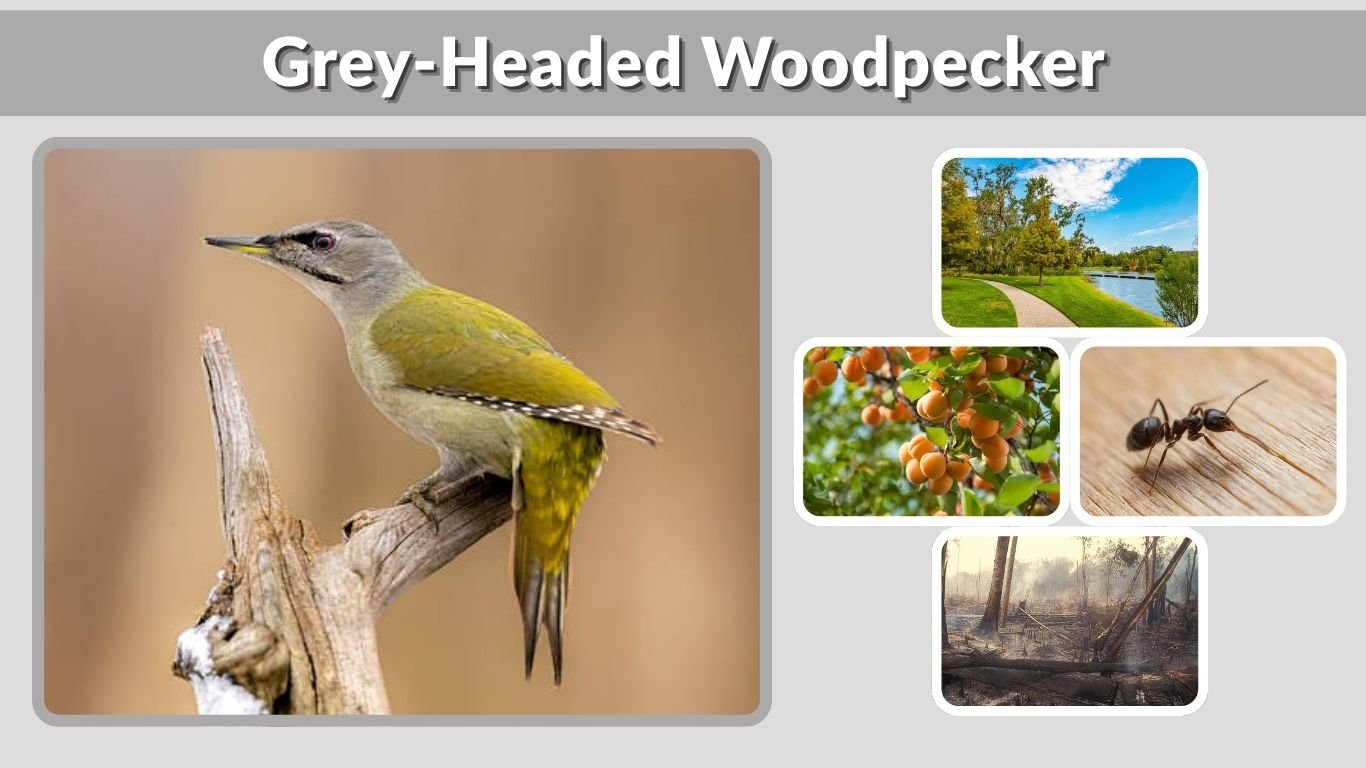
26. Grey-headed Woodpecker

The Grey-headed Woodpecker is a medium-sized Eurasian species closely related to the Green Woodpecker. It is more subdued in color and often found in forested areas across Europe and Asia.
Identification
- Medium size (about 10 to 11 inches)
- Gray head and nape
- Olive-green back and wings
- Pale underparts
- Males have a small red crown patch; females lack red
- Black mustache stripe and long tail
Nesting
Nests are excavated in soft or decaying trees. Clutch size ranges from 5–7 eggs. Both sexes share incubation and feeding responsibilities.
Diet
Feeds mainly on ants and other ground-dwelling insects. Also eats beetles, caterpillars, and some fruits.
Habitat and Behaviors
Found in deciduous and mixed forests, especially those with open clearings. Often forages on the ground like the Green Woodpecker and uses soft, repetitive calls and drumming.
Lifecycle and Lifespan
Breeding begins in late spring. Fledging takes place after about 24–27 days. Lifespan in the wild is around 5–8 years.
27. Eurasian Wryneck
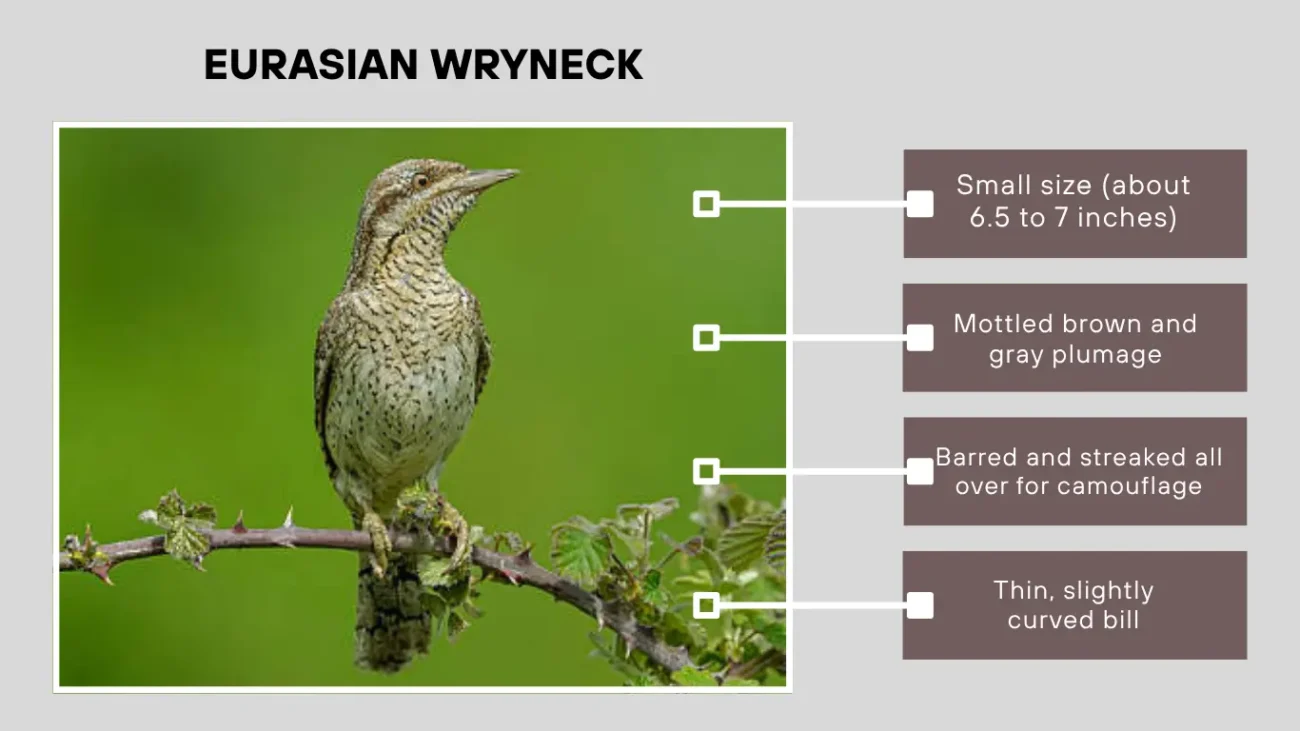
The Eurasian Wryneck is a small, cryptic woodpecker that lacks the stiff tail and strong bill of typical woodpeckers. It is known for its ability to twist its neck in a snake-like motion when threatened.
Identification
- Small size (about 6.5 to 7 inches)
- Mottled brown and gray plumage
- Barred and streaked all over for camouflage
- Thin, slightly curved bill
- Long, pointed tail
- No crest or bold coloration
Nesting
They nest in natural cavities or old woodpecker holes. The female lays 7–10 eggs. Both parents incubate and feed the chicks.
Diet
Feeds primarily on ants and their larvae, which it gathers from the ground using its long, sticky tongue.
Habitat and Behaviors
Found in open woodlands, orchards, farmlands, and gardens. Migratory in northern ranges. Noted for their “wheezing” call and neck-twisting defensive behavior.
Lifecycle and Lifespan
Breeding starts in spring. Young fledge after 20–22 days. Wrynecks typically live 4–6 years in the wild.
28. Japanese Green Woodpecker
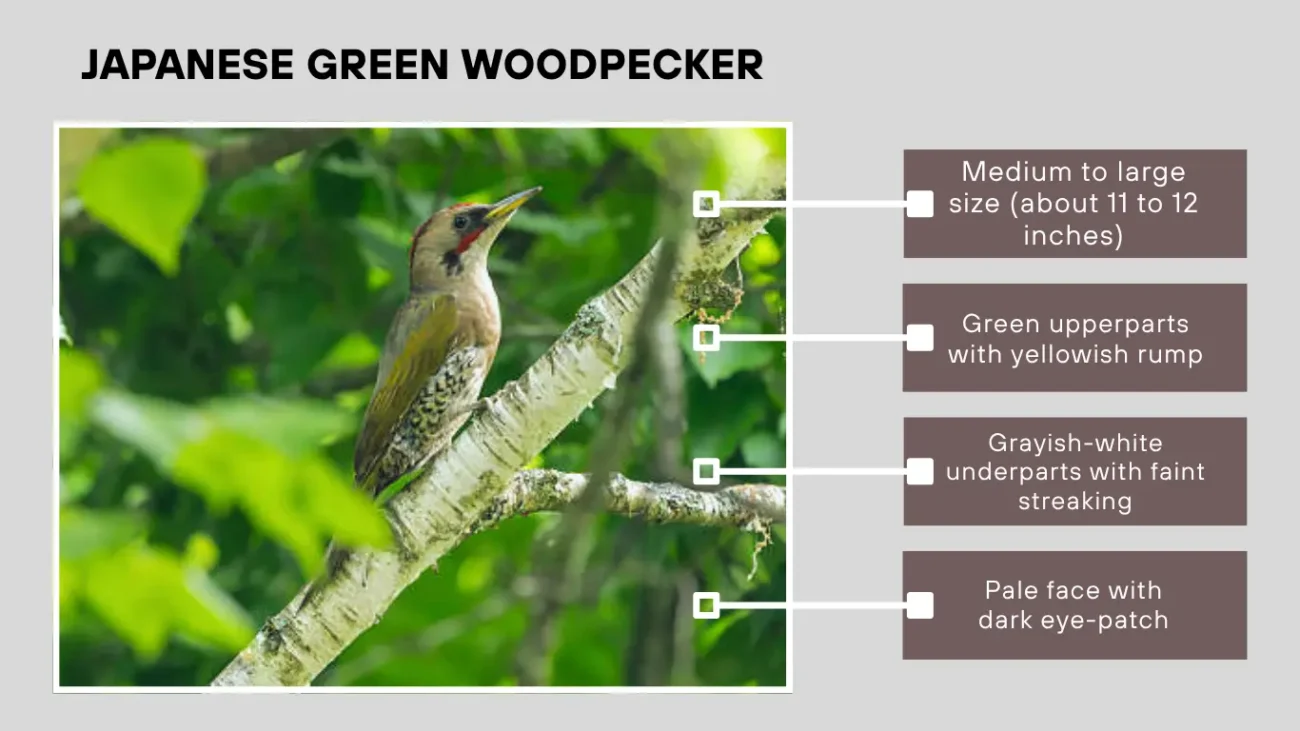
The Japanese Green Woodpecker is an endemic species to Japan and closely related to the Eurasian Green and Grey-headed woodpeckers. It is known for its vibrant plumage and distinct call.
Identification
- Medium to large size (about 11 to 12 inches)
- Green upperparts with yellowish rump
- Grayish-white underparts with faint streaking
- Males have a red crown and mustache stripe; females lack the red mustache
- Pale face with dark eye-patch
- Sturdy, pointed bill
Nesting
Nests are excavated in dead or softwood trees. The female lays 5–7 eggs, with both parents sharing incubation and feeding duties.
Diet
Feeds primarily on ants and other insects found in dead wood or soil. Also consumes berries and seeds during colder months.
Habitat and Behaviors
Found in broadleaf and mixed forests, woodland edges, parks, and temple groves throughout Japan. Vocal and often heard before seen, it produces a loud, laughing “kyo-kyo-kyo” call.
Lifecycle and Lifespan
Breeding occurs in spring. Chicks fledge after about 22–26 days. Estimated lifespan is 6–9 years in the wild.
29. Himalayan Woodpecker
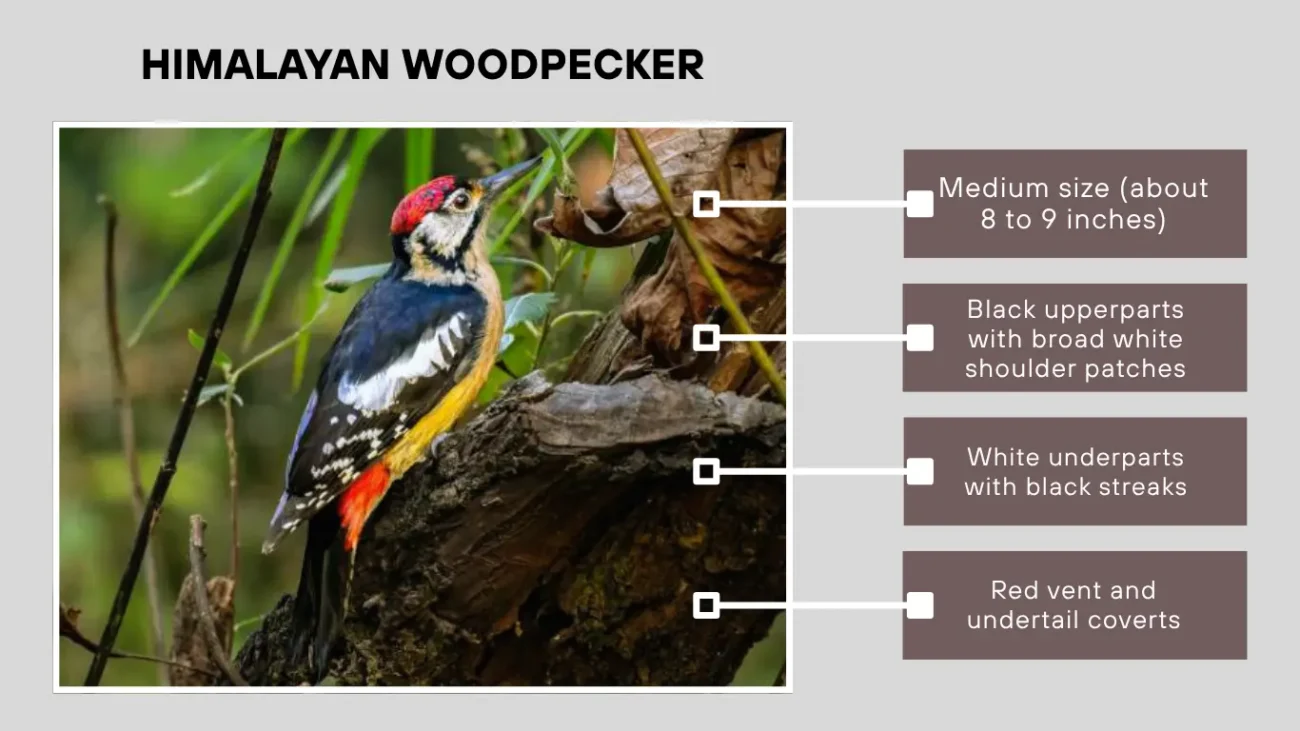
The Himalayan Woodpecker is a striking bird found in forested regions of the Himalayas. It prefers high-altitude coniferous and mixed forests and resembles the Great Spotted Woodpecker.
Identification
- Medium size (about 8 to 9 inches)
- Black upperparts with broad white shoulder patches
- White underparts with black streaks
- Red vent and undertail coverts
- Males have a red crown patch; females have a black crown
- Strong bill and tail for climbing
Nesting
Cavity nester, usually in coniferous trees. The female lays 3–5 white eggs. Both parents contribute to incubation and feeding.
Diet
Feeds on insects, especially larvae and beetles, as well as fruits, seeds, and nuts. Forages along trunks and thick branches.
Habitat and Behaviors
Inhabits pine, fir, and mixed forests in the foothills and mid-altitudes of the Himalayas. Often solitary or in pairs. Recognized by its sharp “pik” call and regular drumming.
Lifecycle and Lifespan
Breeding occurs from April to June. Chicks fledge about 24–27 days after hatching. Lifespan is estimated at 5–8 years.
30. Rufous Woodpecker

The Rufous Woodpecker is a medium-sized tropical species found across South and Southeast Asia. It is unusual among woodpeckers for nesting inside ant nests, particularly those of tree ants.
Identification
- Medium size (about 9 to 10 inches)
- Rufous-brown body with darker scalloped pattern
- Short blackish tail
- Small crest
- Males have a small red patch on the cheek
- Short, slightly curved bill
Nesting
Unique for nesting in active arboreal ant nests. The female lays 2–4 eggs inside the ant colony. Both parents share incubation and feeding.
Diet
Feeds primarily on ants and termites. Also consumes beetles, caterpillars, and some plant matter.
Habitat and Behaviors
Found in moist forests, plantations, and wooded gardens. Rufous Woodpeckers are quiet and inconspicuous, foraging on tree trunks and low branches. They tolerate ant bites while nesting and feeding.
Lifecycle and Lifespan
Breeding generally occurs before the monsoon season. Young fledge in about 20–24 days. Estimated lifespan in the wild is around 5–7 years.
31. Black-rumped Flameback

The Black-rumped Flameback is a widespread and vibrant woodpecker species found across the Indian subcontinent. It is easily recognized by its golden-yellow back and loud calls.
Identification
- Medium size (about 9 to 10.5 inches)
- Bright golden-yellow back (flameback)
- Black rump and tail
- White underparts with dark spotting
- Males have a red crown; females have a black-spotted crown
- White face with dark mustache stripe
Nesting
Nests in tree cavities, often in dead or decaying wood. The female lays 2–4 eggs. Both parents help with incubation and feeding.
Diet
Eats insects like ants and beetle larvae, along with fruits and nectar. Frequently forages by chiseling bark.
Habitat and Behaviors
Common in forests, wooded areas, parks, and even urban gardens. Loud and active, with frequent drumming and high-pitched calls. Often seen in pairs or small groups.
Lifecycle and Lifespan
Breeding season varies by region but generally occurs before the rainy season. Fledging occurs in about 23–26 days. Lifespan typically ranges from 5–8 years.
32. Greater Flameback

The Greater Flameback is a large, striking woodpecker found in the Indian subcontinent and Southeast Asia. It is known for its brilliant golden back and loud, laughing calls.
Identification
- Large size (about 11 to 13 inches)
- Golden-yellow back and wings
- Black tail with white markings
- White underparts with dark spots
- Males have a red crest; females have a black crest with white spots
- Dark face with white lines and markings
Nesting
Excavates cavities in tree trunks, often in tall deadwood. Lays 2–4 white eggs. Both parents are involved in incubation and feeding.
Diet
Feeds on insects such as beetles, ants, and their larvae. Also consumes fruits, seeds, and nectar.
Habitat and Behaviors
Found in forests, wooded areas, plantations, and even near human settlements. Very vocal and often gives a series of loud, rolling calls. Forages actively by climbing and pecking at bark.
Lifecycle and Lifespan
Breeding typically takes place before monsoon seasons. Chicks fledge around 25–28 days after hatching. Lifespan in the wild is around 7–10 years.
33. White-naped Woodpecker
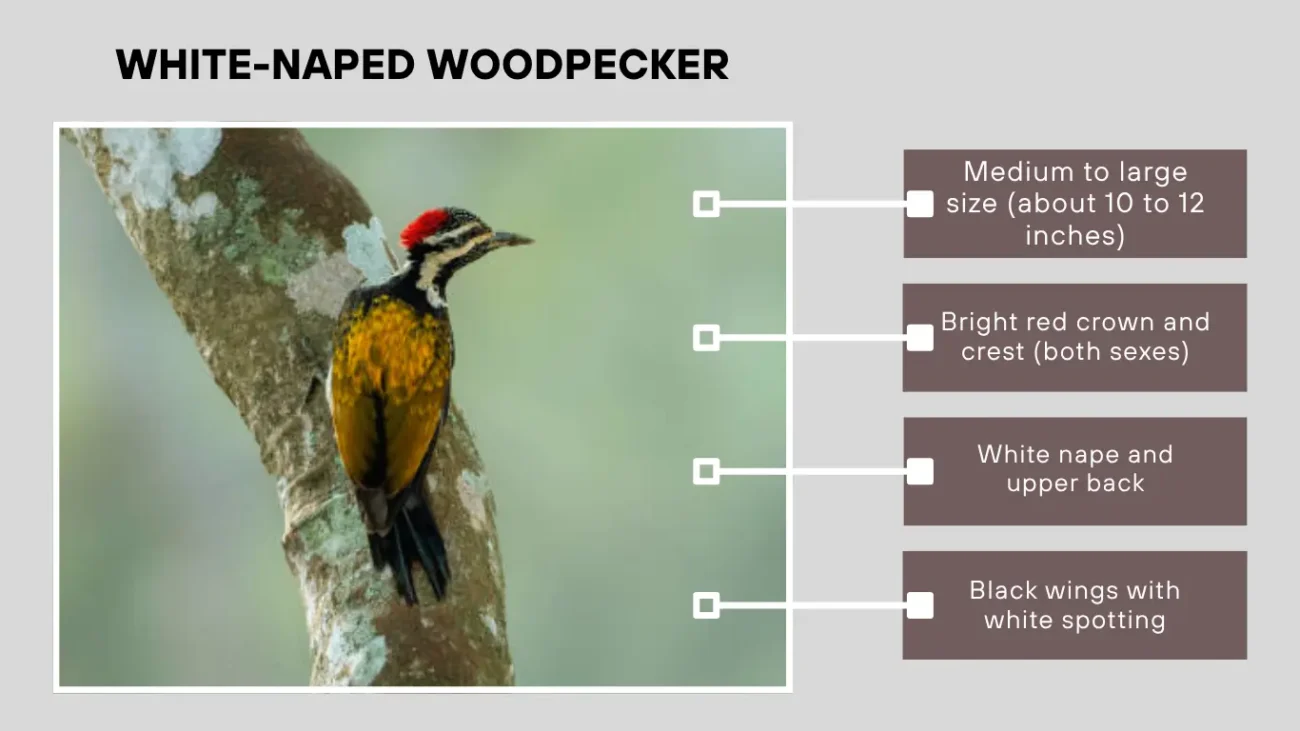
The White-naped Woodpecker is a bold and colorful species native to the Indian subcontinent. It is often seen in dry forests and scrublands.
Identification
- Medium to large size (about 10 to 12 inches)
- Bright red crown and crest (both sexes)
- White nape and upper back
- Black wings with white spotting
- Yellow shoulder patches
- White face with black markings
Nesting
Nests are built in softwood trees or palm trunks. The female lays 2–4 eggs. Both parents share nesting and feeding duties.
Diet
Feeds on insects, especially ants and larvae. Also eats seeds and fruits.
Habitat and Behaviors
Prefers dry deciduous forests, scrublands, and wooded villages. Seen singly or in pairs, often drumming on tree trunks and calling with sharp notes.
Lifecycle and Lifespan
Breeding occurs between March and June. Young birds fledge after about 23–26 days. The average lifespan is estimated at 6–8 years.
34. Brown-capped Pygmy Woodpecker
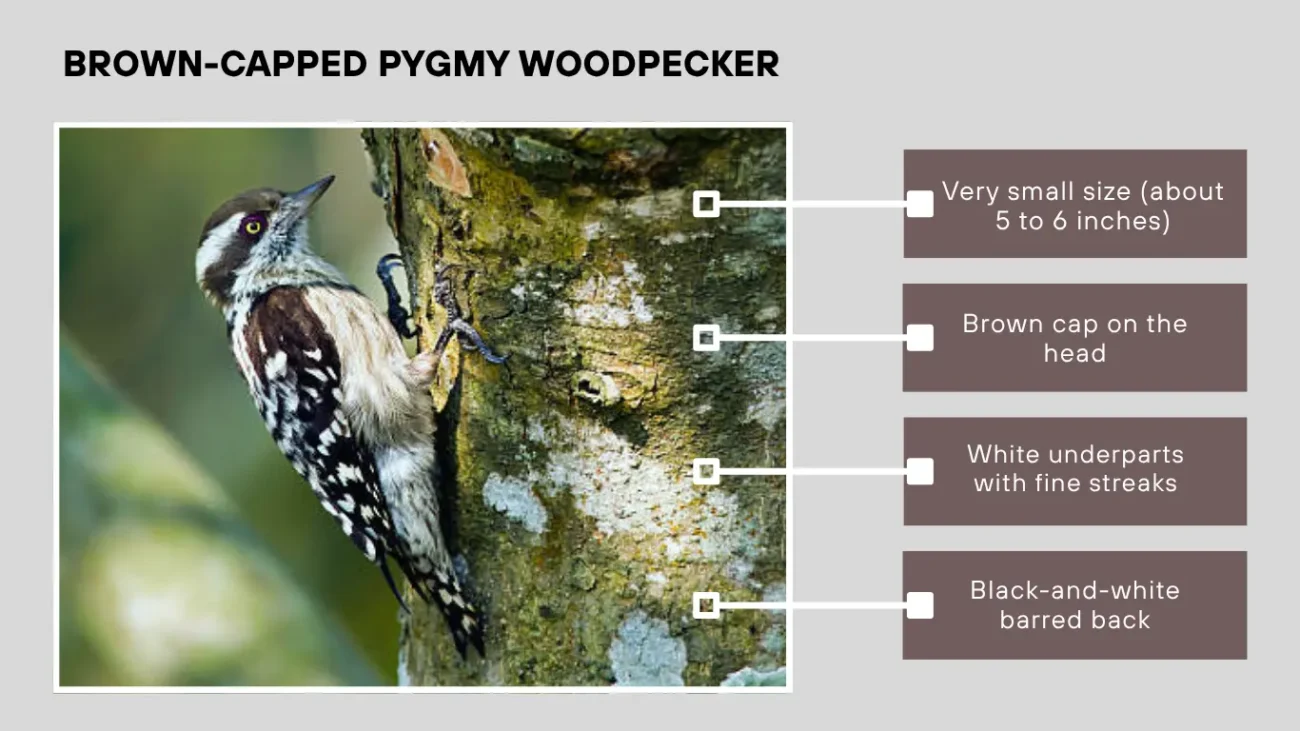
The Brown-capped Pygmy Woodpecker is a tiny and active bird found across the Indian subcontinent. It is one of the smallest woodpecker species, often seen in mixed-species flocks.
Identification
- Very small size (about 5 to 6 inches)
- Brown cap on the head
- White underparts with fine streaks
- Black-and-white barred back
- Males have a small red patch on the rear crown
- Short, pointed bill
Nesting
Nests in small cavities in tree trunks or branches. The female lays 3–4 eggs, and both parents share in incubation and feeding duties.
Diet
Feeds on tiny insects, larvae, spiders, and sometimes nectar. Forages on thin branches and twigs.
Habitat and Behaviors
Inhabits dry deciduous forests, gardens, and wooded urban areas. Very active, often hanging from twigs while pecking. Call is a sharp, high-pitched “tik-tik.”
Lifecycle and Lifespan
Breeding season is usually during spring. Fledging occurs in about 18–22 days. Estimated lifespan in the wild is 4–6 years.
35. Speckled Piculet
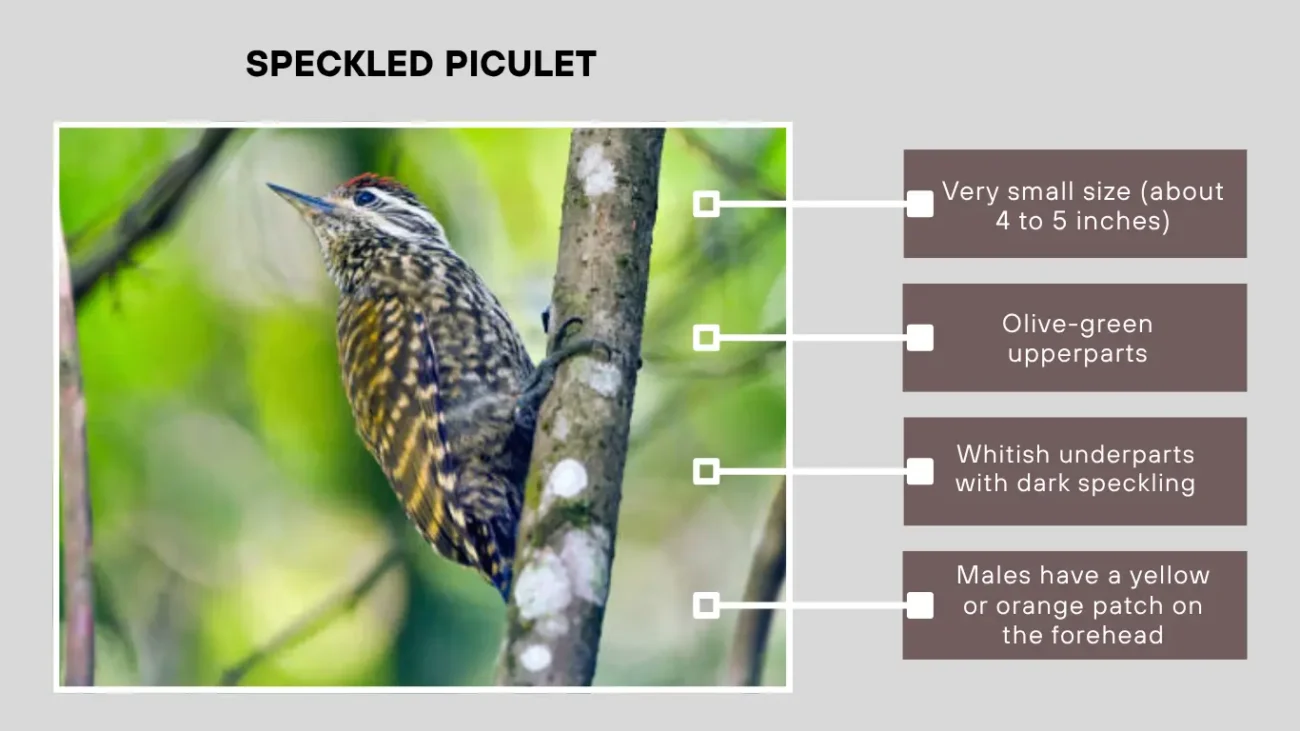
The Speckled Piculet is a small, cryptic woodpecker found in South and Southeast Asia. It is more like a “mini-woodpecker” and spends much of its time in shrubs and lower branches.
Identification
- Very small size (about 4 to 5 inches)
- Olive-green upperparts
- Whitish underparts with dark speckling
- Males have a yellow or orange patch on the forehead
- Short tail and bill
- Rounded head with minimal crest
Nesting
Nests in small tree cavities or dead branches. The female lays 2–4 eggs. Both sexes help incubate and raise the chicks.
Diet
Eats ants, termites, spiders, and tiny insects. Frequently probes into bark and soft wood.
Habitat and Behaviors
Found in lowland forests, scrublands, gardens, and bamboo thickets. Usually quiet and difficult to spot. Moves with quick, jerky motions through foliage.
Lifecycle and Lifespan
Breeding generally starts before monsoon season. Fledging takes place after 17–21 days. Lifespan is around 3–5 years in the wild.
36. Olive-backed Woodpecker
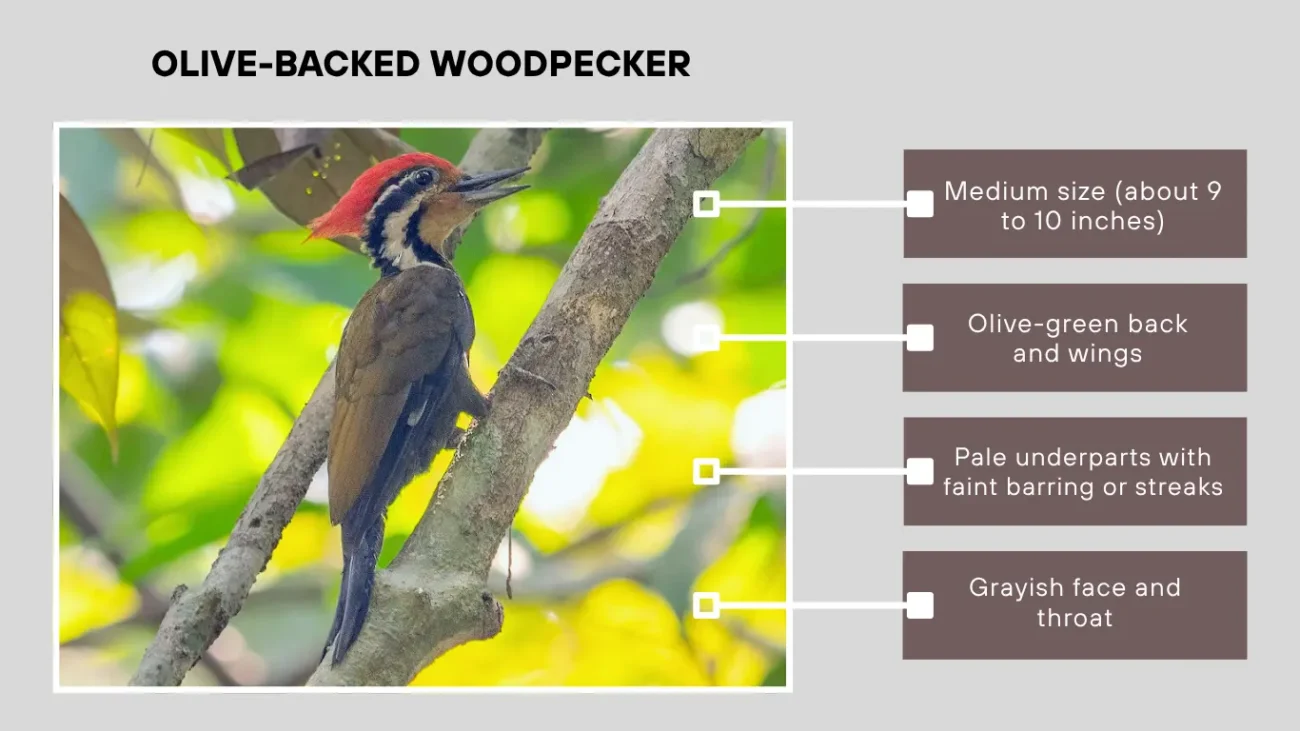
The Olive-backed Woodpecker is a forest-dwelling species native to Southeast Asia. Its duller coloration helps it blend into dense tropical foliage.
Identification
- Medium size (about 9 to 10 inches)
- Olive-green back and wings
- Pale underparts with faint barring or streaks
- Males have a red crown and mustache stripe; females have a black crown
- Grayish face and throat
- Straight, sturdy bill
Nesting
Nests are excavated in decaying tree trunks or large branches. The female lays 2–3 eggs. Both parents share all nesting responsibilities.
Diet
Feeds on ants, termites, beetle larvae, and other wood-boring insects. Occasionally eats fruit and berries.
Habitat and Behaviors
Prefers lowland tropical and swamp forests. Often seen foraging in the middle canopy, quietly tapping or peeling bark. Not highly vocal.
Lifecycle and Lifespan
Breeding typically coincides with the start of the rainy season. Fledging occurs in about 24–26 days. Expected lifespan is 6–8 years.
37. Buff-spotted Woodpecker
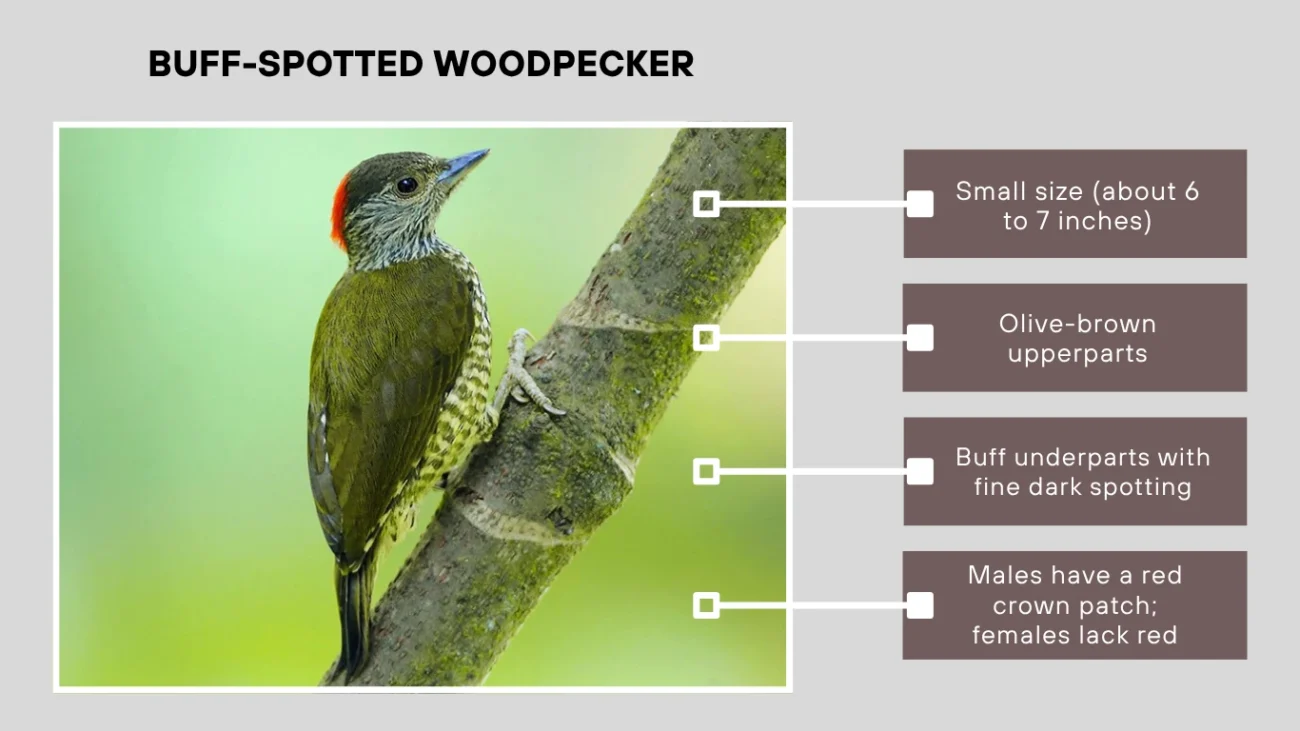
The Buff-spotted Woodpecker is a small and slender species found in African tropical forests. It is known for its finely spotted plumage and secretive behavior.
Identification
- Small size (about 6 to 7 inches)
- Olive-brown upperparts
- Buff underparts with fine dark spotting
- Males have a red crown patch; females lack red
- Pale face with dark eyestripe
- Thin bill and tail
Nesting
Nests in tree cavities, usually in softwood or decaying trunks. The female lays 2–3 eggs. Both sexes help incubate and raise the chicks.
Diet
Feeds on ants, termites, small beetles, and larvae. Gleans insects from bark and foliage rather than drilling.
Habitat and Behaviors
Inhabits lowland rainforests, secondary forests, and forest edges. Secretive and quiet, often seen moving along small branches. Rarely drums.
Lifecycle and Lifespan
Breeding varies by region but often peaks before the rainy season. Young fledge in 20–23 days. Estimated lifespan is 4–6 years.
38. Spot-breasted Woodpecker
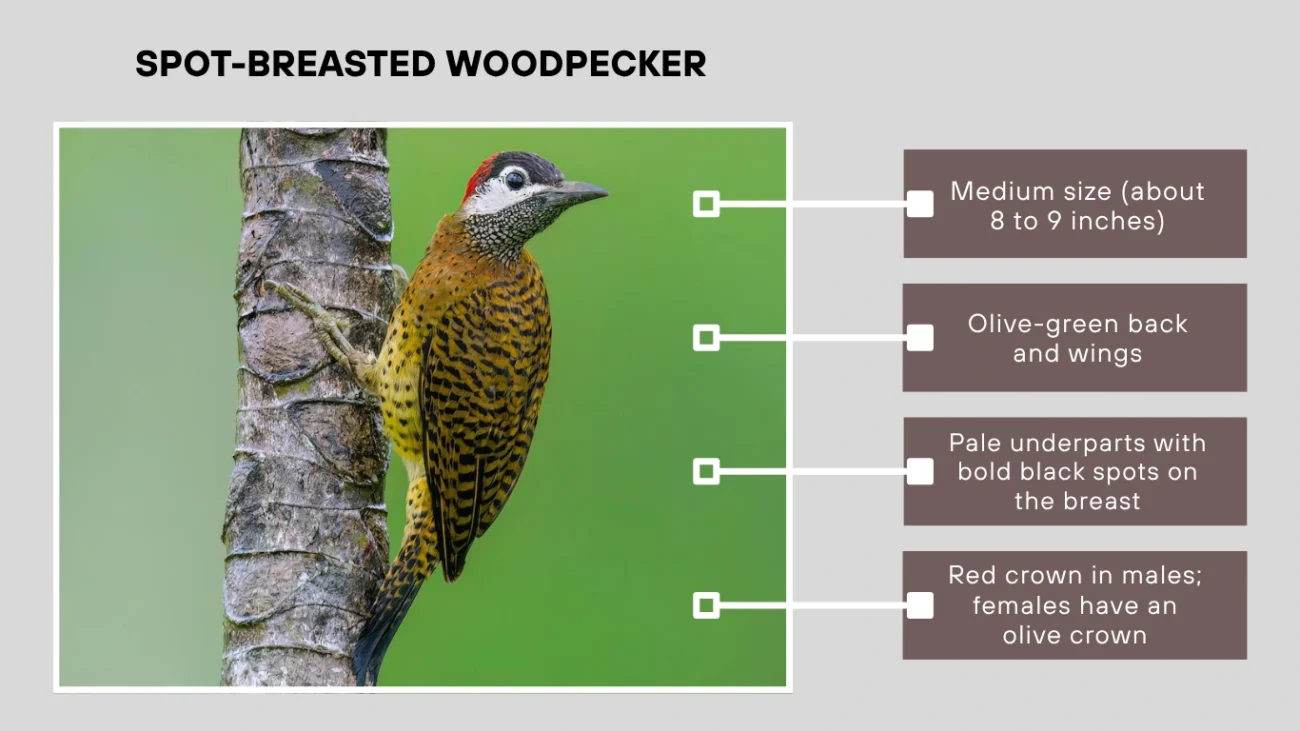
The Spot-breasted Woodpecker is a colorful species native to Central and South America. Its bold markings and spotted chest make it easily recognizable.
Identification
- Medium size (about 8 to 9 inches)
- Olive-green back and wings
- Pale underparts with bold black spots on the breast
- Red crown in males; females have an olive crown
- Yellowish face with black mustache stripe
- Sturdy, straight bill
Nesting
Excavates nest cavities in soft or decaying trees. The female lays 2–4 eggs. Both parents participate in incubation and chick care.
Diet
Eats insects, especially ants and beetle larvae. Also feeds on fruits, berries, and seeds.
Habitat and Behaviors
Found in tropical forests, forest edges, plantations, and open woodlands. Often seen foraging alone or in pairs, quietly tapping on bark.
Lifecycle and Lifespan
Breeding typically occurs during the dry season. Fledging takes place in about 24–26 days. Lifespan in the wild is estimated at 6–8 years.
39. Stripe-cheeked Woodpecker
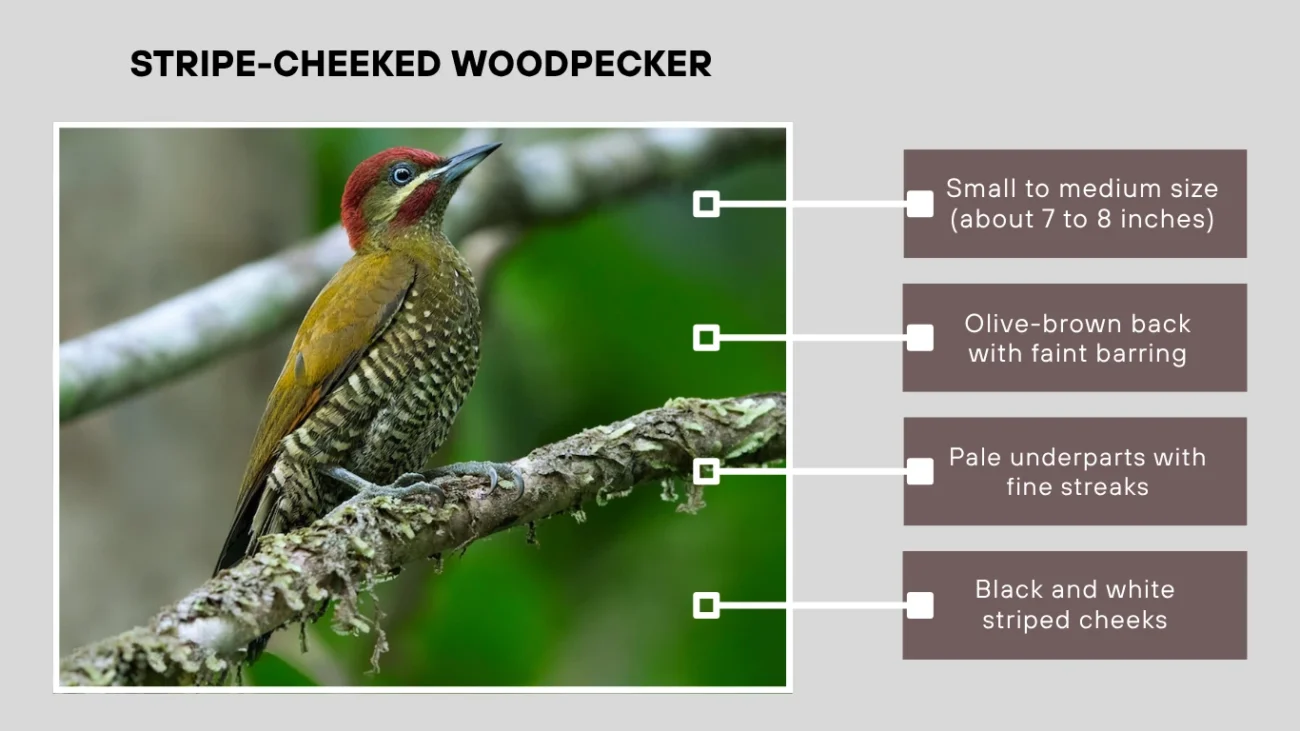
The Stripe-cheeked Woodpecker is a lesser-known species native to the montane forests of South America. It has a distinctive striped face and prefers dense, high-elevation habitats.
Identification
- Small to medium size (about 7 to 8 inches)
- Olive-brown back with faint barring
- Pale underparts with fine streaks
- Black and white striped cheeks
- Males have a red crown; females have a black crown
- Short, narrow bill
Nesting
Nests are excavated in mossy or decaying trees in cloud forests. Females lay 2–3 eggs. Both parents help with incubation and feeding.
Diet
Feeds on insects, especially ants, spiders, and beetle larvae. Also eats small fruits and berries.
Habitat and Behaviors
Lives in subtropical and montane cloud forests at higher elevations. Tends to be shy and reclusive, often moving through thick foliage quietly.
Lifecycle and Lifespan
Breeding usually begins in late spring or early summer. Young fledge after about 22–25 days. Estimated lifespan is 5–7 years.
40. Smoky-brown Woodpecker

The Smoky-brown Woodpecker is a small, inconspicuous bird native to Central and South American forests. Its uniform, dark plumage provides excellent camouflage in dense vegetation.
Identification
- Small size (about 6.5 to 7 inches)
- Uniform smoky-brown plumage
- Males have a small red patch on the nape; females lack red
- Slightly paler underparts with fine barring
- Short tail and slender bill
Nesting
Nests in small cavities of decaying trees or stumps. The female lays 2–3 white eggs. Both parents share incubation and feeding responsibilities.
Diet
Feeds mainly on ants, termites, and beetle larvae. Forages quietly along trunks and branches, often near the forest floor.
Habitat and Behaviors
Found in humid lowland and montane forests, forest edges, and dense secondary growth. Quiet and shy, rarely vocal. Prefers thick cover and rarely drums.
Lifecycle and Lifespan
Breeding season varies by region. Fledging occurs after 22–24 days. Estimated lifespan is 4–6 years in the wild.
41. Powerful Woodpecker
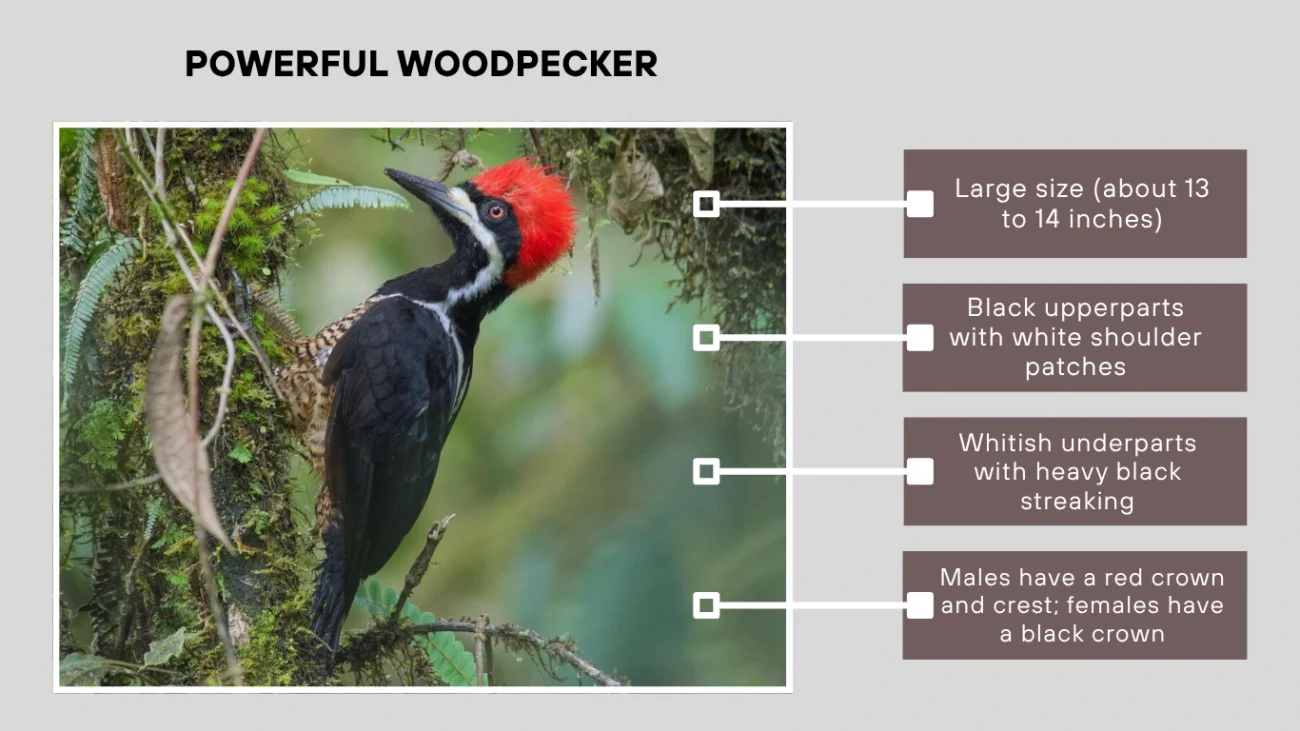
The Powerful Woodpecker is a large and robust species native to the Andean regions of South America. It is known for its strong bill and deep, resonant drumming.
Identification
- Large size (about 13 to 14 inches)
- Black upperparts with white shoulder patches
- Whitish underparts with heavy black streaking
- Males have a red crown and crest; females have a black crown
- Long, strong bill and tail
Nesting
Nests are built in tall trees, often in mature Andean forests. Females lay 2–3 eggs. Both parents participate in incubation and feeding duties.
Diet
Feeds on large insects and larvae, especially wood-boring beetles. Also consumes fruits and nuts occasionally.
Habitat and Behaviors
Inhabits cloud forests and subtropical montane forests. Often seen alone or in pairs. Has a loud, hollow drumming and a sharp, ringing call.
Lifecycle and Lifespan
Breeding takes place during the dry season. Fledglings leave the nest after 26–29 days. The species can live 8–10 years in the wild.
42. Magellanic Woodpecker
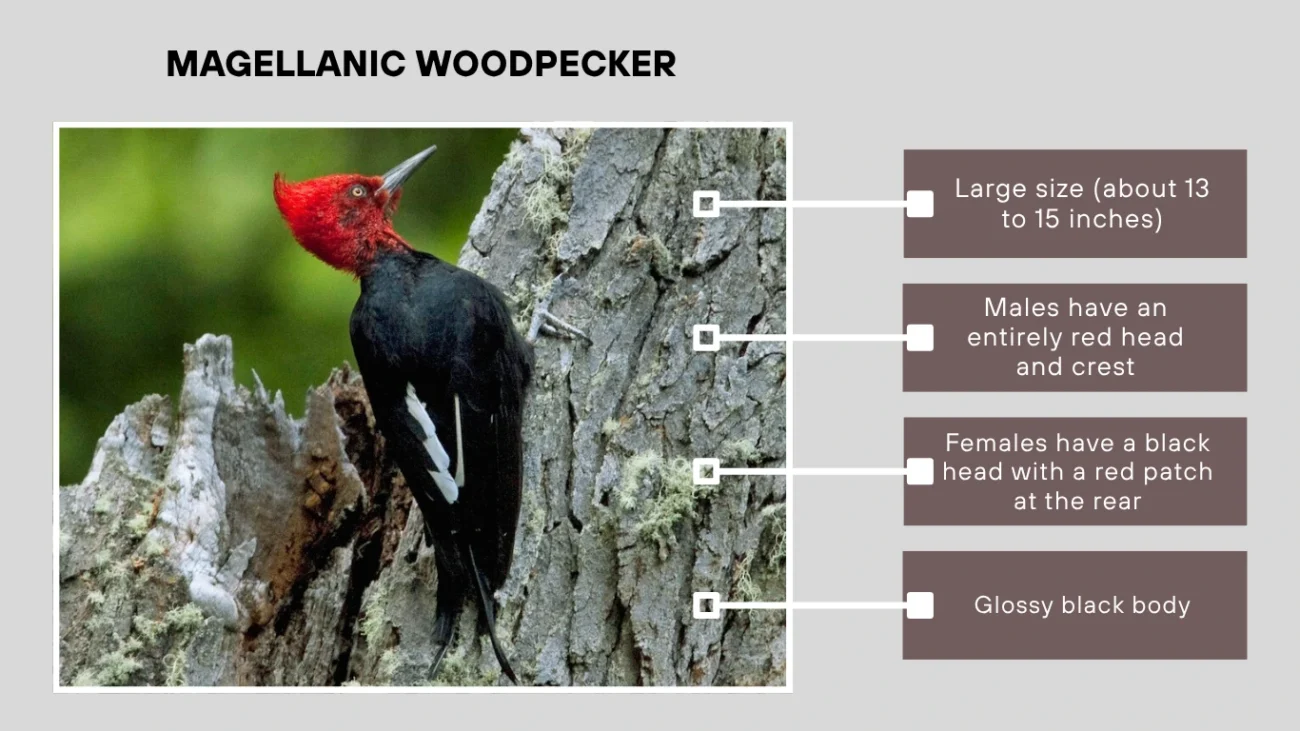
The Magellanic Woodpecker is one of the largest woodpecker species in South America, found in temperate forests of southern Chile and Argentina. It’s notable for its powerful build and striking coloration.
Identification
- Large size (about 13 to 15 inches)
- Males have an entirely red head and crest
- Females have a black head with a red patch at the rear
- Glossy black body
- Strong, chisel-like pale bill
- White markings on wings visible in flight
Nesting
Excavates large cavities in dead trees. The female lays 1–4 eggs. Both parents share incubation and chick-rearing duties.
Diet
Feeds on large wood-boring beetle larvae, ants, and other insects. Also eats fruits and small invertebrates.
Habitat and Behaviors
Lives in mature temperate forests, especially those with old Nothofagus trees. Territorial and noisy, they give sharp, high-pitched calls and deep drumming.
Lifecycle and Lifespan
Breeding occurs in late spring to summer. Fledging happens in about 28–30 days. Estimated lifespan in the wild is 8–12 years.
43. Campo Flicker

The Campo Flicker is a ground-feeding woodpecker found in open habitats across South America. It’s more often seen on the ground than climbing trees.
Identification
- Medium to large size (about 11 to 12 inches)
- Yellow face and throat with black chest band
- Males have a red malar stripe; females lack red
- Speckled underparts
- Black wings with white barring
- Long tail and bill
Nesting
Nests in holes dug into earthen banks, termite mounds, or decaying wood. The female lays 3–4 eggs. Both parents incubate and feed the young.
Diet
Feeds mostly on ants and termites, digging into soil or mounds. Also eats other insects and small fruits.
Habitat and Behaviors
Found in savannas, grasslands, farmland, and pastures. Often seen walking or hopping on the ground. Very social and noisy, often in loose flocks.
Lifecycle and Lifespan
Breeding season varies by region. Fledging takes place in about 23–26 days. Campo Flickers can live around 5–8 years in the wild.
44. Hispaniolan Woodpecker
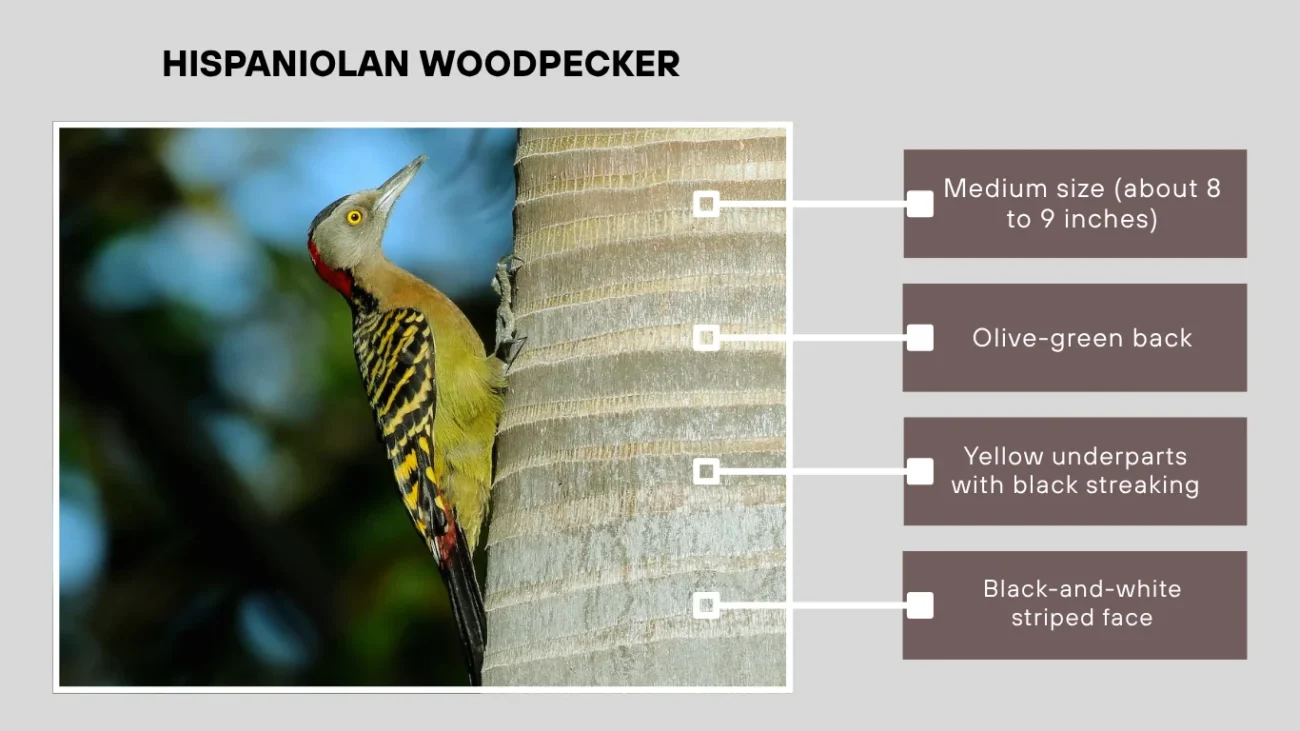
The Hispaniolan Woodpecker is the most common woodpecker in the Dominican Republic and Haiti. It’s a social species, often seen in noisy groups.
Identification
- Medium size (about 8 to 9 inches)
- Olive-green back
- Yellow underparts with black streaking
- Black-and-white striped face
- Males have a red crown and nape; females have a red nape only
- Straight, pointed bill
Nesting
Nests colonially, with multiple pairs excavating cavities in the same tree. Clutch size is 3–5 eggs. Both sexes help with incubation and feeding.
Diet
Feeds on insects, fruits, seeds, and small lizards. Known to visit plantations and gardens for food.
Habitat and Behaviors
Found in a wide range of habitats, including forests, plantations, and urban areas. Highly vocal with loud chattering calls and frequent drumming.
Lifecycle and Lifespan
Breeding occurs from spring to early summer. Chicks fledge in about 24–26 days. Lifespan in the wild is estimated at 6–9 years.
45. Cuban Green Woodpecker
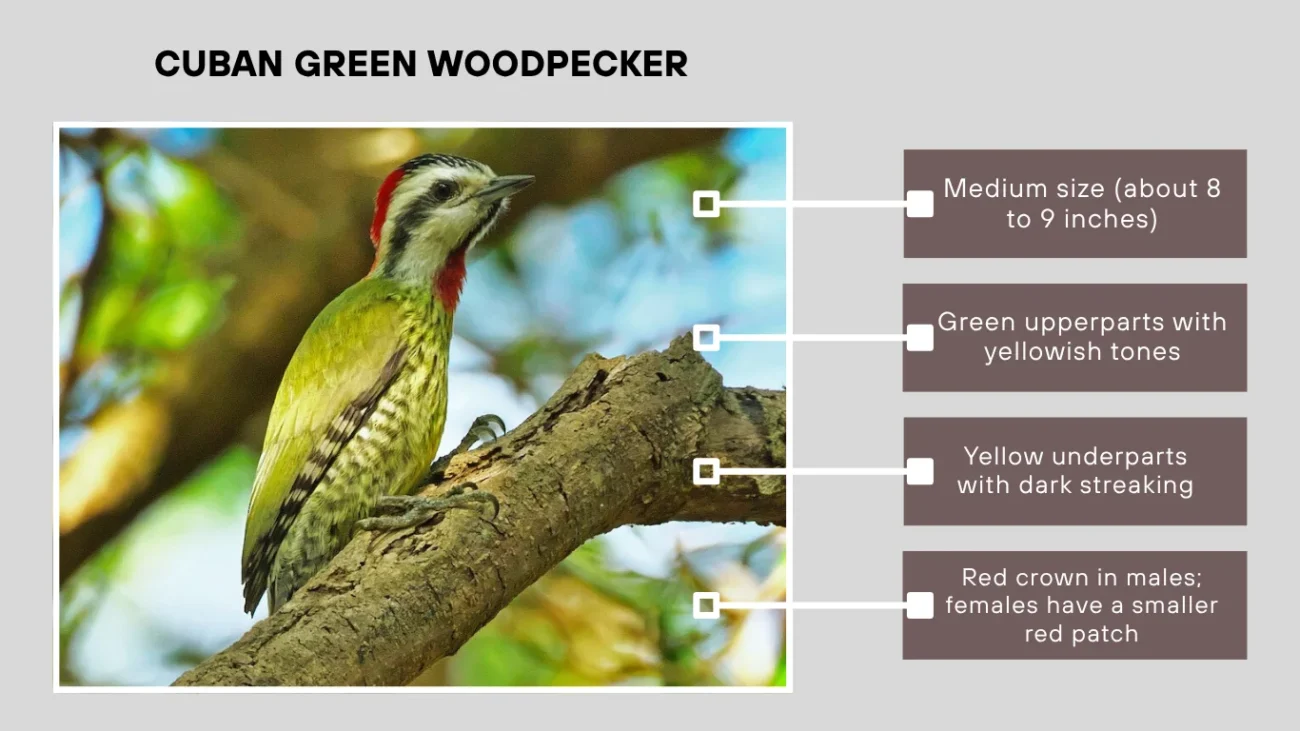
The Cuban Green Woodpecker is an endemic species to Cuba, known for its bright coloration and shrill vocalizations.
Identification
- Medium size (about 8 to 9 inches)
- Green upperparts with yellowish tones
- Yellow underparts with dark streaking
- Red crown in males; females have a smaller red patch
- Black mustache stripe and white face
- Short tail and strong bill
Nesting
Nests in tree cavities, often reusing the same site. Lays 3–5 eggs. Both parents share incubation and feeding duties.
Diet
Feeds mainly on insects, especially ants and larvae. Also eats fruits and nectar.
Habitat and Behaviors
Inhabits forests, woodlands, and gardens throughout Cuba. Vocal and conspicuous, often seen foraging in tree canopies.
Lifecycle and Lifespan
Breeding takes place during the dry season. Fledglings leave the nest in about 22–25 days. Wild lifespan is estimated at 5–8 years.