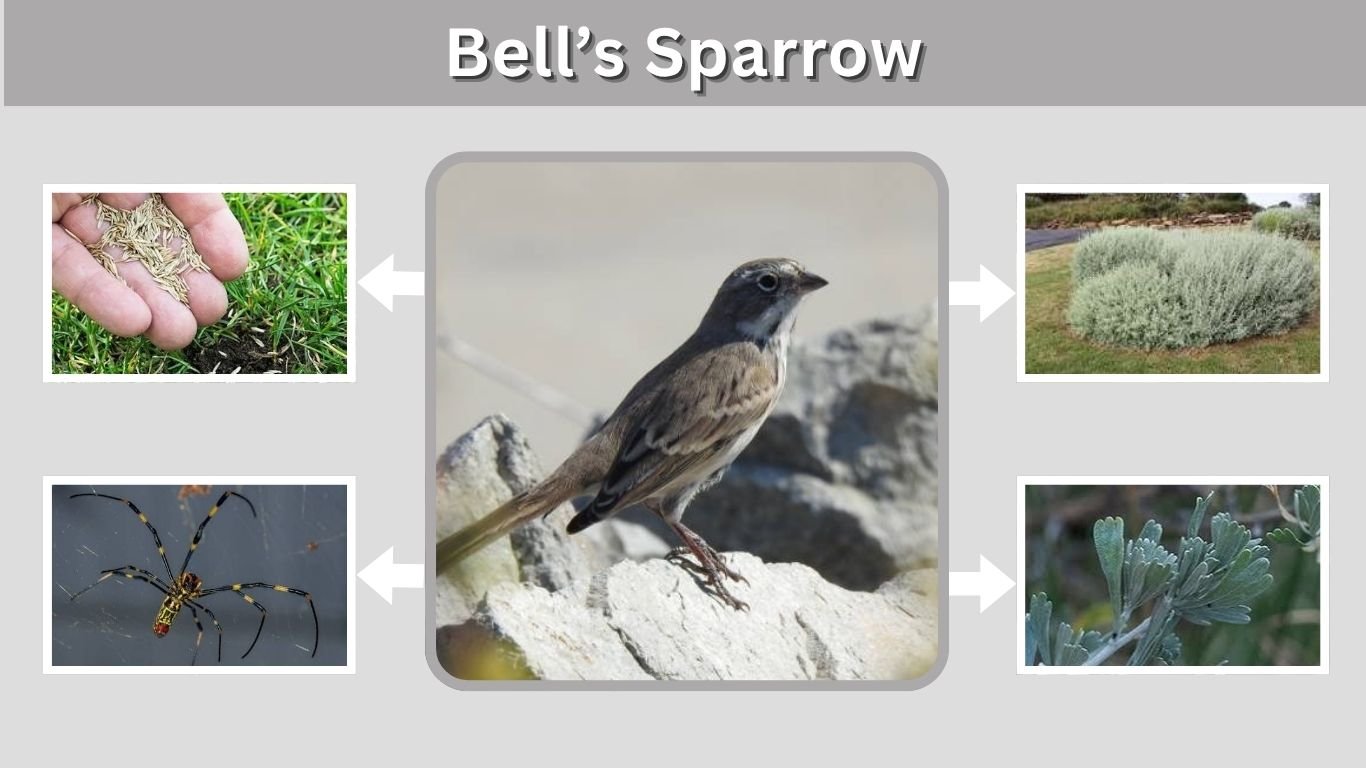
Bell’s Sparrow (Artemisiospiza belli) is a small, long-tailed songbird associated with the dry shrublands of California and northwestern Mexico. Although its gray-and-brown plumage provides excellent camouflage, the bird can be recognized by its white eye ring, dark chest spot, and bold black-and-white throat pattern. It spends much of the day running beneath shrubs, searching for seeds, insects, and spiders. Males become easier to locate during spring when they sing from exposed branches.
Bell’s Sparrow Quick Facts
Bell’s Sparrow belongs to the New World sparrow family, Passerellidae. It was previously grouped with Sagebrush Sparrow under the name “Sage Sparrow,” but the two were recognized as separate species again in 2013.
| Feature | Description |
| Scientific name | Artemisiospiza belli |
| Family | Passerellidae |
| Length | 4.7–5.9 inches |
| Weight | 0.5–0.8 ounces |
| Main foods | Seeds, insects, spiders, and small fruits |
| Habitat | Coastal sage scrub, chaparral, and desert scrub |
| Nest location | Usually inside a low shrub |
| Behavior | Ground forager that frequently runs beneath cover |
The species is about the size of a Chipping Sparrow, with both sexes measuring approximately 12–15 centimeters long and weighing 15–22 grams.
What Does a Bell’s Sparrow Look Like?
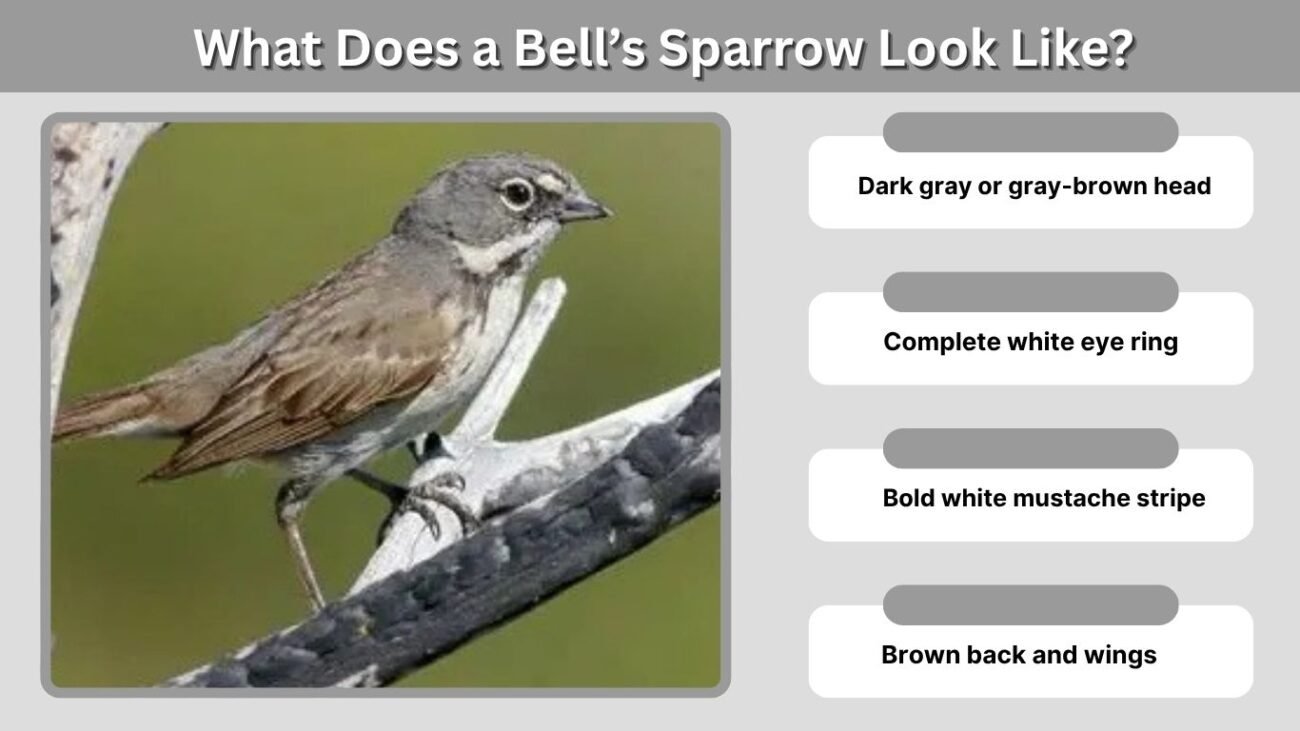
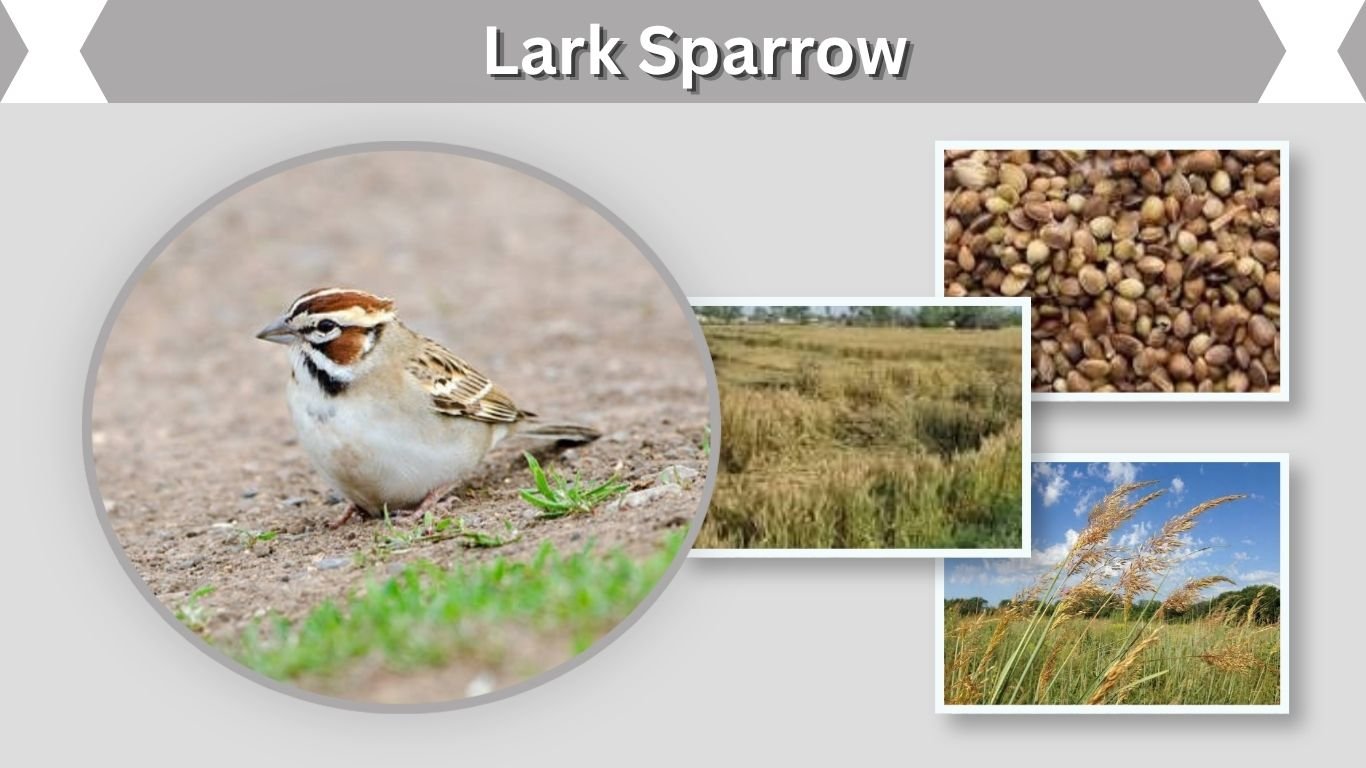
Bell’s Sparrow is a relatively small sparrow with a rounded head, short thick bill, and noticeably long tail. Its colors vary among subspecies, but adults generally share the same important identification marks.
Key Identification Features
- Dark gray or gray-brown head
- Complete white eye ring
- Small white mark in front of the eye
- Bold white mustache stripe
- Dark stripe bordering the white throat
- Small dark spot in the center of the breast
- Whitish underparts with thin streaks along the sides
- Brown back and wings
- Long, mostly dark tail
Coastal birds tend to appear darker and more strongly patterned than birds from desert populations. The contrasting gray head and brown back can be particularly helpful when identifying the darker coastal forms.
Bell’s Sparrow Behavior
Bell’s Sparrows are often difficult to see because they remain close to the ground or hidden inside low vegetation. When moving across an exposed area, they commonly run rather than fly, holding their tails raised above their backs. They may also flick or twitch the tail while perched.
Male, Female, and Juvenile Bell’s Sparrows
Male and female Bell’s Sparrows have similar plumage. Observing their behavior during the breeding season is generally more useful than relying on color when determining sex.
Male vs. Female Bell’s Sparrow
Adult males and females both have gray heads, white eye rings, pale throats, dark chest spots, and brown upperparts. However, only males sing the species’ territorial song. During spring and early summer, males climb to the tops of shrubs, sing briefly, and then drop back to the ground to continue feeding.
Females build the nest and perform most of the incubation. Both parents are believed to participate in feeding the young after the eggs hatch.
Bell’s Sparrow Fledgling and Juvenile
Juvenile Bell’s Sparrows are browner and more heavily streaked than adults. They lack the adult’s clearly defined gray head and have streaks across the breast and belly. Their facial markings are also less distinct.
As young birds mature, the underpart streaking fades and the characteristic gray head, white eye ring, throat pattern, and central breast spot become clearer.
Bell’s Sparrow Habitat and Range
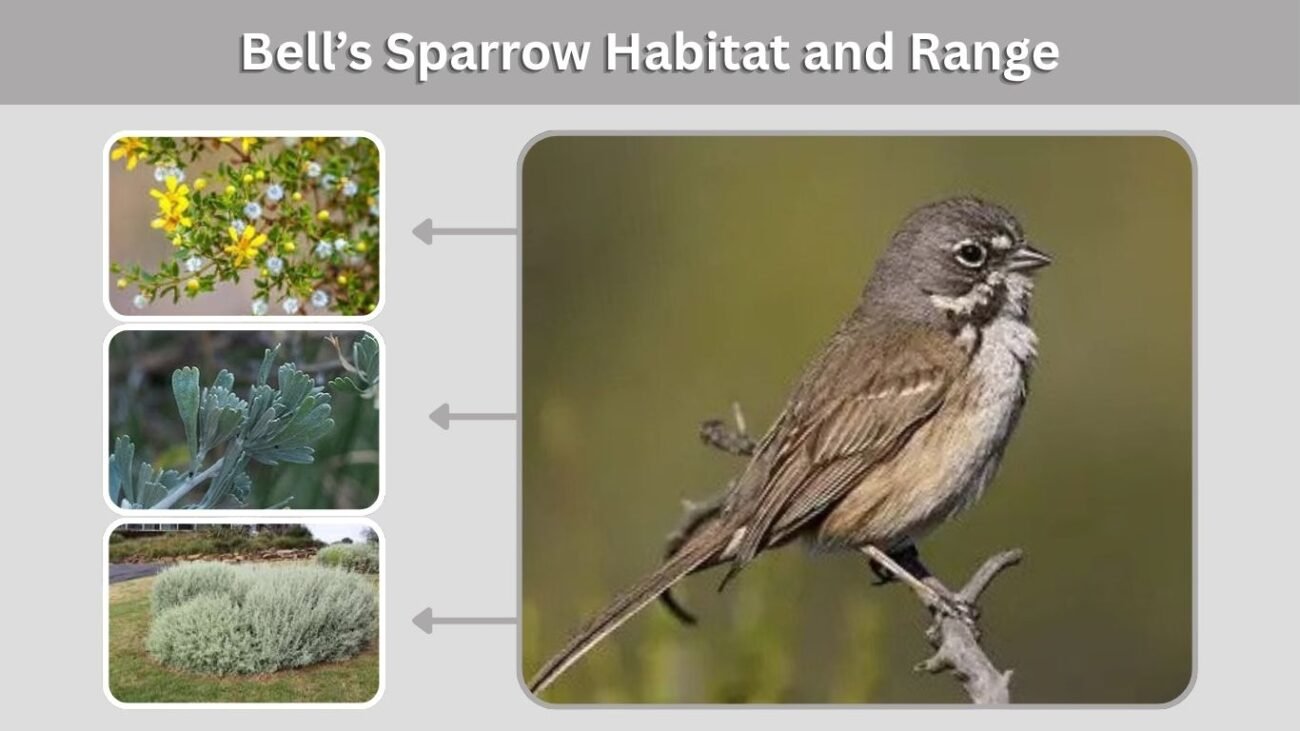
Bell’s Sparrow is closely connected to dry landscapes containing low shrubs and patches of open ground. Shrubs provide nesting sites, song perches, shade, and protection, while the exposed soil beneath them offers feeding opportunities.
Preferred Habitat
The species commonly occupies:
- Coastal sage scrub
- Chaparral
- Big sagebrush
- Saltbush flats
- Creosote scrub
- Bitterbrush and shadscale
- Desert grasslands with scattered bushes
- Maritime scrub on San Clemente Island
In chaparral, Bell’s Sparrows often prefer younger, relatively open vegetation rather than very old, tall, and densely overgrown stands.
Bell’s Sparrow Range
Bell’s Sparrows occur primarily in California and Baja California, Mexico. Populations inhabit California’s coastal ranges, southern foothills, the Mojave Desert, and San Clemente Island.
Many coastal populations remain in the same area throughout the year. Some interior birds migrate short distances, moving toward southern California, western Arizona, and more open desert habitats during winter. They may then form loose mixed flocks with Sagebrush Sparrows and other sparrow species.
Rare individuals may appear far outside their usual western range. Such sightings, including records in New York City, represent unusual wandering birds rather than an established eastern population.
What Does Bell’s Sparrow Eat?
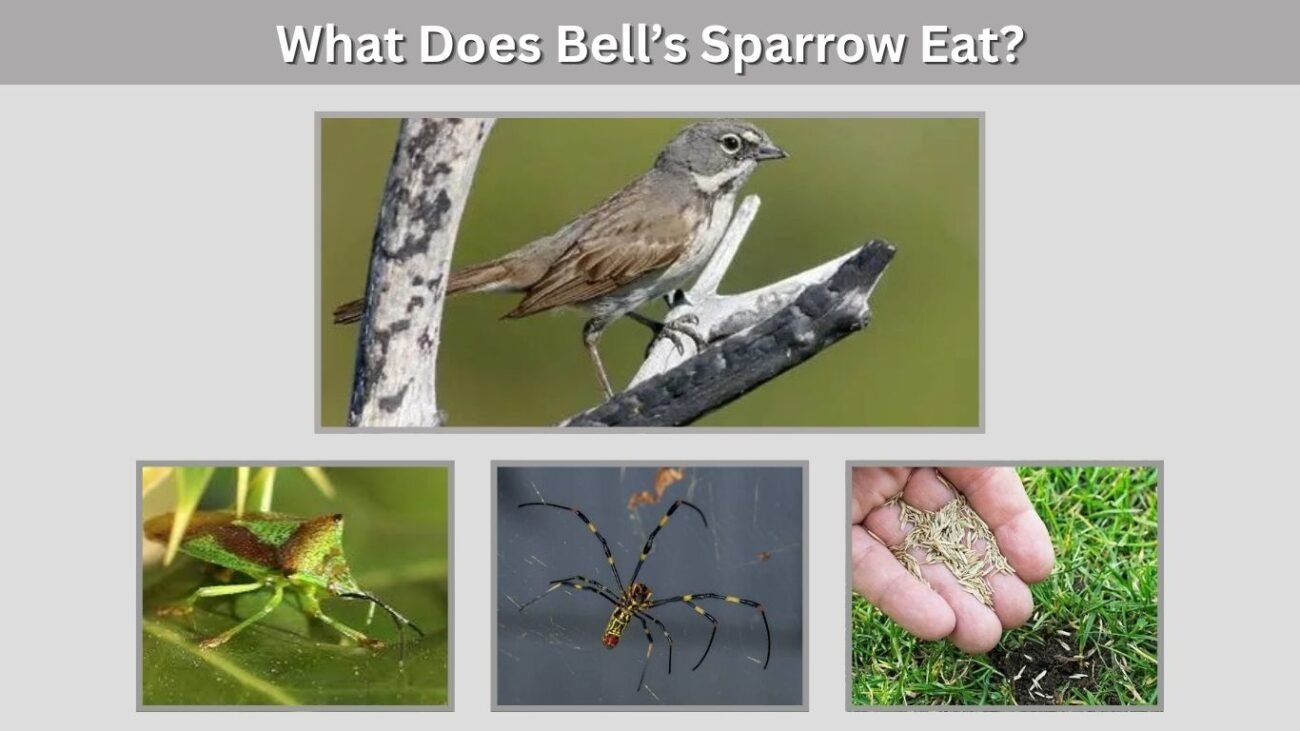
Bell’s Sparrow has an omnivorous diet that changes with the seasons. Insects become especially important during the breeding season, while seeds make up most of the winter diet.
Common Foods
Bell’s Sparrows eat:
- Beetles
- Grasshoppers
- Caterpillars
- True bugs
- Spiders
- Grass seeds
- Pigweed seeds
- Mustard seeds
- Small fruits
- Tender plant material
Adults usually collect food from the ground or low vegetation. They pick seeds and invertebrates from exposed soil, leaf litter, stems, and the spaces beneath shrubs. They occasionally scratch the ground with their feet or catch an insect above the vegetation. Young birds are fed mainly protein-rich insects.
Bell’s Sparrow Song and Call
The male’s song is a quick, abrupt sequence of trills separated by short chip notes. A complete performance normally lasts about two seconds or less. Individual males generally use one basic song pattern, although they may shorten it by leaving off the final notes.
Both males and females produce a distinctive bell-like tink contact call. A stronger version of the same note is used when the bird senses danger. Listening for this call can be an effective way to detect a Bell’s Sparrow concealed beneath dense vegetation.
Bell’s Sparrow Nest and Eggs
Bell’s Sparrows generally place their nests inside low shrubs, although nests may occasionally be constructed in bunchgrass or directly on the ground beneath protective vegetation.
Nest Construction
The female builds an open, cup-shaped nest using twigs and coarse grass. She lines it with finer grass, strips of bark, feathers, wool, or animal hair. The completed structure measures approximately four inches across, with an inner cup about two and a half inches wide.
Common nesting plants include California sagebrush, black sage, white sage, brittlebush, buckwheat, bush mallow, chamise, cholla, and willow. Most nests are positioned fairly close to the ground, allowing the surrounding vegetation to conceal them.
Eggs and Young
A clutch typically contains one to four eggs, although some records describe clutches of up to five. The eggs are pale blue or bluish white and marked with brown, gray, reddish, or black spots.
Incubation generally lasts 10–16 days, and nestlings remain in the nest for around 9–11 days. A pair may raise one to three broods in a productive year, depending partly on rainfall and food availability.
Bell’s Sparrow vs. Sagebrush Sparrow
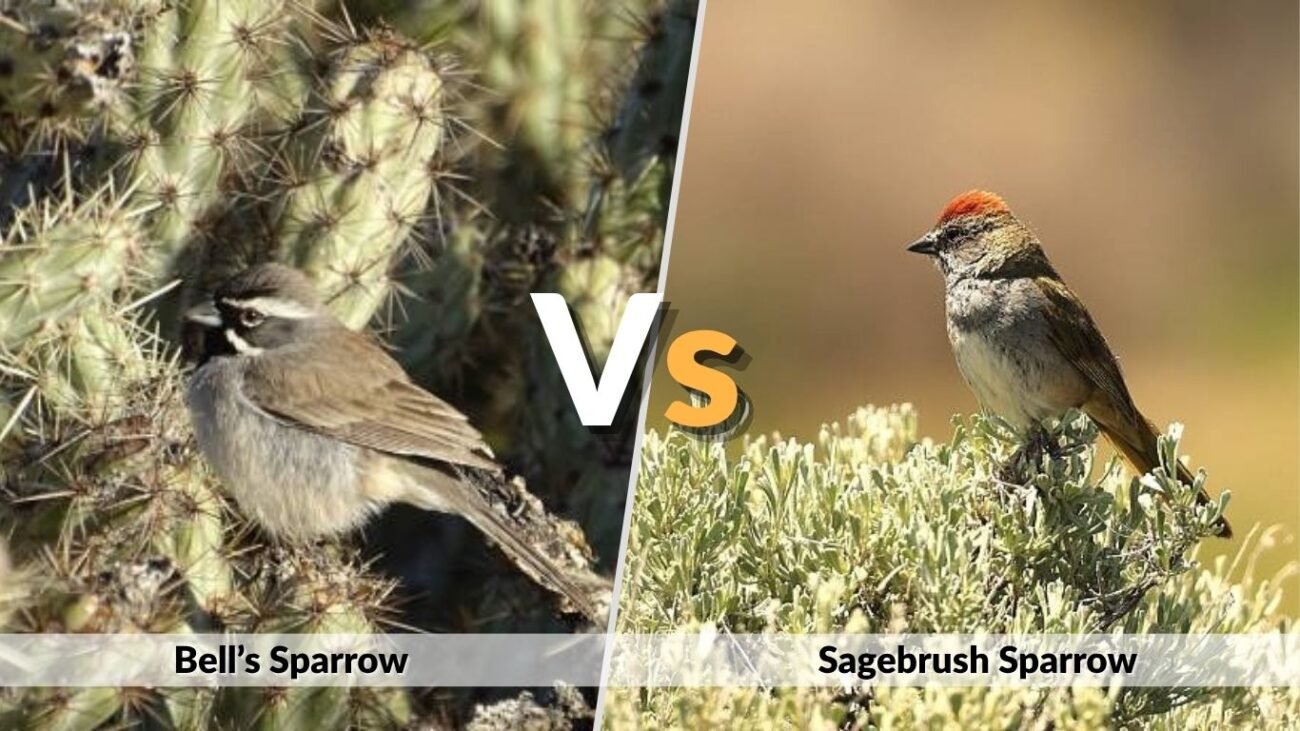
These birds are close relatives and were formerly treated as one species. The lighter desert form of Bell’s Sparrow can be especially difficult to separate from Sagebrush Sparrow.
| Feature | Bell’s Sparrow | Sagebrush Sparrow |
| Overall color | Usually darker brown and gray | Generally paler gray-brown |
| Mustache stripe | Strong black-and-white contrast | Usually less contrasting |
| Back | Often darker; coastal forms may show limited streaking | Usually paler and more visibly streaked |
| Tail | Usually mostly dark | Often shows more white |
| Typical range | California and Baja California | Interior western North America |
| Habitat | Coastal sage, chaparral, and desert scrub | Primarily sagebrush country |
Location is often one of the strongest clues. A dark bird in California coastal sage scrub is likely a Bell’s Sparrow, while a paler bird in extensive interior sagebrush is more likely a Sagebrush Sparrow. However, appearance varies, and some individuals cannot be identified confidently from a brief view or photograph.
Bell’s Sparrow Subspecies
Four commonly recognized subspecies have different ranges and subtle plumage characteristics:
- A. b. belli — a dark coastal form found mainly in California and northern Baja California.
- A. b. canescens — a paler Mojave Desert form that resembles Sagebrush Sparrow.
- A. b. clementeae — the San Clemente Bell’s Sparrow, found only on San Clemente Island.
- A. b. cinerea — a Baja California form with buffier facial markings.
The San Clemente subspecies was formerly protected as threatened under the U.S. Endangered Species Act. Following substantial population and habitat recovery, it was officially removed from the federal list on February 24, 2023. Some older bird guides still describe it as federally threatened because their conservation sections have not been updated.
FAQs
Why is it called Bell’s Sparrow?
The bird’s English and scientific names honor John Graham Bell, a 19th-century American naturalist and taxidermist. The name does not refer to the sparrow’s bell-like contact call, although the species coincidentally produces a distinctive tink sound.
Is Bell’s Sparrow the same as Sage Sparrow?
Not exactly. Bell’s Sparrow and Sagebrush Sparrow were once combined as a single species called Sage Sparrow. Ornithologists separated them again in 2013 because of differences in genetics, appearance, range, habitat, and vocalizations.
Where can you find Bell’s Sparrows in Southern California?
Look in coastal sage scrub, open chaparral, desert scrub, and low shrublands. Early spring mornings offer the best viewing opportunities because territorial males sing from the tops of bushes instead of remaining hidden near the ground.
Does Bell’s Sparrow visit bird feeders?
It is not a regular feeder bird. Bell’s Sparrows normally forage on the ground beneath native shrubs, where they find naturally occurring seeds and insects. Preserving low native vegetation and leaving some undisturbed ground cover is more likely to support them than installing a conventional feeder.
Is the San Clemente Bell’s Sparrow endangered?
It is no longer federally listed as endangered or threatened. The U.S. Fish and Wildlife Service removed the subspecies from the federal list in February 2023 after determining that its population and habitat had recovered sufficiently. Continued habitat management and monitoring remain important.