











Crows and eagles are two of the most fascinating birds in the sky, each admired for unique qualities that define power and intelligence in nature. While the eagle stands for majesty, vision, and strength, the crow represents wit, strategy, and adaptability. Despite sharing the same skies, these two birds are drastically different in lifestyle, behavior, and symbolism. Let’s explore ten key differences that make crows and eagles some of the most intriguing creatures in the avian world.
Size and Physical Appearance
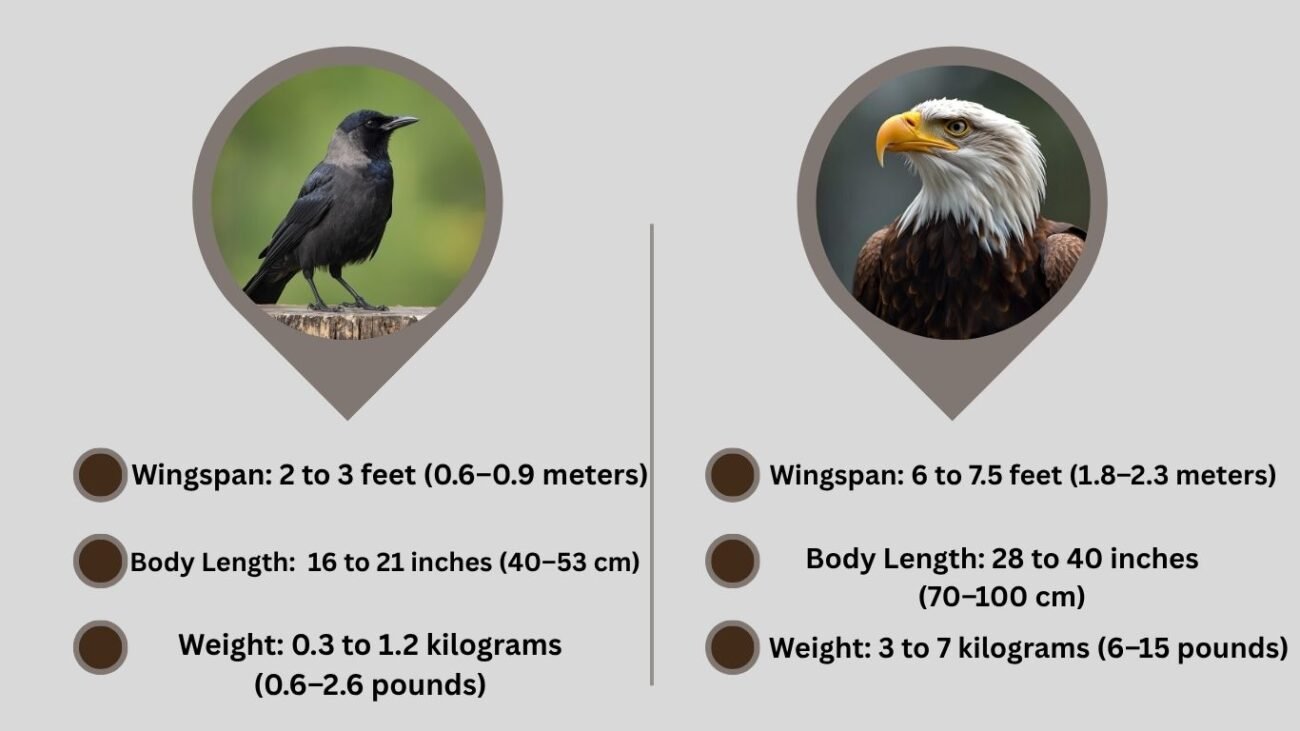
The Giant vs The Trickster
Crows and eagles differ dramatically in their physical traits. The eagle’s large size, strong build, and majestic wingspan make it the undisputed king of the skies, while the crow’s smaller body and sleek design give it agility and adaptability. The table below highlights their key physical differences.
| Feature | Eagle | Crow |
| Wingspan | 6 to 7.5 feet (1.8–2.3 meters) | 2 to 3 feet (0.6–0.9 meters) |
| Body Length | 28 to 40 inches (70–100 cm) | 16 to 21 inches (40–53 cm) |
| Weight | 3 to 7 kilograms (6–15 pounds) | 0.3 to 1.2 kilograms (0.6–2.6 pounds) |
| Beak Type | Strong, hooked beak for tearing flesh | Straight, slender beak for pecking and scavenging |
| Claws/Talons | Long, curved, and extremely powerful | Shorter and weaker, designed for grasping small items |
| Feather Color | Dark brown or golden tones, often with white head/tail in bald eagles | Glossy black feathers with a bluish sheen |
| Eyesight | Can spot prey from over 2 miles away | Excellent vision, but not as far-reaching as an eagle’s |
| Posture and Build | Broad wings, muscular chest, and regal stance | Slim, compact body with agile movements |
Strength and Power
Muscle vs Mobility
Eagles are apex predators known for their raw strength. Their muscular bodies, broad wings, and sharp talons allow them to capture prey like fish, snakes, or small mammals with precision. They can lift animals several times their weight and fly long distances without tiring.
Crows, however, rely on mobility and cunning rather than brute force. Though they can’t overpower larger creatures, they are extremely agile fliers. Crows use strategy, teamwork, and persistence to achieve their goals — often outsmarting predators and even stealing food from stronger birds. This makes them powerful in a different way: not by strength, but by intelligence.
Intelligence and Problem-Solving
Brainpower in Action
When it comes to intelligence, crows are among the smartest birds in the world. Studies have shown that crows can recognize human faces, use tools, remember patterns, and even plan future actions. They work in groups to solve problems, communicate with complex calls, and teach survival tactics to their young.
Eagles, though less social, display their own type of intelligence — rooted in instinct and precision. They rely on extraordinary eyesight, sharp timing, and efficient energy use when hunting. While crows think like strategists, eagles act like masters of execution. Both birds showcase the diversity of intelligence in nature — one driven by wit, the other by instinct.
Hunting and Feeding Habits
Predator vs Opportunist
Eagles are skilled hunters that primarily feed on live prey. They swoop down at incredible speeds, sometimes exceeding 100 miles per hour, to capture fish, rabbits, or reptiles. Their hooked beaks and razor-sharp claws make them deadly and efficient hunters.
Crows, on the other hand, are opportunistic feeders. They eat almost anything — from insects and fruits to garbage and carrion. This adaptability allows them to survive in cities, forests, and even deserts. Unlike eagles, crows often scavenge leftovers or steal food from other animals. In ecological terms, eagles are predators, while crows act as nature’s cleaners — both essential for maintaining environmental balance.
Flight Style and Altitude
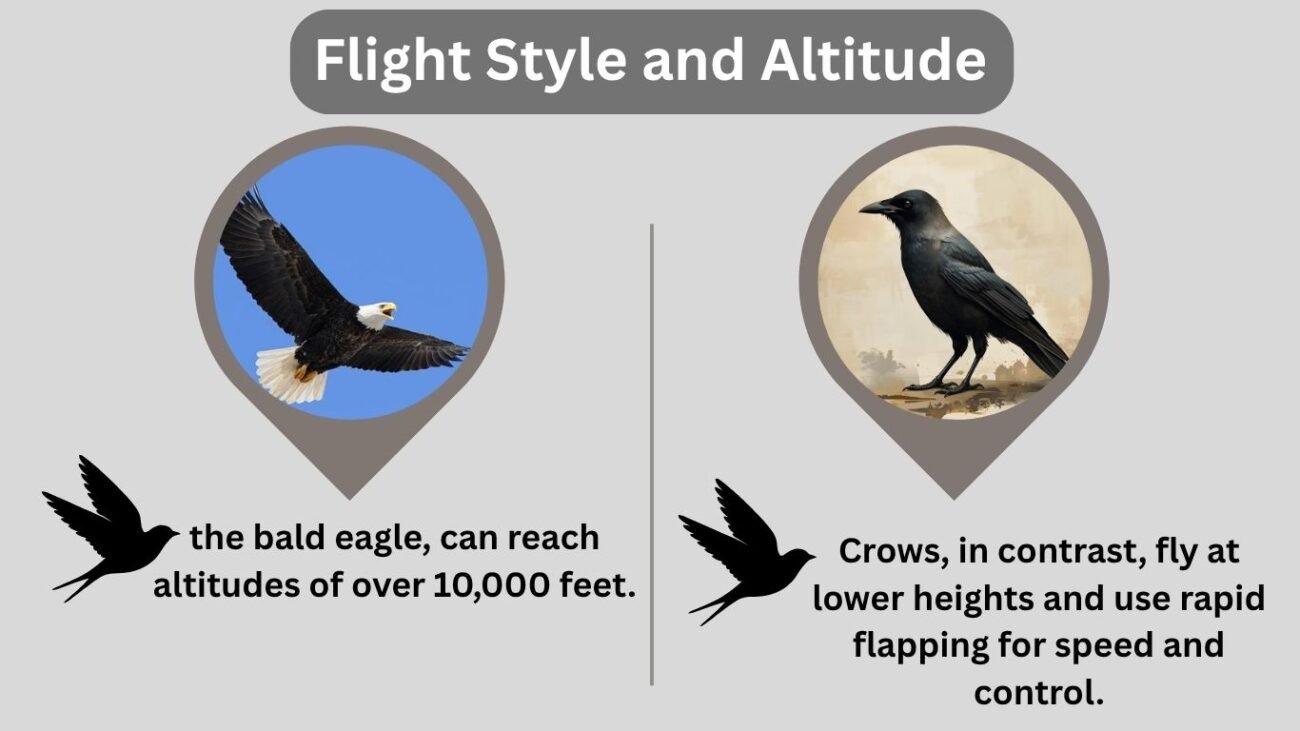
The Soaring Eagle vs The Agile Crow
Flight is another major distinction between these two birds. Eagles are famous for their majestic gliding at high altitudes. They ride thermal air currents, conserving energy as they soar effortlessly above mountains and lakes. Some species, like the bald eagle, can reach altitudes of over 10,000 feet.
Crows, in contrast, fly at lower heights and use rapid flapping for speed and control. Their flight is agile and erratic, ideal for navigating through trees, cities, and dense environments. Interestingly, when crows chase eagles — a behavior known as mobbing — they rarely succeed, as eagles simply ascend higher until the crows retreat, unable to breathe in thinner air.
Social Behavior
The Lone Hunter vs The Social Strategist
Eagles are solitary by nature. They hunt alone, mate for life, and defend large territories from intruders. Their independence mirrors their symbolic association with leadership and self-reliance.
Crows, on the other hand, are extremely social birds. They live in flocks called murders, communicate with dozens of vocalizations, and often work together for food and defense. When threatened, multiple crows will gang up on larger birds, including eagles — an impressive display of teamwork against strength. This difference shows that crows thrive on cooperation, while eagles excel in independence.
Reproduction and Nesting
Building for Legacy
Eagles are meticulous nest builders. Their nests, called eyries, are enormous structures built high on cliffs or tall trees for safety. Some nests can reach up to 10 feet wide and weigh hundreds of pounds, reused and expanded year after year by the same pair. Eagles are loyal partners — they often mate for life and raise their chicks together with remarkable dedication.
Crows, in contrast, build smaller, cup-shaped nests made from twigs and grass, usually hidden in dense branches. They’re protective parents, and unlike eagles, they often receive help from other crows within the group to guard their young. This cooperative parenting mirrors their social nature, reinforcing how teamwork defines the crow’s life from start to finish.
Lifespan and Survival Strategies
Endurance Through Different Means
Eagles typically live longer than crows. In the wild, an eagle can survive between 20 to 30 years, and in captivity, some have reached over 40 years. Their longevity comes from their apex position in the food chain, natural strength, and strategic solitude, which reduces the risk of disease.
Crows, by contrast, have shorter lifespans — usually around 7 to 15 years. Yet, their intelligence and adaptability compensate for it. They can thrive in urban areas, avoid traps, recognize dangers, and even teach their offspring to identify threats. While eagles endure through dominance, crows survive through cunning — two very different yet equally successful evolutionary paths.
Symbolism and Cultural Meaning
Majesty vs Mystery
The eagle and the crow carry deep symbolic meanings across cultures. The eagle, often seen as the “king of the skies,” symbolizes power, courage, and freedom. Many nations, including the United States, use the eagle as an emblem of strength and vision. In mythology, eagles are messengers of gods, representing purity, clarity, and leadership.
Crows, on the other hand, have a more mysterious image. In folklore, they are seen as omens, tricksters, and symbols of transformation. In some cultures, they represent wisdom and intelligence — the thinkers of the natural world. Together, these two birds embody the eternal balance of nature: strength versus strategy, power versus intellect, and light versus shadow.
Conflict and Coexistence

Why Do Crows Attack Eagles?
Perhaps the most dramatic aspect of their relationship is the constant conflict between the two. Crows frequently attack or chase eagles, a behavior known as mobbing. Despite being smaller, crows show incredible bravery in protecting their territory, nests, or food. They dive at eagles, peck their feathers, and even land on their backs during flight.
Eagles rarely retaliate. Instead, they rise higher into the sky, escaping their pursuers. This act has become symbolic — representing wisdom, patience, and rising above negativity. The crow’s aggression isn’t out of hatred; it’s a survival instinct. And the eagle’s calm retreat isn’t weakness; it’s a lesson in restraint and higher perspective.
Key Takeaways
- Eagles symbolize strength, independence, and vision — the rulers of the sky.
- Crows represent intelligence, cooperation, and resilience — the thinkers and survivors.
- Eagles rely on power, while crows depend on teamwork.
- Crows often challenge eagles, but the eagle’s wisdom lies in rising above the fight.
- Both species remind us of balance — between might and mind, dominance and adaptability.
FAQs
Why do crows attack eagles?
Crows attack eagles mainly to defend their nests and territories. They act collectively, diving and pecking to drive the eagle away. This behavior is not hatred but a survival mechanism, ensuring their young remain safe from predators.
Who is smarter — a crow or an eagle?
Crows are considered more intelligent in terms of problem-solving and memory. They can recognize faces, use tools, and even plan actions. Eagles are instinctively intelligent — experts in precision hunting and navigation — but less adaptable to human environments than crows.
Do eagles eat crows?
While rare, it can happen. Eagles generally prefer fish, rabbits, and other small mammals. However, if food is scarce or a crow crosses into its hunting area, an eagle might attack or eat it. Usually, these encounters are about dominance, not feeding.
Do eagles fly higher than crows?
Yes. Eagles are built for high-altitude flight and can soar above 10,000 feet, where oxygen is thin. Crows can’t sustain flight at such heights and will eventually fall back. That’s why when attacked, eagles simply fly higher to escape — an act often used as a life lesson in motivation.
What does the eagle and crow story teach us?
The story where a crow sits on an eagle’s back and pecks at it teaches a profound moral: don’t engage with negativity. The eagle doesn’t fight back; it flies higher until the crow suffocates and falls. It symbolizes wisdom, patience, and emotional maturity in facing life’s challenges.


