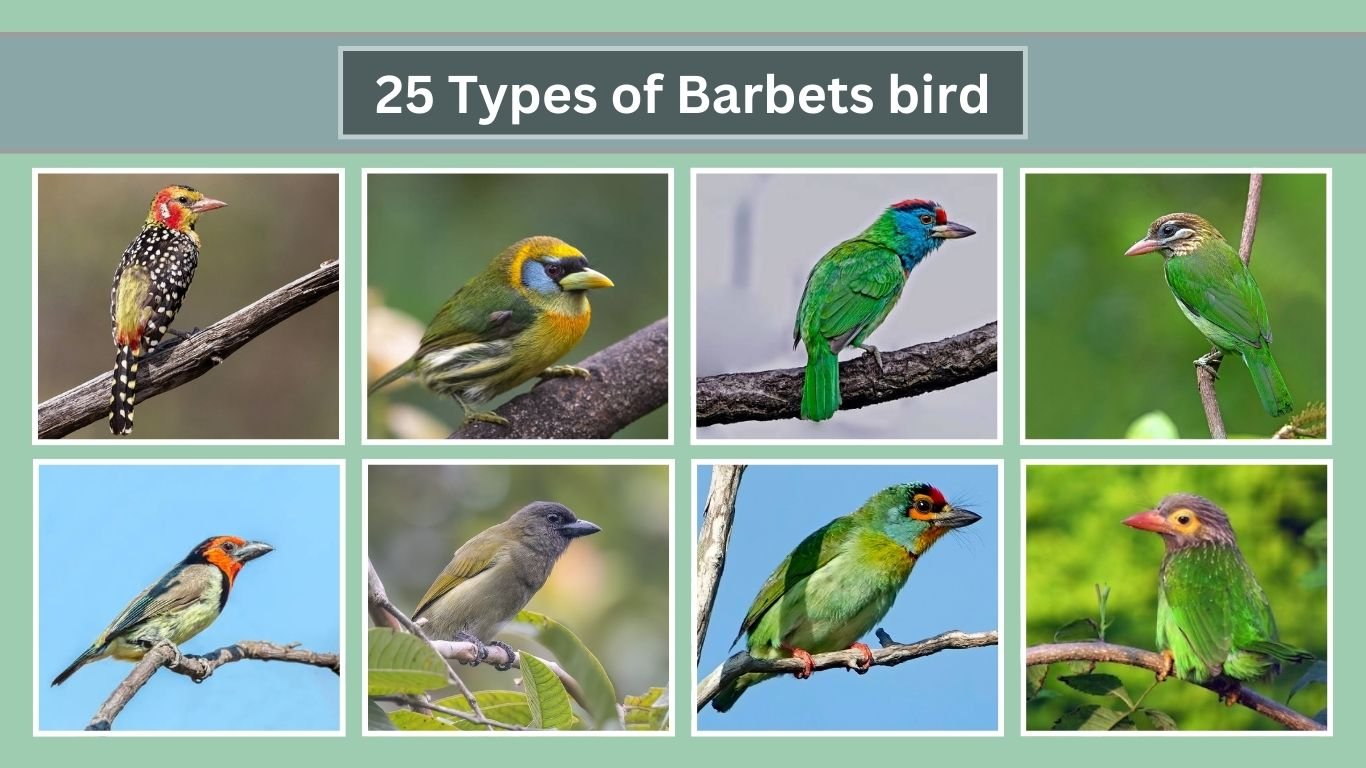
Barbets are small to medium-sized, fruit-loving birds known for their stout bills, vibrant plumage, and loud, repetitive calls that echo through forests and gardens. Found across Asia and Africa, these birds play a vital role in seed dispersal, helping sustain ecosystems. With over 25 remarkable species ranging from the vivid Blue-throated Barbet to the striking Red-and-yellow Barbet, each one displays unique colors, behaviors, and habitats worth exploring in detail.
1. Coppersmith Barbet
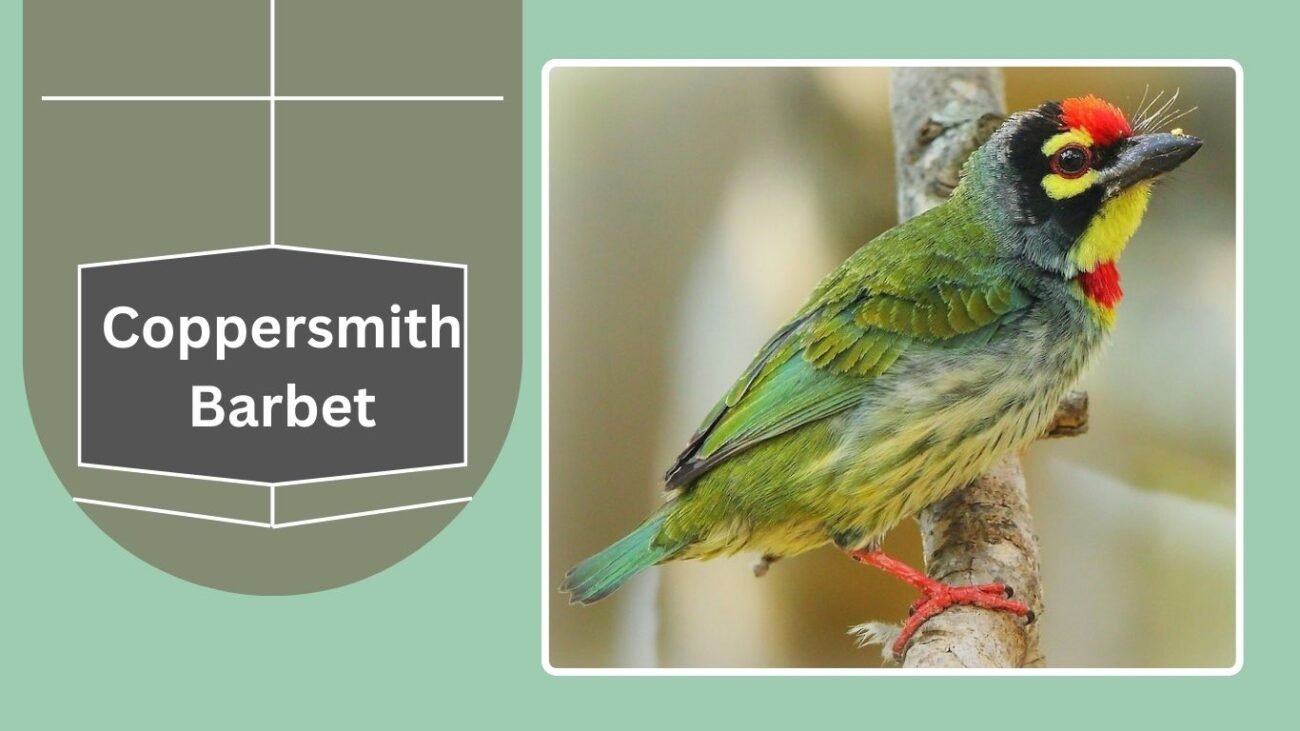
The Coppersmith Barbet (Psilopogon haemacephalus) is a small but colorful bird commonly found across the Indian subcontinent and parts of Southeast Asia. It is well known for its metallic “tuk-tuk” call that resembles the sound of a coppersmith striking metal, which gives the bird its name.
Identification
- Small size, around 15–17 cm in length
- Green body with yellow and red markings on the head
- Bright red forehead and throat patch
- Stout, dark beak adapted for pecking fruit
- Red eyes, often with a yellow eye-ring
Habitat
Coppersmith Barbets thrive in gardens, groves, and light woodlands. They are often spotted in urban parks and fruiting trees in cities as well as rural landscapes.
Diet
Their diet consists mainly of fruits such as figs, berries, and guavas. Occasionally, they also consume insects and flower nectar.
Behavior
They are known for their repetitive metallic calls that can be heard throughout the day, especially in summer. Coppersmith Barbets nest in tree cavities, often excavated by themselves, where both male and female take part in incubation and feeding of the chicks.
2. Lineated Barbet
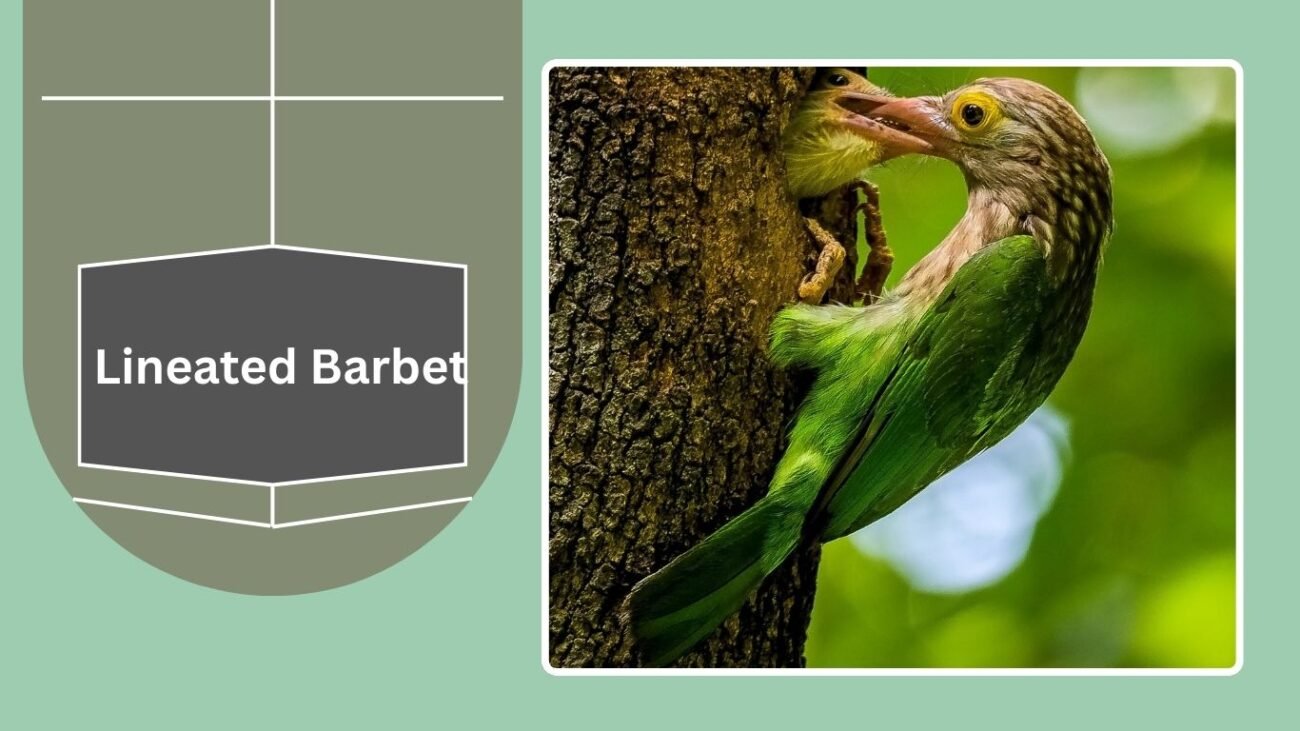
The Lineated Barbet (Psilopogon lineatus) is a medium-sized barbet recognized for its streaked plumage and loud, repetitive calls. It is widespread across South and Southeast Asia and is often seen perched high in trees, blending well with the canopy despite its size.
Identification
- Medium size, about 27–30 cm in length
- Olive-green plumage with distinct brown streaks on the head, neck, and breast
- Large, pale yellow beak without a casque
- Brown eyes with a pale eye-ring
- Strong feet adapted for clinging to branches and tree trunks
Habitat
This species prefers forests, wooded gardens, and orchards, especially areas with large fruiting trees. It is found in countries like India, Nepal, Bangladesh, Myanmar, Thailand, and Cambodia. They are highly adaptable and can also thrive near human settlements.
Diet
Lineated Barbets mainly feed on fruits such as figs, mangoes, and papayas. They also take insects, flower petals, and occasionally small reptiles, making them opportunistic feeders.
Behavior
These barbets are vocal and produce loud “kutroo… kutroo” calls, often repeated for long durations. They nest in cavities that they excavate in tree trunks, where the female lays three to four eggs. Both parents share duties of incubation and feeding. They are usually solitary or in pairs but may join mixed flocks in fruiting trees.
3. Brown-headed Barbet
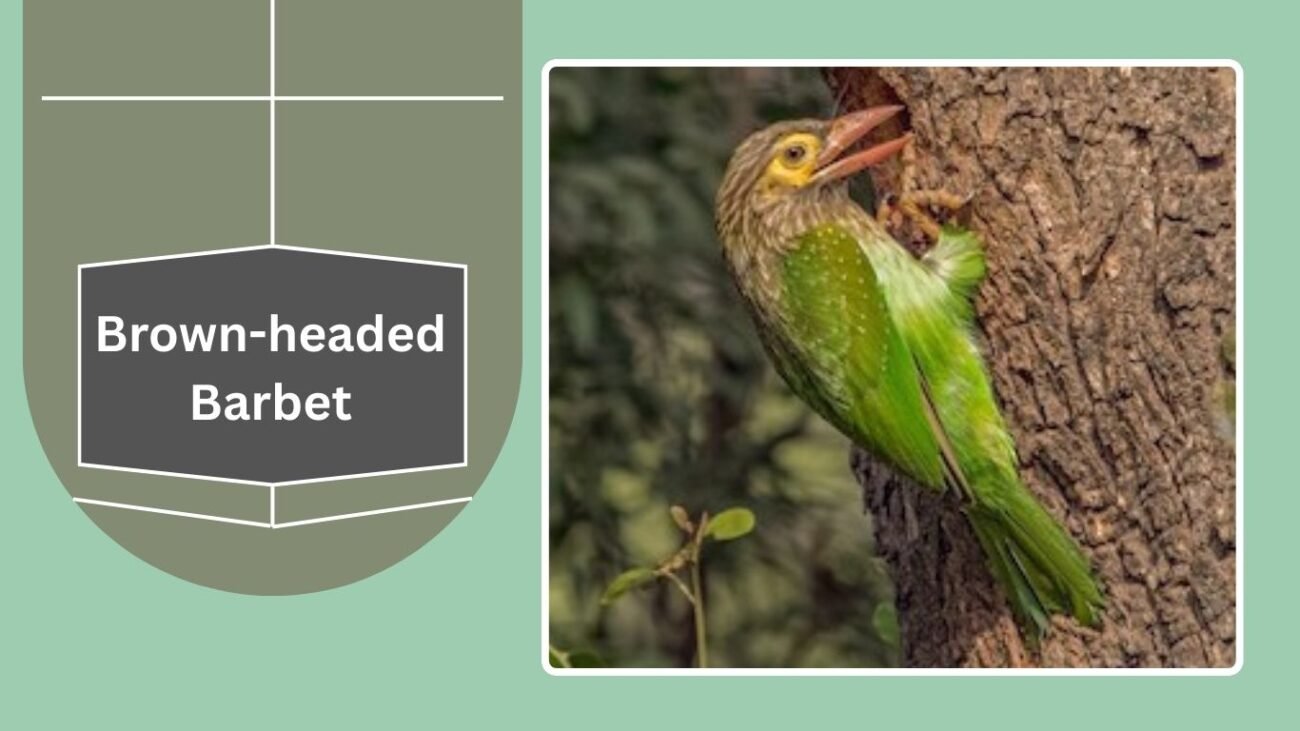
The Brown-headed Barbet (Psilopogon zeylanicus) is a well-known resident bird of the Indian subcontinent, easily recognized by its olive-green body and brownish head. It is commonly spotted in cities, villages, and orchards, where its loud calls often reveal its presence before the bird itself is seen.
Identification
- Medium-sized bird, around 25–29 cm long
- Olive-green plumage with a brown head and throat
- Large yellowish beak without a casque
- Bare patches of yellowish skin around the eyes
- Strong zygodactyl feet (two toes facing forward, two backward) for gripping branches
Habitat
Brown-headed Barbets adapt well to a wide range of environments, from forests and orchards to gardens and city parks. They are widespread in India, Sri Lanka, and Nepal, often found in places with tall fruiting trees.
Diet
These barbets are primarily frugivores, feeding on figs, mangoes, papayas, and berries. Occasionally, they also eat insects, small reptiles, and flower petals. They play a vital role in dispersing seeds, supporting the regeneration of fruiting trees.
Behavior
Known for their continuous, loud “kutroo… kutroo” calls, they often call in chorus during the breeding season, especially in the morning and late afternoon. Brown-headed Barbets nest in tree cavities that they excavate themselves, where both parents incubate the eggs and care for the chicks. They are territorial and frequently chase away other birds from their chosen nesting or feeding trees.
4. White-cheeked Barbet
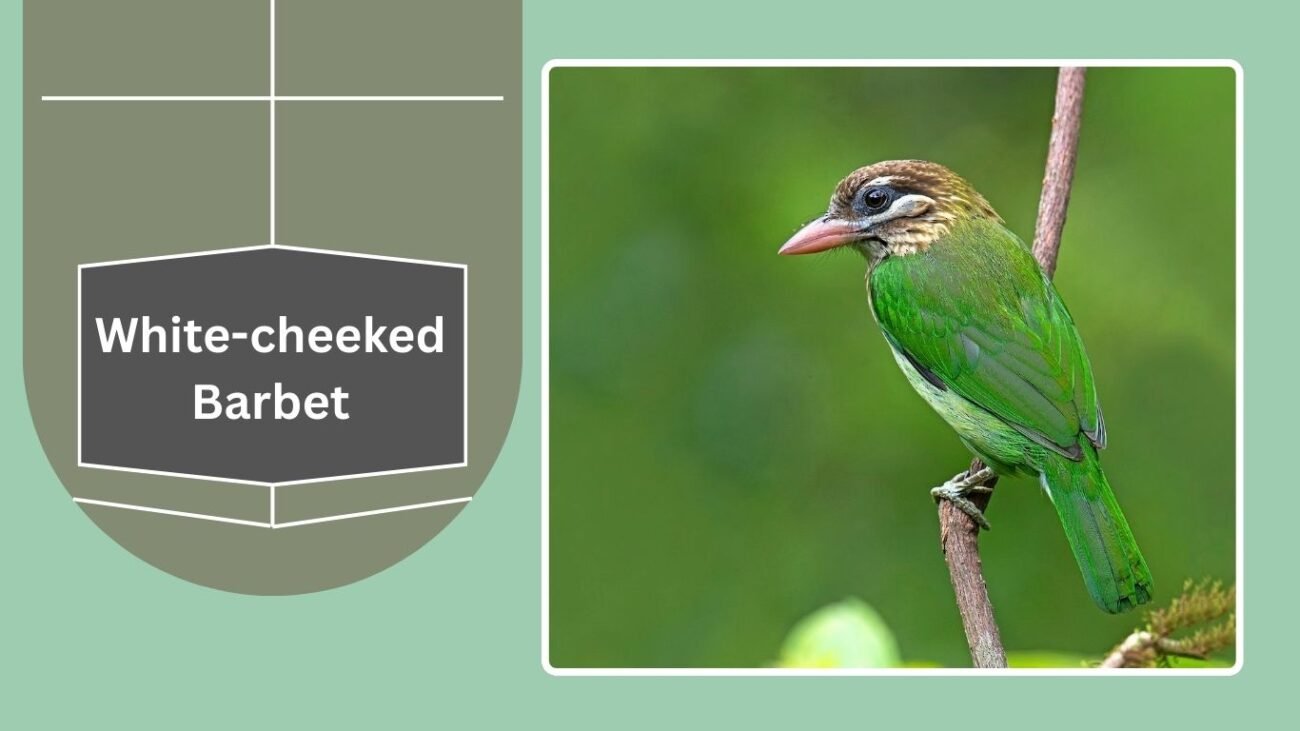
The White-cheeked Barbet (Psilopogon viridis), also called the Small Green Barbet, is a common bird of southern India. Its name comes from the distinctive white streak running across its cheek, which sets it apart from other green barbets. Its persistent “kutroo-kutroo” call is a familiar sound in South Indian cities and countryside.
Identification
- Medium size, about 16–18 cm long
- Bright green body that blends well with foliage
- Prominent white streak running from the eye to the cheek
- Brown-streaked head and throat
- Stout, pale yellow bill and dark eyes
Habitat
This species is primarily found in southern India, thriving in forests, orchards, coffee plantations, and even urban gardens. They are especially abundant in Bangalore and other cities with plenty of fruiting trees.
Diet
The White-cheeked Barbet feeds mainly on fruits like figs, guavas, papayas, and berries. They also take nectar, flower petals, and sometimes insects, which provide additional protein.
Behavior
These barbets are highly vocal, producing repetitive “kutroo-kutroo” calls that are often heard all day. They nest in tree holes, usually excavated in softwood or dead branches. Both male and female share the responsibility of incubating eggs and feeding the chicks. White-cheeked Barbets are generally solitary or found in pairs but often visit fruiting trees in groups.
5. Great Barbet
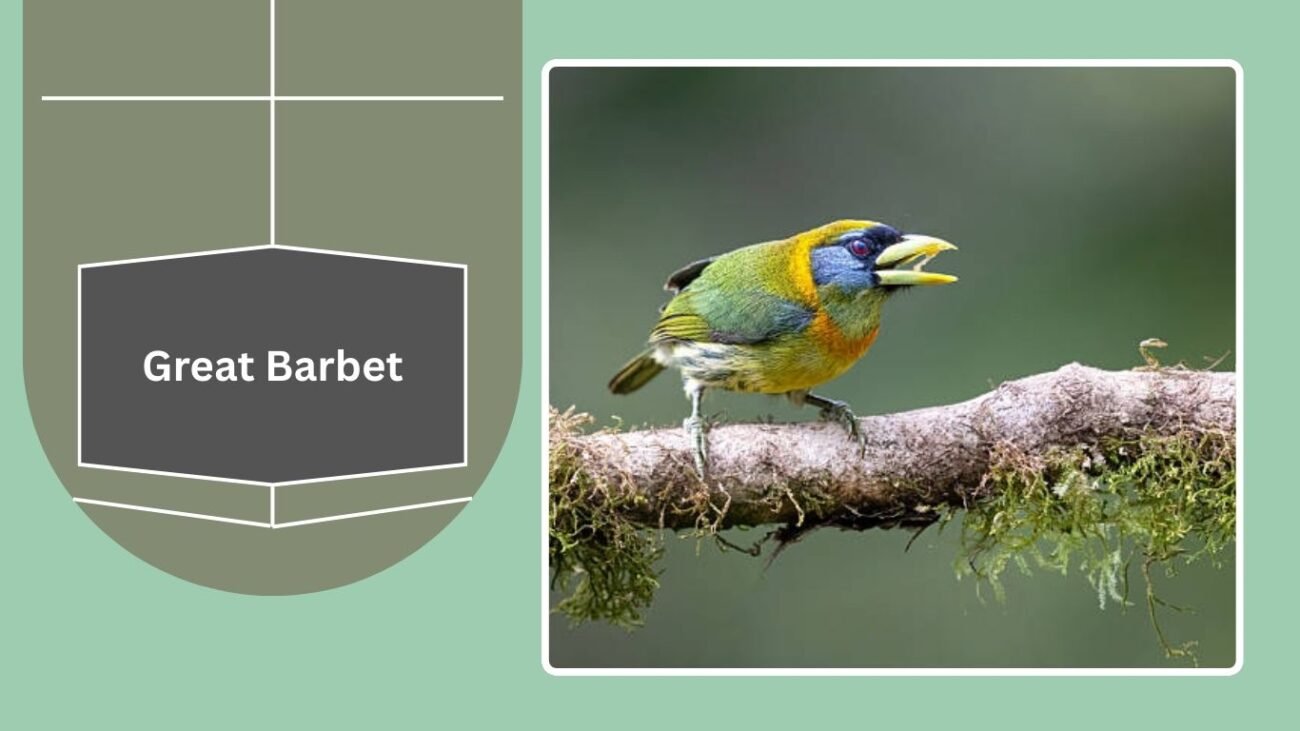
The Great Barbet (Psilopogon virens) is the largest of all barbet species, found mainly in the foothills and forests of the Himalayas. Its striking plumage, coupled with its loud, repetitive calls, makes it an unmistakable presence in its range. This bird is often admired for its colorful appearance and powerful voice that resonates across valleys.
Identification
- Largest barbet, measuring 32–35 cm in length
- Dark green wings and back with blue undertones
- Brownish head with a large, thick yellow bill
- Blue throat and upper breast with streaked brown belly
- Strong, short tail and robust legs for clinging to branches
Habitat
Great Barbets are found in montane forests of the Himalayas, from Pakistan and northern India to Bhutan, Nepal, and parts of Southeast Asia. They inhabit evergreen and broadleaf forests, typically at elevations of 600–2,500 meters.
Diet
They primarily feed on fruits, especially figs and other fleshy fruits, but will also consume insects, caterpillars, and occasionally small reptiles. Their fruit-eating habits play a key role in seed dispersal within mountain forests.
Behavior
Great Barbets are known for their loud, repetitive “piu-piu-piu” calls, often delivered from high perches. They are usually shy and stay within dense forest canopies, making them more often heard than seen. They nest in tree cavities, excavated with their large beaks, where both parents take part in incubation and feeding of chicks.
6. Blue-throated Barbet
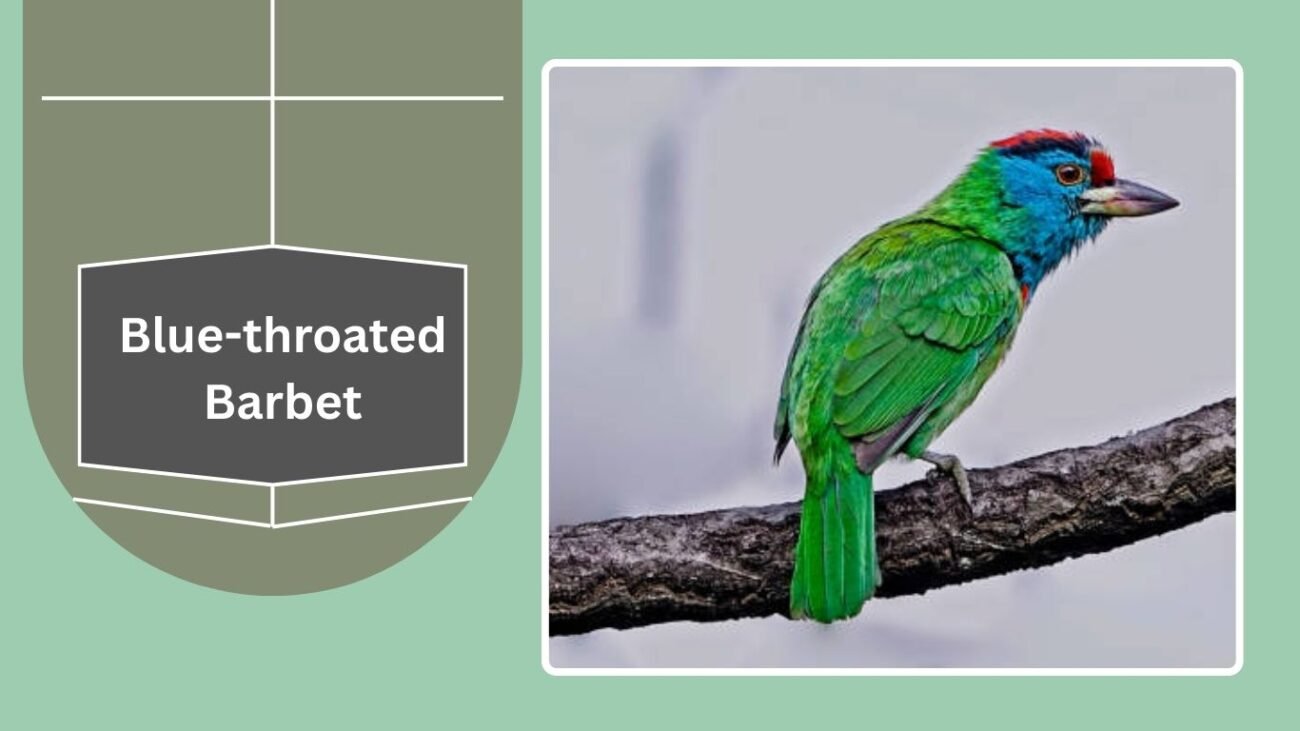
The Blue-throated Barbet (Psilopogon asiaticus) is one of the most colorful barbets, easily identified by its bright blue throat and vibrant plumage. Found widely across the Indian subcontinent and Southeast Asia, it is a common sight in gardens, forests, and orchards where fruiting trees are abundant.
Identification
- Medium-sized bird, about 20–22 cm in length
- Bright green body with a vivid blue throat and face
- Red forehead and crown with black markings around the eyes
- Large, pale yellow bill with slight curve
- Short tail and strong legs adapted for clinging to branches
Habitat
Blue-throated Barbets inhabit forests, wooded gardens, orchards, and city parks. They are distributed across northern India, Nepal, Bhutan, Bangladesh, Myanmar, Thailand, Laos, and Vietnam. They prefer areas with dense fruiting trees.
Diet
Their diet mainly includes figs, guavas, papayas, mangoes, and various berries. They also eat insects like beetles and caterpillars, which provide additional protein. Their fruit-eating behavior helps maintain ecological balance through seed dispersal.
Behavior
Blue-throated Barbets are active and vocal birds, producing loud “kutroo…kutroo” calls, often repeated for long periods. They are mostly solitary or seen in pairs, but they may gather at fruiting trees. During breeding, they excavate nest holes in deadwood or soft branches, where both parents take turns incubating eggs and feeding chicks.
7. Blue-eared Barbet
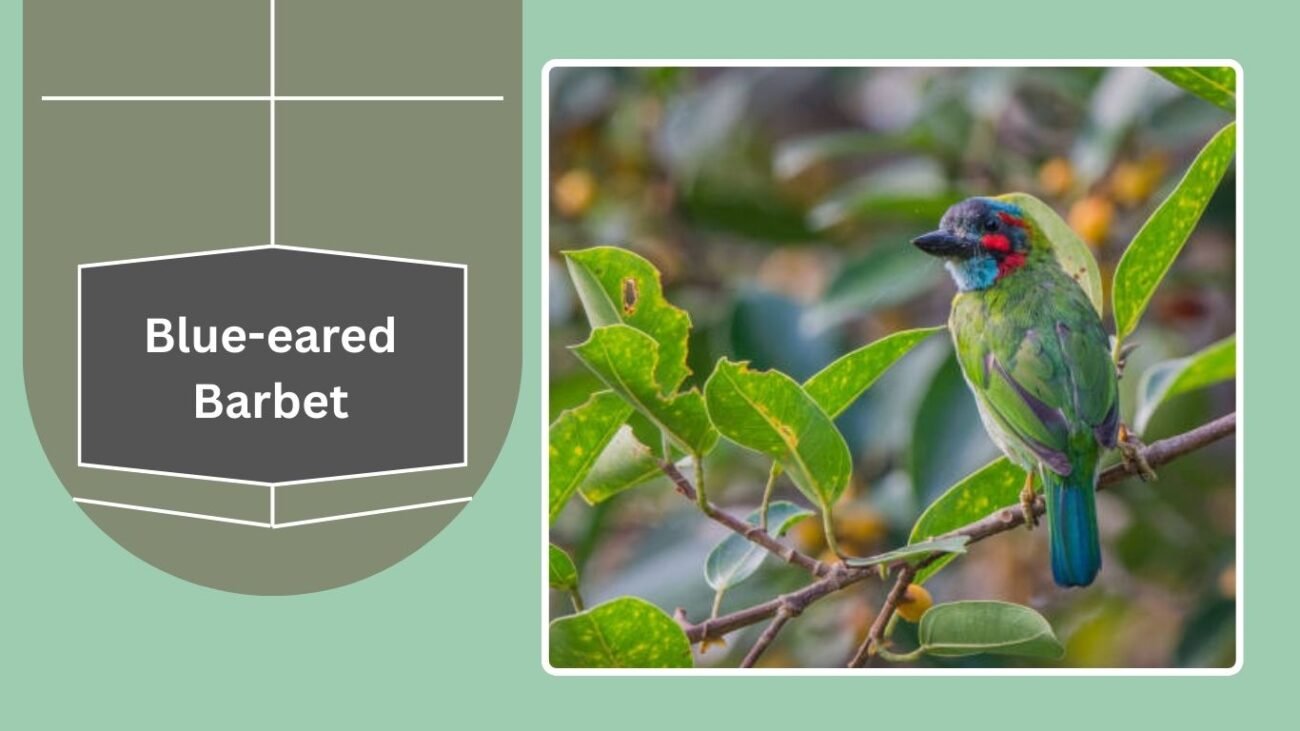
The Blue-eared Barbet (Psilopogon cyanotis) is a small, striking bird known for its vibrant facial markings and constant calling during the breeding season. Despite its colorful appearance, it blends well into leafy canopies, making it more often heard than seen.
Identification
- Small-sized barbet, around 15–17 cm in length
- Green body with a distinctive blue patch around the ears (hence the name)
- Red forehead and throat, with a black eye-stripe
- Stout, pale bill and dark eyes
- Compact body with short tail and strong legs
Habitat
Blue-eared Barbets are widely distributed across South and Southeast Asia, including India’s Northeast, Bangladesh, Myanmar, Thailand, Laos, Cambodia, and Vietnam. They prefer tropical and subtropical forests, gardens, plantations, and fruit-rich urban areas.
Diet
Their primary diet consists of fruits like figs, berries, and guavas, but they also feed on insects, including beetles, grasshoppers, and caterpillars. By dispersing seeds, they play an important ecological role in forest regeneration.
Behavior
These barbets are very vocal, producing a series of repetitive “poop-poop” or “tuk-tuk” notes during the breeding season. They are usually solitary or in pairs but may join small mixed flocks at fruiting trees. Blue-eared Barbets nest in tree cavities, often excavating holes themselves, and both parents participate in raising the chicks.
8. Red-throated Barbet
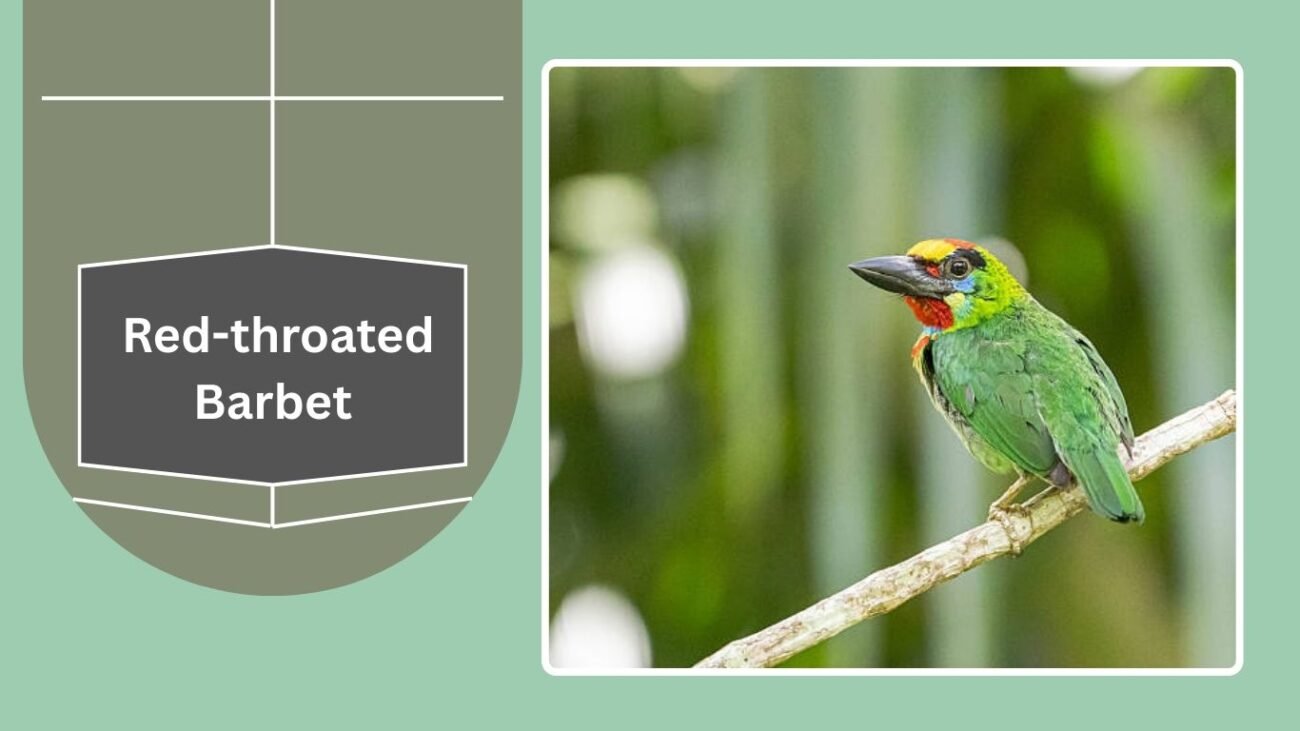
The Red-throated Barbet (Psilopogon mystacophanos) is one of the most vividly colored barbets, easily identified by its striking red throat and multicolored head. Found in Southeast Asia, this bird is a delight to spot in dense forests where its calls echo through the canopy.
Identification
- Medium-sized bird, about 25 cm in length
- Green body with a bright red throat and forehead
- Blue crown and face with yellow streaks around the eyes
- Large, pale yellow bill
- Strong legs and short tail for arboreal movement
Habitat
This species inhabits lowland and hill forests of Malaysia, Thailand, Myanmar, Brunei, and Indonesia, especially Sumatra and Borneo. It prefers dense tropical forests but is also seen in plantations and fruit gardens.
Diet
The Red-throated Barbet feeds mainly on figs, guavas, berries, and bananas. It also consumes insects such as ants, termites, and beetles, making it an omnivore. By dispersing seeds, it contributes to maintaining forest biodiversity.
Behavior
These barbets are known for their loud, resonant “kow-kow” calls that can be heard over long distances. They are usually seen singly or in pairs, though multiple individuals may gather at heavily fruiting trees. During the breeding season, they nest in tree cavities excavated with their stout beaks, where both parents share the responsibility of incubation and chick-rearing.
9. Fire-tufted Barbet
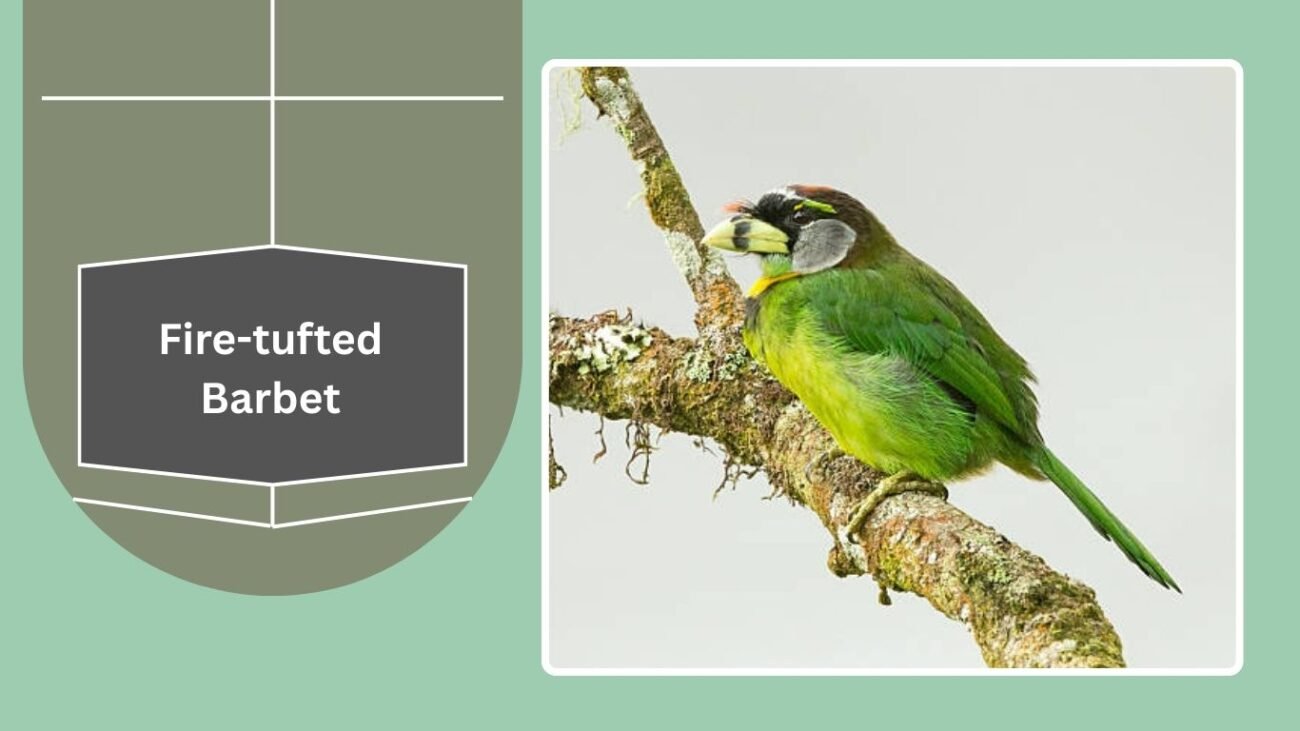
The Fire-tufted Barbet (Psilopogon pyrolophus) is one of the most unique and striking barbet species, easily recognized by the bright red “fire-tufts” of feathers at the base of its bill. Endemic to Southeast Asia, it stands out not only for its appearance but also for its unusual calls that sound more like a cicada than a bird.
Identification
- Medium-sized bird, about 28–30 cm in length
- Green plumage with a black crown and nape
- Distinctive fiery red tufts at the base of the bill
- Bright yellow throat with a white moustachial stripe
- Strong, pale yellow bill and sturdy legs
Habitat
The Fire-tufted Barbet inhabits montane forests of Peninsular Malaysia, southern Thailand, and Sumatra. It is commonly found at elevations between 1,000–2,000 meters, preferring mossy, fruit-rich evergreen forests.
Diet
Their diet consists mainly of fruits such as figs, berries, and bananas. They also supplement their diet with insects, especially beetles and caterpillars. Occasionally, they are observed sipping nectar from flowers.
Behavior
These barbets are famous for their loud, insect-like buzzing calls, often mistaken for cicadas. They are usually seen alone, in pairs, or in small groups feeding on fruiting trees. The species nests in tree cavities, where both male and female share in raising their young. Their brilliant appearance and unusual voice make them one of the most remarkable barbets in Asia.
10. Golden-throated Barbet
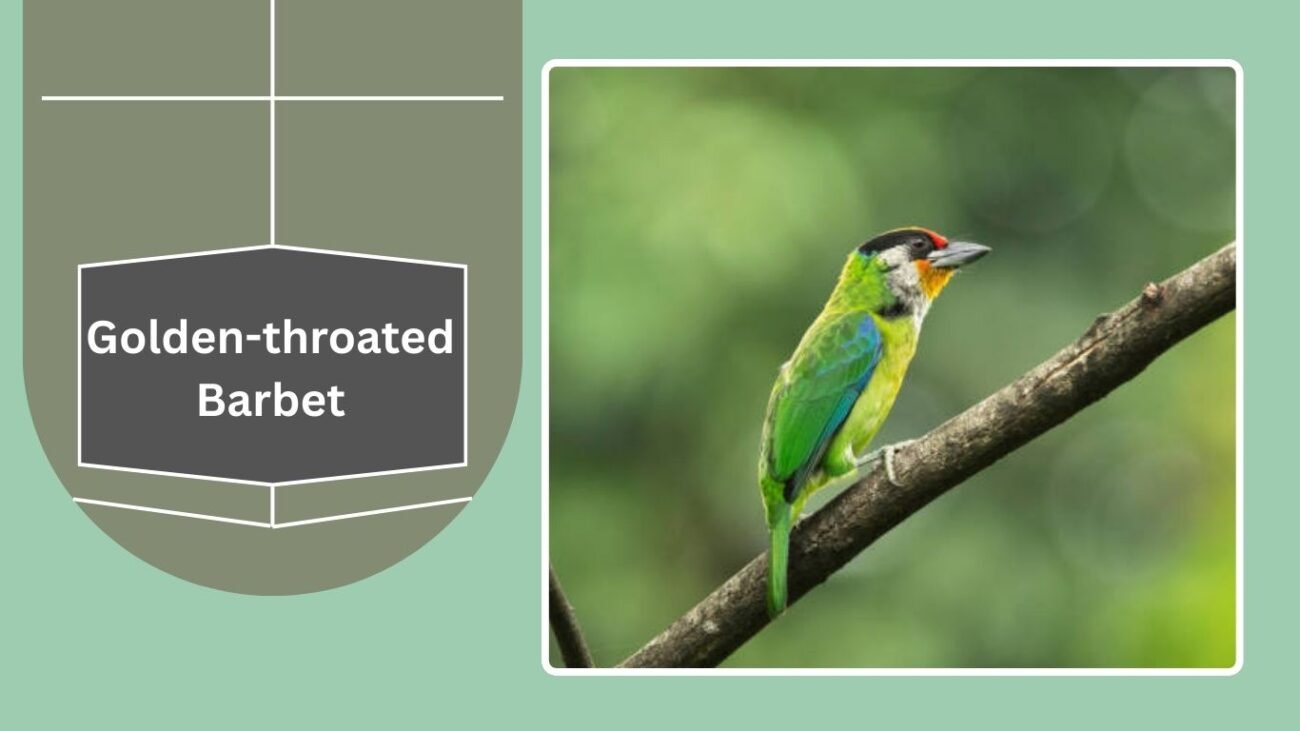
The Golden-throated Barbet (Psilopogon franklinii) is a dazzling forest bird known for its brilliant golden-yellow throat patch that contrasts beautifully with its green body and multicolored head. It is common in the Himalayan foothills and Southeast Asia, where its repetitive calls add to the forest chorus.
Identification
- Medium size, about 20–23 cm long
- Bright green body with a striking golden-yellow throat
- Blue forehead and face, with red on the crown and nape
- Sturdy, pale yellow bill and red orbital ring around the eyes
- Compact body with a short tail and strong climbing feet
Habitat
Golden-throated Barbets are found in subtropical and tropical forests of Nepal, Bhutan, Northeast India, Myanmar, Laos, Vietnam, and southern China. They prefer wooded slopes, orchards, and forest edges at elevations between 600–2,500 meters.
Diet
Their diet is mainly frugivorous, consisting of figs, guavas, and berries. They also eat insects such as beetles, grasshoppers, and caterpillars, and sometimes feed on flower nectar. This feeding behavior makes them vital agents of seed dispersal in their ecosystems.
Behavior
Golden-throated Barbets are active, vocal birds with a repetitive “kutroo-kutroo” call that echoes through forests. They are mostly solitary or in pairs, but may gather at fruiting trees. During breeding, they excavate nest cavities in tree trunks, where both parents incubate the eggs and feed the chicks. Their vibrant colors make them a favorite among birdwatchers in their range.
11. Black-browed Barbet
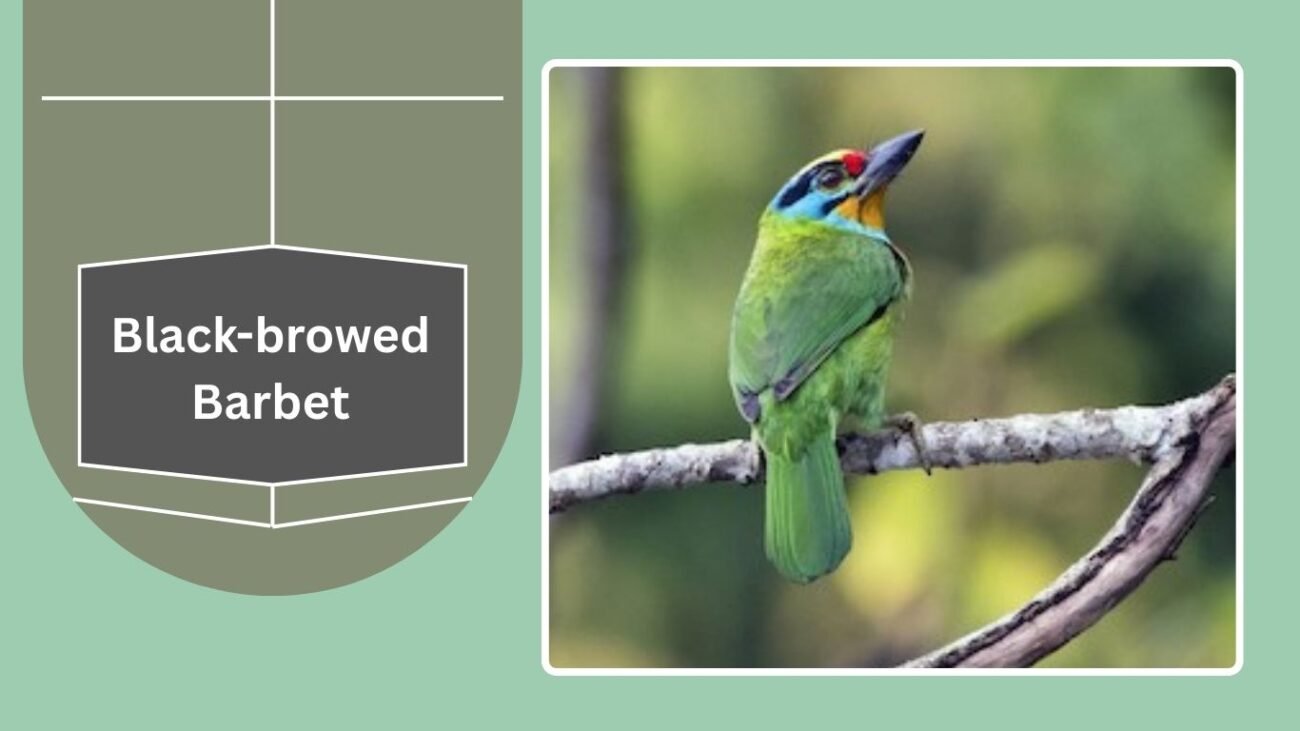
The Black-browed Barbet (Psilopogon oorti) is a colorful forest bird named after the prominent black stripe above its eyes. Its vivid plumage and continuous calling make it a noticeable species across its Southeast Asian range. Despite its bright colors, it blends easily into leafy canopies, where it spends much of its time feeding.
Identification
- Medium-sized bird, about 20–22 cm in length
- Bright green body with a red crown and throat
- Distinct black stripe (brow) running above the eyes
- Blue face with yellow streaks around the throat
- Large, pale yellow bill and strong legs for clinging to branches
Habitat
Black-browed Barbets are native to lowland and hill forests of Thailand, Malaysia, Indonesia (Sumatra, Borneo, Java), and Brunei. They prefer dense evergreen forests, secondary woodlands, orchards, and plantations.
Diet
Their diet is dominated by fruits, particularly figs, guavas, and bananas. They also consume insects such as beetles, termites, and caterpillars, making them opportunistic feeders and important seed dispersers.
Behavior
These barbets are very vocal, producing repetitive “tuk-tuk” or “kow-kow” calls that resonate through forests. They are usually seen alone or in pairs, though small groups may gather at fruiting trees. During the breeding season, they excavate nest holes in softwood or decayed branches, and both parents share the duties of incubation and feeding.
12. Yellow-fronted Barbet
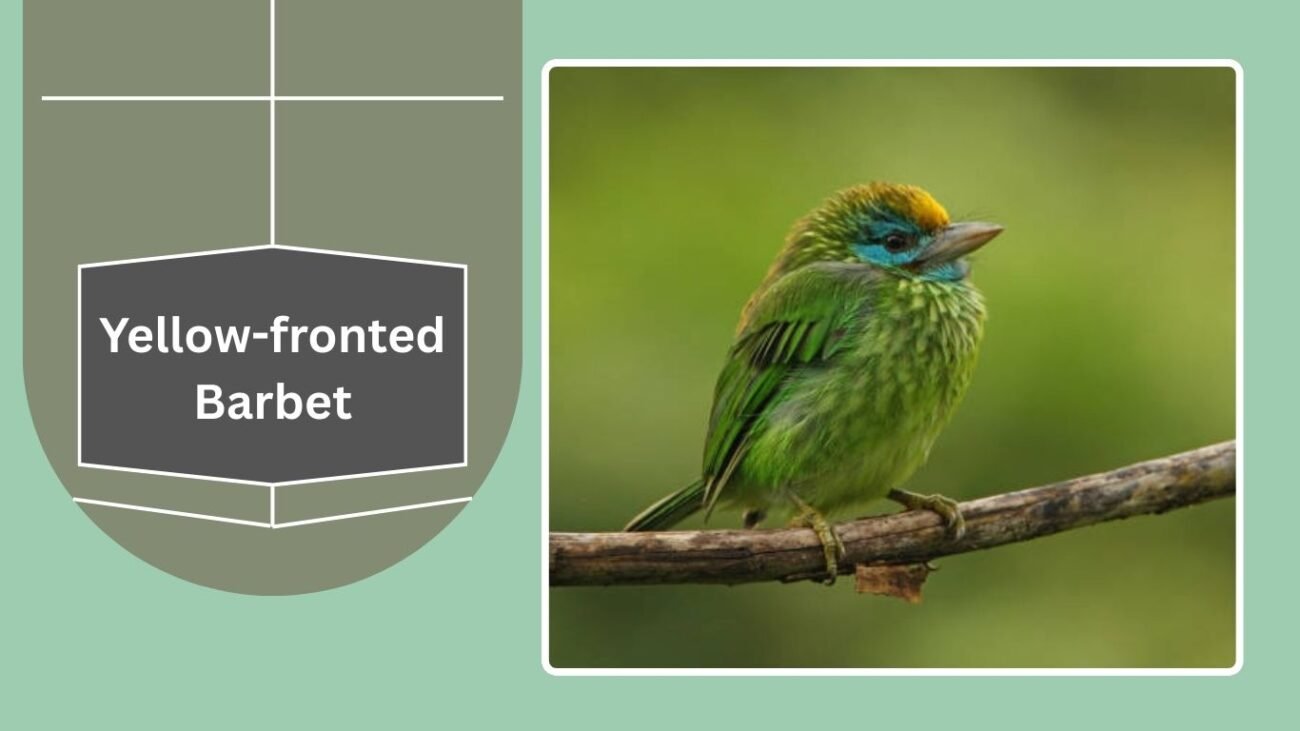
The Yellow-fronted Barbet (Psilopogon flavifrons) is a striking bird endemic to Sri Lanka, known for its brilliant yellow face and forehead. It is one of the island’s most distinctive barbets and a common sight in both forests and home gardens with fruiting trees.
Identification
- Medium-sized bird, about 20–22 cm in length
- Green body with a vivid yellow forehead and face
- Blue throat and lower face with a black eye-stripe
- Stout, pale yellow bill and strong climbing feet
- Short tail and compact body build typical of barbets
Habitat
This species is found exclusively in Sri Lanka, thriving in lowland rainforests, wet-zone hills, gardens, and plantations. They adapt well to human-modified habitats as long as fruiting trees are available.
Diet
Yellow-fronted Barbets feed mostly on fruits like figs, guavas, mangoes, and papayas. They also consume insects, particularly beetles, grasshoppers, and termites, to supplement their diet with protein.
Behavior
These barbets are very vocal, producing loud, repetitive “kow-kow” calls throughout the day. They are often seen in pairs or small groups, moving actively among fruiting trees. During breeding, they excavate nest holes in tree trunks or dead branches, where both parents take part in incubation and feeding of the young. Their bright plumage and constant calls make them an unmistakable part of Sri Lanka’s avifauna.
13. Malabar Barbet
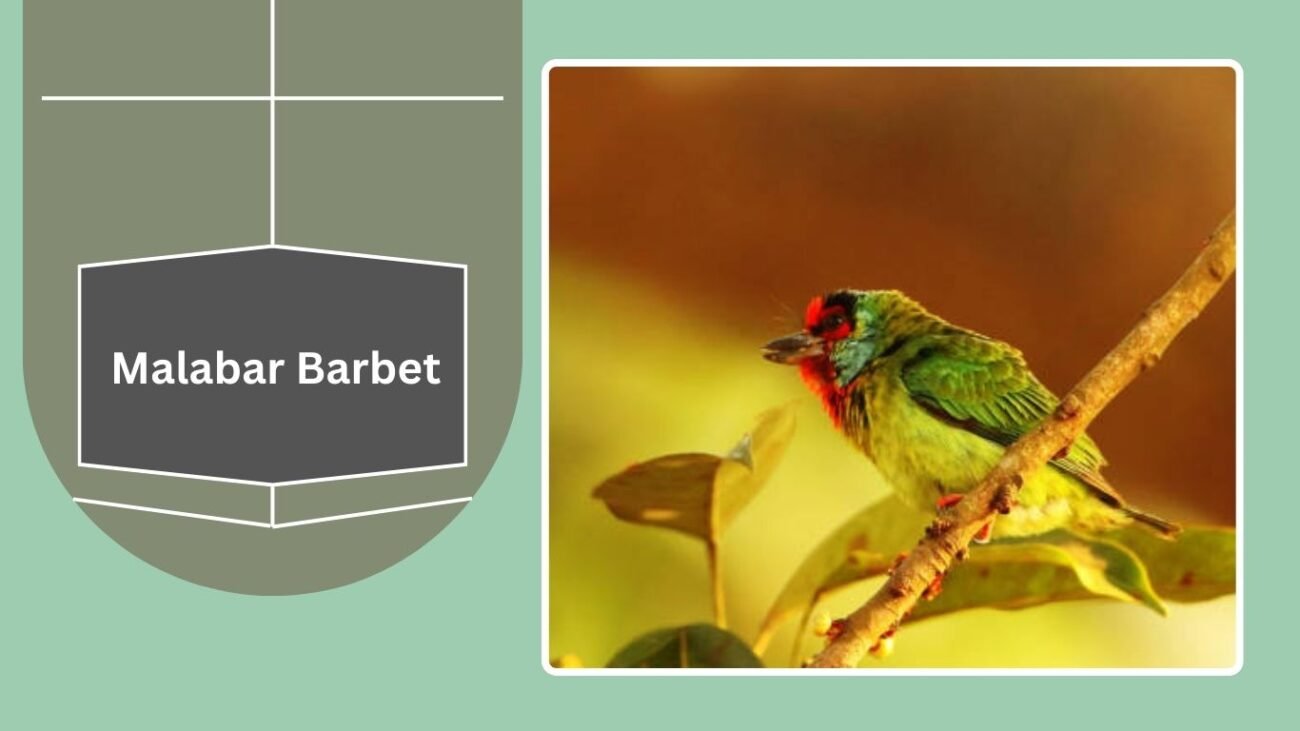
The Malabar Barbet (Psilopogon malabaricus) is a small, vividly colored bird endemic to the Western Ghats of India. Closely related to the Coppersmith Barbet, it is distinguished by its scarlet forehead and throat. Its cheerful calls and bright plumage make it a jewel of the South Indian forests.
Identification
- Small barbet, about 15–17 cm in length
- Green body with a bright red forehead and throat patch
- Black streak running through the eye
- Blue ear-coverts and yellowish belly
- Stout, pale bill and short tail
Habitat
The Malabar Barbet is restricted to the forests and plantations of the Western Ghats in southern India. It inhabits moist deciduous forests, evergreen forests, coffee plantations, orchards, and even urban gardens with fruiting trees.
Diet
This species primarily feeds on fruits like figs, guavas, and papayas, but it also consumes insects such as beetles, grasshoppers, and caterpillars. Its frugivorous habits make it an important seed disperser in its native ecosystem.
Behavior
Malabar Barbets are active and vocal, producing a repetitive “kutroo…kutroo” call similar to their close relatives. They are usually found in pairs or small family groups, especially around fruiting trees. During the breeding season, they excavate nest holes in tree trunks or dead branches, where both parents incubate eggs and feed chicks. Their adaptability allows them to thrive even in semi-urban areas of the Western Ghats.
14. Crimson-fronted Barbet
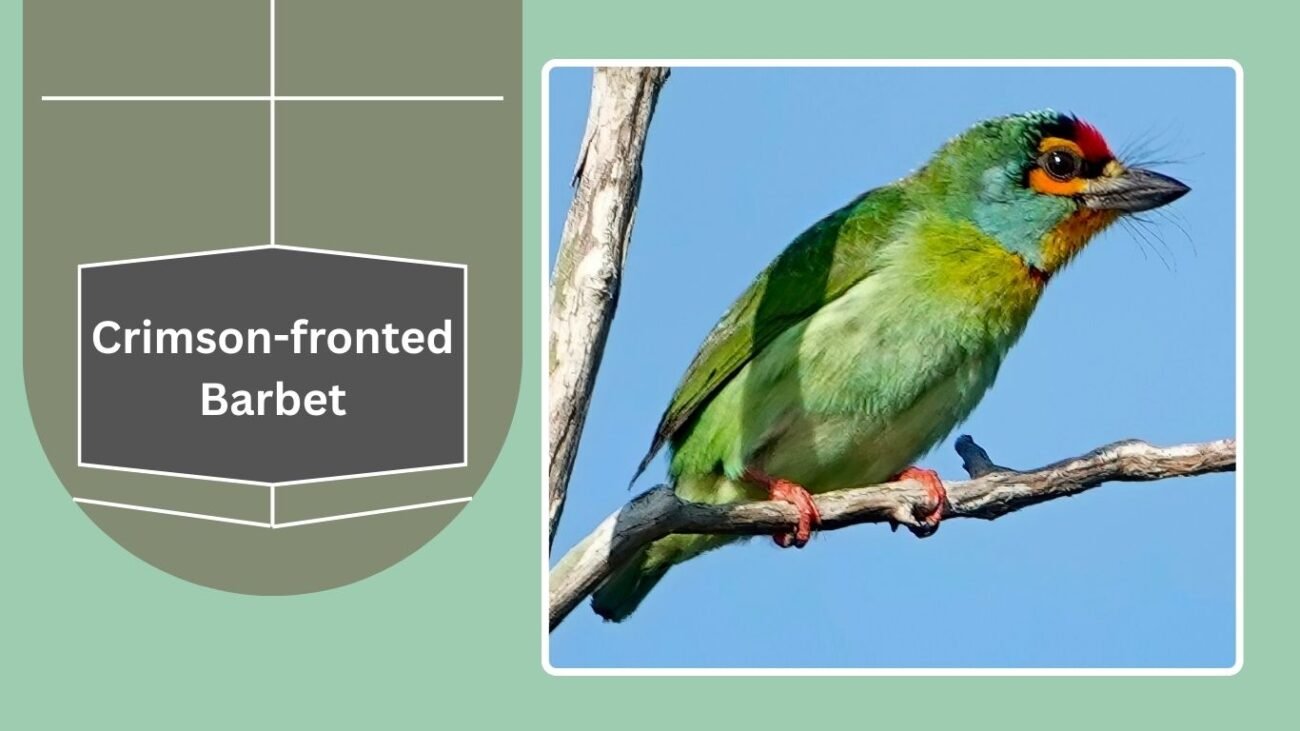
The Crimson-fronted Barbet (Psilopogon rubricapillus) is a brightly colored species native to Sri Lanka. Known for its vivid red forehead and crown, it is often seen flitting among fruiting trees in gardens, forests, and plantations. Its constant, rhythmic calls make it a familiar presence throughout its range.
Identification
- Medium-sized barbet, around 15–17 cm long
- Green body with a striking crimson forehead, crown, and throat
- Blue streaks on the face and around the ear region
- Yellow patches on the throat and belly
- Thick, pale bill suited for fruit feeding
Habitat
Endemic to Sri Lanka, the Crimson-fronted Barbet inhabits lowland rainforests, wet-zone hills, cultivated lands, and home gardens. It thrives in areas where fruiting trees are abundant, adapting well to both natural and human-modified environments.
Diet
This barbet primarily eats figs, mangoes, papayas, and berries. It also supplements its diet with insects such as beetles, grasshoppers, and caterpillars, especially during the breeding season.
Behavior
Crimson-fronted barbets are noisy, producing repetitive “kutroo…kutroo” calls that carry across the forest canopy. They are usually seen in pairs or small family groups, actively hopping between branches while feeding. During breeding, they excavate nest holes in softwood trees, where both parents share incubation and chick-feeding duties. Their vibrant colors make them one of the most eye-catching barbet species in Sri Lanka.
15. Brown-throated Barbet
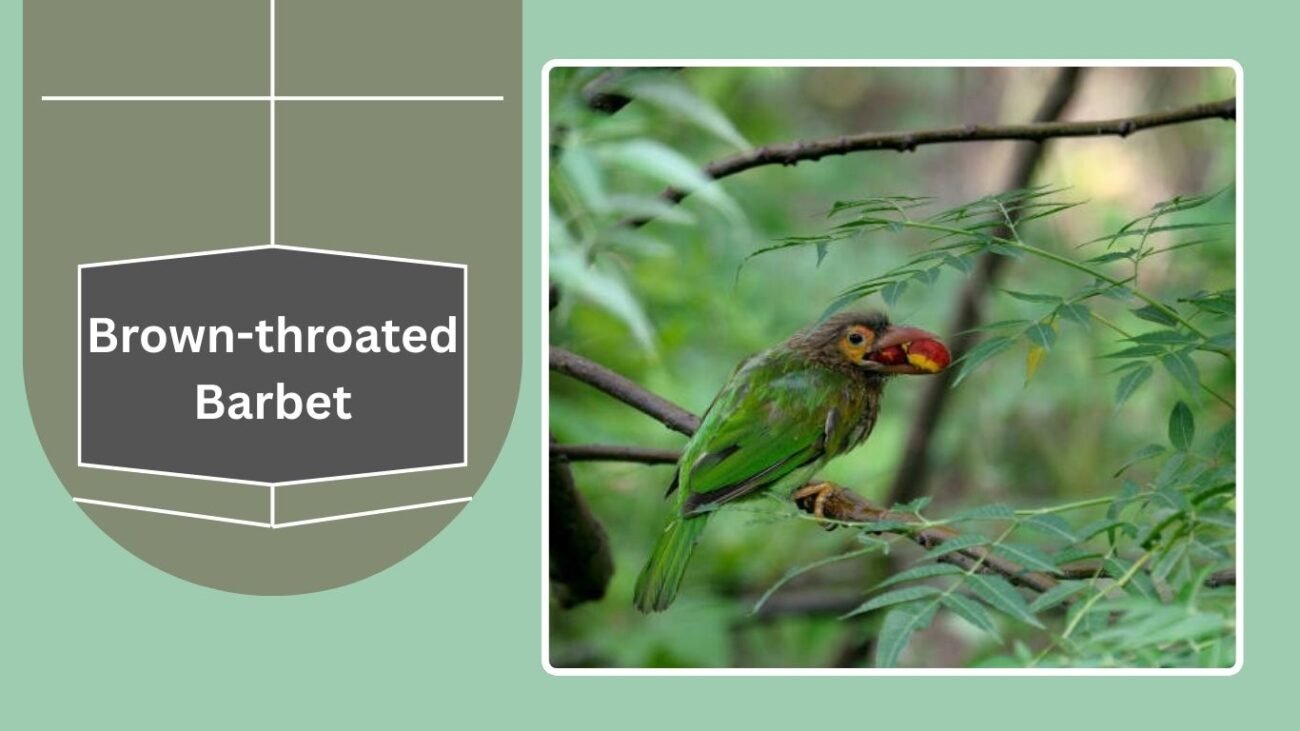
The Brown-throated Barbet (Psilopogon corvinus) is a forest-dwelling bird native to the islands of Java and Bali in Indonesia. It is known for its earthy-colored throat contrasting with its otherwise green body, making it slightly less flashy than other barbets but still striking in appearance.
Identification
- Medium-sized barbet, about 20–22 cm in length
- Green plumage with a distinctive brown throat and upper breast
- Streaked brown crown with hints of blue and yellow around the face
- Pale yellow bill and strong legs adapted for climbing
- Compact body with a short tail typical of barbets
Habitat
This species is mainly found in lowland and hill forests, plantations, and orchards in Java and Bali. It prefers areas with tall fruiting trees and is commonly seen in forest edges and wooded gardens.
Diet
The Brown-throated Barbet feeds primarily on fruits such as figs, bananas, guavas, and other soft fruits. It also consumes insects, including beetles, grasshoppers, and caterpillars, especially when feeding chicks.
Behavior
They are active and noisy birds, producing repetitive, harsh calls that resonate in the forest canopy. Brown-throated Barbets are usually solitary or in pairs but may gather in small groups at fruiting trees. During breeding, they excavate nest cavities in decayed tree trunks, where both parents share the work of incubation and chick-rearing.
16. Yellow-crowned Barbet
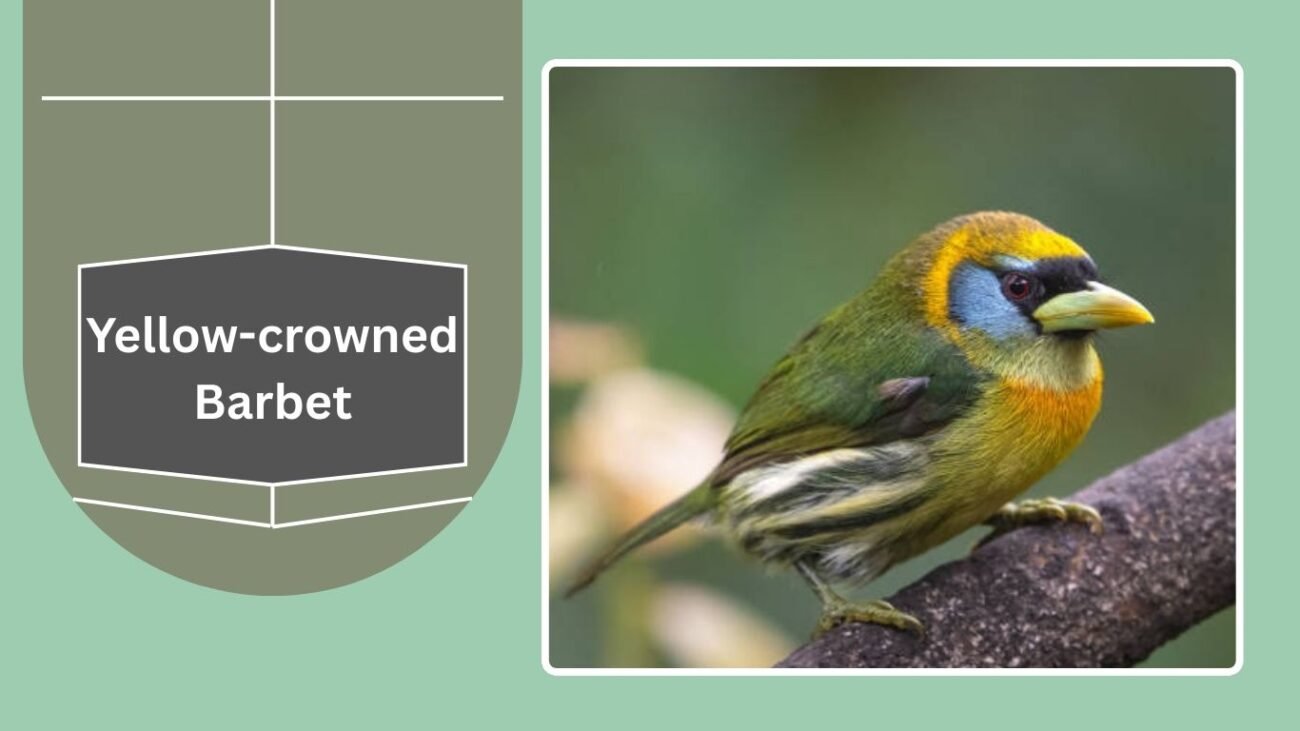
The Yellow-crowned Barbet (Psilopogon henricii) is a rare and attractive species native to the Malay Peninsula and Sumatra. It is recognized by its bright yellow crown patch, which stands out against its green plumage and dark-streaked head.
Identification
- Medium-sized barbet, about 20–22 cm in length
- Green body with a distinct yellow crown patch
- Dark-streaked head with black and brown markings
- Strong, pale bill and robust legs
- Short tail and compact build typical of barbets
Habitat
This barbet inhabits lowland tropical forests, particularly primary and tall secondary growth forests of Peninsular Malaysia and Sumatra. It prefers dense canopies and is usually found at mid to upper forest levels.
Diet
The Yellow-crowned Barbet mainly eats fruits such as figs, berries, and bananas. It also supplements its diet with insects like beetles and caterpillars, which provide essential protein, especially during breeding.
Behavior
These birds are shy and less vocal compared to some other barbet species. Their calls are a series of soft, repetitive notes, often heard from within thick foliage. They are mostly solitary or in pairs, foraging quietly in the canopy. During the breeding season, they nest in tree cavities, excavated with their stout bills, where both parents share the work of raising chicks.
17. Gold-whiskered Barbet
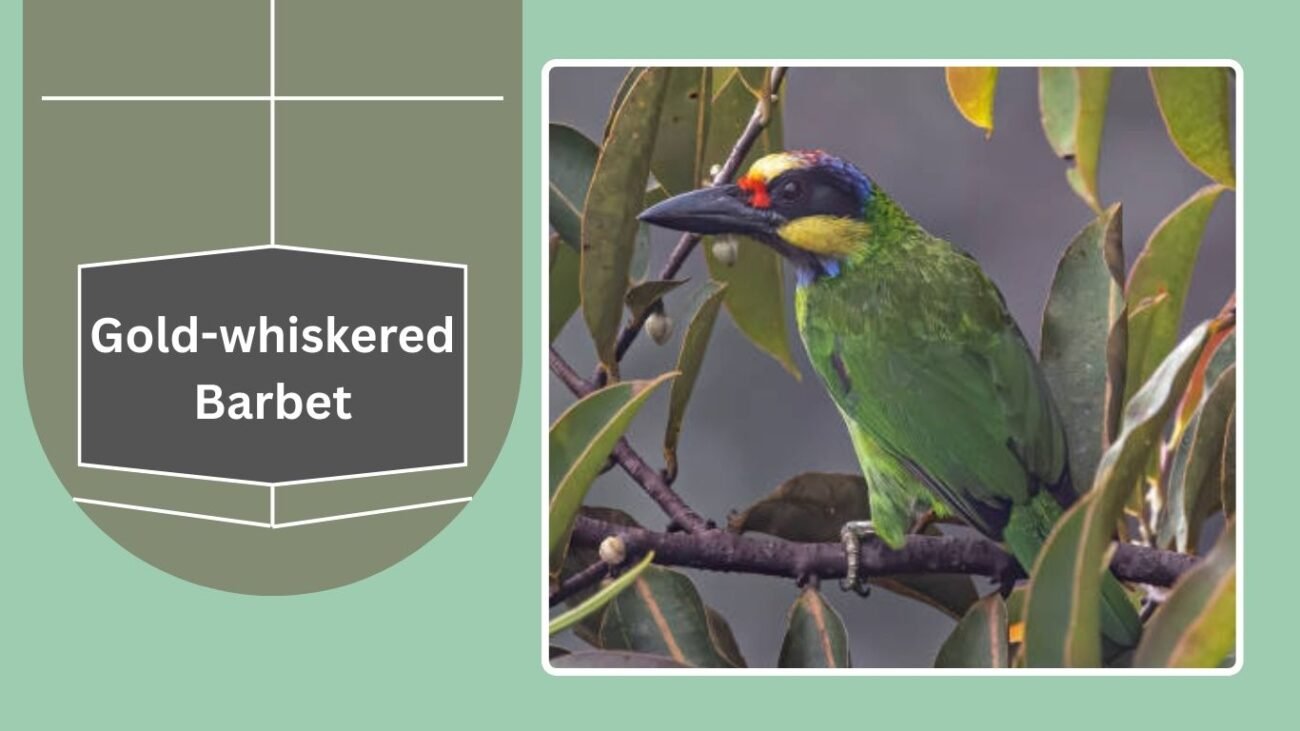
The Gold-whiskered Barbet (Psilopogon chrysopogon) is a large, colorful barbet native to Southeast Asia. It is named after the distinctive golden streaks or “whiskers” on the sides of its face. Known for its loud, rhythmic calls, this bird is an unmistakable resident of tropical forests.
Identification
- Large barbet, around 28–30 cm in length
- Bright green body with golden streaks on the sides of the face
- Red forehead and throat with a blue patch around the eyes
- Strong, pale bill and short tail
- Sturdy feet designed for clinging to branches
Habitat
This species inhabits lowland and hill forests, including secondary growth and plantations, across Thailand, Malaysia, Singapore, Sumatra, and Borneo. It is most common in dense forest canopies and forest edges.
Diet
The Gold-whiskered Barbet feeds primarily on fruits such as figs, mangoes, bananas, and papayas. It also eats insects, including beetles, ants, and grasshoppers, particularly when feeding its young.
Behavior
These barbets are loud and active, producing deep, resonant “kow-kow” calls that echo through forests. They are usually solitary or in pairs, but several individuals may gather at heavily fruiting trees. During breeding, they excavate nest holes in decayed tree trunks. Both parents incubate the eggs and take part in chick feeding. Their brilliant plumage and striking calls make them one of the most distinctive barbet species in Southeast Asia.
18. Red-crowned Barbet
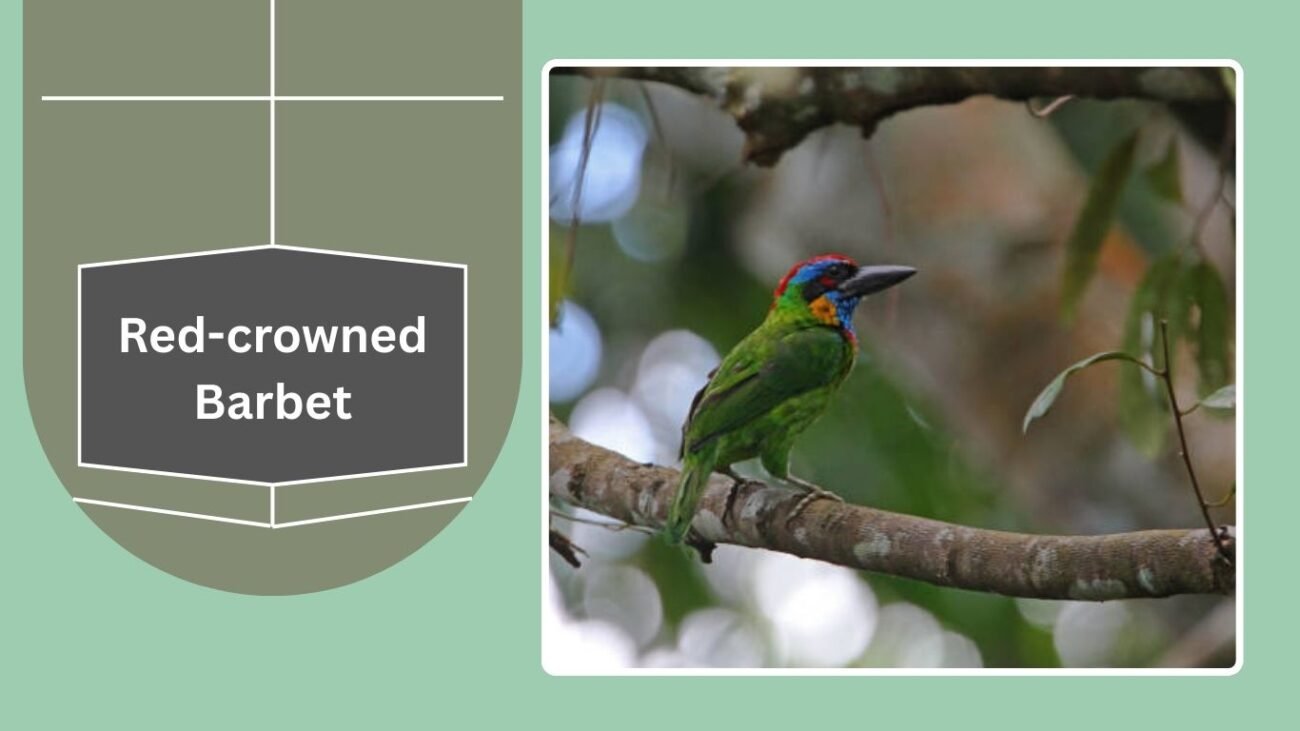
The Red-crowned Barbet (Psilopogon rafflesii) is a vibrant forest bird found in parts of Southeast Asia. Its bright red crown and multicolored face make it easily distinguishable among the green foliage of tropical forests. Though not as commonly seen as some other barbets, its loud calls often reveal its presence.
Identification
- Medium-sized barbet, about 23–25 cm in length
- Green body with a vivid red crown and forehead
- Blue face and throat, with yellow streaks around the eyes
- Large, pale bill and strong legs
- Short, rounded tail typical of barbets
Habitat
This species inhabits lowland and hill dipterocarp forests in Thailand, Peninsular Malaysia, Sumatra, and Borneo. It prefers dense, tall canopies and is usually found in well-wooded areas rather than open gardens.
Diet
Red-crowned barbets feed mainly on fruits like figs, guavas, and berries. They also take insects such as beetles, termites, and caterpillars, especially during the breeding season to provide protein for chicks.
Behavior
These barbets are active and noisy, producing loud, resonant “kow-kow” calls. They are usually solitary or in pairs but may join small groups at fruiting trees. During breeding, they excavate nest holes in tree trunks, where both parents share incubation and chick-rearing duties. Their brilliant red crown makes them one of the most striking barbets in their native forests.
19. Mountain Barbet
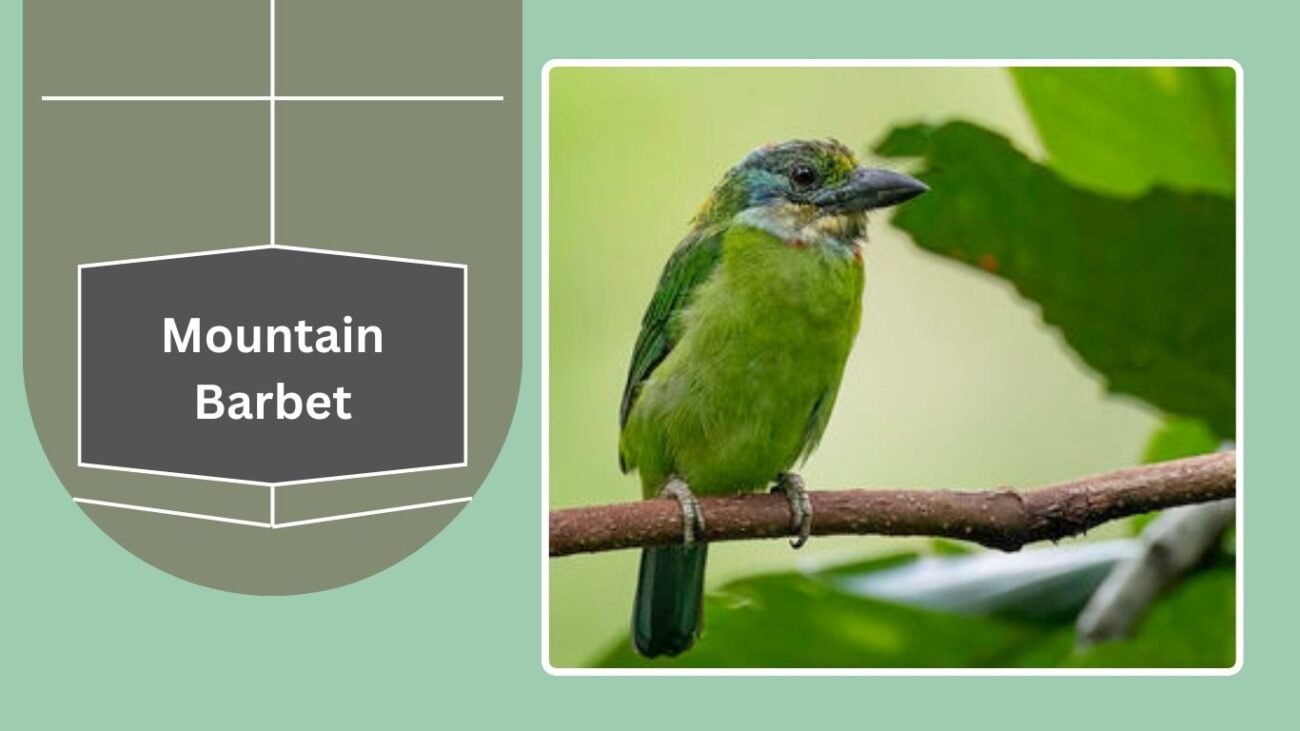
The Mountain Barbet (Psilopogon monticola) is a lesser-known barbet species native to the mountains of Borneo. It is characterized by its earthy-colored face and throat, setting it apart from the more vividly patterned barbets. Its simple appearance reflects its adaptation to highland forests.
Identification
- Medium-sized barbet, about 20–22 cm in length
- Green body with brownish face and throat
- Pale yellow eye-ring and faint streaks on the head
- Sturdy pale bill and strong climbing feet
- Short tail and compact build typical of barbets
Habitat
This species is found in montane forests of northern Borneo, particularly in Sabah and Sarawak. It inhabits elevations between 600–2,000 meters, preferring dense, fruit-rich highland forests.
Diet
The Mountain Barbet feeds mainly on figs, berries, and other soft fruits. It also supplements its diet with insects such as beetles, grasshoppers, and caterpillars, especially during the breeding season when protein is essential for growing chicks.
Behavior
Mountain Barbets are quieter compared to some other barbets, producing soft, repetitive calls. They are usually solitary or found in pairs, often foraging quietly in the mid to upper canopy. During breeding, they excavate nesting cavities in deadwood, with both parents sharing incubation and chick-feeding duties. Though not as brightly colored as other species, they play an important ecological role in seed dispersal in montane forests.
20. White-eared Barbet
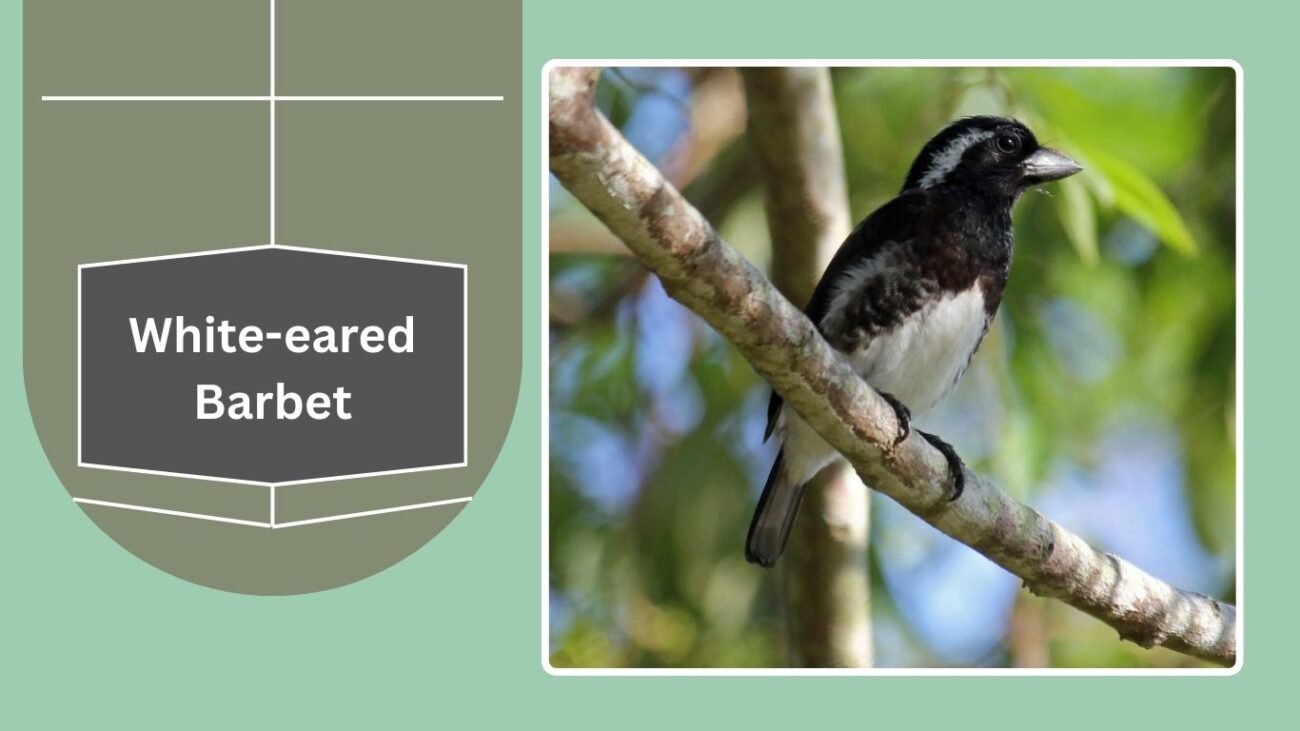
The White-eared Barbet (Stactolaema leucotis) is a distinctive African barbet known for its bold white ear-patches and dark, streaked plumage. Unlike the colorful Asian barbets, this species has a more subdued appearance but is equally important as a seed disperser in its habitat.
Identification
- Medium-sized barbet, about 20–22 cm in length
- Dark brown to blackish body with streaks on the head and breast
- Prominent white patches around the ears (hence the name)
- Large, pale bill and strong zygodactyl feet
- Compact body with a short, stubby tail
Habitat
White-eared Barbets are native to eastern and southern Africa, including Kenya, Tanzania, Mozambique, and South Africa. They prefer woodland, savanna, forest edges, and cultivated lands with tall fruiting trees.
Diet
Their diet consists mainly of fruits such as figs, guavas, and wild berries. They also take insects, including beetles, termites, and grasshoppers, especially when feeding their young.
Behavior
These barbets are social, often found in small flocks, especially around fruiting trees. They produce a variety of calls, including repetitive chattering and harsh notes. During breeding, they excavate nest holes in dead trees or softwood branches. Both parents share the duties of incubation and feeding, and fledglings sometimes remain with parents to help raise the next brood.
21. Green Barbet
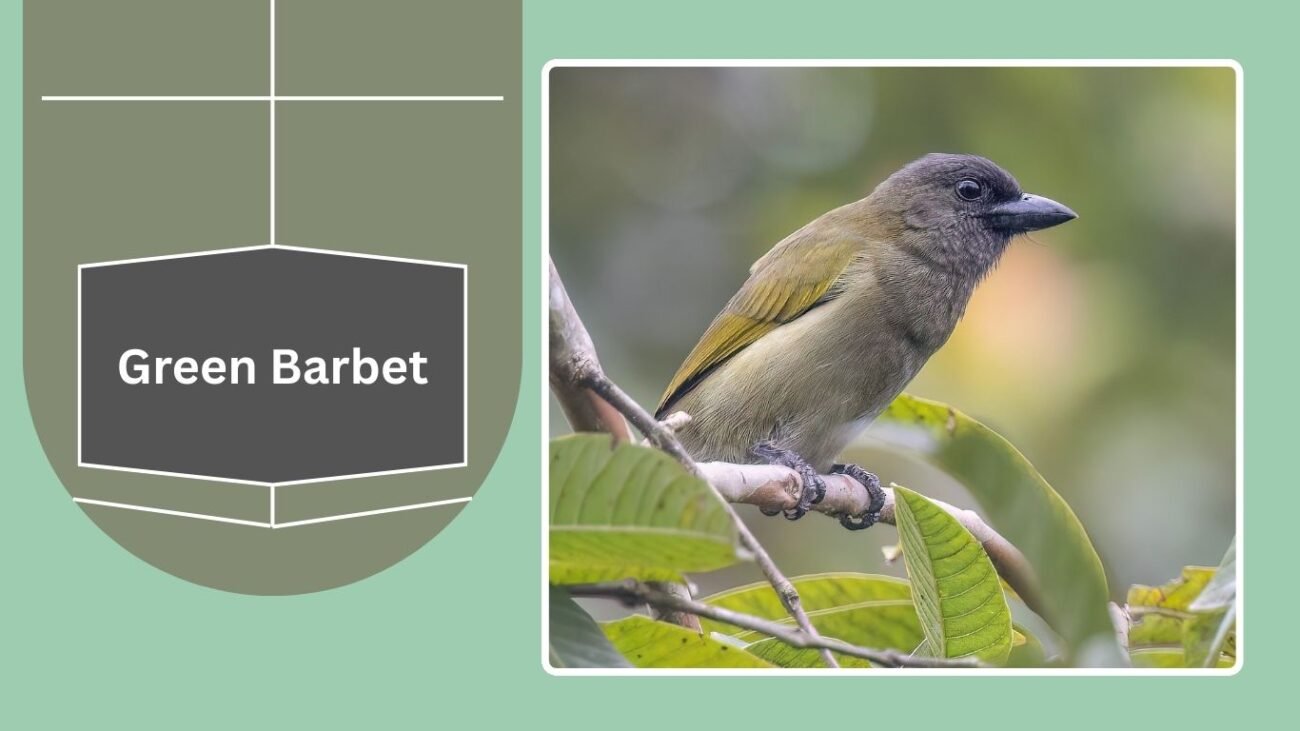
The Green Barbet (Stactolaema olivacea) is a forest-dwelling species native to eastern and southern Africa. True to its name, it has a predominantly greenish-olive plumage that helps it blend seamlessly into the canopy. Its loud, repetitive calls are often heard long before the bird is seen.
Identification
- Medium-sized barbet, about 20–23 cm in length
- Olive-green plumage with faint streaking on the head and underparts
- Strong, pale bill with a slightly hooked tip
- Bare skin around the eyes may appear yellowish or dull
- Compact, short-tailed body with powerful climbing feet
Habitat
Green Barbets inhabit coastal and montane forests, forest edges, and wooded gardens across Kenya, Tanzania, Mozambique, and northeastern South Africa. They prefer tall, fruit-rich trees and are common in both lowland and upland forests.
Diet
Their diet is largely frugivorous, with figs and wild berries forming the bulk of their intake. They also consume insects, particularly beetles, ants, and grasshoppers, providing a protein boost during breeding season.
Behavior
Green Barbets are noisy birds, producing loud, monotonous calls that echo through forests. They are often seen in pairs or small family groups, foraging actively in the canopy. Like other barbets, they excavate nest holes in softwood branches or decayed trunks, where both parents participate in chick rearing. They are important seed dispersers in African forest ecosystems.
22. DeArnaud’s Barbet
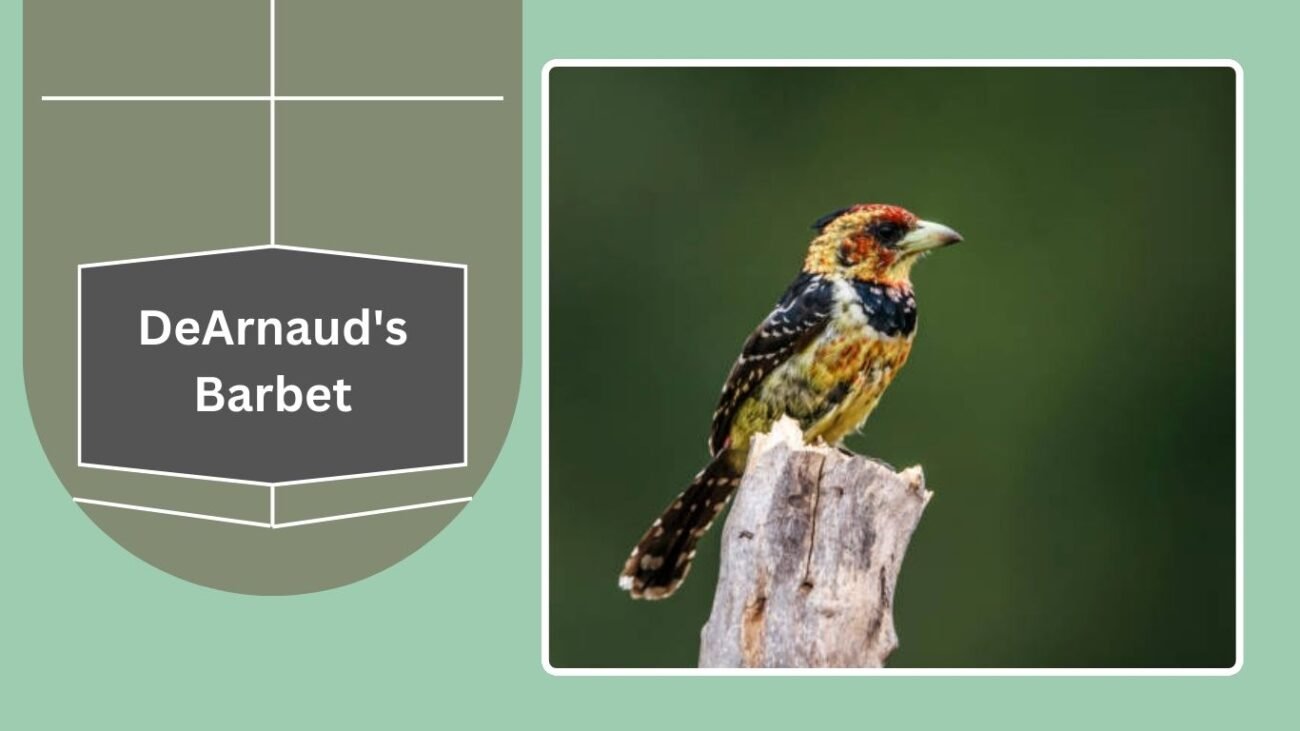
D’Arnaud’s Barbet (Trachyphonus darnaudii) is a small and striking African barbet recognized for its spotted and streaked plumage. Found in East Africa, this bird is often seen hopping on the ground as well as perched in trees, making it one of the more terrestrial barbets.
Identification
- Small barbet, about 16–18 cm in length
- Black and white spotted plumage with yellowish underparts
- Distinct black crown with white streaks
- Strong, pale bill and short tail
- Legs adapted for perching and occasional ground movement
Habitat
This species is common in savannas, dry scrublands, thornbush, and acacia woodlands of Kenya, Tanzania, Ethiopia, Uganda, and Somalia. Unlike forest barbets, it thrives in open, arid landscapes with scattered trees and shrubs.
Diet
D’Arnaud’s Barbets feed on fruits, seeds, and insects. They are opportunistic feeders, eating beetles, termites, and grasshoppers, as well as figs and berries. They sometimes forage on the ground, unlike many arboreal barbets.
Behavior
These barbets are highly vocal and produce a range of chattering, trilling, and buzzing calls, often in duets between pairs. They are territorial and may chase intruders aggressively. They nest in tree cavities or sometimes in termite mounds, where both male and female share incubation and chick-feeding duties. Their striking plumage and ground-foraging habits make them quite different from their forest-dwelling relatives.
23. Red-and-yellow Barbet
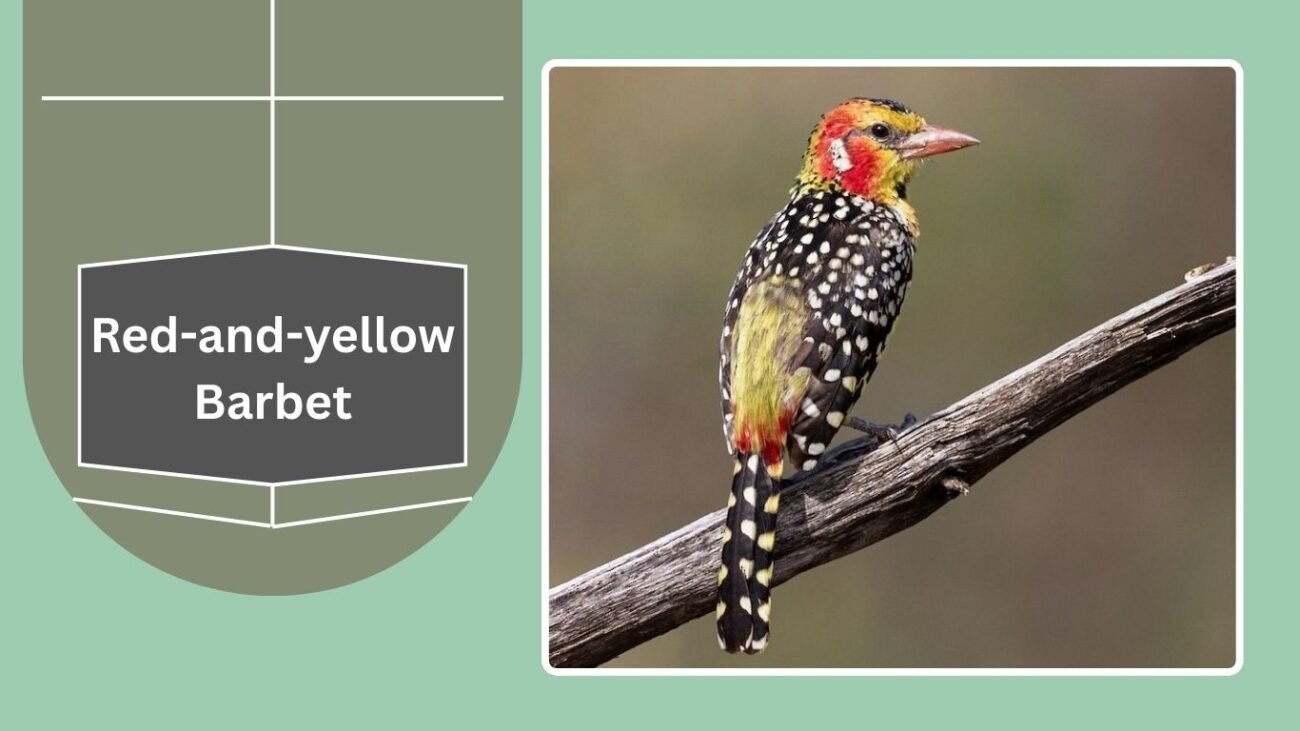
The Red-and-yellow Barbet (Trachyphonus erythrocephalus) is one of the most vividly patterned African barbets, admired for its brilliant red, yellow, and black plumage. Native to East Africa, it is a common sight in arid landscapes, often seen on the ground as well as perched in trees.
Identification
- Medium-sized barbet, about 20–22 cm long
- Bright red head, throat, and chest with yellow underparts
- Black wings and back dotted with white spots
- Strong, pale yellow bill with a slightly hooked tip
- Short tail and sturdy legs, well-suited for ground foraging
Habitat
This species inhabits dry savannas, thornbush, scrublands, and semi-desert regions of Kenya, Tanzania, Ethiopia, Somalia, and Uganda. It adapts well to open landscapes with scattered trees and bushes.
Diet
Red-and-yellow Barbets are omnivorous, feeding on fruits, seeds, and insects. They eat figs, berries, and cultivated fruits, as well as beetles, grasshoppers, and termites. They are often observed foraging on the ground, unlike many arboreal barbet species.
Behavior
These barbets are very active and social, often seen in small groups. They produce loud, melodious calls and sometimes duet songs between mates. They are territorial and will chase away intruders. Nesting usually takes place in burrows dug into termite mounds or earthen banks, which is unusual for barbets. Both parents share incubation and chick-rearing duties. Their dazzling colors and unique nesting habits make them stand out among barbets.
24. Black-collared Barbet
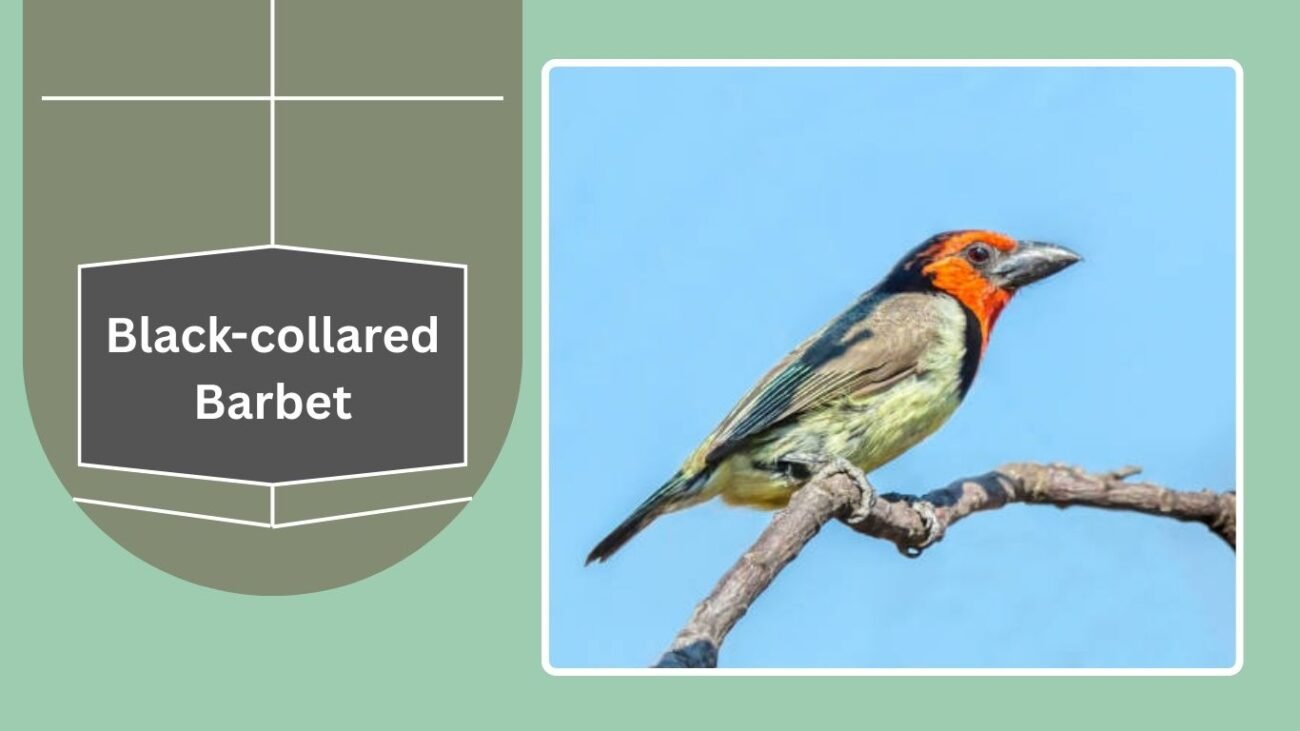
The Black-collared Barbet (Lybius torquatus) is a bold and vocal African barbet, instantly recognizable by the thick black collar around its throat and its bright red face. Its duet calls are a signature sound of African woodlands and savannas, often heard before the bird is seen.
Identification
- Medium-sized barbet, about 20–22 cm in length
- Bright red head and face with a striking black collar around the throat
- Olive-green wings and back with whitish underparts
- Large, robust bill suited for crushing fruits
- Short tail and strong climbing feet
Habitat
This species inhabits woodlands, savannas, riverine forests, and cultivated lands across much of sub-Saharan Africa, including South Africa, Botswana, Namibia, Zimbabwe, Mozambique, and Tanzania. It adapts well to rural and semi-urban areas with fruiting trees.
Diet
Black-collared Barbets feed mainly on fruits such as figs, guavas, and papayas. They also eat insects, including beetles, ants, and termites, especially during the breeding season to provide protein for chicks.
Behavior
They are famous for their synchronized duet calls, where pairs sing alternately in perfect rhythm, producing a loud “too-puddly-too-puddly” sound. These calls serve to strengthen pair bonds and defend territory. They are usually found in pairs or small groups, actively feeding in fruiting trees. Nesting occurs in tree cavities excavated by the pair, with both parents incubating and feeding the young.
25. Spot-flanked Barbet
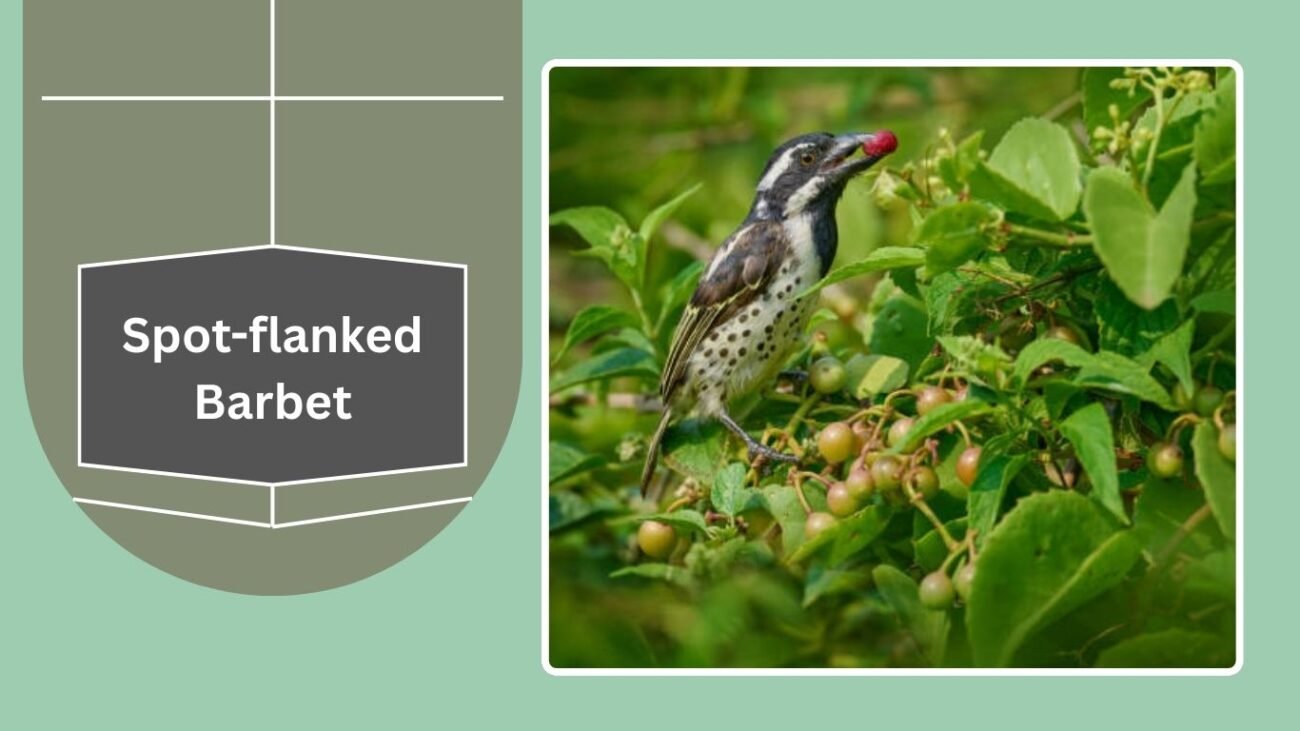
The Spot-flanked Barbet (Tricholaema lacrymosa) is a distinctive African barbet named for the spotted markings along its flanks. It is a common species in East Africa, where it inhabits woodland and savanna habitats. Its bold plumage and loud calls make it easy to identify among other birds in its range.
Identification
- Medium-sized barbet, about 17–20 cm in length
- Black-and-white streaked head with a red patch on the forehead
- White underparts with distinctive black spots along the flanks
- Greenish to olive upperparts
- Strong, pale bill and short tail typical of barbets
Habitat
Spot-flanked Barbets are found in East African countries including Kenya, Tanzania, Uganda, Rwanda, and Ethiopia. They thrive in woodlands, savannas, forest edges, and cultivated lands with scattered fruiting trees.
Diet
Their diet is mixed, consisting mainly of fruits such as figs and berries, but also seeds and insects like beetles, ants, and grasshoppers. They forage both in trees and occasionally on the ground.
Behavior
These barbets are active, noisy birds with a variety of loud, repetitive calls. They are usually found in pairs or small family groups. Like many barbets, they nest in tree cavities, excavated with their stout bills. Both parents share incubation and feeding duties. Spot-flanked Barbets are also known to be territorial, defending feeding and nesting areas aggressively.