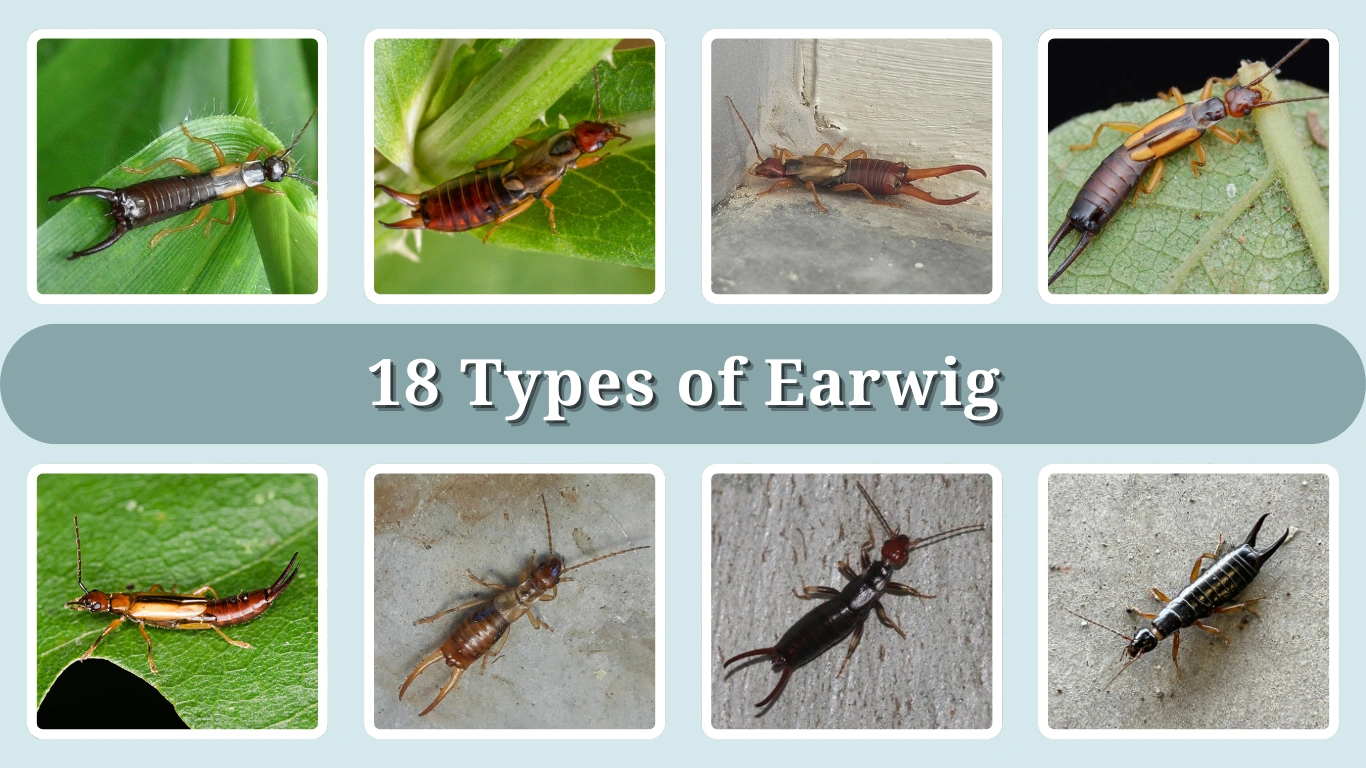
Earwigs are fascinating insects recognized for their pincer-like forceps and nocturnal habits. With more than 2,000 species worldwide, they occupy diverse habitats ranging from gardens and forests to coastal regions. While some earwigs are helpful predators of pests, others may cause minor plant damage. This guide explores 18 different types of earwigs, highlighting their identification, habitats, behavior, and lifecycles to better understand these often-misunderstood insects.
1. European Earwig (Forficula auricularia)

The European earwig is one of the most common and widespread species, often found in gardens, homes, and agricultural areas. It is easily recognizable and has become a well-known earwig across Europe, North America, and other parts of the world.
Identification
- Medium-sized earwig, around 12–15 mm long
- Reddish-brown body with a lighter yellow-brown underside
- Forceps (cerci) are curved in males and straighter in females
- Short, leathery forewings covering transparent hindwings
- Antennae with 14–16 segments
Habitat
The European earwig is typically found in damp, dark places such as under stones, logs, bark, mulch, and leaf litter. They are also common in gardens, compost heaps, and occasionally inside houses.
Behavior
This earwig is nocturnal, feeding at night on a variety of foods including decaying plant matter, fungi, and small insects. They are also known to damage fruits, vegetables, and ornamental plants, making them both beneficial as pest controllers and harmful as garden pests.
Lifecycle
The female lays eggs in soil burrows during late winter or early spring and guards them until they hatch. Nymphs undergo several molts before reaching adulthood in late spring to early summer. Adults can live for about a year, often surviving the winter.
2. Ring-legged Earwig (Euborellia annulipes)

The Ring-legged earwig is a small, dark species commonly found in warmer regions. It is distinctive due to the pale bands on its legs and its tendency to thrive in both natural and human-influenced environments.
Identification
- Small earwig, about 8–12 mm long
- Dark brown to black body
- Legs with noticeable pale yellowish bands (“ringed” appearance)
- Straight, short forceps in both males and females
- Lacks wings, unlike many other earwigs
Habitat
This species prefers warm, moist habitats such as leaf litter, compost, under rocks, and within rotting wood. It is also frequently found in agricultural fields, greenhouses, and near human dwellings.
Behavior
The Ring-legged earwig is omnivorous, feeding on decaying organic matter, fungi, and occasionally soft-bodied insects. It is beneficial in controlling small pests but may also nibble on tender seedlings. It is mostly nocturnal and hides during the day.
Lifecycle
Females lay small clusters of eggs in soil burrows and exhibit maternal care by guarding them. The young nymphs hatch and undergo several molts before maturing into adults within a few months. Adults live less than a year, typically reproducing once per season.
3. Striped Earwig (Labidura riparia)

The Striped earwig is a large and distinctive species, easily recognized by its body markings. It is widely distributed in warmer climates and is often considered one of the more aggressive earwig types.
Identification
- Large earwig, 18–25 mm long
- Light brown to yellowish body with two dark longitudinal stripes running down the thorax
- Well-developed wings; capable of flight
- Forceps are long and strongly curved in males, straighter in females
- Antennae long and segmented
Habitat
This species is commonly found in sandy soils, gardens, farmlands, and near water edges such as riverbanks and coastal areas. They often hide under stones, debris, and vegetation during the day.
Behavior
The Striped earwig is a predatory species, feeding mainly on soft-bodied insects like caterpillars, aphids, and other small invertebrates. While they can provide natural pest control, they may also damage crops if populations are high. They are more aggressive compared to many other earwigs.
Lifecycle
Females construct burrows in the soil and lay eggs inside, guarding them until hatching. Nymphs go through multiple molts before reaching maturity. Adults live for several months and usually reproduce once annually.
4. Seaside Earwig (Anisolabis maritima)

The Seaside earwig is a wingless species commonly found in coastal regions. It is well-adapted to sandy and salty environments, making it different from many other earwig types.
Identification
- Medium-sized earwig, about 15–20 mm long
- Dark brown to black body with a somewhat glossy appearance
- Lacks wings (apterous species)
- Strong, curved forceps more prominent in males
- Antennae are short compared to other species
Habitat
As the name suggests, this earwig prefers coastal habitats, including sandy beaches, dunes, and areas near driftwood and seaweed. They hide under rocks, logs, and debris washed up by tides.
Behavior
The Seaside earwig is primarily nocturnal and predatory. It feeds on small insects, larvae, and decaying organic material, contributing to nutrient recycling in coastal ecosystems. Unlike some other earwigs, it is rarely considered a household or garden pest.
Lifecycle
Females lay eggs in burrows dug into moist sand or soil. Like other earwigs, mothers guard the eggs and early nymphs until they molt. Development from nymph to adult takes several weeks, with adults surviving through the warmer months.
5. Red-legged Earwig (Euborellia arcanum)

The Red-legged earwig is a lesser-known species, distinguished by the reddish tint on its legs. It is more common in warmer regions and is often overlooked due to its small size.
Identification
- Small to medium-sized earwig, around 10–14 mm long
- Dark brown to nearly black body
- Legs with reddish or rust-colored tones
- Wingless species
- Short, straight forceps, with males having slightly more curved pincers
Habitat
This earwig thrives in warm, humid environments, often sheltering under leaf litter, bark, mulch, and stones. It is also common in cultivated lands, gardens, and compost piles where organic matter is abundant.
Behavior
The Red-legged earwig is mostly nocturnal and feeds on decaying organic matter, fungi, and small insects. While generally beneficial as a predator of pests, it may occasionally cause minor damage to tender seedlings.
Lifecycle
Females lay eggs in soil burrows and display parental care by protecting them until they hatch. Nymphs undergo several molts before reaching adulthood. Adults live for several months, typically completing one reproductive cycle per year.
6. Shore Earwig (Anisolabis littorea)

The Shore earwig is a coastal species often confused with the Seaside earwig but can be distinguished by its size and structural features. It is well-adapted to sandy and damp environments.
Identification
- Medium to large earwig, about 18–22 mm long
- Dark brown to nearly black body
- Wingless species
- Forceps are robust and strongly curved in males, straighter in females
- Short, sturdy antennae
Habitat
The Shore earwig is usually found along beaches, dunes, and tidal zones, hiding under stones, driftwood, and seaweed. It favors moist, sandy soils and coastal vegetation areas.
Behavior
This earwig is primarily predatory, feeding on small insects, larvae, and organic debris washed ashore. It plays a role in cleaning up decaying material in coastal ecosystems. Unlike other earwigs, it is rarely seen inland.
Lifecycle
Females dig burrows in sandy soil to lay eggs, which they protect until hatching. The nymphs molt several times before reaching adulthood. The species reproduces seasonally, with adults living through the warmer months.
7. Saint Helena Earwig (Labidura herculeana)

The Saint Helena earwig, also called the Giant earwig, is one of the largest earwigs ever recorded. Native to the remote island of Saint Helena in the South Atlantic Ocean, it is considered critically endangered and possibly extinct.
Identification
- Exceptionally large, up to 80 mm (3 inches) long
- Dark reddish-brown to black body
- Very robust with thick, powerful forceps
- Wingless species
- Heavier and bulkier than any other known earwig
Habitat
Historically, this species inhabited arid, rocky areas on Saint Helena island, often sheltering under boulders and within crevices. It preferred dry, volcanic terrain rather than moist, vegetated habitats typical of other earwigs.
Behavior
The Saint Helena earwig was believed to be nocturnal and predatory, feeding on smaller invertebrates. Its large size and powerful pincers suggest it was adapted for both defense and hunting. Unlike other earwigs, it was not considered a pest.
Lifecycle
Little is documented about its lifecycle, but like other earwigs, females likely laid eggs in soil or rocky crevices and guarded them until hatching. Its development stages are presumed similar to other Labidura species, with multiple molts leading to adulthood.
8. Spongiphorid Earwig (Spongiphoridae family)

Spongiphorid earwigs are a diverse group belonging to the Spongiphoridae family, which includes several small species spread across different regions. They are generally lightweight and more delicate compared to larger earwigs.
Identification
- Small earwigs, usually 5–12 mm long
- Light brown to yellowish body coloration
- Slender build with relatively long antennae
- Some species have short, functional wings
- Forceps are slender and less curved than those of larger earwigs
Habitat
Spongiphorid earwigs are widely distributed and found in leaf litter, under bark, in grasslands, and near decaying vegetation. Some species adapt to urban areas, hiding in gardens and damp crevices.
Behavior
They are generally omnivorous, feeding on fungi, decaying matter, and small insects. Their small size makes them less noticeable, and they are not usually harmful to crops or plants. Many species play a role in natural pest control.
Lifecycle
Like other earwigs, females lay eggs in soil or plant debris and protect them until hatching. The nymphs pass through several molts before reaching adulthood. Their life cycle is shorter than that of larger earwig species, often completing within a few months.
9. Black Earwig (Chelisoches morio)

The Black earwig is a tropical species known for its glossy dark appearance and predatory behavior. It is frequently found in Southeast Asia and other warm regions, often associated with cultivated crops.
Identification
- Medium-sized earwig, about 18–24 mm long
- Shiny black to very dark brown body
- Well-developed wings, capable of short flight
- Forceps long and strongly curved in males, straighter in females
- Antennae relatively long with multiple segments
Habitat
This earwig prefers tropical and subtropical habitats, including agricultural fields, gardens, orchards, and forested areas. It shelters in moist, shaded places such as under leaves, bark, and plant debris.
Behavior
The Black earwig is a highly predatory species, feeding on caterpillars, aphids, termites, and other small insects. It is considered beneficial in agriculture as a natural pest controller. Unlike some earwigs, it rarely feeds on plant matter.
Lifecycle
Females lay eggs in soil burrows or under plant litter and provide maternal care until hatching. Nymphs molt multiple times before reaching maturity. Adults may live for several months, reproducing seasonally in warm conditions.
10. Brown-winged Earwig (Vostox brunneipennis)

The Brown-winged earwig is a relatively small species known for its characteristic wing coloration. It is more common in the Americas and adapts well to both natural and human-influenced habitats.
Identification
- Small earwig, about 8–12 mm long
- Light brown body with distinctive brown-tinted wings
- Wings extend beyond the abdomen in some individuals
- Forceps are short and slightly curved in males, straighter in females
- Antennae are long and segmented
Habitat
This species is usually found in gardens, fields, and grassy areas, often hiding under stones, bark, and leaf litter. It is also seen in cultivated lands and occasionally enters buildings in search of shelter.
Behavior
The Brown-winged earwig is omnivorous, feeding on both decaying plant material and small insects. It is not considered a serious pest but can sometimes nibble on seedlings and tender plant parts. Its role in pest control makes it generally beneficial.
Lifecycle
Like other earwigs, females lay eggs in soil burrows and guard them until they hatch. Nymphs pass through several molts before adulthood. The species completes its life cycle within a few months, reproducing multiple times in warm climates.
11. Lesne’s Earwig (Forficula lesnei)

Lesne’s earwig is a rare species native to parts of Europe, particularly the United Kingdom. It is smaller than the common European earwig and is considered a more specialized species.
Identification
- Small earwig, about 6–9 mm long
- Light brown to reddish-brown body
- Short wings, not capable of flight
- Forceps short and fairly straight in both sexes
- Antennae slender with several segments
Habitat
This species prefers hedgerows, scrublands, and grasslands, often hiding in low vegetation, leaf litter, and beneath bark. Unlike common earwigs, it is less frequently found in gardens or urban environments.
Behavior
Lesne’s earwig is nocturnal and feeds mainly on plant material such as leaves, flowers, and soft shoots. It is not considered a pest due to its small population size and limited distribution.
Lifecycle
The female lays eggs in soil burrows and guards them, as with other earwig species. The nymphs hatch in spring and develop slowly, undergoing multiple molts before becoming adults. This species typically completes one generation per year.
12. Short-winged Earwig (Apterygida media)

The Short-winged earwig is a European species distinguished by its reduced wings, which make it incapable of flight. It is less common than the European earwig and tends to prefer more specific habitats.
Identification
- Medium-sized earwig, about 9–12 mm long
- Light to dark brown body with a slightly shiny surface
- Greatly reduced wings, appearing as small pads
- Forceps relatively short and slightly curved in males, straighter in females
- Antennae with 12–14 segments
Habitat
This species favors grasslands, hedgerows, and woodland edges, often hiding under stones, bark, or leaf litter. It prefers warmer, dry habitats and is less often found in urban gardens compared to other earwigs.
Behavior
The Short-winged earwig is mainly herbivorous, feeding on leaves, flowers, and softer plant parts. It rarely causes noticeable damage and is not considered a significant pest. It is more secretive and less abundant than the European earwig.
Lifecycle
Females lay eggs in soil burrows during spring and guard them until hatching. Nymphs develop through multiple molts, reaching adulthood in summer. Adults are usually short-lived, reproducing once annually.
13. Linear Earwig (Doru lineare)

The Linear earwig is a New World species commonly found in the Americas. It is slender in build and is often associated with crops, where it can act as both a pest and a natural predator.
Identification
- Medium-sized earwig, about 10–15 mm long
- Slender, elongated body, usually dark brown with lighter edges
- Fully winged; forewings short and leathery, hindwings membranous
- Forceps moderately curved in males, straighter in females
- Antennae long and segmented
Habitat
The Linear earwig inhabits grassy fields, agricultural areas, and gardens, where it shelters under leaves, bark, and crop debris. It thrives in moist, warm conditions and is commonly found in corn and other cereal crops.
Behavior
This species is omnivorous, feeding on both plant material and small insects. It is considered beneficial for preying on pests like aphids and caterpillars but may also nibble on crops such as corn silks and young shoots.
Lifecycle
Females lay eggs in soil burrows and protect them until they hatch. Nymphs pass through several molts before reaching maturity in summer. The species usually produces more than one generation per year in warmer climates.
14. Striped Doru Earwig (Doru taeniatum)

The Striped Doru earwig is closely related to the Linear earwig and is also native to the Americas. It is notable for the distinct stripes on its body, which help differentiate it from similar species.
Identification
- Medium-sized earwig, about 10–15 mm long
- Brown to dark brown body with yellowish longitudinal stripes on the thorax and wings
- Fully winged, capable of flight
- Forceps moderately curved in males, straighter in females
- Antennae slender and segmented
Habitat
This earwig is common in cornfields, grasslands, and gardens, particularly in tropical and subtropical regions. It hides during the day under leaves, bark, and plant debris, emerging at night to forage.
Behavior
The Striped Doru earwig is omnivorous, feeding on pests such as caterpillars, aphids, and insect eggs, making it beneficial in agriculture. However, it can also cause minor crop damage by feeding on corn silks and other tender plant parts.
Lifecycle
Females construct soil burrows for egg-laying and provide maternal care until hatching. Nymphs molt several times before becoming adults. In warm climates, multiple generations may occur within a year, allowing populations to grow rapidly.
15. Yellow-legged Earwig (Euborellia plebeja)

The Yellow-legged earwig is a small, wingless species that can be identified by the distinctive yellowish coloration of its legs. It is widely distributed in warm regions and often overlooked due to its small size.
Identification
- Small earwig, about 8–12 mm long
- Dark brown to black body
- Legs pale yellow to yellowish-brown, contrasting with the darker body
- Wingless species
- Forceps short and slightly curved in males, straighter in females
Habitat
This earwig inhabits leaf litter, soil crevices, compost heaps, and decaying vegetation. It thrives in moist and warm environments, often in cultivated lands, gardens, and forest edges.
Behavior
The Yellow-legged earwig is mostly scavenging and omnivorous, feeding on decaying organic matter, fungi, and occasionally small insects. It plays a role in decomposition but rarely causes crop damage.
Lifecycle
Females lay eggs in soil burrows and guard them until hatching. Nymphs pass through multiple molts before reaching adulthood. The species reproduces quickly in favorable warm conditions, with adults living several months.
16. Free-living Earwig (Forficula decipiens)

The Free-living earwig is a lesser-known species of the Forficula genus, closely related to the European earwig. It is smaller in size and less widespread but still notable for its presence in gardens and fields.
Identification
- Small to medium-sized earwig, about 8–12 mm long
- Light to reddish-brown body
- Short wings, not often used for flight
- Forceps slender and slightly curved in males, straighter in females
- Antennae with multiple segments, relatively long
Habitat
This species inhabits gardens, farmland, hedgerows, and grassy areas, preferring moist environments. It shelters under bark, leaves, mulch, and stones during the day.
Behavior
The Free-living earwig is omnivorous, feeding on decaying matter, fungi, and small insects. It plays a role in both pest control and plant damage, depending on food availability, though it is not as destructive as the European earwig.
Lifecycle
Like other earwigs, females dig soil burrows for egg-laying and provide maternal care until hatching. Nymphs go through several molts before adulthood. The species completes one or more generations annually, depending on climate.
17. Common Indian Earwig (Euborellia stali)

The Common Indian earwig is a widespread species in Asia, particularly in the Indian subcontinent. It is small, wingless, and often found in both natural and human-associated environments.
Identification
- Small earwig, about 8–11 mm long
- Dark brown to black body
- Wingless species
- Forceps short and slightly curved in males, nearly straight in females
- Antennae with multiple slender segments
Habitat
This species is commonly found in gardens, croplands, compost heaps, and leaf litter. It thrives in warm, humid environments and shelters under stones, logs, and soil crevices.
Behavior
The Common Indian earwig is omnivorous, feeding on decaying organic matter, small insects, and fungi. It is not considered a major pest but may occasionally nibble on seedlings and tender shoots. Its presence in croplands makes it ecologically significant as both a scavenger and predator.
Lifecycle
Females lay eggs in soil burrows, guarding them until they hatch. Nymphs undergo several molts before reaching adulthood. Adults typically live for a few months, reproducing once or twice per year in favorable climates.
18. Spine-tailed Earwig (Echinosoma denticulatum)

The Spine-tailed earwig is a unique species belonging to the Pygidicranidae family. It is distinguished by the spiny appearance of its tail end, setting it apart from most common earwigs.
Identification
- Medium-sized earwig, about 12–20 mm long
- Dark brown to black body, somewhat flattened
- Distinct spiny projections at the tip of the abdomen (hence the name)
- Winged species, though flight is rarely observed
- Forceps robust, with males having more curved pincers than females
Habitat
This species inhabits tropical and subtropical forests, often found in leaf litter, under bark, rotting wood, and moist soil. It prefers shaded, damp environments with rich organic matter.
Behavior
The Spine-tailed earwig is omnivorous, feeding on decaying vegetation, fungi, and small insects. Its spiny tail end provides extra defense against predators. Unlike some agricultural earwigs, it is not considered a pest.
Lifecycle
Females lay eggs in hidden soil chambers and remain with them until hatching, protecting the young through early development. Nymphs molt several times before reaching maturity. Adults generally live for several months in warm, moist environments.