Locusts are among the most notorious insect pests in the world, capable of forming vast swarms that devastate crops and pastures. Belonging to the grasshopper family, they exhibit dramatic behavioral shifts between solitary and gregarious phases. Found across continents, different species vary in size, habitat, and feeding habits. This guide explores 12 significant locust species, detailing their identification, natural habitats, behaviors, and lifecycles for better understanding and management.
1. Desert Locust (Schistocerca gregaria)

The Desert Locust is one of the most destructive migratory pests in the world, notorious for forming massive swarms that devastate crops across Africa, the Middle East, and Asia.
Identification
- Medium to large size (45–65 mm in length)
- Body color varies: green, yellow, or brown depending on age and phase
- Long hind legs adapted for jumping
- Strong wings with transparent membranes
- Exhibits both solitary and gregarious phases
Habitat
The Desert Locust thrives in arid and semi-arid regions, particularly deserts and dry savannahs. It prefers sandy soils for laying eggs and regions with seasonal rainfall that promote vegetation growth.
Behavior
This locust shows phase polyphenism, shifting between solitary and gregarious forms. In gregarious form, they form swarms that travel long distances, consuming vast amounts of vegetation. Their behavior is highly influenced by environmental conditions such as rainfall and vegetation availability.
Lifecycle
The lifecycle includes egg, hopper (nymph), and adult stages. Eggs are laid in moist sandy soil. Hoppers emerge and pass through 5–6 molts before becoming adults. Adults can live several months, reproducing multiple times if conditions are favorable.
2. Migratory Locust (Locusta migratoria)

The Migratory Locust is one of the most widespread locust species, found across Africa, Asia, and parts of Europe. It is infamous for forming vast swarms that can travel hundreds of kilometers, causing severe agricultural damage.
Identification
- Large size (40–60 mm in length)
- Color varies from green to brown depending on phase and environment
- Pronotum has a distinctive central ridge
- Strong, transparent wings with slight coloration
- Long hind legs suited for powerful jumps
Habitat
Migratory Locusts inhabit grasslands, savannas, wetlands, and cultivated fields. They are particularly associated with areas around rivers, lakes, and floodplains, where vegetation is abundant and soil moisture is suitable for egg-laying.
Behavior
This species displays both solitary and gregarious phases. In solitary form, they remain scattered and less harmful, but in gregarious form, they gather into swarms that can cover immense areas. Their movements are often triggered by changes in vegetation and rainfall patterns.
Lifecycle
The lifecycle consists of egg, hopper, and adult stages. Eggs are deposited in moist soil, often after rains. Hoppers undergo multiple molts before becoming winged adults. Adults can reproduce multiple times under favorable conditions, contributing to rapid population expansion.
3. Red Locust (Nomadacris septemfasciata)

The Red Locust is a major pest species in sub-Saharan Africa, especially notorious for its swarms that damage crops and pasturelands. It is one of the most significant locusts for African agriculture.
Identification
- Large body size (60–80 mm in length)
- Reddish-brown coloration, especially on the wings and hind legs
- Pronotum with distinct ridges and markings
- Long wings adapted for strong flight
- Hind tibiae often reddish, a key identification feature
Habitat
Red Locusts prefer floodplains, grasslands, and savannas. They thrive in areas with tall grasses and seasonal flooding, which provide ideal conditions for breeding and egg-laying. Key outbreak areas include regions around Lake Chilwa, Lake Rukwa, and the Niger River.
Behavior
These locusts live solitarily under normal conditions but can become gregarious when population density increases. In the swarm phase, they can migrate long distances, forming large bands of hoppers and vast adult swarms that devastate vegetation.
Lifecycle
The lifecycle includes egg, hopper, and adult stages. Eggs are laid in moist, sandy soils after rains. Hoppers pass through several molts before reaching adulthood. Adults may live several months and produce multiple generations per year if conditions remain favorable.
4. Bombay Locust (Patanga succincta)

The Bombay Locust is a well-known species in South and Southeast Asia, historically associated with devastating plagues in India. Today, while large-scale outbreaks are less common, it still poses a threat to crops in localized regions.
Identification
- Medium to large size (40–65 mm in length)
- Brown to yellowish coloration, with dark markings on wings
- Broad head with strong mandibles
- Transparent wings with slight brown veins
- Hind femora are robust, aiding in powerful jumps
Habitat
Bombay Locusts are typically found in grasslands, farmlands, and open scrub areas. They prefer regions with monsoonal climates, thriving in areas with alternating wet and dry seasons.
Behavior
This species is known for its tendency to form swarms under favorable conditions, especially after periods of heavy rainfall followed by dry spells. Although less destructive today than in historical times, it still damages rice, maize, sorghum, and other crops.
Lifecycle
The lifecycle begins with eggs deposited in moist soil during rainy seasons. Hoppers emerge and pass through several molts before reaching adulthood. Adults can survive for months and may migrate over long distances in search of food, depending on population density and environmental conditions.
5. Italian Locust (Calliptamus italicus)

The Italian Locust is a significant pest in parts of Europe and Central Asia, where it can cause serious damage to cereal crops and pastures during population outbreaks.
Identification
- Medium size (30–50 mm in length)
- Grey-brown body with mottled markings for camouflage
- Hind wings pale with a dark band along the edge
- Strong hind legs adapted for jumping
- Short, conical head with noticeable eyes
Habitat
This locust prefers dry, steppe-like regions, grasslands, and cultivated fields. It is especially common in areas with sparse vegetation and sandy or rocky soils, which are suitable for egg-laying.
Behavior
The Italian Locust is usually solitary but can form dense groups and swarms under favorable conditions. It is a strong flier and can migrate to new feeding grounds, often causing damage to wheat, barley, oats, and other crops.
Lifecycle
The lifecycle includes egg, hopper, and adult stages. Eggs are laid in bare, sandy soil. Hoppers go through several molts before becoming adults. Adults may live for several months and, in outbreak years, reproduce rapidly, leading to population explosions.
6. Moroccan Locust (Dociostaurus maroccanus)

The Moroccan Locust is one of the most destructive agricultural pests in North Africa, the Middle East, and southern Europe, with swarms capable of devastating large crop areas.
Identification
- Medium size (30–55 mm in length)
- Light brown to grey body with darker mottled patterns
- Short antennae compared to other locust species
- Hind wings transparent with a faint smoky tint
- Pronotum marked with a central keel and fine ridges
Habitat
This locust prefers semi-arid regions, grasslands, and agricultural fields. It thrives in open, sun-exposed areas with loose, sandy soil that allows for egg-laying. Major outbreak zones include Morocco, Algeria, Turkey, and Central Asia.
Behavior
The Moroccan Locust is typically solitary, but when population density increases, it enters the gregarious phase. In swarm form, it can cause severe destruction to cereal crops, pastures, and vegetables. It is considered one of the greatest locust threats in Mediterranean agriculture.
Lifecycle
The lifecycle follows the usual pattern of egg, hopper, and adult. Eggs are laid in the soil in spring. Hoppers develop through multiple molts before becoming winged adults. Adults are highly mobile and can travel long distances, living several months and producing one generation per year.
7. Tree Locust

The Tree Locust is a widespread species in Africa and the Mediterranean region. Unlike most locusts that feed primarily on grasses, this species is notable for feeding on trees and shrubs, often damaging orchards and forests.
Identification
- Large size (50–70 mm in length)
- Greyish-brown or green body with darker mottling
- Hind wings transparent with a slight yellowish tint
- Pronotum with fine ridges and central keel
- Robust hind legs with reddish tibiae
Habitat
Tree Locusts prefer wooded areas, orchards, and savannas where trees and shrubs are abundant. They are often found roosting and feeding on tree foliage rather than grasses.
Behavior
Unlike other highly gregarious locusts, the Tree Locust is more solitary in nature. However, it can still form localized swarms under favorable conditions. It is a voracious feeder on tree crops, including citrus, mango, and various forest species, making it a serious pest for fruit orchards.
Lifecycle
The lifecycle consists of egg, hopper, and adult stages. Eggs are deposited in soil near trees. Hoppers climb onto trees soon after hatching and feed on leaves through several molts. Adults are long-lived, surviving for many months, and reproduce once or twice a year depending on climate conditions.
8. Sahelian Tree Locust (Anacridium melanorhodon)
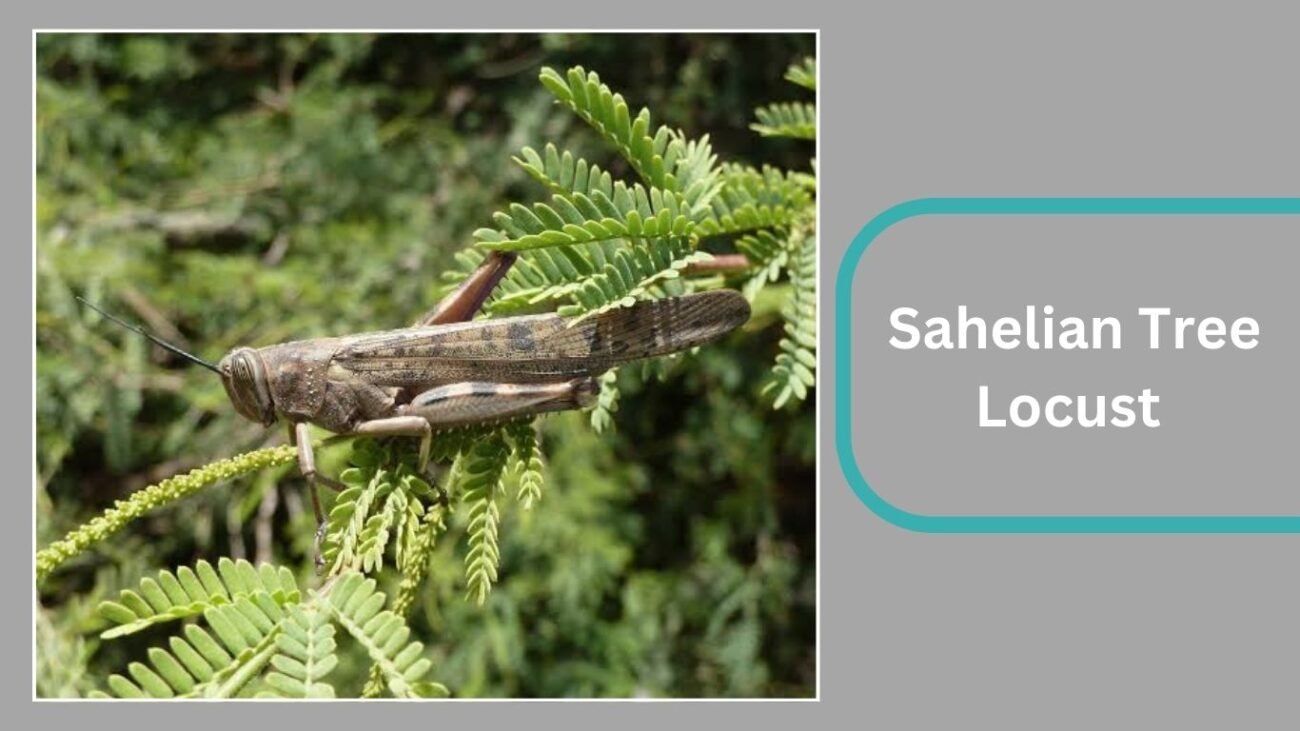
The Sahelian Tree Locust is a destructive pest species found mainly in the Sahel region of Africa. It is particularly harmful to trees and woody vegetation, often affecting both natural ecosystems and cultivated orchards.
Identification
- Large body size (50–70 mm in length)
- Brown or grey coloration with darker mottled markings
- Hind wings transparent with a faint yellow hue
- Strong hind legs with reddish tibiae
- Closely resembles the common Tree Locust but differs slightly in body markings and distribution
Habitat
This species thrives in dry savannas, semi-arid zones, and the Sahel region, where woody plants and trees are available. It prefers areas with scattered vegetation, orchards, and shelterbelts.
Behavior
The Sahelian Tree Locust is generally solitary but can form localized swarms during outbreaks. It primarily feeds on leaves of trees and shrubs, including economically important species such as acacia, citrus, and mango. Its feeding can strip trees of foliage, weakening them and reducing fruit yields.
Lifecycle
The lifecycle includes egg, hopper, and adult stages. Eggs are laid in sandy soil during the rainy season. Hoppers climb onto trees shortly after hatching and feed until reaching adulthood. Adults are strong fliers and long-lived, surviving many months and reproducing seasonally in response to rainfall.
9. Senegalese Grasshopper (Oedaleus senegalensis)
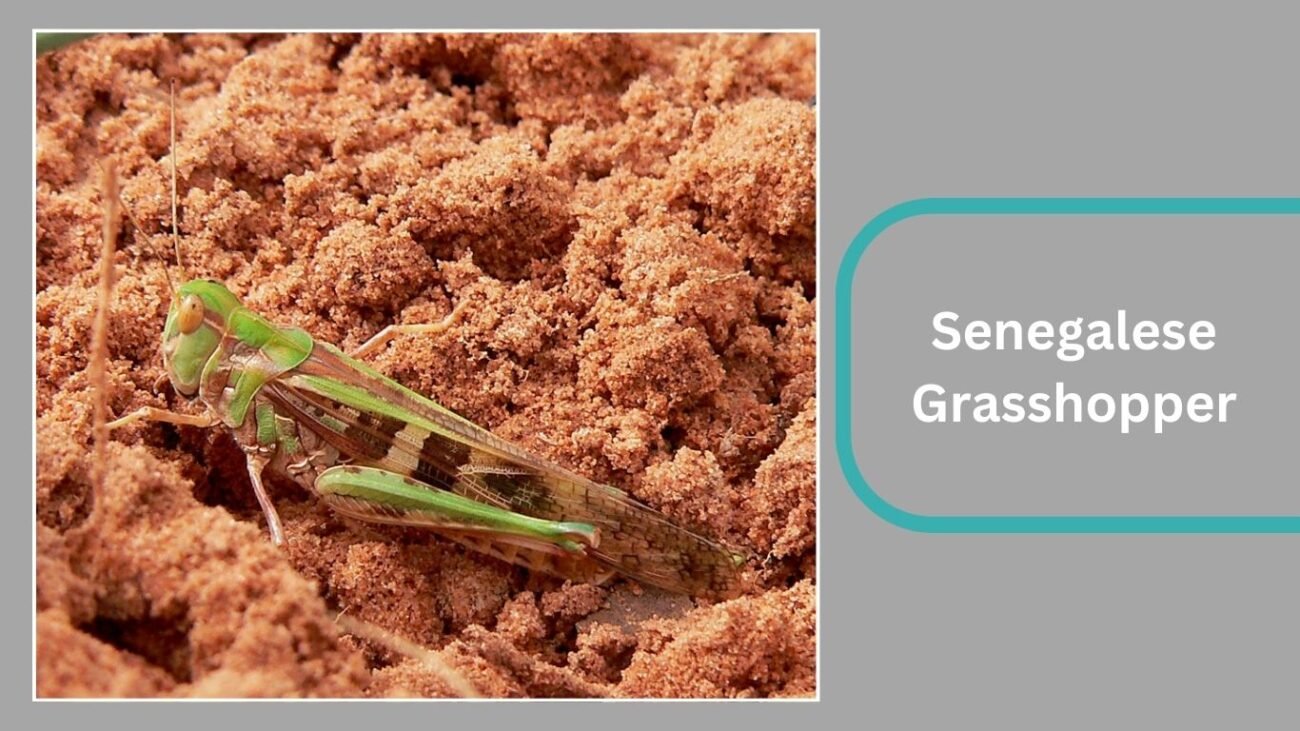
The Senegalese Grasshopper is one of the most serious agricultural pests in the Sahel and West Africa, known for causing extensive damage to millet, sorghum, and other cereal crops.
Identification
- Medium size (30–45 mm in length)
- Brownish or grey body with mottled patterns for camouflage
- Hind wings pale with a distinct dark band
- Short antennae compared to other locust species
- Strong hind legs adapted for jumping
Habitat
This species is common in semi-arid savannas, grasslands, and farmlands of West Africa and the Sahel region. It thrives in areas with seasonal rainfall and open fields where cereal crops are cultivated.
Behavior
The Senegalese Grasshopper is usually solitary but can become highly gregarious during favorable conditions. When population density rises, it forms bands of hoppers and swarms of adults. These swarms migrate across agricultural regions, destroying vast areas of cereal crops.
Lifecycle
The lifecycle includes egg, hopper, and adult stages. Eggs are deposited in sandy soil after rainfall. Hoppers develop quickly through several molts. Adults emerge and are capable of reproducing rapidly, especially during years with abundant rainfall, which often leads to destructive outbreaks.
10. South American Locust (Schistocerca cancellata)

The South American Locust is a notorious pest in South America, especially in Argentina, Paraguay, Bolivia, and Brazil, where swarms have historically caused immense agricultural losses.
Identification
- Large size (45–65 mm in length)
- Brownish or yellowish body with darker patterns
- Transparent hind wings with a faint smoky tint
- Strongly developed hind legs for jumping
- Resembles the Desert Locust in general appearance but is restricted to South America
Habitat
This species inhabits grasslands, savannas, and farmlands across subtropical and tropical South America. It favors regions with alternating wet and dry seasons that encourage vegetation growth and provide suitable conditions for breeding.
Behavior
The South American Locust displays both solitary and gregarious phases. In solitary form, it remains scattered, but in gregarious form, it forms massive swarms capable of migrating hundreds of kilometers. These swarms consume a wide variety of crops, including maize, wheat, sugarcane, and pastures.
Lifecycle
The lifecycle consists of egg, hopper, and adult stages. Eggs are laid in sandy soil following rains. Hoppers pass through several molts before reaching adulthood. Adults can reproduce multiple times in favorable conditions, leading to periodic outbreaks and plagues.
11. Australian Plague Locust (Chortoicetes terminifera)

The Australian Plague Locust is the most damaging locust species in Australia, capable of forming enormous swarms that devastate crops and pastures across the continent.
Identification
- Medium size (25–45 mm in length)
- Brown to green body with mottled patterns
- Hind wings transparent with a dark band
- Pronotum with a central keel and fine ridges
- Hind tibiae bluish to grey, distinguishing feature
Habitat
This species thrives in arid and semi-arid inland regions of Australia. It is commonly found in grasslands, rangelands, and farmlands where rainfall promotes rapid vegetation growth, providing food and breeding sites.
Behavior
The Australian Plague Locust exhibits both solitary and gregarious phases. In high-density conditions, it forms swarms that can travel hundreds of kilometers, feeding on cereal crops, vegetables, and pastures. It is well known for its ability to rapidly increase in numbers after good rainfall.
Lifecycle
The lifecycle includes egg, hopper, and adult stages. Eggs are laid in sandy soils, often after rains. Hoppers develop through 5–6 molts before becoming adults. Adults may reproduce several times a year, especially after successive rainfall events, leading to explosive population growth.
12. Brown Locust (Locustana pardalina)

The Brown Locust is a highly destructive species native to southern Africa, especially notorious for frequent outbreaks that cause severe damage to crops and grazing lands.
Identification
- Medium size (35–50 mm in length)
- Brown to yellowish body with darker mottled patterns
- Hind wings transparent with a faint smoky or yellow tint
- Pronotum with a central ridge and fine markings
- Hind legs long and strong, adapted for jumping
Habitat
The Brown Locust thrives in semi-arid regions of southern Africa, particularly the Karoo and adjacent drylands. It prefers open grasslands and sparsely vegetated areas with sandy or loamy soils suitable for egg-laying.
Behavior
This locust species is well known for its tendency to form dense swarms even under moderate population levels. It primarily feeds on grasses but will also attack cereal crops and pastures. Swarms can persist for long periods, making it one of the most difficult species to control in Africa.
Lifecycle
The lifecycle includes egg, hopper, and adult stages. Eggs are laid in sandy soil during the rainy season. Hoppers pass through several molts before becoming winged adults. Adults can reproduce multiple times, and outbreaks often recur annually in endemic regions.