







Falcons and eagles are two of nature’s most majestic raptors, often admired for their breathtaking flight and lethal hunting skills. Though they share many similarities as birds of prey, their differences in speed, strength, and behavior set them apart in fascinating ways. The falcon dominates with unmatched velocity, while the eagle commands with raw power and presence. This article explores how these two sky hunters differ in anatomy, hunting, and symbolism.
Identification and Physical Characteristics — Falcon vs Eagle

| Feature | Falcon | Eagle |
| Scientific Family | Falconidae | Accipitridae |
| Average Size | 25–40 cm (10–16 in) | 70–100 cm (27–40 in) |
| Wingspan | 70–120 cm (2.3–4 ft) | 180–240 cm (6–8 ft) |
| Body Weight | 0.5–1.5 kg (1–3 lbs) | 3–7 kg (6–15 lbs) |
| Wing Shape | Long, pointed, aerodynamic | Broad, rounded, powerful |
| Flight Style | Fast, agile dives and quick maneuvers | Strong, soaring glides and wide circles |
| Top Speed | Up to 240 mph (during dive) | Up to 100 mph (in dive) |
| Beak Shape | Thin, hooked with a notch for severing prey | Heavy, strongly curved for tearing flesh |
| Talons | Small, sharp, designed for quick grip | Large, thick, capable of crushing bones |
| Hunting Technique | High-speed aerial pursuit | Power-based ambush or swoop |
| Diet Preference | Small birds, bats, rodents | Fish, rabbits, small mammals, carrion |
| Vision Ability | Excellent — ideal for spotting prey in motion | Exceptional — up to 8× stronger than human sight |
| Habitat Range | Open plains, cliffs, urban areas | Forests, lakes, mountains, coastal regions |
| Symbolism | Focus, agility, precision | Strength, leadership, freedom |
Habitat and Geographic Range
Where Falcons Thrive
Falcons are highly adaptable and can live in a wide variety of environments — from open plains and deserts to high mountain cliffs and even urban skyscrapers. They prefer open areas that allow them to hunt in flight. The peregrine falcon, for example, nests on tall ledges or city buildings, using height to its advantage during dives.
Where Eagles Reign
Eagles typically favor regions rich in food and space — near lakes, mountains, and forests. The bald eagle, for instance, is found across North America near water bodies, while the golden eagle dominates mountainous and grassland regions across Eurasia and North America. Their large nests, called eyries, are often built on tall trees or cliffs and reused for many years.
Overlapping Territories
In some regions, falcons and eagles share territories but occupy different ecological roles. Falcons often hunt smaller, fast-moving prey in open air, while eagles target heavier animals from ambush positions. This balance allows both to coexist without competing directly for resources.
Hunting Style and Feeding Behavior
Falcons – The Aerial Assassins
Falcons are precision hunters. Their signature move, the “stoop,” involves climbing to high altitudes before diving at speeds exceeding 240 miles per hour (386 km/h). The peregrine falcon’s aerodynamic design allows it to strike prey mid-air with surgical accuracy. Their diet mainly includes pigeons, small birds, and sometimes bats or rodents. They rely on shock and speed rather than brute strength to incapacitate prey.
Eagles – The Power Predators
Eagles, on the other hand, use stealth and power. They often soar at great heights, spotting prey from afar before swooping down with immense force. Bald eagles are skilled fishers, while golden eagles prefer mammals such as rabbits and foxes. Their talons can exert crushing pressure — enough to pierce bone or lift prey weighing several kilograms. Unlike falcons, eagles often dominate by overpowering rather than outpacing.
Tools of the Trade
Both raptors have evolved specialized tools:
- Talons: Falcons have smaller but sharp talons for grasping quickly. Eagles’ talons are thick, curved, and incredibly strong.
- Beaks: Falcons use the notch on their beak to kill swiftly; eagles tear flesh apart.
- Vision: Both species possess superior eyesight, crucial for locating prey miles away.
Together, these adaptations make each bird a perfect hunter for its respective strategy — speed for falcons, power for eagles.
Speed vs Strength — The Ultimate Sky Duel

The Peregrine Falcon’s Unmatched Speed
The peregrine falcon stands as the fastest bird in the world, reaching record-breaking speeds over 240 mph in a dive. Its narrow wings, stiff feathers, and streamlined body reduce drag and allow it to slice through the air effortlessly. During the stoop, it tucks its wings close to its body, creating a bullet-like shape that maximizes velocity. This incredible speed is used not just for pursuit but to strike prey with stunning force.
The Eagle’s Raw Power and Endurance
Eagles may not match the falcon’s velocity, but they dominate in strength, lift, and stamina. A golden eagle can carry prey heavier than itself while maintaining controlled flight. Its broad wings allow for effortless soaring over long distances without flapping, conserving energy while surveying vast territories. This endurance makes the eagle the undisputed heavyweight of the skies.
Species-Specific Comparisons
Bald Eagle vs Peregrine Falcon
The bald eagle, symbol of freedom and power, contrasts sharply with the peregrine falcon, the embodiment of speed and precision.
The bald eagle measures up to 40 inches in length with an 8-foot wingspan, while the peregrine rarely exceeds 20 inches. In a chase, the falcon would win effortlessly due to its dive speed. However, in a physical contest, the eagle’s size, muscle strength, and talon grip would easily overpower the smaller bird.
Their hunting habits differ too: bald eagles often snatch fish from rivers, while peregrines chase live prey through the air.
Golden Eagle vs Peregrine Falcon
The golden eagle is the ultimate terrestrial hunter. It can dive at 150 mph — slower than a peregrine but still formidable — and strike with massive claws capable of killing foxes and small deer. The peregrine, meanwhile, excels in aerial combat. While the golden eagle’s power dominates the ground, the falcon’s agility controls the sky.
Both species symbolize different extremes of predatory evolution — the falcon’s precision versus the eagle’s power.
Other Notable Raptors (Hawk, Osprey, and Kestrel)
- Hawks are smaller and more versatile than eagles, using quick bursts of speed and agility to catch prey in forests.
- Ospreys specialize in fishing, diving feet-first into water with remarkable accuracy.
- Kestrels — a type of small falcon — hover in midair before swooping on prey, showing a delicate balance of control and accuracy.
Each of these raptors fills a unique ecological role, demonstrating the incredible adaptability of birds of prey.
Diet and Prey Preferences
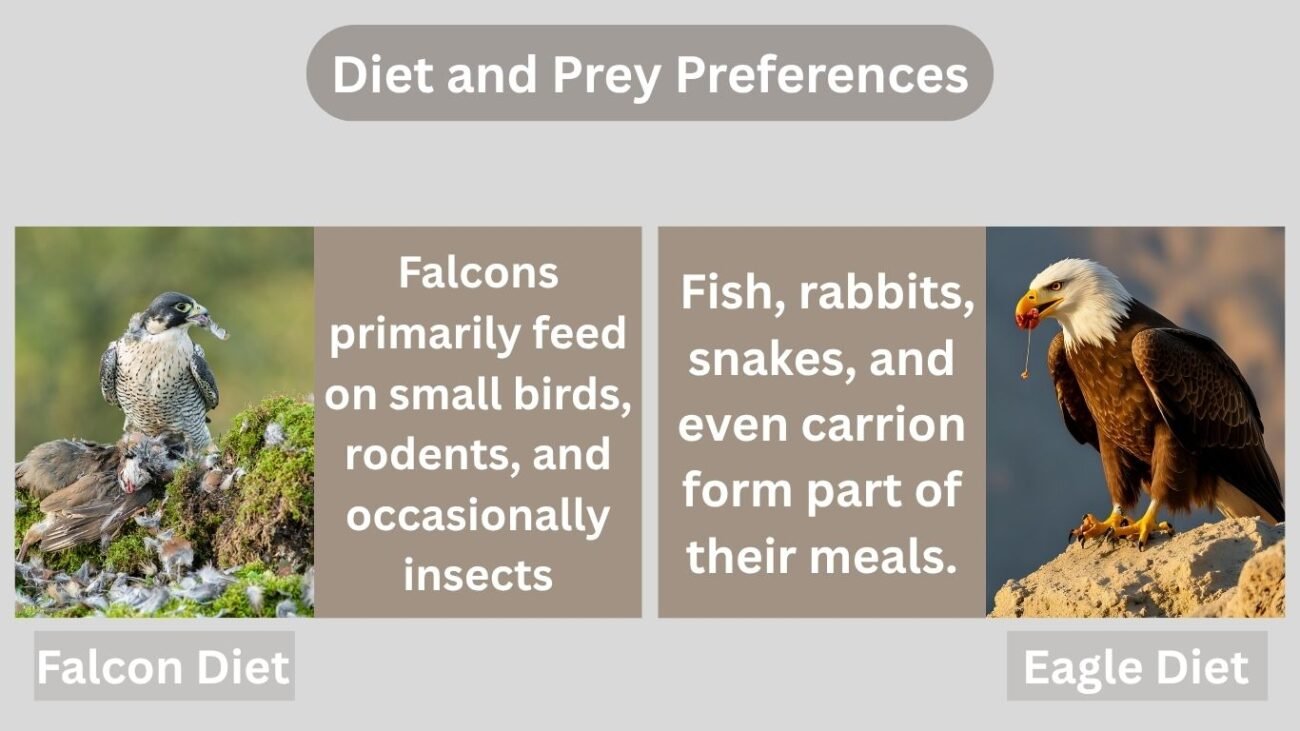
Falcon Diet
Falcons primarily feed on small birds, rodents, and occasionally insects. The peregrine falcon’s diet consists mostly of pigeons, doves, and songbirds. They rely on their superior speed to strike mid-air, often stunning their prey before carrying it away. Falcons usually eat on high perches to stay safe from ground predators.
Their hunting approach reflects efficiency and accuracy — no prolonged chase, no wasted motion. A single, well-timed strike ensures success.
Eagle Diet
Eagles have a broader and more diverse diet. Fish, rabbits, snakes, and even carrion form part of their meals. The bald eagle is famous for swooping down to snatch fish from lakes with pinpoint timing, while golden eagles tackle larger land prey. Some species, like the harpy eagle, hunt monkeys and sloths in dense forests.
Unlike falcons, eagles prefer strength-based kills and can store food in nests to feed their young or return later.
Role in the Ecosystem
Eagles and falcons play a crucial ecological role as apex predators, regulating prey populations and maintaining balance in the food chain.
By hunting weak or sick animals, they help prevent overpopulation and disease spread among smaller species.
Additionally, their nesting habits often benefit other birds who reuse abandoned nests or nearby areas for protection.
Their presence in an ecosystem indicates environmental health — declines in raptor populations often warn of pollution or habitat destruction. The comeback of the bald eagle in North America after DDT bans shows how vital conservation is for these species’ survival.
Symbolism and Cultural Meaning
The Falcon as a Symbol of Speed and Focus
Throughout history, falcons have been admired for their agility and sharp vision. In ancient Egypt, the god Horus — represented with a falcon’s head — symbolized divine kingship and the sky’s power.
In medieval Europe, falconry became a noble pursuit, associated with precision, discipline, and status.
Today, the falcon still represents focus, ambition, and excellence — often used in aviation logos and national emblems for its association with mastery of flight.
The Eagle as a Symbol of Strength and Freedom
Eagles have long symbolized courage and leadership. From the Roman Empire’s Aquila standard to the United States’ bald eagle, these birds embody freedom and dominance. Their commanding presence in the sky inspired countless myths about power and vision.
Native American cultures viewed the eagle as a messenger between humans and the divine — a creature that connects the physical and spiritual worlds.
Shared Spiritual Symbolism
Both birds share symbolic overlap in representing greatness, authority, and vision.
While the falcon symbolizes speed, precision, and the pursuit of goals, the eagle reflects power, victory, and sovereignty.
In essence, they are two sides of the same coin — both inspiring awe and admiration for humanity’s highest ideals.
Key Takeaways
- Falcons represent agility, precision, and record-breaking speed; eagles symbolize strength, power, and endurance.
- Falcons are smaller and faster, reaching speeds above 240 mph, while eagles dominate with lifting strength and control.
- Both birds thrive as apex predators, maintaining ecological balance.
- Symbolically, falcons embody focus and ambition, whereas eagles signify freedom and leadership.
- Their coexistence in nature reflects a perfect balance of speed vs power, precision vs dominance.
FAQs
Which bird is faster, the eagle or the falcon?
The falcon is unquestionably faster. The peregrine falcon’s dive can exceed 240 mph, making it the fastest creature on Earth. Eagles, while swift, typically reach 75–100 mph in a dive, focusing more on strength than speed.
Who is stronger, the eagle or the falcon?
Eagles are far stronger. Their large size, dense muscles, and powerful talons allow them to lift prey several times heavier than themselves. Falcons rely on speed and technique rather than brute force.
Can a falcon defeat an eagle in a fight?
In a direct confrontation, eagles usually win due to size and power. However, falcons could escape easily thanks to agility and superior maneuvering. They rarely fight in the wild, as each dominates different ecological niches.
What is the main difference in their diets?
Falcons hunt smaller birds mid-flight, relying on rapid strikes and aerial chases. Eagles target larger prey such as fish, rabbits, and small mammals, often ambushing from above or stealing from others.
Why are both birds culturally significant?
Falcons symbolize ambition, clarity, and skill, while eagles represent courage, freedom, and authority. Across civilizations — from ancient Egypt to modern nations — both birds stand as timeless icons of power and vision.


