











The albatross is one of nature’s most extraordinary seabirds — a symbol of freedom, endurance, and grace. Known for its incredible wingspan and ability to soar across vast oceans without rest, it captures the imagination of sailors and scientists alike. Around North America, these magnificent birds thrive mainly in the Pacific Ocean and Hawaiian Islands, where they nest, feed, and migrate across thousands of miles each year.
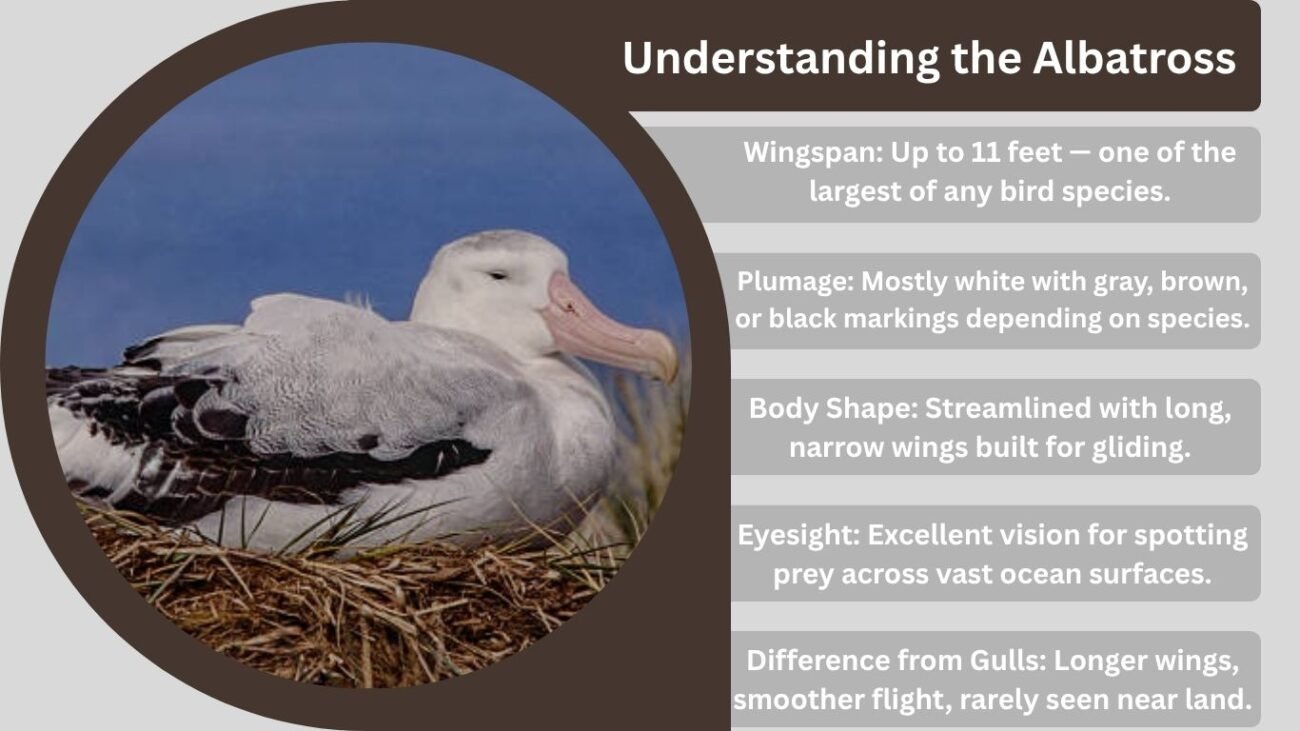
Understanding the Albatross
Physical Traits and Identification (Short View)
- Wingspan: Up to 11 feet — one of the largest of any bird species.
- Plumage: Mostly white with gray, brown, or black markings depending on species.
- Body Shape: Streamlined with long, narrow wings built for gliding.
- Bill: Strong, hooked bill ideal for catching squid and fish.
- Tubenose Feature: Tube-shaped nostrils for detecting scents and excreting salt.
- Flight Style: Uses “dynamic soaring” to glide effortlessly over ocean winds.
- Eyesight: Excellent vision for spotting prey across vast ocean surfaces.
- Difference from Gulls: Longer wings, smoother flight, rarely seen near land.
Main North American Species
Three main species of albatross frequent North American waters:
- Laysan Albatross (Phoebastria immutabilis) – Easily recognized by its white head and body with dark upper wings. It breeds mainly in the Hawaiian Islands and can often be seen gliding along the Pacific.
- Black-footed Albatross (Phoebastria nigripes) – The most common albatross seen off the U.S. West Coast, it has dark brown plumage and distinctive black feet.
- Short-tailed Albatross (Phoebastria albatrus) – Once nearly extinct, this species has a golden head and pink bill and is making a remarkable recovery thanks to conservation efforts.
These species are all part of the Diomedeidae family, adapted to a life spent mostly over open water, far from human civilization.
Habitat and Distribution
Breeding and Nesting Sites
The main breeding colonies of North American albatrosses are found in the Northwestern Hawaiian Islands, particularly on Midway Atoll, Laysan Island, and Kure Atoll. These remote islands offer the isolation and safety the birds need to raise their chicks, free from most land predators.
Each breeding season, thousands of pairs return to the same nesting sites, often to the exact spot they used in previous years. Their loyalty to both mate and location is legendary — some pairs have been known to reunite for over 30 years.
Range Across the Pacific
Outside of breeding season, albatrosses travel immense distances across the North Pacific Ocean. They follow cold, nutrient-rich currents that support an abundance of marine life. Many wander as far as the coasts of California, Oregon, Washington, and Alaska, where they are occasionally spotted by pelagic birdwatchers.
Their distribution depends heavily on ocean winds and food availability. With wings perfectly shaped for gliding, they can travel thousands of miles in a single foraging journey without ever touching land.
Flight and Migration Mastery
Dynamic Soaring Explained
The albatross is a true master of the skies, capable of flying for hours — even days — without flapping its wings. It achieves this through dynamic soaring, a unique flight technique that uses differences in wind speed above ocean waves. By rising into the wind, gliding down with it, and repeating the cycle, the albatross harnesses natural energy, conserving stamina for long-distance travel.
This adaptation allows them to roam the Pacific for weeks at a time in search of food, covering over 10,000 miles on a single trip.
Global Wanderers
Tracking studies have revealed the astonishing scale of albatross migration. These birds can complete entire circuits of the North Pacific, often between Hawaii, Japan, and the coasts of North America. Their routes follow wind patterns and upwelling zones rich in marine life.
The Short-tailed Albatross, once thought extinct, now travels between breeding sites on Japanese islands and feeding grounds near Alaska. Meanwhile, Laysan and Black-footed Albatrosses roam vast areas of the open Pacific, sometimes approaching the Arctic Circle in summer before returning south to nest.
Diet and Feeding Behavior
What Albatrosses Eat
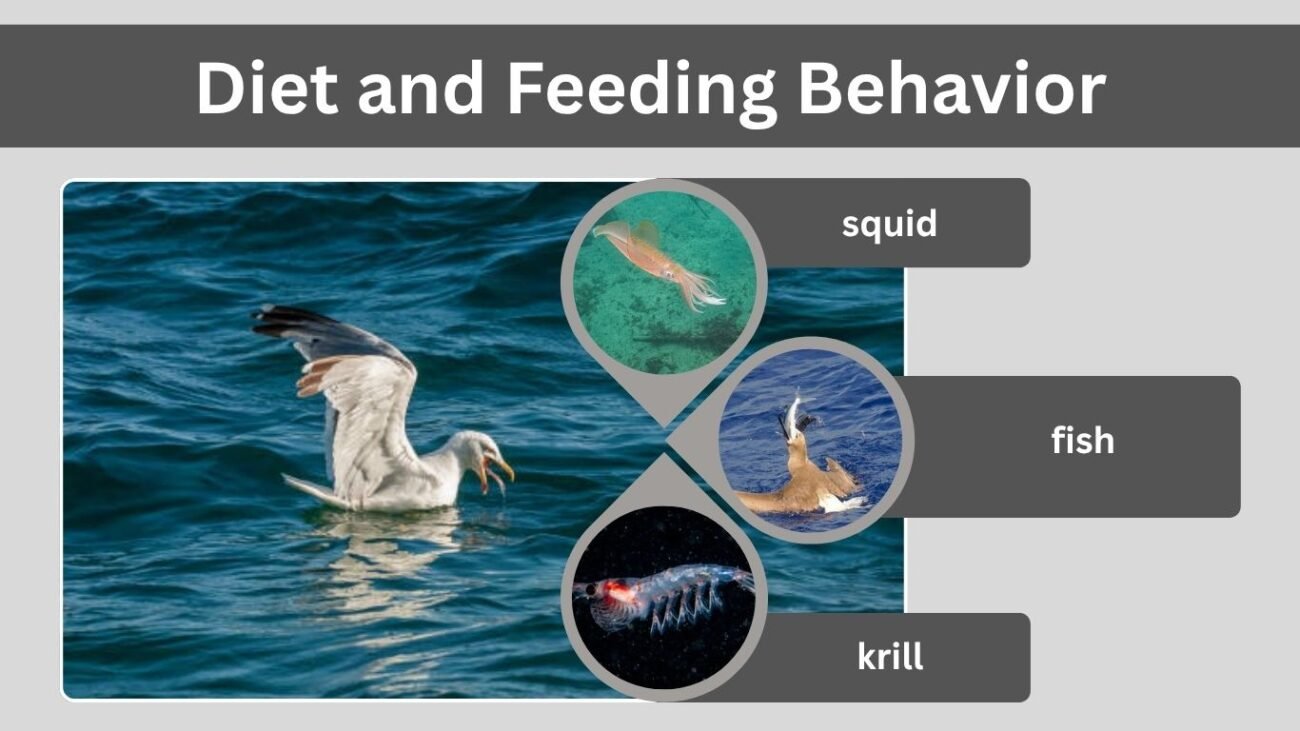
Albatrosses are primarily carnivorous, feeding on squid, fish, krill, and other small marine animals found near the surface. They often feed at night when squid rise closer to the ocean’s surface. These seabirds have an exceptional sense of smell, allowing them to detect prey or carrion from several miles away.
They are also known to scavenge behind fishing vessels, where discarded bait and bycatch provide easy meals — a habit that has both helped and harmed their survival.
Foraging Techniques
When hunting, albatrosses use a method called surface seizing, in which they glide close to the water and snatch prey from the surface without fully diving. Some species are capable of shallow plunge-diving to catch fish or squid just below the surface.
Their diet and feeding range are closely tied to ocean temperature and productivity — shifts caused by climate change can directly affect their ability to find food. To conserve energy, they often feed in areas where currents bring nutrients and prey to the surface.
Breeding, Parenting, and Lifespan
Courtship Rituals
Albatrosses are famous for their elegant and elaborate courtship dances. When young birds reach maturity—often after five to seven years—they return to their birth colonies to find a mate. Courtship involves synchronized head-bobbing, bill-clapping, and whistling sounds, all performed with remarkable precision. These rituals can last for years before a stable pair bond forms, but once bonded, albatrosses typically mate for life.
This lifelong partnership and faithfulness to their nesting site make albatross relationships among the most enduring in the animal kingdom.
Raising the Young
Each breeding pair lays only one egg per year, making reproduction a slow and delicate process. Both parents take turns incubating the egg for about 60–65 days. Once the chick hatches, the parents alternate long feeding trips, returning to regurgitate a nutrient-rich oil made from partially digested fish and squid.
Chicks grow rapidly but remain dependent for many months. It can take five to six months before a young albatross fledges and takes its first flight over the Pacific. Many juveniles will then spend several years at sea before returning to breed.
Longevity and Survival
Albatrosses are among the longest-lived birds on Earth, with lifespans averaging 40 to 60 years. One remarkable Laysan Albatross named Wisdom—banded in 1956—continues to raise chicks at over 70 years old. Such longevity is possible because of their slow metabolism, oceanic lifestyle, and lack of natural predators at sea.
However, their long lifespan also means slower population recovery when numbers decline, making conservation efforts especially crucial.
Natural Predators and Environmental Pressures
Predators on Land and Sea
While adult albatrosses face few natural threats at sea, their eggs and chicks are vulnerable to predators introduced to nesting islands. Rats, cats, and dogs are among the worst offenders, consuming eggs and attacking chicks. Conservationists have worked for decades to eradicate these invasive species from critical habitats like Midway Atoll and Laysan Island.
At sea, large sharks or orcas may occasionally prey on weakened or resting birds, though such events are relatively rare.
Environmental Hazards
Natural hazards like tropical storms and ocean warming events can devastate nesting colonies. Rising sea levels threaten low-lying islands, while stronger storms can wash away nests. Additionally, changes in ocean temperature caused by El Niño cycles can shift prey availability, forcing albatrosses to travel farther for food and increasing the risk of starvation for chicks.
Human Impacts and Conservation
Major Threats
Human activity has historically been the greatest danger to albatross survival. Longline fishing poses a particularly deadly risk—birds attempting to seize bait become hooked and drown. Tens of thousands die this way each year.
Another major issue is plastic pollution. Floating debris, especially bottle caps and lighter fragments, are mistaken for food. Adult albatrosses unknowingly feed these plastics to their chicks, leading to blockages and starvation. The sight of thousands of chicks dying from plastic ingestion on Midway Island has become a haunting symbol of marine pollution.
Climate change also alters wind patterns and reduces available food in traditional feeding areas, further endangering these seabirds.
Conservation Efforts
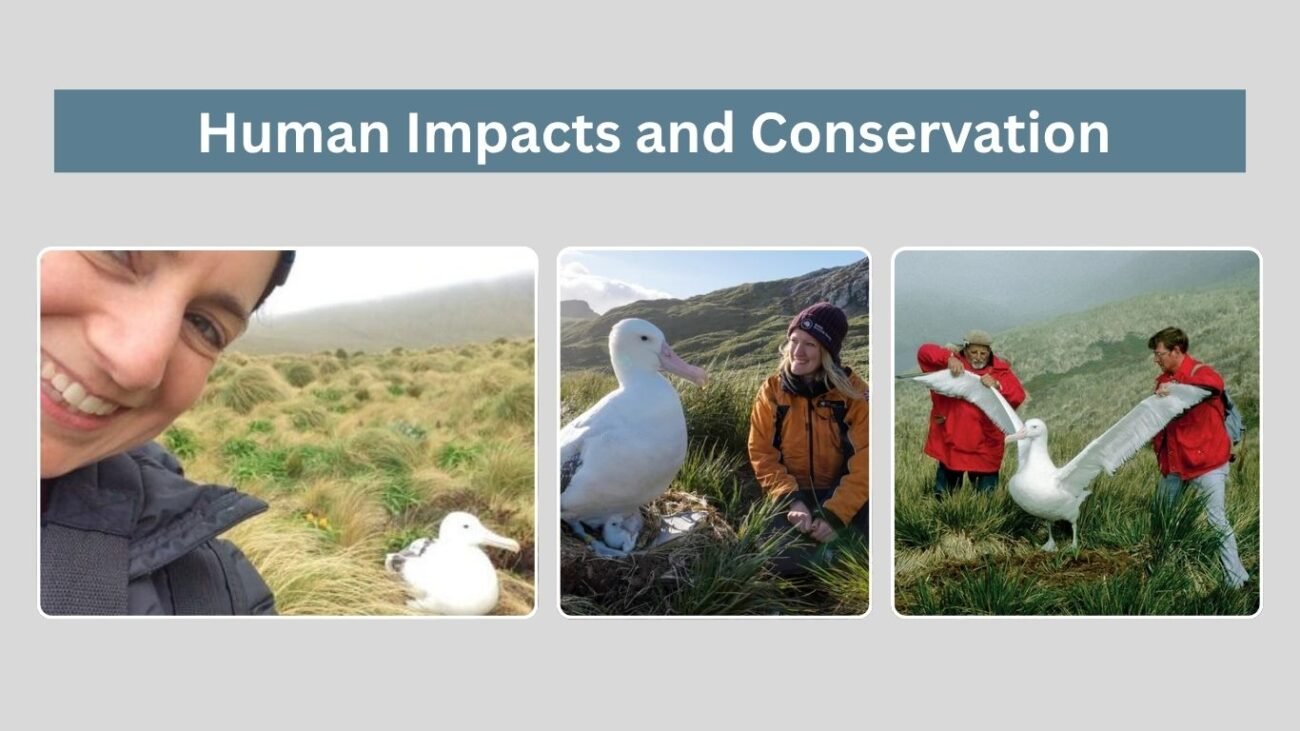
Despite these threats, albatross conservation has seen significant progress. International treaties like the Agreement on the Conservation of Albatrosses and Petrels (ACAP) and programs run by NOAA and BirdLife International focus on protecting nesting grounds, reducing bycatch, and monitoring populations.
Innovative solutions such as bird-safe fishing gear, night setting of lines, and weighted hooks have dramatically reduced deaths. Islands like Midway Atoll are now active wildlife refuges, hosting over 1 million nesting Laysan Albatrosses each year.
The recovery of the Short-tailed Albatross, once down to fewer than 50 individuals, now numbering over 5,000, stands as one of conservation’s greatest success stories.
Symbolism and Cultural Presence
In Literature and Myth
The albatross holds a powerful place in human imagination. In Samuel Taylor Coleridge’s “The Rime of the Ancient Mariner”, the bird represents both good fortune and guilt—a symbol of the bond between humanity and nature. Sailors once believed killing an albatross would bring a curse, linking it to the souls of lost seafarers.
Across the Pacific Islands, however, the albatross is viewed more positively—as a messenger of the sea, guiding travelers safely across vast waters.
Modern Symbolism
Today, the albatross stands as an icon of conservation and environmental awareness. Its image appears in marine protection campaigns, documentaries, and eco-art, representing the delicate balance between human progress and nature’s endurance. The phrase “to have an albatross around one’s neck” has evolved from ancient superstition into a metaphor for burden or guilt—but in the modern world, it reminds us of our responsibility to protect the planet’s oceans.
Ecological Role
Albatrosses play an essential role in maintaining marine ecosystem health. By preying on squid and fish, they help regulate mid-level oceanic food chains. Their guano (droppings) enrich island soils, supporting plant and invertebrate life that, in turn, sustains other seabirds.
As indicator species, albatrosses reflect the state of the ocean itself. Population declines often signal deeper issues such as overfishing or pollution. Protecting them ensures the well-being of countless other marine species.
Key Takeaways
- Albatrosses are among the largest and longest-lived seabirds on Earth.
- Three main species inhabit North American waters: Laysan, Black-footed, and Short-tailed Albatrosses.
- They exhibit remarkable flight endurance and lifelong monogamous bonds.
- Human activities, especially fishing and pollution, pose serious threats.
- Ongoing conservation efforts are gradually restoring their populations and preserving ocean ecosystems.
FAQs
How many albatross species are found in North America?
There are three main species—the Laysan, Black-footed, and Short-tailed Albatross. All breed or feed in the Pacific region, particularly near Hawaii, Alaska, and along the U.S. West Coast.
Where can people see albatrosses in the United States?
They’re most commonly seen in the Northwestern Hawaiian Islands, but birdwatchers on pelagic tours off California, Oregon, and Alaska occasionally spot them gliding low over the waves.
How do albatrosses fly for hours without flapping?
They use a technique called dynamic soaring, which takes advantage of wind gradients above ocean waves, allowing them to glide efficiently with minimal energy use.
Why are albatrosses endangered?
Fishing bycatch, marine pollution, and habitat degradation are the main causes. Climate change further disrupts food availability and nesting conditions.
What makes albatrosses important to the ocean ecosystem?
They control fish and squid populations, fertilize island ecosystems, and serve as indicators of marine environmental health, making them vital to oceanic biodiversity.


