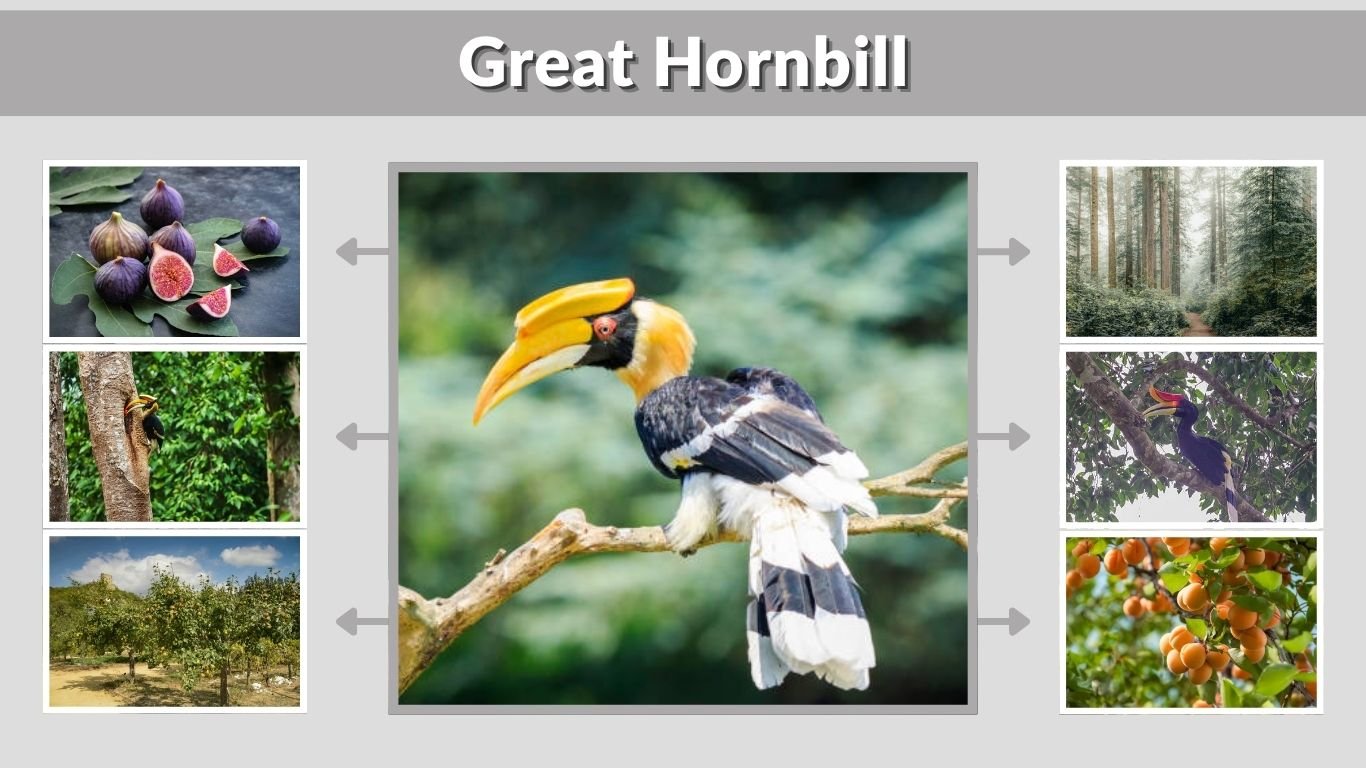
magnificent birds found in Asia. Recognized for its large yellow casque and powerful wings, this species plays a crucial role in maintaining forest ecosystems. Native to India and Southeast Asia, it thrives in dense tropical forests where tall trees support its nesting habits. Its striking appearance, loud wingbeats, and unique breeding behavior make it one of the most fascinating birds to study and observe in the wild.
Physical Characteristics of the Great Hornbill
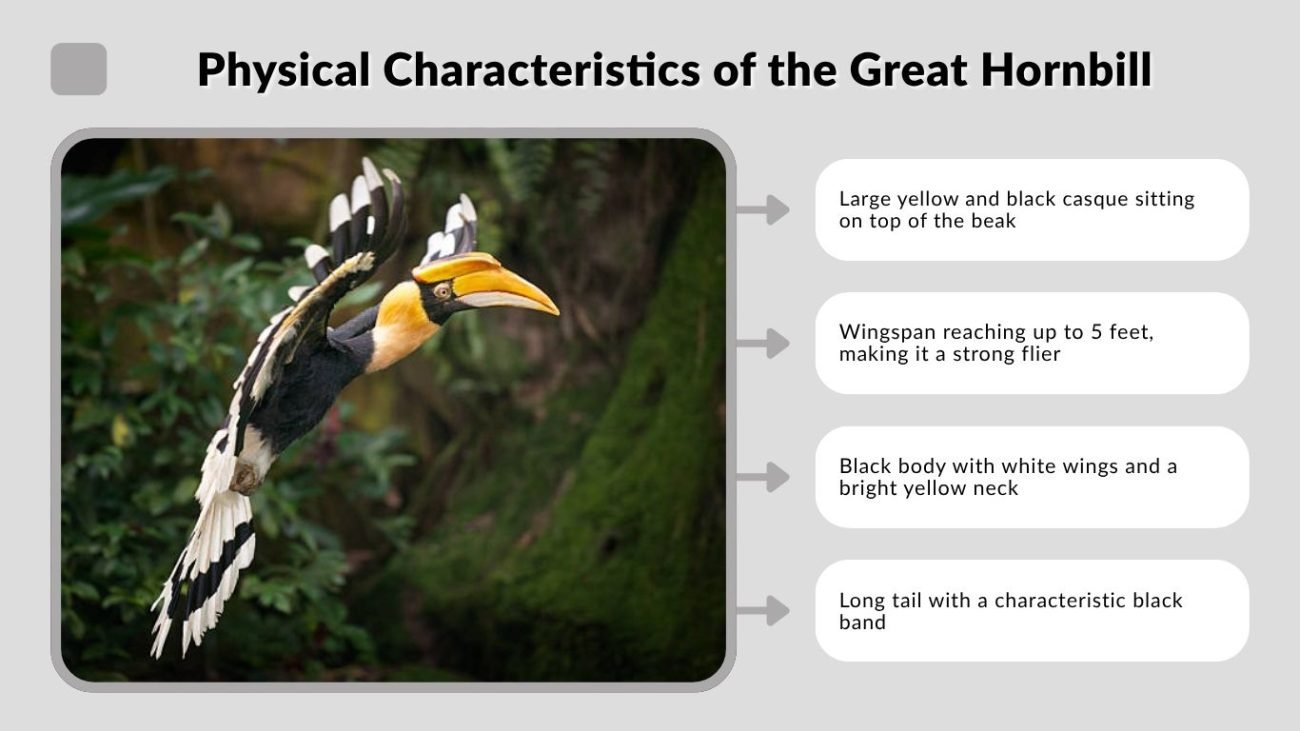
The Great Hornbill stands out due to its impressive size and distinctive features. Its bold colors and massive beak make it easy to identify even from a distance.
Key Features
- Large yellow and black casque sitting on top of the beak
- Wingspan reaching up to 5 feet, making it a strong flier
- Black body with white wings and a bright yellow neck
- Long tail with a characteristic black band
Male vs Female Differences
- Males have larger casques and red eyes
- Females have smaller casques and bluish-white eyes
- Males are generally slightly bigger than females
Great Hornbill Habitat and Distribution
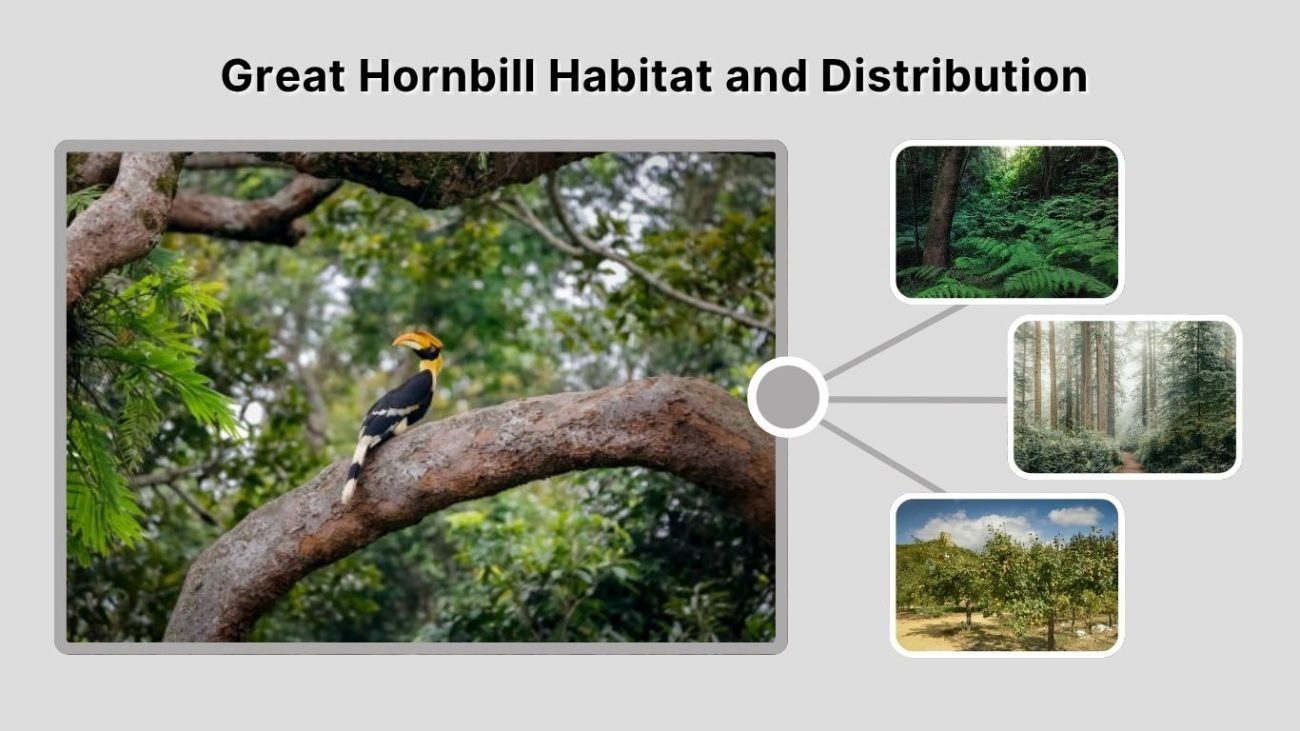
The Great Hornbill is widely distributed across South and Southeast Asia. It depends heavily on forest environments for survival and reproduction.
Where Is It Found?
- Western Ghats and Northeast India
- Nepal and Bhutan
- Thailand, Cambodia, and Malaysia
Natural Habitat
- Dense tropical and subtropical forests
- Evergreen forests with tall trees
- Areas with abundant fruit-bearing trees
Great Hornbill Behavior and Unique Adaptations
This bird has evolved several unique behaviors that help it survive in forest ecosystems. Its adaptations are closely linked to its environment and lifestyle.
Flight and Movement
The Great Hornbill is known for its powerful flight. Its wings produce a loud “whooshing” sound that can be heard from a distance, making it one of the noisiest flying birds in the forest.
Social Behavior
These birds usually live in monogamous pairs and maintain strong bonds throughout their lives. They often move together through the forest canopy in search of food.
Rainforest Adaptations
- Strong wings allow long-distance flight between trees
- Large casque helps amplify calls
- Sharp beak aids in feeding and defense
Great Hornbill Diet and Feeding Habits
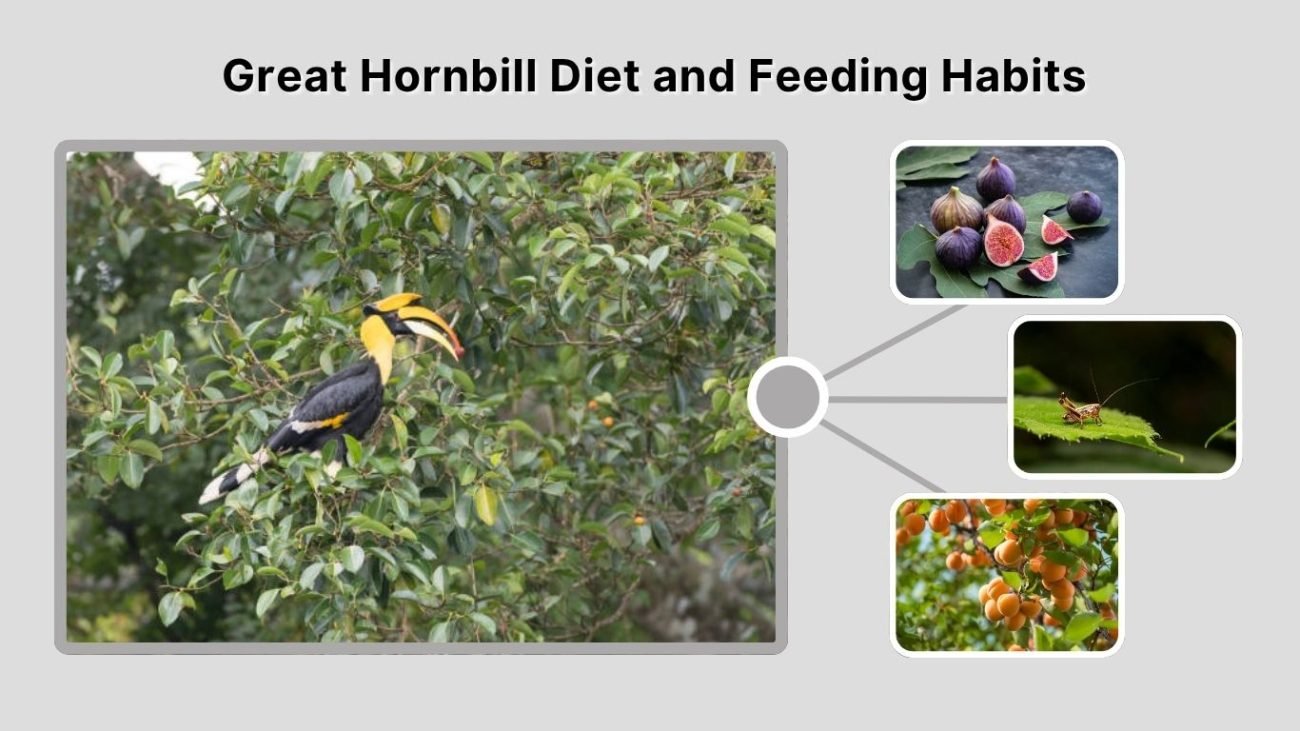
The diet of the Great Hornbill is essential to its role in the ecosystem. It is primarily a fruit eater but also consumes other food sources when available.
What Does It Eat?
- Fruits, especially figs, form the main diet
- Insects and small animals supplement nutrition
- Occasionally feeds on birds and small mammals
Role in the Ecosystem
By eating fruits and dispersing seeds across large areas, the Great Hornbill helps regenerate forests. This makes it a key species for maintaining biodiversity.
Reproduction and Nesting Behavior
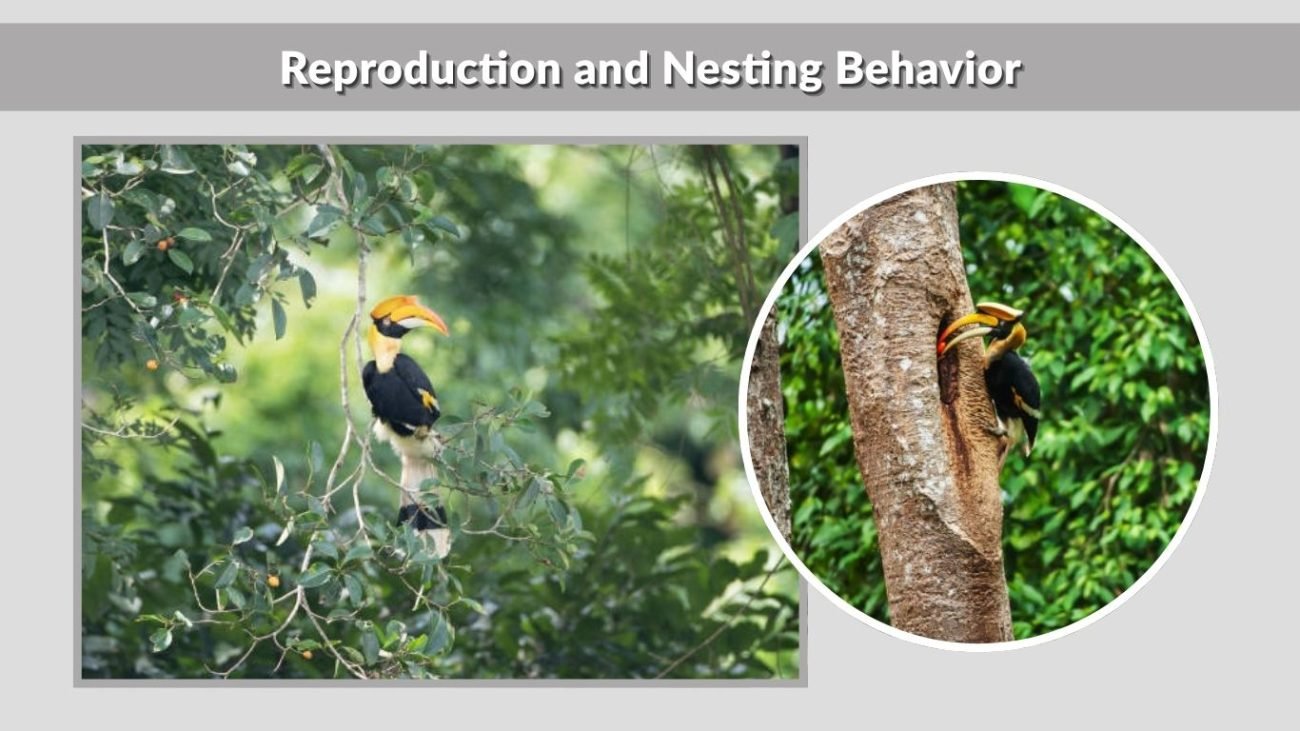
The breeding behavior of the Great Hornbill is one of the most unusual among birds. It shows a high level of cooperation between male and female partners.
Nesting Process
During the breeding season, the female seals herself inside a tree cavity using mud and droppings. Only a small opening is left through which the male feeds her.
Role of the Male
The male plays a critical role by bringing food to the female and later to the chick. This continues for several weeks until the young bird is ready to leave the nest.
Great Hornbill Call and Sounds
The Great Hornbill is not only visually striking but also acoustically unique. Its calls and wing sounds play an important role in communication within dense forests.
Types of Sounds
- Loud, deep calls used to mark territory
- Cackling or roaring sounds during interaction
- Distinctive “whooshing” noise produced by wing beats
Purpose of Calls
- Communication between mating pairs
- Warning signals against predators
- Maintaining distance between groups
Conservation Status and Threats
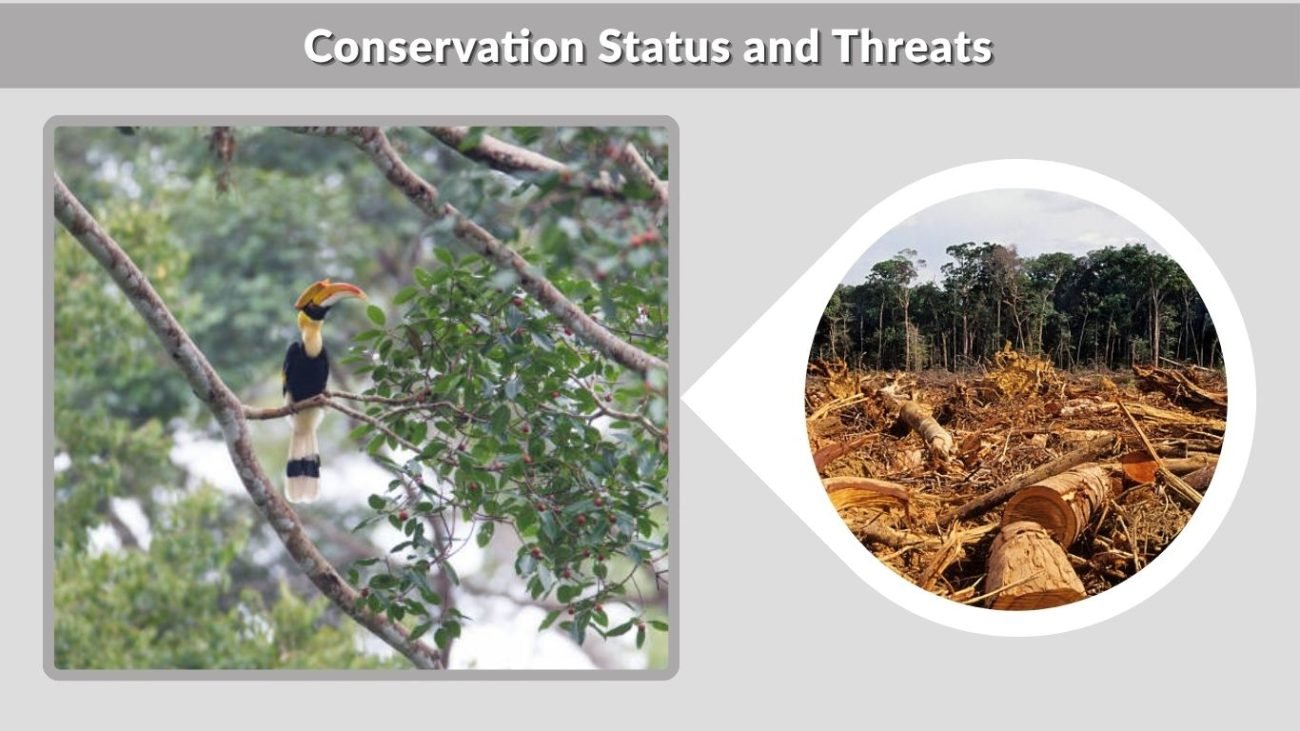
The Great Hornbill faces increasing challenges due to environmental changes and human activities. Protecting this species is essential for preserving forest ecosystems.
IUCN Status
The Great Hornbill is currently classified as Vulnerable. Its population is declining mainly due to habitat loss and human interference. Conservation efforts are ongoing but require stronger implementation.
Major Threats
- Deforestation and habitat destruction
- Hunting for casque and feathers
- Fragmentation of forest ecosystems
Cultural and Regional Importance
The Great Hornbill holds deep cultural value in many regions, especially in India and Southeast Asia. It is often seen as a symbol of nature and tradition.
Significance in India
- State bird of Kerala
- Represents biodiversity and ecological balance
- Featured in local folklore and traditions
Festivals and Recognition
- Celebrated in Nagaland’s Hornbill Festival
- Used as a symbol in conservation awareness programs
- Promotes eco-tourism in forest regions
Interesting Facts About the Great Hornbill
This bird has several fascinating traits that make it unique among avian species.
Quick Facts
- Can live up to 50 years in captivity
- One of the loudest flying birds in the world
- Casque is hollow but structurally strong
- Known as the “farmer of the forest”
Comparison with Other Hornbills
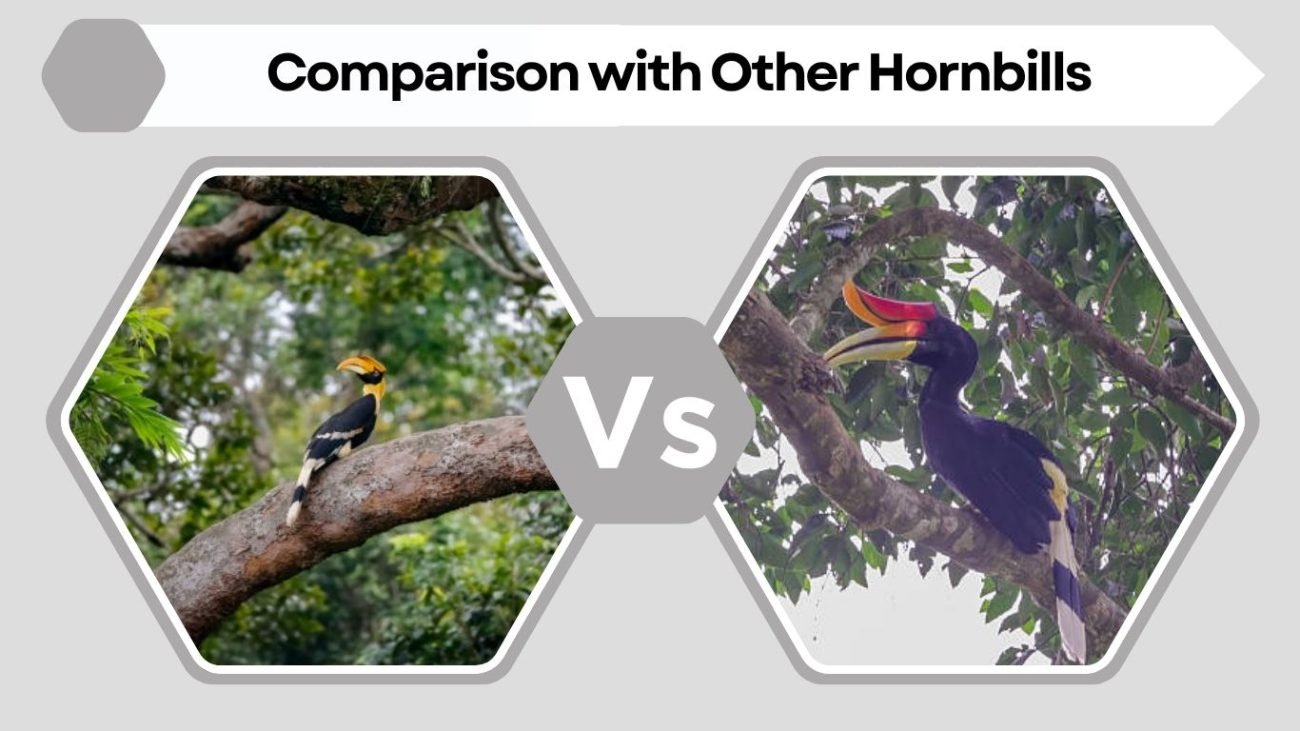
Understanding how the Great Hornbill differs from other species helps highlight its uniqueness.
Great Hornbill vs Rhinoceros Hornbill
- Great Hornbill has a flatter casque
- Rhinoceros Hornbill has a curved, horn-like casque
- Both species are found in Southeast Asia but differ in range
Great Hornbill vs African Hornbills
- Great Hornbill is native to Asia, not Africa
- Larger in size compared to most African hornbills
- African hornbills generally lack a large casque
FAQs
What is the scientific name of the Great Hornbill?
The scientific name of the Great Hornbill is Buceros bicornis. It belongs to the hornbill family and is widely known for its large casque and important ecological role in Asian forests.
Where is the Great Hornbill commonly found?
It is commonly found in India, especially in the Western Ghats and Northeast regions, as well as in countries like Thailand, Malaysia, and Bhutan where dense forests are available.
Why is the Great Hornbill important to the ecosystem?
The bird plays a key role in seed dispersal by consuming fruits and spreading seeds across forests. This helps maintain biodiversity and supports forest regeneration.
What threats does the Great Hornbill face?
Major threats include deforestation, habitat fragmentation, and hunting. These factors have led to a decline in its population, making conservation efforts necessary.
How does the Great Hornbill reproduce?
The female seals herself inside a tree cavity during nesting, leaving a small opening. The male feeds her and the chick until it is strong enough to emerge safely from the nest.