Hawks are some of the most captivating raptors found around the world, known for their sharp vision, swift hunting skills, and diverse habitats. From the familiar Red-tailed Hawk to rare species like Ridgway’s Hawk, each hawk has unique markings, behaviors, and adaptations. In this guide, you’ll discover 35 types of hawks—how to identify them, where they live, and what makes them stand out in the wild or in flight.
1. Red-tailed Hawk (Buteo jamaicensis)
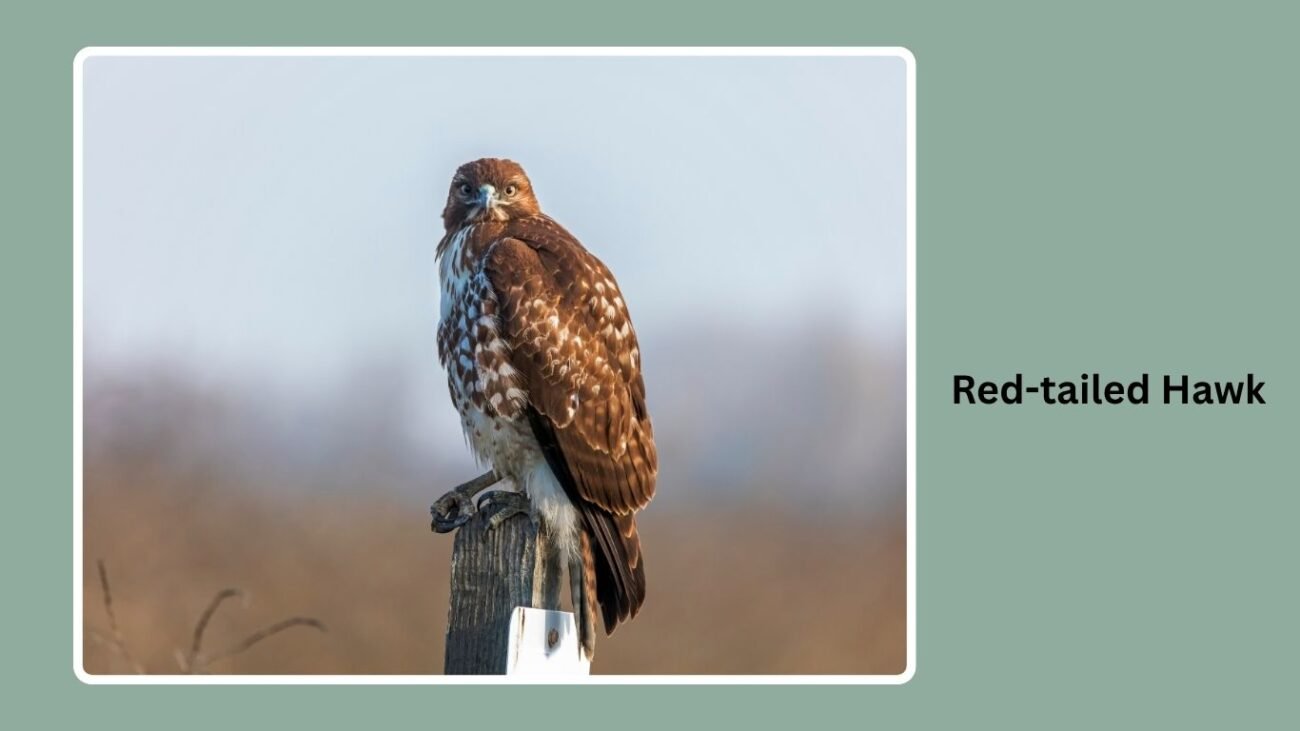
The Red-tailed Hawk is one of the most widespread and easily recognized hawks in North America. Known for its broad wings and signature reddish tail, it thrives in a variety of habitats and is often seen soaring in wide circles over open fields.
Identification
- Size: 18–26 inches in length
- Wingspan: 3.5–4.8 feet
- Stout body with broad, rounded wings
- Rich brown back and pale underparts with dark belly band
- Rusty red tail in adults; brown with stripes in juveniles
Habitat
Found in forests, grasslands, deserts, and urban areas across North America. It prefers open spaces with high perches like utility poles, trees, or cliff ledges for hunting.
Behavior
Primarily hunts from a perch or in soaring flight. Feeds on small mammals like rabbits, squirrels, and voles, but will also take birds and reptiles. Known for its loud, raspy scream, often used in movies to represent all raptors.
Color Pattern
Adults have a warm brown plumage above and a whitish underside with a streaked belly. The reddish tail is the bird’s most distinctive feature. Juveniles show more streaking and have a banded brown tail.
Flight Style
Soars with wings slightly raised in a shallow “V” shape. Slow wingbeats followed by glides. Very stable in wind, often seen circling high on thermals.
2. Cooper’s Hawk (Accipiter cooperii)
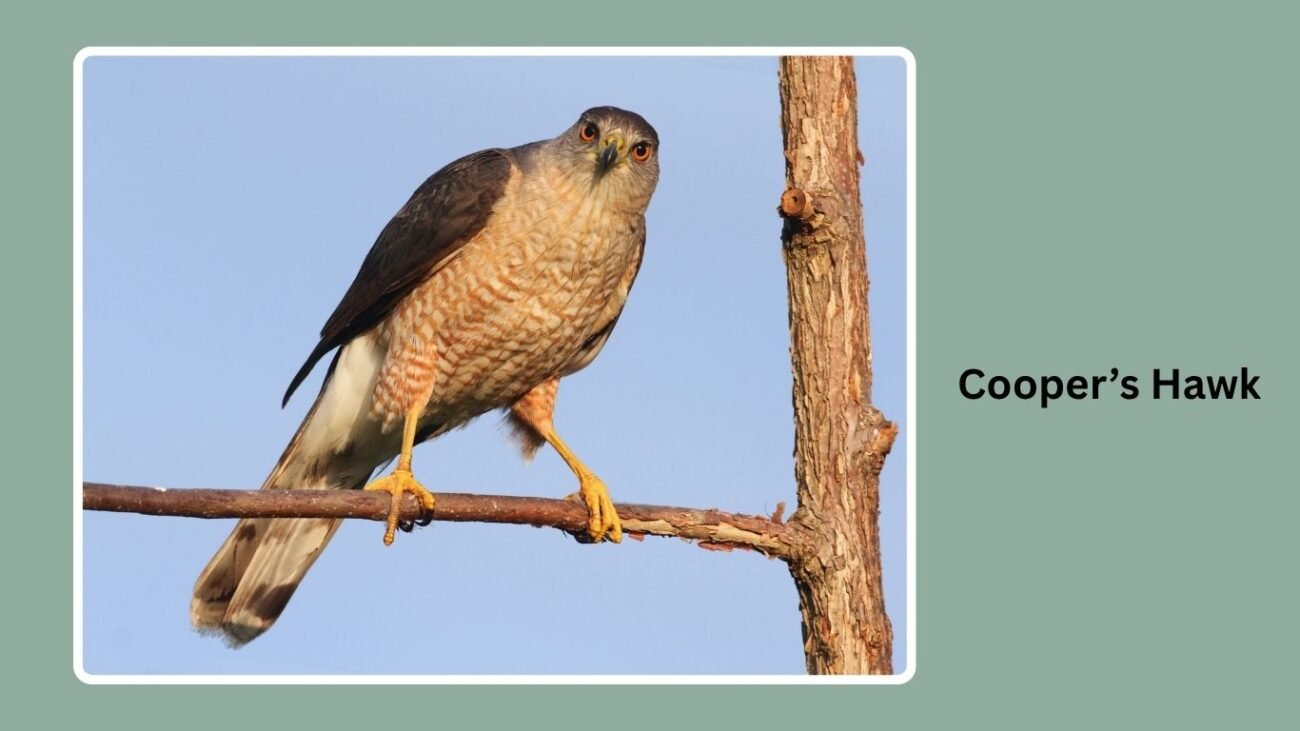
The Cooper’s Hawk is a medium-sized forest hawk known for its agility and speed in chasing birds through dense woods. Common in both wild and suburban environments, it’s often mistaken for the Sharp-shinned Hawk due to similar shape and coloration.
Identification
- Size: 14–20 inches long
- Wingspan: 2.5–3 feet
- Steely blue-gray back
- Pale underparts with reddish barring
- Rounded tail with dark bands and a white tip
- Red eyes in adults; yellow in juveniles
Habitat
Prefers deciduous woodlands, forest edges, and suburban neighborhoods with trees. Frequently visits bird feeders—mainly to prey on the smaller birds.
Behavior
Relies on surprise and agility to catch prey, usually small to medium birds. Often flies fast and low through trees, using cover to approach unseen. Builds large stick nests high in trees.
Color Pattern
Adults show blue-gray upperparts and rufous-barred chest. Juveniles are brown above with heavy streaks below. Tail is rounded and helps distinguish it from the Sharp-shinned Hawk.
Flight Style
Flap-flap-glide pattern typical of Accipiter hawks. Short bursts of fast flapping followed by smooth glides as it maneuvers through tight spaces.
3. Sharp-shinned Hawk (Accipiter striatus)
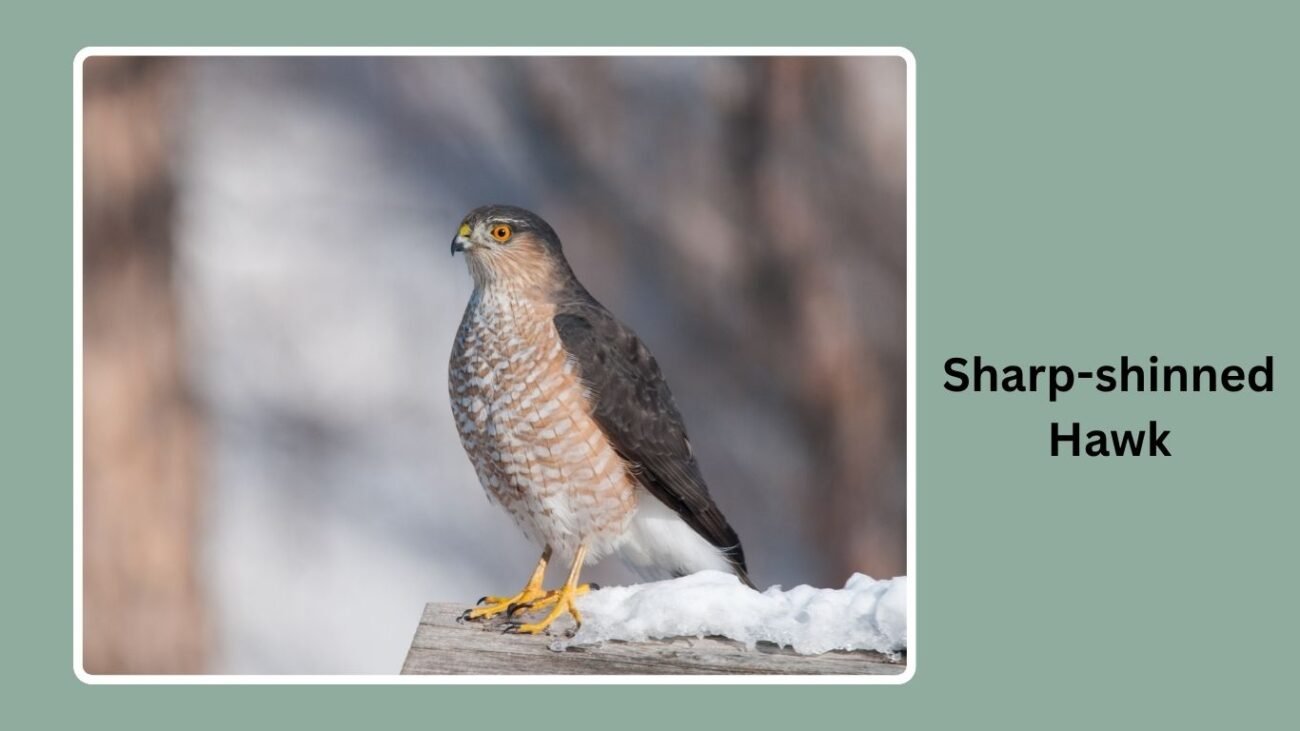
The Sharp-shinned Hawk is the smallest hawk in North America and a lightning-fast predator of songbirds. It is incredibly agile and often darts through trees in pursuit of its prey.
Identification
- Size: 9–13 inches long
- Wingspan: 1.5–2 feet
- Slate-gray back and cap
- Pale underparts with fine reddish barring
- Long, square-tipped tail with dark bands
- Yellow eyes in juveniles; red in adults
Habitat
Found in dense forests, wooded suburbs, and mountainous regions. Commonly seen during migration as it passes through open country and along ridgelines.
Behavior
A stealthy ambush hunter, it surprises small birds with sudden attacks. Known to lurk near bird feeders for easy meals. Nests in tall trees using twigs and bark.
Color Pattern
Adults have bluish-gray backs with reddish barring on the chest. Juveniles are brown above with vertical brown streaks below. The squared-off tail helps differentiate it from Cooper’s Hawk.
Flight Style
Very fast and erratic, using rapid wingbeats and short glides. Frequently seen darting through trees or zipping along hedgerows in low, direct flight.
4. Northern Goshawk (Accipiter gentilis)
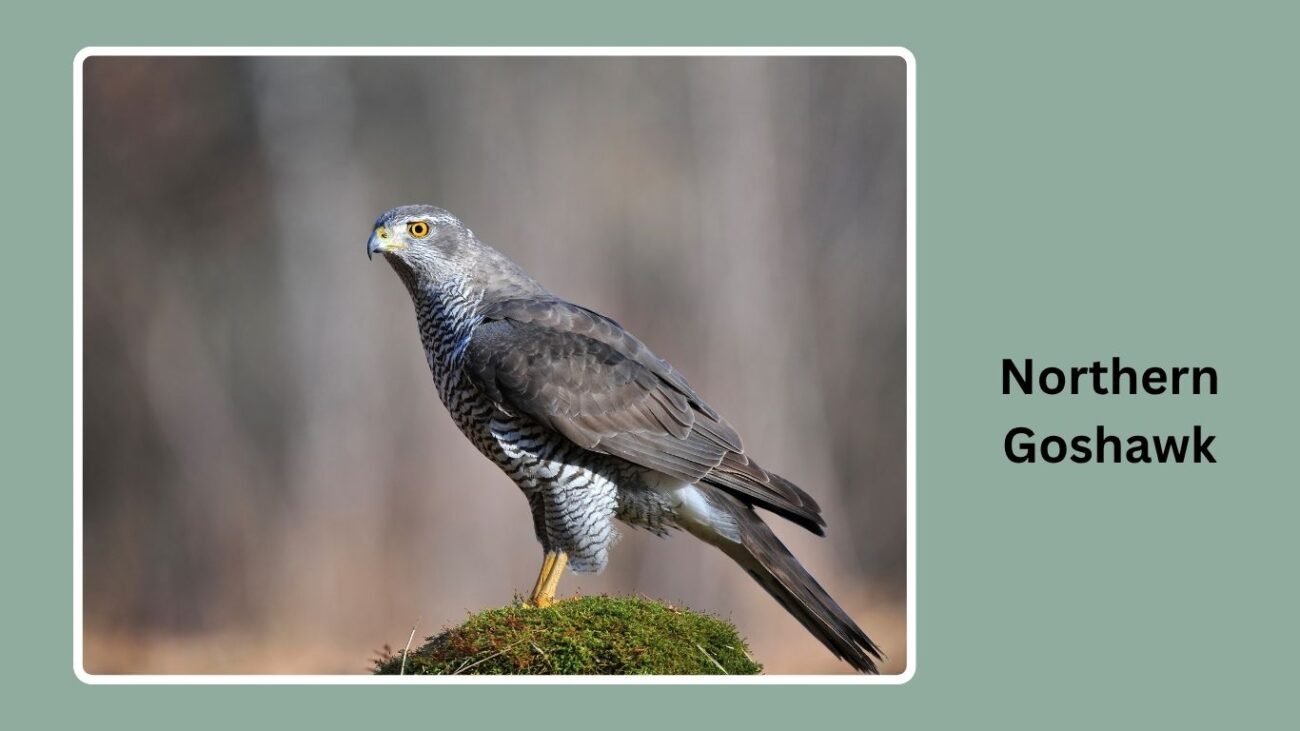
The Northern Goshawk is the largest hawk in the Accipiter genus and a powerful forest hunter. Often elusive, it is revered by birders for its strength, speed, and fierce territorial behavior—especially during nesting season.
Identification
- Size: 20–26 inches long
- Wingspan: 3.5–4.5 feet
- Slate-gray upperparts and light gray underparts with fine horizontal barring
- Prominent white eyebrow (supercilium)
- Thick body, long tail, and broad wings
Habitat
Lives in dense coniferous and mixed forests across North America, Europe, and Asia. Prefers remote woodlands with large, mature trees for nesting and hunting.
Behavior
Aggressively defends nesting areas, even attacking humans if they get too close. Hunts birds, squirrels, and rabbits with fast, calculated ambushes. Builds large stick nests high in trees.
Color Pattern
Adults have a blue-gray back, pale barred chest, and intense red eyes. Juveniles are brown with heavy vertical streaks and pale yellow eyes.
Flight Style
Flies with powerful wingbeats and sudden bursts of speed. Maneuvers skillfully through dense woods using its long tail for tight turns and balance.
5. Swainson’s Hawk (Buteo swainsoni)
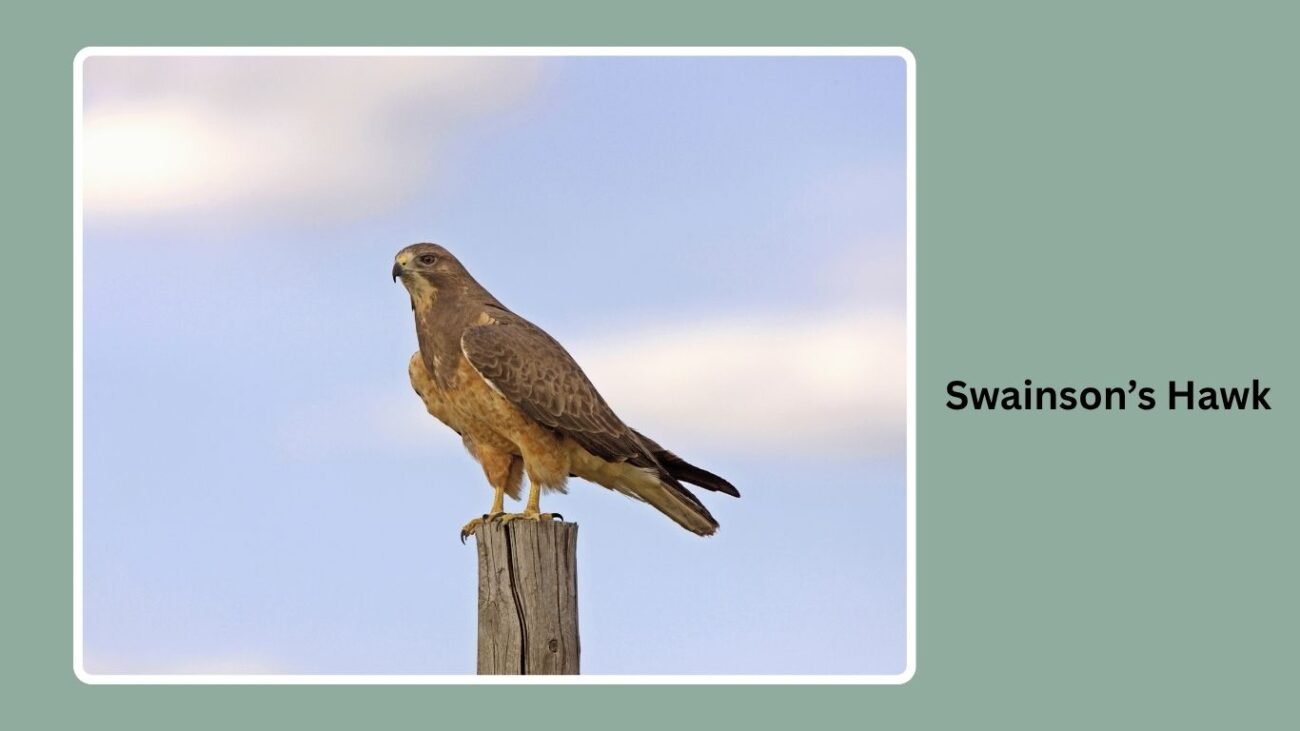
Swainson’s Hawk is a long-distance migrant known for its vast seasonal movements and its preference for open country. It’s one of the most common hawks of the western plains during summer.
Identification
- Size: 18–22 inches long
- Wingspan: 4–4.5 feet
- Pale belly with dark chest patch
- Long, pointed wings with dark flight feathers
- Variable plumage: some are light, others very dark (melanistic)
Habitat
Favors grasslands, prairies, agricultural fields, and open shrublands. Nests in trees or utility poles in open landscapes, especially across western North America.
Behavior
Feeds mainly on insects like grasshoppers during summer, but also hunts small mammals and reptiles. Migrates thousands of miles to winter in South America, often in flocks of hundreds or thousands.
Color Pattern
Light morphs have white underparts with a reddish chest band, while dark morphs are almost entirely chocolate-brown. Both have two-toned underwings in flight: dark coverts with pale flight feathers.
Flight Style
Soars effortlessly with long glides and shallow flapping. Seen in kettles during migration, often mixed with other soaring birds like vultures and hawks.
6. Broad-winged Hawk (Buteo platypterus)
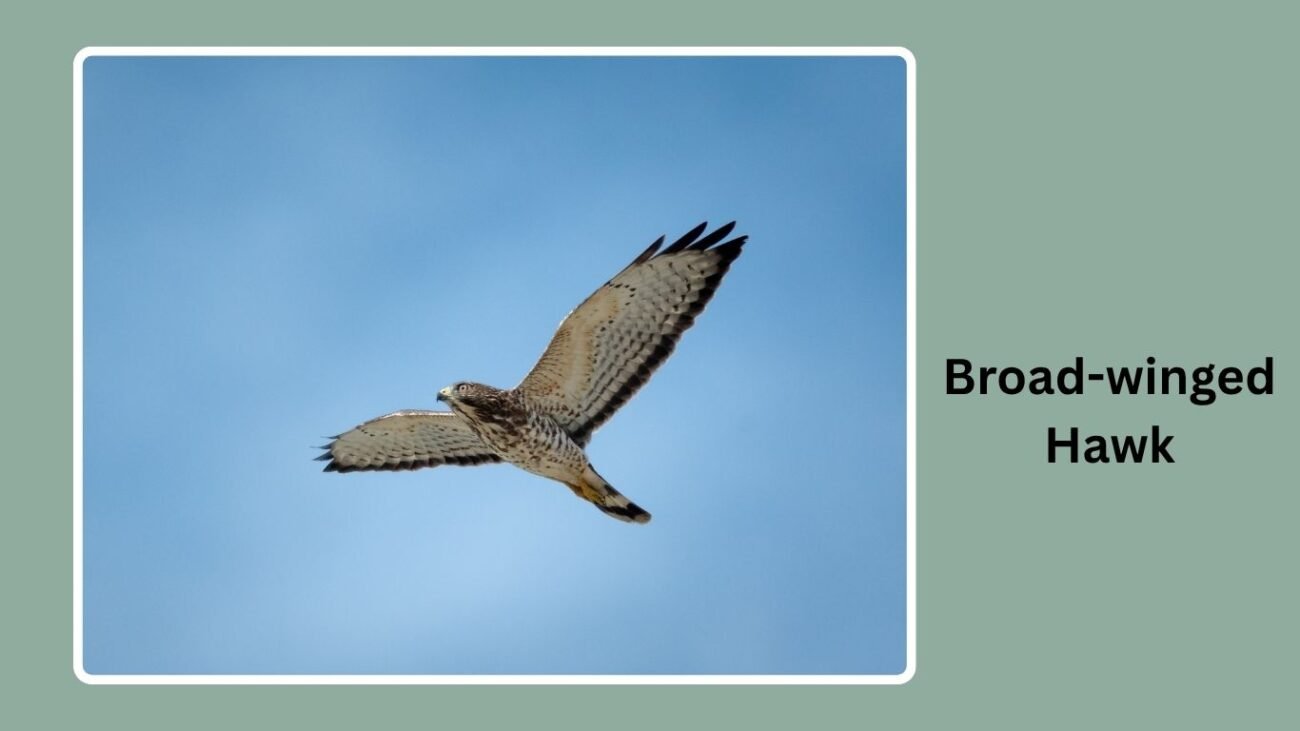
The Broad-winged Hawk is a compact, stocky raptor best known for its impressive migration in massive flocks called “kettles.” Though secretive during breeding, it becomes highly visible in fall as it travels south in the thousands.
Identification
- Size: 13–17 inches long
- Wingspan: 2.5–3.5 feet
- Broad, short wings and medium-length tail
- Brown upperparts
- White underparts with reddish barring on the chest
- Tail has distinct black and white bands
Habitat
Breeds in deciduous or mixed woodlands near water throughout eastern North America. During migration, seen soaring over ridges, fields, and coastlines.
Behavior
Perches silently in forest interiors and ambushes small mammals, amphibians, and insects. During migration, it forms large, soaring flocks that ride thermals for long distances.
Color Pattern
Adults show a warm brown back with finely barred white underparts. The bold black-and-white tail bands are a key field mark. Juveniles are browner and streakier below.
Flight Style
Soars with steady, shallow wingbeats and uses thermals during migration. In forests, uses short bursts of direct flight between perches.
7. Ferruginous Hawk (Buteo regalis)
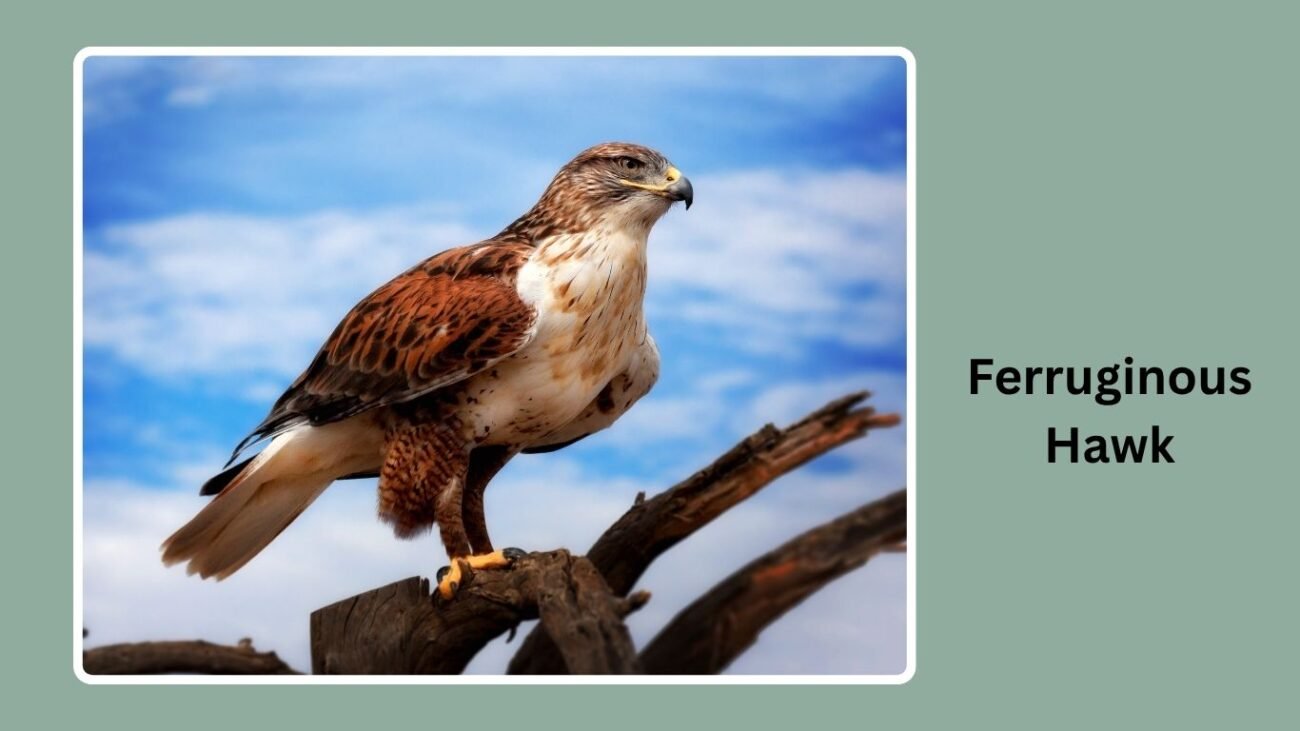
The Ferruginous Hawk is the largest Buteo hawk in North America, recognized by its pale plumage and powerful build. Named for its rusty coloration, it thrives in wide-open plains and grasslands.
Identification
- Size: 22–27 inches long
- Wingspan: 4.5–5 feet
- Large, heavy-bodied hawk with broad wings
- Pale head and underparts
- Rusty “leggings” and back
- Dark morphs are much browner overall
Habitat
Found in open country of the western U.S. and Canada—prairies, deserts, sagebrush, and badlands. Avoids forested and mountainous regions.
Behavior
Feeds mainly on ground squirrels, rabbits, and other small mammals. Hunts from perches, in flight, or even on the ground. Nests on cliffs, trees, or man-made platforms.
Color Pattern
Light morphs are mostly pale with rusty upperparts and leg feathers. Dark morphs are rich chocolate-brown with rufous highlights. Both have a white tail and pale underwings with a dark trailing edge.
Flight Style
Soars with broad wings and a shallow dihedral (V-shape). Capable of powerful flapping when pursuing prey, and often hovers briefly over the ground before striking.
8. Rough-legged Hawk (Buteo lagopus)
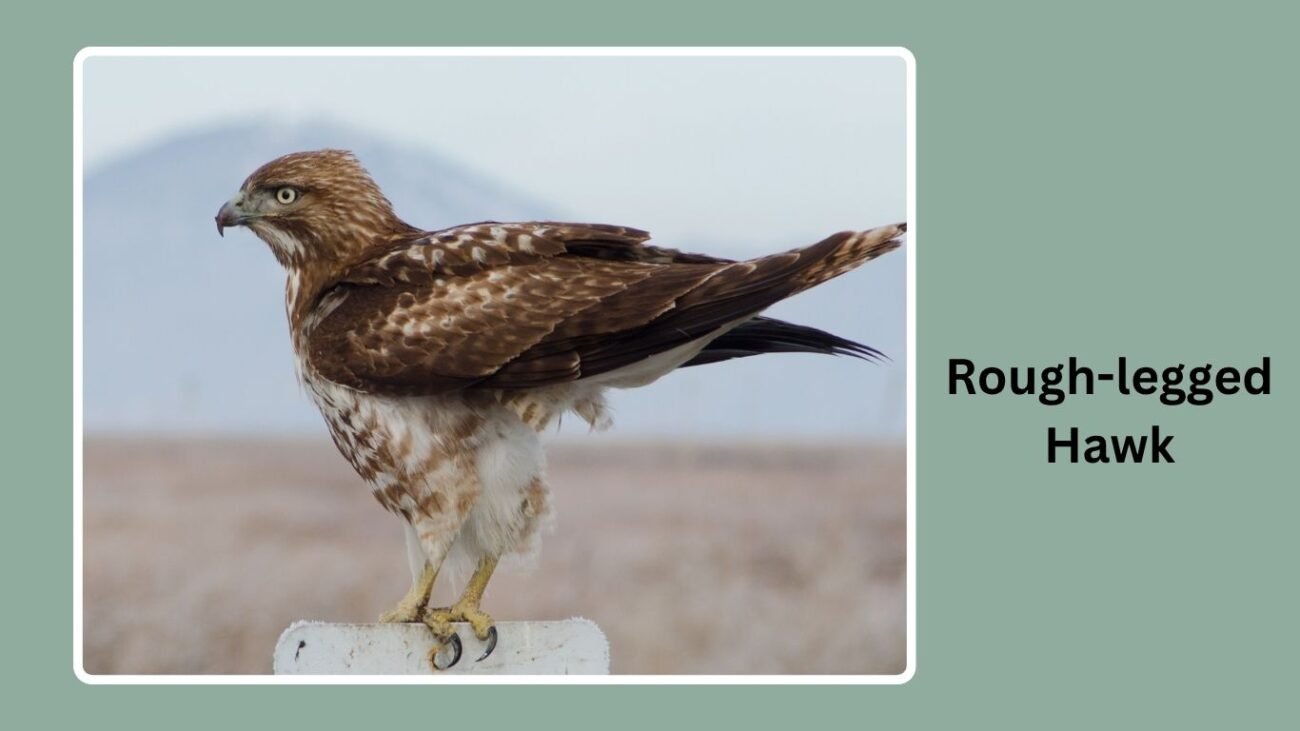
The Rough-legged Hawk is a true Arctic breeder, adapted to cold climates and known for its feathered legs. It winters across open fields and farmlands in the northern U.S., soaring gracefully as it hunts for rodents.
Identification
- Size: 18–23 inches long
- Wingspan: 4.5–5 feet
- Long wings and relatively small beak
- Distinct dark belly patch and wrist marks on underwings
- Light and dark morphs exist
- Feathered legs down to the toes
Habitat
Breeds in the Arctic tundra. Winters in open habitats such as plains, marshes, fields, and prairie farmlands across the northern U.S. and southern Canada.
Behavior
Hunts by hovering over fields or perching on poles and fence posts. Diet consists mostly of voles and lemmings. Builds large stick nests on cliffs or ground outcrops in the tundra.
Color Pattern
Light morphs are pale overall with a dark belly and carpal patches on wings. Dark morphs are deep brown with lighter tail and underwing contrast. All have a white tail with a dark band near the tip.
Flight Style
Slow, buoyant flight with frequent hovering. Holds wings in a slight dihedral. Soars high when scanning for prey, using thermals even in winter.
9. Harris’s Hawk (Parabuteo unicinctus)
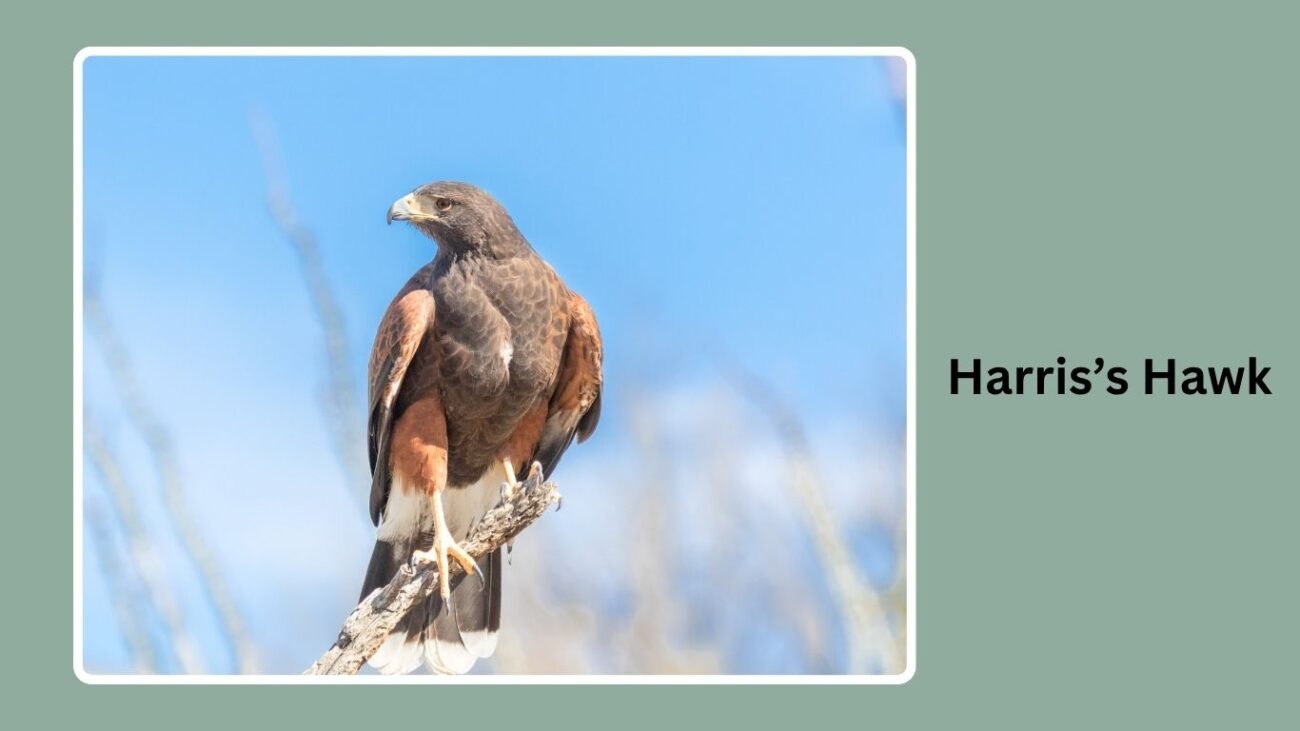
Harris’s Hawk is one of the few raptor species known for cooperative hunting and social living. Native to the southwestern U.S. and parts of Central and South America, it’s a favorite in falconry due to its intelligence and trainability.
Identification
- Size: 18–23 inches long
- Wingspan: 3.5–4 feet
- Dark brown body with chestnut-red shoulders and thighs
- White base and tip of tail
- Yellow cere and legs
Habitat
Prefers desert scrub, arid woodlands, and mesquite areas in the southwestern U.S., Mexico, and parts of South America. Often nests in saguaro cacti, trees, or power poles.
Behavior
Unusual for a hawk, it hunts in cooperative groups of 2–6 birds, chasing down rabbits, rodents, and lizards. Known to use strategy and take turns attacking prey. Very social and often perches in small groups.
Color Pattern
Dark chocolate brown overall with rich chestnut markings and a white-tipped tail. Eye-catching in both flight and at rest due to strong contrasts.
Flight Style
Flies low and powerfully with measured wingbeats. Soars in wide circles when scanning territory, especially in teams during a coordinated hunt.
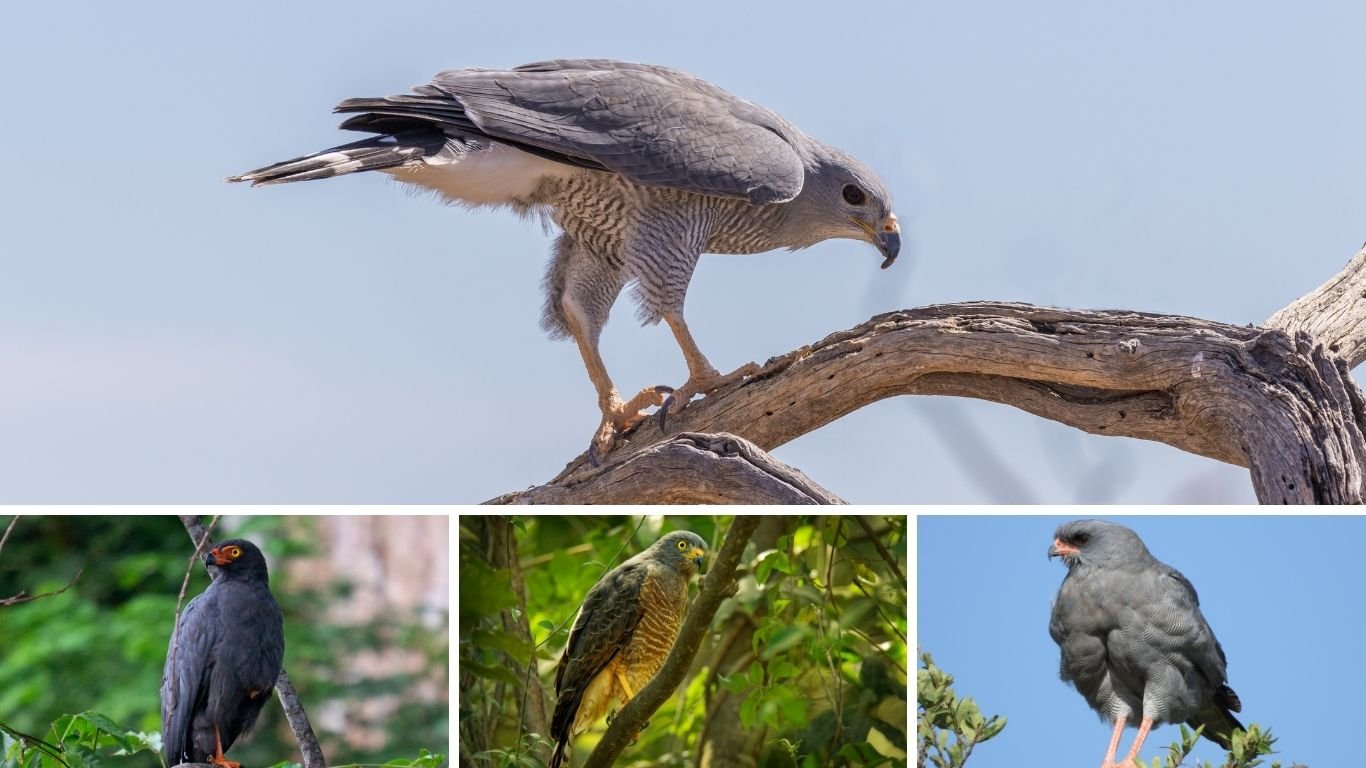
10. Gray Hawk (Buteo plagiatus)
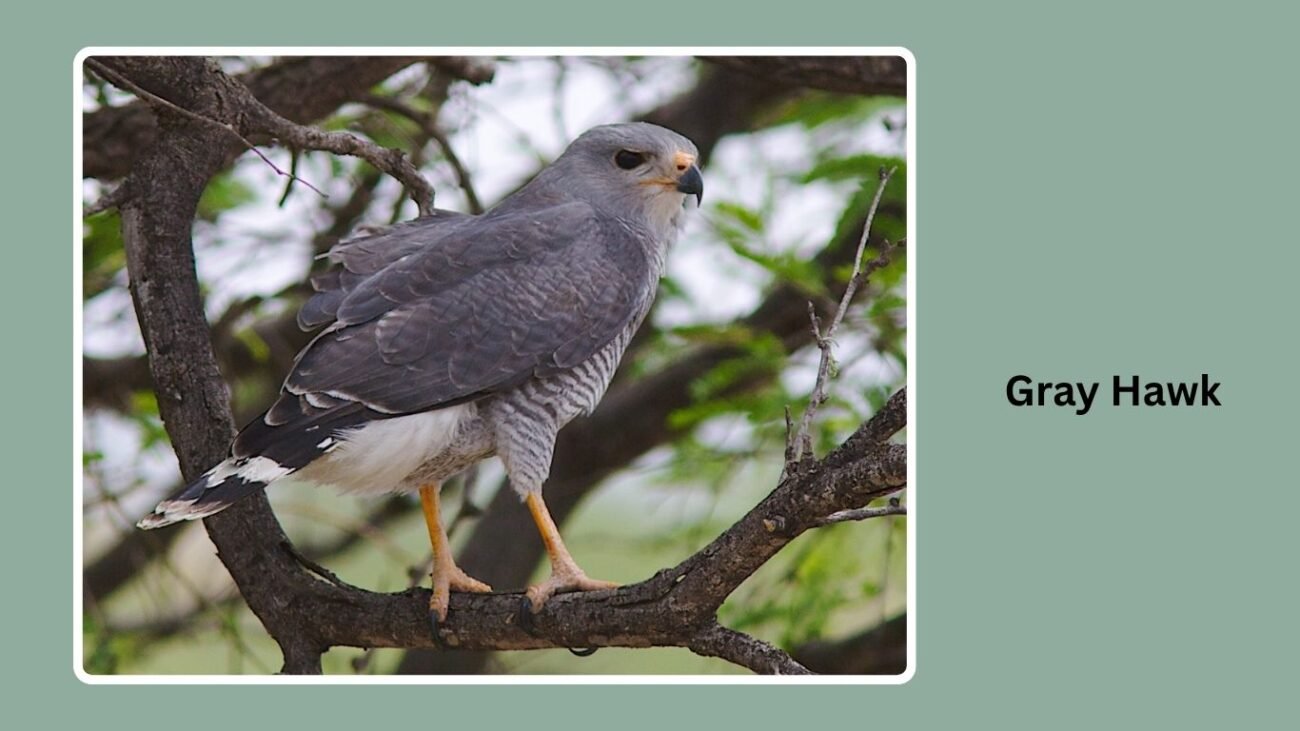
The Gray Hawk is a slender, elegant raptor of the American Southwest and parts of Central America. Its whistle-like call and striking appearance make it a favorite among birders in riparian woodlands.
Identification
- Size: 15–18 inches long
- Wingspan: 2.5–3 feet
- Overall pale gray plumage
- Finely barred underparts
- Long tail with bold black and white bands
- Bright yellow legs and cere
Habitat
Inhabits riparian areas with cottonwood, mesquite, and sycamore trees in southern Arizona, New Mexico, Texas, and into Mexico. Stays near rivers or wooded streams.
Behavior
Hunts from low perches, dropping down on reptiles, insects, and small mammals. Known for its slow, graceful flight and whistled call, especially during breeding season.
Color Pattern
Adults are pale slate-gray with soft white barring below. The black-and-white banded tail is highly visible in flight. Juveniles are browner and streaked below.
Flight Style
Soars in wide, slow circles with elegant, shallow wingbeats. During displays, often performs a slow fluttering “sky dance” above treetops.
11. Zone-tailed Hawk (Buteo albonotatus)
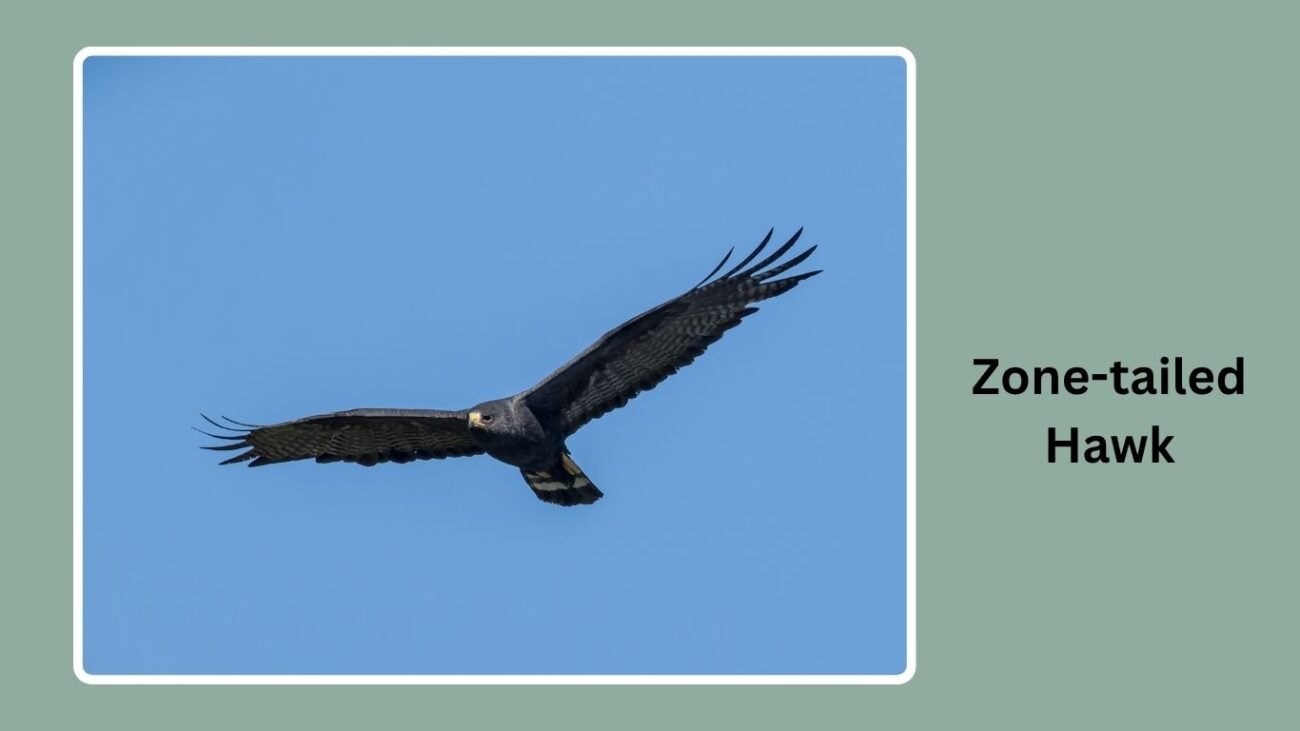
The Zone-tailed Hawk is often mistaken for a Turkey Vulture due to its similar flight profile. This mimicry may help it sneak up on prey, using deception as part of its hunting strategy.
Identification
- Size: 18–22 inches long
- Wingspan: 4.5 feet
- Blackish body and wings
- Bold white bands on tail
- Yellow legs and cere
- Silver flight feathers (visible when backlit)
Habitat
Found in canyons, foothills, and deserts from the southwestern U.S. into Central and South America. Nests on cliffs or in tall trees near rugged terrain.
Behavior
Feeds on small mammals, reptiles, and birds. Often soars with wings held in a V-shape, mimicking Turkey Vultures to get close to prey unnoticed. Usually hunts alone or in pairs.
Color Pattern
Mostly dark with contrasting white bands on the tail. In flight, shows silvery primary feathers and bold two-tone wings—key identifiers from below.
Flight Style
Soars with wings in a slight dihedral (V-shape), rocking in the wind just like vultures. This mimicry behavior is both deceptive and effective in catching prey.
12. Common Black Hawk (Buteogallus anthracinus)
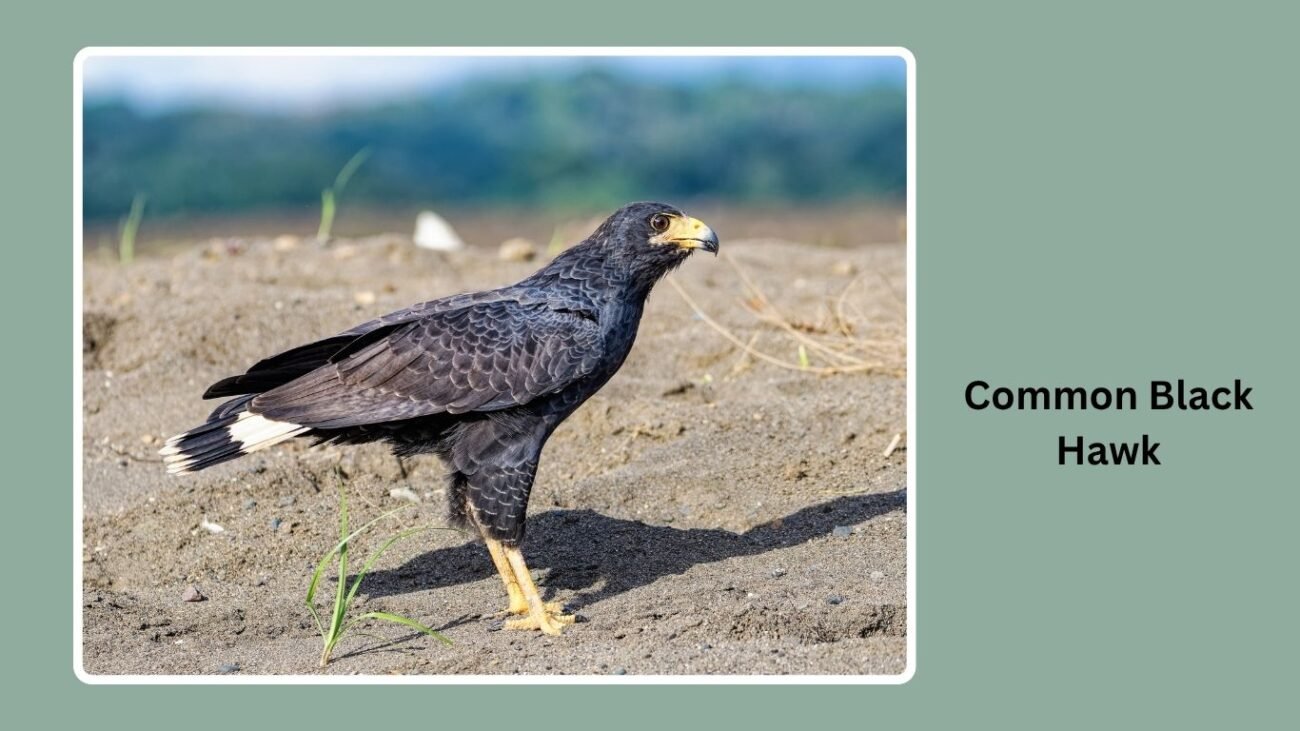
The Common Black Hawk is a stocky, dark-colored raptor typically found near rivers and streams in the southwestern U.S. and Central America. Its loud call and preference for riparian forests make it a standout in its range.
Identification
- Size: 19–21 inches long
- Wingspan: About 4 feet
- Uniform black body
- Broad wings and short tail
- Tail has a single wide white band and a white tip
- Bright yellow legs and cere
Habitat
Lives in riparian woodlands, mangroves, and tropical forests near water. Found in Arizona, New Mexico, Mexico, and parts of Central America. Usually nests in large trees near rivers.
Behavior
Feeds on frogs, fish, snakes, and crustaceans, often hunting from low perches over water. Uses slow, methodical flight and is more likely to soar in the open during courtship or territorial displays.
Color Pattern
Glossy black plumage with a distinctive white tail band. The deep yellow legs and face stand out sharply against its dark body.
Flight Style
Soars with slow, broad wingbeats and often perches low. During migration or displays, glides on flat wings, showing its striking tail band from below.
13. White-tailed Hawk (Geranoaetus albicaudatus)
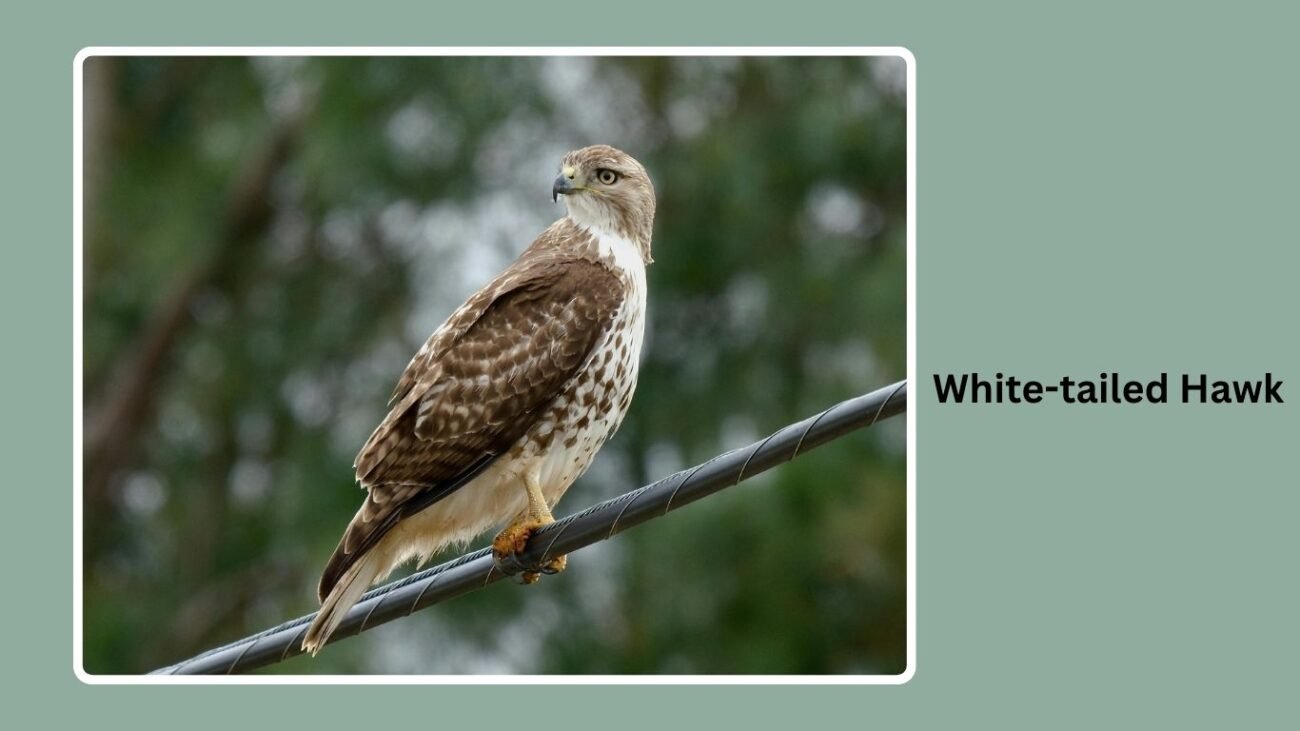
The White-tailed Hawk is a large, handsome raptor of open grasslands and savannas, mainly found in South Texas, Mexico, and Central and South America. Its striking tail and contrasting plumage make it easy to spot in flight.
Identification
- Size: 18–23 inches long
- Wingspan: 4–4.5 feet
- Gray upperparts with a reddish shoulder patch
- White underparts and tail
- Tail has a black subterminal band
- Hooked bill and strong yellow legs
Habitat
Prefers open areas such as coastal prairies, savannas, scrublands, and grasslands. In the U.S., most common in southern Texas. Nests on tall shrubs, cacti, or man-made structures.
Behavior
Feeds on rodents, rabbits, reptiles, and large insects. Hunts from perches or while soaring, often hovering before a strike. Will scavenge opportunistically.
Color Pattern
Adults have pale white underparts, a snowy white tail with a bold black band, and a rusty patch on the shoulder. Juveniles are browner overall and heavily streaked.
Flight Style
Soars gracefully with flat wings and occasionally hovers while scanning for prey. Often glides low over open country, showing its bright white tail and contrasting dark wing tips.
14. Short-tailed Hawk (Buteo brachyurus)
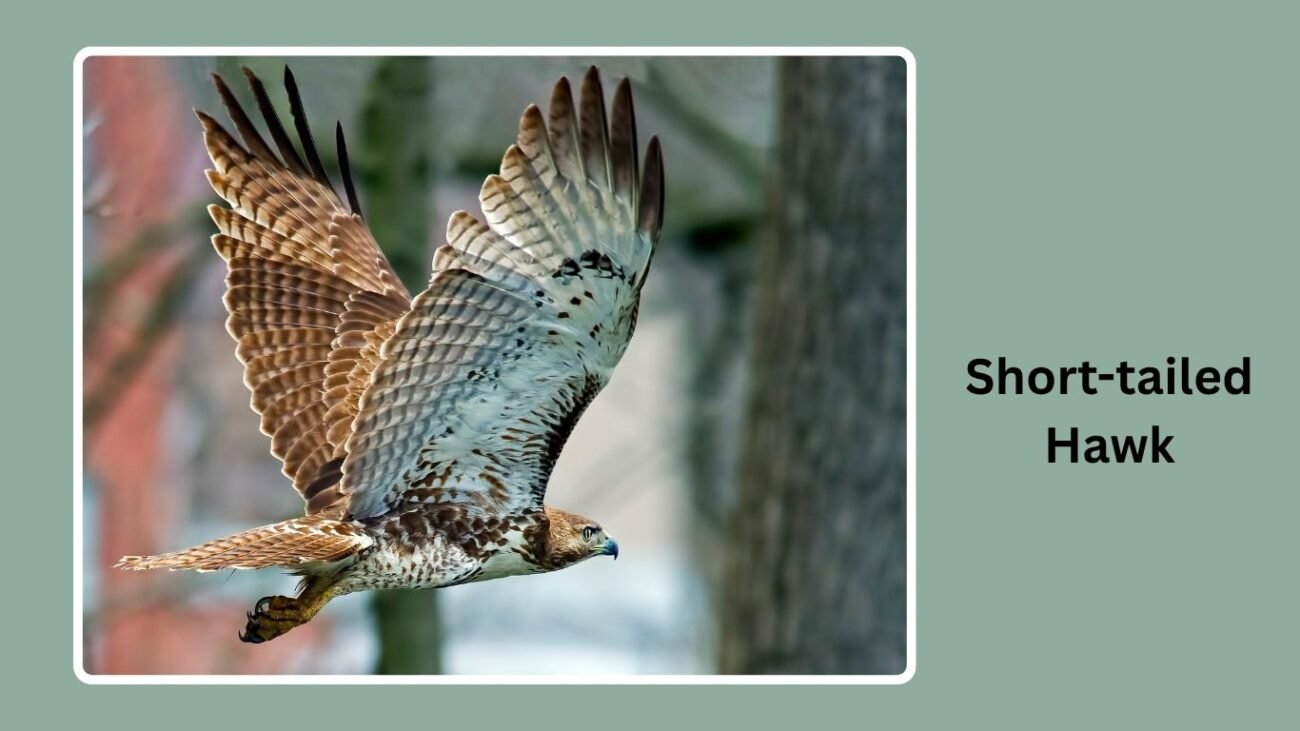
The Short-tailed Hawk is a small, agile hawk mostly found in Florida, Mexico, Central America, and parts of South America. Known for its aerial agility, it often hunts birds mid-flight and is easily spotted circling high in the sky.
Identification
- Size: 15–17 inches long
- Wingspan: Around 3 feet
- Two morphs: light and dark
- Light morph: white underparts with dark flight feathers
- Dark morph: uniformly dark brown or blackish
- Light morph: white underparts with dark flight feathers
- Short, square tail with narrow white bands
Habitat
Prefers open woodlands, subtropical forests, and wetland edges. In the U.S., it’s primarily found in peninsular Florida, often nesting in tall pines or cypress trees.
Behavior
Feeds mainly on small birds, which it catches in mid-air. Hunts from high soaring positions or sudden stoops. Rarely perches openly, making it tricky to observe except in flight.
Color Pattern
Light morphs are pale below with strong contrast in the wings. Dark morphs are nearly all dark brown or black. The short, banded tail is a key field mark in both.
Flight Style
Soars high on thermals with a compact silhouette. Often circles over forests or wetlands before diving toward prey. Uses strong bursts of speed when pursuing birds.
15. Roadside Hawk (Rupornis magnirostris)
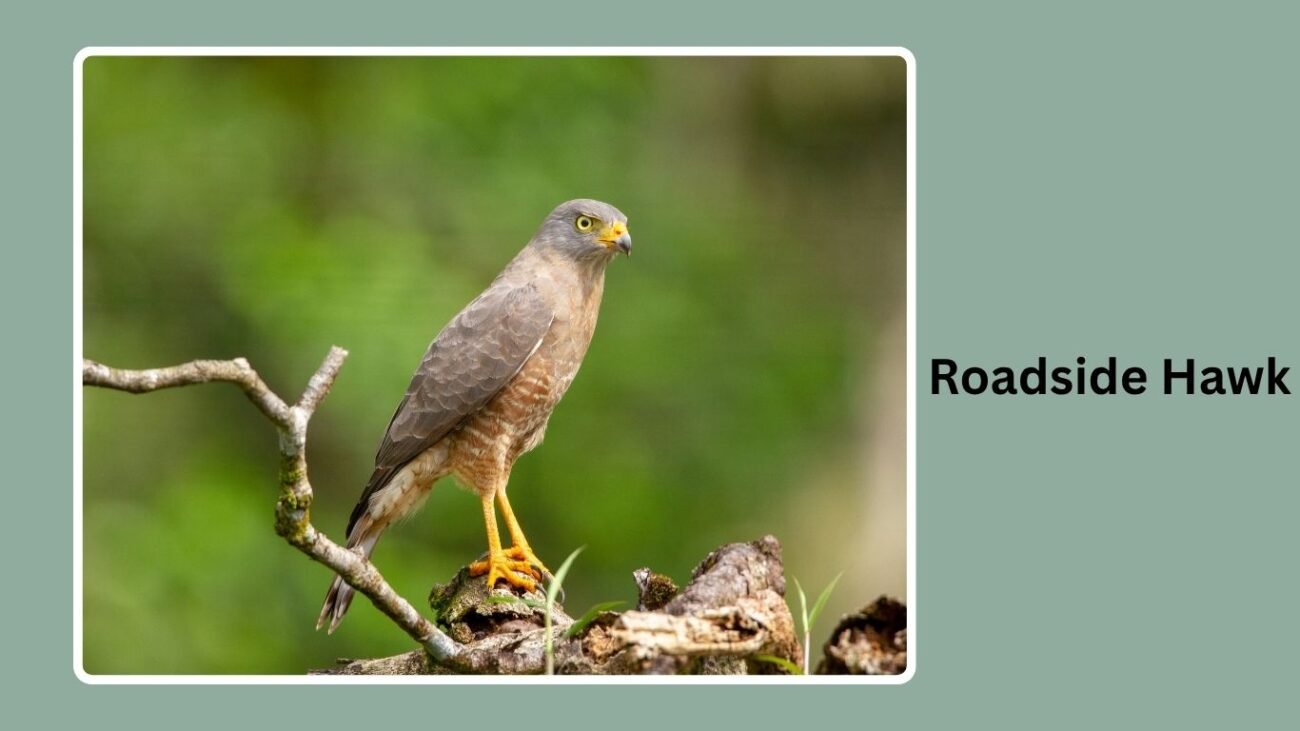
The Roadside Hawk is one of the most common and widespread raptors in Central and South America. Despite its name, it’s found in a variety of habitats and is well known for tolerating human presence.
Identification
- Size: 13–16 inches long
- Wingspan: About 2.5 feet
- Brown-gray upperparts
- Reddish barred underparts
- Yellow face and eyes
- Short tail with dark bands and a white tip
Habitat
Found in tropical forests, savannas, agricultural areas, and urban edges. Common along roadsides, fence lines, and village outskirts—hence its name.
Behavior
Feeds on lizards, snakes, insects, rodents, and small birds. Hunts from exposed perches and often seen swooping down into grass. Vocal and aggressive when nesting—frequently mobbed by other birds.
Color Pattern
Adults show barred reddish chest and belly with a slate-gray head and upperparts. The yellow cere, legs, and eyes stand out brightly. Juveniles are browner and streakier.
Flight Style
Short, quick flights between perches with shallow wingbeats. May glide briefly or soar in thermals, but mostly hunts by perch-and-pounce method.
16. Red-shouldered Hawk (Buteo lineatus)
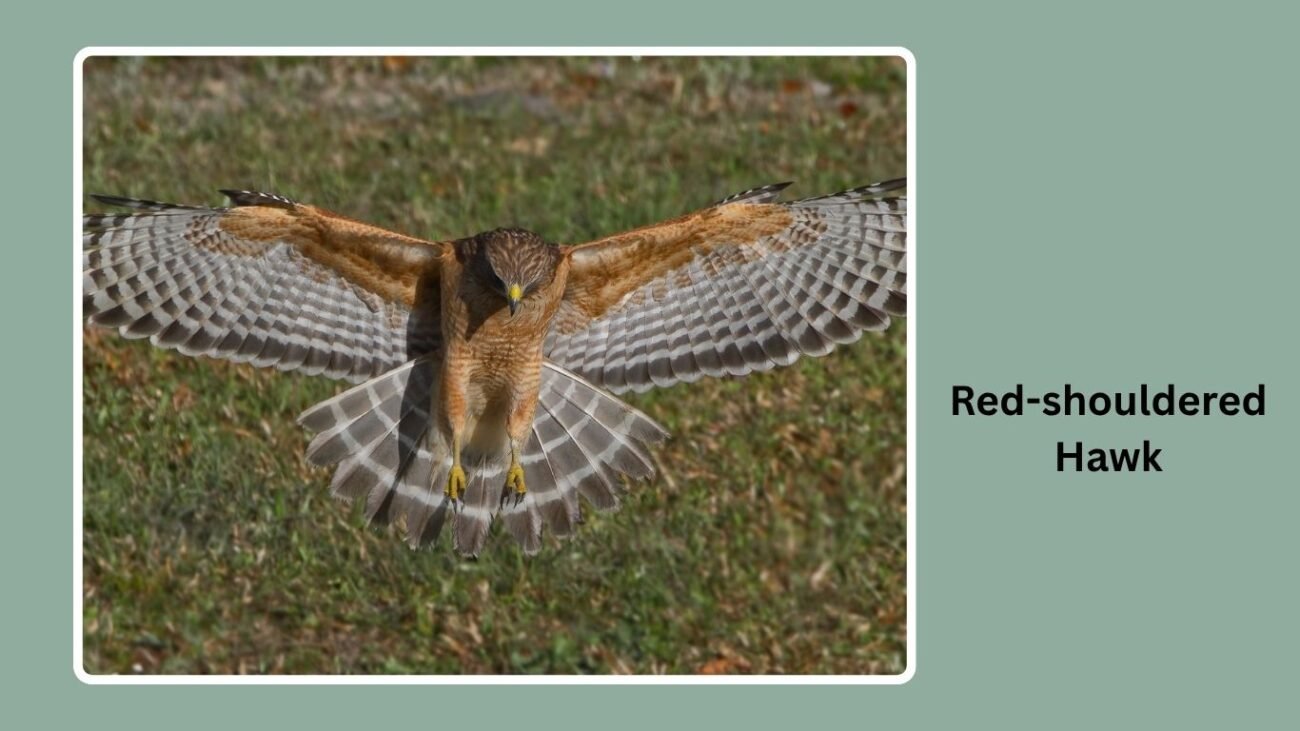
The Red-shouldered Hawk is a striking and vocal forest hawk of eastern North America and parts of California. It’s often heard before it’s seen, calling out its loud “kee-aah” scream over woodlands and wetlands.
Identification
- Size: 17–24 inches long
- Wingspan: 3.3–4 feet
- Reddish-brown chest and shoulder patches
- Black-and-white checkered wings
- Long tail with narrow white bands
Habitat
Inhabits deciduous forests, riverbottom woodlands, swamps, and suburban parks—especially near water. Common in the eastern U.S., and also along the West Coast in isolated populations.
Behavior
Feeds on small mammals, amphibians, reptiles, and large insects. Hunts from mid-level perches or low glides through the trees. Very vocal during breeding and territorial defense.
Color Pattern
Reddish breast and shoulders with contrasting black-and-white wings and tail. Juveniles are brown with heavy streaking on the chest.
Flight Style
Flies with slow wingbeats interspersed with gliding. Often soars in circles above forest canopies, sometimes mistaken for Red-tailed Hawks at a distance.
17. White Hawk (Pseudastur albicollis)
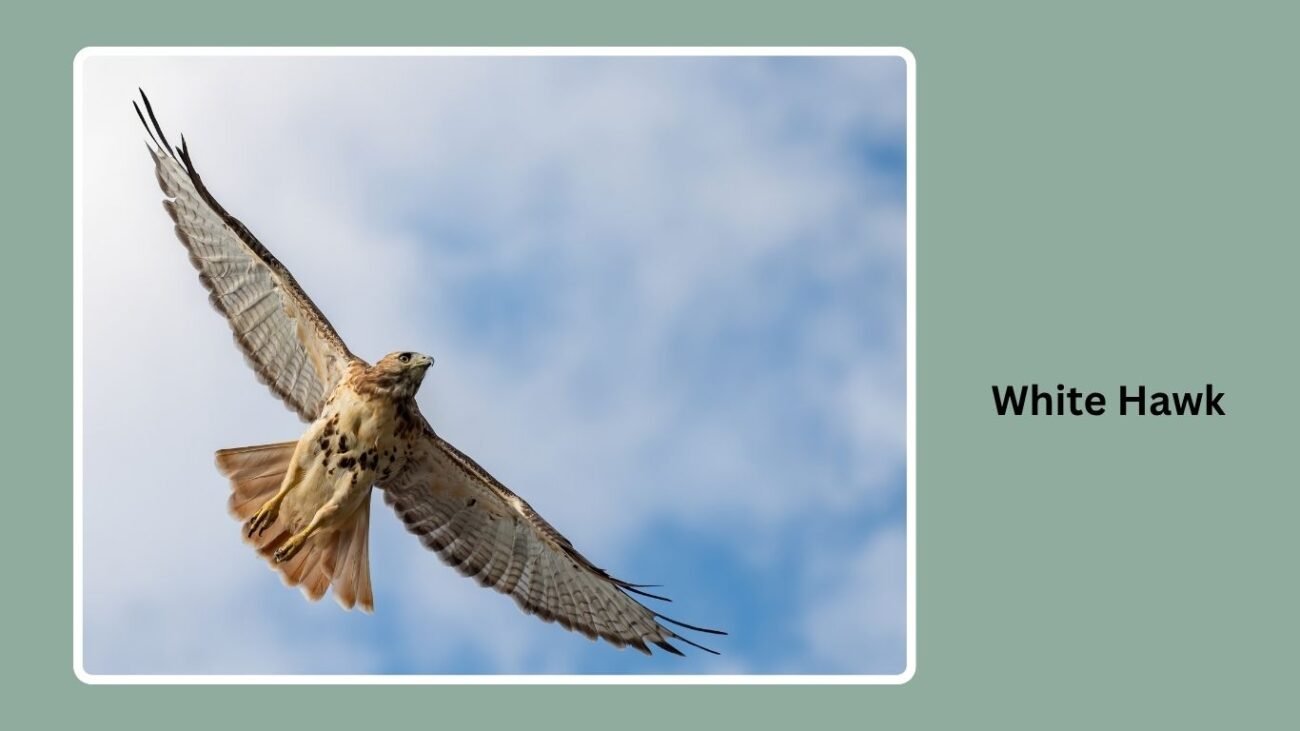
The White Hawk is a beautiful, broad-winged forest hawk of Central and South America. It is best known for its bright plumage and its preference for hunting in tropical forest canopies.
Identification
- Size: 18–22 inches long
- Wingspan: Around 3.5 feet
- Pure white head, body, and underparts
- Black edging on wings and tail
- Strong legs and curved bill
Habitat
Lives in humid tropical forests, especially along riverbanks and foothills from southern Mexico to Bolivia and Brazil. Often seen gliding over canopy gaps or perching in tall emergent trees.
Behavior
Feeds on snakes, lizards, insects, and small mammals. Often waits quietly on high perches before swooping down to grab prey. Known for its calm demeanor and stunning visual presence.
Color Pattern
Adults are bright white with black wingtips and tail bands. Juveniles may show more mottling. The striking white body against green forest makes it easy to spot when visible.
Flight Style
Soars slowly and deliberately with broad wings, often circling above the canopy. Occasionally performs a brief hovering pause before dropping onto prey.
18. Crane Hawk (Geranospiza caerulescens)
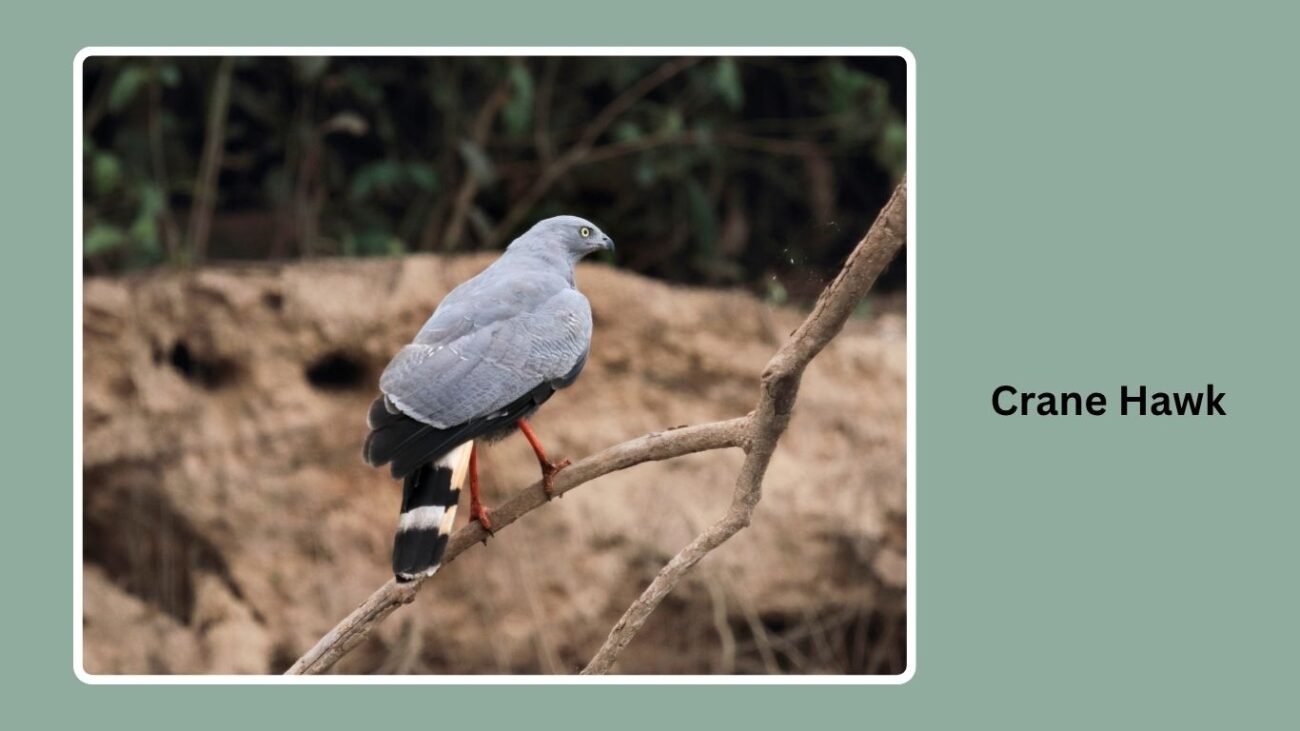
The Crane Hawk is a slim, long-legged raptor of Central and South American forests and woodlands. It’s known for its unique double-jointed legs that allow it to reach into tree cavities and crevices to catch prey.
Identification
- Size: 18–22 inches long
- Wingspan: Around 3 feet
- Slate-gray body
- Long yellow legs
- White tail with broad black bands
- Orange facial skin in adults
Habitat
Found in tropical lowland forests, wooded swamps, and mangroves from Mexico to northern Argentina. Often stays hidden in dense foliage near water.
Behavior
Feeds on lizards, frogs, insects, birds, and nestlings. Uses its extremely flexible legs to extract prey from holes in trees—behavior not typical of most hawks. Forages slowly and methodically.
Color Pattern
Adults are bluish-gray with white and black-banded tails. Immature birds are browner and streaked. Their yellow legs and upright stance give them a crane-like silhouette when perched.
Flight Style
Glides on broad wings with slow, deep wingbeats. Often seen flying low along forest edges or perching near water with a vertical, alert posture.
19. Great Black Hawk (Buteogallus urubitinga)
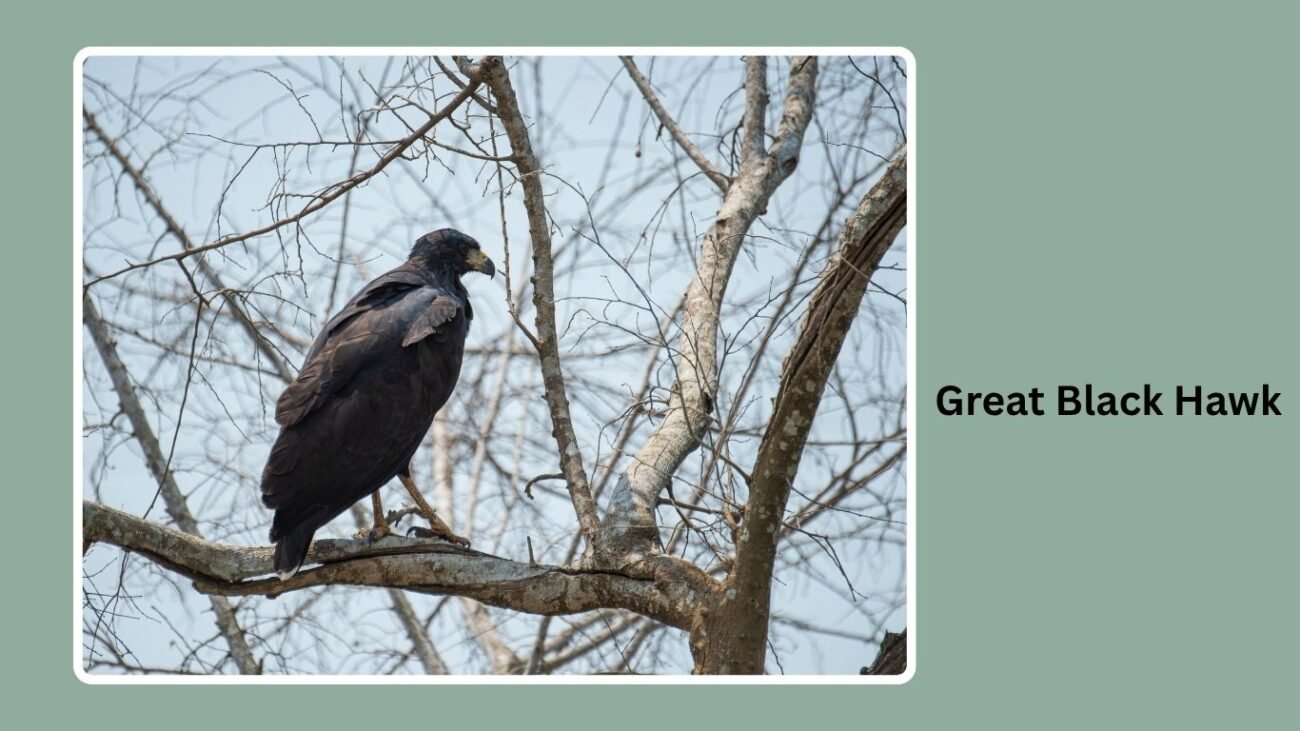
The Great Black Hawk is a large, dark raptor found throughout tropical Central and South America. Similar to the Common Black Hawk but larger and more robust, it’s a formidable hunter near water and forest edges.
Identification
- Size: 22–26 inches long
- Wingspan: 4.5 feet
- Entirely black body and wings
- White tail tip and subtle white tail bands
- Yellow cere, legs, and facial skin
Habitat
Inhabits rainforests, mangroves, riverbanks, and wetlands. Found from Mexico to Argentina, and very rarely seen in the U.S. (notably in Texas and Maine as vagrants).
Behavior
Feeds on snakes, frogs, fish, young birds, and carrion. Hunts both from soaring flight and perches near water. Strong feet and bill allow it to tackle a variety of prey.
Color Pattern
Jet-black plumage with contrasting white tail tip. The yellow legs and face stand out clearly against its dark body. Juveniles are browner and mottled with lighter underparts.
Flight Style
Soars with broad, rounded wings and steady flaps. Patrols riverbanks in low glides or perches patiently, waiting for movement below.
20. Long-legged Buzzard (Buteo rufinus)
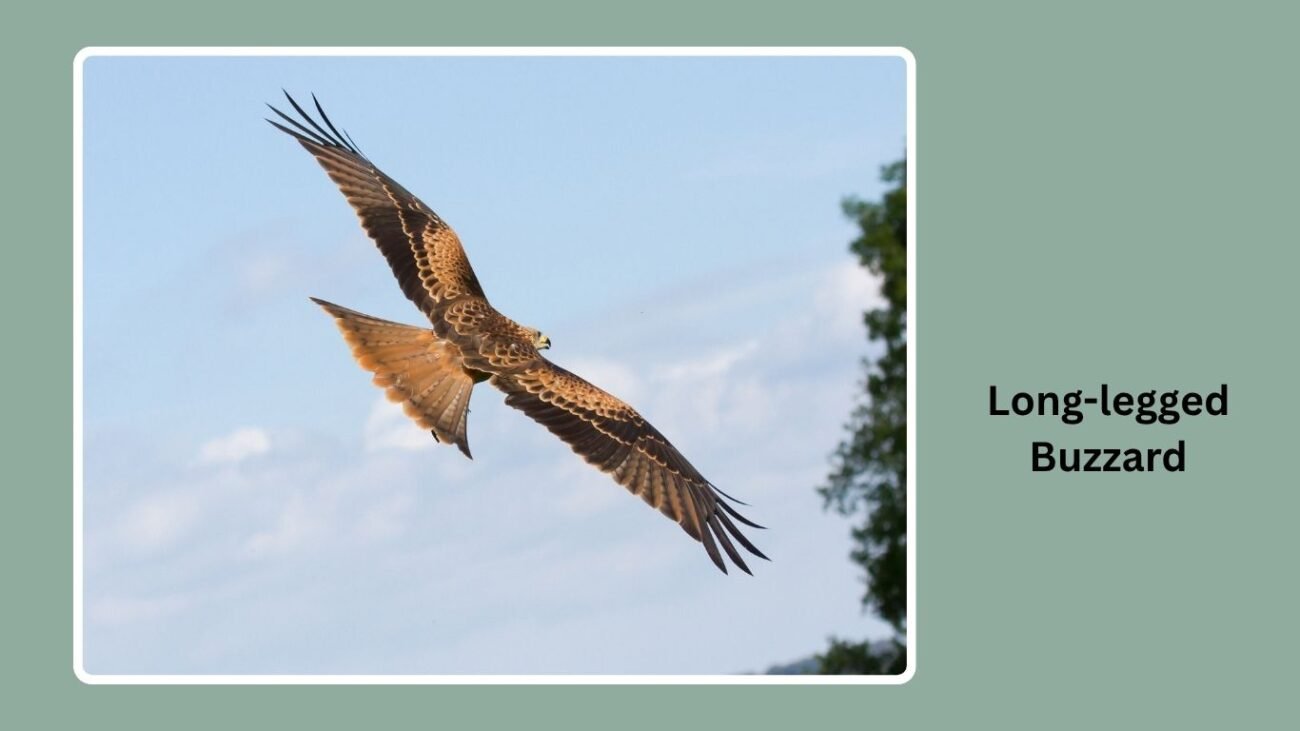
The Long-legged Buzzard is a large, open-country raptor found across Europe, Asia, and parts of North Africa. Named for its noticeably long, feathered legs, it’s often confused with the Rough-legged Hawk due to similar features.
Identification
- Size: 20–25 inches long
- Wingspan: 4.5–5 feet
- Broad wings and long legs covered in feathers
- Variable plumage: pale, rufous, or dark morphs
- Pale tail with subtle banding
Habitat
Prefers semi-deserts, grasslands, steppes, and rocky hillsides. Common in arid and open areas from eastern Europe to Central Asia. Builds large nests on cliffs or trees.
Behavior
Feeds on rodents, reptiles, and large insects. Hunts from perches or by soaring. Known to hover briefly before stooping. Sometimes scavenges.
Color Pattern
Color varies widely, but most show pale head and underparts with rufous or brownish upperparts. Tail is pale with faint barring. Dark morphs are more chocolate-colored.
Flight Style
Soars in wide, lazy circles using updrafts. Flies with slow wingbeats, often gliding with wings slightly raised. Capable of hovering while scanning the ground.
21. Oriental Honey-buzzard (Pernis ptilorhynchus)
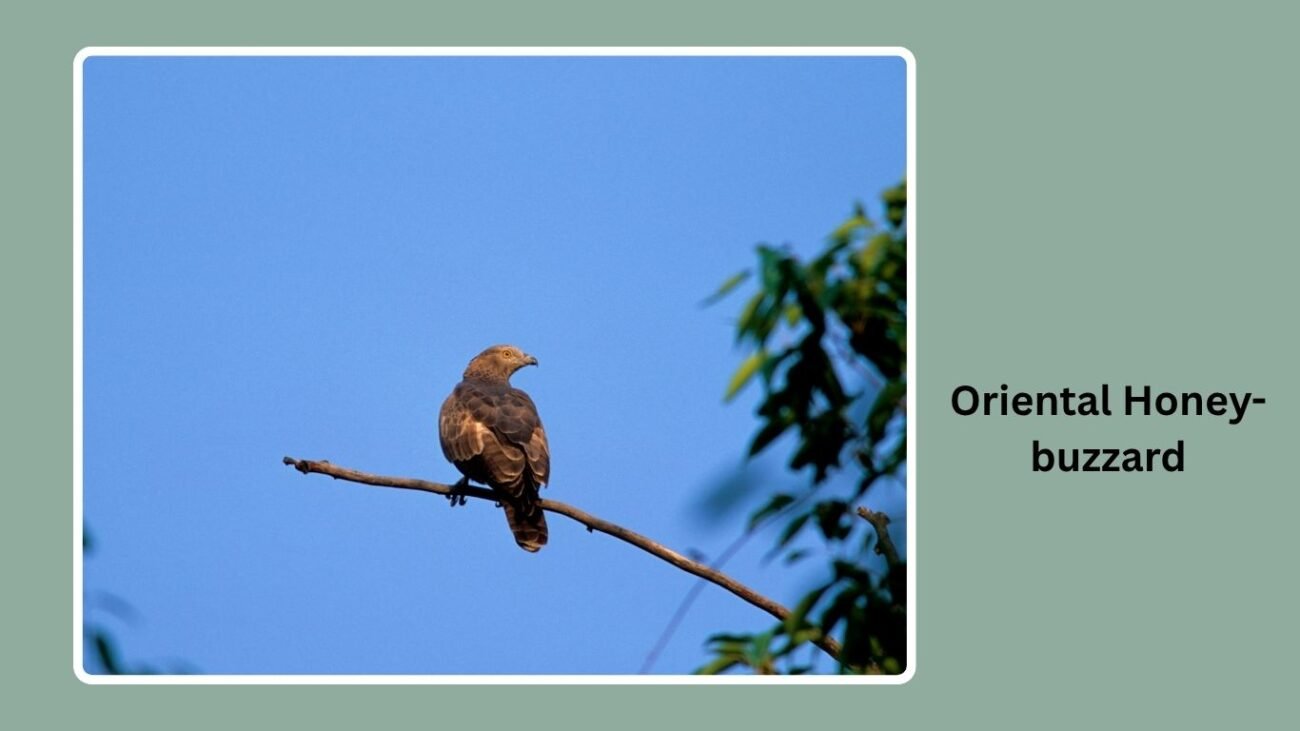
Despite its name, the Oriental Honey-buzzard is not a true buzzard but a specialist raptor adapted to eating bees, wasps, and their larvae. It is widespread across Asia and highly migratory.
Identification
- Size: 22–26 inches long
- Wingspan: About 4.5 feet
- Small head with pigeon-like profile
- Brown upperparts and barred underparts
- Variable patterns with cryptic coloration
Habitat
Inhabits woodlands, tropical forests, and hilly terrain across South, Southeast, and East Asia. Winters in Southeast Asia and the Indian subcontinent after breeding in northern regions.
Behavior
Uses its long bill and scaled facial skin to raid bee and wasp nests. Also feeds on frogs, small reptiles, and fruits. Soars over the canopy or glides low while searching for insect nests.
Color Pattern
Mottled brown to gray with barring and streaks. The small head and long neck give it a distinctive silhouette. Plumage mimics other raptors, possibly as protection from aggression.
Flight Style
Glides with wings held flat and slightly forward. Uses thermals during migration. Often seen circling high over forested landscapes.
22. Black Kite (Milvus migrans)
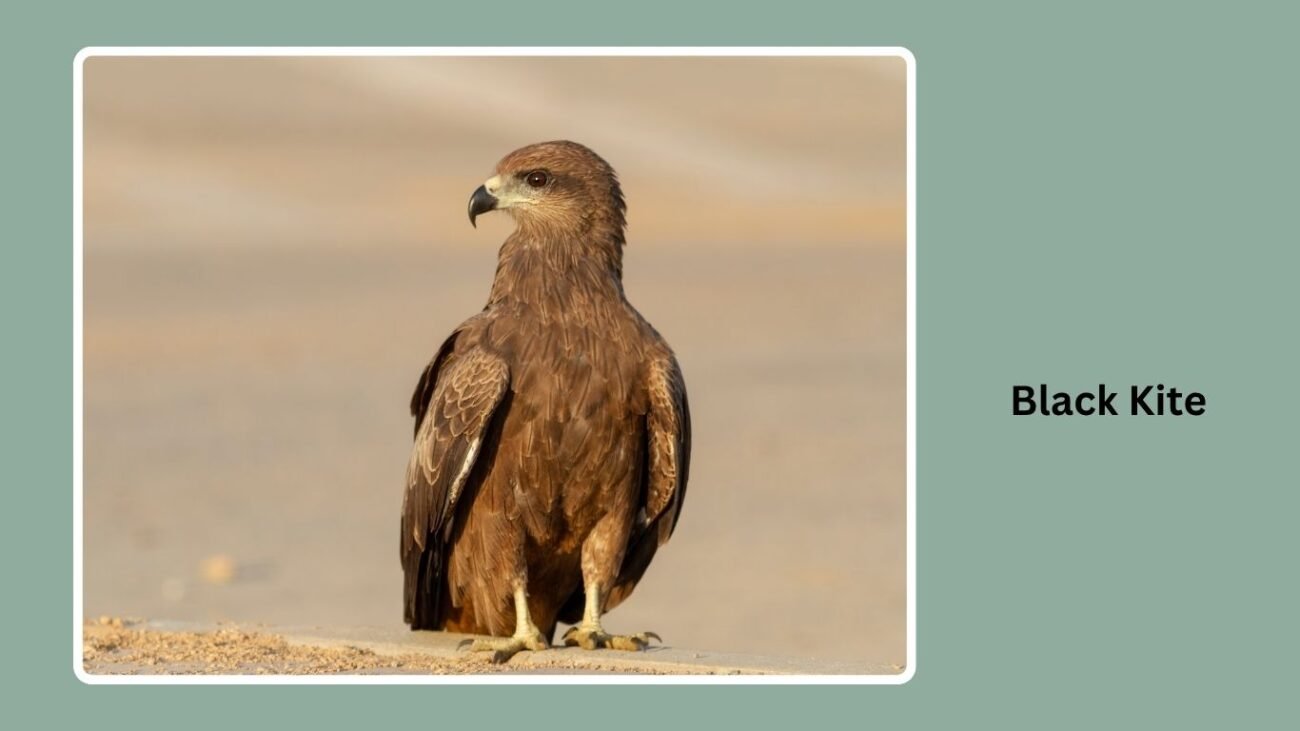
The Black Kite is a highly adaptable and widespread raptor found across Europe, Asia, Africa, and Australia. It thrives near human settlements and is often seen soaring over cities, rivers, and fields.
Identification
- Size: 19–24 inches long
- Wingspan: 4.5–5.5 feet
- Slender body with long, angled wings
- Brown plumage with paler head
- Forked tail and yellow legs
Habitat
Found in a wide range of habitats—wetlands, savannas, open woodlands, farmlands, and urban areas. Common near garbage dumps, ports, and fishing villages.
Behavior
Feeds opportunistically on carrion, fish, scraps, and small prey. Often scavenges around human activity. Highly social—may roost and migrate in flocks.
Color Pattern
Dark brown body with lighter head and throat. Underwings show contrast with paler flight feathers. The forked tail is a key field mark when seen gliding.
Flight Style
Effortless glider, often seen soaring in lazy circles. Uses thermals and updrafts efficiently, with minimal wing flapping. Very maneuverable in flight.
23. African Harrier-Hawk (Polyboroides typus)
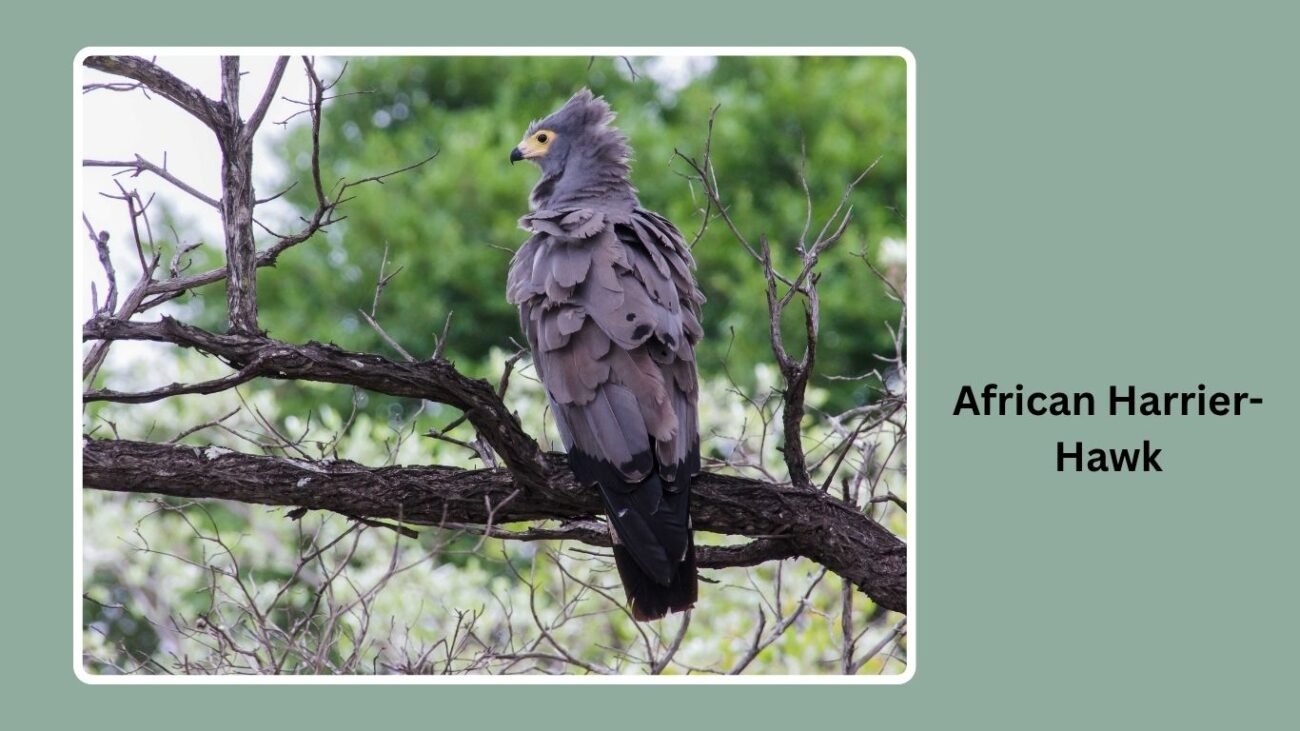
Also known as the Gymnogene, the African Harrier-Hawk is a unique and flexible raptor native to sub-Saharan Africa. Its most notable feature is its double-jointed legs, allowing it to extract prey from nests and tree cavities.
Identification
- Size: 20–25 inches long
- Wingspan: Around 5 feet
- Gray body with black and white barred underparts
- Bare, yellow face that flushes red when excited
- Long legs and rounded wings
Habitat
Found in forests, savannas, wetlands, and urban parks across sub-Saharan Africa. Nests in tall trees and forages in both dense and open areas.
Behavior
Feeds on nestlings, insects, reptiles, and small mammals. Uses its flexible legs to probe holes and cavities for hidden prey. Often forages in a slow, methodical manner.
Color Pattern
Soft gray overall with a white-barred belly and tail. The facial skin is bare and color-changing, often yellow to pinkish-red depending on mood or activity.
Flight Style
Soars with slow wingbeats and often glides low over trees. May hover or hang briefly in the air near tree trunks while foraging. Unique in both appearance and flight.
24. Rufous Crab Hawk (Buteogallus aequinoctialis)
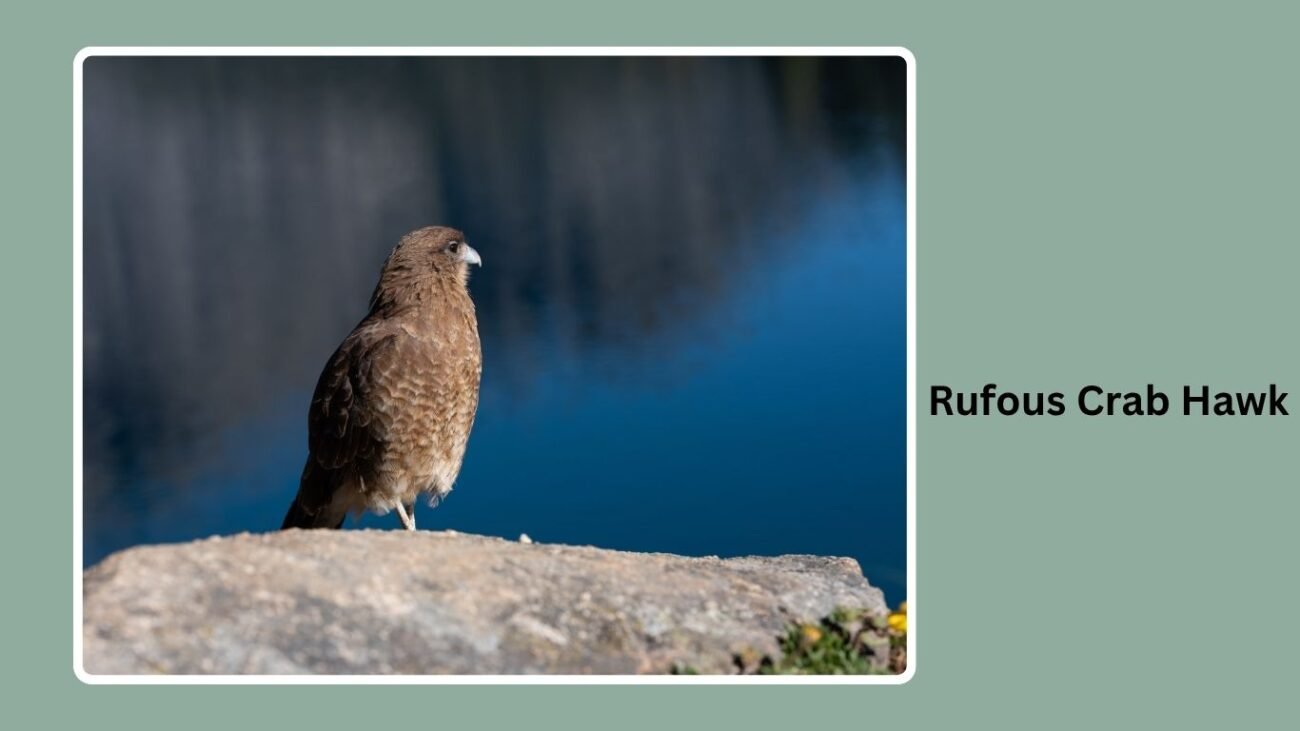
The Rufous Crab Hawk is a coastal specialist found along mangrove-lined shores of northern South America. As its name suggests, it primarily feeds on crabs, using patience and precision to hunt in tidal zones.
Identification
- Size: 18–20 inches long
- Wingspan: Around 3 feet
- Rufous-orange underparts and thighs
- Dark brown upperparts
- Short, broad wings and tail with black and white bands
- Yellow legs and facial skin
Habitat
Restricted to coastal mangroves, estuaries, and brackish wetlands from Venezuela to Brazil. Rare and local due to its very specific habitat requirements.
Behavior
Feeds almost exclusively on crabs, which it hunts during low tide. Waits quietly on low branches or roots before dropping onto prey. Often calls in a harsh, repeated cry.
Color Pattern
Reddish-rufous chest and belly contrast with dark wings and back. The tail has bold black and white bands, visible in flight. Juveniles are duller and more mottled.
Flight Style
Low, direct flight between mangroves. Occasionally soars in tight circles, but typically hunts from low perches close to water.
25. Madagascar Harrier-Hawk (Polyboroides radiatus)
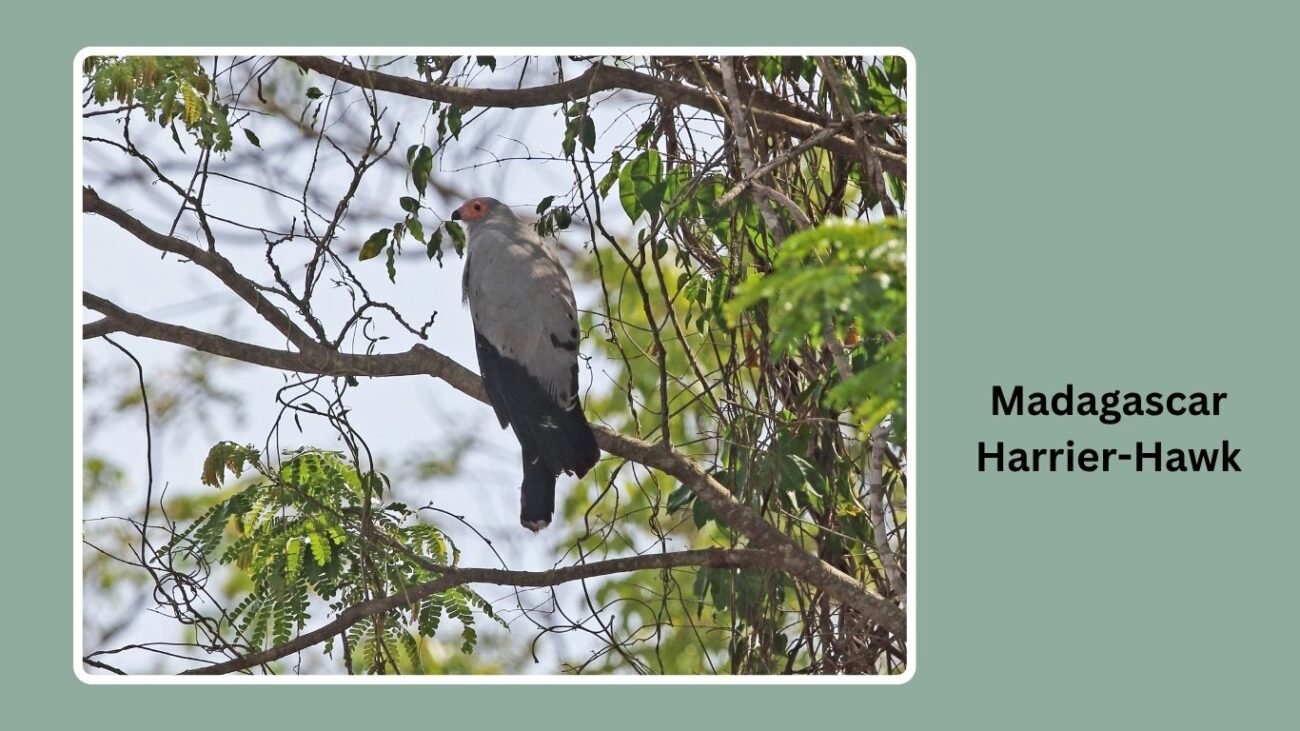
Endemic to Madagascar, the Madagascar Harrier-Hawk is a close relative of the African Harrier-Hawk and shares its remarkable foraging abilities, including double-jointed legs for raiding nests and crevices.
Identification
- Size: 20–24 inches long
- Wingspan: 4.5–5 feet
- Gray upperparts and head
- Black-and-white barred underparts
- Bare yellow face that flushes red
- Long legs with flexible joints
Habitat
Found in forests, savannas, and agricultural landscapes throughout Madagascar. Common in both lowland rainforests and dry deciduous woods.
Behavior
Feeds on eggs, chicks, insects, and small vertebrates. Uses its extendable legs to probe into crevices and nest holes. Forages in a slow, deliberate manner and can hang briefly by its feet.
Color Pattern
Gray above with strongly barred black-and-white belly and tail. Bare facial skin turns reddish when active. Similar in appearance and habits to its African counterpart.
Flight Style
Flies with slow, steady wingbeats and glides over forests or clearings. Occasionally hovers or pauses mid-air to scan or raid potential prey sites.
26. Bonelli’s Eagle (Aquila fasciata)
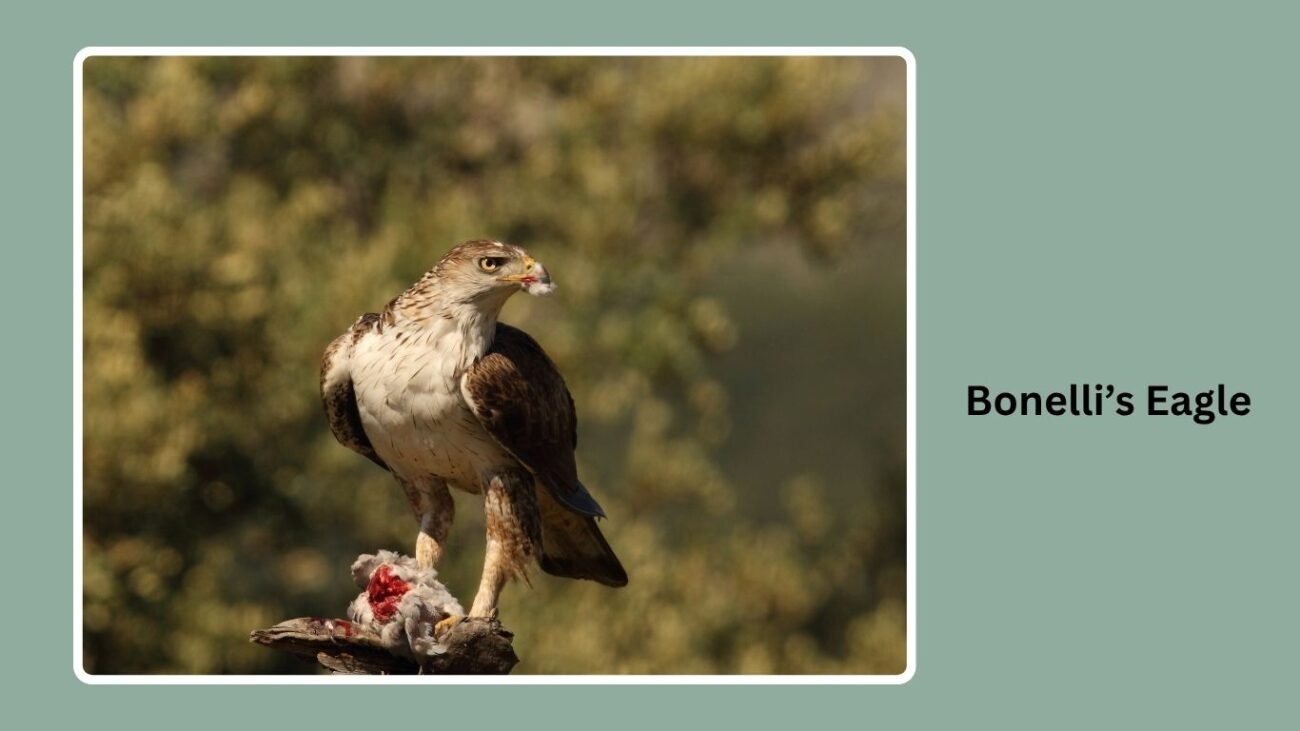
Although often referred to as an eagle, Bonelli’s Eagle is hawk-like in build and behavior—making it a frequent inclusion in raptor identification guides. Found across southern Europe, North Africa, and parts of Asia, it’s known for its powerful flight and striking contrast in coloration.
Identification
- Size: 22–28 inches long
- Wingspan: 5–6 feet
- Dark brown upperparts
- Pale underparts with dark streaks
- Broad wings and long tail with dark terminal band
- Juveniles are more uniformly brown
Habitat
Prefers rugged hills, cliffs, and open woodlands. Often nests on rock ledges or tall trees in Mediterranean regions, foothills, and dry forested landscapes.
Behavior
Feeds on birds, rabbits, and other small mammals. Hunts from soaring flight or high perches, often using surprise and speed. Solitary and territorial during the breeding season.
Color Pattern
Dark back and pale underside with dense streaking. Tail is white with a distinct black band at the end. Contrasting dark “elbow” patches show clearly in flight.
Flight Style
Powerful, slightly stiff wingbeats alternating with long glides. Soars over ridges and valleys, often seen circling in strong thermals.
27. Changeable Hawk-Eagle (Nisaetus cirrhatus)
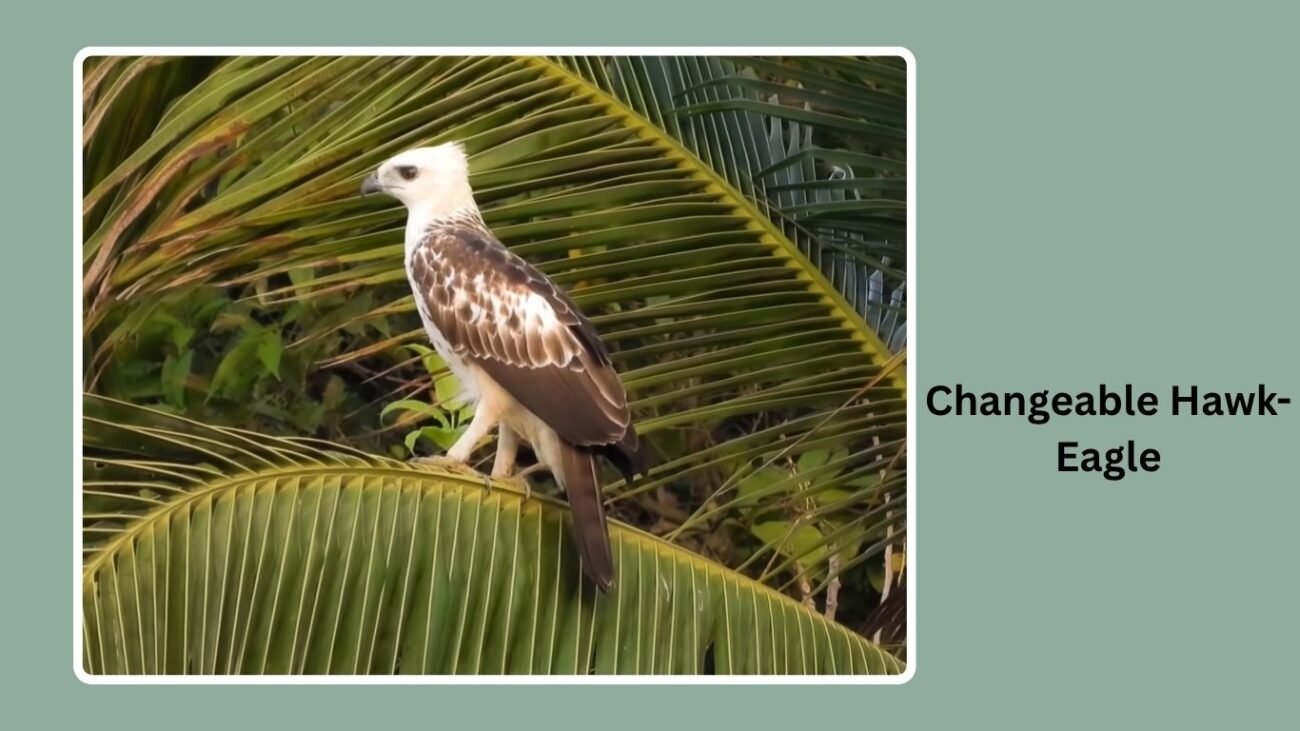
The Changeable Hawk-Eagle earns its name from its highly variable plumage—ranging from pale to dark morphs. Native to South and Southeast Asia, it’s a forest-dwelling raptor known for its fierce hunting skills and striking crest.
Identification
- Size: 23–28 inches long
- Wingspan: Around 4.5 feet
- Prominent crest on head
- Plumage highly variable: pale (streaked), dark, or intermediate
- Long, broad wings and tail
Habitat
Found in forests, wooded hills, and plantations throughout the Indian subcontinent, Southeast Asia, and Indonesia. Prefers dense canopy but sometimes seen soaring above treetops.
Behavior
Preys on birds, reptiles, and mammals. Hunts from perches or during short soaring flights. Known to raid nests of other birds. Builds platform nests high in trees.
Color Pattern
Can be streaked white with brown, entirely dark brown, or a mix of both. All morphs have a bold head crest and yellow eyes. Juveniles are paler with heavy streaking.
Flight Style
Strong, direct flier with steady wingbeats. Soars in wide circles when scanning for prey. Capable of sudden dives through canopy gaps.
28. Crested Goshawk (Accipiter trivirgatus)
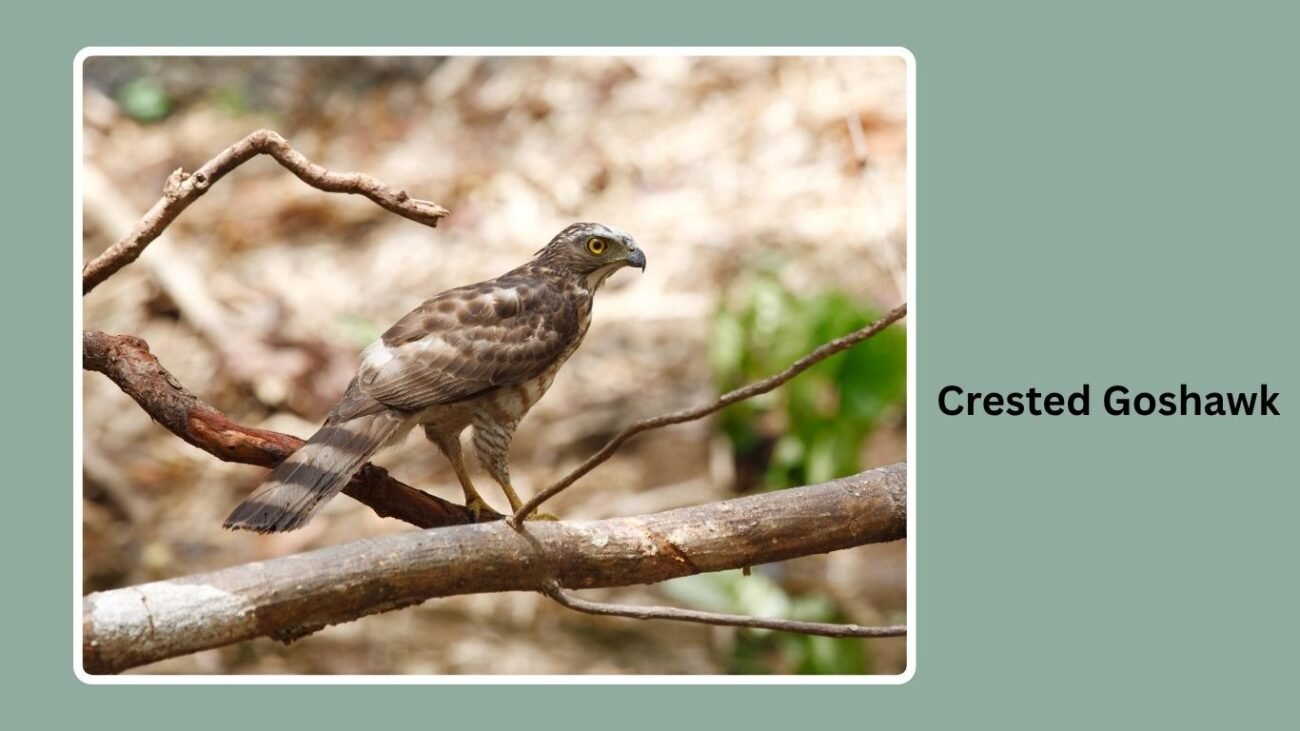
The Crested Goshawk is a small but fierce forest raptor found across South and Southeast Asia. Its bold crest and intense stare give it a commanding presence in the canopy, where it stealthily hunts small birds and mammals.
Identification
- Size: 12–16 inches long
- Wingspan: Around 2.5–3 feet
- Short, rounded wings and long tail
- Prominent black crest on head
- Brown upperparts and finely barred underparts
- Bright yellow eyes and legs
Habitat
Inhabits tropical and subtropical forests, plantations, and even city parks in India, Sri Lanka, Southeast Asia, and southern China. Often found perched quietly in dense foliage.
Behavior
A stealthy ambush predator, it waits silently and then launches short, explosive attacks on birds, lizards, and rodents. Also known for its piercing, repeated call during breeding.
Color Pattern
Adults have dark brown backs, white underparts with fine rufous barring, and a black crest that flares up when alert. Juveniles are paler with more streaking.
Flight Style
Rapid, low flights with a flap-flap-glide pattern typical of Accipiters. Can maneuver sharply through trees and glide short distances between perches.
29. Shikra (Accipiter badius)
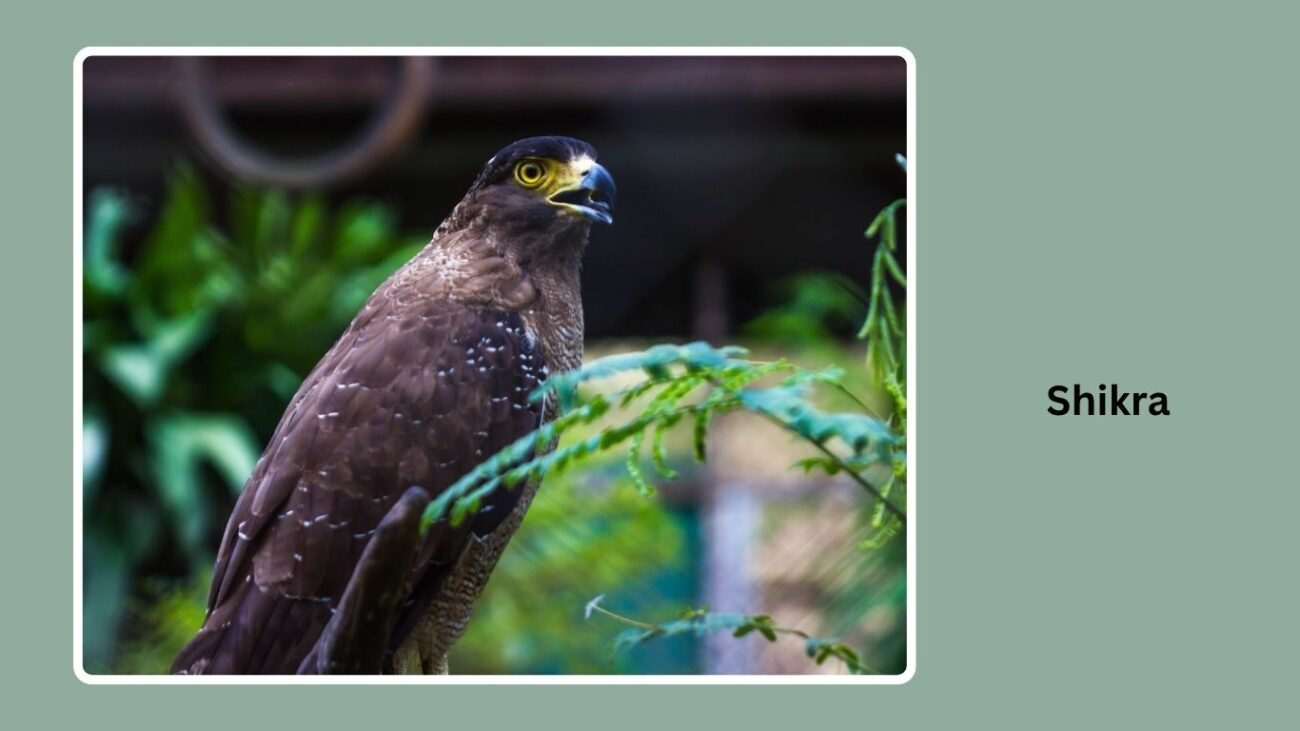
The Shikra is a small, agile hawk commonly found in India, the Middle East, and parts of Africa. Its ability to adapt to both wild and urban environments has made it one of the most familiar raptors in its range.
Identification
- Size: 10–14 inches long
- Wingspan: Around 2–2.5 feet
- Slender body with rounded wings and long tail
- Gray upperparts and finely barred underparts
- Red eyes in adults; yellow in juveniles
Habitat
Found in forests, farmlands, gardens, and cities across its range. Often seen perched on walls, fences, or tall trees in residential areas.
Behavior
Hunts small birds, lizards, and insects with fast, low chases through trees or open spaces. Extremely agile and capable of sudden changes in direction mid-flight.
Color Pattern
Gray above with a barred rufous chest and belly. Tail has distinct dark bands. Juveniles are browner and streaked vertically on the underparts.
Flight Style
Quick and darting with a flap-flap-glide rhythm. Known for low, straight-line flights during hunting and sudden aerial twists when pursuing agile prey.
30. Black-faced Hawk (Leucopternis melanops)
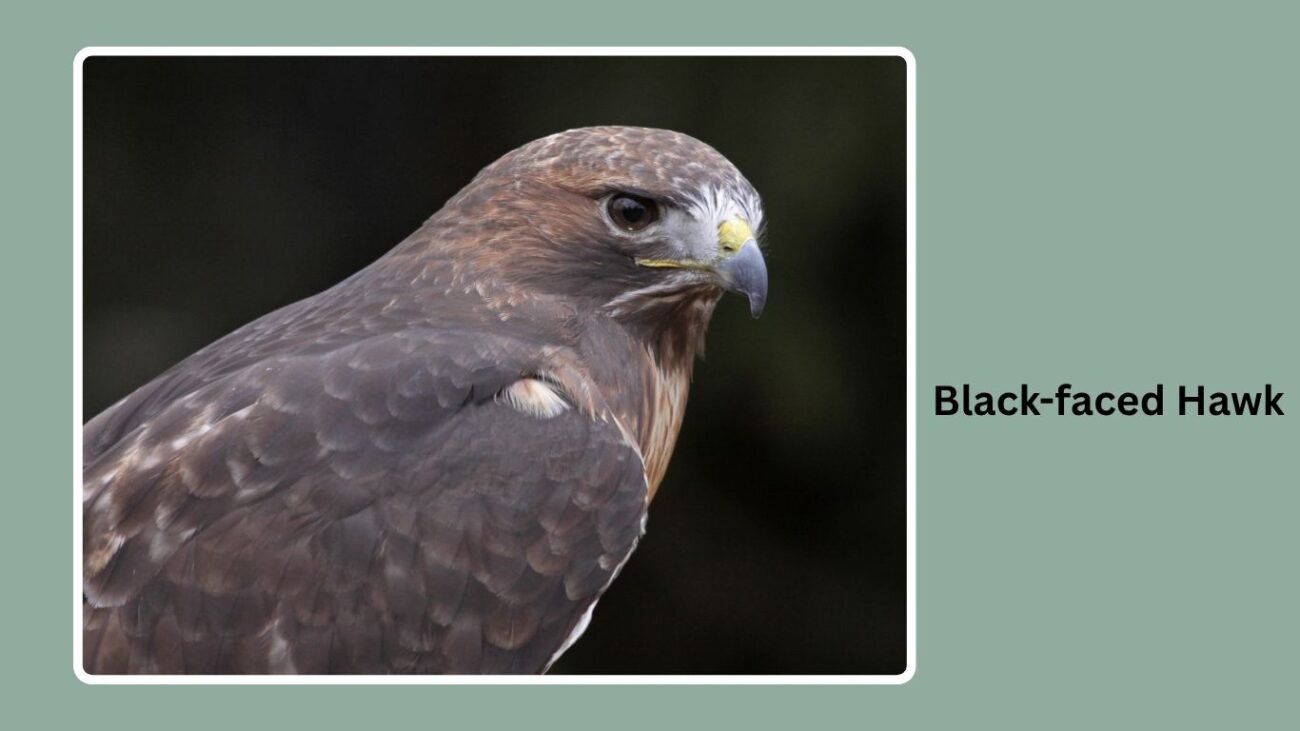
The Black-faced Hawk is a rarely seen raptor of the Amazon rainforest, notable for its bold facial markings and striking black-and-white plumage. Despite its limited range, it is sometimes mistaken for other forest hawks due to its elusive behavior.
Identification
- Size: 15–18 inches long
- Wingspan: Approx. 2.5–3 feet
- White head and underparts
- Black patch around the eyes extending to the nape
- Black wings with white barring
- Tail with black and white bands
Habitat
Inhabits dense lowland rainforests of the western Amazon Basin, primarily in Brazil, Colombia, and Peru. Typically seen along rivers and forest edges.
Behavior
Feeds on small birds, reptiles, and insects. Hunts from hidden perches within the canopy and occasionally along riverbanks. Rarely seen in flight for long durations.
Color Pattern
Bright white underside and head contrasted by a bold black mask and black upper wings. The banded tail and contrasting wing pattern stand out in forest clearings.
Flight Style
Short, low bursts through the forest. Infrequently soars; usually flies from perch to perch with short, flapping flights.
31. Savanna Hawk (Buteogallus meridionalis)
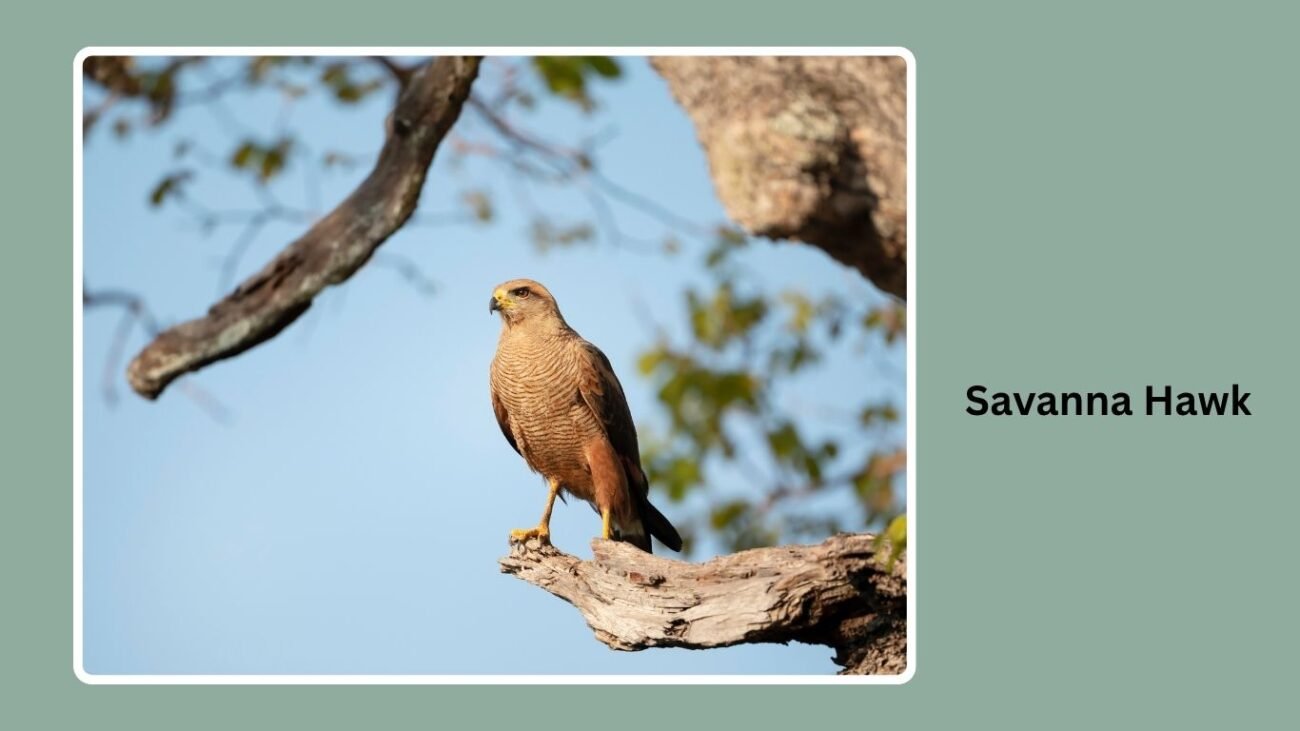
The Savanna Hawk is a broad-winged, long-legged raptor found in open habitats across South America. It is often seen perched conspicuously on fence posts, surveying grasslands for prey.
Identification
- Size: 20–23 inches long
- Wingspan: 4–4.5 feet
- Gray head and reddish-brown body
- Long yellow legs and pale tail with dark band
- Broad wings with black tips and pale patches
Habitat
Widespread in open country, including savannas, pastures, and wetlands from Panama to Argentina. Often nests in low trees or shrubs.
Behavior
Hunts on foot or from perches. Feeds on snakes, frogs, insects, and small mammals. Will scavenge and follow fires or farm machinery to catch fleeing prey.
Color Pattern
Rufous upperparts with grayer tones on the head. Wings are dark-tipped with pale panels visible in flight. Juveniles are mottled with more streaking.
Flight Style
Soars with slow, deep wingbeats. Frequently glides low over open ground, often flapping slowly when hunting or patrolling territory.
32. Plumbeous Hawk (Cryptoleucopteryx plumbea)
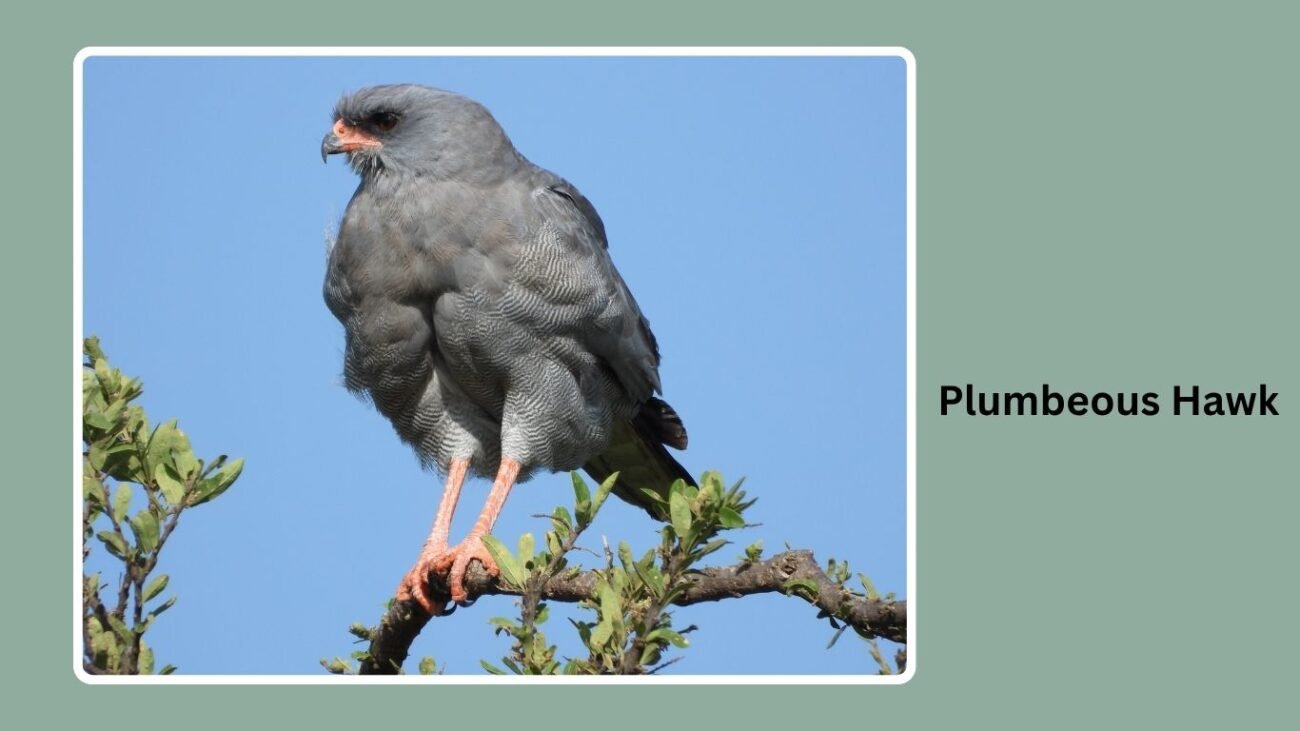
The Plumbeous Hawk is a secretive forest hawk of the Amazon Basin, rarely seen due to its dense rainforest habitat and shy nature. Its smoky-gray coloration allows it to blend effortlessly into the canopy shadows.
Identification
- Size: 14–18 inches long
- Wingspan: Approx. 3 feet
- Slate-gray body with paler throat
- Red eyes and yellow legs
- Short, rounded wings and long tail
Habitat
Inhabits tropical lowland rainforests, especially in Brazil, Colombia, Ecuador, and Peru. Prefers dense canopy and riverine forests far from human activity.
Behavior
Hunts birds, insects, and small reptiles from concealed perches. Often remains still for long periods, then bursts out to grab prey. Extremely secretive and hard to observe.
Color Pattern
Adults are solid lead-gray with a lighter chin. Red eyes contrast sharply with the dark plumage. Juveniles are more mottled, with some streaking and paler tones.
Flight Style
Quick and low through forest gaps. Uses short, rapid flapping and gliding to move between perches. Rarely soars.
33. Slate-colored Hawk (Buteogallus schistaceus)
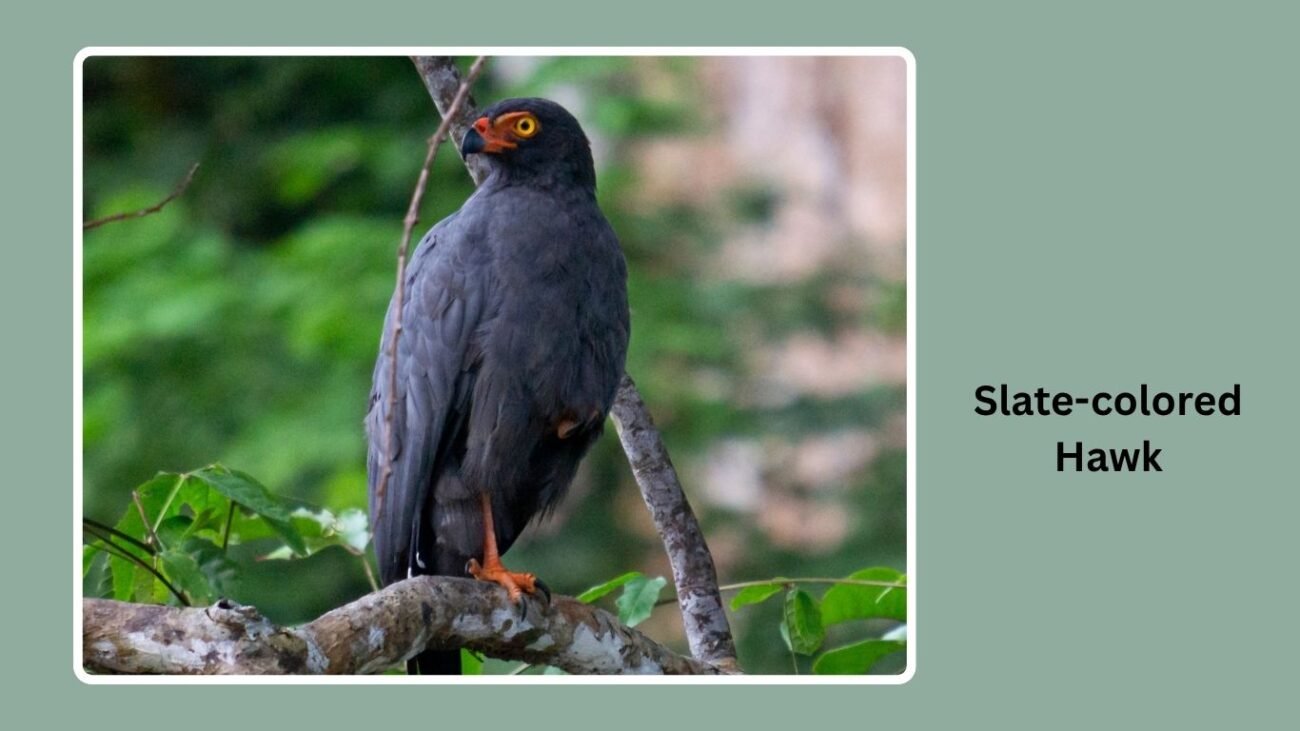
The Slate-colored Hawk is a bold-looking raptor of the western Amazon Basin. It favors swampy forests and floodplains and is often heard before seen due to its loud, high-pitched calls.
Identification
- Size: 17–21 inches long
- Wingspan: About 3.5 feet
- Uniform slate-gray plumage
- Black tail with a bold white band and white tip
- Orange cere and yellow legs
Habitat
Resides in tropical lowland forests, especially near rivers, wetlands, and seasonally flooded areas in Brazil, Bolivia, Colombia, and Peru.
Behavior
Feeds on amphibians, reptiles, crabs, and insects. Hunts from low perches and tree branches. Known for its piercing vocalizations, especially at dawn and dusk.
Color Pattern
Dark slate-gray body with a sharply banded black-and-white tail. The bright orange facial skin and yellow legs add contrast. Juveniles are streaked and paler.
Flight Style
Flies low over water and dense brush in direct, strong bursts. Occasionally soars briefly but mostly uses short, direct flights between hunting spots.
34. Ridgway’s Hawk (Buteo ridgwayi)
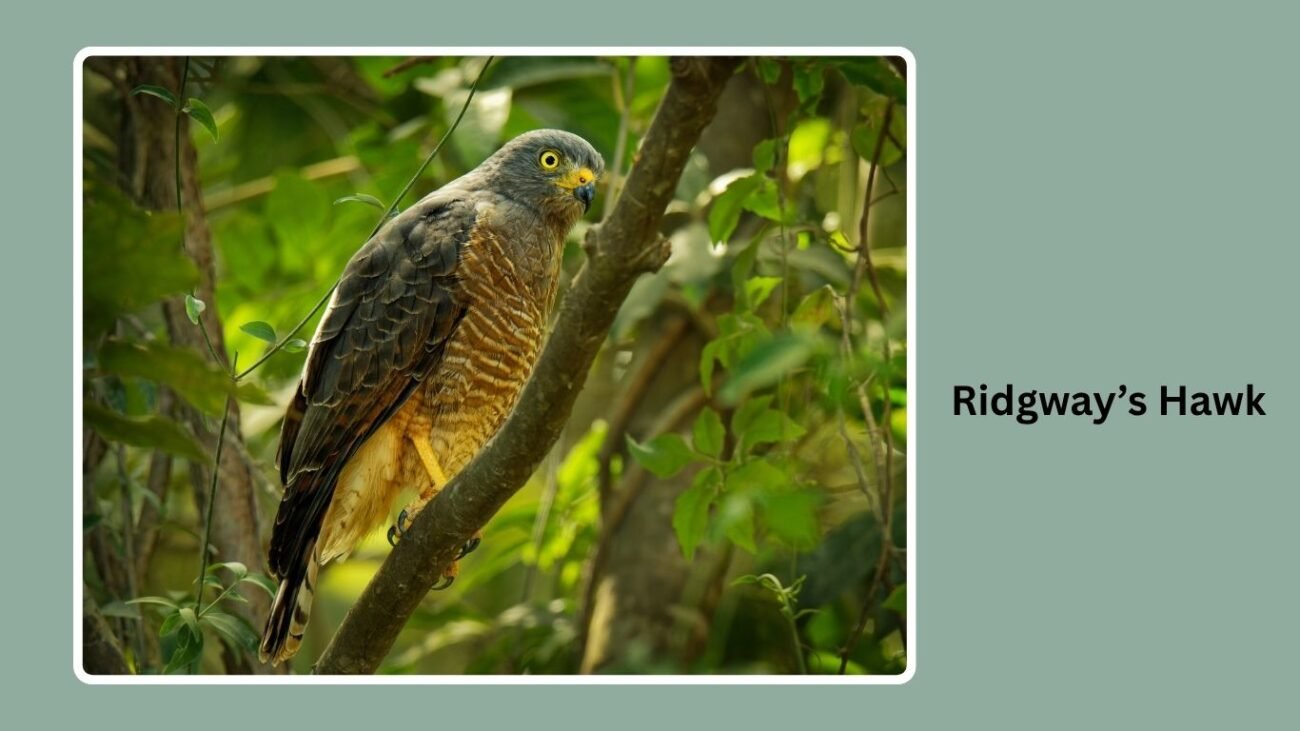
Ridgway’s Hawk is a critically endangered raptor endemic to the Caribbean island of Hispaniola, primarily found in the Dominican Republic. Due to deforestation and persecution, its population is extremely limited and under active conservation.
Identification
- Size: 14–17 inches long
- Wingspan: Around 2.5–3 feet
- Gray head and back
- Reddish underparts with faint barring
- Yellow legs and facial skin
- Short tail with subtle bands
Habitat
Survives in tropical forests, dry woodlands, and areas near farmland in the Dominican Republic. Primarily found in Los Haitises National Park and a few reintroduction zones.
Behavior
Feeds on small mammals, lizards, and birds. Hunts from perches and makes quick dashes through the canopy. Known for being quite tame in protected areas.
Color Pattern
Adults are medium gray above with reddish underparts and a faintly banded tail. Juveniles are browner with streaked undersides. Yellow facial skin is prominent in both.
Flight Style
Glides between trees or perches silently. Rarely soars—most flights are short, quick bursts when pursuing prey or defending territory.
35. Gray-lined Hawk (Buteo nitidus)
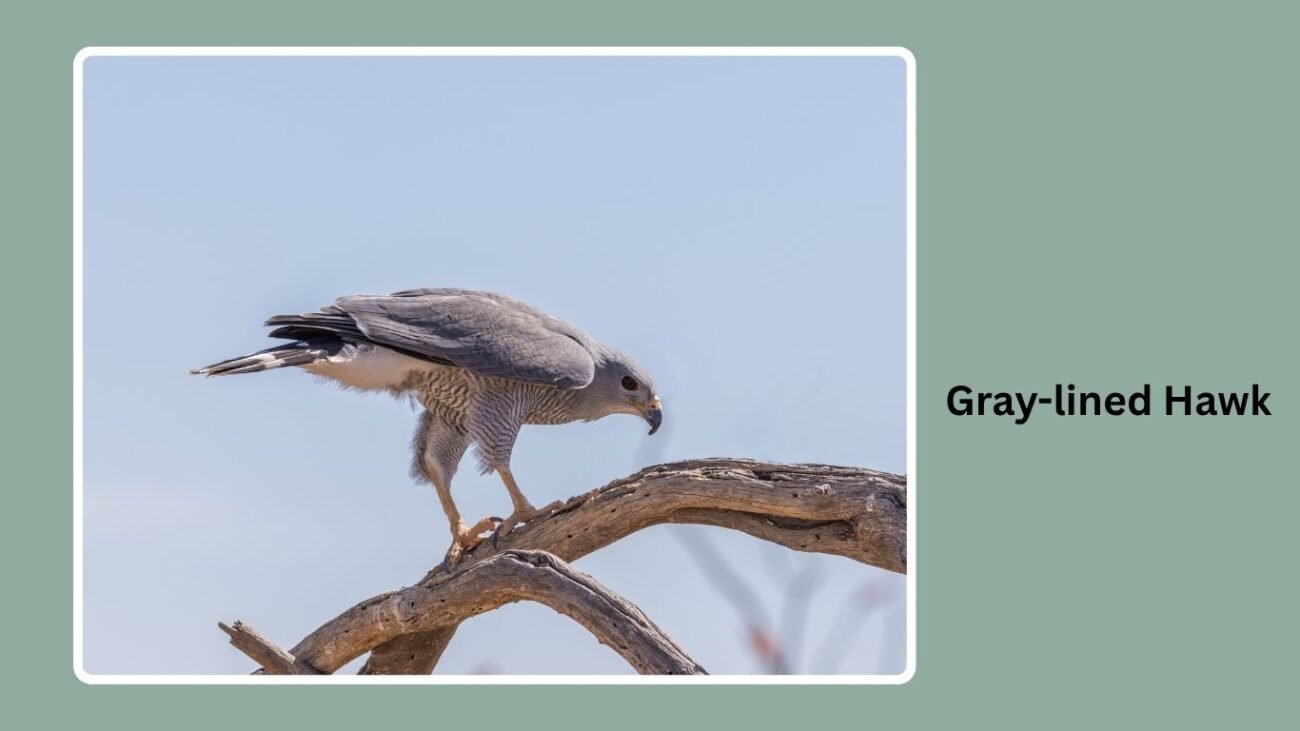
Formerly considered part of the Gray Hawk species, the Gray-lined Hawk is now treated as a distinct species found throughout Central and South America. It favors tropical edges and open areas with scattered trees.
Identification
- Size: 15–18 inches long
- Wingspan: About 3 feet
- Pale gray head and back
- Finely barred white underparts
- Black-and-white banded tail
- Bright yellow legs and cere
Habitat
Common in forest edges, savannas, plantations, and clearings from Mexico to Brazil. Often seen near water or perched along roads.
Behavior
Hunts reptiles, amphibians, and insects from exposed perches. Emits a loud, repeated whistle during breeding season. Active during the day and often seen basking in the sun.
Color Pattern
Light gray above with narrow white and gray barring on the underside. The bold tail bands and yellow legs make it easy to distinguish. Juveniles are browner with streaking.
Flight Style
Soars with wide, rounded wings and stable, gliding patterns. Also uses short flap-and-glide motion when flying between trees or hunting.