










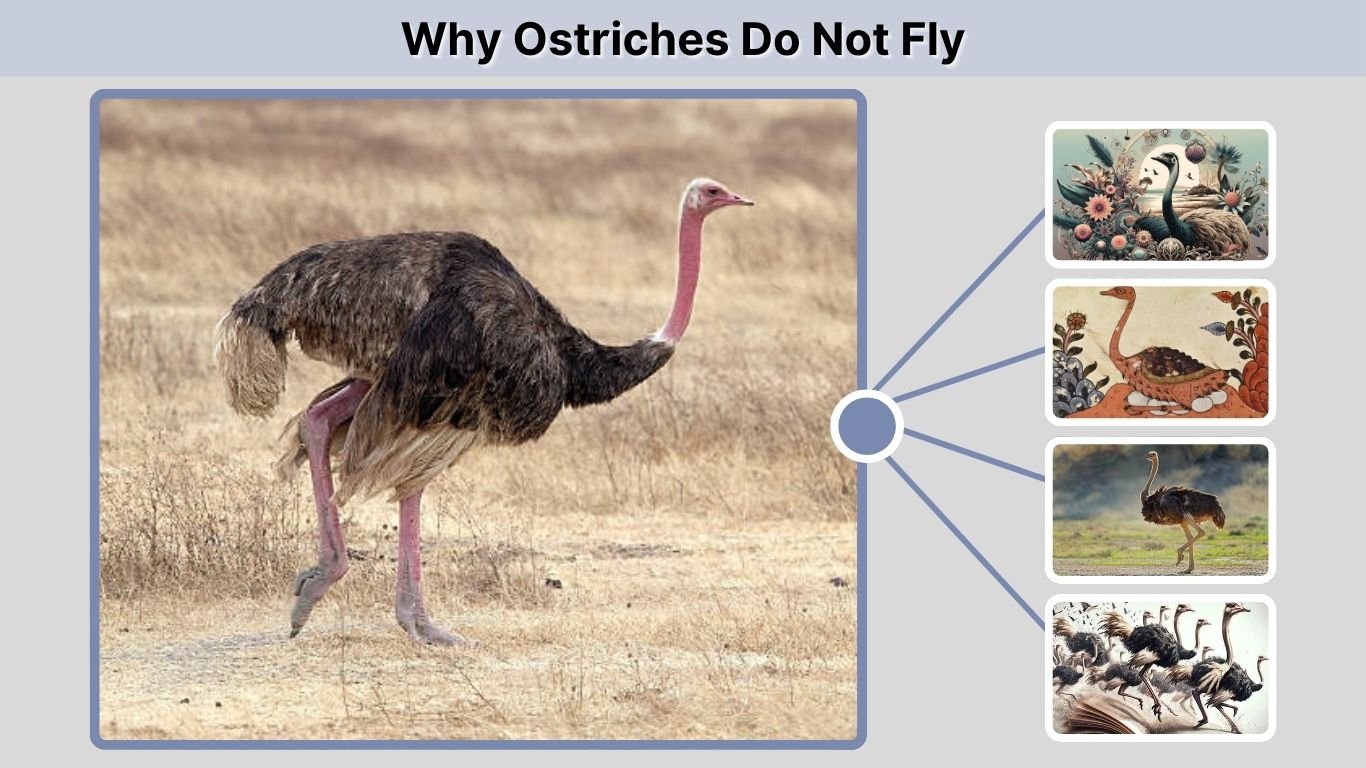
The ostrich is the largest bird on Earth, yet it cannot take flight. Despite having wings, these remarkable birds have evolved to thrive on land instead of in the air. Over millions of years, ostriches traded their ability to fly for speed, endurance, and powerful legs—traits that allow them to survive in open African plains where agility and quickness are essential.
Understanding the Question: Can Ostriches Fly?
Ostriches are members of a unique group known as flightless birds, or ratites. Unlike most birds, they lack the anatomy required for flight. Their wings are not built to generate lift, and their large bodies make airborne movement impossible. Instead, their wings serve specialized roles that help them in running, balance, and even courtship. Thus, while they have the form of a bird, their function is entirely terrestrial.
Physical Reasons Ostriches Cannot Fly
Body Weight and Wing Ratio
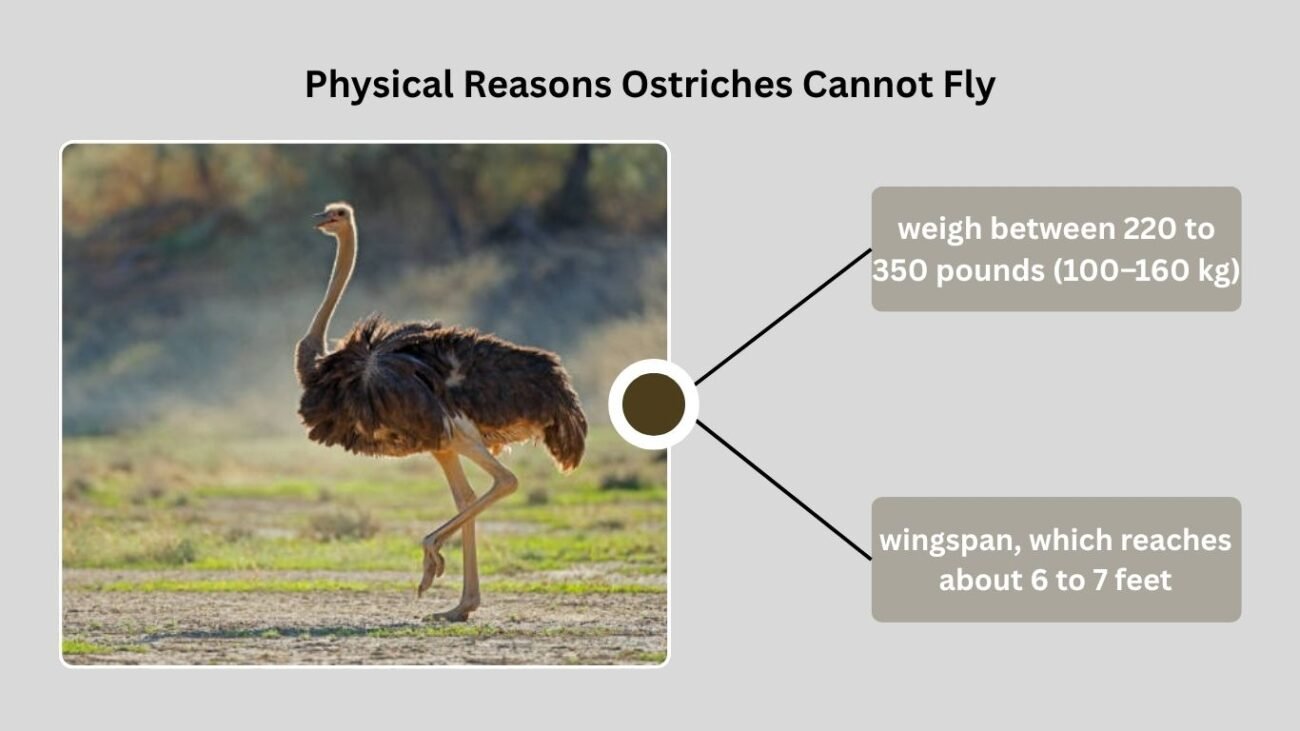
An adult ostrich can weigh between 220 to 350 pounds (100–160 kg), making it far too heavy for flight. Its wingspan, which reaches about 6 to 7 feet, is impressive but not nearly large enough to lift such a massive frame. Flying birds, like eagles or hawks, have lighter skeletons and a much higher wing-to-body ratio, giving them the necessary lift to stay airborne. The ostrich’s body evolved for strength and speed on land rather than the skies.
Skeletal Structure
The structure of the ostrich’s bones also explains its flightlessness. Unlike flying birds, which possess a keeled breastbone to anchor powerful flight muscles, the ostrich has a flat breastbone. This design offers no surface for strong pectoral muscle attachment, meaning the bird cannot generate the force needed for flight. Its skeletal system supports upright walking and running, with long, sturdy legs designed for balance and momentum.
Evolutionary Story Behind Flightlessness
From Flight to Running
Millions of years ago, the ancestors of modern ostriches could likely fly. As Earth’s climate and ecosystems shifted, especially in Africa’s open grasslands, flight became less necessary. Instead, survival favored speed and endurance on land. Ostriches adapted by developing powerful legs, larger bodies, and smaller wings. Over generations, natural selection prioritized ground mobility over flight ability.
Ratite Family Connection
Ostriches belong to a bird group called ratites, which includes emus, cassowaries, rheas, and kiwis. All these birds share similar evolutionary traits: flat breastbones, strong legs, and reduced wing structures. Among them, the ostrich is the largest and fastest. This shared ancestry suggests that all ratites descended from a common flying ancestor, later adapting to their respective environments by losing flight in favor of other survival strategies.
The Purpose of Ostrich Wings
Balance and Steering
Although ostriches cannot fly, their wings are far from useless. When running, ostriches use their wings as stabilizers. The wings act like natural rudders, helping the bird maintain balance and make quick turns at high speeds. This is crucial during predator chases, as their ability to pivot sharply can mean the difference between life and death.
Courtship and Display
During mating season, the wings take on another important role. Male ostriches perform elaborate courtship dances, spreading their wings wide, flapping rhythmically, and bowing to attract females. The contrasting colors of their feathers—black for males and brownish-gray for females—play a key role in communication and attraction. These displays also signal dominance and readiness to mate.
Muscle Adaptations for Running Instead of Flying
Ostriches are built for running, not flying. Their leg muscles are among the most powerful in the animal kingdom, especially the thigh and calf muscles responsible for forward propulsion. In contrast, their pectoral muscles—which birds use for flight—are small and weak. This trade-off allows ostriches to sprint at 40–45 mph (64–72 km/h), making them the fastest birds on land. Evolution shifted their muscular focus from lift to thrust, transforming them into specialists of terrestrial speed.
Why Do Ostriches Have Wings If They Can’t Fly?
Evolutionary Remnants
Ostrich wings are vestigial, meaning they’re remnants of a once-functional trait inherited from flying ancestors. Over time, as the need for flight disappeared, evolution repurposed the wings for new uses—balance, shade, and display—instead of eliminating them entirely. This phenomenon shows how evolution adapts existing structures for new survival roles.
Thermoregulation and Protection
In the intense African heat, ostriches spread their wings to cool themselves by increasing airflow around their bodies. Parents also use their wings to shield chicks from the sun and rain. Their feathers, while not designed for lift, help with temperature control and camouflage, blending the bird into its environment.
Do All Ostriches Fly?
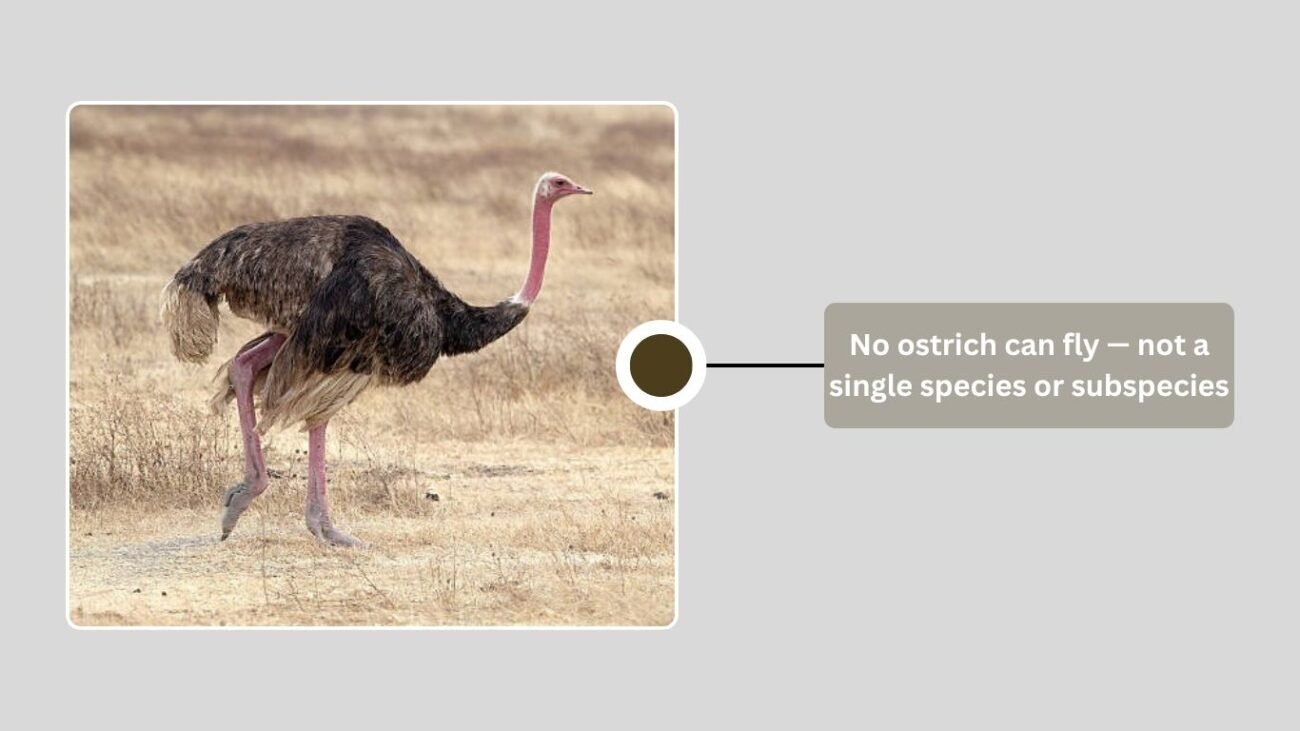
No ostrich can fly — not a single species or subspecies. All members of the ostrich family are entirely flightless. Variations do exist among different types of ostriches, such as differences in feather color or size, but none possess the anatomy required for flight. The structure of their wings and bones is simply not designed to lift their heavy bodies off the ground.
Myths about “flying ostriches” often come from cartoons or folklore, but in reality, ostriches rely on their speed and stamina, not wings, to survive. Over time, evolution removed the need for flight because their lifestyle on wide-open plains didn’t require it. Instead, their wings evolved to serve other purposes — a perfect example of nature’s adaptability.
Do Ostriches Try to Fly?
Ostriches sometimes flap their wings while running or during excitement, but this isn’t an attempt to fly. The movement helps with balance and agility, especially when making quick turns at high speed. Scientists also observe that young ostriches flap their wings during play, a behavior that mimics flying but actually strengthens their muscles and coordination.
This wing-flapping can be seen as an instinctive echo of their flying ancestors — an evolutionary reflex that remains, even though it serves new purposes. In some cases, the wings also help ostriches brake or steady themselves when stopping suddenly after a sprint.
Why Penguins and Ostriches Cannot Fly
Shared Adaptations
Penguins and ostriches share a fascinating evolutionary trait — both are flightless birds, but their wings have evolved for entirely different reasons. For penguins, wings became powerful flippers for swimming underwater. For ostriches, wings turned into tools for balance, display, and protection. In both cases, evolution adapted wings for the environment rather than eliminating them.
Environmental Influence
Penguins inhabit icy oceans where swimming is essential, while ostriches live on vast African plains where running saves lives. Their wings evolved along separate paths, yet both species demonstrate how the environment shapes anatomy. This transformation highlights evolution’s efficiency — adapting body parts for new survival purposes instead of removing them entirely.
Speed as an Alternative to Flight
Running as a Defense Mechanism
For ostriches, flight is unnecessary because they are natural speed champions. With powerful legs and long strides, they can reach speeds up to 45 miles per hour (72 km/h). This makes them faster than most land predators. When chased, ostriches often zigzag or suddenly change direction, using their wings to stay balanced.
Their two-toed feet, unlike most birds’ three or four, give them a lighter and more efficient push-off. Combined with strong tendons and flexible joints, this allows for exceptional speed and endurance. Essentially, ostriches replaced wings for legs of power, an evolutionary trade that ensures survival in open habitats.
Endurance Advantage
Predators such as lions and cheetahs can accelerate quickly, but they tire fast. Ostriches, on the other hand, can maintain moderate running speeds for extended distances, often outlasting their pursuers. This stamina gives them a huge evolutionary edge, allowing them to cover ground efficiently while searching for food or escaping threats.
Human Fascination and Scientific Importance

Study of Biomechanics
Scientists often study ostriches to understand the mechanics of bipedal movement. Their legs work much like springs — storing energy when the foot hits the ground and releasing it during the next step. This natural design has influenced research in robotics, prosthetics, and athletic engineering, helping humans create more efficient motion systems.
Symbolism and Culture
Ostriches have long captured human imagination. Ancient Egyptians saw them as symbols of truth and balance, while modern cultures often depict them as comical for their inability to fly. However, the myth that ostriches bury their heads in sand is false — they actually lower their heads to the ground to blend in with surroundings when threatened.
Ostriches represent adaptation and survival, proving that even without flight, evolution can create a creature perfectly suited to its environment.
FAQs
Why do ostriches not fly even when they have wings?
Ostriches cannot fly because their bodies are too heavy and their wings too small to generate lift. Their skeleton and muscle structure evolved for running, not flying, making them the fastest birds on land but flightless in the air.
What do ostriches use their wings for?
They use their wings for balance while running, mating displays, temperature control, and protection for chicks. Wings help them steer and stabilize their movement rather than provide flight power.
Did ostriches ever fly in the past?
Yes, their ancestors likely had the ability to fly millions of years ago. As they adapted to open landscapes, natural selection favored ground speed and endurance, eventually phasing out the need for flight.
Do emus or ostriches fly?
Neither emus nor ostriches can fly. Both are ratites, a group of flightless birds that evolved with strong legs for running instead of wings for flying.
Why do penguins and ostriches not fly?
Both species adapted their wings for specific environments — penguins for swimming and ostriches for running. Evolution shaped them differently, prioritizing survival in their unique habitats rather than maintaining flight ability.


