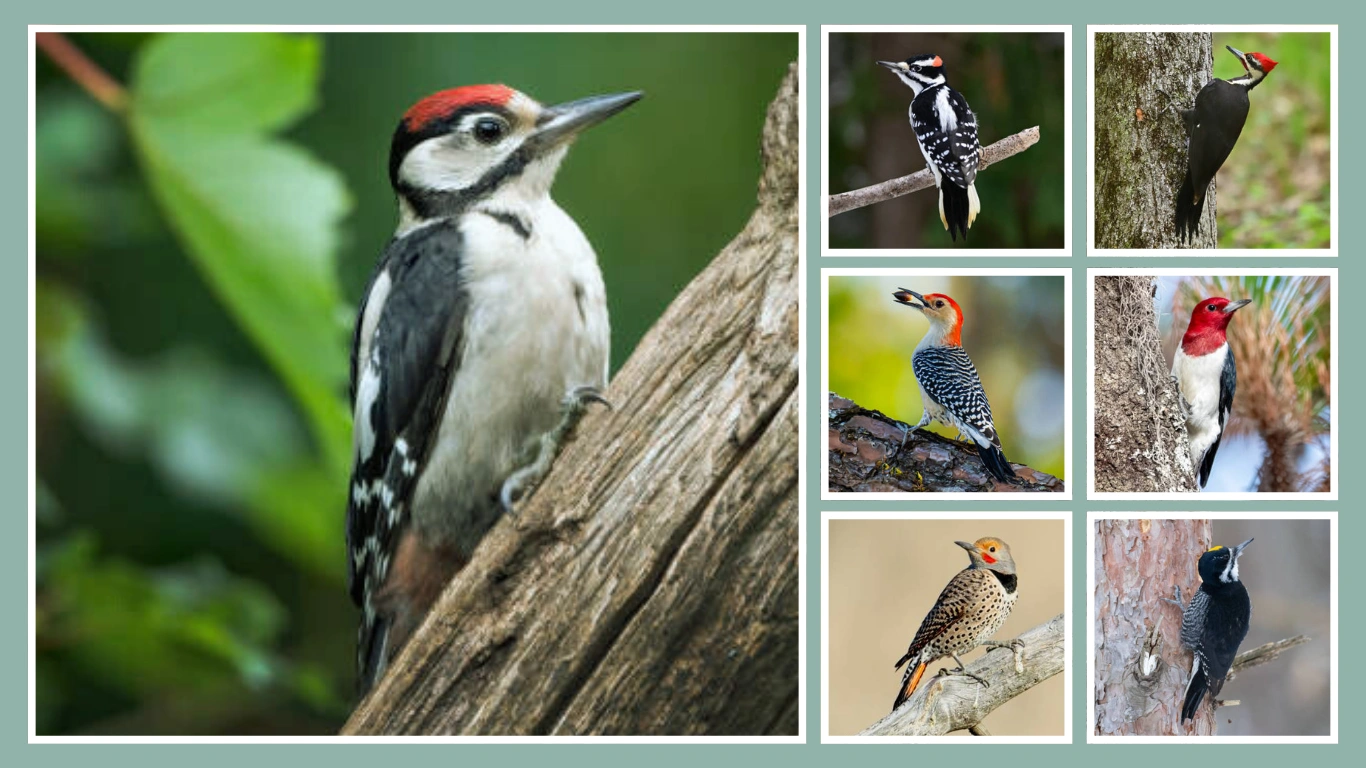
Michigan’s diverse forests and changing seasons support a wide variety of woodpecker species—from tiny Downy Woodpeckers in backyard feeders to elusive Black-backed Woodpeckers deep in the Upper Peninsula’s boreal woods. This guide covers 10 woodpecker species found across Michigan, highlighting how to identify each one, where they’re found in the state, their preferred habitats, and how long they typically live in the wild.
1. Downy Woodpecker
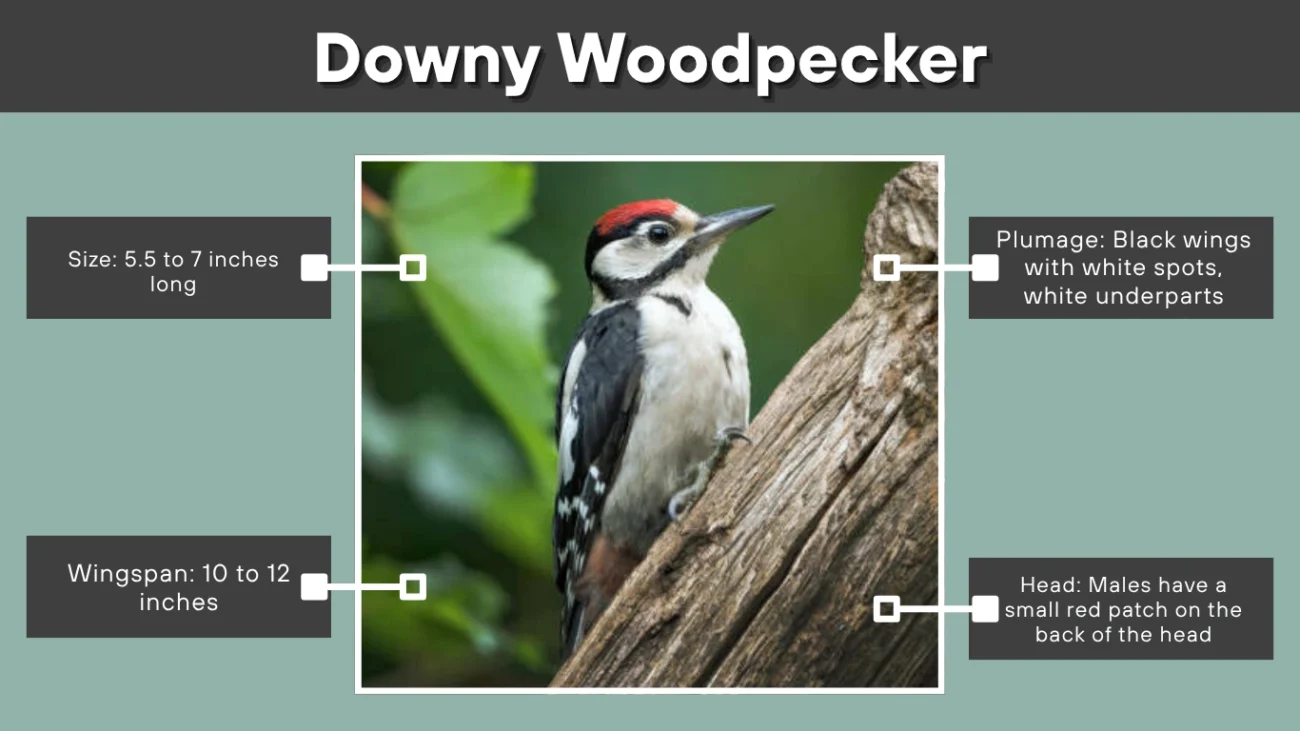
The Downy Woodpecker (Dryobates pubescens) is the smallest and one of the most widespread woodpecker species in Michigan. Its friendly behavior and adaptability make it a frequent visitor to bird feeders and wooded neighborhoods.
Identification
- Size: 5.5 to 7 inches long
- Wingspan: 10 to 12 inches
- Plumage: Black-and-white body, white underparts, barred wings
- Head: Males have a small red patch on the back of the head; females do not
- Bill: Short and straight
- Behavior: Agile climber; drums on tree trunks and branches while foraging for insects
Where Found in Michigan
Found year-round across both the Lower and Upper Peninsulas. Common in forests, parks, and suburban areas statewide.
Habitat
Occupies a wide range of habitats, including mixed woodlands, deciduous forests, urban parks, orchards, and backyards. Prefers areas with dead or dying trees for nesting and feeding.
Lifespan
Typically lives 4 to 6 years in the wild, though individuals can reach up to 11 years under favorable conditions.
2. Hairy Woodpecker
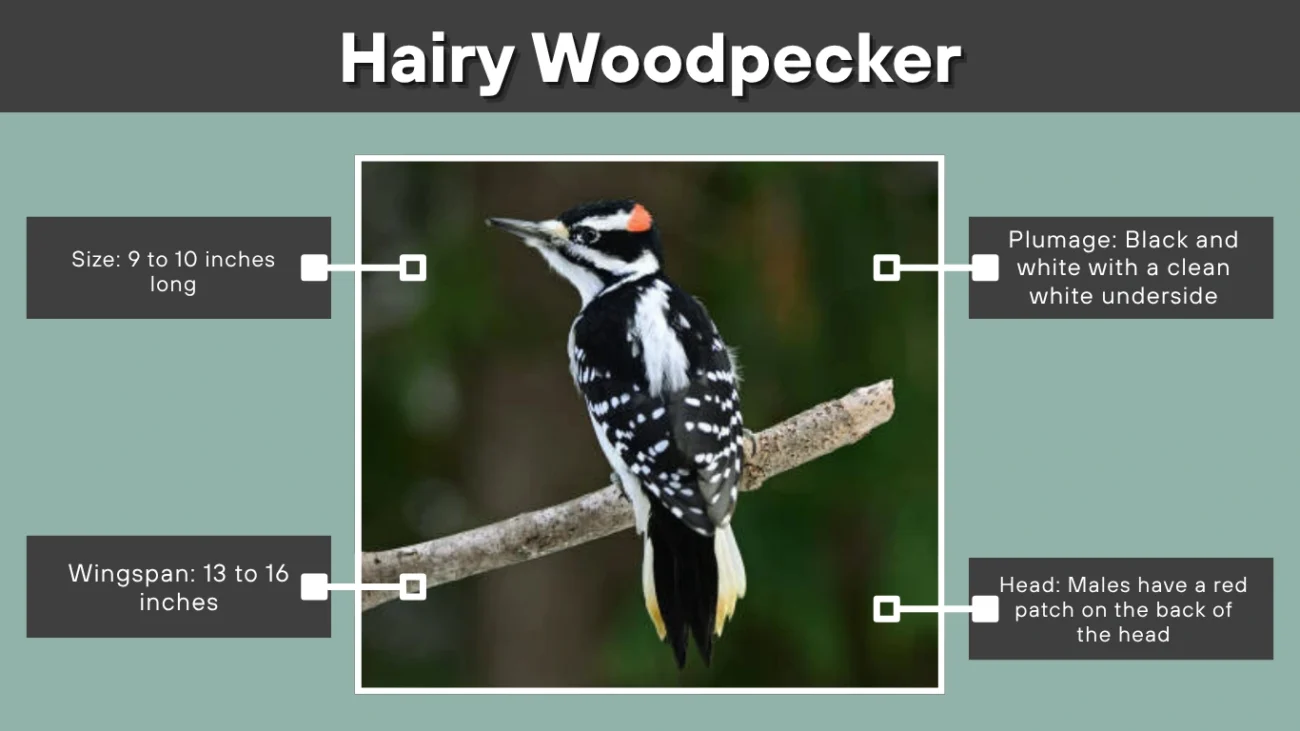
The Hairy Woodpecker (Dryobates villosus) looks similar to the Downy but is larger and more reclusive. It prefers mature forests and is often heard before seen, thanks to its strong drumming.
Identification
- Size: 9 to 10 inches long
- Wingspan: 13 to 16 inches
- Plumage: Black-and-white body, white underparts, white back stripe
- Head: Males have a red patch at the back of the head
- Bill: Long and nearly as long as the head—distinguishing it from the Downy
- Behavior: Strong, steady drumming; forages for beetle larvae under bark
Where Found in Michigan
Common throughout the state all year, in both the Upper and Lower Peninsulas. Most frequently seen in forested regions and natural areas.
Habitat
Prefers mature deciduous and mixed forests, especially with large dead trees. Also found in state parks, forest preserves, and wooded rural properties.
Lifespan
Lives on average 5 to 15 years in the wild. Its deeper drilling technique allows access to food sources unavailable to smaller species.
3. Pileated Woodpecker
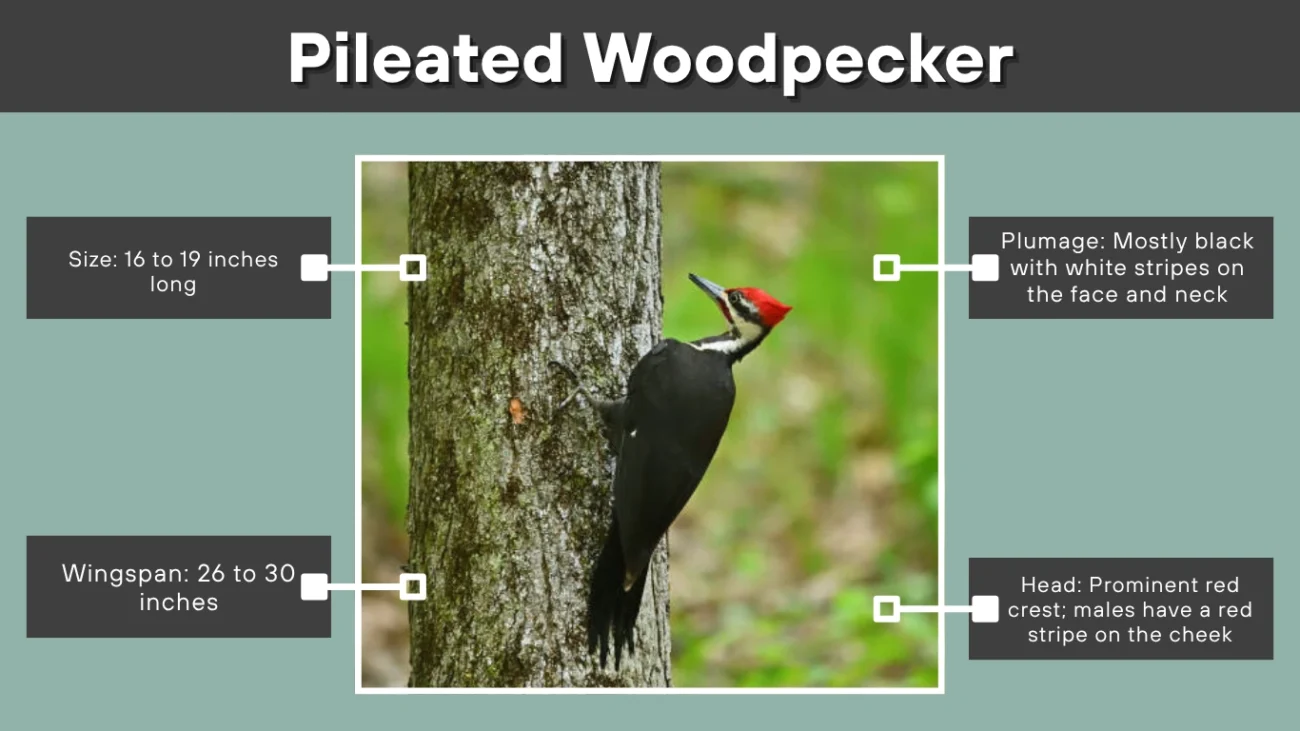
The Pileated Woodpecker (Dryocopus pileatus) is the largest woodpecker in Michigan and one of the most impressive birds in North America. With its loud calls and deep rectangular holes in trees, it’s hard to miss in mature forests.
Identification
- Size: 16 to 19 inches long
- Wingspan: 26 to 30 inches
- Plumage: Mostly black with white stripes on the neck and large white wing patches visible in flight
- Head: Both sexes have a bright red crest; males have an additional red stripe on the cheek
- Bill: Very long and chisel-shaped
- Behavior: Creates large, rectangular holes in trees while searching for carpenter ants and beetle larvae
Where Found in Michigan
Found year-round throughout Michigan, including the Upper Peninsula and large wooded areas of the Lower Peninsula. More common in remote, forested landscapes but increasingly seen in larger suburban parks with mature trees.
Habitat
Prefers extensive tracts of mature deciduous or mixed forests. Often found in bottomland hardwoods, old-growth woodlands, and swampy areas with standing dead trees for nesting and feeding. Also visits wooded suburbs with large trees and minimal disturbance.
Lifespan
Typically lives 9 to 13 years in the wild, with some individuals reaching up to 15 years. Their reliance on old trees for nesting makes them vulnerable to logging and habitat loss, though they are currently stable in Michigan.
4. Red-bellied Woodpecker

The Red-bellied Woodpecker (Melanerpes carolinus) is a striking and vocal species that has expanded its range northward in recent decades. Despite its name, its red crown is far more visible than the faint red wash on its belly.
Identification
- Size: 9 to 10.5 inches long
- Wingspan: 15 to 18 inches
- Plumage: Pale gray face and underparts, black-and-white barred back
- Head: Males have a red crown and nape; females only have red on the nape
- Bill: Medium-length and straight
- Behavior: Frequently calls with a loud “churr” sound; visits feeders for suet and seeds
Where Found in Michigan
Increasingly common throughout the Lower Peninsula and parts of the Upper Peninsula, especially in the southern and central regions. A year-round resident, even during snowy winters.
Habitat
Thrives in open deciduous woodlands, mixed forests, river floodplains, and wooded suburban neighborhoods. Adapts well to human-altered environments with mature trees. Nests in cavities carved into dead or decaying wood.
Lifespan
Lives 6 to 12 years in the wild. It has benefited from forest regeneration and the popularity of bird feeders, helping expand its range northward into more of Michigan.
5. Red-headed Woodpecker

The Red-headed Woodpecker (Melanerpes erythrocephalus) is one of the most visually striking woodpeckers in Michigan, instantly recognized by its deep red head and bold color contrast. It’s also one of the few woodpeckers that stores food and catches insects in flight.
Identification
- Size: 7.5 to 9 inches long
- Wingspan: 16 to 17 inches
- Plumage: Bright red head, snow-white body, black back with white wing patches
- Bill: Straight, strong, and black
- Behavior: Known for caching food in bark crevices and catching flying insects mid-air
Where Found in Michigan
Most commonly seen in southern Michigan, especially in open woodlands, groves, orchards, and agricultural areas. Populations decline northward, but some can still be found in central and southeastern regions. Present from spring through fall, though a few may overwinter.
Habitat
Prefers open habitats such as oak savannas, forest edges, and areas with standing dead trees or snags. It thrives in locations with minimal understory and scattered mature trees. Nesting typically occurs in dead limbs or utility poles.
Lifespan
Typically lives around 9 to 12 years in the wild. Habitat loss and competition for nesting cavities have led to population declines in some areas of Michigan, prompting conservation efforts in local preserves.
6. Northern Flicker

The Northern Flicker (Colaptes auratus), particularly the yellow-shafted variety, is a unique ground-foraging woodpecker often seen probing for ants in Michigan lawns, fields, and forest edges.
Identification
- Size: 11 to 12 inches long
- Wingspan: 16 to 20 inches
- Plumage: Brownish with black bars on the back, spotted underparts, black crescent on the chest
- Head: Males have a black mustache mark; yellow-shafted form has a red patch on the nape
- Tail/Wings: Yellow shafts on the wings and tail feathers
- Behavior: Frequently feeds on the ground, especially for ants—their primary food
Where Found in Michigan
Common and widespread across the state during spring, summer, and fall. Many migrate south for winter, but some may overwinter in southern Michigan, especially in mild years.
Habitat
Prefers open woodlands, forest clearings, fields with scattered trees, and even suburban lawns. Nests in tree cavities or birdhouses, often returning to the same site each year.
Lifespan
Lives an average of 6 to 9 years in the wild. Flickers benefit from grassy open areas for foraging and large trees for nesting but are vulnerable to habitat fragmentation and competition with invasive species like European Starlings.
7. Yellow-bellied Sapsucker

The Yellow-bellied Sapsucker (Sphyrapicus varius) is the only truly migratory woodpecker species in Michigan. Known for drilling neat rows of sap wells in tree bark, it plays a unique ecological role by creating feeding sites for other birds and insects.
Identification
- Size: 7 to 8.5 inches long
- Wingspan: 13 to 16 inches
- Plumage: Black-and-white patterned back, pale yellow belly, and red crown; males also have a red throat
- Bill: Medium-length, straight and slightly pointed
- Behavior: Feeds on tree sap and insects attracted to sap wells; returns to the same trees regularly
Where Found in Michigan
Breeds widely across northern Michigan, including much of the Upper Peninsula and northern Lower Peninsula. Seen during spring and fall migration throughout the state. Winters in the southeastern U.S., not in Michigan.
Habitat
Breeds in deciduous and mixed forests, especially areas with birch, maple, or aspen trees. During migration, it visits orchards, suburban yards, and wooded wetlands where sap-producing trees are available.
Lifespan
Typically lives 5 to 7 years. Migratory behavior makes it more vulnerable to habitat changes along both breeding and wintering grounds.
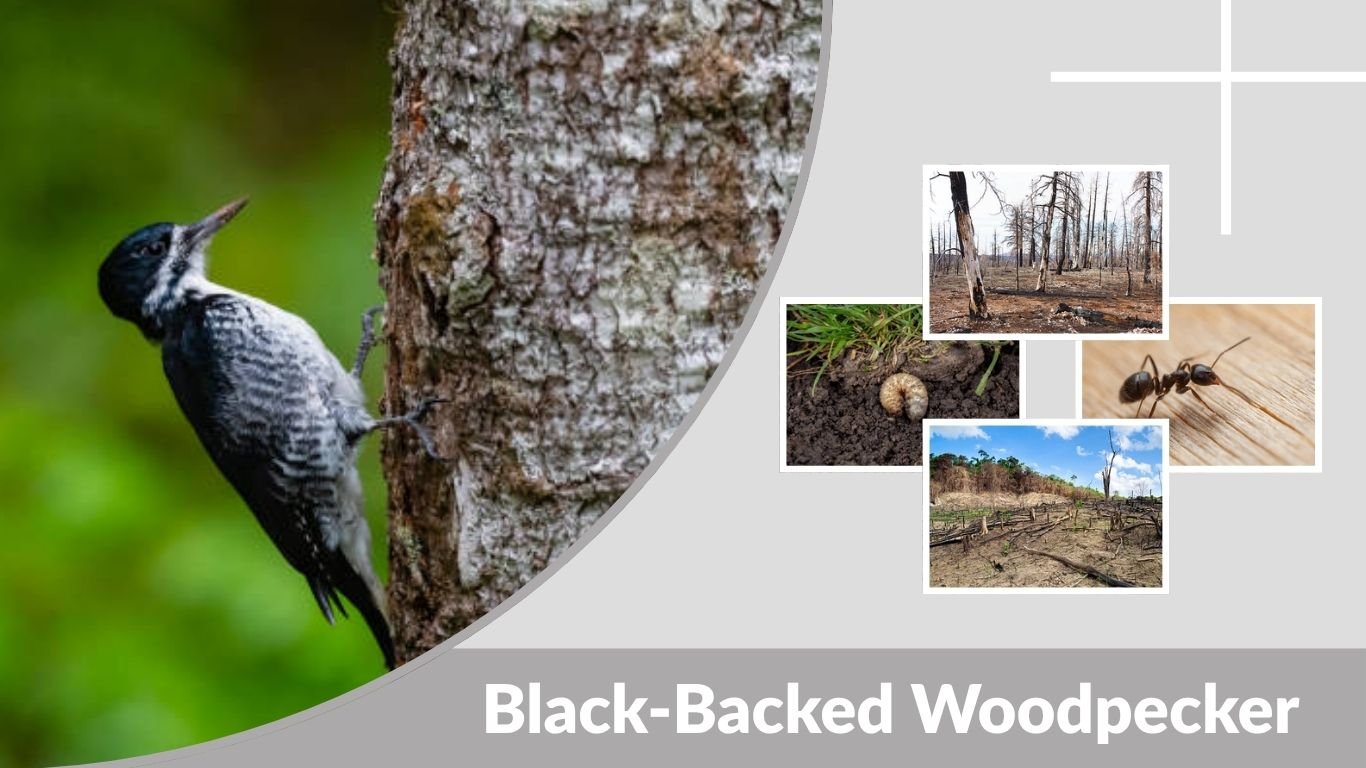
8. Black-backed Woodpecker
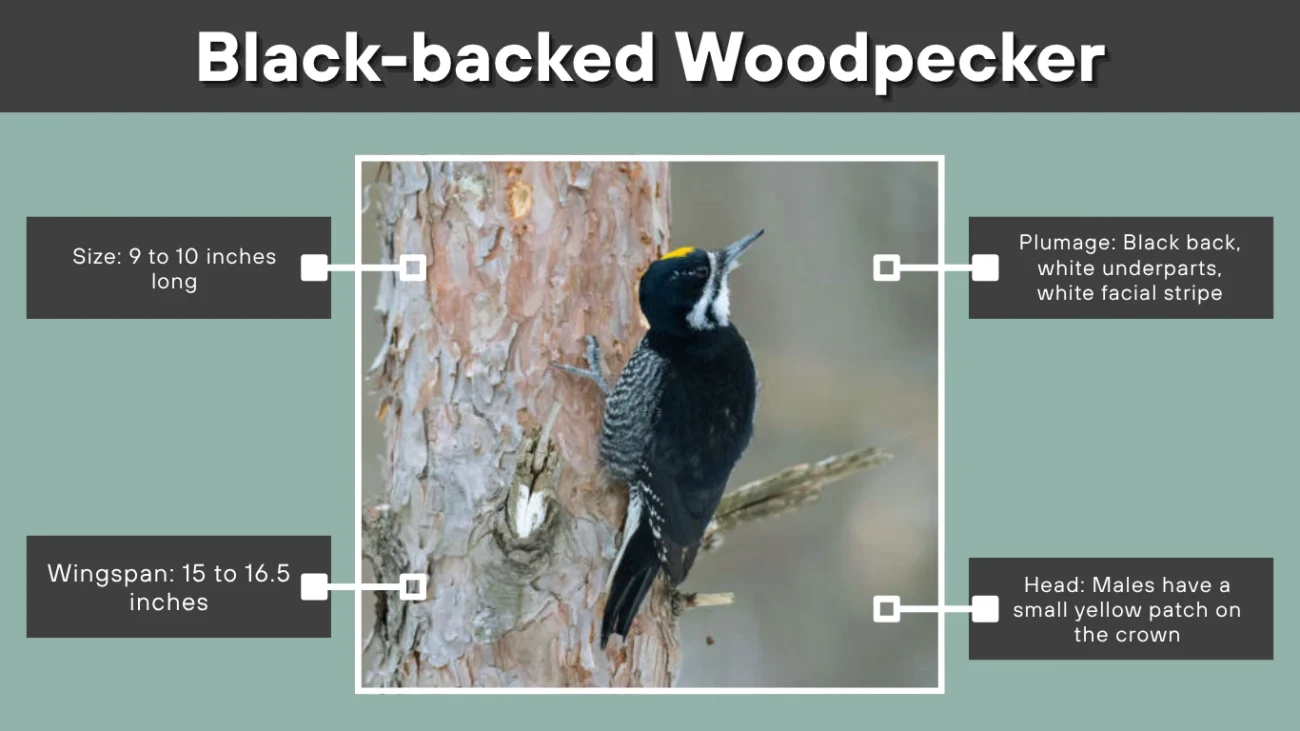
The Black-backed Woodpecker (Picoides arcticus) is a boreal forest specialist found mainly in Michigan’s Upper Peninsula. It thrives in recently burned conifer forests, where it forages for wood-boring beetle larvae.
Identification
- Size: 9 to 10 inches long
- Wingspan: 15 to 16.5 inches
- Plumage: Entirely black back, white underparts, and white facial stripes
- Head: Males have a small yellow patch on the crown
- Bill: Long and powerful, adapted for stripping bark
- Behavior: Very quiet and still; often clings to charred tree trunks in post-burn areas
Where Found in Michigan
Primarily found in the Upper Peninsula, especially in boreal spruce-fir and jack pine forests. Strongly associated with recent burn sites and disturbed forests. Rare to absent in the Lower Peninsula.
Habitat
Prefers burned or beetle-infested coniferous forests where it can strip bark to find insect larvae. Common in remote, undisturbed wilderness, especially in protected forest reserves and fire-managed zones.
Lifespan
Usually lives 6 to 8 years. Population density fluctuates based on wildfire cycles and insect outbreaks, making them sensitive to forest management practices.
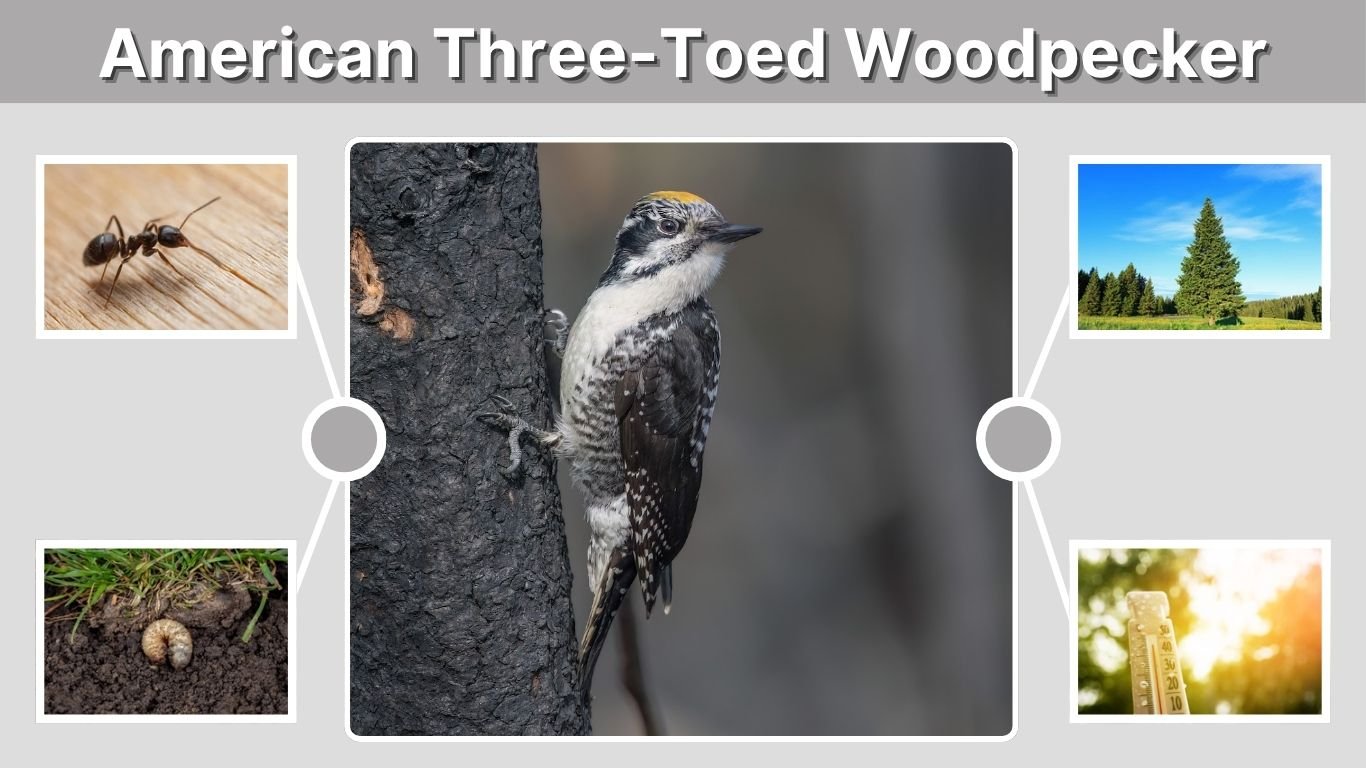
9. American Three-toed Woodpecker

The American Three-toed Woodpecker (Picoides dorsalis) is a secretive and uncommon species in Michigan, most likely to be found in the remote boreal forests of the Upper Peninsula. It is adapted to cold climates and specializes in feeding on bark beetle larvae.
Identification
- Size: 8.5 to 9.5 inches long
- Wingspan: 14.5 to 15.5 inches
- Plumage: Black-and-white barred back, pale underparts
- Head: Males have a yellow crown; females have a black crown
- Bill: Short and chisel-like
- Behavior: Forages quietly, flaking bark off dead or dying conifers to access insects underneath
Where Found in Michigan
Rare and localized, mostly in the Upper Peninsula. May be seen in remote spruce, fir, or tamarack swamps, particularly after insect outbreaks or windstorms. Not typically found in the Lower Peninsula.
Habitat
Prefers cold, damp boreal forests dominated by spruce, fir, or tamarack trees. Especially attracted to forests recently affected by fire, disease, or beetle infestations. Requires old-growth or mature trees for nesting and feeding.
Lifespan
Typically lives 5 to 7 years. Its population depends heavily on the presence of beetle-infested trees, making it vulnerable to changes in forest health and fire suppression practices.
10. Red-cockaded Woodpecker (Historically Documented — Now Absent)

The Red-cockaded Woodpecker (Dryobates borealis) is a federally endangered species that was historically recorded in Michigan, though it is now considered extirpated (no longer present) in the state. It was once found in the far southern edge of the Lower Peninsula.
Identification
- Size: 7.5 to 9 inches long
- Wingspan: 14 to 16 inches
- Plumage: Black-and-white barred back, white cheeks, and small red streak (“cockade”) behind the eye in males
- Bill: Small and sharply pointed
- Behavior: Social and cooperative; lives in groups and excavates nest cavities in living pines
Where Found in Michigan
No confirmed populations currently exist in Michigan. Historical records suggest it may have occurred at the extreme northern edge of its range, in old-growth pine forests in southern Michigan. Today, its range is restricted to the southeastern U.S.
Habitat
Requires mature longleaf pine ecosystems, which are not typical in Michigan. It excavates nesting cavities in living pine trees, often infected with heart rot. Its strict habitat needs likely led to its disappearance from the state.
Lifespan
Lives around 6 to 12 years. Extensive conservation programs are ongoing in the southeastern U.S., but it is no longer considered part of Michigan’s modern bird fauna.
FAQs
What is the most common woodpecker in Michigan?
The Downy Woodpecker is the most widespread and commonly seen woodpecker in Michigan. It thrives in forests, parks, and suburban areas year-round.
Are Pileated Woodpeckers rare in Michigan?
No, Pileated Woodpeckers are not rare. They are regularly found throughout Michigan, especially in mature forests and larger wooded parks. Their large size and loud calls make them easy to recognize.
Do any woodpeckers migrate in or out of Michigan?
Yes. The Yellow-bellied Sapsucker is Michigan’s only truly migratory woodpecker. It breeds in northern Michigan during summer and migrates south in winter.
Where can I see rare woodpeckers like the Black-backed or Three-toed Woodpecker?
These species are mostly found in the Upper Peninsula, especially in remote spruce-fir forests and recently burned areas. Look in managed wilderness areas or state forests.
Can woodpeckers damage trees or property in Michigan?
Woodpeckers can sometimes damage trees or wood siding when searching for insects or creating nesting cavities. However, most species target dead or infested wood and rarely cause serious harm to healthy trees.