Several woodpecker species in North America feature striking red markings on their heads—some with fully red crowns, others with bold throat patches or small red spots. These markings help with identification in the field and often vary by sex and region. This guide highlights 12 woodpecker species known for their red-headed traits, including their appearance, habitats, behaviors, and where they’re commonly found.
1. Red-headed Woodpecker

The Red-headed Woodpecker (Melanerpes erythrocephalus) is one of the most striking and unmistakable woodpeckers in North America. Its bold color contrast and all-red head make it easy to identify, even from a distance. This bird is not only a visual standout but also one of the few woodpecker species known to store food and catch insects in midair.
Head and Body Color
- Head: Entirely deep, glossy crimson red
- Body: Bright white underparts, black back, and large white wing patches that flash in flight
Identification
- Size: 7.5 to 9 inches long
- Wingspan: 16 to 17 inches
- Bill: Straight, black, and sharply pointed
- Behavior: Highly active and vocal; often seen flying out to catch insects or storing nuts and acorns in tree crevices and utility poles
Where Found
Commonly found in the eastern and central United States, especially in open oak woodlands, pine savannas, and farmland edges. In states like North Carolina, Florida, and Michigan, it occurs year-round in suitable habitats, especially where dead trees are available for nesting.
Habitat
Prefers open forests, groves, and areas with standing dead trees or snags. It thrives in habitats with scattered trees and low ground cover. Red-headed Woodpeckers are also often seen in agricultural areas, orchards, and suburban parks.
Lifespan
Typically lives around 9 to 12 years in the wild. Population numbers can fluctuate due to loss of open habitat and competition for nesting sites, but conservation efforts are ongoing in many regions.
2. Acorn Woodpecker
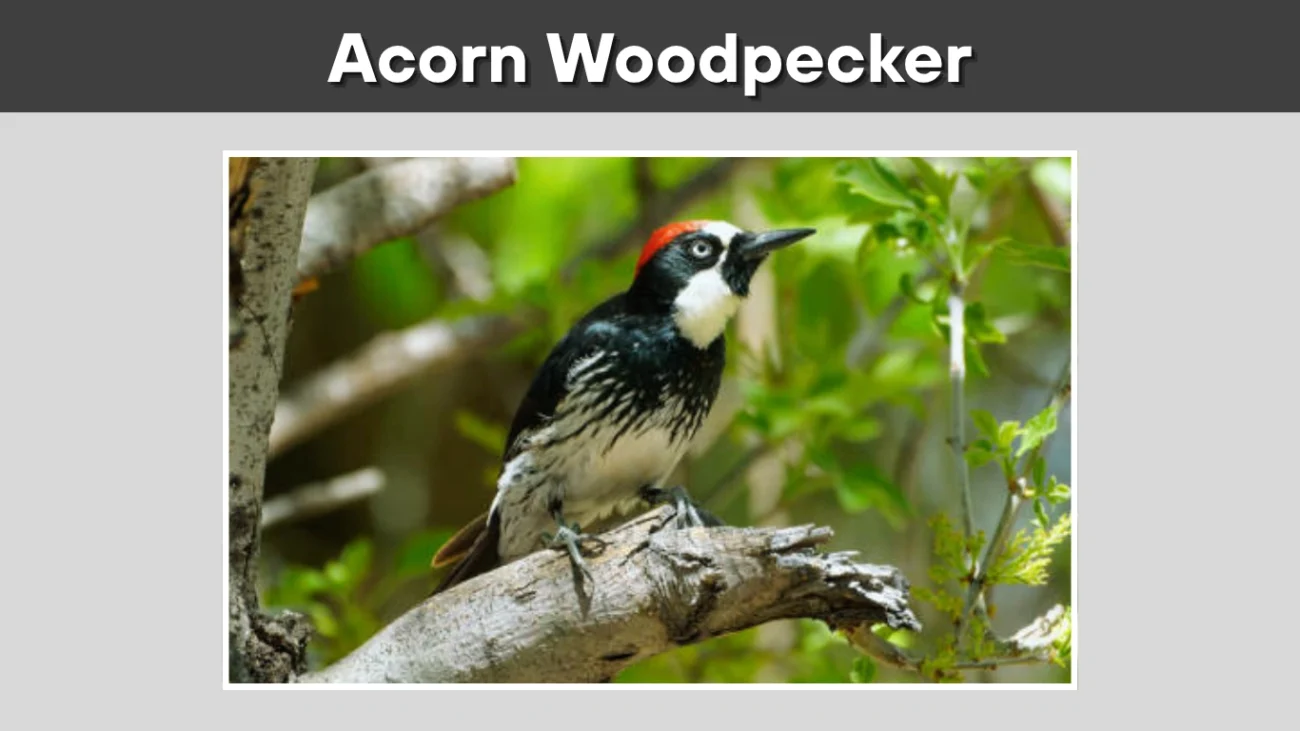
The Acorn Woodpecker (Melanerpes formicivorus) is a unique and highly social woodpecker known for its habit of storing thousands of acorns in specially drilled holes. Its clown-like face and colorful pattern make it very distinctive, especially in oak-dominated landscapes of the western U.S.
Head and Body Color
- Head: Bright red crown, white face, black around the eyes, and a black forehead
- Body: Glossy black back, white rump and belly, with some buff or yellowish tint near the throat
Identification
- Size: 8 to 9 inches long
- Wingspan: 14 to 17 inches
- Bill: Thick, strong, and straight
- Behavior: Lives in cooperative groups; uses “granary trees” to store acorns, sometimes filling thousands of holes across generations
Where Found
Mostly found in the western U.S., especially California, Arizona, New Mexico, and parts of Oregon. It is also found throughout Mexico and Central America. Rare in eastern North America, but occasional sightings occur.
Habitat
Strongly tied to oak woodlands, but also lives in mixed pine-oak forests, wooded canyons, and rural areas. Acorn Woodpeckers need access to both acorn-producing trees and standing dead trees or wooden structures for granary sites.
Lifespan
Typically lives 8 to 12 years in the wild. Their cooperative social structure—where multiple birds help raise the young—contributes to survival and long-term colony success.
3. Gila Woodpecker
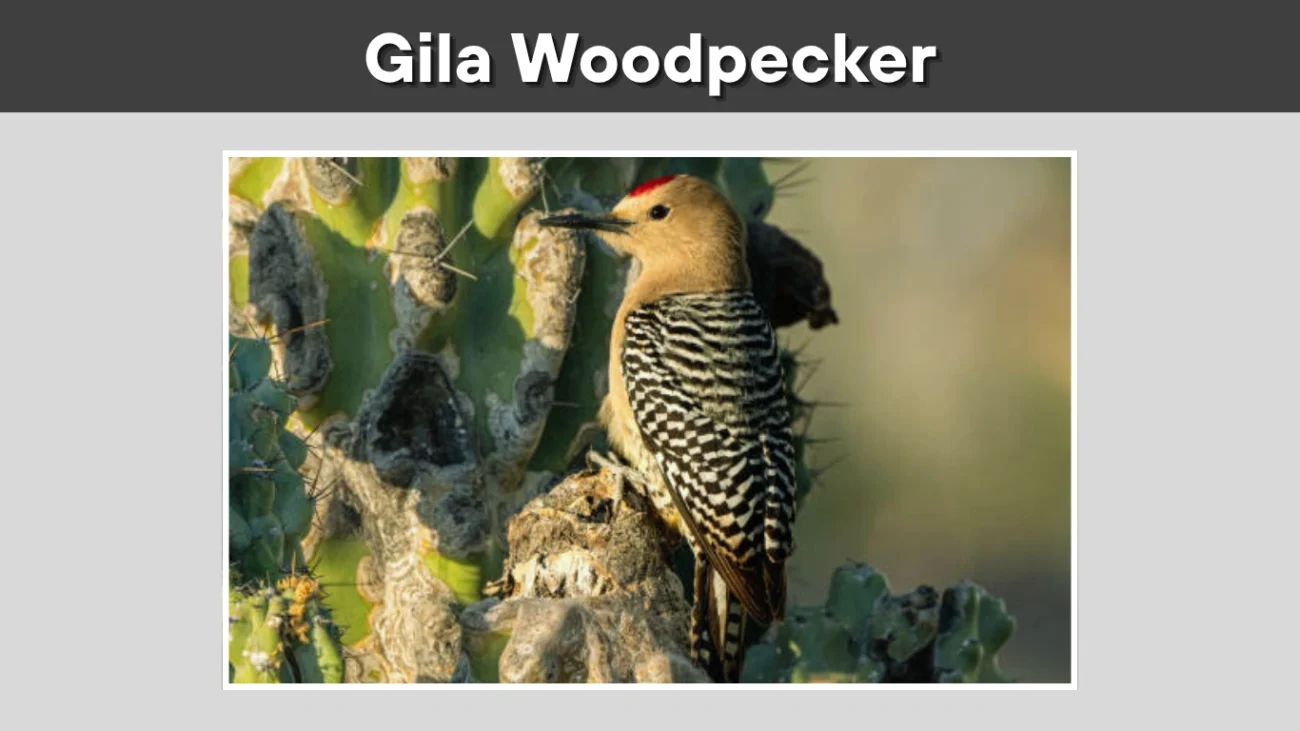
The Gila Woodpecker (Melanerpes uropygialis) is a desert-dwelling species found in the arid regions of the southwestern United States. Its red crown (in males) combined with tan and black-and-white barring makes it stand out in cactus-filled landscapes.
Head and Body Color
- Head: Light tan with a small red patch on the crown (males only)
- Body: Pale tan face and belly, black-and-white barred back and wings
Identification
- Size: 8 to 10 inches long
- Wingspan: 13 to 16 inches
- Bill: Straight, sturdy, and slightly down-curved
- Behavior: Frequently seen perched on cacti or tall trees; often drums on metal objects in urban areas; nests inside saguaro cacti
Where Found
Native to the Sonoran Desert of Arizona, southeastern California, southern Nevada, and southwestern New Mexico. Also found in northwestern Mexico. It’s a year-round resident in these regions.
Habitat
Strongly associated with desert habitats, especially areas with saguaro cacti or large trees such as mesquite and paloverde. Adapts well to suburban and urban areas with palm trees, telephone poles, or cacti for nesting.
Lifespan
Typically lives 6 to 10 years in the wild. While well-adapted to human presence, threats include habitat loss and competition for nesting cavities from European Starlings.
4. Golden-fronted Woodpecker
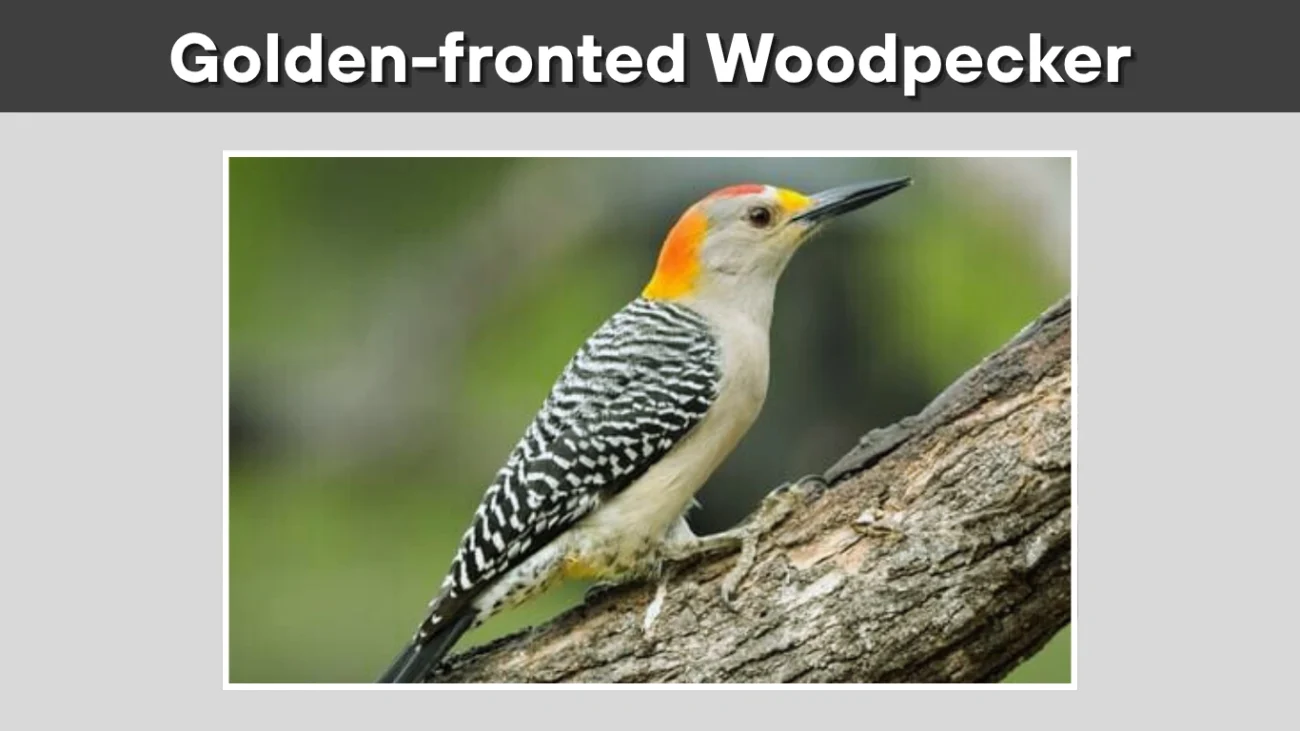
The Golden-fronted Woodpecker (Melanerpes aurifrons) is a vibrant woodpecker species of the southern U.S. and Mexico. Males display a red crown and a striking yellow-orange patch above the bill, creating a multi-colored head that stands out in open landscapes.
Head and Body Color
- Head: Red crown, yellow-orange patch on the forehead, and golden nape (males)
- Body: Pale gray face and belly, black-and-white barred back and wings
Identification
- Size: 8.5 to 10 inches long
- Wingspan: 16 to 17 inches
- Bill: Medium-length and straight
- Behavior: Forages on tree trunks and limbs; often visits feeders and birdbaths in its range
Where Found
Primarily found in Texas, Oklahoma, and parts of New Mexico, extending south into Mexico and Central America. It is a year-round resident in warm, open woodlands.
Habitat
Prefers dry woodlands, mesquite brushlands, riparian zones, open savannas, and farmlands. Also found in rural towns and ranchlands, especially where mature trees or large shrubs are present.
Lifespan
Generally lives 6 to 10 years in the wild. Populations remain stable due to their adaptability, though habitat fragmentation may pose local challenges.
5. Red-bellied Woodpecker
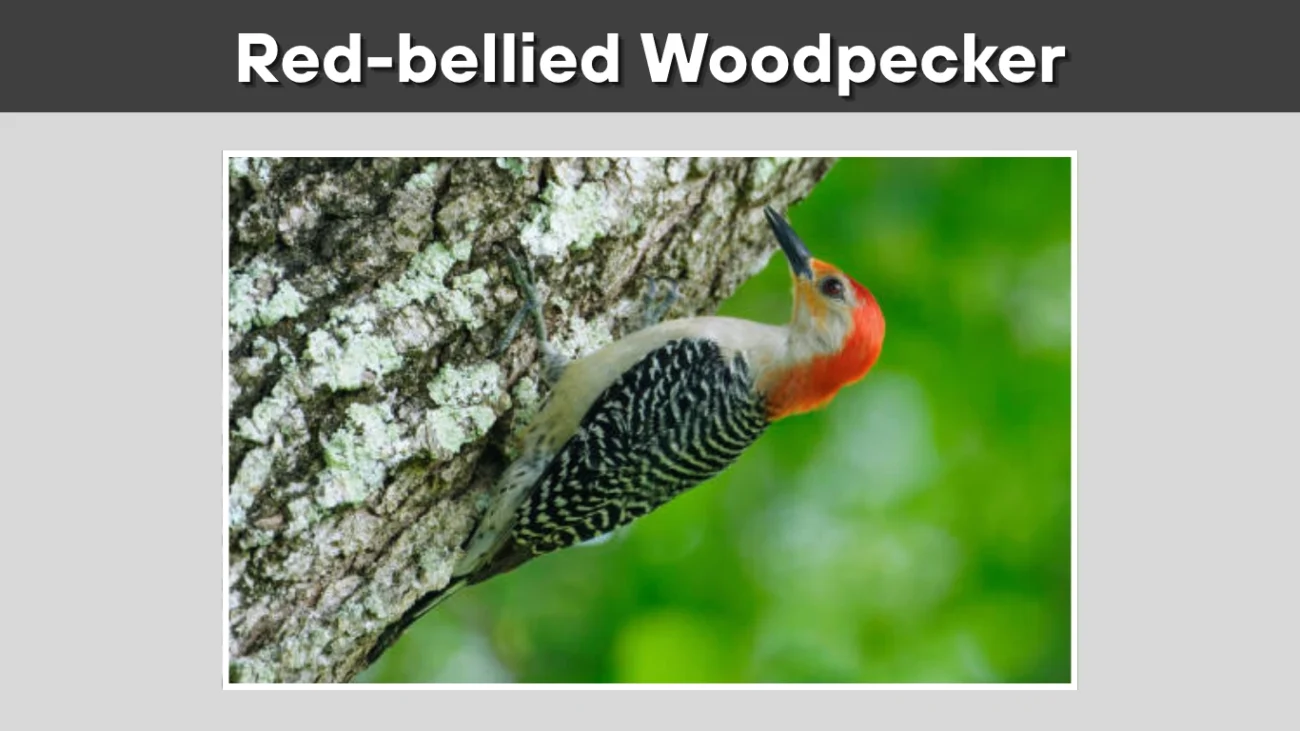
The Red-bellied Woodpecker (Melanerpes carolinus) is a familiar and widespread species in the eastern United States. While its name references a faint red tint on the belly, its vivid red crown and nape are far more noticeable, especially in males.
Head and Body Color
- Head: Males have a bright red crown and nape; females show red only on the nape
- Body: Pale gray face and underparts, with a bold black-and-white barred back and wings
Identification
- Size: 9 to 10.5 inches long
- Wingspan: 15 to 18 inches
- Bill: Straight and medium-length
- Behavior: Loud and vocal; frequently climbs tree trunks and branches, and is a regular at bird feeders
Where Found
Found year-round across the eastern U.S., from Florida to Michigan and east to the Atlantic. Common in forests, cities, and backyards, including much of the southeastern and midwestern U.S.
Habitat
Adapts well to deciduous forests, wooded suburbs, river floodplains, and urban parks. Nests in dead trees or utility poles and often feeds on suet, fruit, and insects.
Lifespan
Typically lives 6 to 12 years. Its adaptability to both natural and urban environments has helped it expand its range northward in recent decades.
6. Pileated Woodpecker

The Pileated Woodpecker (Dryocopus pileatus) is the largest woodpecker in North America. It’s easily recognized by its flaming red crest, which forms a sharp triangle atop its black head and body.
Head and Body Color
- Head: Both sexes have a bright red crest; males have an additional red cheek stripe
- Body: Mostly black body with white facial stripes and large white wing patches visible in flight
Identification
- Size: 16 to 19 inches long
- Wingspan: 26 to 30 inches
- Bill: Long and chisel-like, suited for deep excavation
- Behavior: Excavates large rectangular holes in dead trees for ants and beetle larvae; loud, resonant call and heavy drumming
Where Found
Widespread east of the Rocky Mountains, including the eastern U.S., parts of Canada, and the Pacific Northwest. Present year-round in forested regions of states like North Carolina, Michigan, and Florida.
Habitat
Prefers mature forests, especially hardwood or mixed woods with plenty of dead trees and snags. Also found in swampy lowlands, wooded river corridors, and forested parks.
Lifespan
Typically lives 9 to 13 years, though some individuals survive longer. Due to their need for large trees and deadwood, forest preservation is critical to their continued success.
9. Downy Woodpecker
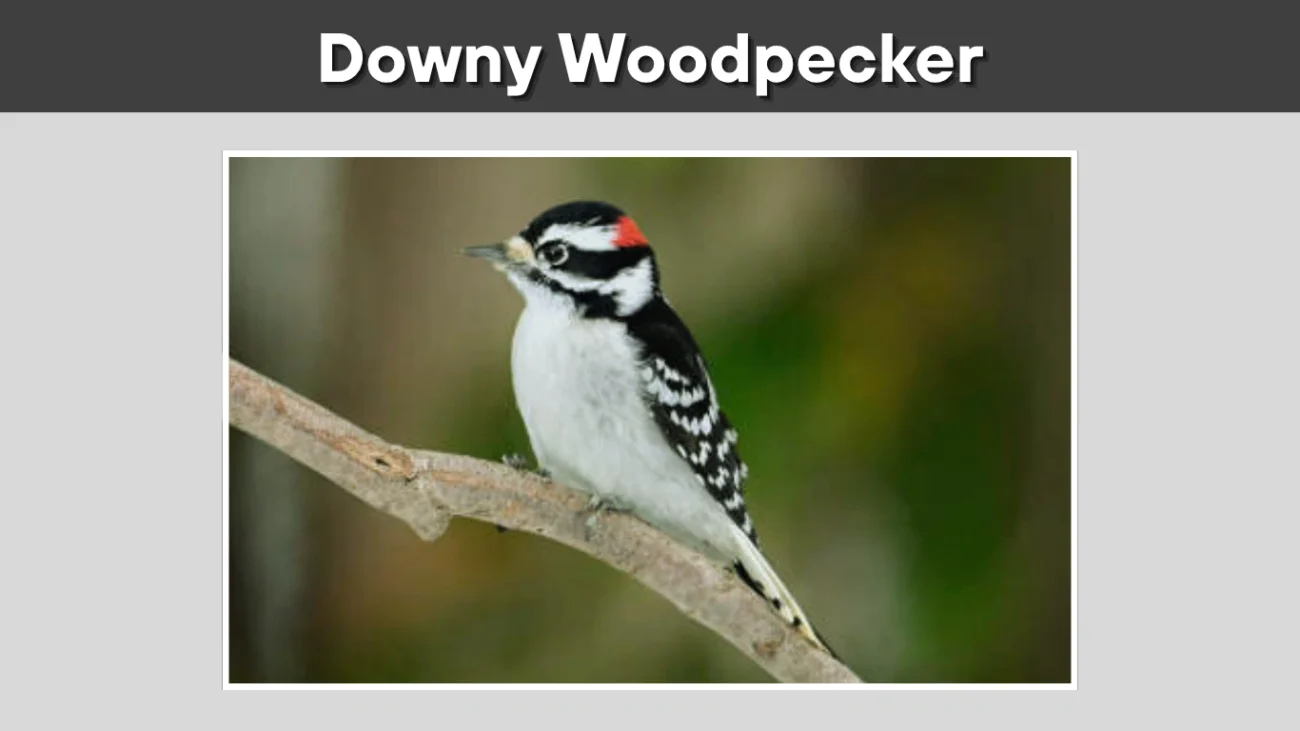
The Downy Woodpecker (Dryobates pubescens) is the smallest woodpecker in North America and one of the most familiar. Despite its size, it’s easy to spot due to its energetic tapping and bold black-and-white coloring. Males feature a distinctive red spot on the back of the head.
Head and Body Color
- Head: Black-and-white striped, with a small red patch on the back (males only)
- Body: White belly, black wings with white spots, and white back stripe
Identification
- Size: 5.5 to 7 inches long
- Wingspan: 10 to 12 inches
- Bill: Short and stubby
- Behavior: Frequently seen foraging on small branches and plant stems; often visits suet feeders
Where Found
Common year-round across most of North America, including North Carolina, Michigan, and Florida. Present in forests, suburbs, parks, and gardens.
Habitat
Thrives in deciduous forests, forest edges, orchards, and suburban areas with trees. Nests in cavities in dead wood and often roosts in the same tree throughout the year.
Lifespan
Typically lives 4 to 6 years, though some may live up to 11 years. Readily adapts to human environments and is one of the most frequently observed backyard woodpeckers.
10. Hairy Woodpecker
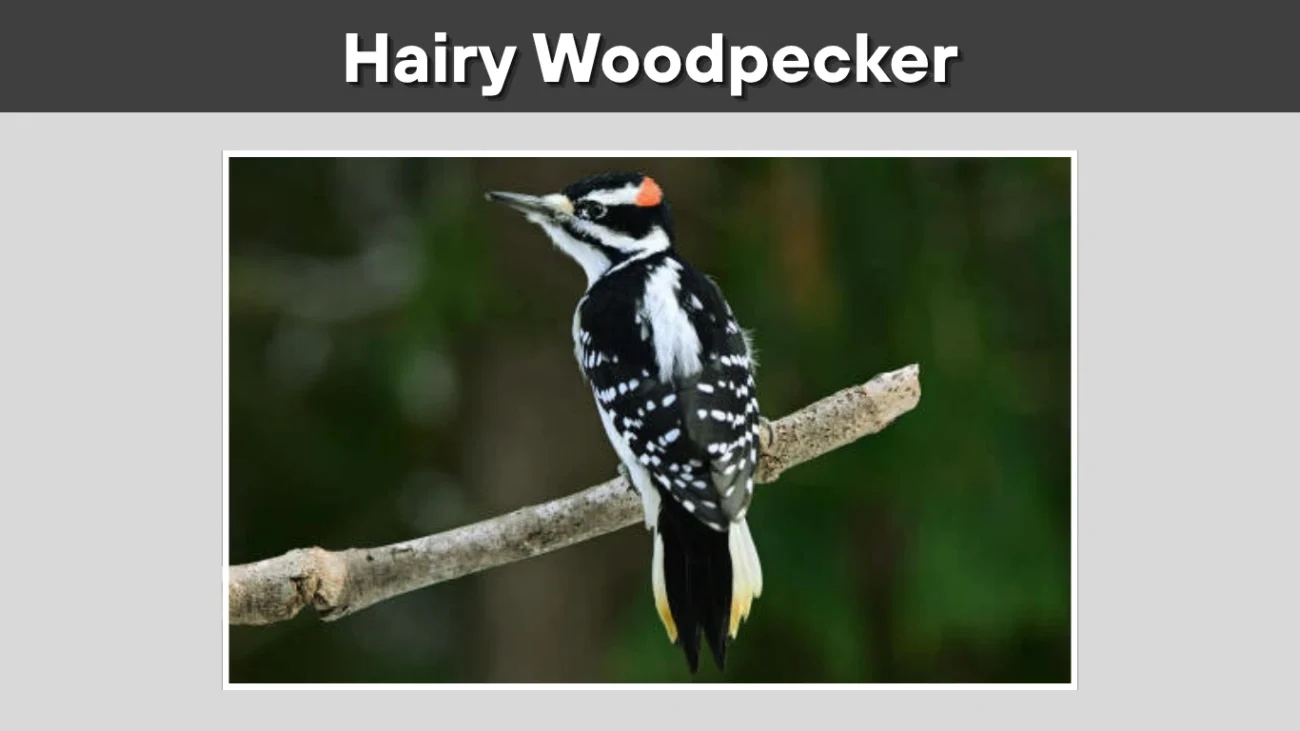
The Hairy Woodpecker (Dryobates villosus) looks nearly identical to the Downy Woodpecker but is larger and has a longer bill. Males also feature a red patch on the back of the head.
Head and Body Color
- Head: Black-and-white striped, with a red patch on the back (males only)
- Body: White belly, black wings with white spots, white back stripe
Identification
- Size: 9 to 10 inches long
- Wingspan: 13 to 16 inches
- Bill: Long, about the same length as the head—key difference from the Downy
- Behavior: More forest-dependent than the Downy; often forages on larger tree trunks
Where Found
Found year-round throughout the continental U.S., including Michigan, North Carolina, and Florida. More common in mature woodlands and large parks.
Habitat
Prefers mature forests, especially those with dead standing trees or large snags. Also found in state parks, rural woodlands, and less frequently in residential areas.
Lifespan
Can live 5 to 15 years, depending on conditions. Their ability to access deeper wood-boring insects gives them an advantage in undisturbed forest habitats.
11. Williamson’s Sapsucker
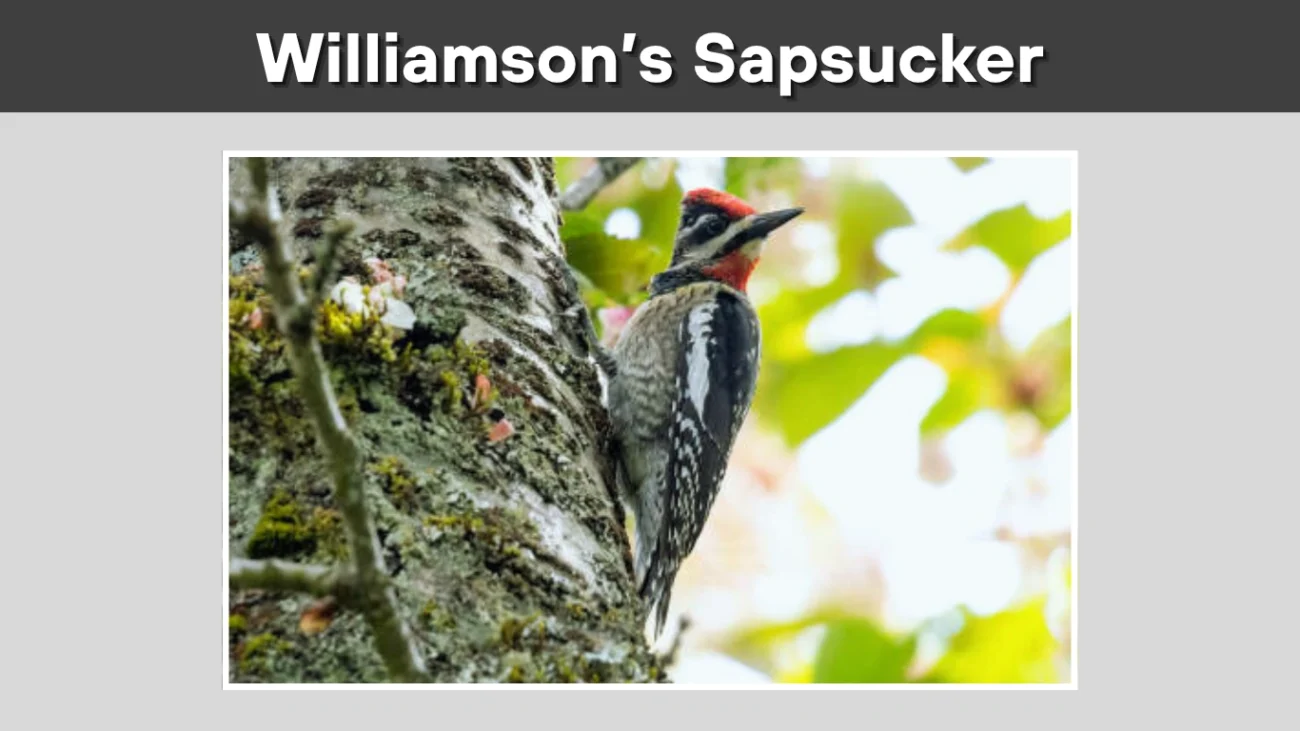
The Williamson’s Sapsucker (Sphyrapicus thyroideus) is a striking, sexually dimorphic woodpecker mostly found in western North America. The male has a red throat, while the female has a completely different appearance, lacking red altogether.
Head and Body Color
- Head (male): Black head with a bright red throat
- Body (male): Black upperparts, white wing patches, yellow belly
- Female: Brown barred back, pale underparts, and no red markings
Identification
- Size: 8.5 to 9.5 inches long
- Wingspan: 15 to 16.5 inches
- Bill: Medium-length and pointed
- Behavior: Drills sap wells in conifers and feeds on both sap and insects; males and females often forage in different areas
Where Found
Native to the mountainous western U.S. (Rockies, Cascades, and Sierra Nevada). Rare or accidental in the eastern U.S.—only occasional vagrant reports exist for states like Michigan or North Carolina.
Habitat
Prefers high-elevation conifer forests, especially areas dominated by firs, pines, and larches. Nests in dead trees and often forages on live conifers for sap and insects.
Lifespan
Generally lives 6 to 9 years in the wild. Not found regularly in the East but included here for its distinct red throat in males.
12. Lewis’s Woodpecker
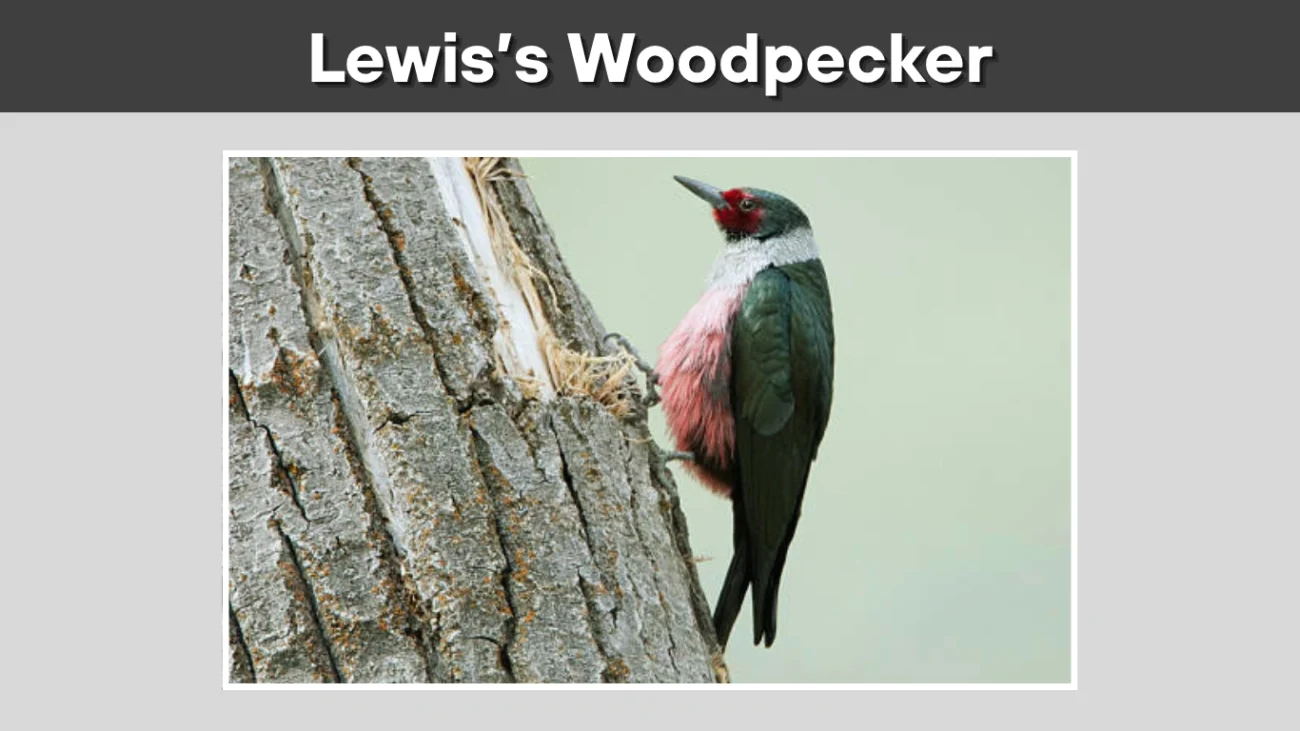
The Lewis’s Woodpecker (Melanerpes lewis) is an unusual woodpecker with unique coloring and behavior. It flies more like a crow and feeds by catching insects in mid-air. Its dark red face is one of its distinguishing features.
Head and Body Color
- Head: Dark red face
- Body: Iridescent greenish-black back, pinkish belly, and gray collar around the neck
Identification
- Size: 10 to 11 inches long
- Wingspan: 19 to 20 inches
- Bill: Medium-length and slightly curved
- Behavior: Often perches quietly and catches flying insects like a flycatcher; rarely drums or pecks
Where Found
Primarily found in the western U.S., especially in open pine forests, burned areas, and riparian woodlands. Rarely seen east of the Rockies; only considered a very rare vagrant in eastern states.
Habitat
Prefers open ponderosa pine forests, burned woodlands, and oak savannas. Nests in tree cavities and forages both in trees and on the wing.
Lifespan
Can live 4 to 10 years. Habitat loss and fire suppression are key threats to its population, which depends on open, semi-arid woodlands and standing dead trees.
FAQs
Which woodpecker has a fully red head?
The Red-headed Woodpecker is the only North American woodpecker with an entirely red head. Both males and females share this bold feature, making it one of the easiest species to identify.
Do all woodpeckers with red on their heads have the same markings?
No. Some, like the Pileated Woodpecker, have a red crest, while others, like the Yellow-bellied Sapsucker, have a red crown or throat. In many species, only the males show red markings.
Are red-headed woodpeckers aggressive?
Some red-headed species, like the Acorn Woodpecker, are highly territorial and social. Others, like the Downy Woodpecker, are less aggressive but will defend feeding and nesting areas.
Can red-headed woodpeckers be seen in backyards?
Yes. Species like the Red-bellied, Downy, and Hairy Woodpeckers with red head markings are commonly seen at suet feeders and in suburban areas with mature trees.
Is the Red-headed Woodpecker endangered?
The Red-headed Woodpecker is not officially endangered, but its population has declined in parts of its range due to habitat loss and competition for nesting sites. Conservation efforts focus on preserving open woodlands and dead trees for nesting.