










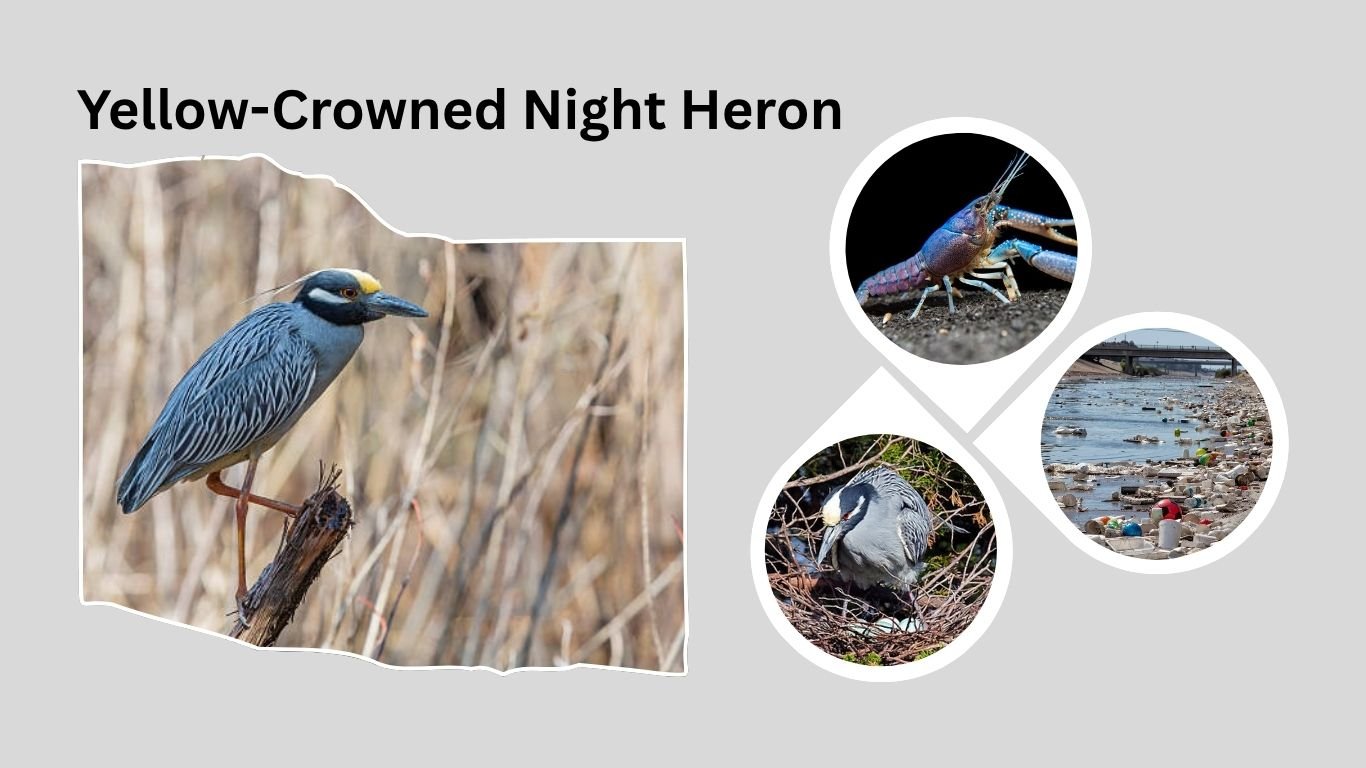
The Yellow-crowned Night Heron (Nyctanassa violacea) is one of North America’s most striking wading birds. With its bold markings, patient hunting style, and mysterious nocturnal habits, this heron captures the quiet elegance of coastal wetlands. Despite its name, the bird is not exclusively nocturnal—many can be spotted feeding during early mornings or late afternoons, particularly in spring and summer.
Found primarily along the Atlantic and Gulf coasts, the Yellow-crowned Night Heron plays a vital role in wetland ecosystems. It helps control crab and crayfish populations while adding to the charm of marshes and tidal creeks with its graceful stance and watchful eyes.
Identification and Physical Characteristics
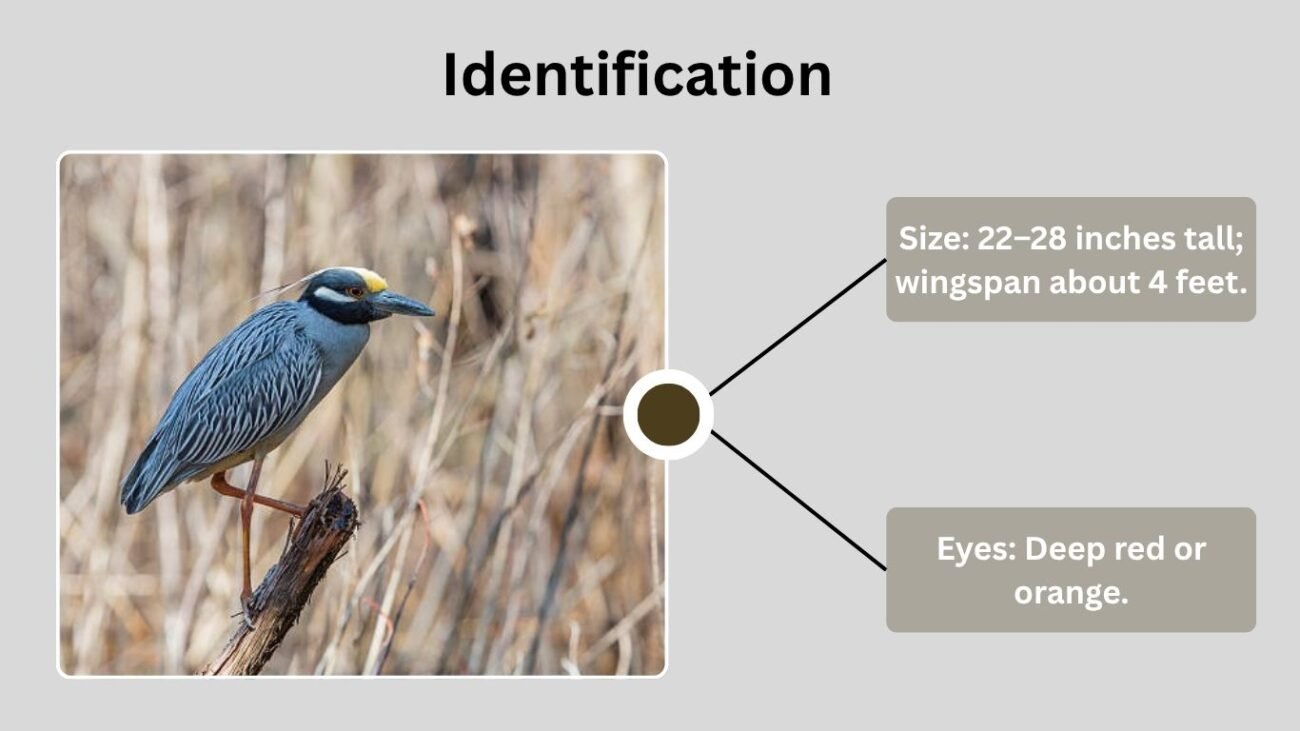
- Size: Medium wading bird, 22–28 inches tall; wingspan about 4 feet.
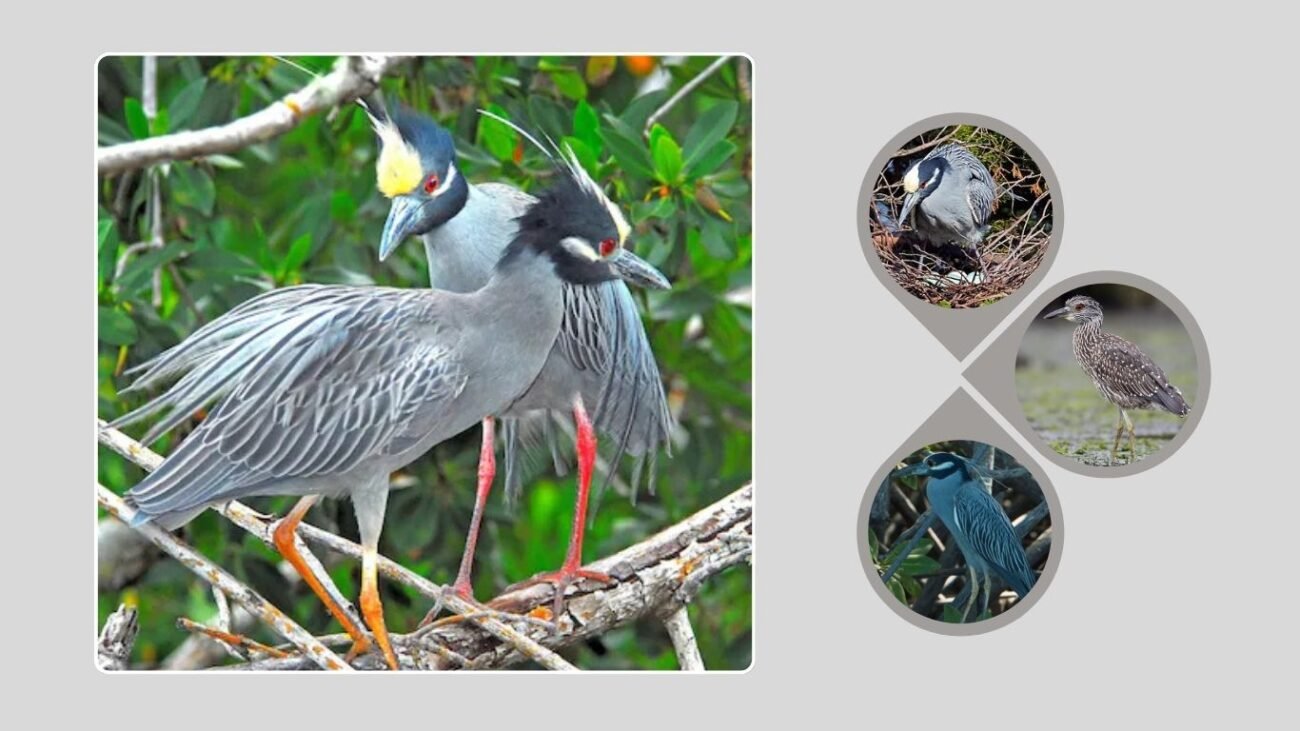
- Body Color: Slate-gray plumage with black face and bold yellow or white crown stripe.
- Eyes: Deep red or orange, prominent and expressive.
- Bill: Thick, black, and strong—perfect for cracking crab shells.
- Legs: Yellow to orange; brighter during breeding season.
- Flight: Steady, with slow wingbeats and neck tucked close to the body.
- Male vs. Female: Similar appearance; males slightly larger and more active during courtship.
- Juvenile Appearance: Mottled brown plumage, streaked chest, lacks yellow crown.
- Immature Transition: Gray patches and faint crown appear after 1–2 years.
- Full Adult Plumage: Achieved at about 2–3 years of age.
Range and Habitat
Geographic Distribution
The Yellow-crowned Night Heron inhabits a wide range extending from the eastern and southern United States down through Central America, the Caribbean, and into northern South America. In the U.S., they are most commonly seen in Texas, Florida, Louisiana, and along the Atlantic coast, including Virginia and North Carolina.
These birds are adaptable but are most often associated with coastal environments. In some regions—such as Houston or New Orleans—they have even adjusted to urban life, nesting in city parks, neighborhoods, and drainage areas that mimic natural wetlands.
Occasional sightings also occur in Oklahoma, Connecticut, and the Galápagos Islands, showing the bird’s impressive adaptability to different climates and habitats.
Preferred Habitat
Yellow-crowned Night Herons prefer wet, wooded areas near water. They thrive in mangroves, marshes, tidal creeks, lagoons, and swamps where crustaceans are abundant. During the breeding season, they often build nests in trees or shrubs overhanging water.
Unlike many herons that prefer open water, Yellow-crowned Night Herons are specialists of shallow, slow-moving wetlands where crabs and crayfish can be easily caught. Their choice of habitat reflects their feeding strategy—quiet, patient, and methodical.
Behavior and Lifestyle
Nocturnal Habits
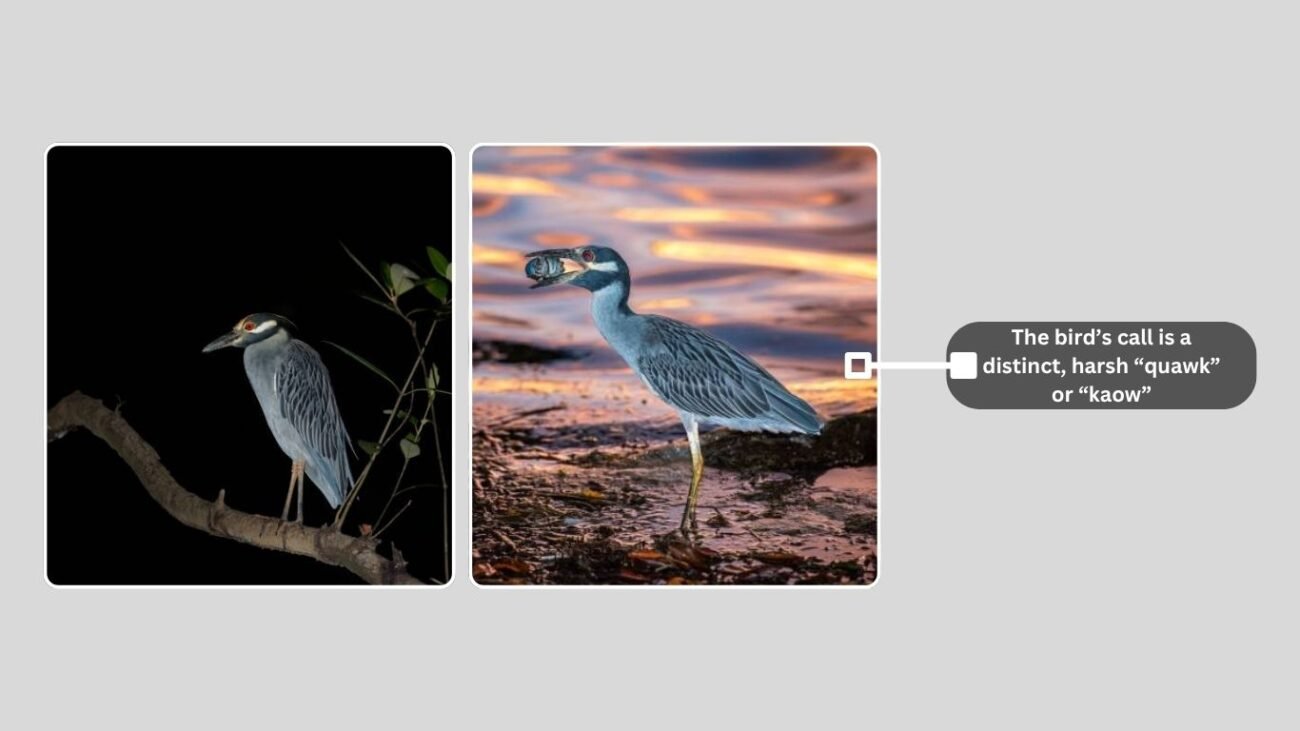
As their name implies, these birds are mostly active at night or during twilight hours. They can often be seen standing motionless near water, waiting for the slightest movement that reveals a potential meal. Their calm and deliberate behavior helps them avoid detection by both prey and predators.
However, not all activity occurs under cover of darkness. In areas where human disturbance is minimal, Yellow-crowned Night Herons will hunt during the daytime, especially when feeding young chicks that require constant nourishment.
Flight and Vocalization
In flight, the Yellow-crowned Night Heron appears steady and deliberate, flapping slowly with its neck tucked in and legs trailing behind. It rarely glides for long distances, preferring short, direct movements between feeding areas or nesting trees.
The bird’s call is a distinct, harsh “quawk” or “kaow”, often heard during the evening or when startled. During courtship, the calls become more varied, including soft clucks and croaks as part of their display rituals.
Social and Territorial Behavior
Outside of breeding season, these herons are mostly solitary feeders, although they may be seen in loose groups in prime feeding grounds. During the nesting season, they form small colonies, sometimes alongside other wading birds like egrets or ibises.
Males can become quite territorial, defending nest sites aggressively from intruders. Despite their quiet demeanor, Yellow-crowned Night Herons are known to chase away rivals with dramatic displays and loud calls when provoked.
Diet and Feeding Habits
What Do Yellow-Crowned Night Herons Eat?
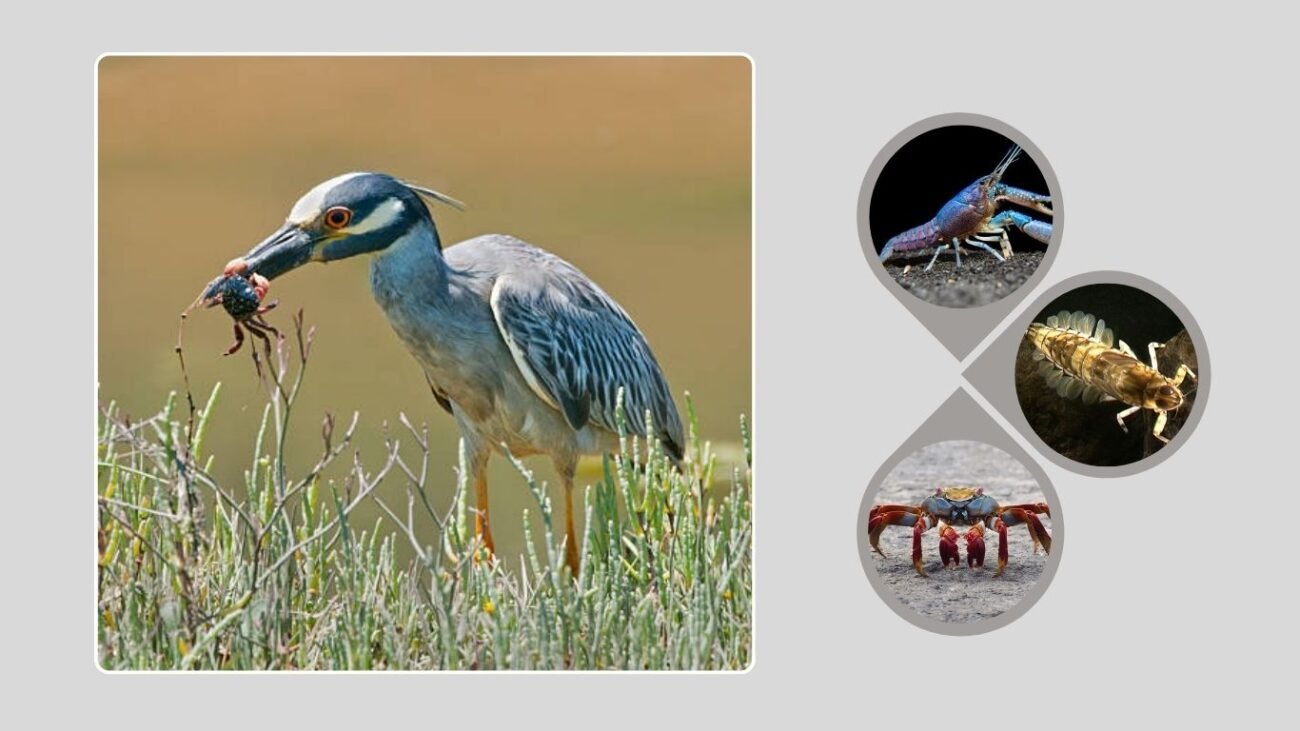
The Yellow-crowned Night Heron is a crustacean specialist. Unlike many other herons that eat fish or amphibians, this species focuses primarily on crabs, crayfish, and other small aquatic invertebrates. Their strong, black bill is perfectly suited for gripping and crushing tough shells.
Occasionally, they will also eat insects, snails, frogs, or small fish—particularly when crustaceans are scarce. Young birds often start with softer prey before mastering the art of crab hunting.
Hunting Techniques
Patience defines their feeding style. These herons stand still for long periods, often in shallow water, before striking with lightning speed when prey appears. They may flip crabs over, remove claws, or even bash them against rocks to make them easier to swallow.
Their method is precise and efficient—each movement calculated for maximum success. In this way, the Yellow-crowned Night Heron embodies the essence of patience and focus that many nature observers find so captivating.
Breeding and Life Cycle
Mating and Courtship
The breeding season for the Yellow-crowned Night Heron typically begins in spring and extends into early summer. Males choose nesting territories and perform elaborate courtship displays to attract females. These displays often include bowing, bill clapping, and raising of the back plumes while making soft calls. Once paired, the male offers twigs to the female as part of the bonding ritual, and together they begin building the nest.
Pairs are generally monogamous during a breeding season and may return to the same nesting area year after year. Their faithfulness to nesting sites has helped researchers track populations and migration routes across multiple years.
Nesting and Eggs
Nests are typically built in trees, shrubs, or mangroves—usually over or near water. Constructed from sticks and twigs, the nests are lined with softer materials like leaves or moss. Colonies are often small, with a few pairs nesting near each other for protection.
A typical clutch consists of three to five pale blue-green eggs. Both parents take turns incubating the eggs, which hatch after about 24 to 26 days. During this time, adults are highly protective and will defend their nests from intruders, including other herons and potential predators.
Chicks and Fledglings
Upon hatching, chicks are covered in soft gray down and are entirely dependent on their parents for food. Adults regurgitate partially digested food into the nest, allowing chicks to feed easily. Within three weeks, young herons begin to wander around the nest branches, and by five to six weeks, they take their first flights.
Even after fledging, juveniles often stay near their parents for a few weeks, practicing hunting skills and learning how to stalk prey efficiently.
Migration and Seasonal Patterns
The migratory habits of the Yellow-crowned Night Heron vary based on geography. Populations in the southern U.S. and Caribbean are largely year-round residents, while northern birds migrate south during the colder months.
In the United States, they typically depart from northern states in late August to October, returning again in March or April. Migration routes follow coastlines, especially along the Atlantic and Gulf coasts.
Young birds are sometimes seen traveling farther south than adults, reaching deep into Central or South America. This behavior might help juveniles find unclaimed territories before returning to breed in later years.
Conservation Status and Population

Are Yellow-Crowned Night Herons Endangered?
Fortunately, the Yellow-crowned Night Heron is currently classified as Least Concern by the International Union for Conservation of Nature (IUCN). Populations are considered stable overall, though local declines have been observed in areas where wetlands are being lost.
Despite this relatively secure status, these herons are still vulnerable to habitat destruction, pollution, and human disturbance—especially during breeding.
Threats
- Habitat Loss: Urban expansion, agriculture, and coastal development have reduced wetland areas critical for feeding and nesting.
- Pollution: Chemical runoff and water contamination affect crab populations, their main food source.
- Climate Change: Rising sea levels threaten low-lying coastal habitats and nesting sites.
- Disturbance: Increased human activity in parks and wetlands can cause birds to abandon nests prematurely.
Conservation Efforts
Protection under the Migratory Bird Treaty Act ensures that Yellow-crowned Night Herons cannot be hunted or captured. Conservation organizations such as Audubon and citizen-science platforms like eBird track sightings and monitor population trends.
Community efforts—such as restoring marshes, reducing pesticide use, and safeguarding nesting trees—play a crucial role in sustaining heron populations.
Comparison: Yellow-Crowned vs. Black-Crowned Night Heron

Key Differences
Both species share similar names and habits, but they are quite distinct in appearance and behavior.
| Feature | Yellow-Crowned Night Heron | Black-Crowned Night Heron |
| Crown Color | Bright yellow to white stripe | Solid black crown |
| Body Color | Bluish-gray with black face | Pale gray with white underparts |
| Eyes | Red to orange | Deep red |
| Bill | Thick, black, slightly longer | Shorter, heavier black bill |
| Juvenile | Streaked with fine spots | Heavily mottled brown |
| Habitat Preference | Coastal wetlands, tidal zones | Broader range including inland ponds |
| Diet Focus | Crabs and crustaceans | Fish, frogs, insects, small mammals |
Juvenile Confusion
Juvenile herons from both species are often mistaken for one another. A reliable field tip: juvenile Yellow-crowned Night Herons usually have lighter streaks on their chest, longer necks, and a slightly grayer tone compared to the more uniformly brown Black-crowned juveniles.
Recognizing these differences is important for accurate identification, especially in bird surveys or photography competitions.
Symbolism and Cultural Meaning
Throughout history, the heron has been a symbol of patience, focus, and independence. The Yellow-crowned Night Heron, with its solitary demeanor and calm nature, embodies these traits perfectly.
In some Native American traditions, herons represent self-reliance and observation, guiding individuals to trust their instincts and move deliberately through life.
Modern spiritual interpretations often connect the Yellow-crowned Night Heron with emotional reflection and inner peace. Spotting one during a quiet walk can serve as a reminder to slow down and find balance—just as this bird patiently waits for the perfect moment to strike.
Observation, Photography, and Birdwatching Tips
Where to See Them
Some of the best places to observe the Yellow-crowned Night Heron include:
- Texas wetlands such as Galveston Bay and Brazoria National Wildlife Refuge
- Florida’s Everglades and coastal mangroves
- Louisiana bayous and swamp forests
- Virginia estuaries and barrier islands
- Connecticut marshlands during migration season
Photography Tips
Photographing this bird requires patience and timing. Early morning or dusk offers the best natural lighting and the highest chance of observing feeding behavior. Use a telephoto lens (300mm or more) to capture close-up shots without disturbing the bird. Focus on the eye and crown for a powerful composition.
Ethical Birding Practices
Always maintain a respectful distance from nests and feeding areas. Avoid flash photography and loud noises, particularly during breeding months. Observing quietly not only protects the birds but also rewards you with more authentic natural behavior.
Fun and Interesting Facts
- The Yellow-crowned Night Heron can live up to 15 years in the wild.
- It is one of the few herons that specializes in eating crabs, often cracking them open before swallowing.
- Despite their quiet nature, they are capable of loud, sharp calls when alarmed.
- Juveniles have been observed traveling hundreds of miles farther south than adults during migration.
- Their nests are sometimes reused by other bird species such as egrets and ibises.
FAQs
1. What does a Yellow-Crowned Night Heron look like?
The Yellow-Crowned Night Heron has a grayish-blue body, a black face, and a bright yellow or white crown stripe on its head. It has red-orange eyes and yellow legs that turn more vivid during the breeding season. Juveniles are brown and streaked without the yellow crown.
2. Where can I find Yellow-Crowned Night Herons?
They are most commonly found along the Atlantic and Gulf coasts of the United States, especially in Texas, Florida, Louisiana, and Virginia. They prefer wetlands, marshes, mangroves, and tidal creeks near coastal or inland waterways.
3. What do Yellow-Crowned Night Herons eat?
Their diet mainly consists of crabs, crayfish, and other crustaceans. They occasionally eat frogs, insects, or small fish. Their strong bill helps them crack open hard shells before swallowing the prey whole.
4. Are Yellow-Crowned Night Herons endangered?
No. The species is listed as Least Concern by the IUCN. However, local populations are affected by wetland loss, pollution, and human disturbance, so conservation of their habitats is still important.
5. How can you tell a Yellow-Crowned Night Heron from a Black-Crowned Night Heron?
The Yellow-Crowned has a yellow or white stripe on the crown, a gray body, and a longer, slender neck, while the Black-Crowned has a solid black head and a stockier build. Juveniles of both species differ mainly by streaking and coloration—Yellow-Crowned juveniles appear grayer and more finely marked.


