











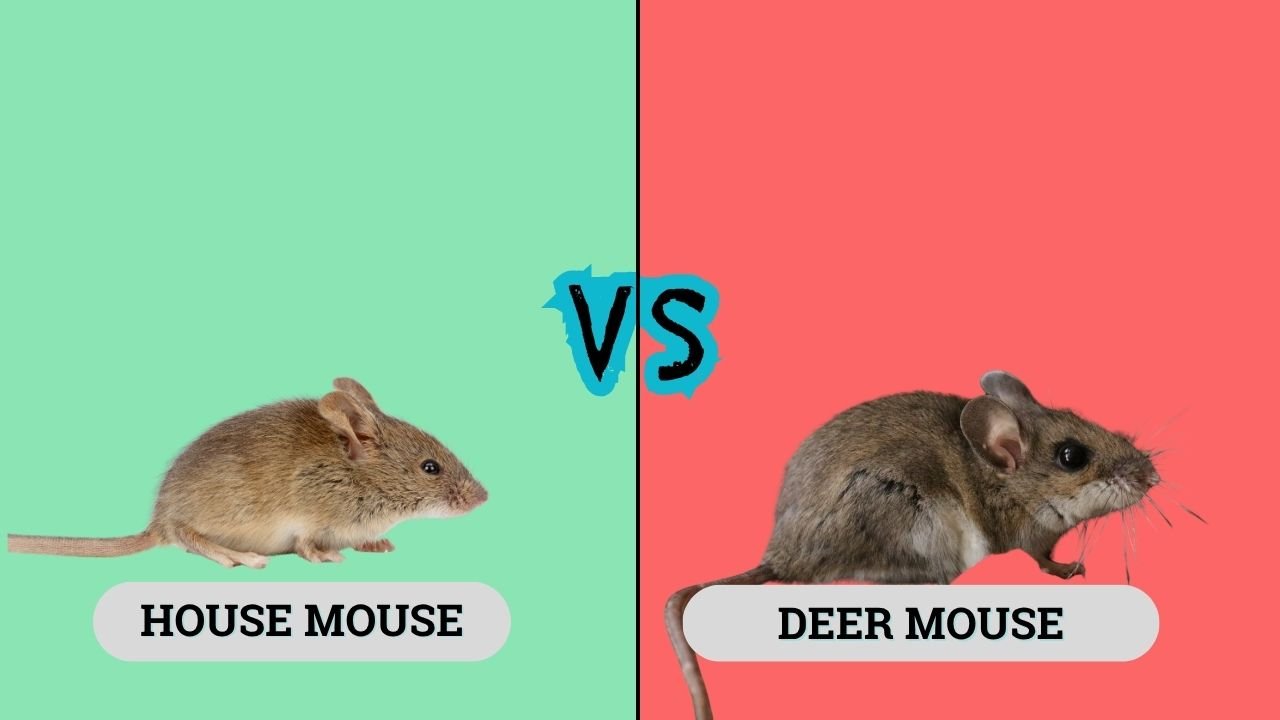
If you’ve seen a mouse scurrying through your home or garage, your first thought is probably how to get rid of it—but before you act, it’s helpful to know exactly what kind of mouse you’re dealing with. Two of the most common types are the house mouse and the deer mouse, and while they may seem similar at first glance, they differ significantly in appearance, behavior, and threat level. This guide breaks down the 7 key differences so you can properly identify and manage these unwanted guests.
House Mouse vs Deer Mouse
| Feature | House Mouse | Deer Mouse |
| Habitat | Indoors near humans | Outdoors in rural or wooded areas |
| Appearance | Uniform gray or brown | Brown with white underbelly |
| Tail | Long and nearly hairless | Bicolored and fur-covered |
| Droppings | Small, rod-shaped | Larger and pointed at both ends |
| Behavior | Bold, active indoors | Cautious, prefers outdoors |
| Reproduction Rate | Year-round, frequent litters | Seasonal, fewer litters |
| Health Risk | Contaminates food | Can carry hantavirus |
1. Habitat Preferences

House Mouse
The house mouse (Mus musculus) thrives in human-made structures like homes, apartments, restaurants, and warehouses. It’s a commensal rodent, meaning it lives near humans and relies on them for food and shelter. You’ll find them nesting in walls, cabinets, attics, or under appliances.
Deer Mouse
The deer mouse (Peromyscus maniculatus) prefers natural habitats like forests, fields, and rural areas. They usually avoid indoor environments but may enter homes during cold months, especially in garages, sheds, or cabins. They build nests in hollow logs, woodpiles, and unused vehicles.
2. Physical Appearance

House Mouse
House mice have uniform coloring, usually gray or brown all over, with no obvious color contrast between their backs and bellies. Their fur is fine and short, with a hairless, scaly tail that is about the same length as their body. They also have small eyes and ears, which is a key identifier.
Deer Mouse
Deer mice are more visually distinctive, with brown fur on top and a bright white underbelly and feet. Their large eyes and ears give them a more alert, outdoorsy look. A key feature is their bicolored tail—dark on top and white on the bottom, and it is also covered with fine fur.
3. Tail Characteristics
House Mouse
A house mouse’s tail is long, skinny, and hairless, often the same length as or slightly longer than the body. It helps with balance and navigating tight spaces indoors. Its scaly texture makes it look rubbery or naked.
Deer Mouse
In contrast, a deer mouse has a shorter, fur-covered tail that’s clearly bicolored—dark above, white below. This is one of the easiest visual markers to distinguish them from house mice. The tail also plays a role in thermoregulation in outdoor environments.
4. Dropping Differences
House Mouse
The droppings of a house mouse are tiny and rod-shaped, about the size of a grain of rice, with rounded ends. They can be found near food sources, inside cabinets, or along walls and baseboards. A house mouse may leave dozens of droppings per day, indicating a serious infestation.
Deer Mouse
Deer mouse droppings are slightly larger and have pointed ends, often left in attics, garages, or other low-traffic areas. Due to their more cautious behavior, their droppings may appear in more hidden spots. These droppings pose a serious health risk due to potential hantavirus contamination.
5. Behavior and Lifestyle

House Mouse
House mice are bold, curious, and adaptable to indoor environments. They move quickly and are active even in occupied homes, usually at night. They gnaw on wiring, insulation, and plastic to build nests. Once they find food and shelter, they reproduce quickly and remain in place.
Deer Mouse
Deer mice are generally timid and cautious, preferring the outdoors. They venture indoors mainly for warmth or food in winter. They rarely establish long-term nests in homes unless undisturbed. Their behavior is more nocturnal and elusive compared to the house mouse.
6. Reproduction and Infestation Risk
House Mouse
House mice breed year-round. A female can produce up to 10 litters per year, each with 5–8 pups. That’s potentially 60+ mice in a few months from a single pair. This rapid breeding makes infestations escalate quickly, especially in kitchens and warm indoor areas.
Deer Mouse
Deer mice reproduce seasonally, usually between spring and fall. They may have 2–4 litters per year, with 3–5 pups per litter. Because they don’t typically live indoors year-round, their infestation risk is lower, but still possible in rural or poorly sealed structures.
7. Health Risk and Disease Concerns
House Mouse
House mice are known to contaminate food sources, chew through packaging, and leave behind urine and droppings. While they can carry diseases like salmonella, they are not typically associated with high-risk viruses. However, their nesting habits can damage insulation and electrical systems.
Deer Mouse
Deer mice pose a higher health risk, especially due to their association with hantavirus pulmonary syndrome (HPS). This potentially fatal virus can be transmitted when humans inhale airborne particles from contaminated deer mouse droppings or urine. Proper protective gear is essential when cleaning up deer mouse-infested areas.
FAQs
Q1. How can I quickly identify whether I have a deer mouse or house mouse?
Look for fur color and tail characteristics. A deer mouse has a white belly and feet, large eyes, and a bicolored tail with fur. A house mouse is uniformly gray or brown, with a hairless tail and smaller features.
Q2. Are deer mice more dangerous than house mice?
Yes, in terms of health risks. Deer mice can carry hantavirus, which is transmitted through inhaled particles from droppings or urine. House mice are more common indoors but usually carry less severe pathogens.
Q3. Can deer mice live indoors full-time like house mice?
Not usually. Deer mice prefer the outdoors and typically come inside only during cold weather. House mice are well adapted to indoor living and can live, breed, and nest entirely inside human structures.
Q4. How do I safely clean areas with deer mouse droppings?
Do not sweep or vacuum directly. Use gloves, a mask, and disinfectant (like bleach solution). Spray droppings to dampen them, then wipe with paper towels. Wash hands thoroughly. This reduces the risk of inhaling hantavirus particles.
Q5. Are traps effective for both house and deer mice?
Yes. Snap traps, glue traps, and live traps work for both. For deer mice, place traps in garages, attics, or sheds where they may enter during winter. For house mice, focus traps around kitchens, basements, and storage areas.
Final Thoughts
Understanding the differences between house mice and deer mice can help you make better decisions when it comes to identification, control, and safety. House mice are more likely to infest homes and multiply rapidly, while deer mice pose greater health risks but tend to stay outdoors. Whether you’re dealing with noise in the attic or droppings in the garage, knowing which type of mouse is present gives you a major advantage in prevention and removal.


