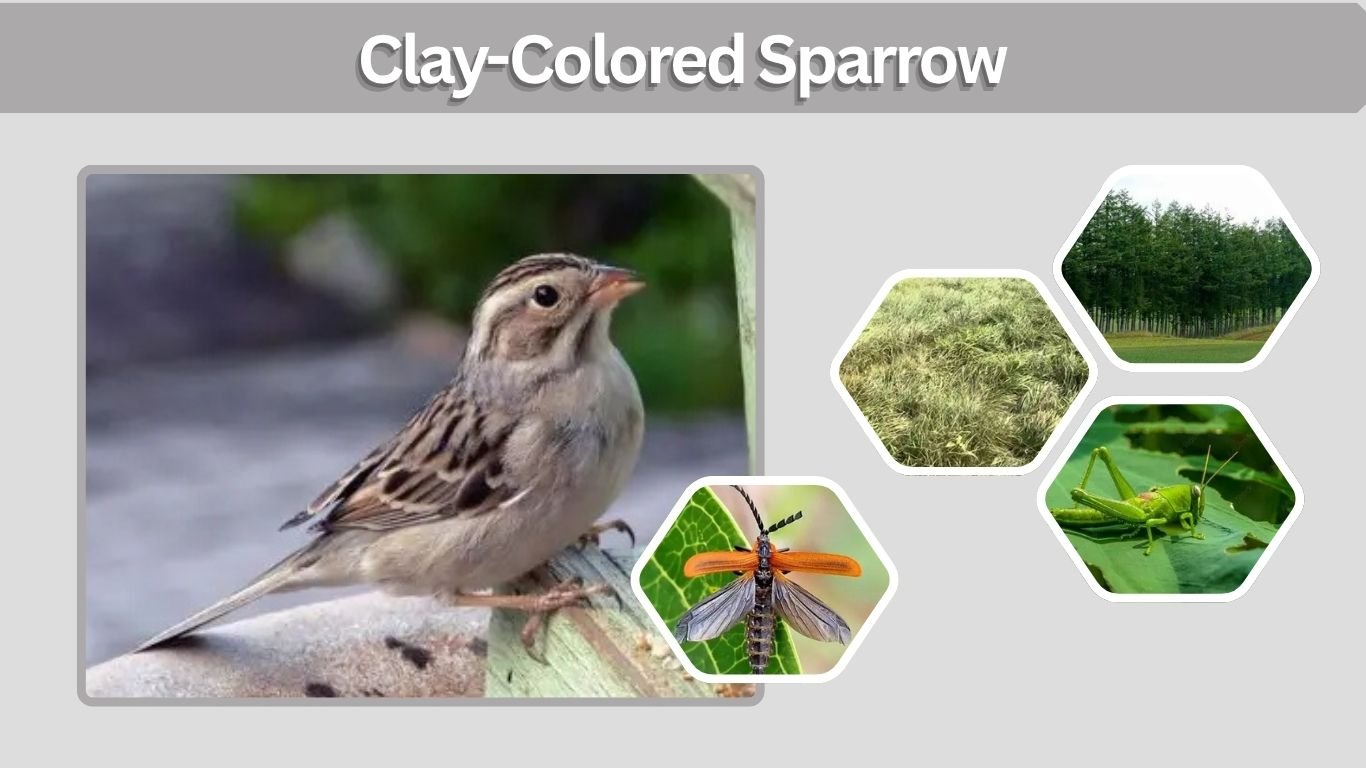
The Clay-colored Sparrow (Spizella pallida) is a small, subtly patterned bird native to North America. It is best recognized by its pale gray collar, brown cheek patch, striped crown, and unusual insect-like song. These sparrows breed mainly in the northern Great Plains and Canadian prairies before migrating south to Texas and Mexico for winter. Because they resemble Chipping and Brewer’s Sparrows, careful attention to the face, neck, bill, and vocalizations is essential for accurate identification.
Clay-Colored Sparrow Quick Facts
The Clay-colored Sparrow belongs to the New World sparrow family. Males and females look nearly identical, although males become easier to notice during the breeding season when they sing from exposed shrubs.
| Feature | Description |
| Scientific name | Spizella pallida |
| Length | About 5–6 inches |
| Main colors | Gray, tan, brown, black, and white |
| Bill | Small, pointed, and pale pinkish |
| Song | Two to eight dry, insect-like buzzes |
| Breeding habitat | Shrubby prairie, field edges, and thickets |
| Winter range | Southern Texas and Mexico |
| Diet | Seeds, insects, and other small invertebrates |
| Eggs | Usually 3–5 pale blue-green eggs |
How to Identify a Clay-Colored Sparrow
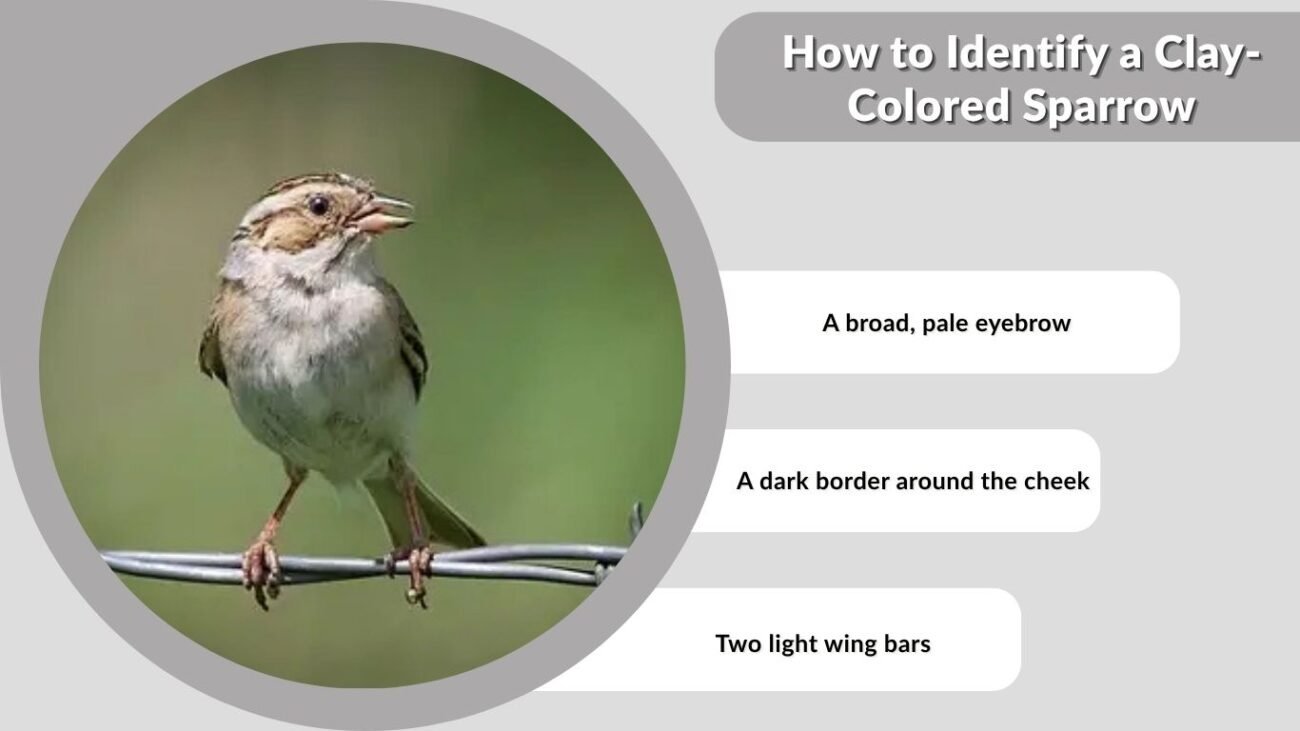
The Clay-colored Sparrow is a petite, slender bird with a relatively long, notched tail and a small bill. Its plumage is not brightly colored, but the face contains several crisp markings that separate it from similar sparrows.
Key Identification Features
Look for the following combination:
- A pale stripe through the center of the crown
- Fine dark streaks along the sides of the crown
- A broad, pale eyebrow
- A brown or buff-colored cheek patch
- A dark border around the cheek
- A pale area directly in front of the eye
- A noticeable light gray collar around the back of the neck
- An unstreaked, pale gray or whitish breast
- Two light wing bars
- A small, pale pinkish or flesh-colored bill
One especially useful feature is the dark line behind the eye. Unlike the Chipping Sparrow, this line generally does not continue through the lores—the area between the eye and bill. The pale gray nape or collar is another dependable field mark.
Juvenile Clay-Colored Sparrow
A juvenile Clay-colored Sparrow looks less cleanly marked than an adult. Young birds may have faint streaking across the breast and softer, less contrasting facial markings. The crown pattern and pale collar gradually become more distinct as the bird matures.
Juveniles can be difficult to distinguish from young Chipping or Brewer’s Sparrows, especially during fall migration. Shape, face pattern, habitat, and accompanying adults may help confirm the identification.
Clay-Colored Sparrow Song and Call
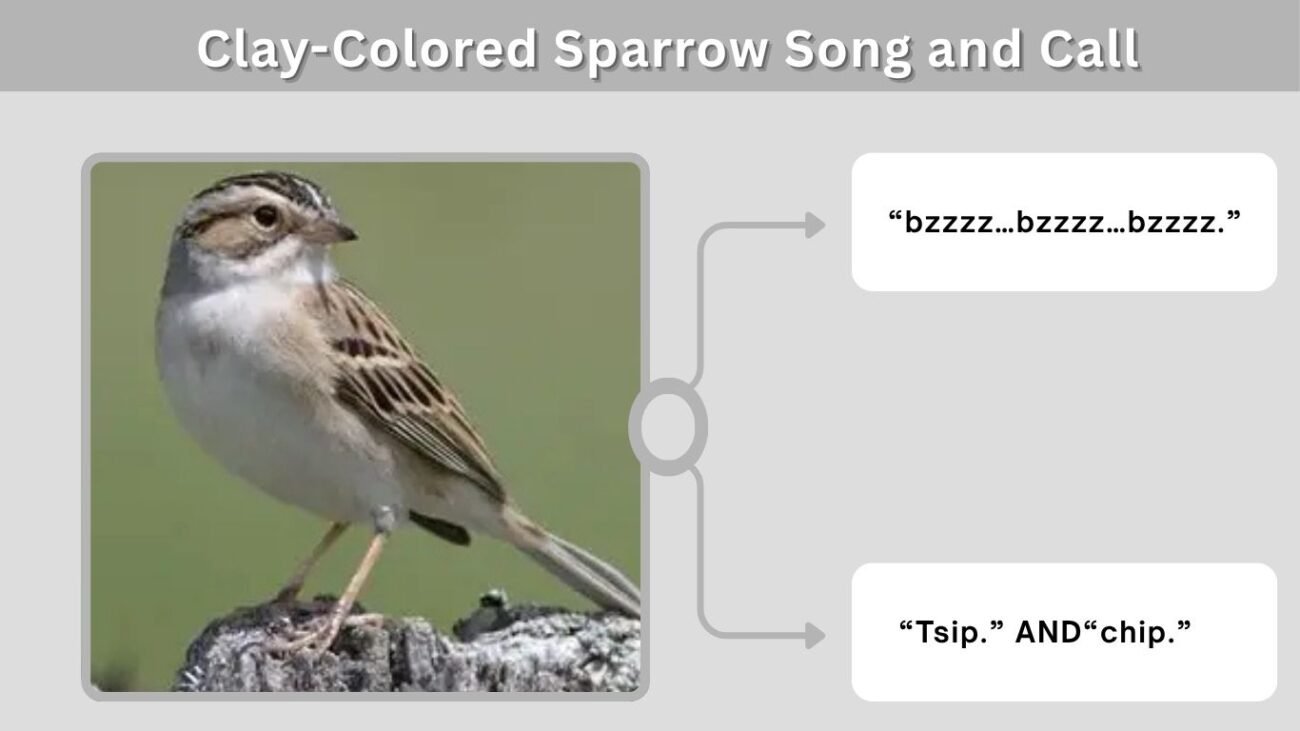
The song is one of the easiest ways to locate this otherwise inconspicuous bird. A male usually sings from the top of a low shrub, small tree, fence, or other exposed perch.
What Does Its Song Sound Like?
The Clay-colored Sparrow song consists of approximately two to eight drawn-out buzzes. The entire performance lasts only a few seconds and sounds more like an insect than a typical musical bird.
It is often represented as:
“bzzzz…bzzzz…bzzzz.”
The song is dry, mechanical, and evenly spaced. Once learned, it is quite distinctive and can reveal a bird hidden among dense shrubs.
Clay-Colored Sparrow Call
Its regular call is a short, high “tsip.” Birds use these notes to communicate with mates, young, and flock members. When alarmed, the call becomes a louder and sharper “chip.”
Range and Migration
Clay-colored sparrows are medium- to long-distance migrants. They breed primarily across the northern Great Plains, southern Canada, and parts of the north-central United States.
Their breeding distribution includes areas from the Canadian prairies south into states such as Montana, North Dakota, South Dakota, Minnesota, Wisconsin, and Michigan. Their breeding range has also extended into some areas farther east.
During autumn, they travel through the central United States and winter mainly in southern Texas and Mexico. Small numbers stray toward the Atlantic and Pacific coasts during migration.
Are Clay-Colored Sparrows Found in Kentucky?
Clay-colored Sparrows may be recorded in Kentucky, but they are not regular breeding birds there. They are most likely to appear as uncommon migrants during spring or fall. Birders should search weedy fields, brushy edges, and mixed sparrow flocks during migration.
Clay-Colored Sparrows in California and Oregon
The species is considered an uncommon migrant or visitor in much of the western United States outside its regular breeding range. Occasional individuals may appear in California, central Oregon, New Mexico, or other western locations, especially during fall migration.
Clay-Colored Sparrow Preferred Habitat
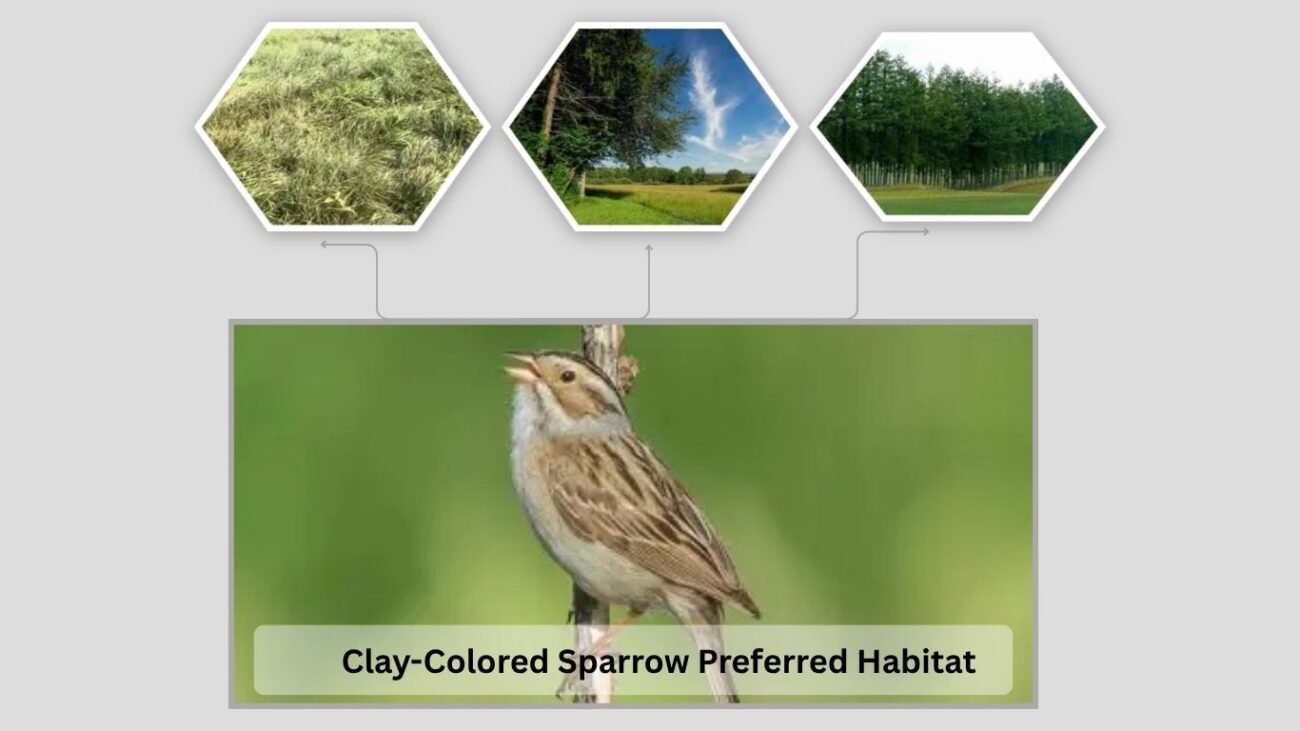
During the breeding season, Clay-colored Sparrows favor open landscapes that contain both grasses and scattered shrubs. Typical locations include:
- Shrubby grasslands
- Mixed-grass prairies
- Abandoned or overgrown fields
- Brushy pastures
- Woodland edges
- Shelterbelts
- Young conifer plantations
- Christmas tree farms
They usually forage close to the ground or within low vegetation, remaining near cover. In winter, they occupy desert grasslands, thorn scrub, brushy hillsides, fields, and upland plains.
Clay-Colored Sparrow Nest, Eggs, and Breeding
Clay-colored Sparrow nests are usually concealed close to the ground. The female commonly places the nest in the lower branches of a dense shrub, often less than one foot above the ground. Rosebushes, snowberry, and other thick shrubs provide protection from predators. Early-season nests may also be built in grass clumps.
What Does the Nest Look Like?
The nest is a small, open cup constructed from:
- Dry grasses
- Fine stems
- Plant fibers
- Rootlets
- Animal hair or other soft material
Dense vegetation surrounding the nest makes it difficult to detect.
Clay-Colored Sparrow Eggs
A typical clutch contains three to five eggs, with four being common. The eggs are pale blue-green and marked with brown spots, often concentrated near the larger end.
The female performs most of the incubation, which lasts approximately 10–14 days. Both parents feed the nestlings. Young usually leave the nest about 7–9 days after hatching, although they may remain unable to fly well for another week.
Clay-Colored Sparrow Diet and Feeding Behavior
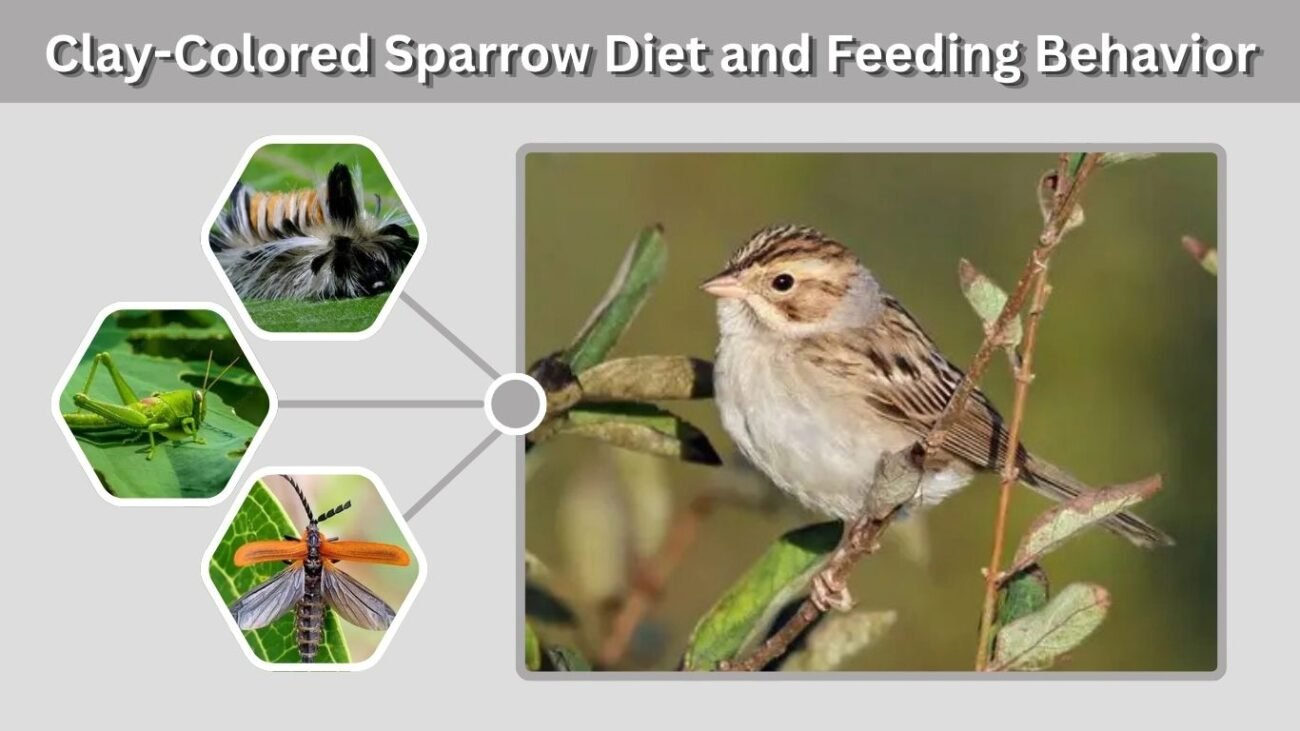
Clay-colored sparrows eat seeds throughout much of the year. They forage on the ground, beneath shrubs, or among low branches, searching for seeds from grasses, weeds, and other plants.
During the breeding season, insects and spiders become more important. Adults collect caterpillars, beetles, grasshoppers, ants, and other small invertebrates for their growing chicks.
Outside the breeding season, these sparrows may join mixed flocks with Chipping, Brewer’s, and other sparrow species.
Clay-Colored Sparrow vs. Similar Sparrows
Correct identification often requires comparing several features rather than relying on one mark.
| Species | Best distinguishing features |
| Clay-colored Sparrow | Gray collar, brown outlined cheek, pale lores, striped crown |
| Chipping Sparrow | Dark line extends through lores; breeding adult has rusty cap |
| Brewer’s Sparrow | Plainer face, weaker cheek pattern, less obvious gray collar |
| House Sparrow | Larger and heavier, thicker bill, different face and body pattern |
| Lincoln’s Sparrow | Streaked breast, buffy chest band, different head pattern |
Clay-Colored Sparrow vs. Chipping Sparrow
These birds are similar in size and shape. A breeding Chipping Sparrow usually has a bright rusty crown, a white eyebrow, and a bold black line running from the bill through the eye.
The Clay-colored Sparrow has a striped crown, pale lores, a brown cheek enclosed by darker lines, and a conspicuous gray collar. Its buzzy song also differs from the Chipping Sparrow’s long, rapid trill.
The two species occasionally hybridize where their breeding ranges overlap, producing birds with intermediate facial and crown patterns.
Brewer’s Sparrow vs. Clay-Colored Sparrow
Brewer’s Sparrows generally have a much plainer, less contrasting face. They lack the Clay-colored Sparrow’s strongly outlined cheek and obvious gray nape. Brewer’s Sparrows also have fine streaking over the crown and a more subdued overall appearance.
FAQs
Is a Clay-colored Sparrow rare?
The species can be common within suitable breeding habitat in the northern prairies. However, it is uncommon or rare outside its normal range, particularly along the coasts and in southeastern states.
Does a Clay-colored Sparrow have a yellow bill?
No. Its bill is usually pale pinkish, flesh-colored, or light gray. Lighting may occasionally make the bill appear slightly yellowish, but yellow is not considered a standard identification feature.
Are Clay-colored Sparrows aggressive?
Males can be territorial during the breeding season. They sing from exposed perches and may chase other males away, but they are not generally considered unusually aggressive toward people or larger animals.
What does a Clay-colored Sparrow look like in flight?
In flight, it appears small and slim with a fairly long, notched tail. Its muted brown back and pale underside may make identification difficult, so observers should wait for the bird to perch and reveal its facial pattern.
What does CCSP mean in birding?
CCSP is a commonly used four-letter abbreviation for the Clay-colored Sparrow. Birders, banders, researchers, and reporting platforms may use this shorthand when recording or discussing the species.