Myna birds are among the most fascinating members of the starling family, known for their intelligence, adaptability, and striking vocal abilities. From the bold and widespread Common Myna to the rare and elegant Bali Myna, each species has unique traits, behaviors, and habitats. Found across Asia and parts of the Pacific, these birds play vital roles in ecosystems while also captivating birdwatchers with their beauty and lively personalities.
1. Common Myna

The Common Myna (Acridotheres tristis) is one of the most familiar and widespread myna birds. Known for its adaptability, intelligence, and loud calls, it thrives in urban areas, farmlands, and gardens. This species has successfully expanded its range far beyond its native South Asia, making it one of the most recognized birds in the world.
Identification
- Medium-sized bird, about 23–26 cm (9–10 in) long
- Brown body with darker head and upperparts
- Bright yellow beak and eye patch
- White wing patches visible in flight
- Strong legs and upright posture
Behavior
Common Mynas are bold, aggressive, and highly social. They often move in pairs or small flocks, feeding on insects, fruits, and food scraps in urban areas. They are excellent mimics, imitating other bird calls and sometimes human-made sounds.
Habitat
Native to South Asia, they are now found across Australia, the Middle East, Africa, and Pacific islands due to introductions. They thrive in cities, towns, agricultural lands, and open countryside.
Importance
While admired for their adaptability and vocal skills, they are considered invasive in many regions where they outcompete native bird species. They also play a role in insect control and seed dispersal.
2. Jungle Myna

The Jungle Myna (Acridotheres fuscus) is a close relative of the Common Myna but is slightly smaller and more associated with forest edges and rural landscapes. It is well-known across South and Southeast Asia, where it is often seen perched in groups or foraging on the ground.
Identification
- Medium-sized bird, about 21–23 cm (8–9 in) long
- Dark gray-brown plumage with a glossy bluish tinge
- Distinct tuft of feathers on the forehead forming a small crest
- Yellow beak and eye patch
- White wing patches visible in flight
Behavior
Jungle Mynas are highly social and often form noisy flocks. They feed on insects, fruits, and seeds, frequently foraging in open fields and near villages. They are also cavity-nesters, often taking over tree hollows or man-made structures.
Habitat
They are widespread in India, Nepal, Bangladesh, Myanmar, and parts of Southeast Asia. They prefer rural farmlands, forest clearings, and open scrublands but also adapt to towns and villages.
Importance
This myna species plays a key role in controlling insect populations and dispersing seeds. Although less invasive than the Common Myna, it still competes with native birds for nesting sites in some regions.
3. Bank Myna

The Bank Myna (Acridotheres ginginianus) is a distinctive myna species native to the northern Indian subcontinent. Unlike other mynas, it is strongly associated with riverbanks, canals, and agricultural landscapes, where it nests in colonies inside earthen banks.
Identification
- Medium-sized bird, about 21–23 cm (8–9 in) long
- Greyish body with darker wings and tail
- Bright orange-red patch of bare skin around the eyes
- Black crown and nape
- Yellow beak and legs
Behavior
Bank Mynas are gregarious and often form large, noisy colonies. They feed mainly on grains, insects, and human food scraps, making them a common sight near markets and farmlands. Their colonial nesting habits involve excavating holes in sandy or earthen banks.
Habitat
Found across northern and central India, Pakistan, Nepal, and Bangladesh, they thrive near rivers, irrigation canals, and agricultural fields. They are less urban-adapted compared to the Common Myna.
Importance
Bank Mynas help in insect control but are sometimes considered agricultural pests due to their habit of feeding on grain crops. Their colonial lifestyle also makes them an interesting species for bird behavior studies.
4. Vinous-breasted Myna

The Vinous-breasted Myna (Acridotheres burmannicus), also called the Pale-bellied Myna, is a beautiful bird native to Southeast Asia. Its soft vinous-brown underparts and glossy plumage make it stand out among other mynas. It is commonly seen in open fields, villages, and lightly wooded areas.
Identification
- Medium-sized bird, about 22–24 cm (8.5–9.5 in) long
- Glossy black head and upperparts with a greenish sheen
- Vinous-brown (rosy-buff) breast and belly
- Bright yellow beak and eye patch
- White wing markings visible in flight
Behavior
Vinous-breasted Mynas are social and often forage in pairs or small groups. They feed on fruits, insects, and grains, frequently visiting cultivated fields. Like other mynas, they are noisy and produce a range of whistles, chatters, and calls.
Habitat
They are distributed across Myanmar, Thailand, Cambodia, Laos, Vietnam, and parts of southern China. They prefer open countryside, agricultural lands, and village surroundings, often nesting in cavities of trees or buildings.
Importance
This myna species plays a useful role in insect control and seed dispersal. It is admired for its striking plumage, making it one of the more attractive mynas in Southeast Asia.
5. Collared Myna
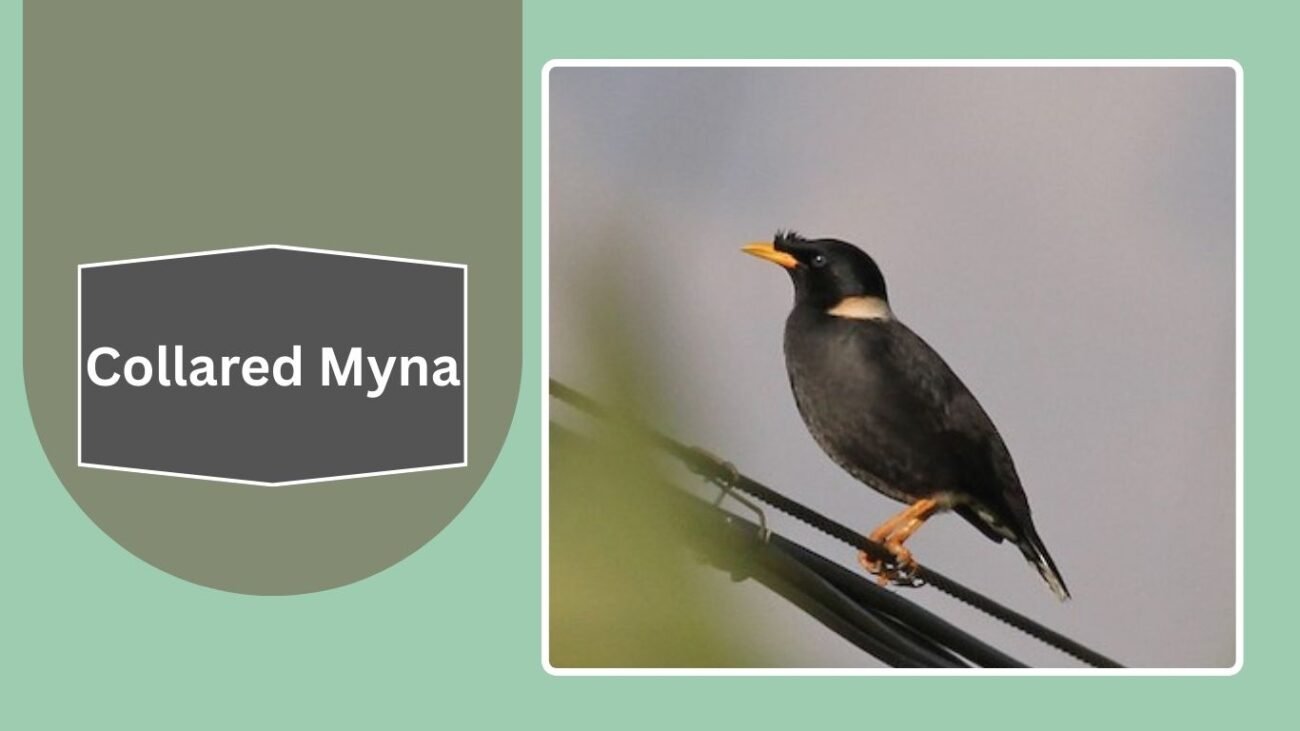
The Collared Myna (Acridotheres albocinctus) is a rare and striking myna found mainly in parts of Southeast Asia. Its contrasting black-and-white plumage and bold facial markings make it unique among myna species. Though not as widespread as the Common or Jungle Myna, it is a distinctive bird in its native range.
Identification
- Medium-sized bird, about 22–24 cm (9 in) long
- Black head and throat with a glossy sheen
- Broad white collar around the nape and sides of the neck
- White underparts with dark upper body
- Yellow beak and eye patch
Behavior
Collared Mynas are usually seen in pairs or small groups. They are active and noisy, feeding on insects, fruits, and seeds. Like other mynas, they often forage on the ground but also perch conspicuously on trees and rooftops.
Habitat
They occur in Myanmar and parts of western Thailand, favoring open woodlands, farmlands, and village edges. They often stay near human settlements but are less urbanized compared to the Common Myna.
Importance
Although not abundant, the Collared Myna contributes to seed dispersal and insect control in its ecosystem. Its distinctive plumage also makes it a sought-after species for birdwatchers exploring its native regions.
6. Great Myna (White-vented Myna)

The Great Myna (Acridotheres grandis), also known as the White-vented Myna, is one of the largest myna species. It is a bold and social bird, easily recognized by its contrasting dark plumage and white vent. This species is widespread in South and Southeast Asia, where it is often seen around farmlands and villages.
Identification
- Large myna, about 25–27 cm (10–11 in) long
- Glossy black body with a greenish-purple sheen
- Distinct white vent and white patches on the wings
- Bright yellow beak, legs, and eye patch
- Upright stance with a strong build
Behavior
Great Mynas are highly gregarious and often move in large, noisy flocks. They feed on insects, fruits, grains, and food scraps. Their calls are loud and varied, including whistles, squawks, and chatters. They are also known to roost communally in large numbers.
Habitat
They are found across the Indian subcontinent and Southeast Asia, including Bangladesh, India, Nepal, Myanmar, and Thailand. They thrive in open countryside, rice fields, towns, and near human settlements.
Importance
This species is ecologically important for insect control and seed dispersal. However, in agricultural areas, they are sometimes seen as pests due to their habit of feeding on ripening grains.
7. White-collared Myna

The White-collared Myna (Streptocitta albicollis) is a striking and uncommon species of myna, endemic to the Indonesian islands of Sulawesi. Its bold black-and-white plumage and distinctive long tail set it apart from other mynas, making it a unique member of the starling family.
Identification
- Medium to large-sized bird, about 25–28 cm (10–11 in) long
- Black head, upperparts, and wings with glossy sheen
- Broad white collar around the neck and extending onto the breast
- White underparts contrasting with dark plumage
- Long, slender tail
- Yellow bill and legs
Behavior
White-collared Mynas are less noisy compared to Common Mynas but are still active and social. They are usually found in pairs or small groups, feeding on insects, fruits, and seeds. Their flight is swift and direct, often moving between forest edges and open areas.
Habitat
This species is restricted to Sulawesi and nearby islands in Indonesia. It inhabits forest edges, open woodlands, farmlands, and sometimes village areas. Due to its limited range, it is not as adaptable as other widespread mynas.
Importance
Being an endemic island, the White-collared Myna plays an essential role in maintaining local ecosystems by dispersing seeds and controlling insect populations. It is also a bird of conservation interest due to its restricted distribution.
8. Golden Myna

The Golden Myna (Mino anais) is one of the most striking and colorful mynas, native to New Guinea and nearby islands. Its bright yellow plumage contrasted with black wings makes it instantly recognizable. Unlike the more urban-adapted mynas, this species is closely associated with tropical forests.
Identification
- Medium-sized bird, about 23–25 cm (9–10 in) long
- Brilliant golden-yellow body and head
- Glossy black wings and tail
- Strong yellow beak and legs
- Dark eyes set against vivid plumage
Behavior
Golden Mynas are active and social, usually found in pairs or small groups. They feed mainly on fruits, nectar, and insects, often foraging high in the forest canopy. Their calls are loud and varied, consisting of whistles and harsh notes.
Habitat
They inhabit lowland rainforests and forest edges across New Guinea and surrounding islands. They are canopy dwellers, often difficult to spot unless they descend to fruiting trees.
Importance
This species is an important seed disperser in rainforest ecosystems. Its brilliant coloration also makes it a favorite among birdwatchers and contributes to eco-tourism in its native range.
9. Javan Myna

The Javan Myna (Acridotheres javanicus), also known as the White-vented Myna in some regions, is a highly adaptable bird originally from Java and Bali. Due to introductions, it has spread widely across Southeast Asia, where it thrives in urban and rural settings.
Identification
- Medium-sized bird, about 22–24 cm (9 in) long
- Glossy black body with a slight greenish sheen
- Distinct white vent and white wing patches visible in flight
- Yellow bill, legs, and bare skin around the eyes
- Short crest of feathers on the forehead
Behavior
Javan Mynas are very social and often form flocks. They are opportunistic feeders, consuming insects, fruits, grains, and food scraps. Their calls are loud, varied, and include chatters and whistles. They often nest in building crevices, trees, and other cavities.
Habitat
Native to Indonesia (Java and Bali), they are now abundant across Singapore, Malaysia, and other parts of Southeast Asia due to introductions. They thrive in cities, villages, parks, farmlands, and open countryside.
Importance
Javan Mynas play a role in insect control and seed dispersal but are considered invasive in some regions where they compete with native bird species. Their adaptability and boldness make them one of the most successful mynas in urban landscapes.
10. Black-winged Starling (White-vented Myna)

The Black-winged Starling (Acridotheres melanopterus), also known as the White-vented Myna, is a striking and endangered myna species native to Indonesia. Its contrasting black-and-white plumage and elegant appearance make it one of the most distinctive mynas, though its population has declined due to habitat loss and trapping for the bird trade.
Identification
- Medium-sized bird, about 22–24 cm (9 in) long
- White body with glossy black wings and tail
- White vent contrasting with dark flight feathers
- Yellow beak, legs, and eye patch
- Sleek build with sharp flight pattern
Behavior
Black-winged Starlings are usually found in pairs or small groups. They are less noisy compared to other mynas but still produce whistles and chatters. Their diet includes insects, fruits, and seeds, and they are often seen feeding in open fields and forest edges.
Habitat
This species is native to Java, Bali, and Lombok in Indonesia. It inhabits open woodlands, farmlands, and grasslands, often preferring areas near human settlements.
Importance
As a natural seed disperser and insect feeder, it contributes to the balance of local ecosystems. Due to its declining numbers, it is now a priority species for conservation, with breeding programs in place to restore its wild populations.
11. Bali Myna

The Bali Myna (Leucopsar rothschildi), also called the Bali Starling, is one of the world’s rarest and most beautiful mynas. Endemic to the island of Bali, Indonesia, it is instantly recognizable for its snow-white plumage and striking blue skin around the eyes. Due to its rarity, it is a highly protected bird and a symbol of Bali’s natural heritage.
Identification
- Medium-sized bird, about 25 cm (10 in) long
- Pure white plumage with a slight crest on the head
- Bright blue bare skin around the eyes
- Black wing tips and tail edges
- Yellow bill and grayish legs
Behavior
Bali Mynas are generally quiet compared to other mynas but produce melodious whistles, chattering, and soft calls. They are often seen in pairs during the breeding season and in small groups outside of it. Their diet includes insects, seeds, and fruits.
Habitat
Naturally restricted to Bali, they inhabit open woodlands, dry savannas, and forest edges. Due to conservation programs, some have also been reintroduced to nearby islands and protected reserves.
Importance
The Bali Myna is critically endangered, with fewer than a few hundred left in the wild. It plays a role in seed dispersal and insect control but, more importantly, stands as a flagship species for bird conservation efforts in Indonesia.
12. Crested Myna

The Crested Myna (Acridotheres cristatellus) is a distinctive starling-like myna known for the small tuft of feathers forming a crest on its forehead. Native to Southeast Asia, it has also been introduced to other regions, including Vancouver in Canada, where it once established a stable population.
Identification
- Medium-sized bird, about 25 cm (10 in) long
- Glossy black plumage with a greenish sheen
- Small erect crest of feathers on the forehead
- Bright orange-yellow beak and legs
- White wing patches visible during flight
Behavior
Crested Mynas are intelligent, social, and noisy birds. They often gather in flocks, feeding on insects, fruits, seeds, and food scraps in urban areas. They are also good mimics, capable of imitating sounds and other bird calls.
Habitat
They are widespread in China, Taiwan, and Southeast Asia, inhabiting farmlands, towns, cities, and open countryside. Introduced populations once existed in North America but declined over time.
Importance
Crested Mynas are effective insect hunters and seed dispersers, contributing to ecological balance. Their adaptability makes them thrive near humans, though in some places they are viewed as minor agricultural pests.
13. Pale-bellied Myna

The Pale-bellied Myna (Acridotheres cinereus) is a lesser-known myna species found in parts of Southeast Asia. As its name suggests, it is recognized for its lighter underparts compared to other mynas, giving it a more subdued yet elegant appearance.
Identification
- Medium-sized bird, about 22–23 cm (8.5–9 in) long
- Grayish upperparts with pale whitish-gray belly
- Blackish head and throat
- Yellow beak, legs, and eye patch
- White wing markings noticeable in flight
Behavior
Pale-bellied Mynas are typically seen in small flocks, often noisy and active while foraging. Their diet includes insects, fruits, grains, and food scraps. Like other mynas, they are cavity-nesters, using tree holes and man-made structures.
Habitat
They are distributed across parts of Myanmar, Laos, Cambodia, and Thailand, usually in open country, cultivated fields, and village surroundings.
Importance
This species contributes to insect control and seed dispersal. Though not as widespread as other mynas, it holds ecological significance within its native range and is of interest to birdwatchers for its distinctive pale underparts.
14. Yellow-faced Myna

The Yellow-faced Myna (Mino dumontii) is a striking bird native to New Guinea and surrounding islands. It is best known for the bright yellow bare skin on its face, which gives the species its name. With its loud, varied calls and vivid appearance, it is one of the more charismatic mynas of the region.
Identification
- Large myna, about 25–28 cm (10–11 in) long
- Glossy black plumage with a purplish sheen
- Distinct bright yellow bare skin around the face and eyes
- Yellow beak and legs
- White wing patches visible in flight
Behavior
Yellow-faced Mynas are vocal and social, often moving in pairs or small flocks. Their calls are loud, consisting of whistles, squawks, and chattering sounds. They feed on fruits, insects, and nectar, frequently visiting fruiting trees in the forest canopy.
Habitat
This species is native to New Guinea and nearby islands. It inhabits lowland and hill forests, forest edges, and sometimes cultivated areas near villages.
Importance
As a frugivore, the Yellow-faced Myna plays an important role in seed dispersal in tropical forests. Its striking appearance also makes it a favorite among birdwatchers and an important part of local biodiversity.
15. White-necked Myna

The White-necked Myna (Streptocitta albicollis) is a large and distinctive myna species endemic to Sulawesi and nearby Indonesian islands. It stands out for its long tail and sharp contrast of black-and-white plumage, making it one of the most elegant members of the starling family.
Identification
- Large myna, about 35–40 cm (14–16 in) long including tail
- Glossy black head, back, wings, and tail
- Prominent white neck, breast, and underparts
- Long, slender tail feathers distinguishing it from other mynas
- Yellow bill and legs
Behavior
White-necked Mynas are less noisy than urban-adapted mynas but are active and alert. They move in pairs or small groups, feeding on fruits, insects, and small invertebrates. Their calls are varied but less harsh compared to Common Mynas.
Habitat
This species is restricted to Sulawesi and nearby smaller islands in Indonesia. It inhabits forest edges, open woodlands, farmlands, and village outskirts.
Importance
Being an endemic island, it is ecologically important for seed dispersal and insect control in its native habitat. Due to its limited distribution, it is of conservation interest and highly valued by birdwatchers.