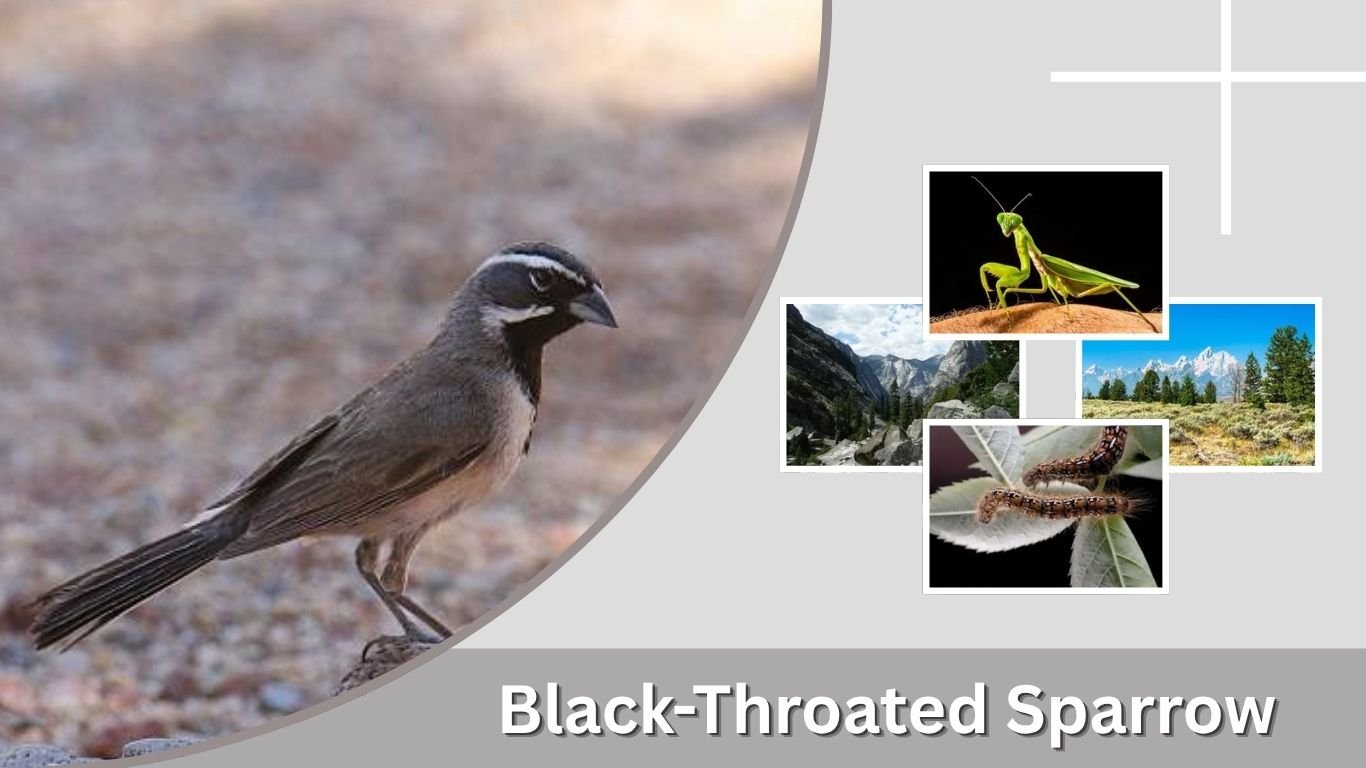
The Black-throated Sparrow (Amphispiza bilineata) is a striking desert songbird recognized by its black throat, bold white facial stripes, and softly colored gray-brown body. It inhabits some of the hottest and driest landscapes in western North America, where it searches beneath shrubs for insects and seeds. Although its markings appear dramatic at close range, its sandy upperparts provide excellent camouflage among rocks, cacti, and desert vegetation.
Black-Throated Sparrow Overview
This species belongs to the New World sparrow family, Passerellidae. It is relatively small and slender, with a rounded head, conical bill, and long tail. Unlike many sparrows, adults have mostly unstreaked underparts and a sharply patterned face that makes identification comparatively easy.
| Feature | Description |
| Scientific name | Amphispiza bilineata |
| Family | Passerellidae |
| Length | Approximately 5–6 inches |
| Wingspan | Approximately 7–8 inches |
| Weight | About 0.4–0.6 ounces |
| Main colors | Gray, brown, black and white |
| Primary habitat | Desert scrub and dry shrublands |
| Main foods | Seeds, insects and plant material |
Black-Throated Sparrow Identification
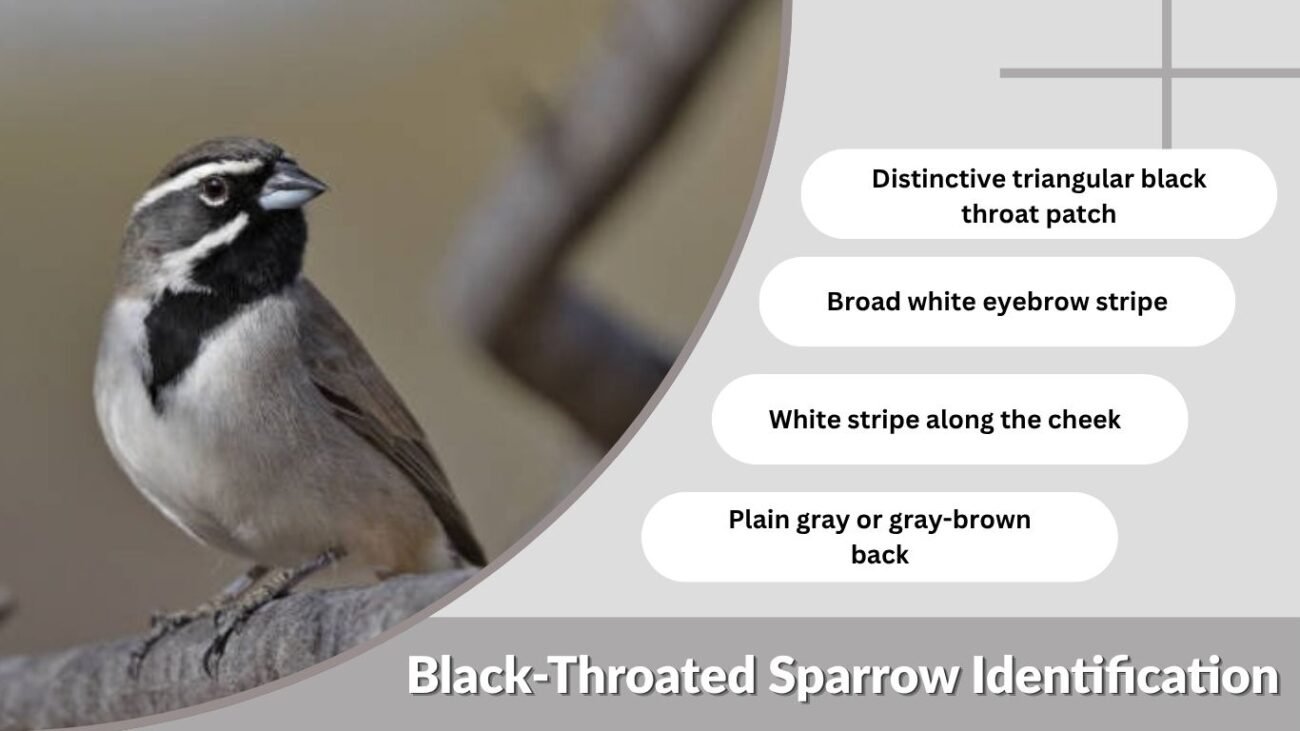
The Black-throated Sparrow’s clean facial pattern separates it from most other desert birds. Adults have gray heads with broad white eyebrow stripes, white whisker-like stripes, dark masks, and triangular black throat patches. Their backs are plain gray-brown, while the belly is pale gray or whitish.
Key Identification Features
- Distinctive triangular black throat patch
- Black mask extending through the eye
- Broad white eyebrow stripe
- White stripe along the cheek
- Plain gray or gray-brown back
- Pale, mostly unstreaked underparts
- Dark, short conical bill
- Long dark tail with white outer edges
- Slender gray or brownish legs
The white areas of the face sharply border the black throat and mask. When the bird flies, narrow white markings along the outer tail feathers may become visible. Its wings can vary from light brown to warm cinnamon, depending on the individual and geographic population.
Male vs Female Black-Throated Sparrow
Male and female Black-throated Sparrows look nearly identical. Both possess the characteristic black throat and strong white facial stripes, so sex usually cannot be determined from plumage alone.
During the breeding season, males are more conspicuous because they sing from the tops of shrubs, cacti, or low trees. Females spend more time gathering nesting material, incubating eggs, and remaining close to the nest. Mated birds may also perform a soft reunion duet when they meet near their territory.
Juvenile and Immature Birds
Juvenile Black-throated Sparrows are much less boldly marked than adults. They have brownish upperparts, a pale throat, and fine streaking across the breast. Their facial stripes are visible but weaker, while the solid black throat patch has not yet developed.
Young birds can resemble Sagebrush Sparrows because both may have pale throats and streaked underparts. However, juvenile Black-throated Sparrows generally show stronger white eyebrow stripes and gradually develop the species’ distinctive black-and-white face.
Black-Throated Sparrow Habitat
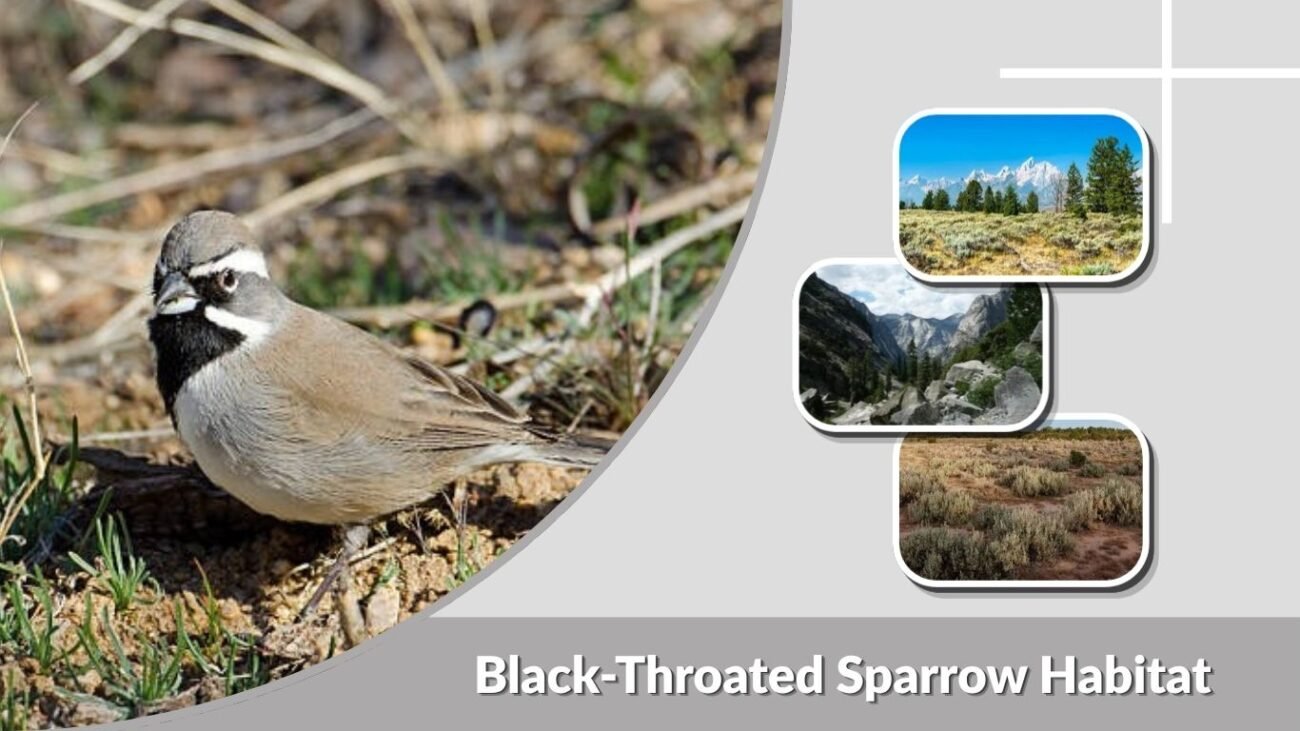
Black-throated sparrows are strongly associated with dry, open country. They prefer landscapes with bare ground and scattered vegetation rather than dense forests or continuous grasslands.
Common Habitats
They may be found in:
- Creosote bush flats
- Mesquite and acacia scrub
- Cholla and prickly pear habitats
- Saltbush-covered desert
- Sagebrush flats
- Rocky canyons and slopes
- Dry grassland with scattered cacti
- Open pinyon-juniper woodland
The species usually favors semi-open places where shrubs and small trees are evenly spaced. These plants provide singing posts, shade, nesting locations, and protection from predators while leaving enough open ground for foraging.
Black-Throated Sparrow Range and Migration
The Black-throated Sparrow occurs across the southwestern United States and northern and central Mexico. Its United States range includes much of Arizona, New Mexico, Nevada, Utah, southern California, western Texas, and neighboring dry regions.
Many populations remain in the same general area throughout the year. Birds living near the northern edge of the range are more likely to move south during winter. Individuals occasionally wander far beyond the normal distribution and have been recorded in the central and eastern United States.
Black-Throated Sparrows in Arizona
Arizona supports Black-throated Sparrows throughout the year. They occupy desert scrub, rocky canyons, creosote flats, and areas containing mesquite, ocotillo, and cholla. Their preference for open vegetation makes them especially characteristic of the Sonoran and Mojave desert regions.
What Do Black-Throated Sparrows Eat?
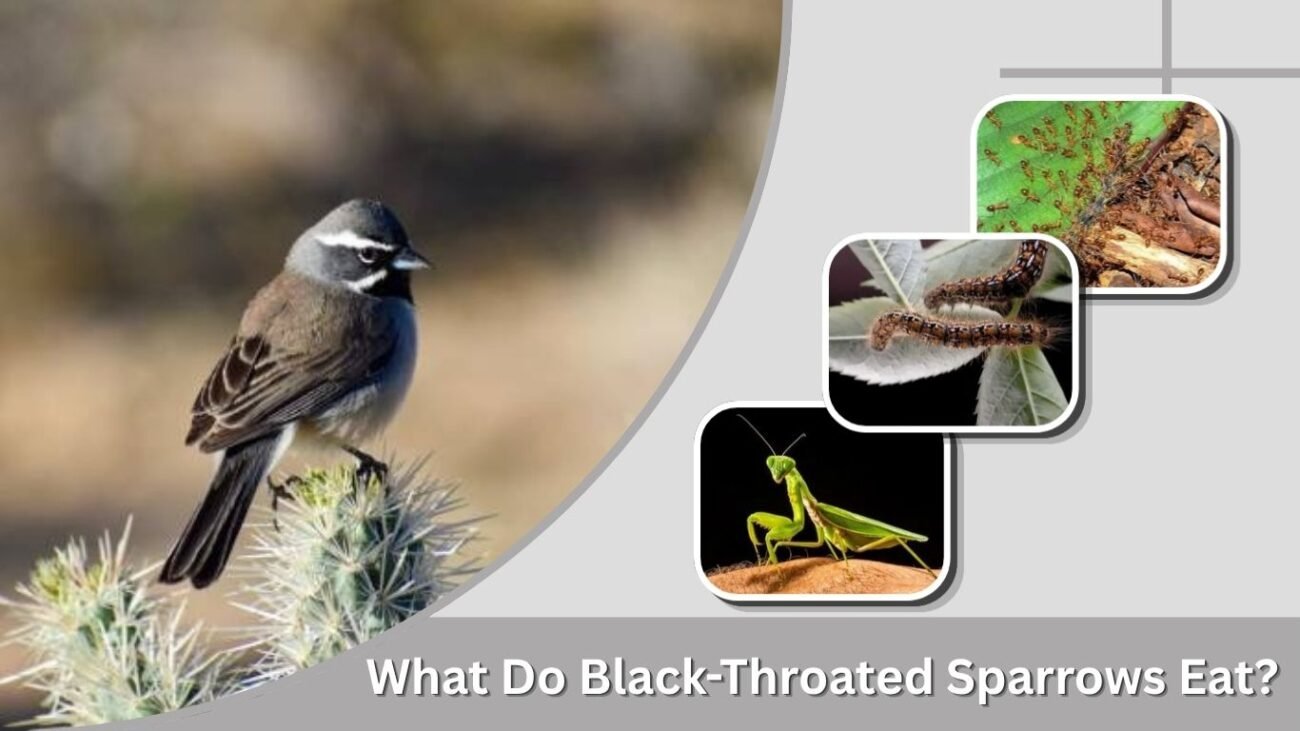
Black-throated Sparrows eat both plant and animal foods. Their diet changes according to the season and the availability of desert resources.
Common Foods
Their diet includes:
- Grass and weed seeds
- Seeds from desert shrubs
- Fresh plant shoots
- Berries and small fruits
- Caterpillars
- Grasshoppers
- Mantids
- Robber flies
- Walking sticks
- Dragonflies
- Spiders and other small invertebrates
Insects are particularly important during spring and summer, when adults require extra protein and must feed growing nestlings. Seeds become the primary food during fall and winter, when insects are less abundant.
Foraging Behavior
These sparrows usually hop or run across the ground beneath shrubs and cacti. They pick seeds from the soil, inspect fallen vegetation, and glean insects from leaves and small branches. Occasionally, they make short flights into the air to capture flying insects.
Black-throated Sparrows can survive for extended periods without visiting open water. They obtain much of the moisture they need from insects, green shoots, fruits, and succulent desert vegetation. However, they may readily drink and bathe when safe water is available.
Desert Adaptations
Living in an arid landscape requires the Black-throated Sparrow to tolerate extreme heat, scarce water, and rapidly changing food supplies.
Important adaptations include:
- Obtaining moisture from insects and plants
- Foraging during cooler portions of the day
- Using shrubs for shade and protection
- Placing nests where afternoon shade reduces heat
- Producing young when seasonal rain improves food availability
- Having sandy plumage that blends into desert surroundings
Research indicates that these birds can maintain their water balance during hot, dry periods by consuming moisture-rich insects and vegetation. Females often position nests on the north or east side of shrubs, giving the nest morning warmth but protection from intense afternoon sunlight.
Song and Calls
The Black-throated Sparrow has a delicate metallic song that suits the quiet desert landscape. A typical song begins with two clear notes followed by a faster buzzy trill. Individual songs vary, and a male may produce several related versions.
Males usually sing from exposed shrub tops during spring to advertise their territories and attract females. Their common calls are soft, high-pitched, tinkling notes. These calls may reveal the presence of birds that are otherwise difficult to notice while feeding close to the ground.
Nesting and Reproduction
The timing of nesting may depend on seasonal rainfall. Rain encourages plant growth and increases insect numbers, giving adults more food for their chicks. A pair generally becomes strongly territorial while the nest is being constructed and the first eggs are laid.
Nest Location and Construction
The female builds a sturdy, open cup in a low shrub or branching cactus, usually within two feet of the ground. Creosote, cholla, acacia, mesquite, brittlebrush, and boxthorn are frequently used.
Coarse grasses, plant stems, rootlets, fibers, small twigs, and weeds form the outer structure. The female lines the cup with soft grass, plant down, and animal hair. Dense branches help conceal the nest from predators and provide shade.
Eggs and Young
| Nesting feature | Details |
| Clutch size | 2–5 eggs |
| Egg color | White to bluish white |
| Incubation | Approximately 11–13 days |
| Nestling period | About 9–10 days |
| Broods | Usually 1–2 per season |
The female performs incubation, while both parents are believed to feed the nestlings. The chicks hatch nearly naked, with closed eyes and only a thin covering of down. Their diet consists mainly of insects until they are ready to leave the nest.
Black-Throated Sparrow vs Similar Birds
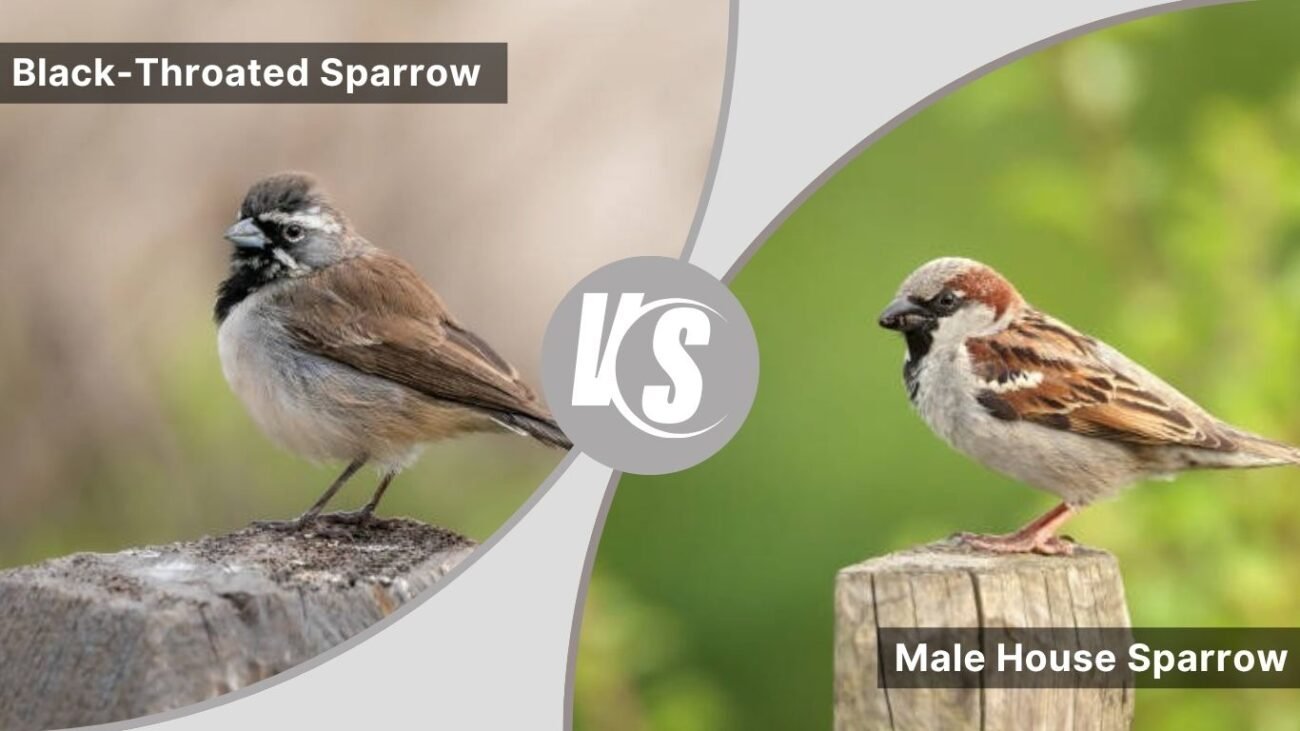
Black-Throated Sparrow vs House Sparrow
| Feature | Black-Throated Sparrow | Male House Sparrow |
| Throat | Large triangular black patch | Black bib on throat and chest |
| Face | Bold black-and-white stripes | Gray crown and chestnut sides |
| Back | Plain gray-brown | Strongly streaked brown |
| Habitat | Natural desert scrub | Farms, towns and buildings |
| Nest | Low shrub or cactus | Building cavity or nest box |
A male House Sparrow may also have a black throat, but it lacks the Black-throated Sparrow’s bold white facial stripes. House Sparrows are closely associated with people and buildings, whereas Black-throated Sparrows primarily occupy undisturbed desert vegetation.
Black-Throated Sparrow vs Black-Chinned Sparrow
The Black-chinned Sparrow has a smaller black patch limited mainly to its chin and upper throat. Its head and breast often appear bluish gray, and it lacks the strong white eyebrow and cheek stripes of a Black-throated Sparrow.
Black-chinned sparrows also tend to occupy rocky slopes covered with chaparral rather than open creosote and cactus desert.
Predators and Threats
Hawks, falcons, owls, snakes, coyotes, and small desert mammals may prey on adults, eggs, or nestlings. Brown-headed Cowbirds also lay eggs in Black-throated Sparrow nests, causing the sparrows to raise cowbird chicks at the expense of their own young.
Habitat loss from development, invasive grasses, severe wildfire, and changing vegetation density can reduce suitable nesting areas. The species remains widespread, but it does not adapt as readily to suburban development as some other desert birds.
FAQs
Are Black-Throated Sparrows rare?
Black-throated Sparrows are generally common in suitable desert habitat throughout the southwestern United States and Mexico. They may appear rare because their normal range is limited and their pale bodies blend into the landscape. Outside western desert regions, sightings are unusual and often involve wandering individuals.
Do Black-Throated Sparrows visit feeders?
They occasionally visit backyard feeding areas within their natural range. Ground-scattered millet and black-oil sunflower seeds may attract them, especially when feeders are near native shrubs. A shallow birdbath can also bring them into view, but dense urban development usually provides unsuitable habitat.
Do female Black-Throated Sparrows have black throats?
Yes. Adult females have black throats and contrasting white facial stripes similar to those of males. The sexes are considered visually alike, making them difficult to separate through plumage alone. Singing behavior during the breeding season is often a better clue for recognizing a male.
Do Black-Throated Sparrows migrate?
Some do. Populations in warmer parts of the Southwest and Mexico may remain year-round, while those breeding near the northern edge of the range often travel south for winter. Their movements can vary with weather, rainfall, food availability, and local habitat conditions.
How long do Black-Throated Sparrows live?
Many probably survive only a few years because of predation, drought, extreme weather, and nesting hazards. However, the oldest documented Black-throated Sparrow was a female that had reached at least six years of age when researchers recaptured and released her during bird-banding work in Arizona.